ISSN Online: 2164-0408 ISSN Print: 2164-0386
Effect of Personality on the Number of Feedback
Requests When Learning a Golf-Putting Task
Tadao Ishikura
Faculty of Sports Science and Health, Doshisha University, Kyoto, Japan
Abstract
This study examined how personality influences the number of feedback requests and anxiety when learning to putt in golf. Twenty university students (10 males and 10 female) stood in front of a partition and putted a golf ball, with the goal of having the ball stop on a line 3.5 m from the starting position, along a path that included uphill and downhill portions. I used the Japanese version of the Big Five Personality Inventory (Big Five) to evaluate participants’ personalities and the Japanese version of the State-Trait Anxiety Inventory Form (STAI-JYZ) to evaluate participants’ an-xiety. After a pretest, participants completed 60 practice trials in which they were al-lowed to ask how far the ball went if and when they wanted to. All participants then performed a posttest. Results showed that constant error, variable error, and total va-riability were lower at posttest than pretest. In addition, the results of a multiple re-gression analysis showed that higher Big Five agreeableness scale and STAI-JYZ an-xiety-present scale scores were associated with fewer requests for feedback. These results suggest that the number of feedback requests was related to consideration and awareness, and these findings have implications for future research on cooperation.
Keywords
Feedback, Personality, Anxiety, Self-Controlled Practice
1. Introduction
When acquiring motor skills, learners receive information about action errors and cor-rect subsequent actions. Consequently, learners become able to perform the action re-liably and accurately. After performing the action, the resulting external feedback pro-vides information about error detection and correction for future performance. There-fore, feedback is important for acquiring motor skills (Schmidt, 1991; Wulf, Shea, & Lewthwaite, 2010).
How to cite this paper: Ishikura, T. (2016). Effect of Personality on the Number of Feedback Requests When Learning a Golf- Putting Task. Advances in Physical Educa-tion, 6, 389-395.
http://dx.doi.org/10.4236/ape.2016.64039
Received: October 6, 2016 Accepted: November 3, 2016 Published: November 7, 2016
Copyright © 2016 by author and Scientific Research Publishing Inc. This work is licensed under the Creative Commons Attribution International License (CC BY 4.0).
http://creativecommons.org/licenses/by/4.0/
Self-controlled practice in which a learner can freely request feedback information is more conducive to learning than practice with a predetermined feedback schedule
(Wulf et al., 2010).Patterson and Carter (2010) indicated that retention and transfer were superior when learners controlled the knowledge of results schedule during acqui-sition of a novel sequential timing task. These results are similar to Chiviacowsky and Wulf (2002), who found that requested knowledge of results increased when partici-pants performed well. The number of feedback requests depends on task characteris-tics, reflects the learner’s independence, motivation, and previous experience, and may be more important than the amount of feedback the learner actually receives (Chivia-cowsky & Wulf, 2002).
Personality and anxiety may affect attitude toward learning or practice strategy (e.g., the number of feedback requests). For example, Zhang (2003) examined the relation-ship between university students’ learning approaches and Big Five personality traits. The results showed that Conscientiousness, Openness, Neuroticism, and Agreeableness were good predictors of learning approaches. However, Extraversion was not related to any of the learning approaches. The personality trait of Intellect is independent from grade point average (GPA) in undergraduate students, and effort regulation mediates the relationship between Conscientiousness and Agreeableness (Bidjerano & Yun Dai, 2007). Chamorro-Premuzic and Furnham (2008) reported that in undergraduate stu-dents, the highest correlation occurred between Conscientiousness and academic per-formance, which was operationalized in terms of second-year exam results, and a posi-tive correlation was present between Openness to experience and academic perfor-mance. In contrast, because there is a negative relationship between anxiety and per-formance on cognitive tasks (Eysenck & Calvo, 1992; Eysenck, Derakshan, Santos, & Calvo, 2007), it has been predicted that anxiety would affect cognitive strategy during motor learning. However, there are conflicting views on how anxiety affects motor performance and motor learning (Masters, 1992; Neiva, Massa, Barros, & Meira, 2014). Based on these reports, it has been hypothesized that requests for feedback are related to personality characteristics and anxiety. For example, Bokums, Meira, Neiva, Oliva, and Maia (2012) examined the relationship between trait anxiety and self-controlled frequency of feedback during acquisition of the overhand volleyball serve. The results showed that although there was not an interaction between acquisition and transfer-test performance, the high anxiety participants requested more feedback than the low an-xiety participants.
This study examined the relationships between the number of feedback requests, personality, and anxiety while learning a golf-putting task. I hypothesized that there would be relationships between Conscientiousness, Agreeableness, and Openness to experience and the number of feedback requests, and that participants with higher an-xiety would request more feedback than those with lower anan-xiety.
2. Method
Ethics Committee for Scientific Research Involving Human Subjects. Participants
Twenty healthy university students (10 male and 10 female; M = 20.6 years, SD = 1.3 years) participated in this experiment. Participants had no prior experience learning golf putting, and all were right-hand dominant or preferred. Participants gave written informed consent and received/1000 cash as remuneration for participation.
Task, Materials, and Design
First, participants completed the Japanese version of the Big Five Personality Inven-tory (Big Five; Gakugei-Tosyo, Inc., Tokyo, Japan) which consist of 70 items to meas-ure personality traits, and the Japanese version of the State-Trait Anxiety Inventory Form (STAI-JYZ; Jitsumukyoiku-shuppan, Inc., Tokyo, Japan) which consist of 40 items to measure anxiety. The Big Five includes five subscales based on the Big Five hypothesis (Goldberg, 1981), which assumes that there are five basic personality traits: Extraversion, Agreeableness, Conscientiousness, Neuroticism, and Openness to expe-rience. Extraversion reflects psychological energy turned to others or objects. Agreea-bleness reflects the degree of cooperativeness with others. Conscientiousness is related to self-control and the reliability and effectiveness of planning. Neuroticism refers to anaphylaxis of emotion, and a tendency to become confused in response to a stressor. Openness to experience reflects the degree of curiosity and concern about inner or ex-ternal worlds. Most of an individual’s personality can be described by interpreting the combined Big Five score. The STAI-JYZ consists of Japanese items translated from the STAI (Spielberger & Sydeman, 1994), and includes four subscales: state-anxiety: anxie-ty-present, state-anxiety: anxiety-absent, trait-anxiety: anxieanxie-ty-present, and trait- anxiety: anxiety-absent. State-anxiety reflects transient reactions to a phenomenon that evokes anxiety, and changes over time. Trait-anxiety is anxiety that is relatively stable across various situations. Anxiety-present is when anxiety exists (e.g., feeling diffident), and anxiety-absent is when anxiety does not exist (e.g., feeling fortunate). The reliabili-ty and suitabilireliabili-ty of the Japanese version of the Big Five Personalireliabili-ty Inventory and the Japanese version of the State-Trait Anxiety Inventory Form are checked and reported
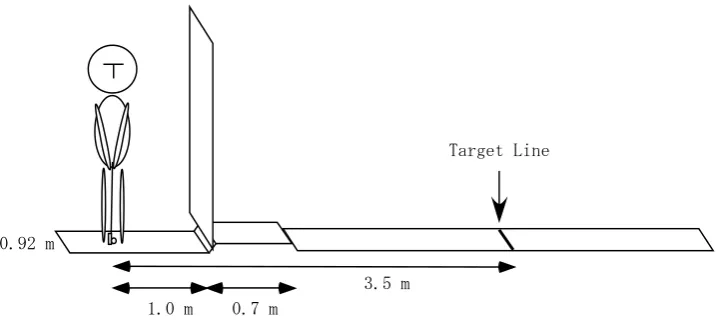
(Murakami & Murakami, 1997; Hidano, Fukuhara, Iwasaki, Soga, & Spielberger, 2000). Participants stood behind a partition and putted a golf ball with the goal of having the ball stop on a line 3.5 m from the starting position. To add difficulty, the path in-cluded uphill and downhill portions (see Figure 1).
Participants completed 60 putting trials. They were allowed to ask how far the ball rolled at the end of a trial. The pre- and post-test included three trials each, without feedback. After the trials, participants reported their level of confidence in their ability to stop the ball between 3.375 and 3.625 m (within 10% of 3.5 m) on a scale from 0% - 100%.
Dependent Variables
0.92 m
1.0 m 0.7 m
3.5 m
[image:4.595.193.554.69.231.2]Target Line
Figure 1. Experimental conditions.
Relationships between the number of feedback requests during practice, personality, and anxiety were evaluated using Big Five subscale scores (extraversion, agreeableness, conscientiousness, neuroticism, and openness to experience) and STAI-JYZ subscale scores (state-anxiety: anxiety-present scale, state-anxiety: anxiety-absent scale, trait- anxiety: anxiety-present scale, and trait-anxiety: anxiety-absent scale).
3. Results
IBM SPSS Statistics Version 22 (IBM SPSS Japan, Inc., Tokyo, Japan) was used for all statistical analyses. The level of significance was set at p < .05. Because there were no significant differences between male and female participants for any dependent varia-ble, we did not include sex as a factor in the analyses.
Number of Feedback Requests
A one-way repeated-measures analysis of variance (ANOVA) was used to assess dif-ferences in the number of feedback requests between pre- and post-test. The mean number of requests for feedback was 35.1 (range = 8 - 59), and there was no significant difference between the first (6.20) and last (6.45) ten trials.
Acquisition
One-way repeated-measures analysis of variance (ANOVA) on CE, VE, and TV were used to evaluate acquisition. There were significant differences in CE (F1.19 = 16.30,
p < .001), VE (F1.19 = 9.90, p < .005), and TV (F1.19 = 47.87, p < .001). Post-test values
were lower than pre-test values (see Table 1). Number of Feedback Requests and Acquisition
Table 1. Pre- and post-test performance.
Test CE VE TV
M SD M SD M SD
Pre 90.00 86.00
p < .001 71.74 46.86 p < .05 138.24 58.41 p < .001
Post 19.50 40.90 38.20 16.21 53.30 29.68
A two-tailed Pearson correlation was used to assess the relationship between the number of feedback requests and skill acquisition. There was no significant relation-ship.
Confidence
A one-way repeated-measures analysis of variance (ANOVA) was used to assess dif-ferences in confidence between pre- and post-test. Confidence did not differ between pre-test (28.05% ± 13.16%) and post-test (34.20% ± 19.82%).
Personality and the Number of Feedback Requests
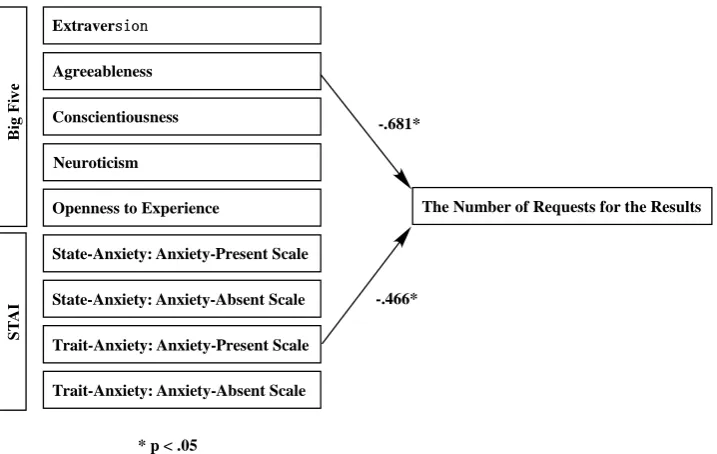
A stepwise multiple regression analysis was conducted to evaluate the relationship between personality and number of feedback requests. The dependent variable was the number of feedback requests, and the independent variables were Big Five and STAI-JYZ scores. The regression was significant (r = .68, F2.19 = 7.44, p < .005). Fewer
[image:5.595.194.553.447.674.2]feedback requests were associated with higher scores on the Big Five Agreeableness scale (standardized partial regression coefficient = −.681) and the STAI-JYZ Trait-an- xiety: Anxiety-present scale (standardized partial regression coefficient = −.466; see
Figure 2).
Relationship between Personality and Performance
A stepwise multiple-regression analysis was conducted to evaluate the relationship between personality and performance. The dependent variables were the CE, VE, and TV at pre- and post-test, and the independent variables were Big Five and STAI-JYZ scores. The regression was not significant.
4. Discussion
The purpose of this study was to examine the relationship among the number of feedback
Extraversion
Agreeableness
Conscientiousness
Neuroticism
Openness to Experience
State-Anxiety: Anxiety-Present Scale
State-Anxiety: Anxiety-Absent Scale
Trait-Anxiety: Anxiety-Present Scale
Trait-Anxiety: Anxiety-Absent Scale
The Number of Requests for the Results -.681*
-.466*
* p < .05
requests in a golf-putting task, personality, and anxiety. I predicted that Conscien-tiousness, Agreeableness, and Openness to experience of the Big Five scale, and higher anxiety would be associated with more requests for feedback. The results showed that although participants improved at the golf-putting task and the number of feedback requests was associated with agreeableness and trait anxiety (anxiety-present), there was no relationship between performance and personality or anxiety. These results do not support the hypothesis, and individuals with a highly agreeable personality and high trait anxiety did not request a great deal of feedback. This is in contrast toBokums et al. (2012), who reported that participants with higher trait anxiety requested far more feedback than those with lower trait anxiety.
Compared with individuals from other nations, Japanese individuals show high agreeableness on the Big Five (McCrae, Yik, Trapness, Bond, & Paulhus, 1998). Accor-dingly, it may be that in the current study anxious participants wanted to avoid bo-thering others and to finish the experiment without interruption, which was achieved by not asking the experimenter for feedback. That is, participants who were highly an-xious and agreeable did not feel anxiety with respect to learning the task; instead, they were concerned for the experimenter and felt constrained in asking for feedback. A highly anxious and agreeable individual might consider it more important to foster a relationship with the experimenter, rather than acquire the skill. Thus, cross-cultural personality factors might affect the number of feedback requests. It may be necessary to set up Japanese group and other country’s group, and to re-examine effects of cross- cultural factor.
References
Bidjerano, T., & Yun Dai, D. (2007). The Relationship between the Big-Five Model of Personality and Self-Regulated Learning Strategies. Learning and Individual Differences, 17, 69-81.
http://dx.doi.org/10.1016/j.lindif.2007.02.001
Bokums, R. M., Meira, C. M., Jr., Neiva, J. F. O, Olivia, T., & Maia, J. F. (2012). Self-Controlled Feedback and Trait Anxiety in Motor Skill Scquisition. Psychology, 3, 406-409.
http://dx.doi.org/10.4236/psych.2012.35057
Chamorro-Premuzic, T., & Furnham, A. (2008). Personality, Intelligence and Approaches to Learning as Predictors of Academic Performance. Personality and Individual Differences, 44, 1596-1603. http://dx.doi.org/10.1016/j.paid.2008.01.003
Chiviacowsky, S., & Wulf, G. (2002). Self-Controlled Feedback: Does It Enhance Learning Be-cause Performers Get Feedback When They Need It? Research Quarterly for Exercise and
Sports, 73, 408-415. http://dx.doi.org/10.1080/02701367.2002.10609040
Eysenck, M. W., & Calvo, M. G. (1992). Anxiety and Performance: The Processing Efficiency Theory. Cognition and Emotion, 6, 409-434. http://dx.doi.org/10.1080/02699939208409696
Eysenck, M. W., Derakshan, N., Santos, R., & Calvo M. G. (2007). Anxiety and Cognitive Per-formance: Attentional Control Theory. Emotion, 7, 336-353.
http://dx.doi.org/10.1037/1528-3542.7.2.336
Hidano, T., Fukuhara, M., Iwasaki, S., Soga, S., & Spielberger, C. D. (2000) A New Edition STAI
Manual. Tokyo: Jitumukyoiku-shuppan. (In Japanese)
Masters, R. S. W. (1992). Knowledge, Knerves, and Know-How: The Role of Explicit versus Im-plicit Knowledge in the Breakdown of a Complex Motor Skill under Pressure. British Journal
of Psychology, 83, 343-358. http://dx.doi.org/10.1111/j.2044-8295.1992.tb02446.x
McCrae, R. R., Yik, M. S. M., Trapnell, P. D., Bond, M. H., & Paulhus, D. L. (1998). Interperso-nality Profiles across Cultures: Bilingual, Acculturation, and Peer Rating Studies of Chinese Undergraduates. Journal of Personality and Social Psychology, 74, 1041-1055.
http://dx.doi.org/10.1037/0022-3514.74.4.1041
Murakami, Y., & Murakami, C. (1997) Scale Construction of a “Big Five” Personality Inventory.
The Japanese Journal of Personality, 6, 29-39. (In Japanese)
Neiva, J. F. O, Massa, M., Barros, J. A. C, & Meira, C. M. Jr. (2014). Trait Anxiety and Goal Dif-ficulty on Learning to Climb the Bachman Ladder. Perceptual and Motor Skills, 118, 375-383.
http://dx.doi.org/10.2466/22.25.PMS.118k17w0
Patterson, J. T., & Carter, M. (2010). Learner Regulated Knowledge of Results during the Acqui-sition of Multiple Timing Goals. Human Movement Science, 29, 214-227.
http://dx.doi.org/10.1016/j.humov.2009.12.003
Schmidt, R. A. (1991). Motor Learning and Performance: From Principles to Practice. Cham-paign, IL: Human Kinetics.
Spielberger, C. D., & Sydeman, S. J. (1994). State-Trait Anxiety Inventory and State-Trait Anger Expression Inventory. In M. E. Maruish (Ed.), The Use of Psychological Testing for Treatment
Planning and Outcome Assessment (pp. 292-332). Hillsdale, NJ: Lawrence Erlbaum Associates.
Wulf, G., Shea, C., & Lewthwaite, R. (2010). Motor Skill Learning and Performance: A Review of Influential Factors. Medical Education, 44, 75-84.
http://dx.doi.org/10.1111/j.1365-2923.2009.03421.x
Zhang, L. (2003). Does the Big Five Predict Learning Approaches? Personality and Individual
Differences, 34, 1431-1446. http://dx.doi.org/10.1016/S0191-8869(02)00125-3
Submit or recommend next manuscript to SCIRP and we will provide best service for you:
Accepting pre-submission inquiries through Email, Facebook, LinkedIn, Twitter, etc. A wide selection of journals (inclusive of 9 subjects, more than 200 journals)
Providing 24-hour high-quality service User-friendly online submission system Fair and swift peer-review system
Efficient typesetting and proofreading procedure
Display of the result of downloads and visits, as well as the number of cited articles Maximum dissemination of your research work
Submit your manuscript at: http://papersubmission.scirp.org/