2013. Vol.3, No.3, 203-207
Published Online September 2013 in SciRes (http://www.scirp.org/journal/ojml) http://dx.doi.org/10.4236/ojml.2013.33027
Effect of Animacy on Word Order Processing in Kaqchikel Maya
Sachiko Kiyama
1, Katsuo Tamaoka
2, Jungho Kim
3, Masatoshi Koizumi
31Functional Brain Imaging Lab, National Center for Geriatrics and Gerontology, Ohbu, Japan 2Graduate School of Languages and Cultures, Nagoya University, Nagoya, Japan
3Graduate School of Arts and Letters, Tohoku University, Sendai, Japan Email: [email protected]
Received June 24th, 2013; revised July 23rd, 2013; accepted July 30th, 2013
Copyright © 2013 Sachiko Kiyama et al. This is an open access article distributed under the Creative Commons Attribution License, which permits unrestricted use, distribution, and reproduction in any medium, provided the original work is properly cited.
This study investigated the processing load of transitive sentences in two different basic word orders (i.e., VOS and SVO) in Kaqchikel Maya, with a particular focus on the animacy of the object. The results of a sentence plausibility judgment task showed that VOS sentences were processed faster than SVO sen- tences regardless of the animacy of the object. This supports the traditional analysis in Mayan linguistics that, although SVO is the most frequently used word order, the syntactically determined basic word order is VOS in Kaqchikel, as in many other Mayan languages. More importantly, the results suggest that the processing load in Kaqchikel sentence comprehension is more strongly affected by syntactic canonicity than production frequency or object animacy.
Keywords: Animacy; Sentence Processing; SO Word Order Preference; Syntax; Kaqchikel
Introduction
According to experimental findings from languages such as Basque, English, Finnish, German, and Japanese, sentences in which the subject (S) precedes the object (O) (SO word order = SOV, SVO, VSO) induce a lower processing load for compre- hension than those in which the opposite occurs (OS word or- der = OSV, OVS, VOS), and thus, they are preferred by speak- ers (Bader & Meng, 1999; Erdocia et al., 2009; Kaiser & Trueswell, 2004; Mazuka, Itoh, & Kondo, 2002; Sekerina, 1997; Tamaoka et al., 2005; Tamaoka et al., 2013; among many oth- ers). However, these previous studies on sentence processing have all targeted languages in which the subject precedes the object in syntactically basic word orders (i.e., SO languages). Hence, it remains unclear whether the preference for SO is a reflection of word order in individual languages or more uni- versal human cognitive features. What we refer to as individual grammar theory in this paper posits that a language’s syntacti- cally determined basic word order has a low processing load in comparison with other possible word orders (e.g., Gibson, 2000), whereas what may be referred to as universal cognition theory hypothesizes that SO word order has a low processing load regardless of the basic word order of any individual language (e.g., Bock & Warren, 1985). To verify which of these two the- ories is correct, it is necessary to examine languages in which the object precedes the subject in syntactically basic word orders (i.e., OS languages), for which the two theories develop differ- ent predictions.
Koizumi et al. (under review) conducted a sentence-proc- essing experiment in Kaqchikel, a Mayan language spoken in Guatemala. The syntactically determined basic word order of Kaqchikel is VOS, although in general, word order is relatively flexible (García Matzar & Rodríguez Guaján, 1997: p. 333).
They found that VOS was processed faster than the two other commonly used word orders, VSO and SVO. This suggests that the preference for SO in sentence comprehension is not univer- sal; rather, syntactic features of individual languages signifi- cantly influence sentence processing load. In other words, the individual grammar theory, rather than the universal cognition theory, was supported.
Kaqchikel
Kaqchikel is 1 of the 21 Mayan languages spoken in Guate- mala. It is mainly used in the highlands west of Guatemala City, the capital. With over 450,000 speakers, it is one of the princi- pal Mayan languages along with K’iche’, Q’eqchi’, and Mam (Brown, Maxwell, & Little, 2006: p. 2; Lewis, 2009; Tay Co- yoy, 1996: p. 55).
Like other Mayan languages, Kaqchikel is head marking: subjects and objects are unmarked, and person and number agreement for both subjects and objects are obligatorily ex- pressed on the verb. Kaqchikel is ergative, like other Mayan languages. In Mayan linguistics, ergative agreement markers (i.e., those that indicate the subject of a transitive verb) are call- ed Set A, and absolutive agreement markers (which indicate either the subject of an intransitive verb or object of a transitive verb) are known as Set B. The order of morphemes in the verb is [Aspect-B-A-Verb stem]1. An example is given in 1) below.
1) Y-e’-in-to’
IC-B3PL-A1SG-help “I help them.”
Since Kaqchikel is a pro-drop language, 1) functions as both independent speech and an independent sentence.
Like its ancestor language, Kaqchikel’s syntactically deter-mined basic word order is VOS, but SVO and VSO are also possible (Rodríguez Guaján, 1994: p. 200; García Matzar & Ro- dríguez Guaján, 1997: p. 333; Tichoc Cumes et al., 2000: p. 195; Ajsivinac Sian et al., 2004: p. 162). According to England (1991), these word orders are derived from VOS through reor-dering rules, as schematically shown in 2)2.
2) Order Derivation
VOS [VOS]
VSO [[V S] REORDERED O] SVO [REORDERED S [VO ]]
Aissen (1992) has proposed more elaborate syntactic struc- tures for Mayan sentences with these word orders, but her analysis agrees with England’s in that VSO and SVO word orders are associated with more complex syntactic structures than VOS word order (see also Coon, 2010; Preminger, 2011).
Given this feature, the following predictions can be made about processing load in the comprehension of Kaqchikel sen- tences: if the preference for SO word order shown by speakers of SO languages is mainly caused by the syntactic structure of the individual language, as suggested by the individual gram- mar theory, VOS sentences should have a lower processing load than VSO or SVO sentences in Kaqchikel. On the other hand, if SO triggers a lower processing load than OS regardless of the basic word order of the individual grammar, as suggested
by the universal cognition theory, then Kaqchikel VOS sen- tences should create a greater processing load than the other two word orders. Koizumi et al. (under review) conducted a sentence-processing experiment to test these predictions. The results of the experiment revealed that for Kaqchikel speakers, the processing load of VOS is lower than that of the two other commonly used word orders, VSO and SVO.
As mentioned in the previous section, however, the produc- tion frequency of SVO is higher than that of VOS in Kaqchikel. Furthermore, SVO order is more frequently produced when the object denotes an animate entity such as a human, compared to when the object is inanimate: SVO (87.1%) vs. VOS (12.9%) with animate objects; SVO (60.9%) vs. VOS (39.1%) with ina- nimate objects (Kubo et al., 2012). The target sentences used in Koizumi et al.’s (under review) experiment all have an inani- mate object. Thus, it is possible that VOS was processed faster than SVO in their experiment because they used sentences with inanimate objects, for which the difference between VOS and SVO, in terms of production frequency, is relatively small. In other words, SVO sentences might be processed faster than VOS sentences if the object is animate, in which case the dif-ference in production frequency between VOS and SVO is much greater. To test this idea, this study conducted a sentence plausibility judgment task to evaluate the effect of object ani- macy on sentence processing load in Kaqchikel Maya.
Method
Participants
A total of 53 Kaqchikel native speakers who live in Guate-mala (28 males; mean age ± SD = 34.7 years ± 10.6) gave their written, informed consent to participate in the research. Be-cause of considerable dialectal and idiolectal variation among Kaqchikel speakers, the data of participants who had less than 80% accuracy in the experiment were excluded, leaving the data of 24 participants in the final analysis.
Materials
Semantically natural, grammatical transitive sentences were arranged into each of the two word orders (VOS and SVO), as shown in 3). Eighty pairs, for 160 target sentences, were cre- ated in this way. Forty pairs of sentences among the 80 pairs had an animate object, and the remaining 40 pairs had an in- animate object. The subject was always animate.
3) a. [VOS]
X-e-ru-pïs ri taq lej ri ch’utitata’ CP-B3PL-A3SG-wrap DET PM tortilla DET uncle “The uncle wrapped the tortillas.”
b. [SVO]
Ri ch’utitata’X-e-ru-pïs ri taq lej DET uncle CP-B3PL-A3SG-wrap DET PM tortilla
Among the 80 sentence pairs, the number of letters did not differ significantly between subjects (M = 10.2 letters, SD = 2.0 letters) and objects (M = 9.7 letters, SD = 2.0 letters) (t79 = 1.61,
p = .11, ns.). Representative examples along with their English translations are shown in the Appendix.
Additionally, 40 transitive sentences that were grammatical but not semantically natural were arranged in each of the two 1The following abbreviations are used in this paper. IC [Incompletive], CP
word orders. They were semantically implausible mostly be- cause of selectional restriction violations (e.g., #Xuch’äj ri kaq’ïq’ rixtaSelfa “Miss Selfa washed the air”). All 120 sen- tence pairs, consisting of 240 sentences, were counterbalanced and then categorized into two groups according to word order. Further, 192 filler sentences were added to each group. All the stimulus sentences were recorded by a male native Kaqchikel speaker and saved as WAV sound files.
The duration of each of the recorded semantically plausible sentences was trimmed in Praat ver. 5.1.31 (Boersma, 2001) to reduce the difference between the VOS and SVO sentences within each pair as much as possible. The trimming was done by slightly shortening the duration of some pauses between phrases. The difference between the duration of VOS sentences (M = 3274 ms, SD = 299) and that of SVO sentences (M = 3274 ms, SD = 299) was not significant (t79 = .130, p = .897, ns.). All the trimmed sentences were judged as natural in terms of pros- ody by our native Kaqchikel consultants.
Procedure
The participants listened to the stimulus sentences in a ran- dom order through headphones. They were asked to judge whether each sentence was semantically plausible and to answer by pushing a YES button (correct sentence) or NO button (incur- rect sentence), as quickly and accurately as possible. The time from the beginning of each stimulus sentence until the button pressing was recorded as the reaction time. E-Prime ver. 2.0 (Psychology Software Tools) was used for presenting the stim-uli and obtaining the behavioral data.
Analysis
Among the 80 pairs of semantically plausible sentences, only items that were correctly judged by each participant were ana-lyzed. Reaction times ranged from 1223 ms to 7635 ms, and all of them were within 2.5 standard deviations at both the high and low ranges from the individual mean of each participant in each category. Statistical analyses were conducted using a lin- ear mixed effects (LME) model (e.g., Baayen, 2008) based on the restricted maximum-likelihood method (REML), which esti- mates the effects of fixed variables that are of interest in the study over random effects that can be assumed as being ran- domly sampled from the population. In this study, we assumed the word order of sentences (i.e., VOS vs. SVO) and animacy of the object (i.e., animate vs. inanimate) as fixed variables, and participant and item (i.e., stimulus sentence) as random vari- ables. PASW ver. 18.0J (SPSS, Inc., 2008) was used to conduct the analysis.
[image:3.595.308.539.119.172.2]Results
Table 1 shows the means and standard deviations of accu-
racy rates for the 80 sets of semantically plausible transitive sentences in the VOS and SVO word orders with animate and inanimate objects. The LME analysis indicated that both fixed effects of the word order (F1, 936 = .354, p = .552, ns.) and ob- ject animacy (F1, 1032 = 1.690, p = .194, ns.) were not significant. The interaction effect of the two variables was not significant either (F1, 933 = .174, p = .677, ns.).
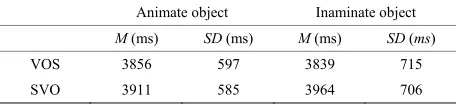
Table 2 shows the means and standard deviations of reaction
times for the correctly judged semantically plausible target sentences. The same analysis revealed that the fixed effect of
Talbe 1.
Accuracy rates (%) of sentence plausibility judgment for Kaqchikel VOS and SVO sentences with animate and inanimate objects.
Animate object Inaminate object M (%) SD (%) M (%) SD (%) VOS 79.6 40.4 81.7 38.8
S
VO 77.1 42.1 81.3 39.1
Talbe 2.
Reaction times (ms) of sentence plausibility judgment for Kaqchikel VOS and SVO sentences with animate and inanimate objects.
Animate object Inaminate object M (ms) SD (ms) M (ms) SD (ms) VOS 3856 597 3839 715 SVO 3911 585 3964 706
word order was significant (F1, 741 = 4.983, p < .05). The fixed effect of object animacy (F1, 741 = .040, p = .842, ns.) and the interaction effect of the two variables (F1, 740 = .692, p = .406,
ns.) were not significant. The results indicated that the differ-ence of reaction times (91 ms) between VOS sentdiffer-ences (M = 3847 ms, SD = 658 ms) and SVO sentences (M = 3938 ms, SD = 650 ms) was significant, regardless of the object animacy.
Discussion
In order to explore the processing load of transitive sentences in two commonly used word orders (i.e., VOS and SVO) in Kaqchikel Maya with reference to the animacy of the object, this study conducted an experiment with a sentence plausibility judgment task. The results of the LME analysis showed that VOS was processed faster than SVO regardless of the animacy of the object. That is, although SVO is more frequently pro-duced when the object is animate compared to when the object is inanimate, the sentence processing load is not significantly affected by this difference. Rather, syntactic features play a more prominent role in sentence processing, a conclusion con- sistent with the individual grammar theory.
A question naturally arises as to why SVO is more frequently used when the object is animate compared to when it is inani- mate, even though the animacy of the object does not affect the processing load3. We suggest that this is because the choice of SO vs. OS order in sentence production is primarily determined by conceptual factors at earlier stages of sentence production (Bock et al., 1985; Tanaka et al., 2011) without regard to the overall computational load, which is also strongly affected by processes in subsequent stages such as the construction of syn- tactic structures. In particular, we agree with Kubo et al. (2012) that similarity-based competition is the key factor here.
Gennari et al. (2012) argues that when there is a temporal overlap in the planning of two conceptually similar nouns, the similarity leads to interference between the semantic informa- tion of the nouns. As a result, when the concept of one noun is activated, the concept of the other noun is inhibited, and the latter noun is mentioned away from the initially activated noun, or simply omitted in the sentence. Moreover, the effect of con-
[image:3.595.309.537.216.268.2]ceptual similarity interacts with language-specific grammatical constraints, and the actual instantiation may vary across lan- guages. Kubo et al. (2012) examined how similarity-based competition influences speakers’ choices of sentence patterns in Kaqchikel. The production of VOS sentences is interesting be- cause the most accessible element, an animate agent noun usu- ally realized as the subject, must be retained in memory until the end of the sentence, and hence, it potentially competes with other elements. If similarity-based competition arises between the subject and object in Kaqchikel, one of them must be real- ized away from the other. Since the object usually follows the verb in Kaqchikel, the increase of competition would lead to the decrease of VOS word order. Kubo et al. conducted two picture description experiments to verify this prediction. In the first experiment, the animacy of the patient noun was manipu- lated (human, animal, inanimate object) such that similarity be- tween the agent (human) and patient varied among conditions. The results showed that VOS sentences were produced more often with an inanimate patient than with an animal or human patient, as predicted by similarity-based competition. In the sec- ond experiment, the researchers examined the effect of an agree- ment morpheme on the verb by changing the number of the object noun. The results replicated the overall patterns of the first experiment. That is, VOS sentences were produced more often with an inanimate patient than with a human patient, even when the number of the subject was different from the number of the object. This indicates that ambiguity resolution is not the most influential factor of the choice of sentence pattern in Kaqchikel. Putting the results together, native Kaqchikel speak- ers seem to be sensitive to the competition caused by the simi- larity of noun concepts involved in an event described in the sentence. Native Kaqchikel speakers select the sentence pattern in order to resolve competition between nouns with similar concepts.
Conclusion
In Kaqchikel Maya, VOS word order is more frequently em-ployed when the object is inanimate than when it is animate. The results of the listening comprehension experiment reported here show that VOS is processed faster than SVO regardless of the animacy of the object. This suggests that the processing load is not significantly affected by the animacy of the object in Kaqchikel.
Acknowledgements
We are grateful to Yoshiho Yasugi, Juan Esteban Ajsivinac Sian, and Lolmay Pedro Oscar García Mátzar for their invalu-able support for our research in Guatemala. We would also like to thank the research participants. The work for the present article was partially supported by the Japan Society for the Promotion of Science under Grant-in-Aid for Scientific Re-search (S) (No. 22222001, PI: Masatoshi Koizumi).
REFERENCES
Ajsivinac Sian, J. E., García Mátzar, L. P. O., Cutzal, M. C., & Alonzo Guaján, I. E. (2004). Gramáticadescriptiva delidiomamayaKa- qchikel:RutzijoxikrucholikriKaqchikelch’ab’äl. Academia de las Lenguas Mayas de Guatemala, Comunidad Lingüística Kaqchikel. Aissen, J. L. (1992). Topic and focus in Mayan. Language, 68, 43-80. Baayen, R. H. (2008). Analyzinglinguisticdata:Apracticalintroduc-
tiontostatisticsusingR. New York: Cambridge University Press.
Bader, M., & Meng, M. (1999). Subject-object ambiguities in German embedded clauses: An across-the-board comparison. JournalofPsy- cholinguisticResearch, 28, 121-143.
Bock, K., & Warren, K. R. (1985). Conceptual accessibility and syntac- tic structure in sentence formulation. Cognition,21, 47-67.
Boersma, P. (2001). Praat, a system for doing phonetics by computer. GlotInternational, 5, 341-345.
Brown, R. M., Maxwell, J. M., & Little, W. E. (2006). ¿Laützawäch?: IntroductiontoKaqchikelMayalanguage. Austin: University of Te- xas Press.
Caplan, D., Chen, E., & Waters, G. (2008). Task-dependent and task- independent neurovascular responses to syntactic processing. Cortex,
44, 257-275.
Coon, J. (2010). VOS as predicate fronting in Chol Mayan. Lingua, 120,
345-378.
England, N. C. (1991). Changes in basic word order in Mayan lan- guages. InternationalJournalofAmericanLinguistics, 57, 446-486. Erdocia, K., Laka, I., Mestres-Missé, A., & Rodriguez-Fornells, A.
(2009). Syntactic complexity and ambiguity resolution in a free word order language: Behavioral and electrophysiological evidences from Basque. BrainandLanguage, 109, 1-17.
García Matzar, L. P., & Rodríguez Guaján, P. B’. J. O. (1997). Rukemik riKaqchikelchi’:Gramáticakaqchikel. Guatemala City: Cholsamaj. Gennari, S., Mirkovic, J., & MacDonald, M. (2012). Animacy and com-
petition in relative clause production: A cross-linguistic investigation. CognitivePsychology, 65, 141-176.
Gibson, E. (2000). Dependency locality theory: A distance-based the-ory of linguistic complexity. In A. Marantz, Y. Miyashita, & W. O’Neil (Eds.), Image, language, brain:Papersfromthefirstmind articulationprojectsymposium (pp. 95-126). Cambridge, MA: MIT Press.
Kaiser, E., & Trueswell, J. C. (2004). The role of discourse context in the processing of a flexible word-order language. Cognition, 94, 113-
147.
Koizumi, M., Yasugi, Y., Tamaoka, K., Kiyama, S., Kim, J., García Matzar, L. P. O., & Ajsivinac Sian, J. E. (under review). On the (non-)universality of the preference for subject-object word order in sentence comprehension: A sentence processing study in Kaqchikel Maya.
Kubo, T., Ono, H., Tanaka, M., Koizumi, M., & Sakai, H. (2012). How does animacy affect word order in a VOS language? Poster present- ed at the 25th Annual CUNY Conference on Human Sentence Pro- cessing, New York.
Lewis, M. P. (2009). Ethnologue:Languagesoftheworld (16th ed.). Dallas, TX: SIL International. http://www.ethnologue.com/
Mazuka, R., Itoh, K., & Kondo, T. (2002). Costs of scrambling in Japa- nese sentence processing. In M. Nakayama (Ed.), Sentenceprocess- inginEastAsianlanguages (pp. 131-166). Stanford, CA: CSLI Pub- lications.
Preminger, O. (2011). Agreementasafallibleoperation. Doctoral dis- sertation, MIT.
Rodríguez Guaján, J. O. (1994). Rutz’ib’axikriKaqchikel:Manualde redacciónKaqchikel. Guatemala City: Editorial Cholsamaj. Sekerina, I. A. (1997). ThesyntaxandprocessingofRussianscrambled
constructions in Russian. Doctoral Dissertation, New York: City University of New York.
Tamaoka, K., Sakai, H., Kawahara, J., Miyaoka, Y., Lim, H., & Koizu- mi, M. (2005). Priority information used for the processing of Japa- nese sentences: Thematic roles, case particles or grammatical func- tions? JournalofPsycholinguisticResearch, 34, 273-324.
Tanaka, M., Branigan, H. P., McLean, J. F., & Pickering, M. P. (2011). Conceptual influences on word order and voice in sentence produc- tion: Evidence from Japanese. JournalofMemoryandLanguage, 65,
318-330.
Tay Coyoy, A. (1996). Análisisdesituacióndelaeducaciónmayaen
Guatemala. Guatemala City: Cholsamaj.
Tichoc Cumes, R., Ajsivinac Sian, J. E., García, L. P. O., Espantzay, I. C., Cutzal, C. M., & Alosno Guajan, E. (2000). Runuk’ulparub’eyal rutz’ib’axikriKaqchikelch’ab’ äl:Gramáticanormativadelidioma MayaKaqchikel. Chimaltenango, Guatemala: Comunidad Lingüísti- ca Kaqchikel de la Academia de las Lenguas Mayas de Guatemala.
Appendix
The followings are representative examples excerpted from the 80 semantically natural, grammatical transitive Kaqchikel sentences (target stimuli) and their English translations. They are presented in the word order of VOS in this Appendix.
1) Sentences with a plural inanimate object and a singular animate subject:
a) X-e-ru-pïs ri taq lej
CP-B3PL-A3SG-wrap DET PM tortilla
ri ch’utitata’ DET uncle “The uncle wrapped the tortillas.”
b) X-e-ru-nïm ri taq wuj
CP-B3PL-A3SG-push DET PM book
ri malka’n. DET widow “The widow pushed the books.”
2) Sentences with a singular inanimate object and a plural animate subject:
a) X--ki-jiq’aj ri jub’ül pom CP-B3SG-A3PL-breath DET fragrant incense
ri taq ajawa’. DET PM man “The men breathed the fragrant incense.”
b) X--ki-chäq ri chäq’ tz’o’ CP-B3SG-A3PL-grind DET mature boiled corn
ri taq atita’ DET PM grandmother
“The grandmothers grinded the mature boiled corn.”
3) Sentences with a plural animate object and a singular ani-mate subject:
a)X-e-ru-kajij ri taq yuqüyb’aq CP-B3PL-A3SG-annoy DET PM bone-setter
ri cholonel.
DET speaker “The speaker annoyed the bone-setters.”
b)X-e-ru-q’etej ri taq rach’alal CP-B3PL-A3SG-embrace DET PM family
ri b’iyinel
DET walker
“The walker embraced the families.”
4) Sentences with a singular animate object and a plural ani-mate subject:
a)X--ki-köl ri achijilom ri taq ixjayilom CP-B3SG-A3PL-save DET husband DET PM wife “The wives saved the husband.”
b)X--ki-k’uxlaj ri kib’aluk CP-B3SG-A3PL-recall DET brother-in-law
ri taq rijitaq