The effects of application of an ancient type of
acupuncture needle on increase in urination of
hospitalized oldest-old people
Mayumi Watanabe1,2*#, Osamu Takano3*, Chikako Tomiyama4, Jianjun Guan5, Guanhui Hou5, Hidetoshi Mori2, Kazushi Nishijo2, Toru Abo6, Kohei Akazawa1
1Department of Medical Informatics, Niigata University Medical & Dental Hospital, Niigata, Japan; #Corresponding Author: [email protected]
2Department of Health, Faculty of Health Science, Tsukuba University of Technology, Tsukuba, Japan 3Urahigashi Veterinary Clinic, Osaka, Japan
4School of Health Sciences, Faculty of Medicine, Niigata University, Niigata, Japan 5Shaanxi University of Chinese Medicine, Shaanxi, China
6Department of Immunology, Niigata University School of Medicine, Niigata, Japan
Received 13 May 2013; revised 14 June 2013; accepted 30 June 2013
Copyright © 2013 Mayumi Watanabe et al. This is an open access article distributed under the Creative Commons Attribution
Li-cense, which permits unrestricted use, distribution, and reproduction in any medium, provided the original work is properly cited.
ABSTRACT
The di-zhen (DZ) is an ancient type of acupunc- ture needle with a history dating back to more than 2000 years. Unlike modern acupuncture needles, the DZ is not inserted subcutaneously and is considered to be safe for common use, even at the bedside of terminally ill patients. In this case study, DZ application was selected and applied 14 times on a 92-year-old patient who had suffered severe oliguria along with admini- stration of diuretics. Urine volume increased 12 out of 14 times following DZ treatment; however, the other two times it was ineffective. To inves- tigate the reason and the differences in effec- tive/ineffective DZ application, two internal con- ditions (effective vs ineffective) were compared by analyzing daily nursing reports (vital signs such as blood pressure, urine volume and body temperature) and weekly clinical data (including renal, liver and immune function, urea nitrogen, creatinine, ALT, AST, the ratio and number of leukocytes, erythrocytes). DZ application in- creased urine volume via a transient modifica- tion of the autonomic nervous system when in- ternal homeostasis was maintained. Aging po- pulations, who often have several diseases and medications, are rapidly increasing in developed countries. Therefore, the study and application of DZ may contribute to a reduction in medical
costs, which have been rapidly and heavily ex- panding recently.
Keywords: Di-Zhen (DZ); Acupuncture; Oldest-Old; Autonomic Nervous System (ANS); Leukocyte; Urination; Terminal Care
1. INTRODUCTION
It is known that acupuncture as a therapeutic interven- tion is widely practiced. Acupuncture is said to be useful as an adjunct application included in a comprehensive management program application, which is known to reduce physical and psychological pain and improve the quality of life [1-3]. However, in cases of hospitalized patients who are the oldest-old or terminally ill, it is very difficult to insert acupuncture needles, which might cause problems such as infection and tissue breakdown [4,5]. The study of new approaches to the oldest-old, including terminally ill patients, addressed current needs given that aging populations are rapidly increasing in developed countries [6-9]. Recently, we studied the basal mechanism of di-zhen (DZ) application. DZ is an ancient type of acupuncture needle without subcutaneous inser- tion, the effects of which are very similar to those of mo- dern needles inserted subcutaneously [10].
ined renal, liver and immune function (including urea nitrogen [UN], creatinine [CRE], ALT, AST, the ratio and number of leukocytes, erythrocytes). Therefore, we ana- lyzed these data to quantify the effect of DZ applications. These results suggested a possibility that urine volume was increased after DZ application. At the same time, the findings indicated a difference between its effective and ineffective stages.
2. MATERIALS AND METHOD
2.1. Subject2.1.1. Patient
A 92-year-old male, an active president of a local metal-processing company, was hospitalized because of aspiration pneumonia, under shock conditions (blood pressure: 20 - 70 mmHg), anuria and high fever. Written informed consent and all data were obtained from the patient and his family, and the study was approved by the institutional review board of Niigata University.
2.1.2. Clinical History
He recovered from brain infarction at the age of 82. He had suffered from arteriosclerosis for the past 2 years, and he routinely underwent acupuncture applications.
2.1.3. Conventional Application
The temperature in the hospital room was kept at 26˚C. Conventional therapy, the existing prescription and the existing quantity of administration of antibiotics, diuretic, fluid infusion, and nutrition were maintained during his hospitalization. DZ application was tried for the purpose of urination. The nursing team recorded vital signs, such as blood pressure, urine volume and body temperature several times each day, and doctors examined venous blood and urine every week to check clinical conditions of renal, liver and immune function.
2.2. DZ Application
The DZ needles made of stainless steel with a column- like body and flat head (Tumujikaze-kun SNM type, Soken Medical Co. Ltd., Toshima, Japan) were selected to avoid any problems such as infection or tissue break- down. An autoclaved DZ was softly pressed vertically onto the body surface for 5 minutes (diameter 5.0 mm, 37.3 g/mm2) at approximately 120 points from the head
to the feet on both sides of the spine as mentioned in our previous study [10]. DZ application points correspond- ing to the Bladder Meridian as defined by the World Health Organization were selected. This meridian ana- tomically passes near the bladder and kidneys, and the
aim of DZ application was to enhance function of these organs to increase urine volume [11,12]. The application was applied by nationally licensed, experienced Japanese
acupuncturists.
2.3. Statistical Analysis
The statistical significance of differences between va- lues was tested using Wilcoxon signed-rank test. P-val- ues of less than 0.05 were considered to be statistically significant.
3. RESULTS
3.1. Systolic Blood Pressure (SBP) Elevated after DZ Application before Day 50
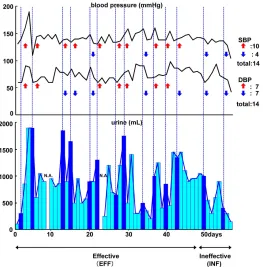
The kidneys filter out waste products from the blood, combining them with water to make urine and control blood pressure [13,14]. Because the volume of urine af- fects blood pressure, two kinds of blood pressures (dia- stolic blood pressure and systolic blood pressure: DBP and SBP) were studied. Compared to DBP, SBP showed an increasing trend after DZ application, although there were no statistically significant differences. After Day 50 of hospitalization, DBP did show elevation (Figure 1,
upper panel).
3.2. Urine Volume Increased after DZ Application before Day 50
The urine volume of the patient, who had suffered from oliguria, showed a step-like increase (103 → 300
→ 850 → 1900 mL) after the first DZ application ( Fig-ure 1, lower panel). Particularly, on all days when urine
volume exceeded 1000 mL, SBP showed an elevation. Urine volume significantly increased with DZ applica-tion compared to without DZ applicaapplica-tion (P < 0.05) (Figure 2). However, after day 50, urine volume was not
increased (Figure 1, lower panel).
3.3. Body Temperature, Total Protein, Erythrocytes and Hemoglobin Decreased
As mentioned, DZ application might have an effect on blood pressure, which is one of several vital signs. Therefore, kinetic changes in body temperature, another type of vital sign, were also studied; body temperature returned to the normal range. At the same time, total protein, erythrocytes and hemoglobin were investigated. All of these measures were consistently below the nor- mal range and showed a decrease (Figure 3).
The number of leukocytes, which had severely ex- ceeded the normal range, began to decrease after Day 10 (Figure 4). The ratio of leukocytes to granulocytes was
Figure 1. Kinetic record of blood pressure, urine volume and the cross
relationship. Upper panel: kinetic record of DBP (diastolic blood pres- sure) and SBP (systolic blood pressure). Comparison of DBP with SBP showed an increasing trend after DZ application (SBP↑10, ↓4 vs DBP↑7,
↓7). After Day 50, DBP did show elevation. Lower: kinetic record of urine volume. Dark blue = days with DZ application; Light blue = days without DZ application. After Day 50, no increase was observed. On days when urine volume exceeded 1000 mL, SBP was elevated.
Therefore, the period of hospitalization was divided into two stages: the effective period when DZ application could increase urine volume and the ineffective period when it did not. In other words, DZ application was ef- fective from Day 1 through Day 49 (effective period) and was ineffective after Day 50 (ineffective period) (Figure 5). To investigate this reason, the internal clinical condi-
tions of the former period and that of the latter were compared. The former was represented by data from Day 22 and the latter by that of Day 50. These days were se- lected because DZ applications were given soon after the clinical medical checks on these 2 days.
Figure 2. Statistical analysis of
days with and without DZ app- lication. Compared to days with- out DZ application (light blue; no DZ), urine volume signifi- cantly increased on days with DZ application (dark blue; DZ) (P < 0.05).
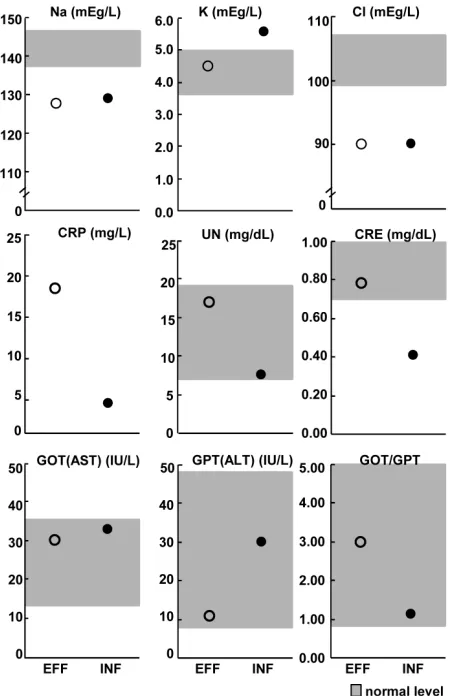
The plasma levels of Na and Cl were lower than the normal range during both periods. The volume of potas- sium (K) in the plasma was out of the normal range dur- ing ineffective period. The plasma level of C-reactive protein during the effective period had been severely high and decreased during the ineffective period; how- ever, it remained over the normal range. UN and CRE were lower during the effective period compared to the ineffective. GPT (ALT) and GOT (AST) were elevated during the ineffective period compared to the effective, during which GOT/GPT decreased inside of the normal range.
3.4. Comparison of the Internal Condition of the Two Points: The Effective and Ineffective
[image:3.595.113.228.455.572.2](×106 /μL)
Figure 3. Kinetic change of body temperature, total protein,
erythrocytes and hemoglobin. These measures were consis- tently below the normal range and showed a decrease.
(×103 /μL)
(×103 /μL)
(×102 /μL)
Figure 4. Kinetic change of the number and the ratio of leuko-
cytes. The number of granulocytes (●) largely decreased after Day 10, while lymphocytes (○) showed a sudden decrease on Day 50. (▲):leukocytes.
4. DISCUSSION
4.1. DZ Application Increased Urine Volume
[image:4.595.312.539.84.432.2]Because the urine volume was higher on days with DZ application compared to days without, it was suggested
Figure 5. Comparison of the internal clinical conditions of the effective and ineffective stages.Effective: Day 22, representing the effective period from Day 1 to 49. Ineffective: Day 50, rep- resenting the ineffective period after Day 50. UN (urea nitro- gen) and CRE (creatinine) are lower during the effective stage compared to the ineffective.
that DZ application could affect urine volume. Several researchers and clinical doctors reported acupuncture and other skin stimulating applications regulated urine vol- ume [15-19]. Recently, we reported that DZ application increases catecholamine (adrenaline, noradrenaline and dopamine) levels. Moreover, there are many clinical re- ports of the ability of various skin stimulating applica- tions, such as acupuncture, moxibustion and massage, to elevate catecholamine levels [10,20,21], which indicates an effect on the autonomic nervous system (ANS). As SBP was elevated the day after DZ application, there is a possibility that the circulatory system is affected as well (Figure 1, upper panel). Given that the maintenance of
[image:4.595.62.284.374.616.2]4.2. DZ Application Affected Urine Volume via Changes in ANS Balance from SNS to PNS Dominance
4.2.1. Urination Was Observed after Transient SNS Dominance
Recently, we reported that DZ application affected the level of adrenaline and noradrenaline, and that it induced a transient sympathetic nervous system (SNS) domi- nance (20 - 40 min) [10]. In fact, urination was observed 20 - 40 minutes after DZ application in the current study (data not shown). The same mechanism was indicated in a transient cutaneous hypothermia, which showed recov- ery within 20 - 40 minutes [10]. These observations agree with the fact that adrenaline and noradrenaline have a short half-life [22,23]. In this way, it is expected that urination was observed after the end of the transient SNS dominance.
4.2.2. DZ Application Affected Urination, Changing the ANS Balance from SNS to PNS Dominance
The detrusor urinae muscle (smooth muscle) contracts in response to the pelvic nerve, a parasympathetic nerve, to cause urination. In short, urination is controlled by the parasympathetic nervous system (PNS) and is suppressed under SNS dominance [24,25]. Therefore, it is thought that urine volume increased after DZ application because of changes in ANS balance from SNS to PNS domi- nance.
4.2.3. Transient SNS Dominance Was Followed by PNS Dominance
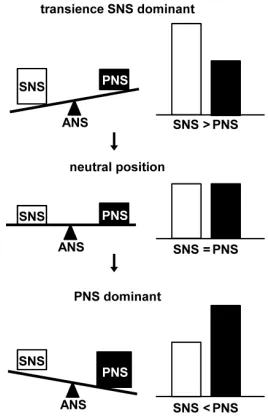
The image of the relationship between transient SNS dominance and the onset of PNS dominance is illustrated in Figure 6. DZ application was stronger than other skin
stimulation [10] and brought about a transient (rapid ap- pearance and disappearance of) SNS dominance. Such a rapid and strong change in ANS balance could induce a kind of rebound, such as the yin-yang like reaction. In other words, SNS suppression was related to PNS domi- nance [26]. Thus, there is the possibility that the transient SNS dominance was followed by a PNS dominance. Fur- ther studies with precise measurements are needed to support this hypothesis.
4.3. DZ Application Was Ineffective When Internal Homeostasis Failed
First, UN and CRE, renal function indicators, largely decreased during the ineffective stage compared to the effective stage (Figure 5). Therefore, it may be plausible
[image:5.595.355.489.84.294.2]to consider that DZ application was ineffective when renal function failed. Second, the number of lymphocytes remained over 1000/μL until suddenly dropping after day
Figure 6. Image of the power ba-
lance between the SNS and PNS. Sympathetic Nervous System (SNS) dominant status induced by DZ app- lication was transient. When the SNS was suppressed, either it was in a neu- tral state or the parasympathetic ner- vous system (PNS) was induced.
50, when DZ application became ineffective. It has been reported that the number and ratio of lymphocytes con- trolled by the PNS [27,28]. The volume of urine, which is also regulated by the PNS, did not increase after DZ application when the number of leukocytes dropped (Figure 4, upper right panel). Therefore, the number of
leukocytes might be considered to be an indicator of the effectiveness of DZ application.
The urination reflex is a local reflex and is controlled by centers in the spinal cord and central nervous system [15,24]. However, increased urine volume was not ob- served after DZ application under a severe and systemic condition. It may be understood that DZ application was ineffective when internal homeostasis failed.
4.4. Specific and Historical Compatibility of DZ and the Bladder Meridian
In this study, DZ was selected because it was practiced during the end-of-life care of an oldest-old patient in a general hospital; it was needed to avoid infection and tissue damage. Because the main purpose of the appli- cation was the application of oliguria, the Bladder Me- ridian, which is said to run through and stimulate the kidneys and the bladder [11,12], was selected.
from the era of the Tyrolean Iceman [29], is more sig- nificant than other applications, it should be possible to observe effects that are specific to DZ application. Fur- ther research is required to support this hypothesis.
5. CONCLUSION
DZ showed effectiveness at the bedside during end- of-life care of the oldest-old. In cases when the effects of administered diuretics are not sufficient, DZ application, with adequate knowledge and appropriate technique, could help improve the quality of life of patients as com- plementary medicine. The oldest-olds often have several diseases and medications [30,31]. DZ application may contribute to reduce medical costs, which have been ra- pidly and heavily expanding recently.
6. ACKNOWLEDGEMENTS
The authors thank all the medical staff, the patient and his family, and Ms. Hiromi Ishiwatari (Soken Medical Co. Ltd.) and Ms. Ryoko Karasawa for assistance with this study.
REFERENCES
[1] National Institutes of Health Office of the Director (1997) Acupuncture. NIH Consensus Statement, 15, 1-34.
http://consensus.nih.gov/1997/1997Acupuncture107PDF. pdf
[2] NIN Consensus Development Panel on Acupuncture (1998) Acupuncture. JAMA, 280, 1518-1524.
doi:10.1001/jama.280.17.1518
[3] Ernst, E., Pittler, M.H. and Wider, B. (2006) Acupuncture. In: Ernst, E., Pittler, M.H. and Wider, B., Eds., The Desk- top Guide to Complementary and Alternative Medicine,
2nd Edition, Mosby Ltd, London, 292-296.
[4] Walsh, B. (2001) Control of infection in acupuncture.
Acupuncture in Medicine, 19, 109-111.
doi:10.1136/aim.19.2.109
[5] Woo, P.C., Lin, A.W., Lau, S.K. and Yuen, K.Y. (2010) Acupuncture transmitted infections. British Medical Jour- nal, 340, 1147-1152. doi:10.1136/bmj.c1268
[6] Roush, W. (1996) Live long and prosper? Science, 273,
42-46.
[7] Christensen, K., Doblhammer, G., Rau, R. and Vaupel, J.W. (2009) Ageing populations: The challenges ahead. Lancet, 374, 1196-1208. doi:10.1016/S0140-6736(09)61460-4
[8] United Nations Department of Economic and Social Af- fairs Population Division (2012) Population facts 2012/4.
http://www.un.org/esa/population/publications/popfacts/p opfacts__2012-1.pdf
[9] Statistics and Information Department Minister’s Secre- tariat, Ministry of Health, Labour and Welfare Japan (2010) Vital statistics, life expectancy at birth.
http://www.mhlw.go.jp/english/database/db-hw/dl/81-1a2 en.pdf
[10] Watanabe, M., Takano, O., Tomiyama, C., Matsumoto, H.,
Urahigashi N., Kainuma, E., Madarame, T., Fukuda, M. and Abo, T. (2012) The effects of application of an an- cient type of acupuncture needle on body temperature, immune function and the autonomic nerve system. Health,
4, 775-780. doi:10.4236/health.2012.410120
[11] World Health Organization Western Pacific Region (2008) WHO standard acupuncture point locations in the western pacific region. World Health Organization Western Pa- cific Regional Office, Manila.
[12] Lee, B.Y., LaRicca, P.J. and Newberg, A.B. (2004) Acu- puncture in theory and practice physiologic effects. Hos- pital Physician, 11-18.
http://turner-white.com/memberfile.php?PubCode=hp_ap r04_theory.pdf11
[13] Osuji, C.U., Nwaneli, C.U., Onwubere, B.J., Onwubuya, E.I. and Ahaneku, G.I. (2012) Renal function in patients with hypertension associated congestive cardiac failure seen in a tertiary hospital. International Journal of Ne- phrology, 2012, 1-5. doi:10.1155/2012/769103
[14] Yee, J. (2008) Diabetic kidney disease: Chronic kidney disease and diabetes. Diabetes Spectrum, 21, 8-10.
doi:10.2337/diaspect.21.1.8
[15] Sato, A., Sato, Y. and Uchida, S. (2002) Reflex modula- tion of visceral functions by acupuncture-like stimulation in anesthetized rats. International Congress Series, 1238, 111-123. doi:10.1016/S0531-5131(02)00418-1
[16] Sato, A., Sato, Y. and Suzuki, A. (1992) Mechanism of the reflex inhabitation of micturition contractions of the urinary bladder elicited by acupuncture-like stimulation in anesthetized rats. Neuroscience Research, 15, 189-198.
doi:10.1016/0168-0102(92)90004-V
[17] Paterno, J.C., Freire, A.O., Soares, M.F., Franco, M.F., Schor, N. and Teixeira, V.P. (2008) Electroacupuncture and moxibustion attenuate the progression of renal dis- ease in 5/6 nephrectomized rats.Kidney and Blood Pres- sure Research, 31, 367-373. doi:10.1159/000176189
[18] Yi, W.M., Pan, A.Z., Li, J.J., Luo, D.F. and Huang, Q.H. (2011) Clinical observation on the acupuncture applica- tion in patients with urinary retention after radical hys- terectomy. Chinese Journal of Integrative Medicine, 17, 860-863. doi:10.1007/s11655-011-0800-5
[19] Radvanska, E., Kamperis, K., Kleif, A., Kovács, L. and Rittig, S. (2011) Effect of laser acupuncture for mono- symptomatic nocturnal enuresis on bladder reservoir func- tion and nocturnal urine output. Journal of Urology, 185,
1857-1861. doi:10.1016/j.juro.2010.12.068
[20] Mori, H., Nishijo, K., Kawamura, H. and Abo, T. (2002) Unique immunomodulation by electro-acupuncture in humans possibly via stimulation of the autonomic nerv- ous system. Neuroscience Letters, 320, 21-24.
doi:10.1016/S0304-3940(02)00012-5
[21] Watanabe, M., Takano, O., Tomiyama, C., Matsumoto, H., Kobayashi, T., Urahigashi, N., Urahigashi, N. and Abo, T. (2012) Skin rubdown with a dry towel, “kanpu-masatsu” is an aerobic exercise affecting body temperature, energy production, and the immune and autonomic nervous sys- tems.Biomedical Research, 33, 243-248.
doi:10.2220/biomedres.33.243
The influence of local anesthetic injected by the pre-ad- ministration method on plasma catecholamine and hemo- dynamic responses. Oral Therapeutics and Pharmacol- ogy, 28, 117-123.
[23] Stiell, I. G., Hebert, P.C., Weitzman, B.N., Wells, G.A., Raman, S., Stark, R.M., Higginson, L.A., Ahuja, J. and Dickinson, G.E. (1992) High-dose epinephrine in adult cardiac arrest. The New England Journal of Medicine, 327, 1045-1050.
doi:10.1056/NEJM199210083271502
[24] Tsuchida, S. (1989) Nervous control of micturition. Ja- panese Journal of Urology, 80, 1257-1277.
[25] Creasey, G.H. and Craggs, M.D. (2012) Functional elec- trical stimulation for bladder, bowel, and sexual function.
Handbook of Clinical Neurology, 109, 247-257.
doi:10.1016/B978-0-444-52137-8.00015-2
[26] Abo, T. and Kawamura, T. (2002) Immunomodulation by the autonomic nervous system: Therapeutic approach for cancer, collagen diseases, and inflammatory bowel dis- eases. Therapeutic Apheresis, 5, 348-357.
doi:10.1046/j.1526-0968.2002.00452.x
[27] Toyabe, S., Iiai, T., Fukuda, M., Kawamura, T., Suzuki, S., Uchiyama, M. and Abo, T. (1997) Identification of nico- tinic acetylcholine receptors on lymphocytes in the pe-
riphery as well as thymus in mice. Immunology, 92, 201-
205. doi:10.1046/j.1365-2567.1997.00323.x
[28] Suzuki, S., Toyabe, S., Moroda, T., Tada, T., Tsukahara, A., Iiai, T., Minagawa, M., Maruyama, S., Hatakeyama, K., Endoh, K. and Abo, T. (1997) Circadian rhythm of leucocytes and lymphocytes subsets and its possible cor- relation with the function of the autonomic nervous sys- tem. Clinical & Experimental Immunology, 110, 500-508.
doi:10.1046/j.1365-2249.1997.4411460.x
[29] Dorfer, L., Moser, M., Spindler, K., Bahr, F., Egarter-Vigl, E. and Dohr, G. (1998) 5200-year-old acupuncture in cen- tral Europe? Science, 282, 242-243.
doi:10.1126/science.282.5387.239f
[30] Sato, T., Sato, K. and Akira Sato, A. (2010) Medication reduction in a convalescent rehabilitation ward. Japanese Journal of geriatrics, 47, 440-444.
doi:10.3143/geriatrics.47.440
[31] Mita, Y., Akishita, M., Tanaka, K., Yamada, S., Nakai, R., Tanaka, E., Nakamura, T. and Toba, K. (2004) Improve- ment of inappropriate prescribing and adverse drug with- drawal events after admission to long-term care facilities.
Geriatrics & Gerontology International, 4, 146-150.