On the Quadratic Transportation Problem
Veena Adlakha1, Krzysztof Kowalski2
1University of Baltimore, Baltimore, MD, USA 2Department of Transportation, Middletown, CT, USA Email: [email protected], [email protected]
Received May 23, 2013; revised June 30, 2013; accepted July 19, 2013
Copyright © 2013 Veena Adlakha, Krzysztof Kowalski. This is an open access article distributed under the Creative Commons At- tribution License, which permits unrestricted use, distribution, and reproduction in any medium, provided the original work is prop- erly cited.
ABSTRACT
We present a direct analytical algorithm for solving transportation problems with quadratic function cost coefficients. The algorithm uses the concept of absolute points developed by the authors in earlier works. The versatility of the pro- posed algorithm is evidenced by the fact that quadratic functions are often used as approximations for other functions, as in, for example, regression analysis. As compared with the earlier international methods for quadratic transportation problem (QTP) which are based on the Lagrangian relaxation approach, the proposed algorithm helps to understand the structure of the QTP better and can guide in managerial decisions. We present a numerical example to illustrate the ap- plication of the proposed method.
Keywords: Quadratic Cost Function; Transportation Problem; Direct Method; Dynamic Shadow Prices
1. Introduction
The classical transportation problem (TP) is a well- structured problem that has been studied extensively in the literature. The TP deals with the distribution of goods from m suppliers (sources) to n customers (destinations).
Each of the m suppliers can ship to any of the n
custom-ers at a shipping cost per unit cij (unit cost for shipping
from supplier i to customer j). Each supplier has ai units
of supply and each customer has a demand of bj units.
The objective is to schedule shipments from sources to destinations so that total transportation cost, ∑∑cijxij, is
minimized. A typical TP is formulated as follows: Minimize
1 1
m n
ij ij i j
Z c x
(1)subject to
1 n
ij i
j
x a
for i = 1, 2, …, m (2)1
m
ij j i
x b
for j = 1, 2, …, n (3)1 1
m n
i j
i j
a b
0
xij for all (i, j).
Like the TP, the quadratic transportation problem (QTP) can be stated as a distribution problem where each of the m suppliers can ship units to any of the n custom-
ers at cost fij(xij) and where fij(xij) is a quadratic function
of xij, the amount shipped from source i to destination j.
The objective is to minimize the total transportation cost while meeting demand at the destinations.
Mathematically, a QTP is formulated as:
Problem QTP:
Minimize
1 1
m n
ij ij i j
Z f x
(4)subject to
1 n
ij i
j
x a
for i = 1, 2, …, m, (5)1
m
ij j i
x b
for j = 1, 2, …, n, (6)1 1
m n
i
i j
a
bj
(7)
0ij ij
f x ; fij
0 0 (8)x a bij, ,i j0, integer
redun-dant if the QTP is balanced, i.e., if Equation (7) is satis-
fied. Note that, as with a classical TP, we assume non- negative conditions and zero value of cost functions at 0. As compared with the linear TP, the QTP provides a su- perior representation of real live distribution problem where the unit cost of transportation is not constant. For example, consider the case where the unit cost of trans- portation might decrease with the volume of transported goods. Conversely, there may be an opposite situation where the unit cost of transportation increases with vol- ume due to highway congestion.
There is no efficient direct algorithm to solve Problem QTP available in the literature. Some authors have at-tempted to solve Problem QTP as a quadratic program with a quadratic objective function involving (m * n) variables subjected to (m + n) linear conditions. The prob- lem thus formulated could then be solved using the the- ory of Lagrange multipliers. Such a process, however, is very cumbersome, as it requires taking partial derivatives with respect to each of the (m * n) variables and (m + n −
1) Lagrange multipliers, and solving the resulting (m * n) + (m + n − 1) equations. This task could be overwhelm- ing even for a small QTP. And with a second-degree polynomial function, one cannot even be sure whether the point obtained is a local minimum or the global minimum. Many current software programs for solving QTP are based on various algorithm developed in the literature based on Lagrange multipliers. Authors ex- perimented with some of these: Lindo, Excel, and WinQSB. In several instances, the three programs pro- vided different results, affirming the inability of these algorithms to always provide the global minimum for a QTP.
Quadratic functions are versatile, as they can be used as approximations for many other functions, as with re-gression analyses and have been used to model special scheduling problems. In this paper we propose a novel direct analytical method to solve a QTP where the cost coefficients are quadratic functions. The proposed algo- rithm exploits the properties of absolute points developed by Adlakha and Kowalski [1] to solve a TP with linear costs. It is easy to apply and provide insight into the problem, and with this, we are able to critically analyze the problem. The algorithm can also be used as a pre- processor to reduce the transportation problem size.
2.
Literature Review
Research on TP has generally addressed situations where linear costs are assumed. In such a case, a TP can be formulated as a linear program and solved by the regular simplex (big-M), the dual simplex method or even an interior approach. However, these algorithms require additional variables, which complicate the formulation, enlarge the tableaux, and increase the number of itera-
tions. These problems led to the stepping-stone (SS) technique, which—as a network-oriented algorithm— proved very successful and became the standard tech-nique for over 60 years. In practice, however, the SS al- gorithm encounters major obstacles, including difficul- ties in identifying an initial basic feasible solution, re- solving SS degeneracy, and enumerating SS paths [2]. Literature is filled with efforts to overcome these defi- ciencies and improve the SS algorithm [3-8]. Korukoğlu and Balli [9] propose a variant of Vogel’s Approximation Method (VAM) to obtain efficient initial solutions for large scale transportation problems. Other researchers [1, 10] provide alternative solution algorithms.
Variations in TP cost functions have been studied by many researchers. Szwarc [11] develops a method for solving TPs with cost coefficients of the form cij = ui+ vj,
where ui and vj represent nonnegative real numbers, a
method that has applications in shop loading and aggre- gate scheduling. Along the same lines, with applications to stock location and information storage, Evans [12] considers TPs in which cost coefficients are factorable, that is, cij = uivj. Evans demonstrates that if the rows are
arranged by non-increasing ui, and the columns by non-
decreasing vj, then the northwest corner rule provides an
optimal solution.
A limited number of researchers have worked on quadratic programming problems. Hochbaum et al. [13]
consider a specialized scheduling problem. They formu- late the problem as an integer program with a quadratic, non-separable objective and transportation constraints. Employing methods of real analysis, they prove a tight proximity result between the integer solution to that problem and a fractional solution of a related polyno- mially solvable problem. Megiddo and Tamir [14] con- sider separable quadratic problems including separable convex QTP with a fixed number of sources. Using the technique of Lagrangian relaxation, they provide linear algorithms based on the multidimensional procedures developed by the authors. Cosares and Hochbaum [15] present a linear algorithm for the continuous QTP with two source nodes.
To mention a few other related works, Eduardo et al.
[16] develop a productivity index for the case of a cost model using a quadratic cost function. Wanner et al. [17]
propose a local search optimizer as an additional operator in multi-objective evolutionary techniques, to help find more precise estimates of the Pareto-optimal surface with a smaller cost-of-function evaluation. The operator em- ploys quadratic approximations of the objective functions and constraints for the purpose of enhancing local search phase. Lu et al. [18] present a long-step infeasible pri-
solver.
3. The Quadratic Transportation Problem
Before we proceed, we reiterate some terminology from the TP literature. A location (i, j) is said to be loaded (oroccupied) if there is a value assigned to it in the solution. Location (i, j) is said to be fully loaded if that value
equals min(ai, bj), i.e., the assignment exhausts supply ai
at source i and/or demand bj at destination j. Location (i, j)
is interchangeably referred to as cell (i, j).
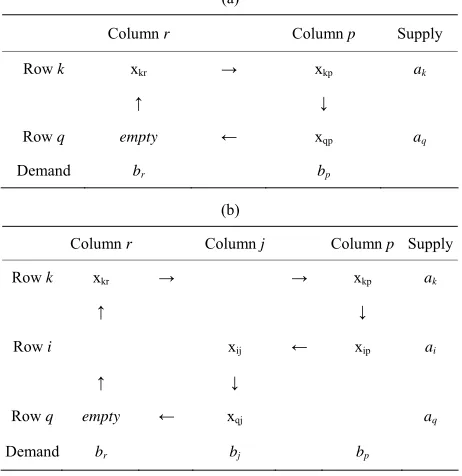
Stepping-stone (SS) chains are commonly used in so- lution procedures for TPs. An SS chain at a cell, (q, r), of
a TP cost matrix refers to an ordered sequence of at least four cells such that 1) any two consecutive cells lie in either the same row or the same column, 2) no three consecutive cells lie in the same row or column, and 3) the last cell in the sequence has a row or column in common with cell (q, r). Tables 1(a) and (b) provide
examples of SS chains involving 4 and 6 cells, respec-tively, where xij denotes the load at cell (i, j). Note that
the allocation of any load at cell (q, r) affects the loads at
all cells in the SS chain at cell (q, r).
3.1. Absolute Points for the QTP
Definition 1: An absolute point (AP) is a cell (q, r) in a
QTP that must be occupied in any optimal solution within the interval from 0 to the smaller of the values aq
and br.
The procedure for finding an AP is based on the fol- lowing assumptions:
Table 1. (a) An Example of an SS Chain of Four Cells; (b) An Example of an SS Chain of Six Cells.
(a)
Column r Column p Supply
Row k xkr → xkp ak
↑ ↓
Row q empty ← xqp aq
Demand br bp
(b)
Column r Column j Column p Supply
Row k xkr → → xkp ak
↑ ↓
Row i xij ← xip ai
↑ ↓
Row q empty ← xqj aq
Demand br bj bp
1) There is a cell (q, r) in a QTP that must be occupied
in any optimal solution within the interval from 0 to the smaller of the values aq and br, i.e., an AP exists.
2) If such a cell (q, r) were excluded in a given
distribu-tion, i.e., not loaded, then there exists an SS chain
leading to cell (q, r) from every other cell that is oc-
cupied.
Suppose cell (q, r) is an AP. Then this cell (q, r) must
be loaded with a shipment from supply aq and demand br
to eliminate the cell (q, r) from future computations. Not
loading it means that, for every other loading in row q
and column r, there will be an SS chain leading to cell (q, r). So we have to prove the existence of an SS chain
leading to (q, r) from every other cell in row q and col-
umn r. If we ignore cell (q, r), we have to load other cells
in row q and column r, for example cells (k, r) and (q, p),
to satisfy demand and supply requirements.
Column r Column p
Row k fkr(x) fkp(x)
Row q fqr(x)* fqp(x)
If there is an SS chain leading to a cell (q, r), then, to
guarantee a gain from this transaction, we must have
kr qr kp qp
f x f x f x f x
or fkr x fqr x} { fkp x fqp x 0 (9)
For a given q and r, if inequality (9) holds for every k
= 1, 2, …, m, and every p = 1, 2, …, n, then (q, r) is an
AP location, and the value {fkr(x) – fqr(x)} is the largest of
the comparisons between rows k and q. Note that the
left-hand side of (9) represents the penalty for placing assignments at locations (k, r) and (q, p) rather than at
location (q, r). See Adlakha and Kowalski [1] for details
on identifying an absolute point for a classical TP. What follows are the steps for identifying an AP in a QTP with cost functions fij(x). These steps involve pivoting on the qth row in the first QTP cost matrix.
Step AP1: Calculate fij q(
x) = fqj(x) – fij(x), i = 1, 2, … m, j = 1, 2, … n. Ignore the qth row as otherwise we would
be comparing it with itself.
Step AP2: Draw all n quadratic curves fij q(
x) on the
same graph, i = 1, 2 … m, iq.
Step AP3: Determine the minimum function fi
q( x)
within the range for each i, iq.
Step AP4: An AP exists if the minimum functions in
each row are in the same column.
Remark 1: For Step AP2, many software packages are
easily available to draw the quadratic curves and to study the ranges.
Remark 2: For Step AP3, to determine the minimum
element fi q(
x), one should simply limit the search to the
[image:3.595.57.288.501.739.2]need to exceed the range min(aq, bj) as this is the
maxi-mum load that can be assigned at cell (q, j).
3.2. Absolute Quadratic Algorithm for the QTP
The algorithm identifies the AP cells, which are loaded sequentially, and the QTP is reduced. It is obvious from the absolute point theory that if a cell were an AP, load- ing it would have no impact on the distribution of the remaining loads. Note that once an AP is identified, it is clear from inequality (9) that the AP has to be loaded with the maximum possible amount.
Step 1: Look for AP cells along each row. Step 2: If none, go to Step 6. Otherwise continue. Step 3: For each AP cell(q, r), assign xqr = min(aq, br).
Change aq (aq - xqr), br (br - xqr).
Step 4: If modified ai or bj = 0, delete the correspond-
ing ith row or jth column.
Step 5: If the above analysis yields a solution, STOP.
Otherwise go back to Step 1 with the reduced cost ma- trix.
Step 6: Find a solution to the reduced cost matrix using
any inductive method.
4. A Numerical Example
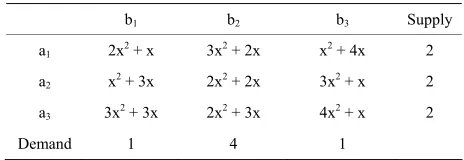
We illustrate the Absolute Point Algorithm for the QTP with the example presented in Table 2.
Step 1: First we search for available APs in the cost
[image:4.595.60.538.316.722.2]matrix. Step AP1 provides the following three fijq(x) = fqj(x) – fij(x) matrices by pivoting on rows i = 1, 2, and 3.
Figure 1 presents fijq(x) functions and curves corre-
sponding to Step AP2 directly under each fijq(x) matrix
for each i. Since there are only three rows, each fijq(x)
matrix has only two sets of differences fqj(x) – fij(x). The
graphs related to pivoting on row 1 are provided directly beneath the fij1(x) matrix where graph fij1,i(x) presents the
set of three quadratic equations in the ith row of fij1(x),
fij1(x) fij2(x) fij3(x)
b1 b2 b3 b1 b2 b3 b1 b2 b3
- - - –x2 + 2x -x2 2x2 – 3x x2 + 2x –x2 + x 3x2 – 3x
x2 – 2x x2 –2x2 + 3x - - - 2x2 x x2
–x2 – 2x x2 – x –3x2 + 3x –2x2 –x –x2 - - -
Table 2. Cost matrix fij(x) for the QTP example.
b1 b2 b3 Supply
a1 2x2 + x 3x2 + 2x x2 + 4x 2
a2 x2 + 3x 2x2 + 2x 3x2 + x 2
a3 3x2 + 3x 2x2 + 3x 4x2 + x 2
Demand 1 4 1
and so on.
1) Step AP3: Looking at the two curves under fij1(x), we
find that the smallest function in fij1,2(x) is f211(x) =
x2-2x for 0 x 1; and the smallest function in fij,1,3(x)
is f311(x) = –x2– 2x for 0 x 1where min(a1, b1) = 1. Step AP4: Since minimum functions f211(x) and f311(x)
are in the first column, Step AP5 indicates that cell (1,
1) is an AP.
2) Similarly looking at the two curves under fij3(x), we
find that the smallest function in fij3,1(x) is f133(x) =3x2
– 3x for 0 x 1; and the smallest function in fij3,2(x)
is f233(x) = x2 for 0 x 1 where min(a3, b3) = 1. Since
minimum functions f133(x) and f233(x) are in the third
column, cell (3, 3) is an AP.
Step 3:
1) For AP cell (1, 1), assign x11 = min(a1, b1) = 1.
Change a1 (a1− 1) = 1; b1 (b1− 1) = 0.
2) For AP cell (3, 3), assign x33 = min(a3, b3) = 1.
Change a3 (a3− 1) = 1; b3 (b3− 1) = 0.
Step 4: Since modified b1 = 0 and b3 = 0, delete the
corresponding first and third columns.
Step 6: The remaining supplies are easily assigned to
the only remaining column—the second column—to meet the demand b2 = 4 units. Table 3 presents the
re-sulting solution with a total cost of 30 for shipping 6 units.
Note that the conditions for APs for the analyzed for-mulation are dynamic and depend both on the values of the function cost coefficients and on the demand and supply values. This means, for example, that a given AP location can stop being an AP for a different set of the demand and supply values.
Shadow Prices for the QTP
Arsham [2] discusses the relationship between the sha- dow prices and the optimal solution of a TP. Using a similar analogy, we utilize the shadow price theory to verify the optimality of a QTP solution. The shadow functions and prices are easily obtained from a QTP so- lution matrix as follows:
1) Set ui+ vj= fij(xij) for all loaded cells.
2) Set v1 (or another uior vj) = 0 and solve the system of
equations for all uiand vjvalues.
3) Compute the shadow function for each unused cell (i, j) as ui+ vj.
According to established TP shadow price theory, the current QTP solution is optimal if all ui + vj function
values obtained in step (iii) above are all less than or equal to the corresponding fij(xij) values. Table 4 presents
the shadow functions for the solution obtained in Table 3
where the loaded cells are marked by *. It is clear that for all currently unused cells the value of the shadow func- tion/price is less than or equal to the corresponding quadratic cost functions from Table 2 if any value greater than 0 and less than the maximum possible value, min(ai, bj), is assigned at the cell. This confirms that the
solution obtained in Table 3 is optimal.
5. Conclusions
We have developed a direct solution algorithm for solv- ing a QTP. The Absolute Quadratic Algorithmis based on various intrinsic characteristics of the QTP. It looks for cells and routes that will always be used in an optimal solution because of cost efficiency, regardless of supply and demand constraints. Since an absolute point must always be loaded in any optimal solution, loading it ex- hausts either a supply or demand. Upon depleting the corresponding row or column, the proposed method also reduces the dimensions of the cost matrix for the QTP. After reductions and eliminations, the solution of the QTP is “squeezed” into the remaining cells and may be determined logically in the last step. We extend the shadow price theory of the TP to the QTP and develop a shadow function matrix to verify optimality.
To the best of our knowledge, besides the very labori- ous Lagrangian method, this algorithm is the first for pro- viding a direct solution of a QTP. As compared with the earlier international methods for QTP which are based on the Lagrangian relaxation approach, the proposed algo-
Table 3. Optimal solution for 3 × 3 QTP.
b1 b2 b3 Supply
a1 1 1 2
a2 2 2
a3 1 1 2
[image:5.595.308.537.651.737.2]Demand 1 4 1
Table 4. Shadow Price Matrix for the QTP Example.
v1 v2 v3 ui
u1 2x2 + x* 3x2 + 2x* 5x2 2x2 + x
u2 x2 + x 2x2 + 2x* 4x2 x2 + x
u3 x2 + 2x 2x2 + 3x* 4x2 + x* x2 + 2x
rithm helps to understand the structure of the QTP better and can guide in managerial decisions. Future work should seek to extend the theory to coefficients repre- sented by higher degree polynomials. Because such func- tions can have local minima, a gradient-type algorithm can fail to obtain the global minimum. It is, of course, possible that a QTP may not have any APs. In such a case, other methods or estimations, including heuristics, can be used, and the shadow price analysis can be used to confirm optimality. Future research is needed to develop other generally applicable methods.
REFERENCES
[1] V. Adlakha and K. Kowalski, “An Alternative Solution Algorithm for Certain Transportation Problems,” Interna- tional Journal of Mathematical Education in Science and Technology, Vol. 30, No. 5, 1999, pp. 719-728.
doi:10.1080/002073999287716
[2] H. Arsham, “Postoptimality Analysis of the Transporta-tion Problem,” JORS: Journal of the Operational Research Society, Vol. 43, No. 2, 1992, pp. 121-139.
[3] S. K. Goyal, “Improving VAM for Unbalanced Prob- lems,” JORS, Journal of the Operational Research Soci- ety, Vol. 35, No. 12, 1984, pp. 1113-1114.
[4] J. Intrator and W. Szwarc, “An Inductive Property of Transportation Problem,” Asia-Pacific Journal of Opera- tional Research Society, Vol. 5, 1988, pp. 79-83.
[5] M. A. Hakim, “An Alternative Method to Find Initial Ba- sic Feasible Solution of a Transportation Problem,” An- nals of Pure and Applied Mathematics, Vol. 1, No. 2,
2012, pp. 203-209.
[6] A. Shafaat and S. K. Goyal, “Resolution of Degeneracy in Transportation Problems,” Journal of the Operational Re- search Society, Vol. 39, No. 4, 1988, pp. 411-413.
[7] A. Sultan, “Heuristic for Finding an Initial B. F. S. in a Transportation Problem,” Opsearch, Vol. 25, 1988, pp.
197-199.
[8] C. E. Wilsdon, “A Simple, Easily Programmed Method for Locating Rook’s Tours in the Transportation Prob- lem,” Journal of the Operational Research Society, Vol.
41, No. 9, 1990, pp. 879-880.
[9] S. Korukoğlu and S. Balli, “An Improved Vogel’s Ap- proximation Method for the Transportation Problem,”
Mathematical and Computational Applications, Vol. 16,
No. 2, 2011, pp. 370-381.
[10] V. Adlakha and H. Arsham, “Simplifying Teaching the Transportation Problem,” International Journal of Mathe- matical Education in Science and Technology, Vol. 29,
No. 2, 1998, pp. 271-285. doi:10.1080/0020739980290210
[11] W. Szwarc, “Instant Transportation Solutions,” Naval Re- search Logistics Quarterly, Vol. 22, No. 3, 1975, pp. 427-
440. doi:10.1002/nav.3800220303
[12] J. R. Evans, “The Factored Transportation Problem,”
Management Science, Vol. 30, No. 8, 1984, pp. 1021-
1025. doi:10.1287/mnsc.30.8.1021
[13] D. S. Hochbaum, R. Shamir and J. G. Shanthikumar, “A Polynomial Algorithm for an Integer Quadratic Non- Separable Transportation Problem,” Mathematical Pro- gramming, Vol. 55, No. 1-3, 1992, pp. 359-371.
[14] N. Megiddo and A. Tamir, “Linear Time Algorithms for Some Separable Quadratic Programming Problems,” Op- erations Research Letters, Vol. 13, No. 4, 1993, pp. 203- 211.doi:10.1016/0167-6377(93)90041-E
[15] S. Cosares and D. S. Hochbaum, “Strongly Polynomial Algorithms for the Quadratic Transportation Problems with a Fixed Number of Sources,” Mathematics of Opera- tions Research, Vol. 19, No. 1, 1994, pp. 94-111. doi:10.1287/moor.19.1.94
[16] M. B. Eduardo, S. J. D. Francisco and J. R. Real, “Adap- ting Productivity Theory to the Quadratic Cost Function, An application to the Spanish electric sector,” Journal of Productivity Analysis, Vol. 20, No. 2, 2003, pp. 233-249.
[17] E. F. Wanner, F. G. Guimaraes, R. H. C. Takahashi and P. J. Fleming, “Local Search with Quadratic Approxima- tions into Memetic Algorithms for Optimization with Multiple Criteria,” Evolutionary Computation, Vol. 16,
No. 2, 2008, pp. 185-224. doi:10.1162/evco.2008.16.2.185
[18] Z. Lu, R. D. C. Monteiro and J. W. O’Neal, “An Iterative Solver-Based Long-Step Infeasible Primal-Dual Path- Following Algorithm for Convex QP Based on a Class of Preconditioners,” Optimization Methods & Software, Vol.