Copyright © 2002, American Society for Microbiology. All Rights Reserved.
Epidemiology of Tuberculosis in Hamburg, Germany: Long-Term
Population-Based Analysis Applying Classical and Molecular
Epidemiological Techniques
Roland Diel,
1Steffen Schneider,
2Karen Meywald-Walter,
3Christa-Maria Ruf,
3Sabine Rüsch-Gerdes,
4and Stefan Niemann
4*
School of Public Health, Heinrich-Heine Universität Düsseldorf, D-40001 Düsseldorf,1Klinikum der Stadt Ludwigshafen, D-67063
Ludwigshafen,2Gesundheits- und Umweltamt Hamburg-Mitte, D-20097 Hamburg,3and National Reference Center for
Mycobacteria, Forschungszentrum Borstel, D-23845 Borstel,4Germany
Received 2 August 2001/Returned for modification 18 September 2001/Accepted 2 December 2001
To determine a detailed picture of tuberculosis (TB) epidemiology in Hamburg, Germany, 423Mycobacterium
tuberculosiscomplex isolates from 77.0% of all patients with culture-confirmed TB diagnosed from 1997 to 1999
in Hamburg were analyzed by IS6110DNA fingerprinting. IS6110restriction fragment length polymorphism
(RFLP) clusters were assumed to have arisen from recent transmission. Results of contact tracing and additional patient interviews were used for further epidemiological analyses. Of the 423 cases, 398 were included in the cluster analysis, of which 135 (33.9%) were classified into 35 clusters ranging from 2 to 23 patients. Epidemiological links verifying recent transmission could be confirmed for 87 of the 135 clustered patients. Risk factors for recent transmission were calculated by a two-step procedure: first, based on patients with clustered isolates; and second, based on patients with clustered isolates and transmission links. In both analyses, alcohol abuse appeared to be the strongest predictor for recent transmission, followed by a history of previous contact tracing and unemployment. Homelessness, foreign ethnicity, sex, drug addiction, and human immunodeficiency virus positivity were not independent risk factors for clustering in multivariate
analyses. Classical contact tracing performed prior to IS6110RFLP analysis identified only 24 of the 135
clustered patient. In conclusion, recent transmission seems to be frequent in Hamburg and was found to be strongly associated with alcohol abuse. Conventional contact tracing appears to be insufficient for the detection of recent transmission chains. The data presented also indicate that improved TB control strategies, including the use of RFLP for the detection of transmission chains, are needed for TB control in the setting of countries with a low incidence of TB.
During recent years, tuberculosis (TB) epidemiology has successfully been analyzed by applying both classical epidemi-ological and molecular strain-typing techniques in population-based studies, e.g., in Europe (3, 10, 30) or the United States (1, 24). Surprisingly, and in contrast to assumptions made based on older epidemiological studies (32), several recent studies revealed a high degree of ongoing transmission even in countries with a low incidence of TB (3, 24). Hence, recently transmitted infections that rapidly progress to active TB seem to play a more important role in countries with a low TB incidence than previously thought, also indicating a need for more carefully targeted TB control measures.
DNA fingerprinting using the insertion sequence IS6110as a probe has become the worldwide standard technique for com-parison of Mycobacterium tuberculosis isolates on the strain level in epidemiological studies (5, 27). The epidemiological analysis of TB using IS6110is based on the observation that the polymorphism of IS6110restriction fragment length poly-morphism (RFLP) patterns among unrelated clinical isolates is high, whereas epidemiologically relatedM. tuberculosisstrains show identical or similar (one band variation) fingerprint
pat-terns (28). Hence,M. tuberculosisstrains with identical finger-print patterns likely indicate recent transmission and a chain of transmission.
In Germany as well as in other Western European countries, the incidence of TB is low compared to that in less developed regions of the world (16, 23). Nevertheless, in 1999, a total of 9,974 cases were reported to the German Federal Statistical Office (25), with an incidence of 12.1 cases per 100,000 inhab-itants. Since in large cities, as well as in the immigrant popu-lation, TB incidence rates are generally two- to fivefold higher than the national average, TB remains a considerable public health challenge in Western European countries. Moreover, especially in Germany, the incidence of TB may increase in the future due to enhanced spreading of susceptible and/or drug-resistant strains from countries with high prevalences of TB, e.g., from the former Soviet Union (SU) (17, 34).
The highest TB incidence (19.1 cases per 100,000 residents) of all 16 German federal states in 1999 was documented in the city of Hamburg, which has a population of 1.7 million. Ham-burg also had the highest proportion of foreign residents, 15.4%, compared with a German national average of 8.9% reported for 31 December 1999 (25). Hamburg is further char-acterized by its international harbor, the largest in Germany, and by being one of the most popular tourist destinations in Germany.
TB surveillance in Germany has so far been based on case
* Corresponding author. Mailing address: Forschungszentrum Bor-stel, National Reference Center for Mycobacteria, Parkallee 18, D-23845 Borstel, Germany. Phone: 188658. Fax: (49)-4537-188311. E-mail: [email protected].
532
on May 15, 2020 by guest
http://jcm.asm.org/
reports to the statistical offices of the German federal states though the public health offices of the district in which patients reside. These reports include information about gender, year of birth, foreign or nonforeign origin, entry date of the report reached at the public health office, listing of body organs in-volved in the TB disease, microbiological confirmation ofM. tuberculosiscomplex infection by culture, and classification by first onset of the disease or relapse. Only a few studies have been performed in Germany applying modern molecular DNA fingerprint techniques that are able to directly trace routes of transmission (27), e.g., to analyze the epidemiology of resistant
M. tuberculosisstrains in Germany (17) or to describe small-scale outbreaks of resistant strains (19). In general, there is a lack of information on important issues of TB epidemiology, such as the contribution of recent transmission to the number of annual new cases or the proportion of TB cases attributable to non-German source cases. However, improved epidemio-logical data are urgently needed to better target TB control efforts and to allow forecasting of future epidemiological trends.
This prospective, population-based study was undertaken to obtain a detailed picture of the TB epidemiology in Hamburg, which is the second largest city in Germany. The study focused on the determination of the rate of TB cases attributable to recent transmission, on possible risk factors associated with recent transmission, and on the identification of pathways of TB transmission in the community. The observations made in Hamburg and conclusions regarding intervention strategies for the future may be of relevance to other urban centers in Eu-ropean countries.
MATERIALS AND METHODS
Data collection.The study includes patients with culture-confirmed TB that were reported to each of the seven district public health departments of Ham-burg between 1 January 1997 and 31 December 1999. Case data were collected prospectively by trained public health staff using a standardized questionnaire. Information was obtained on gender, date and country of birth, nationality, immigration status (if necessary), number of years of residency in Hamburg or elsewhere in Germany, present address (or whether the patient was homeless), whether the patient was living in a health care institution or any public institu-tion, the nature of the patient’s employment, socioeconomic status, any previous known exposure to other persons with TB (especially within the 6 months before development of any symptoms), and the identity of the patient’s household contacts and respective close contacts in occupational or crowded settings, if necessary.
To obtain clinical variables, the following data were also included: date of first onset of illness, type of symptoms and cause of diagnosis, first date of case report to a public health office, and associated medical data, such as human immuno-deficiency virus (HIV) infection, tuberculin skin test, chest radiography findings, and results of microbiological analyses. Alcoholism was defined as a maladaptive pattern manifested by three or more criteria of the World Health Organization ICD-10 classification (33) occurring at any time in the same 12-month period.
Bacterial strains and drug susceptibility testing.Mycobacterial strains from 423 patients were analyzed. Primary isolation and culturing of mycobacterial isolates were performed as described elsewhere (15). All isolates were identified asM. tuberculosiscomplex by using gene probes as instructed by the manufac-turer (ACCUProbe, GenProbe, San Diego, Calif.); differentiation was per-formed as described previously (20). Drug susceptibility was determined by the proportion method on Löwenstein-Jensen medium and/or the modified propor-tion method in BACTEC 460TB (Becton-Dickinson Microbiology Systems, Cockeysville, Md.).
IS6110-RFLP and spoligotyping analysis.Extraction of DNA from mycobac-terial strains and DNA fingerprinting using IS6110as a probe was performed according to a standardized protocol as described elsewhere (17, 27). PvuII-digested total DNA of reference strain Mt.14323 was used in each Southern blot
experiment as an external size standard and was used for quality control and quality assurance of IS6110RFLP experiments. The IS6110fingerprint patterns of mycobacterial strains were analyzed using the Gelcompar software (Windows 95, version 4.2; Applied Maths, Kortrijk, Belgium) as described previously (17, 27). Clusters were defined as groups of patients withM. tuberculosisstrains showing identical RFLP patterns (the same number of IS6110bands at identical positions [position tolerance, 1.3%]).
Isolates with fewer than five bands (n⫽24) were excluded from the initial cluster and epidemiological analysis and were subjected to spoligotyping for separate analysis of strain relationship. Spoligotyping of isolates was performed as described by Kamerbeek et al. (14).
Recent transmission.Clusters were assumed to have arisen from recent trans-mission, and the clustering rate was used to measure the amount of recent transmission in the study population. Independent risk factors for recent trans-mission were calculated by a two-step procedure: first, based on patients with clustered isolates, and, second, based on patients with clustered isolates for whom a transmission link was established.
Statistical analysis.All patients included were classified in two groups: indi-viduals with clustered and nonclusteredM. tuberculosisstrains. Categorical data were compared by the chi-square test or Fisher’s exact test, when expected cell sizes (n) were smaller than five. The Wilcoxon rank sum test was performed to determine whether the distribution of age as a continuous variable differed between the two groups. All tests were performed as two-sided tests.Pvalues below 0.05 were considered statistically significant. Variables that were highly significantly associated with clustering in the univariate analysis were then in-cluded in a multivariate logistic regression model to determine independent risk factors (e.g., adjusted for confounding). The two-sided Cochran Armitage test for trend was used to determine correlations between increasing size of a cluster and variables associated with clustering.
RESULTS
Study population.Between 1 January 1997 and 31
Decem-ber 1999, 529 cases of pulmonary TB and 20 cases of nonpul-monary TB that were culture positive forM. tuberculosis com-plex were reported to the public health offices. Culture isolates from 423 patients (77.0%) were available for RFLP finger-printing, of which 130 were diagnosed in 1997, 149 in 1998, and 144 in 1999.
The male-to-female ratio in the study population was 2.5:1. The patients were from 3 to 97 years old, most of whom (approximately 70%) were between 20 and 60 years of age. Two hundred and forty-seven patients (58.4%) were born in Germany, while 176 (41.6%) were born in 43 different coun-tries, including 47 patients from Afghanistan (26.7%), 31 pa-tients form Turkey (17.6%), 25 papa-tients from Africa (14.2%), 18 patients from countries of the former SU (10.2%), and 17 patients from countries of former Yugoslavia (9.6%). Eighty-one of the non-German patients (46%) were from Asian coun-tries (including 47 patients from Afghanistan as well as 14 patients from Kazakhstan and Uzbekistan).
Species differentiation revealed 418 infections withM. tuber-culosis, three infections withMycobacterium bovis, one infec-tion with Mycobacterium africanum, and one infection with
Mycobacterium microti. The latter case, which represents the first reported case ofM. microtiinfection causing pulmonary TB in an HIV-positive patient in Germany, has recently been described in detail in previous work (12).
Four hundred and one isolates (94.7%) were susceptible to all four drugs tested (isoniazid [INH], rifampin [RIF], pyrazin-amide, and ethambutol). Five percent were resistant to at least one drug, with 4.0% showing resistance to INH, 0.7% to RIF, 0.7% to pyrazinamide (excluding threeM. bovisisolates), and 0.9% to ethambutol. All strains resistant to RIF were also
on May 15, 2020 by guest
http://jcm.asm.org/
resistant to INH and thus were multidrug resistant (one patient from Germany, one from Spain, and one from Kazakhstan).
IS6110RFLP analysis.Of 423 strains, 24 isolates with fewer
than five IS6110RFLP bands were excluded from the initial cluster analysis. The patient withM. microtiinfection was also excluded from epidemiological analysis, since nothing is known about the transmissibility ofM. microtiin humans.
Of the remaining 398 patients, a unique M. tuberculosis
RFLP pattern was found among 263 (66.1%) patients (non-clustered cases). One hundred thirty-five cases (33.9%) shared an identical RFLP pattern with one or more other patients (clustered cases) and were classified into 35 clusters ranging in size from 2 to 23 persons (Fig. 1), of which 18 (51.4%) included just two patients.
Among the 24 isolates with fewer than five IS6110 bands, only six (25.0%) showed a unique RFLP pattern (Fig. 2). The
other 18 isolates (75.0%) clustered into seven groups ranging in size from two to four patients. Of the 24 patients, only four were of German ethnicity (two of whom hadM. bovis infec-tions), indicating thatM. tuberculosis strains with fewer than five bands were not indigenous isolates but were predomi-nately imported into Germany from foreign countries (Fig. 2). Considering the IS6110RFLP patterns and the ethnicity of the patients, it becomes obvious that some RFLP patterns corre-late with the origin of the patients e.g., cluster A, B, or D. This observation was further confirmed by the fact that the M. tuberculosisRFLP pattern of the two Eritrean patients in clus-ter D was previously described by Hermans and coworkers (11) as a genotype (E2) typical of M. tuberculosis isolates from Ethiopia, which is adjacent to Eritrea. Additional spoligotyp-ing analysis reduced the number of clustered isolates to 10 of the 24 strains in five spoligotyping groups (41.7%; data not shown), which, however, still represents a high rate of cluster-ing.
We also identified 15M. tuberculosisisolates that displayed RFLP and spoligotype patterns (hybridization only to spacers 35 to 43) typical for the Beijing family (data not shown), which has initially been found to represent approximately 80% of all
M. tuberculosisstrains from the Beijing region, China (29). The majority (n ⫽ 13) of the 15 patients were immigrants from several Asian countries (Afghanistan,n ⫽ 3; China, n ⫽ 1; Indonesia,n ⫽ 1; Kazakhstan, n⫽ 4; Korea,n ⫽ 1; Nepal,
n⫽1; Pakistan,n⫽1; and Vietnam,n⫽1); only two patients were born in Germany.
Epidemiological analysis of clustered cases and efficiency of
classical contact tracing. In addition to the data based on
[image:3.587.50.276.72.188.2]standardized patient questionnaires, intensive epidemiological investigations including additional patient interviews have
FIG. 1. Number of clusters by cluster size. Total number of clus-tered patients with TB in Hamburg during the study period from 1997 to 1999 was 135.
FIG. 2. IS6110RFLP patterns of strains with fewer than five bands. The positions of the IS6110band were normalized and displayed as bands. The scale depicts the similarity of patterns calculated as described in Materials and Methods. MTB,M. tuberculosis; and MBOV,M. bovis.
on May 15, 2020 by guest
http://jcm.asm.org/
[image:3.587.115.467.455.705.2]been performed for clustered patients (135 patients in 35 clus-ters). Definite transmission links (e.g., household contacts or working contacts) could be verified for 52 patients in 13 of the 35 clusters. In addition, there was strong evidence for epide-miological relationships between 35 members of eight further clusters. Hence, recent transmission could be confirmed for 87 of the 135 clustered patients (64.4%) in 21 clusters (60.0%).
In 4 of the 14 clusters without transmission links, the pa-tients had the same nationality (Afghanistan and Turkey) and were coming from the same or from proximate geographical regions. Even the clinical aspects confirmed that in these cases recent transmission in Germany was not very likely.
The largest cluster identified in this study comprises 23 pa-tients, including 12 smear-positive/culture-confirmed and 11 smear-negative/culture-confirmed cases diagnosed between March 1997 and December 1999 (6 cases in 1997, 5 cases in 1998, and 12 cases in 1999). Classical contact tracing was dif-ficult, since the patients’ residences are located in four differ-ent districts with four responsible public health offices. More-over, three patients had previous phases of pulmonary TB, so that for these cases relapse was suspected as the cause of the actual disease.
Subsequent patient interviews and analysis of questionnaires revealed that transmission of the strain presumably occurred in a particular bar in the red-light district of Hamburg (18 cases) and in a hostel for men (five cases). A 42-year-old highly infectious white male with pulmonary TB could be identified as the connecting link between these two centers of transmission. Although conventional contact tracing correctly identified the relationship of four patients in the hostel, the fifth patient was allocated to another TB case occurring in the same time period in the hostel. The link of the five patients in the hostel to the other 18 cases has not been initially determined, since the index patient did not name all contact persons correctly in the first interview. Among these, contact tracing investigations per-formed prior to RFLP analysis revealed transmission links only for two patients who were customers of the bar and named one another as contacts.
However, retrospective analyses established specific trans-mission links among 13 further patients: five had named one another as contacts and eight had been visiting the bar at the same time period in which the other transmissions occurred. The remaining three patients were tuberculin reactors who presumably had been infected before the start of the study and developed an active pulmonary TB in the study period. Since these patients frequently used the bar, spending most of their free time there, it is reasonable to assume that their infection occurred in the bar milieu.
The difficulties in establishing transmission links in a further cluster comprising five young male patients in an age range from 19 to 35 years again demonstrated the limited efficiency of conventional contact tracing. The patients were born in three different African countries, all coming to Hamburg seek-ing asylum. TB was diagnosed in a time period of 13 months after their arrival in Hamburg. In contact tracing investiga-tions, the patients named 65 contact persons; however, they did not name one another. They all lived on a ship used for hous-ing of immigrants without direct household contacts. However, in August 1998, one of the patients was arrested because of
illegal drug use. Subsequent investigation by the police re-vealed that all clustered patients were frequently smoking wa-ter pipe marihuana in the cabin of the index patient, ideal circumstances for TB transmission.
Regarding the efficiency of classical contact tracing for de-termination of recent chains of transmission compared with IS6110RFLP typing, in total, conventional investigation of the patient contacts conducted before any RFLP typing identified only 24 (27.6%) of the 87 clustered patients with confirmed epidemiological links.
Characterization of cluster patients and identification of
risk factors associated with recent transmission. In a first
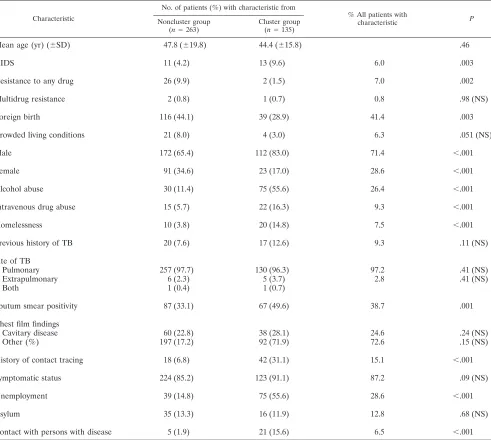
attempt to identify significant differences between the 135 pa-tients in clusters and the 263 papa-tients not in clusters, univariate analysis was performed. The results of the different parameters analyzed are summarized in Table 1. With regard to the dis-tribution of age between the two groups determined by the Wilcoxon rank sum test, there was no significant difference (P ⫽ 0.46). Chi-square testing showed that the patients in clusters were likelier than the nonclustered patients to be HIV infected (P ⫽ 0.003), to be male (P ⬍ 0.001), to be drug abusers (P⬍0.001), to be alcoholics (P⬍0.001), to be home-less (P ⬍ 0.001), to be unemployed (P⬍ 0.001), and to be sputum smear positive (P⫽0.001) and had more known con-tacts with patients who had active TB (P⬍0.001). A previous history of being traced for contact with TB patients before the study period was also significantly associated with clustering (P ⬍0.001).
The prevalence of cavitary lung disease and other presenta-tions, such as radiological features as well as the level of crowded living, were similar for patients in and not in IS6110
RFLP clusters. Drug resistance was more common in patients not included in a cluster (P⫽0.002). The proportion of for-eign-born patients was reduced among the clustered patients compared to nonclustered patients (P⫽0.003).
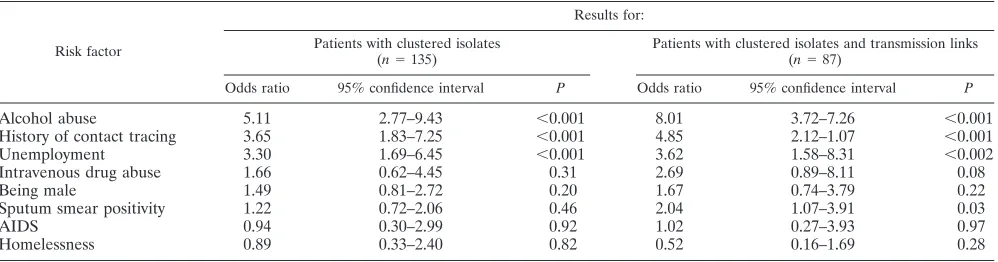
Independent risk factors for recent transmission were deter-mined by logistic regression. Analyses were performed first, for patients with clustered isolates (n ⫽ 135) and, second, for patients with clustered isolates and a confirmed transmission link (n⫽87). In both analyses, alcohol abuse was the strongest predictor for recent transmission, followed by a history of tact tracing (Table 2). Unemployment also represented a con-siderable risk of being in a transmission chain (odds ratio, 3.30;
P⬍0.001), whereas living as a drug addict, being male, and suffering from AIDS or homelessness were not significant in-dependent risk factors in these analyses. Sputum smear posi-tivity was a significant risk factor for clustered patients with confirmed transmission links but not for all clustered patients. Analyzing the trend for increasing cluster size by applying the Cochrane Armitage test for trend revealed a strong posi-tive correlation between increasing size of a cluster and the number of cluster patients matching one of the following vari-ables: alcohol abuse (P⬍0.001), a history of contact tracing (P ⬍ 0.001), and being male (P ⫽ 0.009). In contrast, the number of drug addicts decreased with increasing cluster size (P ⫽ 0.047). There was no significant correlation regarding unemployment (P⫽0.08), AIDS (P⫽0.25), homelessness (P ⫽0.14), and sputum smear positivity (P⫽0.82).
on May 15, 2020 by guest
http://jcm.asm.org/
DISCUSSION
In the study presented, a detailed picture of TB epidemiol-ogy in Hamburg, Germany, has been attained by combining IS6110 RFLP typing and classical epidemiological methods. The data obtained are based on a study period of 3 years in which approximately 80% of all culture-confirmed TB cases reported to the public health offices in Hamburg were ana-lyzed.
The percentage of clustered isolates of 33.9% observed in our study is comparable with that described for other cities, e.g., Paris (approximately 36% [10]) or New York (approxi-mately 37% [1]); however, it is slightly lower than observed in studies performed in The Netherlands and Denmark (ranging from 47 to 57% [3, 26, 30]). These differences between the clustering rates determined in the nationwide studies in The
Netherlands and Denmark may be explained by the shorter study period as well as a smaller study population analyzed in the present study. Differences in the diversity of the patients might also account for differences in clustering rates amongM. tuberculosisisolates observed in different study regions. The exceptionally high rate of clustering found in the Denmark study may moreover be partially the effect of an outbreak of twoM. tuberculosis strains, which represented approximately 40% of all clustered isolates.
A further reason for differences among clustering rates ob-served in other investigations may be the strict cluster defini-tion in this study, including only isolates with identical IS6110
RFLP patterns in clusters. This strict definition was chosen, since our previous studies indicated a high stability of IS6110
[image:5.587.49.540.84.524.2]RFLP patterns in serial patient isolates and in isolates in actual
TABLE 1. Univariate analysis of variables associated with IS6110RFLP clustersa
Characteristic
No. of patients (%) with characteristic from
% All patients with
characteristic P
Noncluster group
(n⫽263) Cluster group(n⫽135)
Mean age (yr) (⫾SD) 47.8 (⫾19.8) 44.4 (⫾15.8) .46
AIDS 11 (4.2) 13 (9.6) 6.0 .003
Resistance to any drug 26 (9.9) 2 (1.5) 7.0 .002
Multidrug resistance 2 (0.8) 1 (0.7) 0.8 .98 (NS)
Foreign birth 116 (44.1) 39 (28.9) 41.4 .003
Crowded living conditions 21 (8.0) 4 (3.0) 6.3 .051 (NS)
Male 172 (65.4) 112 (83.0) 71.4 ⬍.001
Female 91 (34.6) 23 (17.0) 28.6 ⬍.001
Alcohol abuse 30 (11.4) 75 (55.6) 26.4 ⬍.001
Intravenous drug abuse 15 (5.7) 22 (16.3) 9.3 ⬍.001
Homelessness 10 (3.8) 20 (14.8) 7.5 ⬍.001
Previous history of TB 20 (7.6) 17 (12.6) 9.3 .11 (NS)
Site of TB
Pulmonary 257 (97.7) 130 (96.3) 97.2 .41 (NS)
Extrapulmonary 6 (2.3) 5 (3.7) 2.8 .41 (NS)
Both 1 (0.4) 1 (0.7)
Sputum smear positivity 87 (33.1) 67 (49.6) 38.7 .001
Chest film findings
Cavitary disease 60 (22.8) 38 (28.1) 24.6 .24 (NS)
Other (%) 197 (17.2) 92 (71.9) 72.6 .15 (NS)
History of contact tracing 18 (6.8) 42 (31.1) 15.1 ⬍.001
Symptomatic status 224 (85.2) 123 (91.1) 87.2 .09 (NS)
Unemployment 39 (14.8) 75 (55.6) 28.6 ⬍.001
Asylum 35 (13.3) 16 (11.9) 12.8 .68 (NS)
Contact with persons with disease 5 (1.9) 21 (15.6) 6.5 ⬍.001
aNS, not statistically significant.
on May 15, 2020 by guest
http://jcm.asm.org/
chains of transmission from Germany (18, 21). We further excluded isolates with fewer than five IS6110 bands that showed a lowered IS6110RFLP in our and in previous studies (30), in order to achieve a maximum predictive value of clus-tering for recent transmission.
For these reasons, it is likely that this study actually under-estimates the real amount of recent transmission in Hamburg. However, the data presented indicate that a reasonable pro-portion of annual new TB cases in Hamburg is attributable to recent infection, which may be considered a problem of the present TB control program.
Despite our strict cluster definition and the intensive epide-miological investigations performed, transmission links have been determined for only 64% of the clustered patients; for nearly one-third of the patients with clustered isolates, no epidemiological relationship has been established. A possible reason for this result might be that a portion of clustered patients are infected with strains prevalent in a given area and by chance developed an active pulmonary TB during the study period. Furthermore, importation of genetically more homog-enousM. tuberculosisstrains from areas of the world in which TB is endemic, as shown for a subset of clustered patients in our study, may also account for a portion of strains in IS6110
RFLP clusters without any obvious epidemiological link. These data in part question the assumption that every RFLP cluster is indicative of a recent epidemiological link. Consistent with this suggestion, other studies (6, 9) indicated that clustering may also be observed between individuals without any recent transmission link or common contacts by infection with circu-lating strains within a community spreading over a long time. An active TB disease of these patients observed during a study period may then occur by chance through reactivation during the observation period (6, 9). The proportion of such clusters, not representing recent transmission, depends on the number and stability of different strains in a given area and on the number of genetically homogenous strains imported from re-gions of the world where M. tuberculosis strains with lower IS6110 polymorphism are prevalent. Thus, clustering rates should be interpreted carefully. Proportions of recent trans-mission incurred from clustering rates might vary in different studies.
In our study several factors associated with clustering were identified in univariate analysis, including alcohol abuse, HIV
infection, and being male, homeless, or unemployed. Multivar-iate analyses indicated that alcohol abuse was the strongest risk factor associated with recent transmission in Hamburg. This is somewhat surprising, since in several international reports published so far (1, 4, 10), alcohol abuse has not been identi-fied as an independent predictor for recent transmission. Fur-ther independent risk factors for being in an IS6110cluster are a history of contact tracing and unemployment, whereas being male, being homeless, testing positive for sputum smear, living as a drug addict, or suffering from AIDS was not significantly associated with clustering in multivariate analysis.
The finding that HIV infection is not associated with recent transmission is in accordance with other studies performed in Europe, e.g., in The Netherlands (30) and in Paris (10) but is contrary to studies performed in the United States (1, 4, 7, 13, 24).
In contrast to the studies performed in The Netherlands (30) and in Paris (10), homelessness, although highly significant in univariate analysis, did not prove to be an independent risk factor for recent transmission in multivariate analysis. This might be due to the relatively low total number of homeless people (n⫽30; 7.5%) recruited in our study population.
In our study population clustering was not associated with younger patients, representing a major difference with other studies (1, 26). This finding might be due to the specific epi-demiological situation in Hamburg, which to a great extent is characterized by alcoholism and the social behavior associated with it. Even in the largest cluster determined, frequent visiting of a particular bar was identified as the most obvious trans-mission link. The increasing size of this cluster in 1999 indi-cates that the “bar milieu” in a red-light district might be one major setting for transmission of TB in Hamburg.
[image:6.587.44.543.84.215.2]The predominance of unexpected risk factors (e.g., alcohol abuse) in this study might have important implications for inner-city control of TB in the future. According to the stone-in-the-pond-principle (8, 31), expansion contact tracing in Ger-many is usually performed by screening close contacts, starting in concentric circles from the infectious index case. The ques-tion, however, is, how effectively this intervention identifies exposed contacts in a particular case. Moreover, the effective-ness of traditional contact tracing obviously is largely depen-dent on individual willingness to cooperate. Denial of alcohol abuse (or other substance abuse) and the high prevalence of
TABLE 2. Risk factors for recent transmission ofM. tuberculosisa
Risk factor
Results for: Patients with clustered isolates
(n⫽135) Patients with clustered isolates and transmission links(n⫽87)
Odds ratio 95% confidence interval P Odds ratio 95% confidence interval P
Alcohol abuse 5.11 2.77–9.43 ⬍0.001 8.01 3.72–7.26 ⬍0.001
History of contact tracing 3.65 1.83–7.25 ⬍0.001 4.85 2.12–1.07 ⬍0.001
Unemployment 3.30 1.69–6.45 ⬍0.001 3.62 1.58–8.31 ⬍0.002
Intravenous drug abuse 1.66 0.62–4.45 0.31 2.69 0.89–8.11 0.08
Being male 1.49 0.81–2.72 0.20 1.67 0.74–3.79 0.22
Sputum smear positivity 1.22 0.72–2.06 0.46 2.04 1.07–3.91 0.03
AIDS 0.94 0.30–2.99 0.92 1.02 0.27–3.93 0.97
Homelessness 0.89 0.33–2.40 0.82 0.52 0.16–1.69 0.28
aIndependent risk factors for recent transmission were calculated by multiple regression procedures for patients with clustered isolates and for patients with clustered
isolates for whom transmission links were established.
on May 15, 2020 by guest
http://jcm.asm.org/
comorbid psychiatric disorders among alcoholics (22) may re-sult in misinformation and in examinations such as tuberculin skin testing and chest radiography of persons wrongly sus-pected as contacts.
The present approach of contract tracing seems to be insuf-ficient to uncover transmission pathways in urban areas like Hamburg. Only approximately 27.6% (n ⫽24 of 87) of clus-tered patients with confirmed transmission links were identi-fied correctly by the conventional contact tracing in our study. A similar observation was made in Amsterdam by van Deu-tekom and coworkers (26), where only 5.6% of cases with identicalM. tuberculosisIS6110RFLP patterns were identified by conventional contact tracing (26). Improved strategies for contact tracing and more targeted case finding thus might be needed.
IS6110 RFLP typing may more precisely define target groups for health examinations and more precisely show how contact tracing strategies could be adapted to population sub-groups with a high potential of exposure to M. tuberculosis
transmission. Recent observations made in San Francisco (13) suggest that an appropriate intensification of TB control mea-sures directed towards high-risk groups may result in a de-crease of TB transmission.
Our results also confirm previous observations that IS6110
RFLP patterns might be used to trace the global spread of distinct families of genetically highly related M. tuberculosis
strains (11), as shown for the isolates from Eritrean patients or strains of the Beijing family, and the spread of imported strains in the community. Interestingly, strains of the Beijing family, which initially were described to be predominant in China and Asia (2, 29) were also found in our study population. Most patients with strains of the Beijing family were immigrants from several Asian countries; only two were of German na-tionality. Our previous data have shown that strains of the Beijing genotype were also present among drug-resistant M. tuberculosis isolates from German patients (17), mainly iso-lated from immigrants from countries of the former SU. Since strains of the Beijing family have been assumed to have a selective advantage leading to their prevalence in different countries in Asia (29), it might be also possible that this geno-type will spread in the German community in the future. How-ever, our data indicate that patients with Beijing-type strains in Germany likely acquired their infection in their respective homelands. Indications for transmission of strains of the Bei-jing genotype from immigrants to German patients have been found only in few cases.
In conclusion, our study demonstrates that recent transmis-sion (defined by the degree of clustering) accounts for a con-siderable number of annual new TB cases in Hamburg and is strongly associated with alcohol abuse and social behavior as-sociated with it. Conventional contact tracing appeared to be insufficient in these cases. Routine DNA fingerprinting will be required to observe the dynamics ofM. tuberculosis transmis-sion or the prevalence of distinct strain types. DNA finger-printing should therefore become an integral component of surveillance strategies aimed at control of TB in metropolitan areas such as the city of Hamburg. TB control measures may be improved by contact tracing and case-finding strategies that are more carefully targeted to high-risk groups.
ACKNOWLEDGMENTS
We thank I. Radzio, B. Schlüter, P. Vock, and A. Zyzik, Borstel, Germany, for excellent technical assistance. We are grateful to S. Schwander (Department of Medicine, UMD-New Jersey Medical School, Newark, N.J.) for critical reading of the manuscript.
Parts of this work were supported by the Robert Koch-Institut, Berlin, Germany.
REFERENCES
1.Alland, D., G. E. Kalkut, A. R. Moss, R. A. McAdam, J. A. Hahn, W. Bosworth, E. Druckner, and B. R. Bloom.1994. Transmission of tuberculosis in New York City. An analysis by DNA fingerprinting and conventional epidemiologic methods. N. Engl. J. Med.330:1710–1716.
2.Anh, D. D., M. W. Borgdorff, L. N. Van, N. T. Lan, T. van Gorkom, K. Kremer, and D. van Soolingen. 2000.Mycobacterium tuberculosisBeijing genotype emerging in Vietnam. Emerg. Infect. Dis.6:302–305.
3.Bauer, J., Z. Yang, S. Poulsen, and Å. B. Anderson.1998. Results from 5 years of nationwide DNA fingerprinting ofMycobacterium tuberculosis com-plex isolates in a country with a low incidence ofM. tuberculosisinfection. J. Clin. Microbiol.36:305–308.
4.Bradford, W. Z., J. Koehler, E. H. Hiyam, P. C. Hopewell, A. L. Reingold, C. B. Agasino, M. D. Cave, S. Rane, Z. Yang, C. M. Crane, and P. M. Small. 1998. Dissemination ofMycobacterium tuberculosisacross the San Francisco Bay Area. J. Infect. Dis.177:1104–1107.
5.Cave, M. D., K. D. Eisenach, P. F. McDermott, J. H. Bates, and J. T. Crawford. 1991. IS6110: conservation of sequence in the Mycobacterium tuberculosiscomplex and its utilization in DNA fingerprinting. Mol. Cell. Probes5:73–80.
6.Dale, J. W., R. M. Nor, S. Ramayah, T. H. Tang, and Z. F. Zainuddin.1999. Molecular epidemiology of tuberculosis in Malaysia. J. Clin. Microbiol.37: 1265–1268.
7.Daley, C. L., P. M. Small, G. F. Schecter, G. K. Schoolnik, R. A. McAdam, W. R. Jacobs, and P. C. Hopewell.1992. An outbreak of tuberculosis with accelerated progression among persons infected with the human immuno-deficiency virus. N. Engl. J. Med.326:231–235.
8.Deutsches Zentralkomitee zur Bekämpfung der Tuberkulose.1996. Rich-tlinien für die Umgebungsuntersuchungen bei Tuberkulose. Gesund-heitswesen58:657–665.
9.Glynn, J. R., J. Bauer, A. S. de Boer, M. W. Borgdorff, P. E. Fine, P. Godfrey-Faussett, and E. Vynnycky. 1999. Interpreting DNA fingerprint clusters ofMycobacterium tuberculosis. European Concerted Action on Mo-lecular Epidemiology and Control of Tuberculosis. Int. J. Tuberc. Lung Dis. 3:1055–1060.
10.Gutierrez, M. C., V. Vincent, D. Aubert, J. Bizet, O. Gaillot, L. Lebrun, C. Le Pendeven, M. P. Le Pennec, D. Mathieu, C. Offredo, B. Pangon, and C. Pierre-Audigier.1998. Molecular fingerprinting ofMycobacterium tuberculo-sisand risk factors for tuberculosis transmission in Paris, France, and sur-rounding area. J. Clin. Microbiol.36:486–492.
11.Hermans, P. W. M., F. Messadi, H. Guebrexabher, D. van Soolingen, P. E. W. de Haas, H. Heersma, H. de Neeling, A. Ayoub, F. Portaels, D. Frommel, M. Zribi, and J. D. A. van Embden.1995. Analysis of the popu-lation structure ofMycobacterium tuberculosisin Ethiopia, Tunisia, and the Netherlands: usefulness of DNA typing for global tuberculosis epidemiology. J. Infect. Dis.171:1504–1513.
12.Horstkotte, M. A., I. Sobottka, C. K. Schewe, P. Schäfer, R. Laufs, S. Rüsch-Gerdes, and S. Niemann. 2001.Mycobacterium microti llama-type infection presenting as pulmonary tuberculosis in a human immunodefi-ciency virus-positive patient. J. Clin. Microbiol.39:406–407.
13.Jasmer, R. M., J. A. Hahn, P. M. Small, C. L. Daley, M. A. Behr, A. R. Moss, J. M. Creasman, G. F. Schecter, E. A. Paz, and P. C. Hopewell.1999. A molecular epidemiologic analysis of tuberculosis trends in San Francisco, 1991–1997. Arch. Intern. Med.130:971–978.
14.Kamerbeek, J., L. Schouls, A. Kolk, M. van Agterveld, D. van Soolingen, S. Kuijper, A. Bunschoten, H. Molhuizen, R. Shaw, M. Goyal, and J. D. A. van Embden.1997. Simultaneous detection and strain differentiation of Myco-bacterium tuberculosisfor diagnosis and epidemiology. J. Clin. Microbiol. 35:907–914.
15.Kent, P. T., and G. P. Kubica.1985. Public health mycobacteriology. A guide for the Level III laboratory. Centers for Disease Control, U.S. Department of Health and Human Services, Atlanta, Ga.
16.Loddenkemper, R., B. Hauer, D. Sagebiehl, and M. Forbohm.1999. Tu-berkuloseepidemiologie in Deutschland und der Welt mit Schwerpunkt Osteuropa. Bundesgesundheitsbl. Gesundheitsforsch. Gesundheitsschutz 9:683–693.
17.Niemann, S., S. Rüsch-Gerdes, and E. Richter.1997. IS6110fingerprinting of drug-resistantMycobacterium tuberculosis strains isolated in Germany during 1995. J. Clin. Microbiol.35:3015–3020.
18.Niemann, S., E. Richter, and S. Rüsch-Gerdes.1999. Stability of Mycobac-terium tuberculosisIS6110restriction fragment length polymorphism patterns
on May 15, 2020 by guest
http://jcm.asm.org/
and spoligotypes determined by analyzing serial isolates from patients with drug-resistant tuberculosis. J. Clin. Microbiol.37:409–412.
19.Niemann, S., E. Richter, S. Rüsch-Gerdes, H. Thielen, and H. Heykes-Uden. 1999. Outbreak of rifampin and streptomycin-resistant tuberculosis among homeless in Germany. Int. J. Tuberc. Lung Dis.3:1146–1147.
20.Niemann, S., E. Richter, and S. Rüsch-Gerdes.2000. Differentiation among members of theMycobacterium tuberculosiscomplex by molecular and bio-chemical features: evidence for two pyrazinamide-susceptible subtypes ofM. bovis. J. Clin. Microbiol.38:152–157.
21.Niemann, S., S. Rüsch-Gerdes, E. Richter, H. Thielen, H. Heykes-Uden, and R. Diel.2000. Stability of IS6110restriction fragment length polymorphism patterns ofMycobacterium tuberculosisstrains in actual chains of transmis-sion. J. Clin. Microbiol.38:2563–2567.
22.Regier, D. A., M. E. Farmer, D. S. Rae, B. Z. Locke, S. J. Keith, L. L. Judd, and F. K. Goodwin.1990. Comorbidity of mental disorders with alcohol and other drug abuse. JAMA264:2511–2518.
23.Rieder, H. L., J. M. Watson, M. C. Raviglione, M. Forssbohm, G. B. Migliori, V. Schwoebel, A. G. Leitch, and J. P. Zellweger.1996. Surveillance of tuber-culosis in Europe. Working group of the World Health Organization (W. H. O.) and the European Region of the International Union Against Tuberculosis and Lung Disease (IUATLD) for uniform reporting on tuber-culosis cases. Eur. Respir. J.9:1097–1104.
24.Small, P. M., P. C. Hopewell, S. P. Samir, A. Paz, J. Parsonnet, D. C. Ruston, G. F. Schecter, C. L. Daley, and G. K. Schoolnik.1994. The epidemiology of tuberculosis in San Francisco. A population-based study using conventional and molecular methods. N. Engl. J. Med.330:1703–1709.
25.Statistisches Bundesamt.2000. Meldepflichtige Krankheiten, Fachserie 12. Statistisches Bundesamt, Wiesbaden, Germany.
26.Van Deutekom, H., J. J. Gerritsen, D. Van Soolingen, E. J. Van Ameijden, J. D. A. van Embden, and R. A. Coutinho.1997. A molecular epidemiological approach to studying the transmission of tuberculosis in Amsterdam. Clin. Infect. Dis.25:1071–1077.
27.Van Embden, J. D. A., M. D. Cave, J. T. Crawford, J. W. Dale, K. D. Eisenach, B. Gicquel, P. Hermans, C. Martin, R. McAdam, T. M. Shinnick, and P. M. Small.1993. Strain identification ofMycobacterium tuberculosisby DNA fingerprinting: recommendations for a standardized methodology. J. Clin. Microbiol.31:406–409.
28.Van Soolingen, D., and P. W. M. Hermans.1995. Epidemiology of tubercu-losis by DNA fingerprinting. Eur. Respir. J.8(Suppl. 20):649s-656s. 29.Van Soolingen, D., L. Qian, P. E. de Haas, J. T. Douglas, H. Traore, F.
Portaels, H. Z. Qing, D. Enkhsaikan, P. Nymadawa, and J. D. A. van Embden.1995. Predominance of a single genotype ofMycobacterium tuber-culosisin countries of East Asia. J. Clin. Microbiol.33:3234–3238. 30.Van Soolingen, D., M. W. Borgdorff, P. E. de Haas, M. M. Sebek, J. Veen, M.
Dessens, K. Kremer, and J. D. A. van Embden.1999. Molecular epidemiol-ogy of tuberculosis in the Netherlands: a nationwide study from 1993 through 1997. J. Infect. Dis.3:726–736.
31.Veen, J.1992. Microepidemics of tuberculosis: the stone-in-the-pond prin-ciple. Tuber. Lung. Dis.73:73–76.
32.Vynnycky, E., and P. E. Fine.1997. The natural history of tuberculosis: the implications of age-dependent risks of disease and the role of reinfection. Epidemiol. Infect.119:183–201.
33.World Health Organization.1992. The ICD-10 classification of mental and behavioral disorders. World Health Organization, Geneva, Switzerland. 34.World Health Organization.2001. W. H. O. report 2001: global tuberculosis
control. World Health Organization, Geneva, Switzerland.