ABSTRACT
MOHAMED, ISMAIL. Sensitivity Analysis of the Applied Element Method for the Buckling of Uni-axially Compressed Plates. (Under the direction of committee chair Dr. Robert White.)
Sensitivity Analysis of the Applied Element Method for the Buckling of Uni-axially compressed Plates
by
Ismail Mohamed
A thesis submitted to the Graduate Faculty of North Carolina State University
in partial fulfillment of the requirements for the degree of
Master of Science
Applied Mathematics
Raleigh, North Carolina 2013
APPROVED BY:
______________________________ ______________________________ Dr. Ernest Stitzinger Dr. Zhilin Li
BIOGRAPHY
ACKNOWLEDMENTS
TABLE OF CONTENTS
LIST OF TABLES ... vi
LIST OF FIGURES ... vii
CHAPTER 1 INTRODUCTION ... 1
1.1 Motivation and Objectives ... 1
1.2 Overview of the contents of the Thesis ... 3
CHAPTER 2 Buckling of Plates ... 4
2.1 Introduction ... 4
2.2 Derivation of the Governing Equation ... 7
2.3 Boundary Conditions ... 11
2.4 Solution of the governing equation ... 12
CHAPTER 3 The Applied Element Method ... 16
3.1 Introduction ... 16
3.2 AEM Formulation ... 17
3.3 AEM Verification ... 20
CHAPTER 4 RESULTS and DISCUSSION ... 23
4.1 Introduction ... 23
4.2 Problem Set-up ... 23
4.3 AEM Model ... 24
4.4 Numerical Results ... 26
4.4.1 Effect of the number of springs ... 26
4.4.2 Effect of the shear modulus G ... 27
4.5 Discussion of the Numerical Results ... 27
4.5.1 Effect of the correction to the shear modulus G ... 28
4.5.2 Comparison of the correction to the shear modulus G with the exact value ... 28
CHAPTER 5 CONCLUSIONS AND FUTURE WORK ... 35
5.1 Conclusions ... 35
5.2 Future Work ... 36
LIST OF TABLES
LIST OF FIGURES
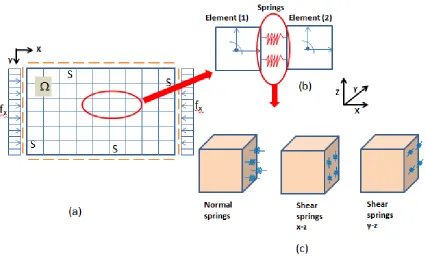
Figure 1-1: AEM Mesh. ... 2
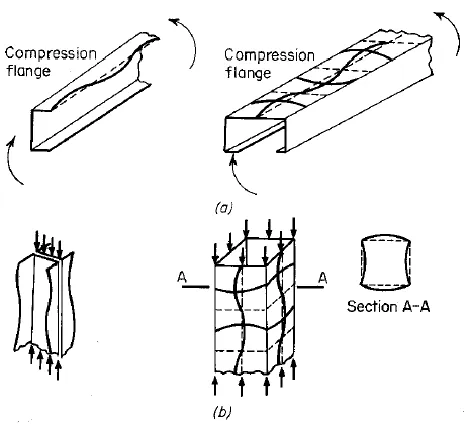
Figure 2-1: Local buckling of compression elements. (a) Beams. (b) Column. adopted from (Yu 2000) ... 5
Figure 2-2: Load versus Out-of-plane Displacement ... 6
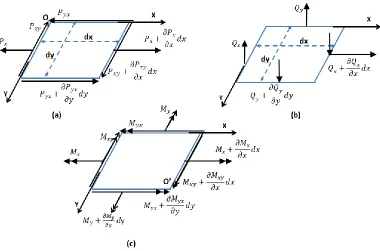
Figure 2-3: Forces and moments of the differential element. ... 8
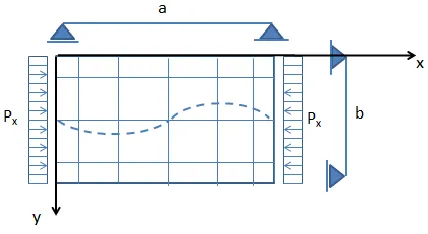
Figure 2-4: Rectangular plate subjected to uni-axial compression stress. ... 13
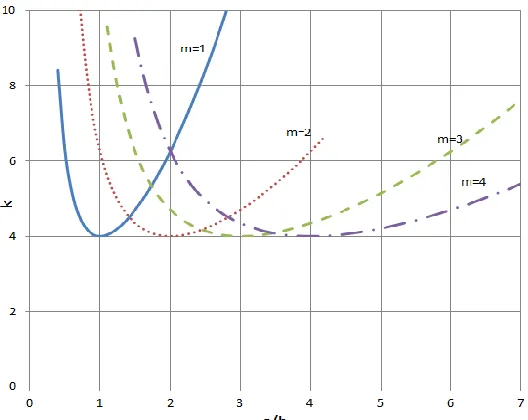
Figure 2-5: Buckling factor versus plate aspect ratio for simply supported rectangular plate. ... 15
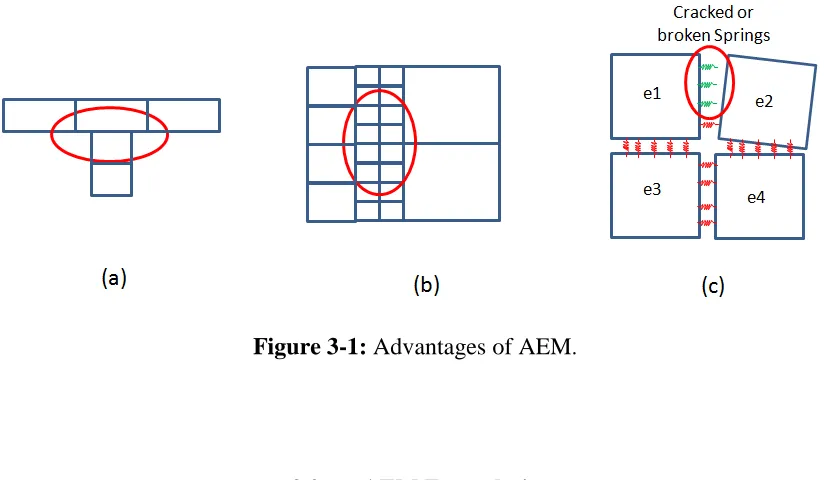
Figure 3-1: Advantages of AEM. ... 17
Figure 3-2: Spring representative area. ... 19
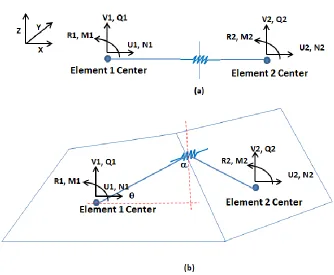
Figure 3-3: Degrees of freedom and end forces of two elements, (a) Idealized position, (b) General position. ... 19
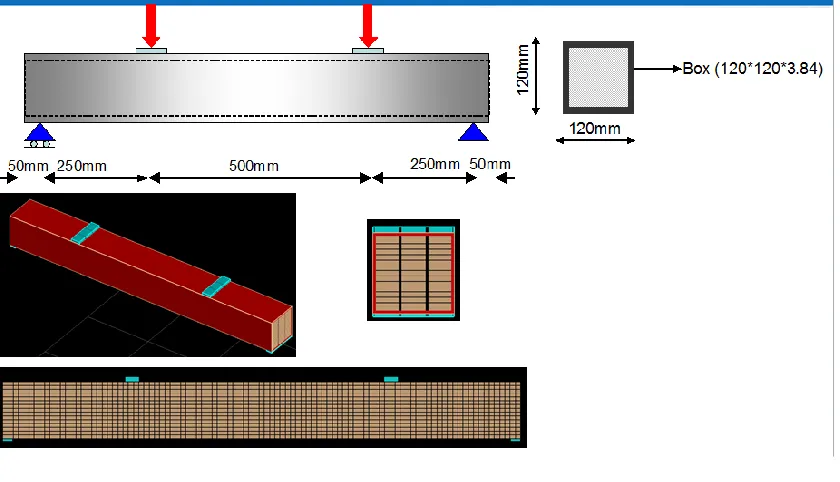
Figure 3-4: Example 1 Set up. ... 20
Figure 3-5: Example 1 Results... 21
Figure 3-6: Example 2 Set up and Results. ... 21
Figure 3-7: Example 3 Set up and results. ... 22
Figure 4-1: Plate dimensions, boundary conditions and loading. ... 24
Figure 4-2: Typical plate mesh, boundary conditions and loading. ... 25
Figure 4-3: Typical plate results; left: the buckling mode and right: the load-displacement chart. ... 25
Figure 4-4: Effect of number of springs for different values of G and for element size 10 mm. ... 31
Figure 4-6: effect of the shear modulus (G) for different values of spring distribution and for element size 10 mm. ... 32 Figure 4-7: Effect of the element size for different values of G and for 5 by 5 spring distribution. ... 32 Figure 4-8: Effect of the element size for different values of G and for 5 by 5 spring distribution relative error. ... 33 Figure 4-9: Effect of the element size for different spring distribution using the G correction factor. ... 33 Figure 4-10: Effect of the element size for different spring distribution using the G correction factor, relative error. ... 34 Figure 4-11: The ratio of the Exact and corrected shear modulus versus element ratio. ... 34
CHAPTER 1
INTRODUCTION
1.1 Motivation and Objectives
The main objective of this project is to estimate the error in the Applied Element Method (AEM). The AEM is a numerical method, like the Finite Element Method, which is used to discretize the domain into a grid of rigid finite elements with three degrees of freedom, three translations and three rotations, located in the geometric center of the element as shown in Figure 1-1. The connection of the elements is established through a mesh of springs on the contact faces of the elements (Meguro and Tagel-Din 2001). The two elements shown in Figure 1-1-b are assumed to be connected by one normal and two shear springs located at contact points, which are distributed around the elements edges. Each group of springs completely represents stresses and deformations of a certain representative volume of the element as shown in Figure 1-1-b.
to change the problem to study the error by numerical and experimental trials through studying a specific problem such as the buckling of plates.
The objective is to drive the fourth order differential equation of the thin plate buckling with a simply supported (Dirichlet and Neumann) boundary conditions (J.M., Timoshenko and Gere 1961). Then solve the partial differential equation and get the critical buckling stress and the corresponding buckling shape or the eigenfunction for the primary eigenvalue. Take this solution as the true or theoretical solution; solve the same problem numerically by an AEM model. Then perform a sensitivity study on the number of elements, the number of the springs and the shear stiffness of the springs to estimate how the error (absolute or relative) behave.
1.2 Overview of the contents of the Thesis
CHAPTER 2
BUCKLING OF PLATES
2.1 Introduction
Flat plates are extensively used in many engineering applications like roof and floor of buildings, deck slab of bridges, foundation footings, water tanks, bulk heads, etc. Plate buckling governs the design of many types of structures, for example, the thickness of the walls used in thin-wall beams. The most efficient designs, used for large spans, usually employ stiffness plates. For purpose of stability analysis, the wall plates between stiffening ribs may normally be analyzed approximately as isolated rectangular plates (Bazant 1991). In cold-formed steel design, individual elements of cold-formed steel structural members are usually thin and the width-to-thickness ratios are large (Yu 2000). These thin elements may buckle locally at a stress level lower than the yield point of steel when they are subject to compression in flexural bending, axial compression, shear, or bearing. Figure 2-1 illustrates local buckling patterns of certain beams and columns, where the line junctions between elements remain straight and angles between elements do not change.
The plates used in these applications are usually loaded either in-plane which causes buckling or out of plane, lateral, which causes bending. The geometry of the plate is normally defined by the middle plane which is a plane equidistant from the top and bottom faces of the plate. The thickness of the plate (t) is measured in a direction normal to the middle plane of the plate. The flexural properties of the plate largely depend on its thickness rather than its other two dimensions (length and width).
bifurcates from the fundamental path at the buckling load. The secondary path for column represents neutral equilibrium. In contrast, the fundamental path for a perfectly flat plate is similar to that of an ideal column. At the critical buckling load, this path bifurcates into a secondary path as shown in see Figure 2-2. The secondary path reflects the ability of the plate to carry loads higher than the elastic critical load. Unlike columns, the secondary path for the plate is stable in case of simply supported on four edges.
Figure 2-1: Local buckling of compression elements. (a) Beams. (b) Column. adopted from (Yu 2000)
1- The Kirchhoff-Love theory (Love 1888) , (Reddy and N. 2007), classical plate theory or thin plate theory which neglects the shear deformation in the thickness of the plate.
2- The Mindlin-Reissner theory (Mindlin 1951), (Reissner and Stein. 1951) , first order shear plate theory or the thick plate theory which considers the shear deformation in the thickness of the plate.
Figure 2-2: Load versus Out-of-plane Displacement
To drive the differential equation of the plate, the Kirchhoff-Love theory is used under the following assumptions:
2- The normal stress and the corresponding normal strain in the normal plane to the mid-surface are negligible for very small deflection ration of the plate span because it’s a small deformation analysis.
3- The plate is ideally flat and the thickness of the plate does not change during a deformation.
4- All loads do not change magnitude or direction when the plate buckles. All applied loads strictly acting in the middle plane of the plate.
5- The material is homogeneous, isotropic, continuous, and linearly elastic.
2.2 Derivation of the Governing Equation
Drive model Eq. 2-21 and the BVP Eq. 2-25 are adopted from (Gambhir 2004). Consider an initial state of equilibrium of a rectangular plate of dimensions a and b such that a >> b subjected to the external edge loads acting in the middle plane of the plate. And consider a free body of a rectangular differential element cut away from that plate with dimensions dx, dy, and t as shown in Figure 2-3-a. The governing differential equation is obtained from the static equilibrium equation of the deformed shape, namely.
∑ ∑ ∑ ∑ Eq. 2-1
Consider the equilibrium of in-plane forces in X-direction as shown in Figure 2-3-a
∑ ( ) ( ) Eq. 2-2
Equilibrium of the moments of in-plane forces about Z-axis passing through O’ and after ignoring the second order terms, yields,
Due to slight curvature in the elements due to transverse deflection, the in-plane forces will have components along the Z-axis. The slopes at the edges x=0 and x=dx are:
( ) ( ) [ ]
In the view of the small deformation assumption:
( ) ( )
The resultant component of in-plane forces
in the positive Z-direction
is: ( ) ( ) ( ) Eq. 2-4
The component of the shear forces along the Z-direction is, see Figure 2-3-b:
[(
) ] [(
) ]
Figure 2-3: Forces and moments of the differential element.
Equilibrium of forces along the Z-direction using equations Eq. 2-4 and Eq. 2-5:
Eq. 2-6
For equilibrium of the moments about X-axis, see Figure 2-3-c,
[ (
) ] (
)
(
)
(
)
Ignoring second order terms, the equation reduces to
Eq. 2-7
Eq. 2-8
From Eq. 2-7 and Eq. 2-8,
Eq. 2-9 Eq. 2-10
Substituting from equations Eq. 2-10 and Eq. 2-9 respectively into equation Eq. 2-6,
Eq. 2-11
This last equation is the governing differential equation of buckling of plates. The moments in the equation can be expressed in terms of the curvatures. Since a thin plate is essentially two dimensional, the constitutive law for an elastic plane-stress problem can be used. These are:
( ) ( )
Eq. 2-12
The strain-displacement relations for a linear problem expressed as Eq. 2-13
Let u and be the displacement along X and Y directions at a distance z above the middle surface which remains unstrained during the transverse displacement, , thus
Eq. 2-14
Eq. 2-15
Substituting the strains expressed in terms of from Eq. 2-15 into Eq. 2-12
( ) ( ) Eq. 2-16
The stress resultant are expressed as ∫ ( ) ( ) Eq. 2-17 ∫
( ) Eq. 2-18
∫ Eq. 2-19 Eq. 2-20
where D is the flexural rigidity per unit length of the plate. D is analogous to the bending stiffness EI of a beam.
Substituting the values of from Eq. 2-17, Eq. 2-18 and Eq. 2-19 into the governing differential equation
(
Eq. 2-22
2.3 Boundary Conditions
The governing equation Eq. 2-21 or Eq. 2-22 is a fourth order partial differential equation in x and y, thus for a unique solution it requires eight boundary conditions: four along X edges and four along Y edges. For our problem, the boundary conditions are simply supported on both directions. The edges are restrained against displacement but are free to rotate i.e. moments are zero i.e.
( ) Thus, ( ) Eq. 2-23
Since, for a supported edge, then Eq. 2-23 can be written as;
(
)
Eq. 2-24
Now the complete problem definition can be read as; ( ) ] Eq. 2-25
2.4 Solution of the governing equation
1- Navier solution which assumes the solution as the infinite sum of double series. It can account for any type of loading but limited to only all-round simply supported rectangular plate.
2- Levy solution which is a more general solution and requires only one pair of edges (opposite edges) to be simply supported while the other pair can have any type of boundary conditions. The solution is assumed as a two parts, the homogeneous part and the particular part.
The Navier solution is used to obtain the exact buckling load and mode shape. The deflected shape of the rectangular plate shown in Figure 2-4 may be represented by a double trigonometric series
∑ ∑
( ) ( ) Eq. 2-26
Where, m and n are the number of half sine waves in the x and y directions, respectively. Obviously, satisfy the boundary conditions in Eq. 2-25 since sin(0) = sin( ) = 0 at x = 0,a and y = 0,b. Substituting Eq. 2-26 into Eq. 2-25 to obtain,
∑ ∑
[ ( ) ] ( ) ( ) Eq. 2-27
One of the solutions is which makes and hence there is no buckling which
( )
Solve for to get,
( ) ( ) ( )
( )
( ) Eq. 2-28
is called the critical local buckling stress and t is the plate thickness.
The minimum buckling load is obtained when n=1, that is, only one half sine wave occurs in the y direction. Therefore,
( ) Eq. 2-29
Then the critical local buckling stress for a rectangular plate subjected to compression in one direction is
( )
Eq. 2-30
The value of k in Eq. 2-29 is plotted in Figure 2-5 for different plate aspect ratios, a/b. as seen when a/b ratio is an integer the value of k equals 4. This k will be used in chapter four when we calculate the critical buckling stress for the simply supported plate problem. This value of k is also applicable for relatively large a/b ratios. The intersection of two curves of k for m and m+1 can be found as follows,
√
√
√
√
Also note that for long plate,
Eq. 2-31
Where is the length of the half sine wave. For long plate, the length of the half sine waves equals approximately the width of the plate, and therefore square waves are formed.
CHAPTER 3
THE APPLIED ELEMENT METHOD
3.1 Introduction
Since the introducing of the computers in the scientific and engineering research in the second half of the nineteenth century, many numerical techniques have been developed to solve bigger and more complex structures. Numerical methods took two main directions based on the nature of the discretization of the continuous domain. Methods that discretize the domain into elements which can deform such as the Finite element Method and methods that discretize the domain into elements which are rigid, no deformations inside the element such as the Discrete Element Method or the Rigid Body and Spring Model (Kawai 1986). The main advantage of the latter is the simplicity to separate the elements. However the main disadvantage is the crack propagation depends on the mesh shape and size (Kikuchi, Kawai and Suzuki 1992). The Applied Element Method (AEM) is one of the discrete element methods.
The main advantages of AEM are (Meguro and Tagel-Din 2001):
1- Element connectivity is through faces not nodes. So it’s very normal to have elements connected as shown in Figure 3-1-a.
2- There is no need for transition elements to connect elements of different geometry, see Figure 3-1-b.
3- It’s very simple to break or crack the element connectivity by removing the springs. The degrees of freedom are at the nodes inside the elements. There are no nodes to break as in case of the Finite Element Method as shown in Figure 3-1-c. 4- There is no need to develop special element for interface between the elements as
Figure 3-1: Advantages of AEM.
3.2 AEM Formulation
The discussion that follows will be for the two dimensional formulation of the AEM which can be extended to the three dimensional version. Consider the simply supported plate in Figure 1-1-a as our domain. The domain is discretized into a mesh of rigid elements. The elements can have a triangular or a general four edges closed convex polygon. Consider two elements of that mesh as shown in Figure 1-1-b. These elements are connected by a series of normal and shear springs at contact points on their shared edges, see Figure 1-1-c. Each contact’s springs represent the physical properties such as mass, inertia, deformations, and stresses of a certain area of the two elements as shown in Figure 3-1. The spring normal and shear stiffness are (Meguro and Tagel-Din 2001);
Eq. 3-1
drive the full stiffness matrix of the two elements shown Figure 3-2, consider only for simplicity one group of springs, one normal and one shear, connects the two elements. Consider the idealized system shown in Figure 3-3-a.Figure 3-1 By following the standard procedure for deriving the stiffness matrix as in (Przemieniecki 1968), the first row of the stiffness matrix is obtained in the following manner
Eq. 3-2
Then calculate the end forces at both ends.
Eq. 3-3
Following the same procedure above, the 6x6 stiffness matrix will be;
[
]
Eq. 3-4
Where U1 = translation degree of freedom in X-direction of the first element, V1 = translation degree of freedom in Y-direction of the first element, R1 = rotational degree of freedom around the Z-direction, N1 = the force in the direction of U1, Q1 = the force in the direction of U2, M1 = the moment in the direction of R1. U2, V2, R2, N2, Q2, and M2 have similar definition but for the second element as shown in Figure 3-3-a.
For a general spring position and element orientation as shown in Figure 3-3-b,
Figure 3-2: Spring representative area.
3.3 AEM Verification
The following are some verification examples taken from (ASI 2010):
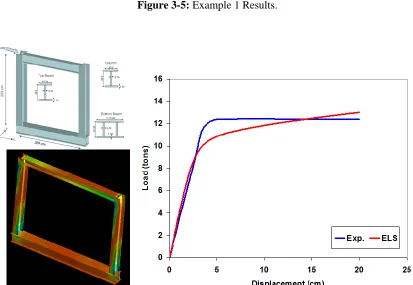
1- Example 1 is a concrete-filled tube girder under four point loading. Figure 3-4 shows the problem set up. As seen in Figure 3-5, the AEM results are very close to the experimental results.
2- Example 2 is a monotonic loading of a steel frame. Figure 3-6 shows the set up and the results. The results are in a good agreement with the experiment.
3- Example 3 is a reinforced concrete deep beam without web reinforcement under four point loading. Figure 3-7 shows the set up and the results. The results match very well with the experiment.
Figure 3-5: Example 1 Results.
Figure 3-7: Example 3 Set up and results.
CHAPTER 4
RESULTS AND DISCUSSION
4.1 Introduction
This chapter is devoted to study the effect of some parameters on the accuracy of the AEM, namely; the number of elements, the number of springs and the value of the shear modulus. The model problem used here is the buckling of the uni-axiallly compressed rectangular plate whose theoretical solution was discussed in chapter 2. The strategy is to build an experimental matrix of runs or simulations. The matrix contains more than 300 runs.
4.2 Problem Set-up
Consider a plate of dimensions 120 mm x 240 mm x1mm as shown in Figure 4-1. The plate is simply supported on all four edges. The plate is loaded in X-direction only until it buckles. Given the material properties, the dimensions and the boundary conditions, Eq. 2-30 can be used to obtain the theoretical buckling load as follows;
( )
Figure 4-1: Plate dimensions, boundary conditions and loading.
4.3 AEM Model
Figure 4-2: Typical plate mesh, boundary conditions and loading.
4.4 Numerical Results
Table 4-1shows the list of values for the three studied parameters;
1- Shear Modulus, G is presented as a multiple of the Young’s modulus. The shear stiffness of the spring was presented in chapter two as Ks=GA/L. When trying this value in the simulation, the error in obtaining the buckling was very high compared to the theoretical value. Upon trying different values for shear stiffness, it was found that this change can give very good results. But the question is how to get this value and what is the theory behind it. To study this effect, the shear stiffness is added as another parameter in the experimental matrix. As a user to the ELS software, the only way to change the shear stiffness was to factor the shear modulus to account for the desired change. So it was selected to represent the G as a multiple of the E in the study.
2- The element size was chosen to range from ten times the thickness (1/10) to one times the thickness (1/1). The element dimensions are kept as a square in the xy-plane.
3- The spring distribution ranges from 2 by 2 springs on the shared faces of the elements to 20 by 20.
For every element size, a table like the one in Table 4-2 was built by running all these simulations. This table shows the buckling load using different combination of G and springs distribution. Table 4-3 shows the relative error of the results of Table 4-2. The relative error is defined as where is the theoretical buckling load calculated in the previous sections and is the numerical buckling load using the AEM.
4.4.1 Effect of the number of springs
least of second order. Another note on the same curve, increasing the number of springs from 10 to 20 has no significant reduction in the error.
4.4.2 Effect of the shear modulus G
Figure 4-6 shows the trend of the buckling load values with respect to the shear modulus G for element thickness ratio of 0.1. The buckling load changes linearly with changing the G. This behavior suggests that by interpolating these values we can accurately locate the exact value of G which gives the least error or zero error.
4.4.3 Effect of the element size
Figure 4-7 shows the trend of the buckling load values with respect to the element thickness ratio. As the elements gets smaller the buckling load gets closer to the theoretical value for a constant value of G. the convergence is at least of second order. The error plot in Figure 4-8 shows that G has a significant effect on the error. For the same value of G (0.0206), the error can be very large for size ratio of 0.1 however it’s very low for size ratio of 0.2. However you can find another value of G for which the error is very low for size ratio 0.1 and very large for size ratio of 0.2. This behavior supports the previous behavior in studying the effect of the number of springs on the results.
4.5 Discussion of the Numerical Results
unit is EA/L. The same idea applicable when you have two objects slide against each other, the force needed to move one object a single unit is GA/L. However this is estimation seems to not function well in case of thin plates. Another estimation may be introduced which is to calculate the shear stiffness based on the beam analogy. The force needed to move a fixed end beam vertically one unit is 12 EI/L ^3. So the correction factor may be,
Eq. 4-1
Eq. 4-2
Equating the above two equation to get
( ) Eq. 4-3
Here d is the representative width of the spring area as shown in Figure 3-2 and L is the representative length of the spring which equals the element size h in our case. The correction value is related to the thickness to element size ratio.
4.5.1 Effect of the correction to the shear modulus G
Figure 4-9 shows buckling load for several element size multiples and for several springs’ distribution using a corrected G value for each run. Figure 4-10 shows the relative error of the results. The correction seems to work for some element size ratios but not working for others. The relative error for size ratio 0.1 is less than 5% while it’s almost 15% for size ration 0.125. However the overall trend shows a slow convergence with reducing the element size if the size ratio 0.125 and 0.5 is excluded from the results. There is no obvious reason for the size ratio 0.125. However for size ratio of 0.5, the reason is this ratio violates the assumption of the thin plate.
4.5.2 Comparison of the correction to the shear modulus G with the exact value
interpolation a G value was calculated for a zero error and it’s called exact G. Then this value has been used to obtain the buckling load to be sure that there is zero error when using the exact G. Then the ratio of the exact G and the corrected G is calculated. Figure 4-11 shows the relation between the ratio of the exact G and the corrected G for different element size ratios. When the ratio is a unit it means that the corrected G is exactly the interpolated value. In general the corrected G is within +/- 5% of the exact value.
Table 4-1: Testing Values for the shear modulus, element size and springs distribution.
Shear Modulus, G, is expressed as a multiple of Young’s modulus, E. G Values = 0.008, 0.008+1*dG, 0.008+2*dG, …..,0.065 , dG=0.0005
Element Size, h (mm)
1 2 3 4 5 6 7.06 8 9.23 10
Thickness / Element size = t/h
1 0.5 0.34 0.25 0.2 0.167 0.1416 0.125 0.1083 0.1
# elements in X-direction
120 60 40 30 24 20 17 15 13 12
# elements in Y-direction
240 120 80 60 48 40 34 30 26 24
Total number of elements
28,800 7200 3200 1800 1152 800 578 450 338 288
Spring Distribution
Table 4-2: The buckling load for element size 10 (mm) for different spring distribution and different G values.
Table 4-3: The relative error of the buckling load for element size 10 (mm) for different spring distribution and different G values.
Table 4-4: Interpolation of the G values compared with the proposed correction values.
Interpolation equations Exact/correction ratio
t/h 4x4 5x5 6x6 4x4 5x5 6x6
Figure 4-4: Effect of number of springs for different values of G and for element size 10 mm.
Figure 4-6: effect of the shear modulus (G) for different values of spring distribution and for element size 10 mm.
Figure 4-8: Effect of the element size for different values of G and for 5 by 5 spring distribution relative error.
Figure 4-10: Effect of the element size for different spring distribution using the G correction factor, relative error.
CHAPTER 5
CONCLUSIONS AND FUTURE WORK
5.1 Conclusions
The effect of three parameters on the accuracy of the Applied Element Method in obtaining the buckling load of a simply supported rectangular plate has been studied. The three parameters are: the element size, the spring distribution and the shear stiffness of the spring. In general the buckling mode produced by the AEM matches the theoretical solution for a rectangular plate of aspect ratio of 1:2. There was a double half sine wave in one direction and a single half sine wave in the other direction. Also the load- lateral deflection of the plate is in a good agreement with what traditionally known about the buckling of plates compared with the buckling of columns. The fundamental path bifurcates to a secondary stable path upon reaching the buckling load.
It was observed that reducing the element size or increasing the number of the spring’s distribution reduces the error in obtaining the buckling load. The rate of the error reduction is at least of a second order. It’s worth mentioning that increasing the number of the spring’s distribution from 10 by 10 to 20 by 20 has a little effect on the results. However increasing the number of the spring’s distribution from 2 by 2 to 5 by 5 has improved the results very much.
5.2 Future Work
REFERENCES
ASI. Extreme Loading for Structures Theoretical Manual. Raleigh, NC: Applied Science International, LLc., 2010.
Azevedo, N. Monteiro, and J.V. Lemos. "Hybrid discrete element/finite element method for fracture analysis." Computer methods in applied mechanics and engineering, 2006: 195, 4579-4593.
Bazant, Zdenek P. Stability of Structures. New York: Oxford University Press, 1991.
Gambhir, Murari L. Stability Anaylysis and Desgin of Structures. Berline: Springer-Verlag, 2004.
Hun, A T. The Book of Irrelevant Citations. Ruston: Psychodelic Publishing Company, 2010. J.M., Timoshenko, and Gere. Theory of Elastic Stability. New York: McGraw Hill Book
Company, 1961.
Jones, S A. "Equation Editor Shortcut Commands." Louisiana Tech Unversity, 2010: http://www2.latech.edu/~sajones/REU/Learning%20Exercises/Equation%20Edito r%20Shortcut%20Commands.doc.
Jones, S A, and K Krishnamurthy. "Reduction of Coherent Scattering Noise with Multiple Receiver Doppler." Ultrasound in Medicine and Biology 28 (2002): 647-653. Jones, S A, H Leclerc, G P Chatzimavroudis, Y H Kim, N A Scott, and A P Yoganathan.
"The influence of acoustic impedance mismatch on post-stenotic pulsed-Doppler ultrasound measurements in a coronary artery model." Ultrasound in Medicine and Biology 22 (1996): 623-634.
Kawai. "Recent developments of the Rigid Body and Spring Model (RBSM) in structural analysis." Seiken Seminar Text Book, Institute of Industrial Science, The University of Tokyo, 1986: 226-237.
Kawai, Tadahiko. "New Element Models in Discrete Structural Analysis." institute of industrial science, university of Tokyo, 1977.
Love, A. E. H. "On the small free vibrations and deformations of elastic shells."
Philosophical trans. of the Royal Society (London), 1888: Vol. série A, N° 17 p. 491–549.
Meguro, Kimiro, and Hatem Tagel-Din. "Applied Element Simulation of RC Structures under Cyclic Loading." ASCE, Vol 127, Issue 11, 2001: 1295-1305.
Mergheim, J., and E. Kuhl and P. Steinmann. "A hybrid discontinuous Galerkin/interface method for te computational modeling of failure." Communications in numerical methods in engineering, 2004: 20:511-519 (DOI: 10.1002/cnm.689).
Michaelstein, J. "Equation Editor." Microsoft Word 2010, The official blog of the Microsoft
OfficeWord Product Team, 2006:
http://blogs.msdn.com/b/microsoft_office_word/archive/2006/10/20/equation-numbering.aspx.
Mindlin, R. D. "Influence of rotator inertia and shear on flexural motions of isotropic, elastic plates." Journal of Applied Mechanics (Journal of Applied Mechanics, 1951, Vol. 18 p. 31–38), 1951: Vol. 18 p. 31–38.
N. Kawashime, M. Kashihara, and M. Sugimoto. "A combination of the finite element method and the rigid-body spring model for plane problems." Finite Elements in Analysis and Design, Elsevier, 1992: 67-76.
Pasluosta, Cristian Feder. Getting My Ph.D. Done! 1. Vol. 1. 1 vols. Ruston, LA: Argentina Publications, 2010.
Przemieniecki, J. S. Theory of Matrix Sructural Analysis. New York: McGraw-Hill, 1968. Reddy, and J. N. Theory and analysis of elastic plates and shells. CRC Press, 2007.
Reissner, E., and M. Stein. "Torsion and transverse bending of cantilever plates. ." Technical Note 2369, National Advisory Committee for Aeronautics,Washington, 1951.
Xiong, Zhang, and Qian Lingx. "Rigid Finite Element and Limit Analysis." ACTA Mechanica Sinica, 1993: Vol.9, No. 2, ISSN 0567-7718,.
Yoo, Chai H, and Sung Lee. Stability of Structures: Principles and Applications. Oxford, UK : Elsevier Inc, 2011.