Copyright © 2000, American Society for Microbiology. All Rights Reserved.
Application of Pulsed-Field Gel Electrophoresis and Binary
Typing as Tools in Veterinary Clinical Microbiology and
Molecular Epidemiologic Analysis of Bovine and Human
Staphylococcus aureus
Isolates
RUTH ZADOKS,1,2* WILLEMVANLEEUWEN,3HERMAN BARKEMA,4OTLIS SAMPIMON,5
HENRI VERBRUGH,3YNTE HEIN SCHUKKEN,1,2ANDALEXVANBELKUM3
Department of Farm Animal Health, Faculty of Veterinary Medicine, 3584 CL Utrecht,1Department of Medical
Microbiology & Infectious Diseases, Erasmus Medical Center Rotterdam, 3015 GD Rotterdam,3Department of
Ruminant Health, Animal Health Service, 9200 AJ Drachten,4and Department of Ruminant Health, Animal Health
Service, 7400 AA Deventer,5The Netherlands, and Quality Milk Promotion Services, Department of Population
Medicine and Diagnostic Sciences, College of Veterinary Medicine, Cornell University, Ithaca, New York 14850-12632 Received 6 October 1999/Returned for modification 30 December 1999/Accepted 26 February 2000
Thirty-eight bovine mammaryStaphylococcus aureusisolates from diverse clinical, temporal, and
geograph-ical origins were genotyped by pulsed-field gel electrophoresis (PFGE) afterSmaI digestion of prokaryotic DNA
and by means of binary typing using 15 strain-specific DNA probes. Seven pulsed-field types and four subtypes were identified, as were 16 binary types. Concordant delineation of genetic relatedness was documented by both techniques, yet based on practical and epidemiological considerations, binary typing was the preferable
method. Genotypes of bovine isolates were compared to 55 previously characterized humanS. aureusisolates
through cluster analysis of binary types. Genetic clusters containing strains of both human and bovine origin were found, but bacterial genotypes were predominantly associated with a single host species. Binary typing
proved an excellent tool for comparison ofS. aureusstrains, including methicillin-resistantS. aureus, derived
from different host species and from different databases. For 28 bovineS. aureus isolates, detailed clinical
observations in vivo were compared to strain typing results in vitro. Associations were found between distinct genotypes and severity of disease, suggesting strain-specific bacterial virulence. Circumstantial evidence furthermore supports strain-specific routes of bacterial dissemination. We conclude that PFGE and binary
typing can be successfully applied for genetic analysis ofS. aureusisolates from bovine mammary secretions.
Binary typing in particular is a robust and simple method and promises to become a powerful tool for strain characterization, for resolution of clonal relationships of bacteria within and between host species, and for
identification of sources and transmission routes of bovineS. aureus.
Infections due to staphylococci are of major importance to veterinary and human medicine.Staphylococcus aureusis one of the most significant pathogens causing intramammary infec-tions in dairy cattle worldwide (6, 15, 34). In humans,S. aureus is a major cause of community-acquired as well as nosocomial morbidity and mortality. In the most recent decades, the in-creasing prevalence of methicillin-resistantS. aureus(MRSA) strains has become an additional infection control problem in human medicine (4, 7, 25). Staphylococcal strains may vary considerably in virulence and epidemiological potential. To control the spread of staphylococcal infections, sources of con-tamination and mechanisms of transmission must be identified. Detailed pathogenetic and epidemiological studies depend on the availability of typing systems that differentiate between strains belonging to the same bacterial species.
In veterinary microbiology, many techniques have been ap-plied for characterization of bovineS. aureusstrains. Pheno-typic methods include phage typing (3, 13, 37), biotyping (11, 23), and multilocus enzyme electrophoresis (MLEE) (12, 17). Genotypic methods include single-gene typing systems, such as
detection of coagulase gene polymorphism (2, 36) and ribotyp-ing (3, 12, 29), and whole-genome typribotyp-ing systems, such as arbitrarily primed PCR (12, 21, 24). Furthermore, plasmid pattern analysis has been used to differentiate amongS. aureus isolates of bovine origin, based on the diversity of extrachro-mosomal DNA (3). In human microbiology, most of these procedures have been superseded by newer methods that have enhanced resolving powers, including pulsed-field gel electro-phoresis (PFGE) of DNA macrorestriction fragments (5, 28, 33) and, more recently, binary typing (40). PFGE is a reliable and reproducible method with high discriminatory power. Drawbacks of this method are that it is laborious and expensive and that complex DNA patterns may be difficult to interpret, especially for large collections of isolates (38, 39). For clinical laboratories processing great numbers of samples, these limi-tations may be impediments to routine use. Binary typing is a highly reproducible and stable library typing method with ex-cellent discriminatory abilities. It has the additional advantage of producing a simple binary output, facilitating interpretation and comparison of typing results, and it lacks experimentally unstable parameters, such as electrophoretic conditions (42). Recently, several authors have reported the use of PFGE for characterization of bovine isolates, but so far binary typing has not been applied toS. aureusisolates of bovine origin (3a, 21a). The purpose of this study was to determine whether PFGE and binary typing are suitable techniques for the differentiation
* Corresponding author. Mailing address: Quality Milk Promotion Services, Department of Population Medicine and Diagnostic Sci-ences, Park View Technology Center I, 22 Thornwood Dr., Ithaca, NY 14850-1263. Phone: (607) 255-8202. Fax: (607) 257-8485. E-mail: R [email protected].
1931
on May 15, 2020 by guest
http://jcm.asm.org/
of isolates ofS. aureusrecovered from bovine mammary se-cretions. In addition, a collection of bovine isolates was com-pared to a collection of human isolates, including methicillin-resistant strains, to explore clonal relatedness of isolates from cattle and humans as determined by binary typing. Finally, associations of bacterial strains with clinical observations in cattle were examined to identify possible relations between genotypes and bacterial virulence or routes of spread.
MATERIALS AND METHODS
Bacterial isolates.This study included 38 bovineS. aureusisolates collected from eight dairy herds in The Netherlands between May 1997 and February 1999. Three herds (I, II, and III) were involved in a longitudinal survey of population dynamics of intramammary infections. In those herds, milk samples were routinely collected from all four udder quarters of each cow at intervals of 3 weeks for 81 weeks. Samples from the other five herds were submitted to the diagnostic laboratory of the Animal Health Service, Deventer, The Netherlands, as part of a dairy health improvement scheme. Bacteria were cultured from milk samples according to National Mastitis Council standards (16) and identified at the species level as described previously (20). Isolates were stored frozen until
further use. Isolates were selected to represent different geographical, temporal, and clinical origins (Table 1).
Binary typing data of 55 humanS. aureusisolates from diverse geographic and temporal origins in the United States and The Netherlands were used (Table 2). Human collections include MRSA strains (n⫽37) and methicillin-susceptibleS. aureus(MSSA) strains (n⫽18) and have been described in detail before (38, 41, 42).
Clinical and subclinical disease characteristics.Detailed records of clinical observations were available for isolates 1 to 33 (Table 1). In addition, somatic cell counts (SCCs) of milk samples yielding isolates 1 to 33, with the exception of isolates 8 to 10, were determined by means of a Fossomatic cell counter (Foss Electric, Hillerød, Denmark). SCC is a measure of the leukocyte content of milk and is used as an indicator of infection. The threshold between noninfected and infected is commonly set at 200,000 cells/ml (10). Isolates 34 and 35 were cultured from bulk milk samples from farm III and disease classifications do not apply. For samples yielding isolates 36 to 40, SCC was determined, but detailed clinical data were not available.
Based on clinical symptoms and SCC, isolates 1 to 33 were classified as belonging to one of four clinical groups, in order of increasing severity of infection as follows: (i) subclinical infection with nonelevated SCC (median, 97 ⫻103cells/ml; range, 11 to 152⫻103cells/ml), (ii) chronic subclinical infection
with elevated SCC (median, 1,278⫻103cells/ml; range, 210 to 7,821⫻103
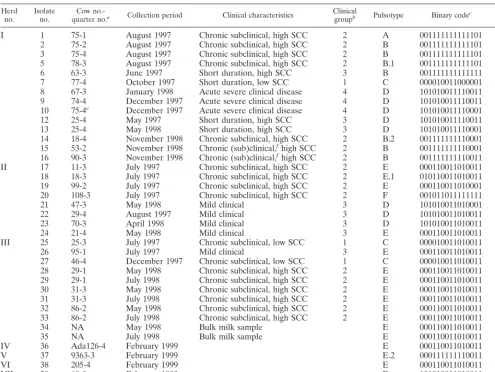
[image:2.612.55.550.84.455.2]cells/ml), (iii) short duration mild clinical disease or short duration subclinical TABLE 1. Summary of epidemiological data, PFGE typing data, and binary typing results for 38 bovineS. aureusisolates
Herd
no. Isolateno. quarter no.Cow no.-a Collection period Clinical characteristics Clinicalgroupb Pulsotype Binary codec Binarytyped
I 1 75-1 August 1997 Chronic subclinical, high SCC 2 A 001111111111101 8189
2 75-2 August 1997 Chronic subclinical, high SCC 2 B 001111111111101 8189
3 75-4 August 1997 Chronic subclinical, high SCC 2 B 001111111111101 8189
5 78-3 August 1997 Chronic subclinical, high SCC 2 B.1 001111111111101 8189
6 63-3 June 1997 Short duration, high SCC 3 B 001111111111111 8191
7 77-4 October 1997 Short duration, low SCC 1 C 000010011000001 1217
8 67-3 January 1998 Acute severe clinical disease 4 D 101010011110011 21747
9 74-4 December 1997 Acute severe clinical disease 4 D 101010011110011 21747 10 75-4e December 1997 Acute severe clinical disease 4 D 101010011110001 21745
12 25-4 May 1997 Short duration, high SCC 3 D 101010011110011 21747
13 25-4 May 1998 Short duration, high SCC 3 D 101010011110001 21745
14 18-4 November 1998 Chronic subclinical, high SCC 2 B.2 001111111110001 8177 15 53-2 November 1998 Chronic (sub)clinical,fhigh SCC 2 B 001111111110001 8177 16 90-3 November 1998 Chronic (sub)clinical,fhigh SCC 2 B 001111111110011 8179
II 17 11-3 July 1997 Chronic subclinical, high SCC 2 E 000110011010011 3283
18 18-3 July 1997 Chronic subclinical, high SCC 2 E.1 010110011010011 11475
19 99-2 July 1997 Chronic subclinical, high SCC 2 E 000110011010001 3281
20 108-3 July 1997 Chronic subclinical, high SCC 2 F 001011011111111 5887
21 47-3 May 1998 Mild clinical 3 D 101010011010001 21713
22 29-4 August 1997 Mild clinical 3 D 101010011010011 21715
23 70-3 April 1998 Mild clinical 3 D 101010011010011 21715
24 21-4 May 1998 Mild clinical 3 E 000110011010011 3283
III 25 25-3 July 1997 Chronic subclinical, low SCC 1 C 000010011010011 1235
26 95-1 July 1997 Mild clinical 3 E 000110011010011 3283
27 46-4 December 1997 Chronic subclinical, low SCC 1 C 000010011010011 1235
28 29-1 May 1998 Chronic subclinical, high SCC 2 E 000110011010011 3283
29 29-1 July 1998 Chronic subclinical, high SCC 2 E 000110011010011 3283
30 31-3 May 1998 Chronic subclinical, high SCC 2 E 000110011010011 3283
31 31-3 July 1998 Chronic subclinical, high SCC 2 E 000110011010011 3283
32 86-2 May 1998 Chronic subclinical, high SCC 2 E 000110011010011 3283
33 86-2 July 1998 Chronic subclinical, high SCC 2 E 000110011010011 3283
34 NA May 1998 Bulk milk sample E 000110011010011 3283
35 NA July 1998 Bulk milk sample E 000110011010011 3283
IV 36 Ada126-4 February 1999 E 000110011010011 3283
V 37 9363-3 February 1999 E.2 000111111110011 4083
VI 38 205-4 February 1999 E 000110011010011 3283
VII 39 68-? February 1999 D 101010011010011 21715
VIII 40 Klara-4 February 1999 G 001011111111101 6141
aUdder quarter numbers: 1, right front; 2, left front; 3, right rear; 4, left rear.
b1, subclinical infection with nonelevated SCC; 2, chronic subclinical infection with elevated SCC; 3, mild clinical disease or short-term subclinical disease with high
SCC; 4, acute severe clinical disease.
cOverall results after hybridization with 15 strain-specific DNA probes (AW-1 through AW-15) developed for typing of humanS. aureusstrains (42). dBinary type is the binary code transformed into a decimal number.
eNew animal assigned same cow number (75) as cow from which isolates 1, 2, and 3 were collected. fSubclinical disease with occasional mild clinical flare-ups (clots in milk).
1932 ZADOKS ET AL. J. CLIN. MICROBIOL.
on May 15, 2020 by guest
http://jcm.asm.org/
disease with high SCC (median, 4,560⫻103cells/ml; range, 411 to 8,710⫻103
cells/ml), and (iv) acute severe clinical disease (Table 1). SCC was not deter-mined for group 4 samples, because clot formation in mammary secretions interfered with SCC measurement.
PFGE.PFGE was carried out as described by Struelens et al. (35).SmaI (Boehringer, Mannheim, Germany) was used for digestion of genomic DNA. PFGE of DNA digests was performed with a CHEF Mapper (Bio-Rad, Veenendaal, The Netherlands) through a 1% SeaKem agarose gel (FMC; San-verTECH, Heerhugowaard, The Netherlands) under the following conditions: initial switch time of 5 s to final switch time of 15 s, run time of 10 h, followed by initial switch time of 15 s to final switch time of 45 s for 14 h; linear ramping; 6 V cm⫺1; 120° angle (60° to⫺60°); 14°C; 0.5⫻Tris-borate-EDTA buffer. A
lambda DNA polymer (Bio-Rad) was used as a molecular size marker. Gels were stained with ethidium bromide for 1 h, destained in water, and photographed under UV light with a charge-coupled device camera.
Macrorestriction patterns were analyzed both visually and by computer-aided methods. Visual interpretation of banding patterns was done following guide-lines suggested by Bannerman et al. (5) and Tenover et al. (38, 39). Isolates with identical restriction profiles were assigned the same type and identified with a capital letter. Isolates that differed from main types by one to three band shifts consistent with a limited number of genetic events were assigned subtypes, indicated with a numeral suffix. Isolates with more than three such differences were considered to be different types. Banding patterns were digitized with a Hewlett-Packard Scanjet IIcx/T scanner and stored as TIFF files. Patterns were analyzed by using GelCompar software (version 4.0; Applied Maths, Kortrijk, Belgium) to calculate Dice coefficients of correlation and to generate a dendro-gram by the unweighted pair group method using arithmetic averages (UPGMA) clustering.
Binary typing. Macrorestriction fragments obtained through PFGE were Southern blotted onto Hybond N⫹membranes (Amersham, Little Chalfont,
Buckinghamshire, United Kingdom). Cloned DNA fragments designed for bi-nary typing of humanS. aureusstrains were used as probes (42). Labeling, hybridization, and detection of the probes were performed with ECL direct labeling and detection systems, according to the manufacturer’s protocols (Am-ersham Life Science, Little Chalfont, Buckinghamshire, United Kingdom). Hy-bridization of 15 DNA probes was scored with a 1 or a 0 according to the presence or absence of a hybridization signal, resulting in a 15-digit binary code for eachS. aureusisolate. Binary codes were transformed into decimal numbers to define binary types (BT), and a dendrogram was constructed by using hier-archical cluster analysis (SPSS 8.0 for Windows; SPSS Inc.).
Statistical analysis.Log-normalized SCCs for clinical groups 1, 2, and 3 were compared by means of one-way ANOVA (SPSS 8.0 for Windows).
Fisher’s exact test of the relationship between clinical groups of origin and strains was performed with analytical software (StatXact version 2.05; CYTEL Software Corporation, Cambridge, Mass.). Isolates 34 to 40 were excluded from this analysis because insufficient clinical data were available. Isolates 29, 31, and 33 were excluded because they represent the same infectious episodes as isolates 28, 30, and 32, respectively. For analysis of the association between clinical groups and pulsotypes, types that occurred only once (A and F) were excluded from analysis and subtypes (B.1, B.2, and E.1) were grouped together with their respective main types. For analysis of the association between clinical groups and binary types, BT clustering at 90% genetic similarity was used to define separate groups.
RESULTS
PFGE.All bovine isolates were typeable by PFGE. Among
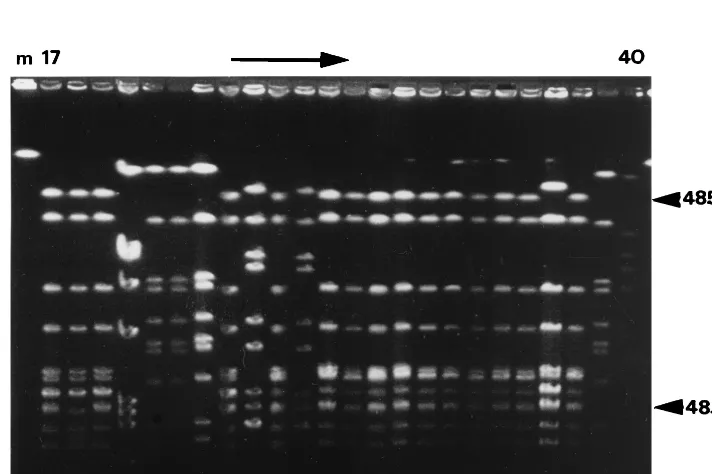
[image:3.612.57.554.83.168.2]38 isolates, seven pulsed-field types and four subtypes were identified through visual interpretation of gels (Fig. 1; Table
[image:3.612.125.481.476.713.2]FIG. 1. Example of PFGE gel ofSmaI macrorestriction fragments of bovineS. aureusisolates, showing isolates 17 to 40. Molecular sizes are indicated on the right. TABLE 2. Characterization of humanS. aureuscollections from which binary types are used in this study
Collection
no. Geographic origin Isolateno. Description of collection Reference(s)
1 United States 41-66 Community-acquired MRSA strains from a New York City hospital (n⫽26) 41 2 United States (CDCb) 67-80 Selection of geographically diverse strains from multicenter collection of MRSA
strains (n⫽5) and MSSA strains (n⫽9) 38, 42
3 The Netherlands 81-85 MSSA strains isolated from healthy persistent nasal carriers (n⫽5) 42 4 The Netherlands 86-95 MRSA strains (n⫽6) and MSSA strains (n⫽4) from outbreaks in Dutch
hospitals and nursing homes 42
aIsolate numbers are as those used in Fig. 4. bCDC, Centers for Disease Control and Prevention.
on May 15, 2020 by guest
http://jcm.asm.org/
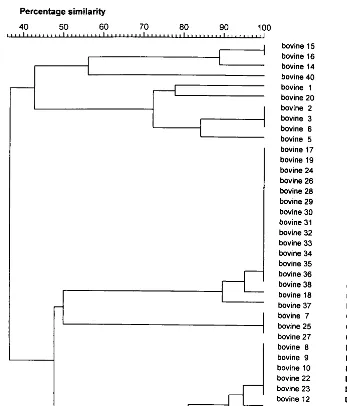
1). Three pulsotypes (A, F, and G) and all subtypes (B.1, B.2, E.1, and E.2) were identified only once, while pulsotypes C, D, and E were found in two, three, and four herds, respectively. GelCompar analysis of PFGE results defined more clusters than visual interpretation. Depending on the level of genetic relatedness, 13, 11, and 8 clusters were identified for 95, 90, and 80% similarity, respectively (Fig. 2). The visually identified pulsotype B was divided into four (95%) or two (80%) separate clusters, while pulsotype D was divided into three (95%), two (90%), and one (80%) cluster(s). In the GelCompar analysis, visual pulsotypes E and E.1 were grouped together at 95% similarity and E, E.1, and E.2 were grouped together at 90% genetic similarity.
Binary typing.All bovine isolates were typeable by the
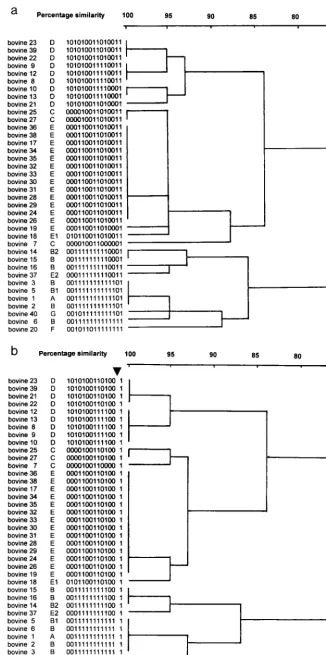
bi-nary method (Table 1). Out of 15 probes designed for typing of humanS. aureusstrains, four hybridized to all bovine isolates (AW-5, AW-8, AW-9, and AW-15), while all other probes hybridized to at least one bovine isolate. Genetic relatedness of isolates based on binary typing was depicted in a dendrogram (Fig. 3a). For 95, 90, and 85% genetic similarity, respectively,
eight, six, and three clusters of strains were identified. Binding of probe AW-14 showed a low level of reproducibility among epidemiologically related isolates. Therefore, a separate den-drogram excluding AW-14 was constructed (Fig. 3b), reducing the number of clusters to six at 95% similarity.
Concordance between PFGE and binary typing.Pulsotypes
assigned to isolates were compared with binary types. General agreement was found between both techniques, but with some discrepancies. Several visually identified pulsotypes were grouped together by binary typing (e.g., A, three B isolates, B.1, and G at 95% binary similarity; E, E.1, and two out of three C isolates at 95% similarity; B, B.2, and E.2 at 90% similarity). Other pulsotypes were divided into multiple binary clusters that differed by two or three probes (e.g., B into two binary clusters at 90% similarity) (Fig. 3a). Concordance of delineation of genotypically related clusters as determined by PFGE and binary typing improved when probe AW-14 was excluded (Fig. 3b).
Within-herd and between-herd heterogeneity.Genetic
[image:4.612.133.480.71.477.2]het-erogeneity among S. aureus isolates recovered from bovine FIG. 2. Dendrogram showing the level of similarity betweenSmaI macrorestriction patterns of 38 bovineS. aureusisolates as determined by PFGE and subsequent GelCompar analysis of digitized photographs. Scale indicates level of genetic relatedness within this set of strains. Capital letters indicate pulsotypes based on visual interpretation of PFGE results.
1934 ZADOKS ET AL. J. CLIN. MICROBIOL.
on May 15, 2020 by guest
http://jcm.asm.org/
FIG. 3. Dendrogram showing the grouping of 38 bovineS. aureusstrains on the basis of hybridization scores after binary typing with probes AW-1 to AW-15 (a) and after omission of probe AW-14, which is associated with hypervariable regions on the bovine staphylococcal genome (b). Isolate number, visual pulsotype, and binary code are given for all isolates. Scale indicates level of genetic relatedness within this set of strains.
1935
on May 15, 2020 by guest
mammary secretions was observed within and between herds. Isolates from herd I (n⫽16) were divided into four pulsotypes (A to D), and subclonal variation was observed in pulsotype B (subtypes B.1 and B.2). In herd II (n⫽8), three pulsotypes (D to F) were identified, with subclonal variation in pulsotype E (subtype E.1). In herd III (n⫽11), two pulsotypes (C and E) occurred. In isolates obtained from five herds that were not related to each other or herds I, II, and III, three pulsotypes and one subtype were identified (D, E, E.2, and G), demon-strating that both heterogeneity and homogeneity between herds exists.
Heterogeneity based on binary typing parallels heterogene-ity of pulsotypes for all herds.
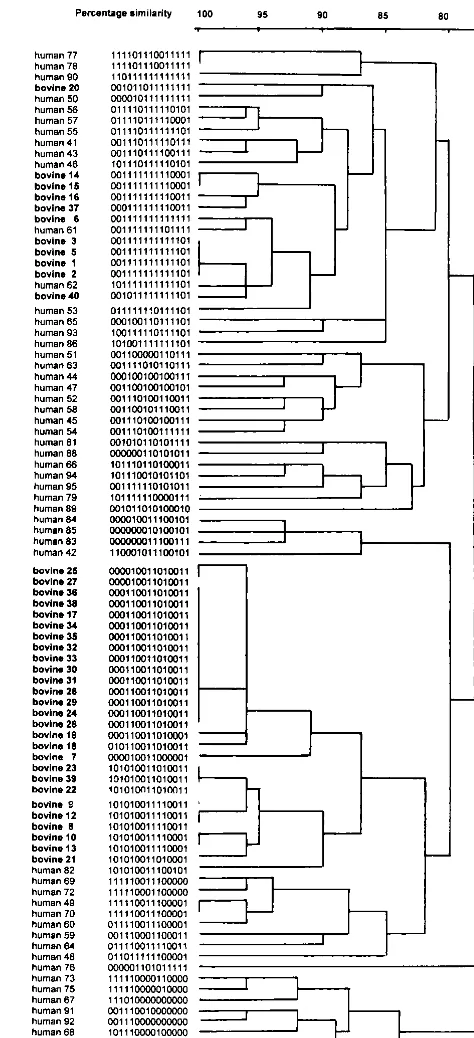
Comparison of bovine and human strains.Binary types of
bovine isolates from this study were compared to a well-de-fined collection of human S. aureus isolates that had been typed previously by the same method (41, 42). Most isolates clustered as host-specific clones, and full identity of the 15-digit binary codes of bovine and human isolates was never observed (Fig. 4). At 95% similarity, human isolate 61 clustered together with bovine isolate 6 (one-digit difference at probe AW-11), and human isolate 62 clustered with bovine isolates 1 to 5 (one-digit difference at probe AW-1) and bovine isolate 40 (two-digit difference). At 90% similarity, these bovine and hu-man isolates formed one cluster that also included huhu-man isolate 53. Human isolates within this cluster differed from bovine isolates in the same cluster by three digits at most, with differences associated with 6 out of 15 DNA probes used. Human isolate 82 clustered together with all bovine type D isolates at 90% similarity, as did human isolate 50 with bovine isolate 20. Human isolates 50, 53, 61, and 62 were community-acquired MRSA strains from a New York City hospital (Table 2). Human isolate 82 was an MSSA strain isolated from a persistent nasal carrier in The Netherlands. Bovine isolates that clustered with human isolates originated from four Dutch dairy herds that were epidemiologically unrelated to each other or the human sources ofS. aureusincluded in the com-parison.
Association with clinical characteristics.Mean SCC of
quar-ter milk samples differed with those of clinical groups for groups 1, 2, and 3 (F value⫽ 45.63,P ⬍ 0.001, degrees of freedom [df]⫽2). Subclinical infection with low SCC (clinical group 1) was associated with pulsotype C (Table 1; three C isolates in three group 1 samples). Binary typing discriminated between type C isolated from herd I (BT, 1217) and herd III (BT, 1235), in agreement with geographical clustering. Chronic subclinical infection with high SCC (clinical group 2) was as-sociated with pulsotypes A and B in herd I. Pulsotypes A and B were not isolated from any samples belonging to clinical group 1 or 4 and only once from group 3. In herds II and III, clinical group 2 was associated with pulsotype E. Type E was also isolated from a group 3 sample, while one group 2 sample yielded pulsotype F. Clinical group 3 yielded several strains, categorized as B (herd I), D (herds I and II), or E (herds II and III). Acute severe clinical mastitis (clinical group 4) was asso-ciated with pulsotype D.
Associations between clinical groups and visually identified pulsotypes were statistically significant (Fisher statistic ⫽
26.00,P⫽0.002, df⫽9). Associations between clinical groups and binary clusters were of borderline statistical significance when all probes were included in the analysis (Fisher statis-tic⫽24.70,P⫽0.05, df⫽15). Associations were significant after exclusion of probe AW-14 (Fisher statistic⫽19.10,P⫽
0.02, df⫽15).
DISCUSSION
PFGE and binary typing.Variation in gene content of
staph-ylococcal chromosomes may be associated with the presence of nonessential but clinically or epidemiologically relevant genes (e.g., virulence genes, resistance genes) (23, 28). PFGE is a well-known and powerful method for detection of genetic vari-FIG. 4. Dendrogram showing the grouping of 55 unrelated humanS. aureus
strains described previously (42) and 38 bovineS. aureusstrains on the basis of hybridization scores after binary typing with 15 DNA probes. Isolate numbers and binary codes are shown for all isolates. Scale indicates level of genetic relatedness within this collection of strains.
1936 ZADOKS ET AL. J. CLIN. MICROBIOL.
on May 15, 2020 by guest
http://jcm.asm.org/
[image:6.612.314.551.73.592.2]ation inS. aureus populations (5, 35). Binary typing is a re-cently developed high-resolution molecular typing system that produces simple binary output and has the potential to become a technically simple and fast library typing system forS. aureus strains (42). In this study, PFGE profiles and binary codes for 38 isolates derived from bovine mammary secretions were de-termined and compared. After PFGE ofSmaI macrorestric-tion fragments, seven main pulsotypes and four subtypes were identified visually. Computer-aided cluster analysis identified more distinct types, depending on the level of genetic similarity chosen as the cutoff value. What level of discrimination be-tween clusters of strains is desired depends on the purpose of genotyping, and results of PFGE must be analyzed in light of the epidemiological background (5, 35). One visually identified pulsotype, type B, was subdivided over multiple clusters after UPGMA analysis, even at low genetic similarity levels (Fig. 2). Isolates were from similar clinical and geographical back-grounds, but subdivision may be related to different temporal origins of the samples (Table 1). Discrepancies between visual and computer-aided interpretation are a drawback of pulsed-field typing and limit its usefulness as a routine diagnostic technique for large numbers of samples.
In this study, binary typing was preceded by PFGE typing, but binary typing can be performed as a single typing technique (42). Binary typing yielded 16 binary codes clustered in three to eight clones, depending on levels of genomic similarity. The relevant level of discrimination and suitability of individual probes are subject of further study. However, interpretation of probe binding results is unequivocal. Probes AW-12 and AW-13 yielded identical results, while probes AW-5, -8, -9, and -15 hybridized to all bovine strains and did not contribute to the discriminatory power of the typing system. A larger collec-tion of bovine isolates should be studied to determine the informative value of these probes for differentiation of bovine S. aureusstrains.
Concordance between PFGE and binary typing.Several
pul-sotypes were subdivided by binary typing. Binary codes within a pulsotype often differ by no more than one digit, and in many cases it was the digit associated with probe AW-14 (Table 1; Fig. 3a). The observed discrimination within pulsotypes may therefore be related to the detection of hypervariable domains on the genome of bovineS. aureusstrains with probe AW-14. Similar hypervariability or inconsistent presence of probe-binding sequences has been described for epidemiologically and genetically related humanS. aureusstrains (40). The re-sults could imply that probe AW-14, which is stable for typing of humanS. aureusstrains, is not stable for typing ofS. aureus strains of bovine origin. On the other hand, probe AW-14 could be used to study short-term genome evolution in bacte-rial populations of bovine origin (41).
When binary code differences caused by probe AW-14 are ignored, closer agreement between binary typing and pulsed-field typing is obtained, but some one-digit differences within pulsotypes remain (Fig. 3b). Pulsotypes C isolated from herds I and III differ by one digit, which was associated with probe AW-11. This genotypic difference can be related to different geographical origins, but not to a difference in clinical course of infection. For pulsotype D, differences exist in geographical origin and in clinical course. Whether severity of disease is a herd effect (herd I versus herd II), a strain effect (BT 21745 and 21747 versus BT 21713 and 21715), a cow effect (mild cases in older animals, severe cases in heifers), or a chance effect is unknown.
Some binary clones are subdivided by PFGE (e.g., B and B.2 within BT 8177 and A, B, and B.1 within BT 8189). Since isolates within these binary types were of similar geographical,
temporal, and clinical origin, binary typing seems the epidemi-ologically superior technique in these cases.
Within-herd and between-herd heterogeneity. PFGE and
binary typing differentiated strains within and between herds. Similar results were obtained by means of PCR-based DNA fingerprinting in the United States (24) and The Netherlands (21), through MLEE analysis of a worldwide collection of strains (17), by coagulase gene typing of European, American, and Asian isolates (2, 36), with a combination of techniques for bovine isolates from the United States and Ireland (12), and by PFGE of German isolates (3a). In all studies, including the present one, a limited number of predominant types was found both within herds, in agreement with the contagious nature of S. aureus mastitis (21), and between herds, suggesting that certain variants present in the environment may have a predi-lection for causing intramammary infections (2, 12, 36).
Subclonal heterogeneity within herds may be due to tempo-ral evolution. Herds were selected for inclusion in the longi-tudinal survey based on a history of the presence of the patho-gen in the herd for more than 1 year. The study period covered an additional 18 months, allowing for further genetic diversi-fication (41). Similar subclonal genetic variation over time has been described for DNA macrorestriction patterns from hu-manS. aureusisolates (27).
Comparison of bovine and human strains.Out of 55 human
isolates and 38 bovine isolates, five human and 16 bovine isolates belonged to clusters sharing 90 to 95% similarity, as determined by binary typing. At higher similarity levels, all clones were host species specific. Similar results were obtained by Kapur et al. (17) and by Lopes et al. (22). The results are consistent with the concept of host specificity amongS. aureus clones and imply that successful transfer of bacteria between humans and cattle is not a frequent event (17). However, several studies are available that suggest that transfer of bac-teria between humans and cows is possible (13, 30, 37). Those studies mostly focus on the role of humans as a source of infection for dairy cattle. Another reason to be concerned about interspecies transfer ofS. aureusis the routine use of antibiotics in dairy herd management (15, 32, 34). In farms withS. aureusmastitis problems, oxacillin is used as a dry cow treatment for all animals (8). Resistance to the closely related antibiotic methicillin is rare in bovineS. aureus(22) but has been reported in New York State (29), Europe (9), and Japan (cited in reference 18). Widespread use of oxacillin could pro-mote the selection of resistant clones (7). If interspecies trans-fer occurs, methicillin resistance in bovine strains may contrib-ute to increasing prevalence of MRSA strains in humans. Since binary typing is a library system that can be applied toS. aureus isolates originating from humans and cattle, it is a useful tool in monitoring origins of MRSA strains and interspecies trans-fer ofS. aureus. Addition of probes to test for the presence of themecAgene in the bovine typing system would furthermore allow monitoring of MRSA prevalence in veterinary diagnostic laboratories.
Association with clinical characteristics.A limited number
of isolates were included in statistical analyses, and the inter-dependence of within-herd observations was not taken into account. Thus, results of the analyses must be interpreted with care. However, in this study there was a significant correlation betweenS. aureusstrains and disease characteristics observed in vivo. Such information is rarely available because most stud-ies focus on clinical or subclinical mastitis only (21, 21a, 37) or don’t contain information on the clinical background of sam-ples (2, 12, 36). Matthews et al. (24) observed heterogeneity between subclinical and clinical isolates based on arbitrarily primed PCR, but heterogeneity within the group of subclinical
on May 15, 2020 by guest
http://jcm.asm.org/
isolates and overlap between genotypes isolated from both groups precluded firm associations. Kenny et al. (19) reported enterotoxin production by bovine mammary isolates ofS. au-reusand suggested that enterotoxin production may be associ-ated with the clinical course of disease. Matsunaga et al. (23) attempted to relate toxin production and other virulence fac-tors to the severity of clinical disease. They concluded that the properties of S. aureus strains isolated from peracute cases were different from those of acute and chronic isolates. No obvious differences between acute and chronic isolates were observed. The first conclusion is in agreement with our finding that all group 4 cases (peracute cases) are attributable to a specific pulsotype and binary type. In addition, our results suggest a difference between acute (clinical) and chronic (sub-clinical) cases, as shown by the associations between pulsotype C and clinical group 1, pulsotypes B and E and group 2, and pulsotype D and group 3, respectively.
Pulsotypes C and E differed in binding of probe AW-4 only but were associated with a clearly distinguishable leukocyte response in vivo (low versus high SCC). Differences in leuko-cyte response in vitro have been described by Aarestrup et al. (1) for different coagulase types isolated from cases of subclin-ical mastitis. Probe AW-4 has been shown to be homologous to a mobile genetic element, IS257 (42). IS257, also known as IS431, is a common insertion sequence in the staphylococcal chromosome and plasmids and can be associated with several resistance determinants, including methicillin resistance (7).
It must be emphasized that associations between clinical outcome of disease, pulsotypes, binary types, and specific probes in the binary typing system are as yet speculative, and more typing needs to be done. If associations are confirmed, binary typing can be used for the identification of unusual and more virulent strains, allowing for further pathogenetic studies and for tailored advice to farmers on the management of specific cases.
An aspect of the association between genotype and epide-miological background that merits attention is the relation between pulsotype D and its origin. Pulsotype D was isolated from all group 4 samples, all of which were obtained from heifers before first calving. The occurrence ofS. aureusmastitis in preparturient heifers is a widely reported phenomenon (14, 26). Based on biotyping, antibiograms, and phage typing, Rob-erson et al. (31) concluded that milk from the dairy herd and heifer body sites are the most likely sources of infections. In their study, the environment was a possible source of infection in 17 out of 61 cases but never the sole possible source. In contrast, our results show that the predominantS. aureus ge-notype in the milking herd (pulsotype B, BT 8177 and 8189) is different from the genotype found in heifer mastitis isolates (pulsotype D, BT 21745 and 21747). This implies that the dairy herd is not the most likely source of heifer infections. In herd II, all type D cases occurred at a time when no other infected animals were present in the milking herd, as determined by routine samplings taken every 3 weeks (data not shown). Though not conclusive, this observation also suggests that the environment is a more likely source of infection than the dairy herd. Determination of reservoirs, including environmental sources, is considered an important step when attempting to control S. aureus in a dairy herd (30, 32). The genotyping techniques presented in this paper can be helpful in elucidating the relative importance of environmental sources in the farm level ecology ofS. aureus.
Conclusion and future developments.This study shows that
both PFGE and binary typing can be successfully applied to characterizeS. aureusisolates of bovine mammary origin. Bi-nary output was easier to interpret than banding patterns
gen-erated by PFGE, and binary typing seemed superior to PFGE in clustering isolates from similar epidemiological back-grounds. As a library typing system, binary typing facilitates the comparison ofS. aureusisolates of bovine and human origins from worldwide collections, analysis of clonal relatedness and host specificity, and monitoring of interspecies transfer. In this study, genetically related clusters of strains of human, bovine, and mixed origins occurred. For isolates obtained from bovine mammary secretions, associations between bacterial strains and clinical characteristics of infection in vivo were observed, as was a tentative association between strains and sources of infection. Those observations need further validation through the study of larger strain collections or infection experiments. We conclude that binary typing in particular is a technique that is suitable for use in veterinary clinical microbiology and may contribute to the development of case-specific and farm-spe-cific recommendations for the management ofS. aureus prob-lems in bovine medicine.
REFERENCES
1.Aarestrup, F. M., N. L. Scott, and L. M. Sordillo.1994. Ability of Staphylo-coccus aureus to resist neutrophil bactericidal activity and phagocytosis. Infect. Immun.62:5679–5682.
2.Aarestrup, F. M., C. A. Dangler, and L. M. Sordillo.1995. Prevalence of coagulase gene polymorphism inStaphylococcus aureusisolates causing bo-vine mastitis. Can. J. Vet. Res.59:124–128.
3.Aarestrup, F. M., H. C. Wegener, and V. T. Rosdahl.1995. Evaluation of phenotypic and genotypic methods for epidemiological typing of Staphylo-coccus aureusisolates from bovine mastitis in Denmark. Vet. Microbiol.
45:139–150.
3a.Annemu¨ller, C., C. La¨mmler, and M. Zschock.1999. Genotyping of Staph-ylococcus aureusisolated from bovine mastitis. Vet. Microbiol.69:217–224. 4.Ayliffe, G. A. J.1997. The progressive intercontinental spread of
methicillin-resistantStaphylococcus aureus. Clin. Infect. Dis.24:S74–S79.
5.Bannerman, T. L., G. A. Hancock, F. C. Tenover, and J. M. Miller.1995. Pulsed-field gel electrophoresis as a replacement for bacteriophage typing of Staphylococcus aureus. J. Clin. Microbiol.33:551–555.
6.Barkema, H. W., Y. H. Schukken, T. J. G. M. Lam, M. L. Beiboer, H. Wilmink, G. Benedictus, and A. Brand.1998. Incidence of clinical mastitis in dairy herds grouped in three categories by bulk milk somatic cell count. J. Dairy Sci.81:411–419.
7.Chambers, H. F.1997. Methicillin resistance in staphylococci: molecular and biochemical basis and clinical implications. Clin. Microbiol. Rev.10:781–791. 8.Cummins, K. A., and T. A. McCaskey.1987. Multiple infusions of cloxacillin for treatment of mastitis during the dry period. J. Dairy Sci.70:2658–2665. 9.Devriese, L. A., and J. Hommez.1975. Epidemiology of methicillin-resistant
Staphylococcus aureus in dairy herds. Res. Vet. Sci.19:23–27.
10. Dohoo, I. R., and K. E. Leslie.1993. Evaluation of changes in somatic cell counts as indicators of new intramammary infections. Prev. Vet. Med.10:
225–237.
11. Farah, I. O., E. Pedersen, C. Halgaard, and K. Bruhn.1988. Comparative characterization and biotyping ofStaphylococcus aureusisolates from human and bovine sources. Acta Vet. Scand.29:303–310.
12. Fitzgerald, J. R., W. J. Meaney, P. J. Hartigan, C. J. Smyth, and V. Kapur.
1997. Fine-structure molecular epidemiological analysis ofStaphylococcus aureusrecovered from cows. Epidemiol. Infect.119:261–269.
13. Fox, L. K., M. Gershman, D. D. Hancock, and C. T. Hutton.1991. Fomites and reservoirs ofStaphylococcus aureuscausing intramammary infections as determined by phage typing: the effect of milking time hygiene practices. Cornell Vet.81:183–193.
14. Fox, L. K., S. T. Chester, J. W. Hallberg, S. C. Nickerson, J. W. Pankey, and L. D. Weaver.1995. Survey of intramammary infections in dairy heifers at breeding age and first parturition. J. Dairy Sci.78:1619–1628.
15. Gonzalez, R. N., D. E. Jasper, T. B. Farver, R. B. Bushnell, and C. E. Franti.
1988. Prevalence of udder infections and mastitis in 50 California dairy herds. J. Am. Vet. Med. Assoc.193:323–328.
16. Harmon, R. J., R. J. Eberhart, D. E. Jasper, B. E. Langlois, and R. A. Wilson.
1990. Microbiological procedures for the diagnosis of bovine udder infection. National Mastitis Council, Arlington, Va.
17. Kapur, V., W. M. Sischo, R. S. Greer, T. S. Whittam, and J. M. Musser.1995. Molecular population genetic analysis ofStaphylococcus aureusrecovered from cows. J. Clin. Microbiol.33:376–380.
18. Kawano, J., A. Shimizu, Y. Saitoh, M. Yagi, T. Saito, and R. Okamoto.1996. Isolation of methicillin-resistant coagulase-negative staphylococci from chickens. J. Clin. Microbiol.34:2072–2077.
19. Kenny, K., R. F. Reiser, F. D. Bastida-Corcuera, and N. L. Norcross.1993. Production of enterotoxins and toxic shock syndrome toxin by bovine mam-mary isolates ofStaphylococcus aureus. J. Clin. Microbiol.31:706–707.
1938 ZADOKS ET AL. J. CLIN. MICROBIOL.
on May 15, 2020 by guest
http://jcm.asm.org/
20.Lam, T. J. G. M., A. Pengov, Y. H. Schukken, J. A. H. Smit, and A. Brand.
1995. The differentiation ofStaphylococcus aureusfrom other Micrococ-caceae isolated from bovine mammary glands. J. Appl. Bacteriol.79:69–72. 21. Lam, T. J. G. M., L. J. A. Lipman, Y. H. Schukken, W. Gaastra, and A. Brand. 1996. Epidemiological characteristics of bovine clinical mastitis caused byStaphylococcus aureusandEscherichia colistudied by DNA fin-gerprinting. Am. J. Vet. Res.57:39–42.
21a.Lange, C., M. Cardoso, D. Senczek, and S. Schwarz.1999. Molecular sub-typing ofStaphylococcus aureusisolates from cases of bovine mastitis in Brazil. Vet. Microbiol.67:127–141.
22. Lopes, C. A. D. M., G. Moreno, P. R. Curi, A. F. Gottschalk, G. R. Modolo, A. Horacio, A. Correˆa, and C. Pavan.1990. Characteristics ofStaphylococcus aureusfrom subclinical bovine mastitis in Brazil. Br. Vet. J.146:443–448. 23. Matsunaga, T., S. Kamata, N. Kakiichi, and K. Uchida.1993. Characteristics
ofStaphylococcus aureusisolated from peracute, acute and chronic bovine mastitis. J. Vet. Med. Sci.55:297–300.
24. Matthews, K. R., S. J. Kumar, S. A. O’Conner, R. J. Harmon, J. W. Pankey, L. K. Fox, and S. P. Oliver.1994. Genomic fingerprints ofStaphylococcus aureusof bovine origin by polymerase chain reaction-based DNA finger-printing. Epidemiol. Infect.112:177–186.
25. Musser, J. M., and V. Kapur.1992. Clonal analysis of methicillin-resistant Staphylococcus aureusstrains from intercontinental sources: association of themecgene with divergent phylogenetic lineages implies dissemination by horizontal transfer and recombination. J. Clin. Microbiol.30:2058–2063. 26. Myllys, V.1995. Staphylococci in heifer mastitis before and after parturition.
J. Dairy Res.62:51–60.
27. O’Brien, F. G., J. W. Pearman, M. Gracey, T. V. Riley, and W. B. Grubb.
1999. Community strain of methicillin-resistantStaphylococcus aureus in-volved in a hospital outbreak. J. Clin. Microbiol.37:2858–2863.
28. Prevost, G., B. Jaulhac, and Y. Piemont.1992. DNA fingerprinting by pulsed-field gel electrophoresis is more effective than ribotyping in distin-guishing among methicillin-resistantStaphylococcus aureusisolates. J. Clin. Microbiol.30:967–973.
29. Rivas, A. L., R. N. Gonzalez, M. Wiedmann, J. L. Bruce, E. M. Cole, G. J. Bennett, H. F. Schulte, D. J. Wilson, H. O. Mohammed, and C. A. Batt.1997. Diversity ofStreptococcus agalactiaeandStaphylococcus aureusribotypes recovered from New York dairy herds. Am. J. Vet. Res.58:482–487. 30. Roberson, J. R., L. K. Fox, D. D. Hancock, J. M. Gay, and T. E. Besser.1994.
Ecology ofStaphylococcus aureusisolated from various sites on dairy farms. J. Dairy Sci.77:3354–3364.
31. Roberson, J. R., L. K. Fox, D. D. Hancock, J. M. Gay, and T. E. Besser.1998.
Sources of intramammary infections fromStaphylococcus aureusin dairy heifers at first parturition. J. Dairy Sci.81:687–693.
32. Saperstein, G., L. S. Hinckley, and J. E. Post.1988. Taking the team ap-proach to solving staphylococcal mastitis infection. Vet. Med.83:940–947. 33. Saulnier, P., C. Bourneix, G. Prevost, and A. Andremont.1993. Random
amplified polymorphic DNA assay is less discriminant than pulsed-field gel electrophoresis for typing strains of methicillin-resistantStaphylococcus au-reus. J. Clin. Microbiol.31:982–985.
34. Sischo, W. M., L. E. Heider, G. Y. Miller, and D. A. Moore.1993. Prevalence of contagious pathogens of bovine mastitis and use of mastitis control prac-tices. J. Am. Vet. Med. Assoc.202:595–600.
35. Struelens, M. J., A. Deplano, C. Godard, N. Maes, and E. Serruys.1992. Epidemiologic typing and delineation of genetic relatedness of methicillin-resistant Staphylococcus aureus by macrorestriction analysis of genomic DNA by using pulsed-field gel electrophoresis. J. Clin. Microbiol.30:2599– 2605.
36. Su, C., C. Herbelin, N. Frieze, O. Skardova, and L. M. Sordillo.1999. Coagulase gene polymorphism ofStaphylococcus aureusisolates from dairy cattle in different geographical areas. Epidemiol. Infect.122:329–336. 37. Swartz, R., P. J. Jooste, and J. C. Novello.1985. Bacteriophage typing of
Staphylococcus aureusstrains isolated from Bloemfontein dairy herds. J. S. Afr. Vet. Assoc.56:69–73.
38. Tenover, F. C., R. Arbeit, G. Archer, J. Biddle, S. Byrne, R. Goering, G. Hancock, G. A. He´bert, B. Hill, R. Hollis, W. R. Jarvis, B. Kreiswirth, W. Eisner, J. Maslow, L. K. McDougal, J. M. Miller, M. Mulligan, and M. A. Pfaller.1994. Comparison of traditional and molecular methods of typing isolates ofStaphylococcus aureus. J. Clin. Microbiol.32:407–415. 39. Tenover, F. C., R. D. Arbeit, R. V. Goering, P. A. Mickelsen, B. E. Murray,
D. H. Persing, and B. Swaminathan.1995. Interpreting chromosomal DNA restriction patterns produced by pulsed-field gel electrophoresis: criteria for bacterial strain typing. J. Clin. Microbiol.33:2233–2239.
40. van Leeuwen, W., M. Sijmons, J. Sluijs, H. Verbrugh, and A. van Belkum.
1996. On the nature and use of randomly amplified DNA from Staphylococ-cus aureus. J. Clin. Microbiol.34:2770–2777.
41. van Leeuwen, W., A. van Belkum, B. Kreiswirth, and H. Verbrugh.1998. Genetic diversification of methicillin-resistantStaphylococcus aureusas a function of prolonged geographic dissemination and as measured by binary typing and other genotyping methods. Res. Microbiol.149:497–507. 42. van Leeuwen, W., H. Verbrugh, J. van der Velden, N. van Leeuwen, M. Heck,
and A. van Belkum.1999. Validation of binary typing forStaphylococcus aureusstrains. J. Clin. Microbiol.37:664–674.