Copyright © 2002, American Society for Microbiology. All Rights Reserved.
Multiplex PCR Assays for Simultaneous Detection of Six Major
Serotypes and Two Virulence-Associated Phenotypes of
Streptococcus suis
in Tonsillar Specimens from Pigs
Henk J. Wisselink,* Jeroen J. Joosten, and Hilde E. Smith
Division of Infectious Diseases and Food Chain Quality, Institute for Animal Science and Health, 8200 AB Lelystad, The Netherlands
Received 8 October 2001/Returned for modification 3 March 2002/Accepted 12 May 2002
Multiplex PCR assays for the detection and identification of variousStreptococcus suisstrains in tonsillar
specimens from pigs were developed and evaluated. In two separate reactions, five distinct DNA targets were
amplified. Three targets, based on theS. suiscapsular polysaccharide (cps) genes specific for serotypes 1 (and
14), 7, and 9, were amplified in multiplex PCR I. Two other targets, based on the serotype 2- (and 1/2-) specific
cpsgene and theepfgene, encoding the EF proteins of virulent serotype 2 and highly virulent serotype 1 strains,
were amplified in multiplex PCR II. To identify false-negative results, firefly luciferase (luc) DNA and primers
based on thelucgene were included in the assay. The multiplex PCR assays were evaluated with tonsillar
specimens from pigs infected withS. suisstrains. The results obtained with the PCR assays were compared with
the results obtained with a bacteriological examination. Most (94%) of the results obtained with multiplex PCR assays were confirmed by the bacteriological examination. The PCR method seems to be more sensitive compared to the bacteriological method, since the remaining 6% of the samples were positive by PCR and negative by bacteriological examination. These results indicate that the PCR method is highly specific for the
detection ofS. suisstrains most frequently involved in clinical disease in infected pig herds. The serotypes
found by PCR in tonsillar specimens from diseased pigs were compared with the serotypes of the strains isolated from the affected tissues of the same pigs. The results showed that there is significant association
between carriership and clinical illness forS. suisserotype 9 and EF-positive serotype 2 strains and not for
serotype 7 and EF-negative serotype 2 (or 1/2) strains.
Streptococcus suis is an important agent of meningitis, ar-thritis, pericarditis, peritonitis, pneumonia, and sudden death in young piglets. Most infections occur when pigs are at the age of 3 to 12 weeks. Especially after weaning, the pigs are suscep-tible to infection (11). The disease has a worldwide distribution and causes considerable losses to pig production (3). Attempts to control the disease are still hampered by the lack of effective vaccines and sensitive diagnostic tools.
So far, 35 serotypes of S. suis based on capsular antigens
have been described (5, 6, 8, 14), with serotypes 1/2, 1, 2, 7, 9, and 14 being among the most prevalent serotypes recovered
from diseased animals (29).S. suiscolonizes the palatine
ton-sils of both healthy and diseased pigs (2, 12, 25). Subclinical carrier pigs are known to be the source of infection for young sensitive pigs (9). Detection of these carriers may lead to a
better understanding of the epidemiology ofS. suisinfections
and may help in the development of effective control measures. At present, no sensitive and specific methods are available for
the detection of pigs carryingS. suisstrains. The bacteria can
be cultured from tonsillar specimens by traditional microbio-logical techniques. However, tonsils are also colonized by
non-virulentS. suisstrains and other streptococcal species, which
are difficult to distinguish on the basis of colony morphology. To meet this shortage, serotype-specific isolation techniques
with selective-elective media (25) and an immunomagnetic separation technique (7) have been developed. However, so far their use has been limited to serotype 2 and 1/2 strains. More-over, these methods are very laborious and time-consuming and have a low sensitivity.
For more convenient detection of specific serotypes and
virulence-associated phenotypes ofS. suis, PCR procedures
could be used. Recently, a PCR assay was described and
successfully applied to detect virulentS. suisserotype 2 and
highly virulent serotype 1 strains and weakly virulentS. suis
serotype 2 strains in tonsillar specimens from pigs (28). The PCR primers in this assay are based on the sequence of the
extracellular protein factor (epf) gene encoding the EF
pro-tein, a marker of virulence in serotype 2 strains and highly virulent serotype 1 strains (23, 27). The PCR primers also
amplified fragments of the relatedepf*gene, encoding the
EF* protein of weakly virulent serotype 2 strains. (Theepf
and epf* genes are highly homologous; however, the epf*
genes contain several repeated inserts [20] and thus encode proteins with higher molecular weights [asterisks are used herein to distinguish both the variant genes and the proteins they encode]. Therefore, EF*-producing strains gave rise to larger PCR products than the virulent EF-positive strains of
S. suisserotype 1 and 2 [28]).
In addition, we recently developed PCR assays for
detec-tion of S. suis serotype 1 (and 14), 2 (and 1/2), 7, and 9
strains in tonsillar specimens from pigs (21, 22). These
as-says are based on the capsular polysaccharide (cps)
biosyn-thesis loci of S. suis serotypes 1, 2, 7, and 9 (19, 21, 22).
* Corresponding author. Mailing address: Division of Infectious Diseases and Food Chain Quality, Institute for Animal Science and Health, P.O. Box 65, 8200 AB Lelystad, The Netherlands. Phone: 31.320.238403. Fax: 31.320.238153. E-mail: [email protected].
2922
on May 15, 2020 by guest
http://jcm.asm.org/
However, these PCR assays were not optimized for maxi-mum sensitivity or evaluated for specificity. Moreover, a large number of individual PCR assays were required if single primer sets were used on large numbers of clinical specimens. To reduce the number of tests, we combined the single PCR assays with a set of two multiplex PCR assays. The tests were carried out in a 96-well microplate format,
allowing large-scale application, and were evaluated with
tonsillar specimens from pigs infected withS. suisstrains.
The results showed that the multiplex PCR assays are spe-cific and sensitive diagnostic tools suitable for the detection of
pigs carryingS. suisserotype 1 (and 14), 2 (and 1/2), 7, and 9
and virulentS. suisserotype 2 and highly virulentS. suis
[image:2.587.133.450.74.548.2]sero-type 1 strains.
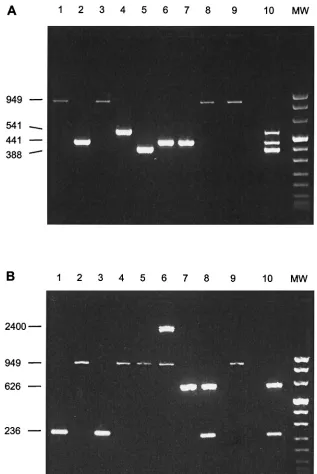
FIG. 1. PCR products obtained in multiplex PCR I (A) or multiplex PCR II (B) with purified chromosomal DNA (1 ng) of eightS. suisstrains spiked with 10 fg of pGL2-Basic vector. Samples were separated on a 2% agarose gel stained with ethidium bromide. Lane designations are indicated.S. suisserotype 1/2, strain 5209 (lane 1);S. suisserotype 1, strain 5210 (lane 2);S. suisserotype 2 (EF*-positive), strain 5211 (lane 3); S. suisserotype 7, strain 5216 (lane 4);S. suisserotype 9, strain 5218 (lane 5);S. suisserotype 14, strain 5223 (EF*-positive) (lane 6);S. suistype 1 (EF-positive), strain 6388 (lane 7);S. suistype 2 (EF-positive), strain 4005 (lane 8); negative control (withoutS. suisDNA) (lane 9); mixture of chromosomal DNA (1 ng) of strains in lanes 1 to 8 (lane 10). Lane MW contains DNA molecular size markers (0.019 to 1.11 kbp; Roche); the sizes (in base pairs) of the PCR products are indicated on the left.
VOL. 40, 2002 S. SUIS MULTIPLEX PCR ASSAYS 2923
on May 15, 2020 by guest
http://jcm.asm.org/
MATERIALS AND METHODS
Bacteria and growth conditions.Reference strains ofS. suisserotypes 1/2 and 1 to 34 (5, 6, 8, 14), EF-positive strains ofS. suisserotypes 1 (strain 6388) and 2 (strain 3), serotype 2 strains belonging to the five different EF* classes (20, 23, 27), 18 other streptococcal strains belonging to Lancefield groups A to E, G, L, P, and Q, and 24 bacterial strains belonging to the genera Staphylococcus, Micrococcus,Aerococcus,Actinobacillus,Bordetella,Escherichia,Pasteurella, Pro-teus,Salmonella, andSerratia, and a yeast, aCryptococcussp. (collection ID-Lelystad), were used in this study.
Strains were plated on Columbia blood agar plates (code CM 331; Oxoid Ltd. Inc. Columbia, Md.) supplemented with 6% horse blood and grown overnight at 37°C in air with 5% CO2. Colonies were inoculated in Todd-Hewitt broth (code
CM 189; Oxoid) and grown overnight at 37°C.
[image:3.587.138.451.72.339.2]Tonsillar specimens.Tonsils from 38 pigs obtained from 28 farms were col-lected at the Animal Health Service, Boxtel, The Netherlands, and stored at ⫺20°C. All pigs showed clinical signs of disease such as meningitis, sepsis, pneumonia, or arthritis.S. suisstrains were isolated from tissues typically af-fected byS. suissuch as brains, organs, lungs, or joints.
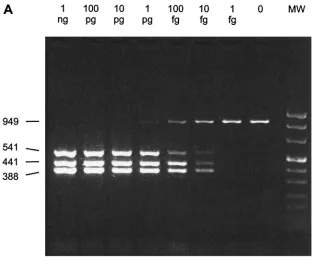
FIG. 2. Sensitivity of multiplex PCR I (A) and II (B) on a mixture of chromosomal DNAs ofS. suisserotype 1, 7, and 9 (A) or on an EF-positive S. suisserotype 2 strain (B). Samples were separated on a 2% agarose gel stained with ethidium bromide. The amount of target DNA tested in the PCR assays is indicated above the lanes. All samples contained 10 fg of positive control DNA. Lane MW contains DNA molecular size markers; the sizes (in base pairs) of the PCR products are indicated on the left.
on May 15, 2020 by guest
http://jcm.asm.org/
Tonsillar specimens were prepared for PCR by the multiscreen method as described previously (28).
To evaluate the results obtained with the multiplex PCR assays,S. suis sero-type 1 (and 14), 2 (and 1/2), 7, and 9 and EF-positiveS. suisstrains were directly isolated from the tonsillar specimens with a bacteriological examination (28). To do this, tonsillar specimens were plated, and colonies were lifted onto sterilized GeneScreen Plus membranes (New England Nuclear Corp., Boston, Mass.) and hybridized with serotype-specificcpsprobes or anepf-specific probe (see below). Hybridizing colonies were subcultured, characterized and serotyped by standard procedures (4, 26).
PCR conditions.Oligonucleotide primers used in the multiplex PCR assays for the detection ofS. suisserotype 1 (and 14), 2 (and 1/2), and 9 and EF-positiveS. suisstrains were as described before (22, 28), except for the reverse primer in the serotype 2-specific PCR. The new primer has the sequence 5⬘-CATTTCCTAA GTCTCGCACC-3⬘and corresponds to positions 14027 to 14008 in thecps2J gene (22). The primers used for the detection of serotype 7 strains correspond to positions 3185 to 3206 and 3726 to 3705 in the serotype 7-specificcpsgene (21). The sequences were 5⬘-GAATCAATCCAGTCAGTGTTGG-3⬘and 5⬘-CTAA TTCGATACGAAGCTAAAC-3⬘.
In multiplex PCR I, primers specific for serotype 1 (and 14), 7, and 9 strains were combined. Amplified fragments are 441, 541, and 388 bp in length, respec-tively. In multiplex PCR II, primers specific for serotype 2 and EF-positive strains were combined. In this PCR, amplified fragments are 236 and 626 bp in length, respectively.
To control for failure of DNA amplification and to confirm the reliability of the PCR assays, each sample was spiked with a positive control template. For this, the pGL2-Basic vector (Promega, Madison, Wis.) encoding the firefly lu-ciferase gene (luc) was used. Oligonucleotide primers amplifying a part of theluc gene, corresponding to positions 723 to 744 and 1672 to 1651 on the pGL2-Basic vector, had the sequences 5⬘-CGTCAGATTCTCGCATGCCAGA-3⬘and 5⬘-T TGCGTCGAGTTTTCCGGTAAG-3⬘. This resulted in a PCR product of 949 bp.
As the template for PCR, we used 1 ng of purified chromosomal DNA (16) from bacterial strains or 25l of clinical sample prepared for PCR as described above. The reaction mixtures (50l) contained 10 mM Tris-HCl (pH 8.3), 2 mM MgCl2, 50 mM KCl, 0.2 mM each of the four deoxynucleotide triphosphates, 0.4
M each of the primers, and 1.5 U of AmpliTaq Gold DNA polymerase (Perkin Elmer Applied Biosystems, Roche Molecular Systems, Branchburg, N.J.).
PCR mixtures were overlaid with two drops of mineral oil. DNA amplification was carried out in microplates (Thermowell H; Corning Costar, Cambridge, Mass.) in a DNA thermal cycler (Omnigene; Hybaid, Teddington, Middlesex, United Kingdom). The program used for multiplex PCR I consisted of incuba-tion for 10 min at 95°C and 40 cycles of 0.45 min at 94.8°C, 1.10 min at 60°C, and 3 min at 72°C, followed by incubation for 10 min at 72°C. The program used for multiplex PCR II consisted of incubation for 10 min at 95°C and 40 cycles of 0.45 min at 94.8°C, 1.10 min at 63°C, and 1.20 min at 72°C, followed by incubation for 10 min at 72°C. Then 20l of the PCR products was separated by electrophoresis on 2% agarose gels, stained with ethidium bromide (0.25g/ml), and photo-graphed under UV light.
Hybridization.Reference strains ofS. suisserotypes 1, 2, 7, and 9 and strain 3 (EF-positive) were used in individual PCR assays to amplify serotype 1-, 2-, 7-, and 9-specifccpsfragments and anepf-specific fragment, respectively. These fragments were purified from the amplification products with a High Pure PCR product purification kit (Roche) and labeled with [␣-32P]dCTP (3,000 Ci
mmol⫺1; Amersham Corp., Arlington Heights, Ill.) by use of a random primed
labeling kit (Roche). The DNA on the blots was hybridized at 65°C with appro-priate DNA probes, as recommended by the supplier of the GeneScreen Plus membranes. After hybridization, the membranes were washed twice with a so-lution of 40 mM sodium phosphate (pH 7.2)–1 mM EDTA–5% sodium dodecyl sulfate for 30 min at 65°C and twice with a solution of 40 mM sodium phosphate (pH 7.2)–1 mM EDTA–1% sodium dodecyl sulfate for 30 min at 65°C.
DNA sequence analysis.DNA sequences were determined on an ABI Prism 3700 DNA analyzer system (Perkin Elmer Applied Biosystems). Samples were prepared by use of an ABI Prism BigDye terminator cycle sequencing ready reaction kit (Perkin Elmer Applied Biosystems).
Statistical analysis.For each serotype, the association between clinical disease and tonsillar carriership was assessed by Fisher’s exact test on independence in 2 by 2 tables. APvalue smaller than 0.05 was considered significant. These tests were carried out with StatXact 4 for Windows (Cytel Software Corporation, Cambridge, Mass.).
RESULTS
Specificity of the multiplex PCR assays.To test the
speci-ficity of the multiplex PCR assays, PCRs were performed on
the various S. suis reference strains and on a panel of 18
streptococcal and 24 nonstreptococcal strains. As shown in Fig. 1A and B, PCR products of the predicted sizes were obtained
on chromosomal DNAs (1 ng) of theS. suisserotype 1/2, 1, 2,
7, 9, and 14 and EF-expressing strains. Multiplex PCR II am-plified a fragment of about 2,400 bp of chromosomal DNA of theS. suisserotype 14 strain (Fig. 1B, lane 6). This indicates
the presence of an S. suis strain expressing an EF* protein.
Multiple amplification products were observed in a mixture of chromosomal DNA of the above-mentioned eight strains (Fig. 1A and B, lane 10). No amplification products were obtained
on any of the otherS. suisserotypes or on any of the other
strains examined (results not shown). This indicates that the
multiplex PCR assays are highly specific for the detection ofS.
suis serotype 1, 2, 1/2, 7, 9, and 14 and EF-positive S. suis
strains.
As expected, in the negative control (without chromosomal
S. suisDNA), an amplification product of the internal positive control was detected (Fig. 1A and B, lane 9). No interference was observed between the internal positive control primer set
with chromosomal DNA (1 ng) of theS. suisreference strains
and vice versa between theS. suis primer sets and internal
positive control DNA (1 ng) (results not shown).
We also used the multiplex PCR II on chromosomal DNA of EF*-producing serotype 2 strains. In addition to the serotype
2-specific cps PCR products, epf* PCR products of various
sizes (1,278, 1,505, 2,313, 2,537, and 2,993 bp) were expected (28). However, a faint amplification product was obtained on chromosomal DNA of the strain expressing the smallest EF* protein, whereas no amplification products could be detected in the other EF*-producing strains (results not shown). Ap-parently, multiplex PCR II is not able to efficiently detect EF*-producing strains.
Sensitivity of the two multiplex PCR assays.The
sensitiv-ity of the multiplex PCR assays was determined with
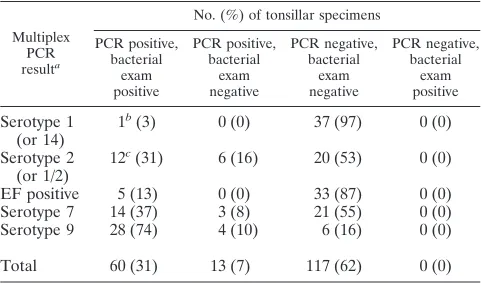
chro-TABLE 1. Comparison of multiplex PCR assays and bacteriological examination for 38 tonsillar specimens from diseased pigs
Multiplex PCR resulta
No. (%) of tonsillar specimens
PCR positive, bacterial exam positive PCR positive, bacterial exam negative PCR negative, bacterial exam negative PCR negative, bacterial exam positive Serotype 1 (or 14) 1
b(3) 0 (0) 37 (97) 0 (0)
Serotype 2 (or 1/2) 12
c(31) 6 (16) 20 (53) 0 (0)
EF positive 5 (13) 0 (0) 33 (87) 0 (0) Serotype 7 14 (37) 3 (8) 21 (55) 0 (0) Serotype 9 28 (74) 4 (10) 6 (16) 0 (0)
Total 60 (31) 13 (7) 117 (62) 0 (0)
aSimilar PCR products were amplified forS. suisserotype 1 and 14 strains and
for serotype 2 and 1/2 strains due to common capsular genes (18).
bS. suisserotype 14 strain as detected by bacteriological examination. cS. suisserotype 1/2 (7 of 12) and EF-positiveS. suisserotype 2 strains (5 of
12) as detected by bacteriological examination.
VOL. 40, 2002 S. SUIS MULTIPLEX PCR ASSAYS 2925
on May 15, 2020 by guest
http://jcm.asm.org/
[image:4.587.301.542.93.235.2]mosomal DNA of S. suis serotype 1, 2, 7, and 9 and an EF-positive serotype 2 strain. In both multiplex PCR as-says, 10 fg of chromosomal DNA of the various serotypes and phenotypes was sufficient to amplify a fragment which could easily be detected by eye on an agarose gel (Fig. 2A and B).
Evaluation of the multiplex PCR assays.We subsequently
analyzed tonsillar specimens by multiplex PCR assays and by bacteriological examination (28) to compare the two tests. The results are summarized in Table 1, and several examples are
shown in Fig. 3A and B. All tonsillar specimens bacteriologi-cally positive for a specific serotype or phenotype were also positive in the corresponding PCR. Moreover, tonsils negative in the multiplex PCR for a specific serotype or phenotype were also negative for this particular serotype or phenotype with the bacteriological method. Some samples positive in the multiplex PCR tested bacteriologically negative (3 of 17 for serotype 7, 4 of 28 for serotype 9, and 6 of 18 for serotype 2 [and 1/2]). This suggests that, especially for serotype 2 (and 1/2), the PCR method is more sensitive than the bacteriological examination.
FIG. 3. PCR products in multiplex PCR I (A) and multiplex PCR II (B) obtained directly on tonsillar specimens collected from diseased pigs carrying serotype 1 (and 14), 2 (and 1/2), 7, and 9 and EF-positiveS. suisstrains as detected by bacteriological examination. PCR products were obtained from tonsillar specimens collected from pigs carryingS. suisserotype 1/2 (lane 1);S. suisserotype 7 (lane 2);S. suisserotype 9 (lane 3); S. suisserotype 7 and 9 strains (lane 4);S. suisserotype 7 and 14 strains (lane 5);S. suisserotype 1/2 and 9 strains (lane 6);S. suisserotype 2 (EF-positive phenotype) and 7 strains (lane 7);S. suisserotype 2 (EF-positive phenotype) and 9 strains (lane 8); andS. suisserotype 1/2, 7, and 9 strains (lane 9). All samples contained 10 fg of positive control DNA. Lane MW contains DNA molecular size markers; the sizes (in base pairs) of the PCR products are indicated on the left.
on May 15, 2020 by guest
http://jcm.asm.org/
To corroborate this and to exclude false-positive PCR results, we repeatedly tested the samples both by PCR and by bacte-riological examination. The same results were obtained. More-over, the specificity of the serotype 2 PCR product of samples, which could not be confirmed bacteriologically, was further examined by sequence analysis and cross-hybridization exper-iments. All fragments showed the expected serotype 2-specific sequence and hybridized specifically with the serotype 2-spe-cific probe (data not shown). From these data, we conclude that the multiplex PCR assays are more sensitive than the bacteriological examination.
Comparison of serotypes isolated from tonsils and affected
tissues of diseased pigs.We next compared the results of the
serotypes found by PCR in tonsillar specimens of diseased pigs and the serotypes of the strains isolated from the affected tissues of the same pigs. Table 2 shows that in 89% (34 of 38)
of the cases, anS. suisstrain in the tonsils belonged to the same
serotype as the disease-causing strain. For some serotypes, a
significant (P⬍0.05) association between clinical illness and
carrier state could be found. Four of five pigs carrying
EF-positiveS. suisserotype 2 strains and most of the pigs (27 of 32)
carrying a serotype 9 strain were also clinically ill due to such a strain. Such an association was not found in EF-negative serotype 2 (and 1/2) and 7 strains. One and two pigs suffered from serotype 1/2 and 7 infections, respectively, whereas 13 and 17 pigs, respectively, carried these bacteria on their tonsils. This could indicate that compared to the EF-positive serotype 2 and serotype 9 strains, EF-negative serotype 2 (and 1/2) and 7 strains are less virulent.
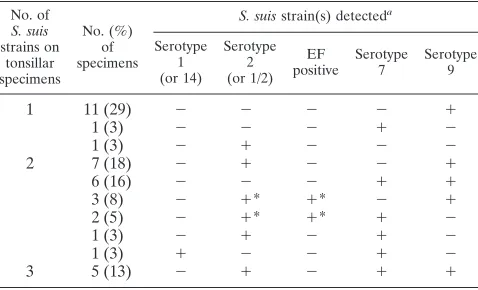
Multiple serotypes in tonsillar specimens from pigs.In 66%
(25 of 38) of the tonsillar specimens examined, two or moreS.
suisstrains were identified by the multiplex PCR assays on the
same tonsillar specimen (Table 3). Most frequently, a combi-nation of serotypes 9 and 2 (and 1/2) (18%) and serotypes 9 and 7 (16%) strains were detected by the multiplex PCR as-says. In five (13%) of the tonsillar samples, the multiplex PCR
assays identified S. suis strains belonging to three different
serotypes, serotypes 2 (and 1/2), 7, and 9.
DISCUSSION
We previously showed that a PCR based on the epfgene
specifically detects virulent strains of S. suis serotype 2 and
highly virulent strains ofS. suisserotype 1 (28). In addition,
PCR assays on the serotype-specificcpsgenes ofS. suis
sero-types 1, 2, 7, and 9 specifically identifiedS. suisserotype 1 (and
14), 2 (and 1/2), 7, and 9 strains (21, 22). In the present study, we improved the diagnostic value of these PCR methods by a multiplex approach. In two separate reactions, we could easily identify serotype 1 (and 14), 7, and 9 (multiplex PCR I) as well
as serotype 2 (and 1/2) and EF-positiveS. suisstrains
(multi-plex PCR II). The multi(multi-plex PCR assays are easy to perform and allow large-scale application; 96 samples can be processed simultaneously. Compared to standard bacteriological assays, the PCR assays are much more rapid to perform. Therefore, these assays may be important diagnostic tools to detect pigs carrying the most frequently isolated serotypes and
virulence-associated phenotypes ofS. suis. It may be applicable for
ep-idemiological and transmission studies and can contribute to
efforts to control or eradicateS. suisinfections.
Evaluation of the multiplex PCR assays with tonsillar spec-imens from diseased pigs showed that both assays are highly specific and sensitive. The bacteriological examination con-firmed most (94%) of the results obtained with the multiplex PCR assays. The PCR method seemed to be more sensitive than the bacteriological method, since 13 of 73 samples posi-tive by PCR were negaposi-tive by bacteriological examination. Low levels of bacterial cells (live or dead) in the tonsillar specimens may explain the differences in results obtained with the two
methods.S. suisstrains producing an EF* protein yielded in
multiplex PCR II only the serotype 2 products, although larger
epf* PCR products of various sizes were also expected (28).
Apparently, in the multiplex PCR, theepf* gene was far less
efficiently amplified than the 236-bp amplicon of the serotype
2-specificcpsgene. Since the frequency ofS. suisstrains
iso-lated from diseased pigs which produce the EF* protein is very low (29), detecting strains producing an EF* protein in the multiplex PCR is a not a necessity.
[image:6.587.302.541.93.238.2]In the bacteriological examination, we isolated serotype 1/2
TABLE 2. S. suisstrains isolated from affected tissues compared withS. suisstrains detected by multiplex PCR assays on tonsils from
38 diseased pigs
S. suisstrain
No. of pigs in which bacteria were:
Isolated from affected tissues Detected by PCR on tonsils Isolated from affected tissues and detected by PCR on tonsils
Serotype 1 (or 14) 1 0 0
Serotype 2 (or 1/2)a 1 13 1
EF positive 4 5 4
Serotype 7 2 17 2
Serotype 9a 29 32 27
NTb 1 0 0
Total 38 61 34
[image:6.587.42.284.102.251.2]aSignificant association between clinical disease and tonsillar carriership. bNT, nontypeable.
TABLE 3. Multiple serotypes ofS. suisstrains in tonsillar specimens from diseased pigs as detected by multiplex PCR assays
No. of S. suis strains on tonsillar specimens No. (%) of specimens
S. suisstrain(s) detecteda
Serotype 1 (or 14) Serotype 2 (or 1/2) EF
positive Serotype7 Serotype9
1 11 (29) ⫺ ⫺ ⫺ ⫺ ⫹
1 (3) ⫺ ⫺ ⫺ ⫹ ⫺
1 (3) ⫺ ⫹ ⫺ ⫺ ⫺
2 7 (18) ⫺ ⫹ ⫺ ⫺ ⫹
6 (16) ⫺ ⫺ ⫺ ⫹ ⫹
3 (8) ⫺ ⫹* ⫹* ⫺ ⫹
2 (5) ⫺ ⫹* ⫹* ⫹ ⫺
1 (3) ⫺ ⫹ ⫺ ⫹ ⫺
1 (3) ⫹ ⫺ ⫺ ⫹ ⫺
3 5 (13) ⫺ ⫹ ⫺ ⫹ ⫹
aS. suisserotype 1 (and 14), 7, and 9 strains were detected by multiplex PCR
I, andS. suisserotype 2 (and 1/2) and EF-positiveS. suisstrains were detected by multiplex PCR II.⫺, negative result;⫹, positive result; *, tonsillar specimens which contained an EF-positive serotype 2 strain.
VOL. 40, 2002 S. SUIS MULTIPLEX PCR ASSAYS 2927
on May 15, 2020 by guest
http://jcm.asm.org/
and 14 strains which hybridized specifically with the serotype 2 and 1 probes, respectively. In early studies it was shown that serotype 1/2 strains cross-react in agglutination tests with an-tiserum against serotype 1 and serotype 2 strains (13). For serotype 1 and 14 strains, a one-way capsular cross-reaction in agglutination tests was described (6).
A significant association between carriership and clinical
illness was observed for S. suis serotype 9 and EF-positive
strains and not for serotype 7 and EF-negative serotype 2 (or 1/2) strains. This could indicate that, compared to serotype 9 and EF-positive strains, serotype 7 and EF-negative serotype 2 (or 1/2) strains are less virulent. This idea corresponds well with the observation that in The Netherlands, serotype 9 and EF-positive strains were more frequently isolated from dis-eased pigs than serotype 7 and EF-negative serotype 2 (or 1/2) strains (29). Moreover, our data confirmed earlier studies in-dicating that EF-negative serotype 2 and 1/2 strains are possi-bly less or nonvirulent for pigs compared to EF-positive
sero-type 2 strains (27, 29). A role for EF in the virulence ofS. suis
serotype 7 strains is not very likely because it was found in recent studies that all serotype 7 strains isolated from diseased pigs were EF-negative (1, 29). Whether the serotype 7 strains detected by the multiplex PCR assays in this study are less virulent than serotype 9 or EF-positive serotype 2 strains or whether these strains are totally nonvirulent is unknown. Ex-perimental infections in pigs will be necessary to examine the virulence of the serotype 7 strains.
So far, the multiplex PCR assays have been carried out on specimens consisting of tonsillar specimens from pigs. How-ever, for routine detection of carriers, tonsillar swab specimens from live animals would be preferred as a sampling method. Our experience is that the PCR assay is applicable to tonsillar swab specimens from live pigs, perhaps with a slightly lower sensitivity (24). Nevertheless, additional experiments in which carrier rates obtained on whole tonsils are compared with those on tonsillar swabs and tonsillar biopsies are necessary.
MultipleS. suisserotypes were found on tonsils of diseased
pigs. Earlier, it was found that pigs can be infected with
mul-tiple serotypes ofS. suis(15, 17). These findings may account
in part for the difficulty in disease control by vaccines. At present, for control of the disease by vaccines, autogenous bacterins are used. It seemed that these vaccines confer pro-tection only against challenge with strains of a homologous serotype (10). It can be hypothesized that a bacterin vaccine prepared from one serotype may suppress clinical disease caused by that particular serotype, but that new outbreaks
caused by S. suis strains belonging to other serotypes may
occur. Therefore, identification of specific strains, not only those involved in clinical disease in infected herds but also those involved in the carrier state, may be needed to provide adequate control measures. The current multiplex PCR assays can contribute to such an approach.
ACKNOWLEDGMENTS
We gratefully acknowledge K. Peperkamp, Animal Health Service, Boxtel, The Netherlands, for kindly collecting and providing tonsillar specimens.
REFERENCES
1.Allgaier, A., R. Goethe, H. J. Wisselink, H. E. Smith, and P. Valentin Weigand.2001. Relatedness ofStreptococcus suisisolates of various
sero-types and clinical backgrounds as evaluated by macrorestriction analysis and expression of potential virulence traits. J. Clin. Microbiol.39:445–453. 2.Arends, J. P., N. Hartwig, M. Rudolphy, and H. C. Zanen.1984. Carrier rate
ofStreptococcus suiscapsular type 2 in palatine tonsils of slaughtered pigs. J. Clin. Microbiol.20:945–947.
3.Chengappa, M. M., L. W. Pace, J. A. Williams, C. H. Herren, and S. E. Ascher.1990. Efficacy of tiamulin against experimentally induced Streptococ-cus suistype-2 infection in swine. J. Am. Vet. Med. Assoc.197:1467–1470. 4.Devriese, L. A., K. Ceyssens, J. Hommez, R. Kilpper Balz, and K. H. Schleifer.
1991. Characteristics of differentStreptococcus suisecovars and description of a simplified identification method. Vet. Microbiol.26:141–150. 5.Gottschalk, M., R. Higgins, M. Jacques, M. Beaudoin, and J. Henrichsen.
1991. Characterization of six new capsular types (23 through 28) of Strepto-coccus suis. J. Clin. Microbiol.29:2590–2594.
6.Gottschalk, M., R. Higgins, M. Jacques, K. R. Mittal, and J. Henrichsen.
1989. Description of 14 new capsular types ofStreptococcus suis. J. Clin. Microbiol.27:2633–2636.
7.Gottschalk, M., S. Lacouture, and L. Odierno.1999. Immunomagnetic iso-lation ofStreptococcus suisserotypes 2 and 1/2 from swine tonsils. J. Clin. Microbiol.37:2877–2881.
8.Higgins, R., M. Gottschalk, M. Boudreau, A. Lebrun, and J. Henrichsen.
1995. Description of six new capsular types (29–34) ofStreptococcus suis. J. Vet. Diagn. Investig.7:405–406.
9.Higgins, R., M. Gottschalk, K. R. Mittal, and M. Beaudoin.1990. Strepto-coccus suisinfection in swine. A sixteen month study. Can. J. Vet. Res.
54:170–173.
10.Kebede, M., M. M. Chengappa, and J. G. Stuart.1990. Isolation and char-acterization of temperature-sensitive mutants ofStreptococcus suis: efficacy trial of the mutant vaccine in mice. Vet. Microbiol.22:249–257.
11.Lamont, M. H., P. T. Edwards, and R. S. Windsor.1980. Streptococcal meningitis in pigs: results of a five-year survey. Vet. Rec.107:467–469. 12.Mwaniki, C. G., I. D. Robertson, and D. J. Hampson.1994. The prevalence
ofStreptococcus suistype 2 in Western Australian piggeries. Aust. Vet. J.
71:385–386.
13.Perch, B., E. Kjems, P. Slot, and K. B. Pedersen.1981. Biochemical and serological properties of R, S, and RS streptococci. Acta Pathol. Microbiol. Scand. B89:167–171.
14.Perch, B., K. B. Pedersen, and J. Henrichsen.1983. Serology of capsulated streptococci pathogenic for pigs: six new serotypes ofStreptococcus suis. J. Clin. Microbiol.17:993–996.
15.Reams, R. Y., D. D. Harrington, L. T. Glickman, H. L. Thacker, and T. L. Bowersock.1996. Multiple serotypes and strains ofStreptococcus suisin naturally infected swine herds. J. Vet. Diagn. Investig.8:119–121. 16.Sambrook, J., E. F. Fritsch, and T. Maniatis.1989. Molecular cloning: a
laboratory manual. Cold Spring Harbor Laboratory, Cold Spring Harbor, N.Y.
17.Sihvonen, L., D. N. Kurl, and P. Salmela.1986. Infection withStreptococcus suisserotypes 1 and 2 in the same diseased pig. Acta Vet. Scand.27:626–628. 18.Smith, H. E., M. Damman, J. van der Velde, F. Wagenaar, H. J. Wisselink, N. Stockhofe-Zurwieden, and M. A. Smits.1999. Identification and charac-terization of the cpslocus ofStreptococcus suis serotype 2: the capsule protects against phagocytosis and is an important virulence factor. Infect. Immun.67:1750–1756.
19.Smith, H. E., R. de Vries, R. van’t Slot, and M. A. Smits.2000. Thecpslocus ofStreptococcus suisserotype 2: genetic determinant for the synthesis of sialic acid. Microb. Pathog.29:127–134.
20.Smith, H. E., F. H. Reek, U. Vecht, A. L. Gielkens, and M. A. Smits.1993. Repeats in an extracellular protein of weakly pathogenic strains of Strepto-coccus suistype 2 are absent in pathogenic strains. Infect. Immun.61:3318– 3326.
21.Smith, H. E., L. van Bruijnsvoort, H. Buijs, H. J. Wisselink, and M. A. Smits.
1999. Rapid PCR test forStreptococcus suisserotype 7. FEMS Microbiol. Lett.178:265–270.
22.Smith, H. E., V. Veenbergen, J. van der Velde, M. Damman, H. J. Wisselink, and M. A. Smits.1999. Thecpsgenes ofStreptococcus suisserotypes 1, 2, and 9: development of rapid serotype-specific PCR assays. J. Clin. Microbiol.
37:3146–3152.
23.Stockhofe-Zurwieden, N., U. Vecht, H. J. Wisselink, H. van Lieshout, and H. E. Smith.1996. Comparative studies on the pathogenicity of different Streptococcus suisserotype 1 strains, p. 299.InP. G. Monetti and G. Vignola (ed.), Proceedings of the 14th International Pig Veterinary Society Congress. University of Bologna, Bologna, Italy.
24.Swildens, B., H. J. Wisselink, H. E. Smith, and J. H. M. Verheijden.2000. Tonsillar swabs can be used in a PCR assay for the detection of virulent Streptococcus suisserotype 2 strains in weaned piglets, p. 535.InC. Cargill and S. McOrist (ed.), Proceedings of the 16th International Pig Veterinary Society Congress, Melbourne, Australia.
25.Van Leengoed, L. A., U. Vecht, and E. R. M. Verheyen.1987.Streptococcus suistype 2 infections in pigs in the Netherlands (part two). Vet. Q.9:111– 117.
on May 15, 2020 by guest
http://jcm.asm.org/
26.Vecht, U., L. A. van Leengoed, and E. R. M. Verheijen.1985.Streptococcus suisinfections in pigs in the Netherlands (part one). Vet. Q.7:315–321. 27.Vecht, U., H. J. Wisselink, J. E. van Dijk, and H. E. Smith.1992. Virulence
ofStreptococcus suistype 2 strains in newborn germfree pigs depends on phenotype. Infect. Immun.60:550–556.
28.Wisselink, H. J., F. H. Reek, U. Vecht, N. Stockhofe-Zurwieden, M. A. Smits, and H. E. Smith.1999. Detection of virulent strains ofStreptococcus suistype
2 and highly virulent strains ofStreptococcus suistype 1 in tonsillar specimens from pigs by PCR. Vet. Microbiol.67:143–157.
29.Wisselink, H. J., H. E. Smith, N. Stockhofe-Zurwieden, K. Peperkamp, and U. Vecht.2000. Distribution of capsular types and production of murami-dase-released protein (MRP) and extracellular factor (EF) ofStreptococcus suisstrains isolated from diseased pigs in seven European countries. Vet. Microbiol.74:237–248.
VOL. 40, 2002 S. SUIS MULTIPLEX PCR ASSAYS 2929