R E S E A R C H A R T I C L E
Open Access
Association of the UCP-1 single nucleotide
polymorphism A-3826G with the
dampness-phlegm pattern among Korean
stroke patients
Ji Hye Lim, Mi Mi Ko, Tae-Woong Moon, Min Ho Cha
*and Myeong Soo Lee
Abstract
Background:Patients with stroke have various syndromes and symptoms. Through pattern identification (PI), traditional Korean medicine (TKM) classifies the several syndromes and symptoms of stroke patients into five categories: Fire-heat (FH), Dampness-phlegm (DP), Yin-deficiency (YD), Qi-deficiency (QD) and Blood-stasis (BS). DP has been associated with obesity and hyperlipidemia. Uncoupling protein-1 (UCP-1), which plays a major role in thermogenesis and energy expenditure can increase the risk of obesity and can be related metabolic disorders. In this study, we elucidated the association of three polymorphisms located in the UCP-1 promoter and coding region with DP among Korean stroke patients.
Methods:1,593 patients with cerebral infarction (583/DP, 1,010/non-DP) and 587 normal subjects were enrolled. The genotypes A-3826G, G-1766A and Ala64Thr (G+1068A) for each subject were determined by polymerase chain reaction with TaqMan probes and five percent of subjects were re-genotyped by sequencing method to confirm the accuracy of genotyping. The results were analyzed using a multiple logistic regression model to evaluate the genetic associations: the UCP-1polymorphisms of normal versus those of DP subjects and those of normal versus those of non-DP subjects.
Results:A significantly higher percentage of subjects in the DP group possessed the A-3826G G allele than the A allele (OR=1.508, p=0.006). Furthermore, the number of subjects with the GG type of A-1766G was significantly lower in the non-DP group than the normal group in the recessive model (OR=0.606, p=0.042). In addition, an analysis of the relationship among 2 SNPs of UCP-1 and lipid serum concentration showed that the serum level of HDL cholesterol was significantly higher in subjects with the A-3826G G allele in the normal group (p=0.032). Serum triglyceride and HDL cholesterol were also associated with the A-1766G variant in the recessive model (p=0.002, p=0.046).
Conclusions:These results suggest that that the A-3826G and A-1766G UCP-1 polymorphisms, which are related to obesity, might be candidate genetic markers for the DP pattern in the TKM diagnosis system.
Keywords:UCP-1, Polymorphism, Dampness-phlegm, A-3826G, A-1766G, Ala64Thr, Triglyceride
* Correspondence:[email protected]
Medical Research Division, Korea Institute of Oriental Medicine, 1672 Yuseongdae-ro, Yuseong-gu, Daejeon 305-811, Republic of Korea
Background
Uncoupling protein-1 (UCP-1) is a mitochondrial transporter that is present in the mitochondrial inner membrane, and it functions in ATP synthesis by dissi-pating oxidative energy from brown adipose tissue (BAT) [1,2]. The metabolic activities of BAT are related to the gene quantity of UCP-1 and the extent of stimu-lation of the sympathetic nervous system (SNS). Thus, polymorphism of the UCP-1 gene could have an ad-verse effect on energy homeostasis because of reduced mRNA expression [3].
UCP-1 plays important roles in energy homeostasis, and UCP-1 gene polymorphisms have been implicated in the pathogenesis of obesity and related metabolic disor-ders, including lipid disorders [3,4]. An A-3826G poly-morphism within the promoter region of the UCP-1 gene is a candidate gene polymorphic site related to these disorders. The G allele of A-3826G was reported to be associated with higher body fat gain, increased BMI, and reduced postprandial thermogenesis by Nagai et al. and Oppert et al. [4,5] and also known to be related with resistance against diet-induced weight loss, reduced resting energy expenditure (REE) in young women, reinforcing the metabolic action of BAT and its effect on resting energy balance in adults [6]. The A-1766G, which was found from Korean women, was also related with body fat mass and abdominal fat, and haplo-type (GAG) constructed by A-3826G, A-1766G and Ala64Thr was shown to be associated with less reduc-tion of waist-hip ratio (WHR) and body fat mass than in non-carriers among Korea women [5-7]. The Ala64Thr (G+1068A) is also known to be associated with increased WHR among Caucasians as well as lower fat content and WHR [8].
Traditional Korean medicine (TKM) is built on a med-ical foundation of comprehensive, integrated and holistic approaches. Pattern Identification (PI) in TKM is a unique diagnostic system that uses a comprehensive analysis on symptoms and signs [9], and is being cate-gorized stroke into five PI: Fire-heat (FH), Qi-deficiency (QD), Dampness-phlegm (DP), Yin-deficiency (YD), and Blood-stasis (BS) [10-12]. Among these patterns, the DP pattern occurs by the prevention of Qi-blood circulation in the body, resulting in a pathological product due to various mechanisms [12]. Subjects with the DP tend to be obese and to have dyslipidemia, which is one of the causes of coronary disease [13,14].
Recently, TKM research reported a relationship be-tween single nucleotide polymorphisms (SNP) in the Paraoxonase 1 (PON1) or Neuropeptide Y (NPY) and DP pattern [15,16]. The C-2033T and L55M polymorph-isms of PON1 were related with low antioxidant capacity and serum lipid levels with obese subjects in the DP group [15]. NPY, which is widely expressed in central
and peripheral nervous systems, the T allele of C-399T has a negative association with DP pattern by decreased levels of serum cholesterol, which were significantly higher in DP group [16]. In this study, we investigated the genetic distribution of the 3 SNPs of UCP-1 among Korean stroke patients with cerebral infarction (CI) DP or non-DP group and compared with normal group.
Methods
Study subjects
A total of 2180 Korean subjects including 587 controls without any sign of stroke and 1593 CI patients were en-rolled in this study. In order to minimize the regional bias, the subjects were recruited from 10 Oriental Med-ical Hospitals from 2006 to 2010, including from Kyung-Hee Oriental Medical Hospital (Houeugi, Koduk in Seoul), Dae-Jeon University Oriental Medical Hospital, Wonk-Kang Oriental Medical Hospital (Jeonju, Iksan), Dong-Guk Oriental Medical Hospital (Ilsan), Kyung-Won Oriental Medical Hospital (Seoul), Dong-Sin Oriental Medical Hospital (Kwangju, Sunchon), and Sang-Ji Oriental Medical Hospital. The classification on 583 DP and 1,010 non-DP group (FH, QD, YD and BS) was performed by two TKM doctors using the Standard Pattern Identification for Stroke (K-SPI-Stroke) [17]. Patients participated in this study were diagnosed as cerebral infarction by computed tomography or mag-netic resonance imaging. CI subtypes included large ar-tery atherosclerosis (LAA), cardioembolism (CE), small vessel occlusion (SVO), stroke of other determined eti-ology (SOE) and stroke of undetermined etieti-ology (SUE) subtype according to the Trial of ORG 10172 in Acute Stroke Treatment (TOAST) classification. Individuals with signs of stroke were excluded from normal groups. Subjects with infectious disease and liver diseases were also excluded. This study was approved by the Institu-tional Review Boards of the Korean institute of Oriental Medicine and by each of the Oriental Medical Hospitals.
Laboratory analysis
Anthropometric parameters of each subject were obtained with a questionnaire described by Kang et al. [14]. The level of serum parameters including fasting blood sugar (FBS), total cholesterol (TC), triglyceride (TG) and high density lipoprotein (HDL-C) were determined by auto-mated biochemical analyzer (Olympus AU400,Japan).
Preparation of genomic DNA and identification of SNPs
chain reaction (PCR) primers and TaqMan probes designed by ABI, Inc. (Applied Biosystems, Inc., USA). Primer information for each SNP is shown in Additional file 1: Table S1. In addition, samples for 5% of the parti-cipants were validated by sequencing to confirm the genotyping accuracy. The genotyping error rate was 0.3% according to the direct sequencing of PCR pro-ducts (data not shown). The kappa value of each SNP ranged from 0.93 to 100, which indicates good accuracy. The Hardy-Weinberg equilibrium (HWE) was calculated usingχ2tests, and a linkage disequilibrium (LD) analysis was performed to examine the relationship between each SNP and was constructed by HapAnalyzer software [18].
Statistical analyses
Data were statistically analyzed with SAS software, ver-sion 9.1.3 (SAS Institute, Inc., NC). Differences in con-tinuous variables were determined by Student’st-test or Wilcoxon rank-sum test after confirming normality by a Kolmogorov-Smimov test. Categorical variables were compared with a Chi-squared test or Fisher’s exact test. Estimation of the association of SNPs with DP was per-formed by multiple logistic regression, which was adjusted for sex, age, smoking status and drinking status, as well as odds ratios (ORs), with 95% confidence inter-vals (95% CI). The effect of the A-3826G and A1766G
polymorphisms on serum lipid and sugar in the normal group was evaluated by a general linear model after adjusting for sex, age, smoking status and drinking sta-tus. Statistical significance was set at p < 0.05.
Results
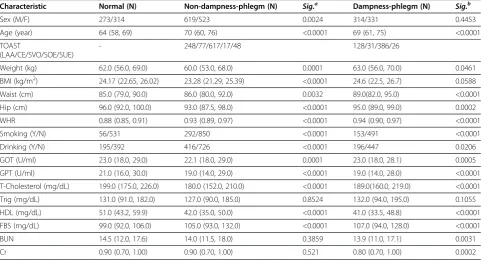
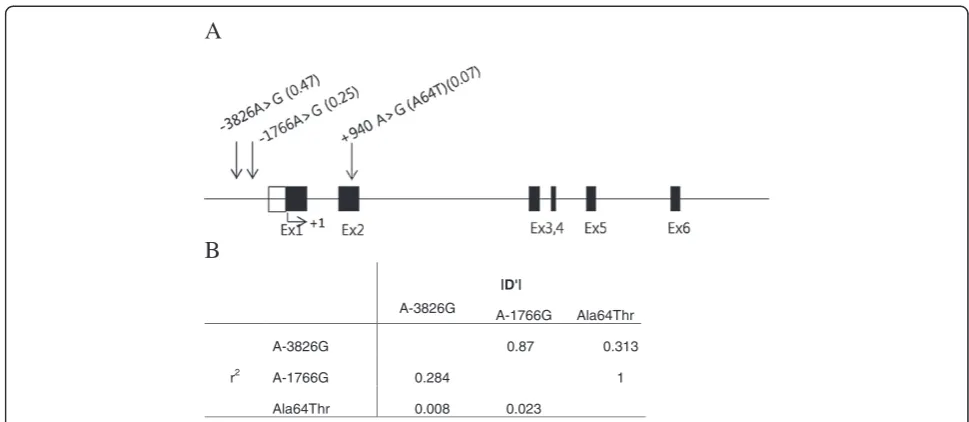
The demographic and clinical characteristics of CI patients classified as DP group or Non-DP group and normal subjects are summarized in Table 1. The results showed that body characteristics (weight, waist, and WHR) values in DP group were significantly higher than those in normal group (p< 0.0001). Additionally, serum lipid parameter (total cholesterol and triglyceride) levels were higher in the DP group than those in non-DP group. General characteristics of subjects in each pattern of Non-DP group are shown in Additional file 2: Table S2. The locations of 3 SNPs within the UCP-1 gene are shown in Figure 1(A), and their characteristics are listed in Table 2. Two of these SNPs are located in the UCP-1 promoter region, and the other SNP is located in exon 2. All of the studied SNPs satisfied the Hardy-Weinberg equilibrium (p > 0.05) according to the Inter-national HapMap Project [17]. The LD coefficients be-tween the 3 SNPs are shown in Figure 1(B). The value of r2 was 0.008-0.284, which means that the three SNPs
[image:3.595.57.539.431.691.2]were not linked. These results are consistent with
Table 1 General characteristics of the study subjects
Characteristic Normal (N) Non-dampness-phlegm (N) Sig.a Dampness-phlegm (N) Sig.b
Sex (M/F) 273/314 619/523 0.0024 314/331 0.4453
Age (year) 64 (58, 69) 70 (60, 76) <0.0001 69 (61, 75) <0.0001
TOAST
(LAA/CE/SVO/SOE/SUE)
- 248/77/617/17/48 128/31/386/26
Weight (kg) 62.0 (56.0, 69.0) 60.0 (53.0, 68.0) 0.0001 63.0 (56.0, 70.0) 0.0461
BMI (kg/m2) 24.17 (22.65, 26.02) 23.28 (21.29, 25.39) <0.0001 24.6 (22.5, 26.7) 0.0588
Waist (cm) 85.0 (79.0, 90.0) 86.0 (80.0, 92.0) 0.0032 89.0(82.0, 95.0) <0.0001
Hip (cm) 96.0 (92.0, 100.0) 93.0 (87.5, 98.0) <0.0001 95.0 (89.0, 99.0) 0.0002
WHR 0.88 (0.85, 0.91) 0.93 (0.89, 0.97) <0.0001 0.94 (0.90, 0.97) <0.0001
Smoking (Y/N) 56/531 292/850 <0.0001 153/491 <0.0001
Drinking (Y/N) 195/392 416/726 <0.0001 196/447 0.0206
GOT (U/ml) 23.0 (18.0, 29.0) 22.1 (18.0, 29.0) 0.0001 23.0 (18.0, 28.1) 0.0005
GPT (U/ml) 21.0 (16.0, 30.0) 19.0 (14.0, 29.0) <0.0001 19.0 (14.0, 28.0) <0.0001
T-Cholesterol (mg/dL) 199.0 (175.0, 226.0) 180.0 (152.0, 210.0) <0.0001 189.0(160.0, 219.0) <0.0001
Trig (mg/dL) 131.0 (91.0, 182.0) 127.0 (90.0, 185.0) 0.8524 132.0 (94.0, 195.0) 0.1055
HDL (mg/dL) 51.0 (43.2, 59.9) 42.0 (35.0, 50.0) <0.0001 41.0 (33.5, 48.8) <0.0001
FBS (mg/dL) 99.0 (92.0, 106.0) 105.0 (93.0, 132.0) <0.0001 107.0 (94.0, 128.0) <0.0001
BUN 14.5 (12.0, 17.6) 14.0 (11.5, 18.0) 0.3859 13.9 (11.0, 17.1) 0.0031
Cr 0.90 (0.70, 1.00) 0.90 (0.70, 1.00) 0.521 0.80 (0.70, 1.00) 0.0002
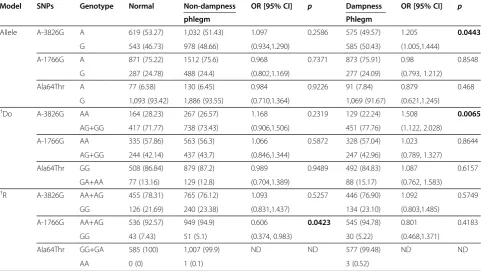
previous reports, and the SNP distribution in normal subjects was polymorphic and in accord with the HWE in Table 2. Table 3 shows the allele and genotype distri-bution of the three SNPs in the non-DP and DP groups compared with the normal groups. The percentage of subjects with the G allele of A-3826G was significantly higher in the DP group than in the normal group in the dominant model (77.76% in dampness-phlegm vs. 71.77% in normal, OR = 1.508, p = 0.006, power=85.3%). In other hand, G allele of A-1766G and A allele of Ala64Thr were previously revealed to be highly related to obesity showed little relation with obesity in this study of comparing the DP group with normal group. However, the G allele frequency of A-1766G was significantly lower in the non-DP group than the normal group in the reces-sive model (4.77% in non-dampness-phlegm vs. 5.10% in normal, OR = 0.606, p =0.0423, power=56.9%).
To confirm which factor was affected by A-3826G or A-1766G, we compared serum lipid parameters accord-ing to genotype in normal subjects (Table 4). A-3826G was associated with serum HDL-C. The mean serum HDL-C of the subjects with the GA and GG type at
the −3826 position of the UCP-1 gene was 52.74 mg/dL
and 54.63 mg/dL, respectively. These means were sig-nificantly higher than the mean serum HDL-C (50.92 mg/dL) of the subjects with the AA type in the dom-inant model (p = 0.0317, power=50.3%). The level of serum triglycerides (p = 0.0229, power=97.5%) and HDL-C (p = 0.0465, power=39.3%) was associated in the recessive model. However, parameters on obesity and serum lipids were not significantly different be-tween DP group and non-DP group (data not shown).
Discussion
A recent study published by Kim et al. explained that dampness-phlegm is an impediment to Qi, energy that circulates in channels called meridians and that causes various symptoms and signs when blocked or disrupted because of its high turbidity, heaviness, stickiness, and downward flowing properties [12,19]. In addition, DP was related to clinical indicators, such as overweight, pale tongue, and slippery pulse [12]. In TKM, DP has long been a suspected as a cause for obesity. Dong-eui-bo-gam, which are the most extensively read medical texts by TKM doctors and are praised as one of the
A
B
|D'|
A-3826G A-1766G Ala64Thr
r2
A-3826G 0.87 0.313
A-1766G 0.284 1
[image:4.595.54.539.87.298.2]Ala64Thr 0.008 0.023
Figure 1Polymorphisms in UCP-1. A) A map of the SNPs located in the 4q28-q31 locus of the UCP-1 gene. Minor allele frequencies are shown in parentheses. The translation start site is indicated by +1. Open and closed boxes represent the untranslated and translated regions,
respectively.B) Linkage distribution among the three SNPs.
Table 2 Characteristics of SNPs identified by genomic sequencing of the promoter and exon of UCP-1 in the normal group
SNP Rs No. Position Nucleotide
change
Genotype distribution (N) Minor allele frequency
HWE p
CC CR RR
A-3826G rs1800592 Promoter A>G 126 291 164 0.4673 0.8845
A-1766G rs3811791 Promoter A>G 335 201 43 0.2478 0.0974
[image:4.595.56.539.666.734.2]most important medical texts in TKM [20], declared dampness-phlegm as a main factor of obesity, stating that overweight people have an abnormal biomechanical flow and that the Qi deficiency generates cold, cold gen-erates dampness, and dampness gengen-erates phlegm, which finally leads to obesity [21]. Recently, there have been several scientific attempts to verify the relationship between DP and obesity. The study of the relationship of DP tongue diagnosis to hyperlipidemia in stroke sug-gests that serum lipid levels, such as total cholesterol, HDL cholesterol, and triglyceride, were higher in the DP group than those in the non-DP group [12]. In addition,
Min et al. reported that TC, BMI and waist
[image:5.595.57.539.112.383.2]circumference were significantly increased in DP patients [22]. A case–control study of the relationship of DP and blood lipid levels revealed that DP was signifi-cantly correlated with increased LDL cholesterol and was an independent predictor of hyperlipoproteinemia [23]. However, few studies using a genetic analysis to prove the relationship between DP and obesity have been carried out up to now. An analysis on obesity-related genotype can provide a significant insight to present scientific evidence including a number of clinical trials that show the relationship between DP and obesity. UCP-1 is a major obesity-related gene that regulates en-ergy homeostasis inside body [24]. When exposed to
Table 3 The genotype distribution of UCP-1 polymorphisms in the dampness-phlegm and non-dampness-phlegm groups compared with the normal group
Model SNPs Genotype Normal Non-dampness OR [95% CI] p Dampness OR [95% CI] p
phlegm Phlegm
Allele A-3826G A 619 (53.27) 1,032 (51.43) 1.097 0.2586 575 (49.57) 1.205 0.0443
G 543 (46.73) 978 (48.66) (0.934,1.290) 585 (50.43) (1.005,1.444)
A-1766G A 871 (75.22) 1512 (75.6) 0.968 0.7371 873 (75.91) 0.98 0.8548
G 287 (24.78) 488 (24.4) (0.802,1.169) 277 (24.09) (0.793, 1.212)
Ala64Thr A 77 (6.58) 130 (6.45) 0.984 0.9226 91 (7.84) 0.879 0.468
G 1,093 (93.42) 1,886 (93.55) (0.710,1.364) 1,069 (91.67) (0.621,1.245)
†Do A-3826G AA 164 (28.23) 267 (26.57) 1.168 0.2319 129 (22.24) 1.508 0.0065
AG+GG 417 (71.77) 738 (73.43) (0.906,1.506) 451 (77.76) (1.122, 2.028)
A-1766G AA 335 (57.86) 563 (56.3) 1.066 0.5872 328 (57.04) 1.023 0.8644
AG+GG 244 (42.14) 437 (43.7) (0.846,1.344) 247 (42.96) (0.789, 1.327)
Ala64Thr GG 508 (86.84) 879 (87.2) 0.989 0.9489 492 (84.83) 1.087 0.6157
GA+AA 77 (13.16) 129 (12.8) (0.704,1.389) 88 (15.17) (0.762, 1.583)
†R A-3826G AA+AG 455 (78.31) 765 (76.12) 1.093 0.5257 446 (76.90) 1.092 0.5749
GG 126 (21.69) 240 (23.38) (0.831,1.437) 134 (23.10) (0.803,1.485)
A-1766G AA+AG 536 (92.57) 949 (94.9) 0.606 0.0423 545 (94.78) 0.801 0.4183
GG 43 (7.43) 51 (5.1) (0.374, 0.983) 30 (5.22) (0.468,1.371)
Ala64Thr GG+GA 585 (100) 1,007 (99.9) ND ND 577 (99.48) ND ND
AA 0 (0) 1 (0.1) 3 (0.52)
* The values indicate the frequency of subjects (%). OR (95% CI) and Siga, Sigb value were calculated using a binary logistical regression model adjusted for sex, age, smoking, and drinking with normal versus non-dampness-phlegm, normal versus dampness-phlegm .†Do and R denote dominant and recessive models, respectively. CI: confidence interval.P-values with statistical significance were presented in bold (<0.05).
Table 4 Association analysis of serum biochemical parameters by genotype of UCP-1 among the normal group
Parameter Genotype P
A-3826G A-1766G A-3826G A-1766G
AA AG GG AA AG GG Do R Do R
n 164 291 125 335 200 43
BMI (kg/m2) 24.44±2.76 24.30±2.56 24.59±3.01 24.30±2.68 24.49±2.81 24.70±2.66 0.9351 0.4065 0.3249 0.463
TC (mg/dl) 201.52±43.28 204.15±37.74 196.79±37.72 202.46±40.18 201.52±38.82 196.98±38.69 0.8485 0.0708 0.5684 0.3833
TG (mg/dL) 151.66±89.69 149.56±78.51 137.61±78.32 150.28±74.70 147.42±84.47 111.60±58.36 0.4427 0.1699 0.2031 0.0028
HDL-cholesterol (mg/dl) 50.92±12.41 52.74±12.79 54.63±14.26 51.63±12.97 53.37±12.89 56.43±14.36 0.032 0.0847 0.0379 0.0465
[image:5.595.58.539.611.718.2]coldness, the expression of UCP-1 is promoted by adap-tive thermogenesis, that is, heat generation consuming pH-gradient induced by oxidative phospholyation and by increased adrenergic stimulation, β3-agonists, retinoids, thyroid hormone, PPARγligand and leptin [25,26].
However, the inhibition of gene expression or gene ac-tivity caused by genetic deficiency of UCP-1 may result in imbalance on heat generation inside body, which changes in the oxidation of free fatty acids in the mito-chondria can alter the blood levels of lipids through tis-sue cholesterol transport and ultimately lead to obesity. Therefore, this mechanism to control blood lipids may be affected by genetic polymorphisms such as A-3826G polymorphism of UCP-1 gene [27]. This was proved by a study that showed lowered activation of sympathetic nerve and declined expression of UCP-1 in BAT of obese rats and by another in vivo study that reported overex-pression of UCP-1 reduced degree of obesity induced by high fat diet. This signifies the acceleration of energy consumption by the expression of UCP-1 is effective to the prevention and suppression of obesity [28,29].
The A-3826G, A-1766G and Ala64Thr, polymorph-isms of UCP-1 gene, were previously associated with weight loss, abdominal obesity and metabolic disorder, which are risk factors of stroke. In the current study, we examined that A-3826G SNP were significantly asso-ciated with DP among Korean stroke patients. The G al-lele frequency of A-3826G was significantly higher than the A allele in the DP group (p=0.0247), and the number of subjects with the GG or GA genotype was larger than those with the AA type. A large distribution of G allele revealed after the analysis on A-3826G polymorphism among the patients with DP is also found among the obese [30]. Considering DP acts as a causative factor of obesity in TKM, and UCP-1 is regulator of obesity, DP and UCP-1 seem to be highly associated each other. In-vestigating the genetic polymorphic distribution is meaningful to predict and diagnose obesity.
Oberkoflr et al. reported that UCP-1 mRNA levels in visceral fat were lower in obese subjects and that UCP-1 mRNA levels in fat tissue were regulated by the UCP-1 genotype [31,32]. This result may have been observed because the G allele carrier of A-3826G in UCP-1 regu-lated by the extent of obesity may have reduced expres-sion, which causes less energy dissipation as heat.
This study has several limitations. The first limitation relates to the diagnostic standard for PI. The PI types were confirmed by two experts with sufficient clinical experiences. Nevertheless, their diagnoses did not match. PI still has limitations in consistency and reproducibility because of its high dependence on subjective diagnostic indicators. Second, although DP in TKM is generally considered as a major causative factor for obesity, DP is not the sole cause that induces obesity, and other
pattern such as Fire-Heat has also potential to result in obesity [33]. Third, sample size was not enough to generalize the association between UCP-1 polymorph-isms and DP. Especially, the number of subjects in nor-mal group was snor-maller than that of the patients group. Thus, a further study to confirm the association will be needed.
We already reported that polymorphisms of the PON1 and NPY genes, which were associated with stroke and obesity, were related to DP among Korean stroke patients. The results of this study replicate the relationship that other studies have found between genetic polymorphism and PI, and the A-3826G SNP of the UCP-1 gene might be a predictive genetic marker for DP pattern.
Conclusions
We showed an association of UCP1 polymorphisms with DP in Korean stroke patients. A-3826G and A-1766G UCP-1 polymorphisms, which are related to obesity, might be candidate genetic markers for DP pattern in the TKM diagnosis system.
Additional files
Additional file 1:Table S1.Primer sets for PCR amplification and genotyping of each SNP.
Additional file 2:Table S2.General characteristics of Non-dampness-phlegm pattern subjects.
Competing interests
The authors declare that they have no competing interests.
Authors’contributions
JHL: performance of experiments, data analysis, writing manuscript. MMK: data analysis (statistics). TWM and MSL: design and coordination and helped to draft the manuscript. MHC: experimental design, performance of experiments, writing manuscript. All of the authors read and approved the final manuscript.
Acknowledgements
This research was supported by a grant from the Korea Institute of Oriental Medicine (K12130).
Received: 13 June 2012 Accepted: 26 September 2012 Published: 9 October 2012
References
1. Ricquier D, Bouillaud F, AM CD, Miroux B, Mozo J, MC AG, Rousset S: The biology of mitochondrial uncoupling proteins.Diabetes2004, 53:130–135.
2. Collins S, Cao W, Daniel KW, Tonya MD, Medvedev AV, Onuma H, Surwit R: Uncoupling proteins, and energy expenditure.Exp Biol Med2001, 226:982–990.
3. Park MJ:Recent Advances in Regulating Energy Homeostasis and Obesity.Korean Journal of Pediatrics2005,2:126–137.
4. Nagai N, Sakane N, Kotani K, Hamada T, Tsuzaki K:Uncoupling protein 1 gene−3826 A/G polymorphism is associated with weight loss on a short term, controlled-energy diet in young women.Nutr Res2011,31:255–261. 5. Oppert JM, Vohl MC, Chagnon M, Dionne FT, Doulcier AM, Ricquier D,
(UCP) gene and human body fat.Int J Obes Relat Metab Disord1994, 18:526–531.
6. Shin HD, Kim KS, Cha MH, Yoon YS:The effect of UCP-1 polymorphisms on obesity phenotypes among Korean female subjects.Biochem Biophys Res Commun2005,335:624–630.
7. Kim KS, Cho DY, Kim YJ, Choi SM, Kim JY, Shin SU, Yoon YS:The finding of new genetic polymorphism of UCP-1 A-1766G and its effects on body fat accumulation.Biocmimica et Biophysica Acta2005,1741:149–155. 8. Herrmann SM, Wang JG, Staessen JA, Kertmen E, Schmidt-Petersen K, Zidek
W, Paul M, Brand E:Uncoupling protein 1 and 3 polymorphisms are associated with waist-to-hip ratio.J Mol Med2003,81:327–332. 9. Park TY, Lee JA, Cha MH, Kang BK, Moon TW, Choi TY, Ko MM, Choi JA, Lim
JH, Jeong HY, Lee MS:The Fundamental Study for the Standardization and Objectification of Pattern Identification in Traditional Korean Medicine for Stroke (SOPI-Stroke): An overview of phase I.European Journal of Integrative Medicine2012, :e133–e139.
10. Lee JA, Lee JS, Kang BK, Ko MM, Moon TW, Cho KH,et al:Report on the Korean Standard Pattern Identifications for Stroke-III.Korean Journal of Oriental Internal Medicine2011,32:232–242.
11. Go HY, Kim YK, Kang BK,et al:Report on the Korean standard differentiation of the symptoms and signs for the stroke-2.
Korean Journal of Oriental Physiology& Pathology2006,20:1789–1791. 12. Kim HJ, Bae HS, Park SU, Moon SK, Park JM, Jung WS:Clinical approach to
the standardization of oriental medical diagnostic pattern identification in stroke patients.Evidence based Complementary and Alternative Medicine
2011, :7. Article ID 768492.
13. Jung WW, Lee WC:The Literature on“Dam-eum”resulted on stroke.
Dongguk J. the institute of oriental medicine1999,8:133–144. 14. Kang JS, Kim DH, Shin HS, Cho CH, Lee JH, Kang BK, An JJ, Jo HK,et al:
The study on relationship of Dampness-phlegm tongue diagnosis to hyperlipidimia in stroke patients.J of KIOM2009,13:24–33. 15. Lim JH, Ko MM, Lee JS, Bang OS, Cha MH:Genetic association of SNPs
located at PON1 gene with dampness and phlegm pattern identification among Korea stroke patients.K.J. Oriental Med2010,31:752–762. 16. Ko MM, Kang BK, Lim JH, Lee MS, Cha MH:Genetic Association of NPY
Gene Polymorphisms with Dampness-Phlegm Pattern in Korean Stroke Patients.Evid Based Complement Alternat Med2012, 7. Article ID 109796. 17. Kang BK, Park TY, Moon TW, Lee JA, Ko MM, Choi JA, Lee MS:Reliability and validity of a Pattern Identification Questionnaira for Koran stroke patients.BMC Complement Altern Med2012,12:55.
18. Jung HY, Park JS, Park YJ, Kim YJ, Kim K, Koh IS:Hapanlyzer; Minimum Haplotype Analysis System for Association Studies.Genomics & Informatics2004,2:107–109.
19. Wood DL, Wood JL:Acupuncture Handbook.Health Science Press1964,4:133. 20. Heo J:Dongeuibogam.Dongeuibogam Press2005, 920.
21. Heo J, Park CK:A study on Heo Joon’s life and examining about Dongeuibogam.K.H. Univ. O. Med. J1986,9:301–318.
22. Min IK, Kim CH, Hwang JW,et al:The relation of Dampness-Phlegm and metabolic syndrome in acute stroke patients.Journal of Korean Oriental Medicine2009,30:109–119.
23. Kim MJ, Kang BK, An JJ, Yoo HR, Kim YS, Seol IC:Case–control study on relationship of dampness-phlegm to blood lipid level in stroke patients.
K .J .Oriental Physiology & Pathology2006,23:1470–1479.
24. Cho HJ, Kim WS, Park SY, Kim JB:PPARs and UCPs: Two major regulator in energy homeostasis.Biochemistry News2002,22:256–265.
25. Prusiner SB, Cannon B, Ching TM, Lindberg O:Oxidative metabolism in cell isolated from brow adipose tissue. 2. Catecholamine regulated respiratory control.Eur J Biochem1968,7:51–57.
26. Bukowiecki LJ, Follea N, Lupien J, Paradis A:Metabolic relationships between lipolysis and respiration in rat brown adipocytes. The role of long chain fatty acids as regulators of mitochondrial respiration and feedback inhibitors of lipolysis.J Biol Chem1981,256:12840–12848. 27. Kazuhiko K, Shinji F, Kokoro T, Yoshiko S, Narumi N, Toshiyuki Y, Naoki S:
The Association Between the Uncoupling Protein-1 Gene A-3826G Polymorphism and High-density Lipoprotein Cholesterol in A General Japanese Population: A Consideration of the Obesity Status.J Clin Med Res2011,3:319–324.
28. Himms-Hagen J:Brown adipose tissue thermogenesis and obesity.
Prog Lipid Res1989,28:67–115.
29. Collins S,et al:Role of leptin in fat regulation.Nature1996,380:677.
30. Dhall M, Chaturvedi MM, Rai U, Kapoor S:Sex-dependent effects of the UCP1 -3826 A/G polymorphism on obesity and blood pressure.
Ethn Dis2012,22:181–184.
31. Oberkofler H, Dallinger G, Liu YM, Hell E, Krempler F, Patsch W:uncoupling protein gene: quantification of expression levels in adipose tissue of obese and non-obese human.J Lipid Res1997,38:2125–2133.
32. Esterbauer H, Oberkofler H, Liu YM, Breban D, Hell E, Krempler F, Patsch W: Uncoupling protein-1 mRNA expression in obese human subjects: the role of sequence variations at the uncoupling protein-1 gene locus.
J Lipid Res1998,39:834–844.
33. Lim JH, Ko MM, Lee HY, Go HY, Moon TW, Cha MH, Lee MS:Differential Association of Uncoupling Protein 2 Polymorphisms with Pattern Identification among Korean Stroke Patients: Diagnostic System in Traditional Korean Medicine.Evid Based Complement Alternat Med2012, 2012:532078. Epub 2012 Aug 13.
doi:10.1186/1472-6882-12-180
Cite this article as:Limet al.:Association of the UCP-1 single nucleotide polymorphism A-3826G with the dampness-phlegm pattern among Korean
stroke patients.BMC Complementary and Alternative Medicine201212:180.
Submit your next manuscript to BioMed Central and take full advantage of:
• Convenient online submission
• Thorough peer review
• No space constraints or color figure charges
• Immediate publication on acceptance
• Inclusion in PubMed, CAS, Scopus and Google Scholar
• Research which is freely available for redistribution