A SYSTEMATIC REVIEW OF FACTORS AFFECTING THE ADOPTION
OF CLOUD COMPUTING FOR E-GOVERNMENT IMPLEMENTATION
Muntasser A. Wahsh and Jaspaljeet Singh Dhillon
Department of Information Systems, Universiti Tenaga Nasional, Selangor, Malaysia E-Mail: [email protected]
ABSTRACT
E-Government refers to the use of information and communication technology by the government agencies to electronically deliver their services to citizens. Despite the huge benefits and synergies it grants to governments and societies, many obstacles and challenges arise in the successful implementation of e-Government, especially, in the developing countries. Cloud computing is a promising technology that has been proposed to overcome the challenges to implement e-Government. This paper systematically reviews factors that affect the adoption of cloud computing for e-Government and public sectors. Salient factors based on their frequencies were identified. Related studies found in different databases such as IEEE Xplore, Emerald, and Science Direct were identified for the review. On the whole, fifty-nine factors were identified and the results show that the following seven factors appear most frequently: compatibility, relative advantage, complexity, top management support, security, trust, and technology readiness. Most of the influential factors are seen to be related to technology. This review will be useful to decision makers in governments and public sectors who intend to leverage on cloud computing to overcome the challenges they face in implementing e-Government successfully.
Keywords: e- Government, cloud computing, adoptions, TOE.
INTRODUCTION
Most, if not all, countries have embarked the implementation of e-Government by utilizing modern technology to deliver quality services to citizens. e-Government can be defined as the use of modern ICT such as information technology, network technology, and office automation technology, particularly, web-based internet applications to improve the quality of services and provide convenient access to government information [1]. e-Government provides services to different groups of people and sectors, which can be classified into the following four categories: Government to Government (G2G), Government to Citizens (G2C), Government to Business (G2B) and Government to Employees (G2E) [2].
The first category is G2G that allows governments’ organizations and agencies to cooperate and interact online based on mega databases including exchange of information and commodities. The second category is G2C. This refers to services provided to the citizens online, in particular, through the electronic service delivery for offering information and communications. G2B, which falls into the third category, actively supports e-transaction processes such as e-procurement and developing electronic marketplace for government purchases. In addition, it carries out governmental procurement tenders via electronic means in order to strengthen the transparency and provide fair opportunities for all stakeholders. G2E, falling into the final category, embarks on initiatives that will facilitate the management of the civil service and internal communication with governmental employees in order to make e-career applications and processing system paperless in e-office.
Levels and quality of services provided to the citizens differ from country to country and it is apparent that they are low in developing countries due to the challenges which are manifold. In a recent study on e-Government challenges in Pakistan, the lack of government information infrastructure, low telecommunication infrastructure, low human capital index and lack of online availability to citizens and/or business services were found to be the main barriers faced to implement e-Government [3]. Challenges faced in the e-Government implementation in Iraq have been addressed and it was found that infrastructure instability and political influence, corruption and poor resource management were among the contributing factors towards the main challenges faced [4]. In a similar context, investigation of e-Government challenges in less developed countries taking Cambodia as a case study found that lack of proper facilities such as infrastructure development, law and ICT policy, management, equity issues, privacy and security and the digital divide are among the challenges that hinder e-Government development in Cambodia [2].
association passes from first knowledge of innovation, to
forming an attitude towards innovation, to a decision to adopt or reject, to implementation of new idea, and to confirmation of this decision” [9]. In this study, the adoption refers to the development the e-Government using cloud computing resources, function, feature, models, and capabilities.
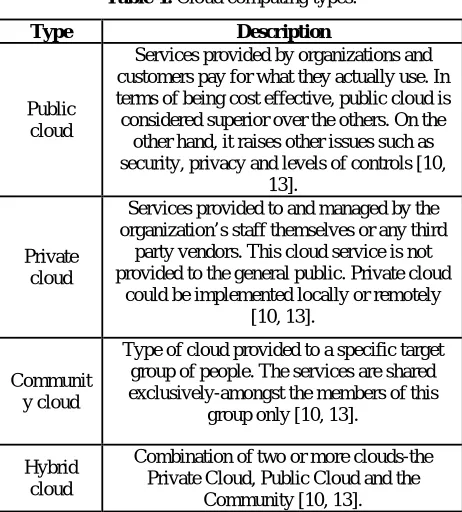
Cloud computing then might well be a model for enabling holistic, convenient, on-request network access to a shared pool of computing resources that can be rapidly provisioned and released with minimal management effort or service provider interaction [10]. The most widely and used definition of cloud computing is the one given by the National Institute of Standards and Technology (NIST) which defined it as a paradigm for providing universal, convenient, on-demand network access to a shared pool of configurable computing resources (e.g., networks, servers, storage, applications, and services) that can be rapidly controlled with minimal management effort or service provider interaction [11]. Researchers have classified cloud computing services into four types mainly: public, private, hybrid, and community cloud computing (see Table 1). It is important for decision makers to obtain a comprehensive view of the types of cloud computing. This information will enable them to select the most appropriate architecture that matches the criteria and requirements of their environments [12].
There are essentially four types of e-Government deficiencies [5]:
Failure in meeting requirements of public services. Difficulties of business collaboration.
High budget in IT and low utilization rate in resources. Poor control of security and high costs of operation
and maintenance.
Cloud computing has some unique key characteristics that attracts the attention of decision makers to leverage on this technology in addressing their concerns over e-Government implementation. Stated below are some of these key characteristics of cloud computing [5]:
High performance: Super computing power, large capacity of data storage, and powerful data analysis capability.
Flexibility and dynamic scalability: IT resources could be distributed or re-distributed automatically with the increase or decrease of business volume.
Low-cost: Costs are lowered and resource utilization rate is increased owing to centralized allocation, management and maintenance of IT physical and software resources.
Ubiquitous: Users can access systems through the network, regardless of users’ location or the kind of device they are using (e.g. PC, mobile phone, or PDA). Reliability and easy maintenance: Cloud computing
has professional teams in place for better security and maintenance.
[image:2.612.312.543.207.463.2]Therefore, characteristics of cloud computing mentioned above can help to overcome technical challenges such as government information infrastructure, low telecommunication infrastructure, and lack of online availability to citizens and/or business services by providing instant, low cost, flexible, and on demand technological services. In addition, cloud computing adoption can resolve social and political challenges by
Table-1. Cloud computing types.
Type Description
Public cloud
Services provided by organizations and customers pay for what they actually use. In terms of being cost effective, public cloud is considered superior over the others. On the
other hand, it raises other issues such as security, privacy and levels of controls [10,
13].
Private cloud
Services provided to and managed by the organization’s staff themselves or any third
party vendors. This cloud service is not provided to the general public. Private cloud
could be implemented locally or remotely [10, 13].
Communit y cloud
Type of cloud provided to a specific target group of people. The services are shared exclusively-amongst the members of this
group only [10, 13].
Hybrid cloud
Combination of two or more clouds-the Private Cloud, Public Cloud and the
Community [10, 13].
speeding up e-Government implementation and replace all legacy paper-based systems which in turn can increase the efficiency, citizens’ comfortability, processes’ transparency to eliminate the bribery. Moreover, cloud computing adoption help in manage the resources wisely. Namely, low cost data storage instead of warehouses of paper files as well as speed storing and retrieving of records [4].
factors relative advantage, top management support, firm
size, competitive pressure and trading partner pressure characteristics have more significant effects on the adoption of cloud computing [7]. In addition, the results of some studies also differed in terms of ordering of the factors based on their classification. For example, among the four dimensions, the most important factor was technological followed by human, organizational and environmental factors in that order [5]. On the contrast, most of the factors that affect the adoption of cloud computing were related to the environmental context [14].
The objectives of this study then are to conduct, firstly, a systematic literature review (SLR) of the factors affecting the adoption of cloud computing for e-Government implementation, secondly, to determine the most important factors and finally to categorize them as being either technological or organizational in nature.
This paper is organized as follows. The following section describes the methodology employed in conducting the SLR. The subsequent section presents a review of the selected 12 studies. The section next deals with reports and discussion of the results of the review. This section also presents the salient common factors that were found to affect the adoption of cloud computing. The conclusion section contains both the summary and possible future work.
METHODOLOGY
Academic studies were reviewed by using search engines in the following databases: IEEE Xplore, Emerald,
and Science Direct. Keywords such as ‘cloud computing adoption factors’, ‘cloud computing in public sectors’, ‘cloud computing in e-Government’, ‘e-Government implementation by using cloud computing’ and a combination of these keywords have been used to identify the related studies that carried out investigation on the factors influencing cloud computing adoption in e-Government development.
Inclusion criteria that governed the search were: (1) behavioral studies that included conceptual models and hypothesis, (2) studies investigating e-Government implementation and (3) cloud computing adoption in public sectors. The exclusion criteria were: (1) all technical studies, (2) studies not related to e-Government or public sectors and (3) studies that did not investigate cloud computing adoption factors in the English language. In total, 203 studies were selected by looking at the title: 78 from IEEE Xplore, 64 from ScienceDirect and 61 from Emerald. From these 203 studies, seven duplicated studies were elected to be omitted. After having read the abstract exhaustively, 137 studies that were related to technical issues were excluded. A further 46 studies were also excluded as they were beyond scope, i.e. focusing on universities and small and medium enterprises SME. A study was also removed as it was written in the Chinese language. In the end, there remained 12 studies that matched the set inclusion criteria for the review. Figure-1 summarizes the flow diagram of the SLR.
Figure-1. SLR flow diagram.
IEEE Xplore
(78)
Articles that met inclusion criteria = 12 Science Direct
(64)
Emerald (61)
Total number of studies = 203
Unfrequented studies = 196
Behavioral studies = 59
Excluding duplicated studies =7
Excluding technical studies= 137
Excluding different scope = 46
Literature review
After selecting studies that met the inclusion criteria, the articles were reviewed individually. Table-2 presents the 12 selected articles that carried out investigations into the adoption of cloud computing to
address the challenges of e-Government implementation. The table shows the authors and years their findings were published, independent variables (IV), the dependent variable (DV), methodology used and results obtained.
Table-2. Factors affecting the adoption of cloud computing for e-Government.
Author IV DV Methodology Results
[5]
Technology - Data Security
- Complexity - Compatibility
- Costs Human - CIO innovativeness - Perceived technical
competence Environment - Government policy
- Perceived industry pressure Organization - Relative advantage - Top manager support
- Adequate resources - Benefits
Cloud computing
adoption
Survey of 60 hospital in
Taiwan
The findings of the study indicated that data security, perceived technical competence, cost, top manager support and complexity were the most important factors. Among them, the most important factor was found to be technology followed by human, organizational and environmental factors in that order.
[6]
- Relative advantage - Compatibility
- Complexity - Trialability - Observability
Cloud computing
adoption
Interview with 19 IT professional (Business and
IT engineering)
to find their attitude toward Cloud
adoption in Taiwan
The findings showed that the primary concerns of IT managers and software engineers were on the compatibility of the cloud computing adoption with companies’ existing policies, IT development environment, business needs and relative advantages. The findings also suggested that most IT companies in Taiwan would not adopt cloud computing until the uncertainties associated with cloud computing, e.g. security and standardization were significantly reduced.
[7]
Technology - Relative advantage
- Complexity - Compatibility
Organization - Top management support
- Firm size - Technology readiness
Environment - Competitive pressure - Trading partner pressure
Cloud computing
adoption
Questionnaire conducted on
111 large companies in
Taiwan
The findings revealed that relative advantage, top management support, firm size, competitive pressure, and trading partner pressure characteristics had a significant impact on the adoption of cloud computing.
[8]
- Relative advantage - Compatibility
- Complexity
Cloud computing
adoption
Survey of 280 respondents
The findings indicated that relative
- Organizational readiness
- Training and education - Top management support
- Perceived usefulness - Perceived ease of use - Trading partner support
- Competitive pressure
in India competency, top management commitment, training and education were the important variables for affecting cloud computing adoption.
[14]
Technological - Relative advantage
- Compatibility - Complexity
Organization - Interoperability
- Focus on key Business processes - More organization
- Meet security Standards - Meet environmental
Standards - Transparency of
Processes standards Environment - Bureaucracy - Political matters
- Legal issues
Cloud adoption in
the public sector
Interview with 21 participants
in UK, Greece, Germany,
Italy and Poland
The findings of the interview showed that from the technological perspective, relative advantage compatibility and complexity are important factors.
From the organizational perspective, desire for interoperability, reduction of IT management overheads, need for meeting security and environmental policies, and transparency of processes desire were identified as to be positively influencing the adoption. From Environmental angle, bureaucracy, political matters and legal issues seemed to be influencing cloud adoption in the public sector. Most of the factors that were identified as hindrances to the cloud computing adoption were seen to be related to the environmental context.
[15]
This was a literature review study done to identify the factors that may influence an
organization’s intention to move towards adopting the
cloud.
Intention to adopt cloud
Literature review
The finding was a proposed model that included Technological Factor (Availability, Reliability, Security, Privacy, Trust) Diffusion of innovation (Relative advantage, Compatibility, Complexity) Organizational Factor (Top management support, Organization size, Technology readiness), Environmental Factor (Compliance with regulations, Competitive pressure, Trading partner pressure, Physical location).
[16]
Technological - Privacy - Security - Reliability Organizational - Top management support
- Technology readiness Environmental - Government policy - Legal environment
- Competition
Cloud computing
adoption
Interview with five IT experts in the
healthcare sector in
Jordan
The findings indicated that the adoption of cloud computing in the healthcare sector was affected by the technological context, which includes privacy, security, and reliability.
From the organizational perspective, the factors included top management support and technology readiness.
[17] This was an exploratory study
using case study
Cloud computing
adoption
Survey of respondents
in Netherlands,
Austria, Portugal,
Spain, Norway and
Belgium
The findings indicated that relative
advantage, compatibility, complexity, trialability, observability, collaboration, traceability, trust and auditability, convincing IT manager, security and legal issues, perception of the term cloud and risk were the most important factors for cloud adoption.
[18]
Technology context - Relative advantage - Technology complexity - Technology compatibility
Organizational context - Firm size - Top management support
- IT expertise of business users
Environment context - Competition intensity - Regulatory environment
Cloud computing
adoption
Survey carried out on
699 IT experts from
USA, Germany, Austria and
Italy
Results indicated that the technology and organization context impacted implementation decisions.
[19]
Technology - Lack of interoperability
- Convenience - Compatibility
Organizational - Organizational
innovativeness - IT know how - Entrepreneurial orientation
Environment - Trust in supplier - Competitive pressure - Organizational Mobility
Use of cloud computing
and performance.
Survey was carried out on 137 European organizations
Findings showed that convenience, compatibility, organizational innovativeness, entrepreneurial orientation and trust in suppliers had significant influence on the use of cloud computing. Organizational mobility mediated the relationship between use of cloud computing and performance.
[20]
- Performance expectation - Effort expectation
- Social influence - Trust in e-Government
- Perceived risk - Facilitating conditions
- Security concerns
Cloud computing
adoption
Survey of 251 respondents
in Taiwan
The results indicated that effort expectation, social influence, trust in e-Government and perceived risk had significant effects on the intentions to adopting e-invoicing. Additionally, trust in e-Government and perceived risk mediated the relationship between behavioral intentions and security concerns regarding e-Government.
[21]
Organizational readiness - IT infrastructure - Top management support
Technological readiness - Relative advantage
- Simplicity - Compatibility - Experienceability Environmental readiness
- Competitor pressure - Partner pressure
Saas Readiness -Attitude toward
SaaS - Intention
to use SaaS
Survey of 173 respondents
in China
FINDINGS AND DISCUSSIONS
Identification of factors affecting the adoption of cloud computing is essential as it will enable decision makers to overcome the pending challenges of e-Government implementation. Based on the literature review that helped identify 12 models pertaining to the adoption of cloud computing. The choice of 12 models is based on the fact that studies of cloud computing related to public sectors are few [14]. The result of analyzing the models was given in Table-2. It can be seen as indicated in Table 2, that there are many factors that have been used repeatedly to predict the adoption behavior of cloud technology. All in all, 59 factors were identified.
Although some factors give the same meaning of other factors E.g. ease of use is perceived as simplicity. However, factors have been counted based on their constant names without any judgment of the meaning because some researchers have used similar terms differently. For example, relative advantage and perceived usefulness have been used in the same study [8]. A frequency analysis was conducted to identify the extent to which these factors were repeated.
The findings showed that factors of the diffusion of innovation (DOI) were highly frequent. Researchers claimed that DOI is part of TOE [8]. Many researchers have criticized the TOE framework, the model was described as taxonomy for categorizing variables and it does not represent an integrated conceptual framework or a well-developed theory [22]. Hence, there is a requirement of a more robust framework to study organizational adoption. Similarly, another study highlighted that TOE framework has no major constructs in each context [7]. TOE framework is limited in its explanatory power of technology adoption [23] and has unclear major constructs and the variables of TOE framework may vary with the context of the study [24]. TOE was adapted by many researchers and they alter the model to include variety of technological factors. These include the factors of DOI such as compatibility and complexity [5, 14, and 25] and other factors such as security [5, 15, and 16] and trust [15]. This was probably attributed to the fact that the previous studies mostly used the technology-organization-technology (TOE) framework which contained the factors of DOI as technological factors.
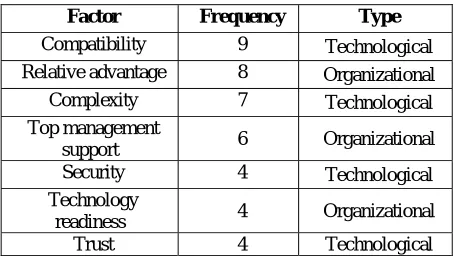
Table-3 is a presentation of the most frequent factors affecting the adoption of cloud computing from the reviewed models. Compatibility topped the list with a frequency of nine followed by relative advantage with a frequency of eight and complexity with a frequency of seven. These were seen as the most frequent factors among the previous studies. Other frequent factors include top management support with a frequency of six followed by security, technology readiness and trust with a frequency of four for each. Based on the classification of the previous studies, the factors were sorted into technological and organizational types. Compatibility and
[image:7.612.314.541.225.354.2]complexity were considered by all previous studies as a technological factor. In terms of relative advantage, some considered it an organizational factor while others believed it to be a technological factor. Factors such as trust and security were considered as technological factors too whilst technology readiness and top management support were considered as being organizational factors. Table 3 shows the various factors, their frequencies, and their type or orientation.
Table-3. Most frequented factors in selected studies.
Factor Frequency Type
Compatibility 9 Technological Relative advantage 8 Organizational
Complexity 7 Technological
Top management
support 6 Organizational
Security 4 Technological
Technology
readiness 4 Organizational
Trust 4 Technological
The findings of the study showed that the researchers had used intensively a quantitative approach to explain the variation in the cloud computing adoption. Among the reviewed models, 75% had used a questionnaire to be used as an instrument to extract data. The qualitative approach received less attention-only a percentage of 17 of the reviewed models had used an interview approach to collect the necessary data. A total of 8% of the reviewed studies were from established literature review. This means that there is a lack in the areas of qualitative approach and review studies especially with regards to SLR in terms of cloud computing adoption factors.
In comparison, TOE was the most deployed framework for explaining the variation in cloud computing adoption. A total of 83% of the reviewed studies had used TOE. The framework was merged with Technology acceptance model (TAM) in one of the reviewed studies. Unified theory of acceptance and use of technology (UTUAT) were used in a different study. Despite the fact that DOI is an integral part of TOE, the model was used purely in one of the reviewed studies.
computing adoption to implement e-Government in developing countries.
Figure-2. The proposed model of cloud computing adoption to develop e-Government.
CONCLUSION AND FUTURE WORK
This study reviewed factors that influence cloud computing adoption to develop e-Government in order to overcome challenges such as information infrastructure, low Telecommunication Infrastructure, Low Human Capital Index, lack of online availability to citizens or business services, professional workforce, resistance handling, collaboration and top leadership commitment.
Many factors were found to be important in terms of influencing decision makers’ opinion to adopt cloud computing to build systems to provide services to different stakeholders.
However, based on reviewed studies, only seven out of the total fifty nine factors displayed a frequency of four to nine times while the other factors showed a frequency of once or twice only.
There is insufficient past studies related to the adoption of cloud computing to develop e-Government. Therefore, the present study aims to further enrich the literature of such studies. In addition, this study can be used by decision makers as a guide to assist them if and when they might want to consider utilizing cloud computing in public sectors and they would like to know the kind of factors that might impact their intentions in cloud computing adoption.
Finally, it is recommended that further studies are conducted regarding factors that might affect cloud computing adoption as well as expanding in the studying of other theoretical models such as UTAUT, TAM, and DOI. In addition, conducting more quantitative and qualitative studies to test factors more exhaustively and come out with the most influencing factors that might affect cloud computing adoption in e-Government development and public sectors will be a step in the right direction. It is noteworthy to mention that this is an ongoing research. Therefore, in future work, the proposed model here may well be more empirically validated to come out with a better tested framework.
REFERENCES
[1] Yanqing, G. 2010. E-government: Definition, goals, benefits and risks. International Conference on Management and Service Science. pp. 1-4.
[2] Sang, S., Lee, J. D., and Lee, J. 2009. e-Government challenges in least developed countries (LDCs): a case of Cambodia. In Advanced Communication Technology, 2009. ICACT 2009. 11th International
Conference. Vol. 3, pp. 2169-2175.
[3] Khan, F., Khan, S., and Zhang, B. 2010. E-Government Challenges in Developing Countries: A Case Study of Pakistan. In Management of e-Commerce and e-Government (ICMeCG) Fourth International Conference. pp. 200-203. IEEE.
[4] A. Al-Dabbagh. 2014. Former Spokesman: Iraqi Decision Makers Are Unqualified and Incompetent. Retrieved from: http://rudaw.net/english/interview.
[5] Lian, J. W., Yen, D. C., and Wang, Y. T. 2014. An exploratory study to understand the critical factors affecting the decision to adopt cloud computing in Taiwan hospital. International Journal of Information Management. Vol. 34, pp 28-36.
[6] Lin, A., and Chen, N. C. 2012. Cloud computing as an innovation: Perception, attitude, and adoption. International Journal of Information Management. Vol. 32, pp. 533-540.
[7] Low, C., Chen, Y., and Wu, M. 2011. Understanding the determinants of cloud computing adoption. Industrial management & data systems. Vol. 111, pp. 1006-1023.
[8] Gangwar, H., Date, H., and Ramaswamy, R. 2015. Understanding determinants of cloud computing adoption using an integrated TAM-TOE
Cloud
Computing
Adoption
Technological
Compatibility
Complexity
Security
Trust
Organizational
Top management support
Technology readiness
model. Journal of Enterprise Information
Management. Vol. 28. pp. 107-130.
[9] Rogers, E. M. 1995. Diffusion of Innovations: modifications of a model for telecommunications. Die Diffusion von Innovationen in der Telekommunikation. Vol.17, pp. 25-38.
[10]Mell, P., & Grance, T. 2011. The NIST definition of cloud computing.
[11]Rozsnyai, S., Slominski, A., and Doganata, Y. 2011. Large-scale distributed storage system for business provenance. In Cloud Computing (CLOUD), 2011 IEEE International Conference. pp. 516-524..
[12]Zhang, W., and Chen, Q. 2010. From E-government to C-government via cloud computing. International Conference on E-Business and E-Government. pp. 679-682.
[13]Parikh, S. M. 2013. A survey on cloud computing resource allocation techniques. In Engineering (NUiCONE), Nirma University International Conference,IEEE. pp. 1-5.
[14]A. Polyviou and N. Pouloudi. 2015. Understanding Cloud Adoption Decisions in the Public Sector. 48th
Hawaii International Conference on System Sciences. pp. 2085–2094.
[15] N. Alkhater, R. Walters, and G. Wills. 2014. An investigation of factors influencing an organization’s intention to adopt cloud computing, International Conference on Information Society (i-Society 2014). pp. 337–338.
[16]Sulaiman, H., and Magaireah, A. I. 2014. Factors affecting the adoption of integrated cloudbased e-health record in e-healthcare organizations: a case study of Jordan. In Information Technology and Multimedia (ICIMU), 2014 International Conference,IEEE. pp. 102-107.
[17]Kuiper, E., Van Dam, F., Reiter, A., and Janssen, M. 2014. Factors influencing the adoption of and business case for Cloud computing in the public sector. In eChallenges e-2014Conference. pp. 1-10.
[18]Borgman, H. P., Bahli, B., Heier, H., and Schewski, F. 2013. Cloudrise: exploring cloud computing adoption and governance with the TOE framework. In System Sciences (HICSS), 46th Hawaii
International Conference on pp. 4425-4435.
[19]Picoto, W. Crespo. N. Kahn. F. 2013. Cloud Computing Usage and Organizational Mobility - An Empirical Assessment.
[20]Lian, J. W. 2015. Critical factors for cloud based e-invoice service adoption in Taiwan: An empirical study. International Journal of Information Management. Vol. 35, pp. 98-109.
[21]Yang, Z., Sun, J., Zhang, Y., and Wang, Y. 2015. Understanding SaaS adoption from the perspective of organizational users: A tripod readiness model. Computers in Human Behavior. Vol. 45, pp. 254-264.
[22]Dedrick, J., and West, J. 2003. Why firms adopt open source platforms: A grounded theory of innovation and standards adoption. In Proceedings of the workshop on standard making: A critical research frontier for information systems. pp. 236-257
[23]Yang, Z., Sun, J., Zhang, Y., and Wang, Y. 2015. Understanding SaaS adoption from the perspective of organizational users: A tripod readiness model.Computers in Human Behavior. Vol. 45, pp. 254-264.
[24]M. Musawa and E. Wahab. 2012. The adoption of electronic data interchanges (EDI) technology by Nigerian SMEs: A conceptual framework. Journal of Business Management and Economics. Vol. 3, no. 2, pp. 055–068.