BUREAUCRATIC STRUCTURES
AND ORGANIZATIONAL
COMMITMENT OF SENIOR PUBLIC
OFFICIALS
EVIDENCE FROM A CROSS-NATIONAL STUDY OF 20 EUROPEAN
COUNTRIES
Kohei Suzuki
Hyunkang Hur
WORKING PAPER SERIES 2018:9
QOG THE QUALITY OF GOVERNMENT INSTITUTE
Department of Political Science
University of GothenburgBox 711, SE 405 30 GÖTEBORG November 2018
ISSN 1653-8919
2
Bureaucratic Structures and Organizational Commitment of Senior Public Officials: Evidence from a Cross-National Study of 20 European Countries1
Kohei Suzuki Hyunkang Hur
QoG Working Paper Series2018:9 November 2018
ISSN 1653-8919
ABSTRACT
In recent years there has been growing scholarly interest in the effects of bureaucratic structures on corruption, socioeconomic development, government effectiveness, policy implementation, and support for democracy. However, very few attention has been paid to a link between bureaucratic structures and civil servants’ work morale, especially organizational commitment. Do public sector managers in closed civil service systems show more commitment to the organization than those in more open bureaucracies? We argue that senior public sector managers in closed bureaucratic structures show higher levels of organizational commitment than those in more open civil service systems. However, such higher commitment mainly comes from the economic costs of leaving organization, lack of outside alternative, and perceived obligation to remain in the organization, not from their engagement in their organizational goals and values. Using two unique large comparative data sets on public bureaucracies and public managers—the COCOPS Top Executive Survey (Hammerschmid 2015) and the QoG (Quality of Government) Expert Survey (Dahlström et al. 2015)—we find support for hypothesis.
We appreciate financial support from the research project, “Out of Control or over Controlled? Incentives, Audits and New Public Management”, and we gratefully acknowledge the financial support from Riksbankens Jubileumsfond (the Swedish Foundation for Humanities and Social Sciences). We also appreciate very useful comments from the members of the Quality of Government Institutes and participants at the APSA 2017 annual conference and the ECPR 2017 annual conference.
Kohei Suzuki
The Quality of Government Institute Department of Political Science University of Gothenburg [email protected]
Hvunkang Hur
Department of Public Administration and Health Management
School of Business
Indiana University, Kokomo [email protected]
3
1. Introduction
The last two decades saw a reappraisal of Weberian bureaucratic structures (Dahlström, Lapuente, and Teorell 2012a, Dahlström and Lapuente 2017, Evans and Rauch 1999, Fukuyama 2013, Miller 2000, Olsen 2006, 2008, Painter and Peters 2010, Rauch and Evans 2000, Rothstein and Teorell 2008). Scholars have identified significant influences of bureaucracy in public policies, their implementation, and socioeconomic outcomes. A large body of literature has identified significant empirical link between characteristics of state bureaucracy and macro-level outcomes. Certain characteristics of bureaucracy such as merit-based recruitment of civil servants and impartial exercise of government authority (i.e. Weberian bureaucracy) have been found to be empirically linked with various macro-level outcomes.2 While previous cross-national studies have enhanced the
understanding about such positive links between institutional features of bureaucracy and country-level outcomes, little attention has been paid to individuals who actually work for good quality of government and public services: individual civil servants.
The ideal type of Weberian bureaucracy assumes that civil servants hold “esprit de corps” or shared norms and goals as professional, achieved through meritocratic recruitment, career distinctiveness of public servants, and socialization process within bureaucracy (Dahlström and Lapuente 2017, Evans and Rauch 1999, Miller 2000, Peters 2010). Such shared norms as professional and strong identification with colleagues and organizational goals enhance the impartiality of institutions or respect for rule of law, which works as a safeguard against political opportunism (Miller 2000). In the Weberian model of bureaucracy, the ethical attributes of the “good” bureaucrat are “adherence to procedure, acceptance of sub- and superordination, commitment to the purposes of the office and so forth” (Du Gay 2000, p.4). Good bureaucrats are expected to have obedience to the order and loyalty to the organization they work for. However, do civil servants working within different bureaucratic structures equally share such shared “esprit de corps” and commitment to the office? For instance, do civil servants who work in relatively open civil service system, which has flexible
2Results of previous studies suggest that the way that the state’s administrative body is structured or the quality of
government institution has a significant effect on macro-level outcomes including socioeconomic development (Evans and Rauch 1999, Nistotskaya, Charron, and Lapuente 2015, Rauch and Evans 2000), corruption prevention (Charron et al. 2017, Dahlström and Lapuente 2012, Dahlström, Lapuente, and Teorell 2012a), regulatory quality and entrepreneurship (Nistotskaya and Cingolani 2015), scientific productivity (Fernández-Carro and Lapuente-Giné 2016), country level innovation outputs (Suzuki and Demircioglu 2017), policy implementation (Cornell 2014), civic actions (Cornell and Grimes 2015), and political legitimacy, satisfaction with government, and support for democracy (Boräng, Nistotskaya, and Xezonakis 2017, Dahlberg and Holmberg 2014, Rothstein 2009), and administrative effectiveness.
4
entries and promotions, open job advertisement, and less public-private distinctions, show same levels of commitment to the organization they work for compared with those who work in relatively closed civil service system? Are there any significant cross-national variations in the degree of organizational commitment of bureaucrats? What explains such cross-national variations in their commitment?
To the best of the authors’ knowledge, cross-national variations in bureaucratic commitment have been not empirically tested.3 As indicated in the classic management literature by Mayo (2014) and
Barnard (1968), operating organization is difficult because organizational members typically do not hold devotion to the organizational objectives beyond own self-interests (Ouchi 1980). However, commitment is “what makes us like what we do and continue doing it, even when the payoffs are not obvious” (Salancik 1977, p.62). Therefore, organizational commitment is one significant factor that makes organizations perform well. Investigating what civil servants are committed to and how they see their relationship with the organization they work for is important to understand reasons for well-functioning bureaucracy. Previous studies on bureaucratic structures and good governance have identified certain institutional characteristics of high-performance bureaucracy (i.e. politically autonomous and meritocratically recruited bureaucrats). Now it is time to scale down the unit of analysis and examine how individual bureaucrats are committed to their organization and how institutional features of bureaucracy are related to their commitment.
To study civil servants’ commitment, we rely on the concept of organizational commitment borrowing from the management literature (Meyer and Allen 1991, Meyer et al. 2002). Organizational commitment has been widely used as a significant indicator for employee work morale. It refers to the strength of an employee’s identification with a particular organization as well his level of involvement in that organization's activities (Meyer and Allen 1991, p.67). Organizational commitment is a useful concept to identify public officials’ relationship with the government organization they work for, providing measurement for levels of psychological involvement in organizational activities and how they are committed to the organization. Organizational commitment is multi-dimensional. According to Meyer and Allen (1991) and Wiener and Vardi (1980, p.86), the organizational commitment can take three forms: (a) affective commitment: being
3 In their cross-national research on organizational commitment in US and India, Chordiya, Sabharwal, and Goodman
(2017) also claim that there have been few studies of public employees’ commitment in a cross-national setting. In studies of commitment in the private sector, there have been several studies about commitment and national culture (see Fischer and Mansell (2009) for meta-analysis).
5
emotionally attached to, identifying with, and engaging in organizational goals, culture values (Allen and Meyer 1990, Lapointe, Vandenberghe, and Panaccio 2011, Moldogaziev and Silvia 2015); (b) continuance commitment: refers to commitment to organization based on the economic costs of leaving organization, lack of outside alternative, and “the exchange of involvement for rewards” (Collins 2016, p.161) and (c) normative commitment: refers to commitment as a perceived obligation to remain in the organization (Allen and Meyer 1990), and “should be loyal to his organization, should make sacrifices on its behalf, and should not criticize it” (Wiener and Vardi 1980, p.86). Affective, continuance and normative commitment are best viewed as distinguishable components; that is, employees can experience each of these psychological states to varying degrees (Allen and Meyer, 1990, p. 3). Thus, for example, organizational members who have strong continuance and normative commitment do not necessarily have same levels of affective commitment. Public officials who show their desire to continue to be a member of an organization for economic reasons or because of feelings of obligation to remain in an organization may not necessarily show commitment based on loyalty towards organizational goals and mission (Chordiya, Sabharwal, and Goodman 2017). Therefore, some officials may have a strong need and a strong sense of obligation to remain in their organization, but they may not have strong value congruence with their organization. It means the ‘net sum’ of a person’s overall commitment to the organization, therefore, reflects each of these separable psychological states (Allen and Meyer 1990, p4).
Why do we need to look at commitment of bureaucrats? Some forms of commitment are beneficial, and some are harmful for organizations (Salancik 1977). According to Meyer, Allen, and Smith (1993, 539), “[e]mployees with a strong affective commitment remain with the organization because they want to, those with a strong continuance commitment remain because they need to, and those with a strong normative commitment remain because they feel they ought to do so”. Results of previous meta-analysis suggest that affective commitment is most strongly tied with job performance and other outcomes followed by normative and continuance commitment. In particular, continuance commitment has often been found to be unrelated or negatively related to those employee behaviors (Meyer et al. 2002, Mathieu and Zajac 1990). Management literature has not yet established the agreement on organizational consequences of each type of commitment. Most studies on the consequences of commitment are mainly individual level outcomes such as job performance, turnover intention, attendance, lateness, absence, or organizational citizenship behavior, work stress (see Meyer et al. (2002), Meyer and Maltin (2010), Mathieu and Zajac (1990) for reviews of previous studies). However, some studies show that organizational commitment is the key determinant of
6
employee attitudes toward organizational change, change schema, and functional flexibility (Cordery et al. 1993, Iverson 1996, Lau and Woodman 1995). These studies support that that organizational commitment may be related with organizational-level outcomes such as organizational change or innovativeness. Types of civil servants’ commitment can be a crucial for national-level success of policy implementation and high-performance of bureaucracy as well. Bureaucrats’ commitment to their tasks can enhance legitimacy in the policy implementation process (Rothstein and Teorell 2008). A key reason for the successful implementation of the Swedish Labour Market Policy is the creation of mission-oriented bureaucratic organization, which Rothstein (1985, 1996) calls “cadre organization”. Members in the cadre organization share strong commitment to the organizational ideology and mission, which lead to “high level of responsiveness to change” in new leadership and changes in the labor market (Hunt and Ivergard 2007, p.32).4
In fact, the following figure 1 shows a bivariate relationship between mean values of two different types of organizational commitment (i.e. “affective commitment”, which is based on goal and mission congruence with organization and “continuance commitment, which is based on monetary benefits) from the COCOPS Top Executive Survey (Hammerschmid 2015) and measures of NPM reform from the the QoG Expert Survey (Dahlström et al. 2015). Countries where senior public officials show higher commitment to their organization’s mission and goals (e.g. Sweden, Finland, the Netherlands, and Denmark) tend to score higher in terms of innovativeness of management style, while those countries with higher committed officials based on economic benefits (e.g. Hungary and Serbia) show lower score of innovativeness measured by NPM reforms. Figure 2 shows a relationship between the above two types of commitment and citizens’ confidence in the public services from the World Values Survey/European Values Survey. Countries with highly committed public officials based on mission and goals show higher values of citizens’ confidence in the public services, while countries with highly committed officials based on their economic needs and costs associated with leaving tend to record lower trust in the civil service systems.
7
FIGURE 1, (PUBLIC OFFICIALS’ ORGANIZATIONAL COMMITMENT AND NPM REFORM LEVEL)
Source: COCOPS Executive Survey on Public Sector Reform in Europe (Hammerschmid 2015) and the QoG expert survey dataset II (Dahlström et al. 2015).
FIGURE 2, (PUBLIC OFFICIAL’S ORGANIZATIONAL COMMITMENT AND CITIZENS CONFIDENCE IN THE CIVIL SERVICE SYSTEMS)
Source: COCOPS Executive Survey on Public Sector Reform in Europe (Hammerschmid 2015) and the World Value Survey in the Quality of Government Standard Dataset, version Jan17. (Teorell et al. 2017).
Austria Belgium Croatia Denmark Estonia Finland France (1963-) Germany Hungary Iceland Ireland Italy Lithuania Netherlands Norway Portugal Serbia Spain Sweden United Kingdom Correlation coefficient=0.41 (p=0.07) 6 8 1 0 1 2 1 4 1 6 4.5 5 5.5 6 Affective commitment NPM reform level Fitted values
AustriaBelgium Croatia Denmark Estonia Finland France (1963-) Germany Hungary Iceland Ireland Italy Lithuania Netherlands Norway Portugal Serbia Spain Sweden United Kingdom Correlation coefficient=-0.70 (p=0.0006) 6 8 1 0 1 2 1 4 1 6 3 3.5 4 4.5 5 5.5 Continuance commitment NPM reform level Fitted values
Austria Belgium Croatia Denmark Estonia Finland Germany Hungary Iceland Ireland Italy Lithuania Netherlands Norway Portugal Serbia Spain Sweden United Kingdom Correlation coefficient=0.47 (p=0.04) 2 2 .2 2 .4 2 .6 2 .8 4.5 5 5.5 6 Affective commitment
Confidence: the civil services Fitted values
Austria Belgium Croatia Denmark Estonia Finland Germany Hungary IcelandIreland Italy Lithuania Netherlands Norway Portugal Serbia Spain Sweden United Kingdom Correlation coefficient=-0.56 (p=0.0122) 2 2 .2 2 .4 2 .6 2 .8 3 3.5 4 4.5 5 5.5 Continuance commitment
8
Although exploring public officials’ commitment and macro-level outcomes itself is not a scope of this paper, these figures suggest the importance of studying types of public officials’ commitment in a cross-national setting. As Fukuyama (2013) laments, the functioning of bureaucracies has
attracted little scholarly attention in the modern political science. Bureaucratic motivation,
commitment, and work morale are relatively overlooked in comparative studies. On the other hand, substantial body of the public management literature has examined the determinants of individual behavior or attitudes of public sector employees within an organizational setting. However, despite the recent increase in comparative public management (Meier, Rutherford, and Avellaneda 2017), the field has been mainly utilizing a single country study and said to be neglecting the national characteristics of bureaucracies and a broad view of governance, assuming that “all states are alike” (Milward et al. 2016, 312, Roberts 2017). Comparative research in public administration and management is still few (Dahlström, Lapuente, and Teorell 2012b, Eglene and Dawes 2006, Fitzpatrick et al. 2011, Van de Walle et al. 2016). In filling this research gap, we aim at connecting the study of comparative bureaucratic structure with the public management literature. Our paper seeks to contribute to the recent debate over “stateless” in the public management literature as well as studies of comparative bureaucracy.
This paper looks at one specific feature of Weberian bureaucracy, closedness/openness of civil service systems measured by the QoG Expert Survey(Dahlström et al. 2015), as a predictor for commitment. Closed civil service systems are characterized with career distinctiveness of the public service (Christensen 2012, Lœgreid and Wise 2007, Peters 2010, Rauch and Evans 2000). The public service career are restricted through formalized exams, public employees enjoy life time tenure protection, and special labor regulations are applied to public sector employees. On the other hand, the open civil service systems have career mobility of public officials between public and private sectors, more diverse and flexible entries to the public sector, and less public-private distinctions. Organizational commitment is measured by 5,487 survey responses from senior public managers in 20 European countries (Hammerschmid 2015). We measure an overall level of commitment as well as three distinctive types of commitment (i.e. affective, continuance, and normative commitment). We hypothesize that senior public officials in more closed civil service systems show higher levels of overall commitment to organization. In particular, senior officials in the closed bureaucracy are likely to show stronger commitment based on the perceived costs associated with leaving the organization (continuance commitment) as well as their feeling of or perceived normative obligation to stay at organization (normative commitment). However, levels of their identification with organization and
9
its mission and values (i.e. affective commitment) are not necessarily associated with levels of closedness. Results of our multilevel analysis provide support our hypotheses, controlling for other individual-level and country-level confounding factors. Results of our large-N analysis seem to also complement existing management studies of organizational commitment by providing external validity for these findings in a cross-national setting.
2. Closed Weberian Bureaucracy
The ideal types of Weberian bureaucracies include a set of distinctive characteristics including lifelong tenure, merit-based recruitment through competitive examinations, regularized procedures for internal promotion, highly regulated and organized reward structures, and career distinctiveness of the public service (Christensen 2012, Lœgreid and Wise 2007, Merton 1940, Peters 2010, Rauch and Evans 2000). Weberian bureaucratic model has diverse components (Olsen 2008), which makes operationalization challenging for researchers (Dahlström and Lapuente 2017). Since underlying assumption of Weberian bureaucracy is isolation of civil servants from external forces such as private market and political discretion, this paper focuses on the closedness/openness of bureaucracies in terms of employment. Closed civil service systems are characterized with formalized entries and promotions, internal promotion, strength of seniority rules, and special labor laws that regulate public sector employees. On the other hand, open civil service systems contain more flexible entries and promotions, open job advertisement to a broader pool of job candidates, less public-private organization distinctions in terms of labor laws. Therefore, while public organizations in the closed civil service systems are close to the characteristics of the ideal Weberian bureaucracies, those in the open civil service systems are similar to private organizations.
There are mainly three reasons why a closed system is preferred for a well-functioning and effective government (Dahlström and Lapuente 2017). First, bureaucratic closedness helps to create the common spirit among the members of a group (esprit de corps), who spend their entire career lives in the public sector, through socialization. Such shared spirit may enhance impartiality and respect for the rule of law (Horton 2011, Vandenabeele, Scheepers, and Hondeghem 2006). Second, closed bureaucratic systems enable public sector managers to have a longer time horizon through the provision of life-time employment. Restrictions on civil service also provide an incentive for expertise creation (Gailmard and Patty 2007). Finally, lifetime employment and socialization with those with
10
esprit de corps provide material incentives for public servants’ willingness to follow organizational orders and rules, which is a basis of rationality of bureaucracy (Olsen 2008).
In reality, public administration scholar have identified cross-national variations in the degree of closedness and openness of bureaucracy (Auer, Demmke, and Polet 1996, Bekke and Meer 2000, Peters 2010, Dahlström and Lapuente 2017). In particular, the idea of the traditional civil service system has been challenged by reform efforts to reduce the distinctiveness of public service careers and make public organizations more like private organizations (Lœgreid and Wise 2007). Figure 3 shows a variation in closedness/openness among our samples of 20 European countries. Countries such as France, Belgium, Italy, Croatia, Austria, Germany, and Spain have relatively closed civil service systems, in which entries to the public service career are restricted through formalized exams, public employees enjoy life time tenure protection, and special labor regulations are applied to public sector employees. In other words, in the closed bureaucratic systems, the public service is considered as a distinct career from the rest of the society (Peters 2010). On the other hand, bureaucrats in the countries such as Sweden, Finland, United Kingdom, Denmark, Estonia, and the Netherlands work in more open civil service systems. Public officials experience career mobility back and forth between public and private organizations (Peters 2010); more diverse ways for entries to the public services; less distinctiveness between public and private organizations in terms of labor laws.
FIGURE 3, (VARIATIONS IN BUREAUCRATIC CLOSEDNESS ACROSS SAMPLE COUNTRIES)
Source: The QoG expert survey dataset II (Dahlström et al. 2015)
0 5 10 15 20 Bureaucratic closedness France (1963-) Belgium Italy Croatia Austria Germany Spain Ireland Lithuania Norway Portugal Serbia Iceland Hungary Netherlands Estonia Denmark United Kingdom Finland Sweden
11
3. Organizational Commitment as work morale and attitudes
This study focuses on organizational commitment as a measurement for a relationship between public managers and their organizations. Research on organizational commitment has spread over four decades (Becker 1960, Meyer and Allen 1991, Mowday, Porter, and Steers 1982, Porter et al. 1974, Salancik 1977). Organizational commitment refers to the strength of an employee’s identification with a particular organization as well his level of involvement in that organization's activities (Meyer and Allen 1991, p.67). Managing employees’ work organizational commitment as an employee work morale is crucial concern for managers in public organization, since higher levels of involvement in that organization activities (i.e. high level of employee organizational commitment) are expected to lead to positive workplace outcomes such as work effort, productivity, and performance (Moldogaziev and Silvia 2015). In fact, a substantial body of research have already shown that organizational commitment is positively related to work motivation, work effort, productivity, and performance (Anderfuhren-Biget et al. 2010, Boardman and Sundquist 2009, Caillier 2013, Locke 1997, Moynihan and Pandey 2007, Wright 2004).
Results of management studies suggest that organizational commitment is multi-dimensional. According to the Allen and Meyer (1990) and Meyer and Allen (1991), organizational commitment can take three forms: (a) affective commitment refers to employees’ emotional attachment to, identification with, and involvement in, the organization; (b) continuance commitment refers to commitment based on the costs that employees associate with leaving the organization (c) normative component refers to employees’ feelings of obligation to remain with the organization. Specifically, the nature of each different form of commitment show significantly different effect on employee outcomes. Indeed, previous meta-analytic reviews of commitment demonstrate that affective and normative commitment are positively correlated with job performance and organizational citizenship behavior, while continuance commitment are negatively correlated with job performance and unrelated with organizational citizenship behavior (Meyer et al. 2002). Additionally, in terms of turnover, absenteeism, and stress and work-family conflict consequences, the correlations between the three commitment scales and turnover were all negative, while only affective commitment was found to be negatively related to absenteeism, however, continuance commitment are positively correlated with absenteeism and stress and work-family conflict (Meyer et al. 2002). Thus, results of previous meta-analysis suggest that affective commitment is most strongly tied with job performance and other employee outcomes followed by normative and continuance commitment. In particular,
12
continuance commitment has often been found to be unrelated or negatively related to those employee behavior outcomes (Meyer et al. 2002).
Specifically, a variety of theoretical explanations have been offered for why organizational commitment occurs, and numerous constructs have been examined as its antecedents. Previous research has shown that the organizational commitment is explained by a broad range of antecedents such as motivational factors, individual factors, organizational culture, managerial level, sector, institutional context, politics and power, political environment and administrative reform, public service motivation, leadership, goal clarity and empowerment, performance appraisal systems (Moon 2000, Dick 2011, Stazyk, Pandey, and Wright 2011, Wilson 1999, Yang and Pandey 2008, Taylor 2007, Moldogaziev and Silvia 2015, Park and Rainey 2007). However, individual and organizational variables are the main targets of scholarly interests in public management, resulting in not relating these variables to bureaucratic structures (Egeberg 1999). Country-level institutional factors such as administrative characteristics of bureaucracy has been relatively overlooked, while some literature consider cultural factors in variations of commitment (Fischer and Mansell 2009, Meyer et al. 2012, Randall 1993).
4. Linking Bureaucratic Structure with Organizational Commitment
The ethical attributes of the “good” bureaucrat in the Weberian model of bureaucracy are “adherence to procedure, acceptance of sub- and superordination, commitment to the purposes of the office and so forth” (Du Gay 2000, p.4). Weber’s work (1947) does not include a term of “commitment” as direct translation (Swailes 2002). However, the term, “zweckrational” action or “rational action in relation to goals”, which seems to be similar to the organizational commitment, appears in Weber’s work (Swailes 2002, p.156). Hierarchical bureaucratic structures with formal rules and regulated career recruitment and promotion system, which are significant components of Weberian bureaucracy, help to achieve zweckrational or bureaucrats’ commitment to the organization they work for (Swailes 2002). However, despite a well-known concept of Weberian bureaucracy and its assumption of civil servants’ acceptance of organizational goals and commitment, to the best of the authors’ knowledge, previous empirical studies remain silent regarding cross-national variations in levels of commitment of civil servants and how institutional features of bureaucracy are associated with such variations. Partly due to the image of ideal type of neutrality and rationality of bureaucracy, scholarly attention to the emotional aspects of bureaucracy has not been enough explored (Graham 2002).13
We expect that the closed Weberian bureaucratic systems is significantly associated with continuance, normative commitment, and overall organizational commitment. These proposed theoretical mechanism can be explained by organizational commitment theory, turnover intention theory, and job insecurity theory.
First, we can expect that the closed Weberian bureaucratic systems are positively associated with continuance commitment. According to Becker (1960) and Meyer and Allen (2002), the likelihood that employees will stay with the organization will be positively related to the magnitude and number of side bets they recognize. In addition, the lack of employment alternatives also increase the perceived costs associated with leaving the organization. The fewer viable alternatives employees believes are available, the stronger will be their continuance commitment to their current employer. This argument is consistent with turnover intention theory literatures. Literature on the turnover and turnover intention of public sector employees in the US case suggest the importance of the availability of outside career options (i.e. exit options) (Grissom, Viano, and Selin 2016, Bertelli and Lewis 2012, Lee and Whitford 2007, Whitford and Lee 2014). In countries with more closed bureaucratic structures, bureaucrats spend their entire career in the public sector and invest their time and resource for acquiring public-sector specific skills and knowledge. Outside employment opportunities are expected to be limited in countries with the closed civil service systems than in countries with more open civil service systems, thus, employee feel the fewer viable alternatives or side-bests in this closed system. Thus, based on job insecurity theory and turnover intention theory, we expect that senior public managers in more closed systems are likely to show higher continuance organizational commitment.
Secondly, we can also expect that the closed Weberian bureaucratic systems are positively associated with normative commitment. Meyer and Allen (1990 and 2002) also proposed that normative commitment will be influenced by the individual’s experiences both prior to (familial/cultural socialization) and following (organizational socialization) entry into the organization. So they argued that an employee would have strong normative commitment to the organization if significant other have been long-term employees of an organization and /or have stress the importance of organizational loyalty and those employees who have been led to believe-via various organization practices-that the organization expects their loyalty would be most likely to have strong normative commitment to it. In fact, lifelong tenure protection, together with merit-based recruitment and distinct public service career, is one of the tenets and principles of Weberian bureaucracy (Christensen 2012, Peters 2010). The closed system (i.e. life time employment and career distinctiveness of the
14
public sector employees) gives employee high job security. Thus, we could assume that employees in closed Weberian Bureaucratic system will be highly likely to believe that organization expects their loyalty, since employees have seen that their significant other/peers have been long-term employees of an organization (tenured system) in closed Weberian bureaucratic system and those employees might believe that organization expects their loyalty via Weberian bureaucracy, thus senior managers who are in closed Weberian bureaucratic system would be highly likely to believe that organization expects their loyalty, and it would have strong normative commitment to the organization.
Third, we can expect that the closed Weberian bureaucratic systems are not associated with affective commitment. Meyer and Allen (1990) proposed that antecedents of affective commitment fall into four categories: personal characteristics, job characteristics, work experiences, and structure characteristics. As Meyer and Allen (1987) pointed out, the strongest evidence has been provided for work experience antecedents (such as organizational support or perception of justice), most notably those experiences that fulfill employees’ psychological needs to feel comfortable within the organization and competent in the work-role. In fact, hierarchical bureaucratic structures with formal rules and regulated career recruitment and promotion system are significant components of Weberian bureaucracy. Thus, we can assume that employees in closed Weberian bureaucracy systems could have less psychological organizational support or justice than employees in open system, and, those psychological experiences could not fulfill employees’ psychological needs to feel comfortable within the organization and competent in the work-role. Thus, we could expect that the senior managers in Weberian bureaucratic closed system is not necessarily linked with higher level of affective organizational commitment.
Lastly, we hypothesize that overall level of organizational commitment of senior public officials are higher in the closed bureaucracies than those in the more open systems. Allen and Myer (1990, p. 3-4) pointed out that continuance and normative commitment are best viewed as distinguishable components; that is, employees can experience each of these psychological states to varying degrees. Especially, they argued that the ‘net sum’ of a person’s overall commitment to the organization, therefore, reflects each of these separable psychological states. Thus, despite a positive link between the closed systems and continuance and normative commitment and lack of expected link between the closedness and affective commitment, we could expect that senior public managers in more closed systems are likely to show more overall commitment than those in open civil service systems in terms of the ‘net sum’ of a person’s overall commitment.
15
Hypothesis 1: Closed bureaucratic structure is positively associated with senior public sector managers’ continuance commitment.
Hypothesis 2: Closed bureaucratic structure is positively associated with senior public sector managers’ normative commitment.
Hypothesis 3: Closed bureaucratic structure is not associated with senior public sector managers’ affective commitment.
Hypothesis 4: Closed bureaucratic structure is positively associated with senior public sector managers’ overall organizational commitment.
5. Data and Methods
Cross-national comparison is very common in the field of political science. However, little comparative research has been done in the study of public administration and bureaucracy (Dahlström, Lapuente, and Teorell 2012b, Eglene and Dawes 2006, Fitzpatrick et al. 2011). One reason for the scarcity of studies comparing national bureaucracies has been the lack of systematic data on both bureaucratic structures and bureaucrats’ behavior. This study aims to bridge this gap in the literature utilizing two unique cross-national data sets. The first one is the COCOPS Executive Survey on Public Sector Reform in Europe (Hammerschmid 2015), which contains the survey answers of 9,333 senior public sector executives from 21 European countries. The second data set is the QoG Expert Survey Dataset II (Dahlström et al. 2015), which captures characteristics of national bureaucratic structures constructed from the opinions of over 1,200 country experts. In this study, we combine these two data sets and assess how the country-level bureaucratic structure influences bureaucratic attitudes across countries. Independently, both the COCOPS survey and the QoG Expert Survey data have been used in many academic publications.5 The empirical novelty of this
study is combining these two data sets.
5 For the COCOPS survey, see, for example, Andrews (2017), Hammerschmid, Van de Walle, and Stimac (2013),
Hammerschmid et al. (2016), Ongaro, Ferré, and Fattore (2015), Raudla et al. (2015), Raudla et al. (2017), Van der Voet and Van de Walle (2015). For the QoG Expert Survey, see Boräng, Nistotskaya, and Xezonakis (2017), Charron, Dahlström, and Lapuente (2016), Cho et al. (2013), Cornell (2014), Cornell and Grimes (2015), Dahlström and Lapuente (2017), Fernández-Carro and Lapuente-Giné (2016), Gustavson and Sundström (2016), Kopecký et al. (2016),
16
The COCOPS Executive Survey took place between 2012 and 2015 as part of the COCOPS project. The goal of the project was to conduct cross-national and quantitative assessment of the impact of NPM -style reforms in European countries (Hammerschmid, Oprisor, and Štimac 2015). In particular, the survey aimed at capturing experiences and perceptions of public sector executives regarding the current status of management, coordination, and administrative reforms, the effects of NPM-style reforms on performance, and the impact of the financial crisis. The survey was jointly designed and developed by a cross-national team of public administration researchers. One of the notable features of the survey is that it represents a full census of all central government ministries and agencies and relevant regional and state government ministries in the target countries in order to avoid random sampling and response bias issues. The survey was sent to all defined high-level public sector senior executives.6 The survey targeted 36,892 senior-level managers from 21 countries
(Austria, Belgium, Croatia, Denmark, Estonia, Finland, France, Germany, Hungary, Iceland, Ireland, Italy, Lithuania, the Netherlands, Norway, Poland, Portugal, Serbia, Spain, Sweden, and the United Kingdom). Poland is dropped from our sample due to missing data, which results in 20 countries in our sample. The final valid response after the data cleaning procedure was 9,333 and the response rate was 25.3%. The response rate is satisfactory compared with other executive surveys in public administration.
The QoG Expert Survey provides a quantitative assessment of Weberian bureaucracy, which has been empirically overlooked (Dahlström, Lapuente, and Teorell 2010). The survey was designed based on pioneering work on mapping the bureaucratic structure in 35 less-developed countries by Peter Evans and James Rauch (Rauch and Evans 2000, Evans and Rauch 1999). The first version of the survey was conducted by a group of researchers at the QoG Institute in 2008–2012, which led to the first Expert Survey data set (Teorell, Dahlström, and Dahlberg 2011). The Expert Survey II was carried out in 2014. The Expert Survey II data was collected from survey responses from 1,294 country experts covering 159 countries. The survey asks for expert perceptions of the current status and characteristics of a country’s public bureaucracy. The survey questions are mainly centered on
Nistotskaya and Cingolani (2015), Sundell (2014), Schuster (2016), Van de Walle et al. (2016), Versteeg and Ginsburg (2016), Van de Walle, Steijn, and Jilke (2015).
6 Within the central government ministries, public officials in two top-administrative levels are included in the target. Within
central government agencies, the first two executive levels are targeted. State-owned enterprises and audit courts are excluded. Appropriate regional and state government ministries and agencies are included in order to maximize the number of senior executives reached. However, local government bodies and local service delivery organizations are not included (Hammerschmid, Oprisor, and Štimac 2015).
17
bureaucratic structures such as recruitment and career system, replacement, compensation, policy making and implementation, gender representation, and transparency. Relevant to our research, the data set contains variables regarding administrative characteristics and reform.
5.1 Dependent Variable
This study utilizes organizational commitment variable created as an additive index from the COCOPS survey items that aim to collect public managers’ three forms of organizational commitment. Our dependent variable comes from picking how far the respondent agrees or disagrees with the following seven statements: 1) “I feel valued for the work I do”, 2) “I would recommend it as a good place to work”, 3) “I really feel as if this organisation's problems are my own”, 4) “I would be very happy to spend the rest of my career with this organization”, 5) “It would be very hard for me to leave my organisation right now, even if I wanted to”, 6) “I was taught to believe in the value of remaining loyal to one organization”, 7) “Things were better in the days when people stayed with one organisation for most of their career”. Following Caillier (2013), Meyer and Allen (1991), and Moldogaziev and Silvia (2015), we measured three types of organizational commitment, namely affective commitment from items 1-2, continuance commitment from 4, 5, 6, and 7, and normative commitment from 3. Affective commitment is a mean value of answers for survey items 1-2 (Cronbach's alpha=0.75) and continuance commitment is a mean values of items 4-7 (Cronbach's alpha=0.69). As for the normative commitment, we use the original scale (ordinal from 1 to 7) of the answer for item 3. We also created an overall commitment variable, which is a mean value of affective, continuance, and normative commitment variables (Cronbach's alpha=0.71). Since all these commitment variables do not take values lower than 0 and greater than 7, we treat them as truncated dependent variables. One can find individual variations in levels of overall organizational commitment across sample countries (Figure A1 in appendix). Figure 4 shows variations in mean values of all four types of commitment variables across our sample countries. In fact, levels of commitment differ not only across countries but also across types of commitment.
18
FIGURE 4, (COUNTRY COMPARISON OF MEAN VALUES OF ORGANIZATIONAL COMMITMENT BY COMMITMENT TYPE)
Source: COCOPS Executive Survey on Public Sector Reform in Europe (Hammerschmid 2015)
5.2 Independent Variables
We use the QoG Expert Survey Dataset II to capture the one country-level independent variable: bureaucratic closedness. This is aggregate measure, and this variable has been used in previous research (Dahlström, Lapuente, and Teorell 2012a, Dahlström and Lapuente 2017). This independent variable is bureaucratic closedness. Following also the existing literature this index is based on a principal component analysis (Cronbach’s alpha = 0.75) of the following three questions: (1) “Public sector employees are hired via a formal examination system”; (2) “Once one is recruited as a public sector employee, one remains a public sector employee for the rest of one’s career”; and (3) “The terms of employment for public sector employees are regulated by special laws that do not apply to private sector employees.” The higher the values, the more isolated, or “closed,” public employees are from the practices of the private sector.
19 5.3 Control Variables
This study controls for other factors that are expected to influence organizational commitment. The relatively small number of countries (N = 20) does not allow us to include a large number of controls at the country level. Therefore, we limit the number of controls to significant factors that may affect our dependent variables and test them in different models. The models include GDP per capita (2011-15 mean values, logged) as a country level control from the QoG Standard Dataset (Teorell et al. 2017). Previous research has identified country culture as a significant predictor for organizational commitment (Fischer and Mansell 2009). Therefore, we use national cultural factors from Hofsted’s dimension of cultural values, namely power distance and individualism-collectivism (Hofstede, Hofstede, and Minkov 2010) as additional country-level control variables for robustness check models. In addition, we control for the following individual-level factors that may affect individual organizational commitment: gender, organizational type (ministry or agency/other), organizational size, respondent’s current position, age, years of experience in current organization, private sector experience, educational level, degree of job autonomy, organizational social capital, job satisfaction, and organizational goal clarity. All of these variables are collected or created from the COCOPS survey dataset. Table 1 presents descriptive statistics of all variables in the analysis. We conducted collinearity diagnostics using Variance Inflation Factors (VIF) based on our main models. Mean values of VIF are less than 1.49 in all main models (models 2 in table 3). The highest individual VIF score for individual variables is 1.77 (age). These results suggest that the models do not have serious multicollinearity issues. Table 2 reports correlation matrix.
20 TABLE 1, (DESCRIPTIVE STATISTICS)
Obs Mean Std.Dev. Min Max
Dependent variables
Overall organizational commitment 5,487 4.55 1.07 1 7
Affective commitment 5,487 5.23 1.35 1 7
Continuous commitment 5,486 4.15 1.36 1 7
Normative commitment 5,469 4.79 1.76 1 7
Independent variable
Closed bureaucracy 5,487 15.16 2.53 10.84 18.82
Individual level controls
Female managers 5,487 1.38 0.48 1 2
Organizational type 5,487 0.53 0.50 0 1
Organizational size 5,487 1.04 0.70 0 2
Respondent's position 5,487 0.90 0.75 0 2
Age 5,487 1.02 0.77 0 2
Working years at current organisation 5,487 0.91 0.72 0 2
Private sector experience 5,487 0.95 0.69 0 2
Educational level 5,487 0.94 0.57 0 2
Degree of job autonomy 5,487 29.67 10.84 8 56
Organizational social capital 5,487 43.46 10.69 9 63
Job satisfaction 5,487 5.67 1.28 1 7
Organizational goal clarity 5,487 10.94 2.77 2 14
Country level control
GDP/capita 5,487 39,060.78 20,760.84 5,974.79 95,307.31
TABLE 2, (CORRELATION MATRIX)
1 2 3 4 5 6 7 8 9 10 11 12 13 14 15 16 17 18
1 Overall organizational commitment 1 2 Affective commitment 0.58 1 3 Continuance commitment 0.90 0.24 1 4 Normative commitment 0.60 0.20 0.41 1 5 Closed bureaucracy 0.03 -0.13 0.06 0.15 1 6 Female managers -0.03 -0.02 -0.02 -0.03 -0.10 1 7 Organizational type 0.08 0.06 0.08 -0.01 -0.35 0.07 1 8 Organizational size -0.03 0.01 -0.03 -0.05 -0.01 -0.06 -0.03 1 9 Respondent's position 0.09 0.12 0.01 0.14 0.02 -0.10 0.10 -0.05 1 10 Age 0.14 0.08 0.15 0.00 0.02 -0.09 0.01 0.00 0.15 1
11 Working years at current organization 0.18 0.01 0.25 -0.02 0.01 -0.02 0.03 0.09 -0.09 0.29 1 12 Private sector experience -0.05 0.01 -0.07 -0.02 -0.14 -0.01 0.12 -0.04 0.02 0.01 -0.15 1 13 Educational level -0.05 0.00 -0.05 -0.07 0.09 -0.05 0.02 -0.02 0.07 0.05 0.01 -0.05 1 14 Degree of job autonomy 0.04 0.32 -0.10 -0.02 -0.22 -0.10 0.13 0.07 0.36 0.08 -0.08 0.08 0.10 1 15 Organizational social capital 0.35 0.55 0.17 0.12 -0.18 -0.06 0.05 -0.08 0.07 0.09 0.05 0.04 0.01 0.28 1 16 Job satisfaction 0.49 0.72 0.26 0.21 -0.13 0.01 0.04 0.00 0.12 0.07 0.02 0.00 -0.03 0.26 0.48 1 17 Organizational goal clarity 0.33 0.44 0.19 0.13 -0.19 0.01 0.20 -0.05 0.09 0.07 0.03 0.04 -0.04 0.24 0.47 0.39 1 18 GDP/capita -0.27 0.15 -0.34 -0.36 -0.05 -0.10 -0.06 0.12 -0.06 0.17 0.02 0.08 0.07 0.29 0.18 0.09 0.04 1
22 5.4 Empirical Strategy
Our dataset has a hierarchical structure, with public sector managers (level 1) nested in country-level factors (level 2), and thus multilevel analysis seems to be an appropriate method (Center for Multilevel Modeling 2008, Jones 2008). We assume that intercepts of individual-level variables can vary across countries due to the country-level factors, therefore a random intercept model is applied. Since the main dependent variables in this study are censored continuance variables of mean values of survey items ranging from 1 to 7, we employ multilevel mixed-effects tobit regression models. As for the normative commitment variable, we utilize multilevel ordered logit models as the variable is in ordinal form from 1 to 7. The first model includes only individual-level independent and control variables. The second model adds a country-level control variable and the closed bureaucracy variable. In our robustness check models (models 3-8), we run models with a different set of country-level controls, including country cultures (power distance and individualism from Hofsted’s dimension of cultural values), competitive salary in the public sector, administrative burden, corruption perception index (public officials/ civil servants), and polity score.
6. Results
Results of the multilevel tobit regression models are reported in table 3 for both the overall organizational commitment (i.e. mean values of affective, continuance, and normative commitment) and three types of commitment. Model 1 for all dependent variables include only individual level variables. First, we look at results of continuance commitment. The individual variable only model (model 1) shows that being female (p<0.01), having more than 5 years of private sector experience (p<0.1), acquiring master-level or Ph.D. level education (p<0.01) are negatively associated with continuance organizational commitment. On the other hand, working at agency/other organization compared with ministry (p<0.01), being more than 46 years old (p<0.01), working for more than 5 years at the current organization of respondent (p<0.01) are positively correlated to continuance commitment. In model 2 with country-level variables, directions of impact of individual level variables do not largely change. Higher GDP is associated with lower continuance commitment. The more bureaucratic structure is closed, the higher continuance commitment is. This holds an empirical support for H1.
23
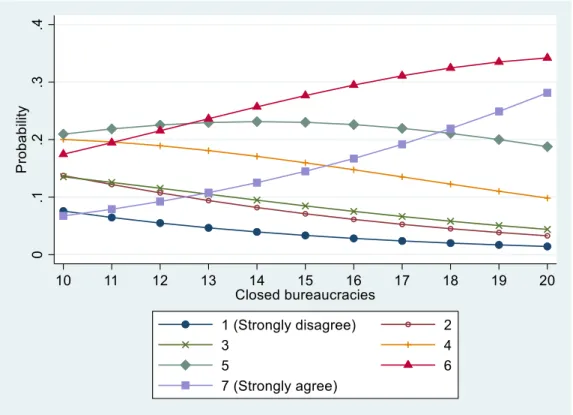
Regarding normative commitment, which is organizational commitment based on sense of obligation to keep membership at organization, the individual-level only model shows that being female (p<0.1) and having Ph.D. level education (p<0.05) are negatively associated with normative commitment variable. Alternatively, working for agency/other (p<0.01), having top-level or second level position as opposed to third level position (p<0.01), being more than 46 years old (p<0.01), having less than or more than 5 years of private sector experience compared with no experience (p<0.05), job autonomy (p<0.05), social capital, job satisfaction, and organizational goal clarity (p<0.01) are positively correlated to normative commitment. Model 2 with country-level variables shows that results do not change significantly. GDP/capita is negatively associated with normative commitment (p<0.01). Closed bureaucracy is positively correlated to commitment (p<0.01). Holding other variables at constant, senior public officials in more closed systems are likely to exhibit higher normative commitment to the organization they work for compared with those in more open systems. Recall that the normative commitment dependent variable is ordinal from 1 to 7. Respondents are asked to pick one from 1 (strongly disagree) to 7 (strongly agree) regarding a survey item, “I really feel as if this organisation's problems are my own”. Higher outcome values mean higher levels of normative commitment. Visualizing predicted probabilities helps to interpret results of multilevel ordered logit model. Figure 5 visualized the predicted probabilities for outcomes 1-7. As seen from the figure, probabilities of selecting outcomes 7 (strongly agree) or 6 increase as the degree of bureaucratic closedness increases. Probability of selecting outcome 7 is above 30 % when the closedness value is higher than 17, which is around Spain’s closedness value (17.04). Probabilities of picking low levels of normative commitment such as outcomes 1-3 are relatively higher when closedness bureaucracy variable is low (i.e. open civil service systems). On the other hand, these probabilities drop as the degree of closedness increases. In other words, senior public officials in more closed systems are less likely to show lower normative commitment than those in more open systems. This gives an empirical support for H2.
24
TABLE 3, (MULTILEVEL MODELS MEASURING SENIOR PUBLIC MANAGERS’ ORGANIZATIONAL COMMITMENT)
1: ref.=male executives, 2: ref.=Ministry, 3: ref.<100, 4. ref.=third hierarchical level , 5: ref.=45 or less, 6: ref.=less than 5 years, 7: ref.=none, 8: ref.=BA level
DV=Continuance
Commitment
DV=Normative
Commitment DV=Affective Commitment DV=Overall Commitment
Model 1 Model 2 Model 1 Model 2 Model 1 Model 2 Model 1 Model 2
Independent variable
Closed bureaucracies 0.09*** 0.18*** 0.02 0.08***
(0.03) (0.05) (0.02) (0.02)
Individual level controls
Female managers 1 -0.13*** -0.13*** -0.09* -0.09* -0.00 -0.00 -0.09*** -0.09*** (0.03) (0.03) (0.05) (0.05) (0.03) (0.03) (0.02) (0.02) Organizational type 2 =Agency or Other 0.15*** 0.15*** 0.15*** 0.15*** -0.00 0.00 0.10*** 0.10*** (0.04) (0.04) (0.06) (0.06) (0.03) (0.03) (0.02) (0.02) Organizational size 3 =100-999 0.01 0.02 -0.00 0.00 0.06* 0.06* 0.03 0.03 (0.04) (0.04) (0.07) (0.07) (0.03) (0.03) (0.03) (0.03) Organizational size=over 1000 0.07 0.08* -0.09 -0.08 0.07* 0.07* 0.05 0.06* (0.05) (0.05) (0.08) (0.08) (0.04) (0.04) (0.03) (0.03) Respondent's position4 -0.00 -0.01 0.25*** 0.24*** 0.12*** 0.12*** 0.06** 0.06**
=Second hierarchical level in
organisation (0.04) (0.04) (0.06) (0.06) (0.03) (0.03) (0.03) (0.03)
=Top hierarchical level in
organisation -0.06 -0.07 0.46*** 0.45*** 0.09** 0.09** 0.04 0.04 (0.05) (0.05) (0.08) (0.08) (0.04) (0.04) (0.03) (0.03) Age5=46-55 0.20*** 0.21*** 0.18*** 0.18*** -0.04 -0.04 0.12*** 0.12*** (0.04) (0.04) (0.06) (0.06) (0.03) (0.03) (0.03) (0.03) =56 or older 0.49*** 0.49*** 0.25*** 0.26*** -0.04 -0.04 0.29*** 0.29*** (0.04) (0.04) (0.07) (0.07) (0.04) (0.04) (0.03) (0.03) Working years at current organisation6
0.29*** 0.29*** -0.02 -0.03 -0.03 -0.03 0.16*** 0.15*** =5-20 years (0.04) (0.04) (0.06) (0.06) (0.03) (0.03) (0.03) (0.03) =More than 20 years 0.74*** 0.74*** 0.06 0.05 0.01 0.01 0.43*** 0.42***
(0.05) (0.05) (0.08) (0.08) (0.04) (0.04) (0.03) (0.03) Private sector experience7 -0.02 -0.01 0.14** 0.15** -0.00 -0.01 0.01 0.01
=Less than 5 years (0.04) (0.04) (0.06) (0.06) (0.03) (0.03) (0.03) (0.03) =More than 5 years -0.09* -0.08* 0.19** 0.19** -0.03 -0.03 -0.03 -0.03
(0.05) (0.05) (0.07) (0.07) (0.04) (0.04) (0.03) (0.03) Educational level8 = MA level -0.12*** -0.13*** -0.05 -0.06 -0.01 -0.01 -0.08** -0.08**
(0.05) (0.05) (0.07) (0.07) (0.04) (0.04) (0.03) (0.03) =PhD/Doctoral level -0.20*** -0.20*** -0.23** -0.23** 0.01 0.01 -0.14*** -0.14***
(0.06) (0.06) (0.10) (0.10) (0.05) (0.05) (0.04) (0.04) Degree of job autonomy -0.00 -0.00 0.01** 0.01*** 0.01*** 0.01*** 0.00* 0.00* (0.00) (0.00) (0.00) (0.00) (0.00) (0.00) (0.00) (0.00) Organizational social capital 0.01*** 0.01*** 0.02*** 0.02*** 0.03*** 0.03*** 0.02*** 0.02***
(0.00) (0.00) (0.00) (0.00) (0.00) (0.00) (0.00) (0.00) Job satisfaction 0.24*** 0.24*** 0.30*** 0.30*** 0.62*** 0.62*** 0.33*** 0.33***
(0.01) (0.01) (0.02) (0.02) (0.01) (0.01) (0.01) (0.01) Organizational goal clarity 0.04*** 0.04*** 0.04*** 0.04*** 0.06*** 0.06*** 0.04*** 0.04***
(0.01) (0.01) (0.01) (0.01) (0.01) (0.01) (0.00) (0.00)
Coutry level control
GDP/capita (ln) -0.85*** -1.18*** 0.07 -0.59***
(0.10) (0.20) (0.07) (0.07)
Variance of random intercept at the
country level 0.45*** 0.08*** 1.12*** 0.31*** 0.05*** 0.04*** 0.23*** 0.04*** (0.14) (0.03) (0.36) (0.10) (0.02) (0.01) (0.07) (0.01)
Constant 1.40*** 8.88*** -0.66*** -1.78** 1.03*** 6.01***
(0.19) (1.12) (0.11) (0.84) (0.13) (0.78)
Number of individuals (level1) 5,486 5,486 5,469 5,469 5,487 5,487 5,487 5,487
Number of countries (level 2) 20 20 20 20 20 20 20 20
Standard errors in parentheses *** p<0.01, ** p<0.05, * p<0.1
25
FIGURE 5, (PREDICTED NORMATIVE COMMITMENT BY DEGREE OF CLOSED BUREAUCRACY)
*Samples are based on model 2 in Table 3
Next, we look at affective commitment. Results of model 1 with only individual controls show that variance of random intercept at the country level is 0.05 (p<0.01), justifying the use of multilevel model. Factors such as organizational size (100-999 and over 1000 compared with less than 100 members) (p<0.1), being top hierarchical position (p<0.05) and second level position (p<0.01), job autonomy, social capital, job satisfaction, and goal clarity (p<0.01) are positively associated with affective commitment. Model 2, which adds country-level variables, show that these results do not significantly change. GDP/capita and closed bureaucracy are positively associated with affective commitment, however they fail to reach statistical significance. Thus, our model does not find any evidence that closed bureaucracy is positively correlated to affective commitment. This provides empirical supports H3.
Figure 6 shows predicted values of overall organizational commitment and continuance commitment as the degree of closed service systems varies. These values are calculated based on model 2 in table 3. Holding other factors at mean, higher degree of bureaucratic closedness increases senior public managers’ overall organizational commitment as well as continuance commitment. Senior public officials working in more closed civil service systems are likely to have higher overall as well as continuance commitment than those working in more open systems.
26
FIGURE 6, (PREDICTED OVERALL AND CONTINUANCE COMMITMENT BY DEGREE OF CLOSED BUREAUCRACY*)
*Samples are based on model 2 in Table 3 for each dependent variable
Regarding overall commitment dependent variable (H4), variance of random intercept at the country level is 0.23 (p<0.01), which justifies the use of multilevel model. Being a female senior manager (as opposed to being male) is negatively associated overall commitment (p-value<0.01). Compared to working at ministry, senior managers working at agency or other have higher overall commitment (p<0.01). Second hierarchical position as opposed to have third level position is positively correlated to overall commitment (p<0.05). Being 46-55 years old and 56 or older compared with being less than 45 is also positively associated with overall commitment (p<0.01). Job autonomy (p<0.1), organizational social capital (p<0.01), job satisfaction (p<0.01), and organizational goal clarity (p<0.01) are also positively linked with the dependent variable. On the other hand, having Ph.D. (p<0.01) or master level education (p<0.05) is negatively associated with overall commitment. Model 2 adds a closed bureaucracy and GDP/capita variable as country-level factors. Adding country variables do not significantly change the effects of individual level variables on the dependent variable. Variance of random intercept at the country level is dropped to 0.04 (p<0.01) after including country-level variables. Higher GDP/capita is negatively associated with overall commitment (p<0.01). Closed bureaucracy is positively related to overall commitment (p<0.01). Results show that holding other factors constant, closed bureaucracies are positively correlated to public managers’ overall organizational
27
commitment. This means that public sector managers working in more closed bureaucracies are likely to have higher overall organizational commitment to the organization they work for than those in more open bureaucratic structures, holding other factors constant. This provides empirical support for H4.
We ran robustness check models with additional control variables. Those additional variables include country cultures (power distance and individualism from Hofsted’s dimension of cultural values),
competitive salary in the public sector, administrative burden, corruption perception index (public officials/ civil servants), and polity score. Direction of coefficients of closed bureaucracy are quite robust across models with different country controls as seen in table 4. Closed bureaucracy has positive empirical association with overall organizational commitment (p<0.01), continuance commitment (p<0.01), and normative commitment ((p<0.01 or p<0.05), holding other variables at mean. Affective commitment is not statistically significantly associated with closed bureaucracy. These results demonstrate robustness of our results. In sum, results of multilevel models show that bureaucratic structure matters for levels of some types of organizational commitment. There are strong empirical positive association between closed bureaucracy and higher levels of overall organizational commitment, continuance commitment, and normative commitment. However, as we hypothesized, we do not find any empirical link between bureaucratic closedness and levels of affective commitment.
28
TABLE 4, (RESULTS FROM MULTILEVEL MODEL ESTIMATES: USING ADDITIONAL COUNTRY LEVEL CONTROLS
Continuance Commitment Normative Commitment
Model 3 Model 4 Model 5 Model 6 Model 7 Model 8 Model 3 Model 4 Model 5 Model 6 Model 7 Model 8
Independent variable
Closed bureaucracies 0.11*** 0.09*** 0.09*** 0.09*** 0.13*** 0.10*** 0.14** 0.19*** 0.17*** 0.22*** 0.15** 0.17***
(0.03) (0.03) (0.03) (0.03) (0.03) (0.03) (0.06) (0.05) (0.05) (0.06) (0.07) (0.06)
Country level controls
GDP/capita (ln) -0.99*** -0.88*** -0.85*** -0.85*** -1.04*** -0.94*** -0.87*** -1.38*** -1.19*** -1.36*** -1.19*** -1.13***
(0.13) (0.13) (0.10) (0.12) (0.14) (0.11) (0.27) (0.24) (0.19) (0.21) (0.29) (0.23)
Culture: power distance -0.01 0.02
(0.01) (0.01)
Culture: individualism 0.00 0.01
(0.01) (0.01)
Public sector salary -0.03 0.21
(0.09) (0.17) Administrative Burden 0.03 0.53** (0.15) (0.27) Corruption Perception: -0.41* -0.11 Public Officials/Civil Servants (0.22) (0.45) Polity Score 0.21* -0.04 (0.11) (0.24)
Variance of random intercept 0.07*** 0.08*** 0.08*** 0.08*** 0.07*** 0.07*** 0.29*** 0.29*** 0.29*** 0.27*** 0.29*** 0.32***
at the country level (0.02) (0.03) (0.03) (0.03) (0.02) (0.02) (0.10) (0.10) (0.10) (0.09) (0.10) (0.11)
Constant 10.48*** 9.05*** 8.94*** 8.63*** 11.60*** 7.62***
(1.48) (1.21) (1.13) (1.48) (1.86) (1.22)
Number of individuals (level1) 5,343 5,343 5,486 5,343 5,146 5,343 5,326 5,326 5,469 5,326 5,130 5,326
Number of countries (level 2) 19 19 20 19 19 19 19 19 20 19 19 19
Standard errors in parentheses *** p<0.01, ** p<0.05, * p<0.1
29
TABLE 4, (RESULST FROM MULTILEVEL MODEL ESTIMATES: USING ADDITIONAL COUNTRY LEVEL CONTROLS (CONTINUED))
Affective Commitment Overall Commitment
Model 3 Model 4 Model 5 Model 6 Model 7 Model 8 Model 3 Model 4 Model 5 Model 6 Model 7 Model 8
Independent variable
Closed bureaucracies 0.00 0.02 0.03 0.01 0.04 0.02 0.08*** 0.08*** 0.08*** 0.08*** 0.10*** 0.08***
Country level controls (0.02) (0.02) (0.02) (0.02) (0.03) (0.02) (0.02) (0.02) (0.02) (0.02) (0.02) (0.02)
GDP/capita (ln) 0.22** 0.16* 0.08 0.15* 0.03 0.09 -0.60*** -0.61*** -0.59*** -0.60*** -0.71*** -0.64***
(0.09) (0.09) (0.07) (0.08) (0.11) (0.08) (0.10) (0.09) (0.07) (0.08) (0.10) (0.07)
Culture: power distance 0.01** -0.00
(0.00) (0.00)
Culture: individualism -0.00 0.00
(0.00) (0.00)
Public sector salary -0.11* -0.02
(0.06) (0.06)
Administrative Burden -0.15 0.04
(0.10) (0.10)
Corruption Perception: Public
Officials/Civil Servants -0.05 -0.26
(0.17) (0.16)
Polity Score -0.01 0.12
(0.09) (0.08)
Variance of random intercept at the
country level 0.03*** 0.04*** 0.04*** 0.04*** 0.04*** 0.04*** 0.04*** 0.04*** 0.04*** 0.04*** 0.03*** 0.03***
(0.01) (0.01) (0.01) (0.01) (0.01) (0.01) (0.01) (0.01) (0.01) (0.01) (0.01) (0.01)
Constant -3.30*** -2.21*** -1.56** -0.89 -1.41 -1.75* 6.17*** 6.11*** 6.05*** 5.66*** 7.71*** 5.27***
(1.03) (0.84) (0.79) (1.01) (1.42) (0.97) (1.08) (0.83) (0.79) (1.00) (1.31) (0.86)
Number of individuals (level1) 5,344 5,344 5,487 5,344 5,147 5,344 5,344 5,344 5,487 5,344 5,147 5,344
Number of countries (level 2) 19 19 20 19 19 19 19 19 20 19 19 19
Standard errors in parentheses *** p<0.01, ** p<0.05, * p<0.1 Individual controls are not reported.
7. Discussion and Conclusions
Previous studies on bureaucratic structure and good governance have identified certain institutional characteristics such as merit-based recruitment and impartial exercise of public authority as one of the strong predictors for government effectiveness, lower level of corruption, and various socioeconomic outcomes. Despite the growing concern for comparative public management, we still have limited understanding about how different bureaucratic structures are associated with work-related bureaucratic attitudes and behaviors. This is partly because of strong assumption of neutral and somewhat faceless and inhuman image of Weberian bureaucracy, which is a starting point of the most previous studies. Previous studies have identified significant institutional features of high performing bureaucracies. However, we still have limited understanding of how such institutional characteristics are associated with bureaucratic attitudes and behavior in a cross-national setting. Aside from institutional factors, bureaucrats’ relationship with their organization or their acceptance of organizational goals, mission, and values, and forms of commitment may also be one reason for well-functioning bureaucracies and favorable macro-level outcomes. Furthermore, civil servants in specific stricture of bureaucracy may tend to share certain work-related behavior and attitude. This study shifted the unit of analysis from macro-level institutional factors to individual-level bureaucrats and examined this understudied link in a cross-national setting.
We have argued that closed bureaucratic structures (i.e. restriction to entry through formal exams, tenure protection, and special regulations for public sector employees) are associated with higher levels of overall organizational commitment. However, all forms of commitment are not equally correlated to the closedness. This paper hypothesized that senior public managers in more closed bureaucracy show higher levels of overall commitment to the organization they work for than those who work in more open civil service system. However, commitment of senior managers in the closed system mainly stems from “the exchange of involvement for rewards, a necessity with limited alternatives” (Collins 2016, p.161) or sense of obligation from peers to stay in the organization. Senior managers in more closed systems are likely to be committed to their organization mainly due to the fear of loss or normative obligation, but not emotional attachment or identification. After controlling for significant individual and country level factors, results of multilevel study supports our hypotheses.
Such differences in types of commitment across different bureaucratic features suggest an implication for previous studies on comparative bureaucracy. Results of this study suggest the importance of