Georgia State University Georgia State University
ScholarWorks @ Georgia State University
ScholarWorks @ Georgia State University
Communication Sciences and Disorders
Dissertations Department of Communication Sciences and Disorders
2-25-2010
Effectiveness of a Computer-Based Syntax Program in Improving
Effectiveness of a Computer-Based Syntax Program in Improving
the Morphosyntax of Students Who are Deaf/Hard of Hearing
the Morphosyntax of Students Who are Deaf/Hard of Hearing
Joanna Erin Cannon Georgia State University
Follow this and additional works at: https://scholarworks.gsu.edu/epse_diss
Part of the Educational Psychology Commons, and the Special Education and Teaching Commons
Recommended Citation Recommended Citation
Cannon, Joanna Erin, "Effectiveness of a Computer-Based Syntax Program in Improving the
Morphosyntax of Students Who are Deaf/Hard of Hearing." Dissertation, Georgia State University, 2010. https://scholarworks.gsu.edu/epse_diss/63
This dissertation, EFFECTIVENESS OF A COMPUTER-BASED SYNTAX
PROGRAM IN IMPROVING THE MORPHOSYNTAX OF STUDENTS WHO ARE DEAF/HARD OF HEARING, by JOANNA E. CANNON, was prepared under the direction of the candidate‟s Dissertation Advisory Committee. It is accepted by the committee members in partial fulfillment of the requirements for the degree Doctor of Philosophy in the College of Education, Georgia State University.
The Dissertation Advisory Committee and the student‟s Department Chair, as representatives of the faculty, certify that this dissertation has met all standards of excellence and scholarship as determined by the faculty. The Dean of the College of Education concurs.
____________________________ ____________________________
Susan R. Easterbrooks, Ed.D. Kathryn Wolff Heller, Ph.D.
Committee Chair Committee Member
____________________________ ____________________________
Nicole Patton-Terry, Ph.D. Phillip Gagne, Ph.D.
Committee Member Committee Member
____________________________ Kim Viel-Ruma, Ph.D.
Committee Member
____________________________ Date
____________________________ Peggy A. Gallagher, Ph.D.
Chair, Department of Educational Psychology and Special Education
____________________________ R. W. Kamphaus, Ph.D.
AUTHOR‟S STATEMENT
By presenting this dissertation as a partial fulfillment of the requirements for the
advanced degree from Georgia State University, I agree that the library of Georgia State University shall make it available for inspection and circulation in accordance with its regulations governing materials of this type. I agree that permission to quote, to copy from, or to publish this dissertation may be granted by the professor under whose direction it was written, by the College of Education's director of graduate studies and research, or by me. Such quoting, copying, or publishing must be solely for scholarly purposes and will not involve potential financial gain. It is understood that any copying from or publication of this dissertation which involves potential financial gain will not be allowed without my written permission.
All dissertations deposited in the Georgia State University library must be used in
accordance with the stipulations prescribed by the author in the preceding statement. The author of this dissertation is:
Joanna E. Cannon 3113 Riverbrooke Trail
Atlanta, GA 30339 The director of this dissertation is:
Dr. Susan R. Easterbrooks
Department of Educational Psychology and Special Education College of Education
Vita
JOANNA E. CANNON ADDRESS
3113 Riverbrooke Trail Atlanta, GA 30339 EDUCATION
2010 Ph.D. Georgia State University
Education of Students with Exceptionalities Concentration: Deaf Education
2005 Ed.S. Piedmont College
Curriculum and Instruction
1997 M.S. University of Tennessee
Special Education: Education of Deaf/Hard of Hearing
1996 B.S. University of Tennessee
Special Education: Education of Deaf/Hard of Hearing
PROFESSIONAL EXPERIENCE
2006- Present Temporary Clinical Instructor, Department of Educational Psychology and Special Education, Georgia State
University
1998-2006 Teacher of the Deaf/Hard of Hearing, Cobb County Board of Education, Marietta, Georgia
1997-1998 Teacher of the Deaf/Hard of Hearing, Henry County Board of Education, McDonough, Georgia
PRESENTATIONS AND PUBLICATIONS
Cannon, J. E.,Swoszowski, N., & Gallagher, P.(2009, Nov.).Beliefs, Practices, and Skills of Pre-service Teachers about Inclusion of Students with Disabilities – Results. Teacher Education Division of the Council for Exceptional Children Conference, Charlotte, North Carolina.
Cannon, J. E. (2009, April). Vocabulary instruction through American Sign Language books. Council for Exceptional Children Conference, Seattle, Washington. Miller, E., Beal-Alvarez, J., & Cannon, J. E. (2009, Mar.). Foundations for Literacy: A
Cannon, J. E., Fredrick, L. D., & Easterbrooks, S. R. (2010). Vocabulary acquisition through books in American Sign Language. Communication Disorders Quarterly, 31, 98-112.
Cannon, J. E. (2008, Nov.).Beliefs, practices, and skills of pre-service teachers about inclusion of students with disabilities. Teacher Education Division of the Council for Exceptional Children Conference, Dallas, TX.
Cannon, J. E., & Kenner, B. (2007, Nov.).Preparing teachers for inclusive settings: Models of collaboration in higher education.Teacher Education Division of the Council for Exceptional Children Conference, Milwaukee, Wisconsin.
PROFESSIONAL SOCIETIES AND ORGANIZATIONS Council for the Education of the Deaf
Council for Exceptional Children (2006-present):
Division for Communicative Disabilities and Deafness Teacher Education Division
ABSTRACT
EFFECTIVENESS OF A COMPUTER-BASED SYNTAX PROGRAM IN IMPROVING THE MORPHOSYNTAX OF STUDENTS WHO ARE
DEAF/HARD OF HEARING by
Joanna E. Cannon
The purpose of this study was to determine if the frequent use of LanguageLinks: Syntax Assessment and Intervention (LL), produced by Laureate Learning Systems, Inc., as a supplemental classroom activity, affected morphosyntax structures (determiners, tense, and complementizers) in participants who are Deaf/Hard of Hearing (DHH) and use American Sign Language (ASL). Twenty-six students from an urban day school for the Deaf participated in this study. Two hierarchical linear modeling (HLM) growth curve analyses were used to examine the influence of LL on the comprehension of
morphosyntax based on two dependent variables: 1) the scores from LL‟s Optimized Intervention (OI; Wilson, 2003) reports; and 2) the scores from a subset of the
the syntax and semantic subtest; and 2) the Basic Reading Inventory (BRI; Johns, 2008) scores. The results indicated that the BRI scores, t(22) = 3.522, p = .002, were
statistically significant predictors of change over time on the LL program. A dependent t-test was used to examine the comprehension of morphosyntax based on the third
EFFECTIVENESS OF A COMPUTER-BASED SYNTAX PROGRAM IN IMPROVING THE MORPHOSYNTAX OF STUDENTS WHO ARE
DEAF/HARD OF HEARING by
Joanna E. Cannon
A Dissertation
Presented in Partial Fulfillment of Requirements for the Degree of
Doctor of Philosophy in
Education of Students With Exceptionalities
in
the Department of Educational Psychology and Special Education in
the College of Education Georgia State University
Copyright by Joanna E. Cannon
ii
ACKNOWLEDGMENTS
I would like to thank my advisor, Dr. Susan R. Easterbrooks, for all her guidance and for sharing her invaluable knowledge in the field of Deaf education, as well as her patience and support. I would also like to thank Dr. Peggy Gallagher for her supervision and mentoring as an instructor for the past four years. I would like to thank Dr. Kristine Jolivette for including me in her mentoring group during my final year in the program.
I would like to thank all my committee members for their feedback and
collaboration, which challenged me to enhance my research study for this dissertation. Dr. Phillip Gagne was essential in the statistical analysis of this research and I thank him for his patience and humor. My fellow doctoral students in the Deaf Education program, Jessica Bergeron, Jennifer Beal-Alvarez, and Elizabeth Miller were always invaluable sources of information and support throughout the program and I feel honored to have studied with them at Georgia State University.
I also want to thank Nikki Josephs and Nicole Swoszowski, my fellow doctoral students and musketeers, for all their love and collaboration throughout the program, for without them I would not have achieved this goal.
iii
Page
List of Tables ... iv
List of Figures ...v
Abbreviations ... vi
Chapter 1 THE PROBLEM ...1
Introduction and Statement of the Problem ...1
Theoretical Basis ...3
Line of Inquiry ...5
Overview of Study ...7
2 REVIEW OF LITERATURE ...10
3 METHODOLOGY ...17
Participants ...17
Independent and Dependent Variables ...18
Research Design...19
Procedures ...21
Data Collection ...31
Data Analysis ...33
4 RESULTS ...34
5 DISCUSSION ...39
Conclusions ...45
Implications...47
Limitations and Suggestions for Further Research ...48
References ...56
iv
LIST OF TABLES
Table Page
v
Figure Page
1 Student Report Data Collection Spreadsheet ...24
vi ABBREVIATIONS ASL BRI CASL CC CWG
American Sign Language Basic Reading Inventory
Comprehensive Assessment of Spoken Language Core Composite
Comprehension of Written Grammar DHH DELV-NR EOWPVT HLM IEP LL MAE NCLB OI
Deaf/Hard of Hearing
Diagnostic Evaluation of Language Variation –Norm Referenced Expressive One-Word Picture Vocabulary Test
Hierarchical Linear Modeling Individualized Education Plan
LanguageLinks: Syntax Assessment and Intervention Mainstream American English
No Child Left Behind Optimized Intervention TGG
TOD
1 CHAPTER 1 THE PROBLEM
Introduction and Statement of the Problem
Language delays in students who are Deaf/Hard of Hearing (DHH)are often due to their difficulty with the acquisition of morphosyntax, or the functional rules that govern linguistic units in English (Ewoldt, 1990; Quigley & Power, 1972; Quigley, Wilbur, & Montanelli, 1976). Morphosyntax is an essential building block in the language and reading development for this low-incidence population. Delays in reading comprehension are often a result of delays in language development for students who are DHH (Kelly, 1996). Reading skills are crucial for students who are DHH to become productive citizens, yet the median reading level of an 18 year old adult who is DHH has remained around a 3.9 grade equivalent for the past thirty years (Babbidge, 1965;
Commission On the Education for the Deaf, 1988; Holt, Traxler, & Allen, 1997; National Agenda, 2005).
2
Meadow-Orlans, 1996). These factors may result in a restricted linguistic environment causing delays in language development (Coryell & Holcomb, 1997; Kelly, 1996; Yoshinaga-Itano, 1986; Yoshinaga-Itano, & Apuzzo, 1998).
When a parent has normal hearing and his or her child is DHH and uses sign language, the parent must first learn a second language, American Sign Language (ASL), before fully communicating with the child. This language barrier often results in children who are DHH lacking quality adult models of communication at very early ages (Coryell & Holcomb, 1997). Research results have indicated that poor models of standard
language affect a child‟s acquisition of morphosyntax; these deficits are a problem for students who are DHH because limited syntactic ability influences reading
comprehension (Kelly 1996; Power, & Quigley, 1973; Quigley & King, 1980; Quigley, Wilbur, Montanelli, Power, & Steinkamp, 1976). Therefore, intervention research is needed to address the deficits in morphosyntax and enhance language development of students who are DHH.
This low-incidence population experiences many challenges while learning to read. Acquiring a basic foundation of English is fundamental to the task of successfully reading and comprehending text in the classroom. Understanding the components of language (e.g., syntax, semantics, and pragmatics) is the basic foundation for learning how to read. When compared to hearing students, students who are DHH and use ASL may acquire language and reading differently due to the bilingual nature of the process (Brown & Brewer, 1996; McNally, Rose & Quigley, 2007).
(Pipp-Siegel, Sedey, VanLeeuwen, & Yoshinaga-Itano, 2003). Those students who struggle with learning grammatical structures of English often become apathetic about language instruction because they may lack the basic skills necessary to be successful at higher-level activities. This may cause a learned helplessness among students with special needs because teachers, parents, or peers step in and complete tasks for them with the intention of relieving the student‟s frustration (Marks, 1998). If students who are DHH experience
frustration in language acquisition, then this might decrease their motivation to complete language tasks and increase the need for a socially valid intervention in the classroom setting (Pipp-Siegel et al.).
Theoretical Basis
One previous method for instructing students who are DHH in the acquisition of morphosyntax was based on Chomsky‟s Transformational Generative Grammar (TGG) theory. This theory was developed through Chomsky‟s observations and studies of how
people acquire language and morphosyntax (Chomsky, 1957). TGG theory proposed that humans have the potential for an innate, Universal Grammar (Chomsky, 1965). Chomsky posited that the human brain is prewired to receive linguistic input and extract
grammatical principles that allow us to generate an infinite number of sentences based on linguistic rules. Chomsky further proposed that there is a deep structure and a surface structure to human language. The deep structure represents the underlying meaning of information. The surface structure is how we express that information. Chomsky stated that we use grammatical parameters and linguistic rules to transform the deep structure to surface structure. For example, the deep structure “The dog chased the cat” is the
4
structure of information can be presented through multiple surface structures (Chomsky, 1965).
Prior to the 1960‟s students who are DHH were taught to model a teacher‟s
surface structure. Modeling and Self-Correction is one approach to teaching language to students who are DHH (Easterbrooks & Baker, 2002). This practice is based on the Natural Approach to learning language (Groht, 1955) and motherese (Bellugi & Klima, 1976; Meadow, 1981; Reilly & Bellugi, 1996; Snow, 1972). The Natural Approach to learning language is based on students‟ cognitive and developmental growth (Gleitman, 1981). Chomsky‟s perspective that one should learn the deep structure that supports the
surface structure revolutionized Deaf education in the 1970s, resulting in the development of grammar-based curricula at most schools for the Deaf in the nation (Blackwell, Engen, Fischgrund, & Zarcadoolas, 1978; Bunch, 1979). When the promised results were not forthcoming (Commission on the Education of the Deaf, 1988) and with the advent of the Bilingual-Bicultural Approach in Deaf education (Nelson, 1998; Prinz, & Strong, 1998), many schools and programs stopped teaching grammar intensively. This resulted in the sobering fact that language skills of students who are DHH are not much better off today than they were 30 years ago (Nelson; Prinz, & Strong).
Recent advances in Chomsky‟s theory provide the field of Deaf education with a
new way of looking at English grammar instruction. Chomsky‟s theory evolved through the years from TGG to the Minimalist Program as he further examined the grammatical components of English and attempted to simplify the explanatory nature of his language model (Chomsky, 1995; Chomsky, 2005; Fitch, Hauser, & Chomsky, 2005). The
the numerous and complex generative rules of grammar and simplifying the explanation of how grammatical structures work in the English language. Previous phrase structure rules and transformational rules of generative grammar were eliminated because Chomsky realized they were not necessary in order to teach students how to master the English language. The concepts of deep structure and surface structure were also eliminated because Chomsky believed they could be replaced with categories of language. Chomsky proposed that language can be divided into two categories: the lexical category and the functional category. The lexical category includes nouns, verbs, adjectives, adverbs, and prepositions and develops across one‟s lifespan. For example, one might never learn what „apogee‟ means but still be considered well-educated because
the lexical category is seen as an open category that grows throughout one‟s lifetime. Examples of the functional category include determiners, tense, and complementizers and this category contains a finite set of word types (see Appendix A). This is considered to be a closed set because one can never add to it. For example, it is highly unlikely that the English language will ever acquire a new verb tense. Chomsky proposed that if language learners could master the components of the functional category, then they would master the syntax of language (Chomsky, 2005). Therefore instructional strategies that focus on the development of the functional category in students who are DHH may be a promising practice for the field of Deaf education.
Line of Inquiry
6
language development for students who are DHH include age of onset of the hearing loss, degree of hearing loss, age of amplification, age of intervention, parental involvement, parental hearing status, and reading level (Stinson & Kluwin, 2003).
The field of Deaf education has struggled with determining effective strategies for teaching English language skills to all students who are DHH, taking into account their predictors of success. Research regarding instructional strategies to increase language acquisition in the field of Deaf education is scarce (Easterbrooks, 1999; Schimmel & Edwards, 2003). However, there are a few best practices supported by research in Deaf education that could be used to address the problem. One widespread best practice in the 1960‟s and 1970‟s was teaching language through visual representation (Easterbrooks &
Baker, 2002), a structured approach based on Chomsky‟s theory of TGG (Chomsky, 1957; Fitch et al., 2005). A line of research followed that led to the instructional practice of scaffolding instruction of grammatical structures (Quigley & King, 1980). Scaffolding instruction included teaching grammatical structures in a developmental order so that new knowledge could be built upon prior knowledge to create a higher level
understanding of complex sentence structures (Blackwell et al., 1978).
Cawthon, 2007) TODs may be prevented from addressing language needs due to time constraints, and may require a language intervention that is a supplemental classroom activity for this population. In order to scaffold language instruction, basic grammatical skills must first be mastered before students who are DHH are able to tackle curriculum that follows the state standards and consequently, to pass state mandated testing under NCLB (Cawthon). There is often a lack of time in the school day to cover both mandated curriculum and supplemental curriculum that will assist students with language delays. Therefore an independent, supplemental classroom activity that requires minimal time away from the curriculum could be beneficial to decrease language deficits for students who are DHH.
One research-based instructional strategy that can be used as a supplemental classroom activity with these students is the use of multimedia tools because they can increase motivation to complete academic tasks (Cannon, Fredrick, & Easterbrooks, 2010; Dangsaart, Naruedomkul, Cercone, & Sirinaovakul, 2008; Massaro & Light, 2004). Motivation is an important component of any language intervention program that aims to increase student achievement and be a socially valid intervention in the classroom
(National Reading Panel, 2000). Increased achievement in the classroom leads to increased motivation (Pipp-Siegel et al., 2003).
Overview of the Study
8
Program (Wilson, 2007; Wilson, Fox, & Pascoe, 2003; 2008). To increase language acquisition, LL is designed to teach students grammatical forms such as determiners, tense, and complementizers from Chomsky‟s functional category in developmental order
(Wilson; Wilson et al., 2003; 2008). Determiners are the head of the sentence and dictate the grammar that follows in the sentence. Determiners modify nouns and cannot exist outside of a noun phrase (Moats, 2000; Wilson et al., 2003; 2008). For example, when starting a sentence with “the”, the next word can be “boy” but it can never be “he.” Tense
is associated with verbs and also dictates the grammar of the entire sentence (Moats; Wilson). For example, when using the phrase “jumped”, the next word can be “high” or “over the fence” but it can never be “will”. Complementizers introduce and characterize
complement clauses, which tell the audience more information about the proposition expressed in a clause (Adger, 2003; Wilson). For example, the complementizers “if” and “whether” can be used in both, “We asked whether the dinner was ready” and “We wondered if the dinner was ready” to let the audience know that both clauses are
interrogative. The LL software program attempts to combine these forms of
morphosyntax (determiners, tense, and complementizers) into a self-paced, supplemental classroom activity that scaffolds instruction (Finn, Futernick, & MacEachern, 2005; Wilson; Wilson et al., 2003).
functional categories, allowing the participant to practice the rules of morphosyntax and increase his or her skills through a scaffolded lesson (Finn et al., 2005; Wilson, 2007; Wilson et al., 2003; 2008).
Prior research using the LL software program was conducted with preschoolers who had Language Impairments. The use of the program demonstrated a significant increase in the participants‟ expressive language after using the software (Finn et al., 2005). The results of this research were extended when Merchant, deVilliers, and Smith (2008) conducted a study with kindergarten and first graders who were Hard of Hearing, used the auditory/oral method of communication and who had cochlear implants. The auditory/oral method uses a combination of assistive technology, auditory training, and speech therapy so that students are able to communicate through listening and speech (Ling, 1986). The participants significantly increased their expressive skills and morphosyntax after using the LL program.
The current study extends the previous research through the inclusion of
10 CHAPTER 2
REVIEW OF THE LITERATURE
The current language abilities of students who are DHH reflect the lack of effective strategies and best practices available for use in Deaf education classrooms (Easterbrooks, 1999; Schimmel & Edwards, 2003) and in general education classrooms (Fuchs & Fuchs, 1995). Students who are DHH may experience language delays of up to five years below their current grade level in school (Holt et al., 1997). As previously discussed this is due to a lack of available proficient language models in the home, but can also be attributed to a lack of proficient language models in the school setting (Moats, 1994). General and special education teachers often lack training and/or skills in the English language sufficient to teach English grammar to their students (Moats). Additionally, TODs may lack the necessary ASL skills because few states enforce standards in ASL proficiency among TODs. A review of state teacher standards for certification and the National Association for the Deaf website reveal that only three states, New Jersey, Texas, and Minnesota, require a standard of ASL proficiency in their TODs (National Association for the Deaf, 2009).
The lack of effective strategies and best practices for TODs can also be attributed to the scarce research in these areas with students who utilize ASL as their primary mode of communication (Easterbrooks & Stephenson, 2006; Luckner & Handley, 2008). The bifurcation of Deaf education (auditory/oral vs. ASL) contributes to the lack of
in the last 20 years has focused on students who use the auditory/oral method, due in part to the invention, widespread use of, and fascination with cochlear implants and
advancements in hearing aid technology (Luckner & Handley). Programs that focus on spoken language development tend to address the surface structure of sentences and utilize a modeling and expansion approach (Easterbrooks & Baker, 2002). In modeling and expansion, a teacher will say a sentence in the manner expected, the child will repeat, and the teacher will expand what the child has said (Easterbrooks & Baker). This does not necessarily allow for a focus on specific elements of the functional category of English.
Although advances in the field of assistive technology devices for the Deaf have significantly increased during this time period, not all students who are DHH benefit academically from these devices (Geers, Moog, Biedenstein, Brenner, & Hayes, 2009; Wang, Trezek, Luckner, & Paul, 2008). Those students who are DHH and who use ASL as their primary mode of communication continue to experience English language deficits. Research to develop intervention strategies that increase their English language skills is needed (Wang et al.).
During the 1970s, Quigley and colleagues performed a series of studies with both hearing students and students who are DHH to determine the hierarchy of syntactic structure development, how syntactic rules are established, and the stages of acquisition pertaining to syntax (Brasel & Quigley, 1977; Power & Quigley, 1973; Quigley,
12
participants who were DHH between the ages of 10 and 19 years old experienced significant delays in vocabulary development, comprehension of complex syntax
patterns, and comprehension of the morphological rules of English when compared to 60 hearing students (Russell, Quigley, & Power, 1976). The comprehension of the hierarchy of morphosyntax influences students who are DHH‟s expressive language abilities and reading comprehension (Hargis, 1976).
These findings are supported by later research (Allen, 1986; Ewoldt, 1990; Kelly, 1996; Schirmer & McGough, 2005). Kelly extended the research regarding the
relationship between morphosyntax and reading when he studied 325 participants who were DHH. Kelly found that vocabulary and syntactic knowledge were related because the participants with more complex morphosyntax were more successful at applying their vocabulary knowledge while reading. Further research and expansion of the hierarchies support their significance in the language and reading developmental process
(Easterbrooks & Baker, 2002).
Neidle, 1992; Neidle et al.). This results in restricted models of English syntax for students who are DHH. Therefore, intervention research is needed to address these deficits and enhance language development for this population.
Similarities and differences in morphosyntax deficits for ASL users versus hearing second language learners are apparent when comparing the two populations (Paul, 2003). Both populations must be able to take information in linguistic units
(phrases, sentences, and paragraphs) and combine the units with their prior knowledge of textual demands (vocabulary, syntax, and concepts). These processes must take place in the working memory model and place high-level demands on two of its‟ components, the phonological loop and the visual-spatial sketchpad (Baddeley & Hitch, 1974). The phonological loop is responsible for vocabulary acquisition (Baddeley, Gathercole, & Papagno, 1998) and may be a barrier to textual demands of a task for students who are DHH. The visual-spatial sketchpad is responsible for processing and linking visual stimuli in the short-term memory (Baddeley & Hitch). Second language learners face the possible barrier of the episodic buffer (Baddeley & Hitch, 2000), which links information for comprehension of experiential concepts. Both of these unique groups of students have similar difficulties with the linguistic units and textual demands involved in the
comprehension of morphosyntax in written and/or spoken language (Paul). As previously stated using a socially valid intervention is a key factor in
increasing language achievement in students who are DHH and multimedia formats show promise as a motivating teaching strategy (Akbulut, 2007; Blom-Hoffman,
14
Massaro & Light, 2004; Verhallen, Bus, & de Jong, 2006). The non-stimulating rote memorization of syntactic patterns used in the scaffolded instruction of English is typically not motivating for students because of the tedious nature of the task (Harper & de Jong, 2004). In order to make language learning more motivating to struggling learners, Laureate Learning Systems, Inc. developed the LL software program. By combining the scaffolded instruction of the functional categories of English in a
multimedia format, LL attempts to gain student‟s interest and maintain it throughout the six modules in each of the six levels of the software program (Wilson, 2007; Wilson et al., 2003; 2008)..
Merchant et al. (2008) used the LL software program with students who were Hard of Hearing, used cochlear implants, and utilized spoken English as their primary language and mode of communication. This study was conducted with 5 participants from kindergarten and 5 participants from first grade at a school for the Deaf that promoted spoken language development over signed language development. The researchers pretested (time 1) the participants on vocabulary using the Expressive One-Word Picture Vocabulary Test (EOWPVT) and on morphosyntax using the Diagnostic Evaluation of Language Variation – Norm Referenced (DELV-NR; Seymour, Roeper &
de Villiers, 2005). The experimental and control groups were matched according to pretest scores and randomly assigned to either group. The experimental group used the LL software program. The control group used a different Laureate Learning Systems, Inc. software program that focused on vocabulary and categorization concepts. Both groups used the software programs for 20 minutes three times per week for 10 weeks. At the midpoint in the study the participants were evaluated using the EOWPVT and the DELV-NR (Seymour et al.; time 2) and then the groups switched programs so that each group received the LL software program. At the conclusion of the study the participants were evaluated using the EOWPVT and the DELV-NR (Seymour et al.) assessments (time 3) as posttest data. The results of the paired t-test on time 3 data (end of the training) versus time 1 (beginning of the training) revealed significant improvement of the morphosyntax of the participants in the study. Merchant et al. noted that the participants‟ expressive
16
software has not been examined with students who are DHH and receive instruction in environments where ASL and other forms of sign language are the preferred mode of communication.
Merchant et al. (2008) made accommodations so that the participants in their study could utilize the LL software program. This was necessary because some of the directions and feedback in the software program are auditory, although the training and assessment items are presented in print accompanied by verbally recited phrases. The 8 participants who had cochlear implants listened to the program using headphones that were adjusted to their various head shapes and placement of implants. This
accommodation was accomplished using foam pieces that were attached to the underside of the headphone strap. For the 2 participants who used hearing aids, direct audio input was used so they could receive the recording on the software directly into their hearing aids. Accommodations to the settings of the LL program are reviewed in the Materials section for the current study.
17 CHAPTER 3 METHODOLOGY
The setting for this study was an urban day school for students who are DHH located in a major metropolitan Southeastern area. The school enrolls students from preschool through 12th grade who are from 28 counties in and around a major
metropolitan area. At the inception of the study there were approximately 200 students enrolled in the school ranging from 3 to 21 years old. Each classroom consisted of small group instruction with class sizes ranging from 4 to 8 students and was equipped with up to five computers. This setting provided a homogenous sample of students who are DHH in that all the students in this setting use some form of sign language, as opposed to spoken English, as their mode of communication and all school personnel are proficient in ASL.
Participants
This study included 26 participants. Parent permission forms were sent home to all kindergarten through fifth grade students (n = 45). Thirty-eight forms were returned and of those 27 students met the inclusion criteria and one participant dropped out of the study after two weeks when they were transferred to another school. The inclusion criteria were: 1) students between 5 and 12 years of age who are DHH at an urban day school for the Deaf; 2) degree of hearing loss of at least 40dB aided pure-tone average of the better ear average; 3) scores at or above the instructional reading rating at the
18
Inventory (BRI; Johns, 2008). Exclusion criteria included: 1) any students with
documented additional disabilities; and 2) scores below an instructional reading rating at the preprimer level based on teacher report of the child‟s most recent BRI (Johns) assessment. The preprimer level was selected because the participants had developed some word recognition skills at this rating and this skill was necessary to participate in the intervention.
A total of 8 teachers were included in the study, 2 from kindergarten classes, 1 from a combined first/second grade class, 1 from third grade, 2 from fourth grade classes, and 2 from fifth grade classes. These 8 teachers were recruited as facilitators of the intervention for this study. Inclusion criteria included: 1) current certification in Deaf education; 2) classroom teachers of the current grade level of the participants of the study; and 3) proficiency in ASL as determined by the school‟s evaluation of their skills prior to employment. Exclusion criteria included: 1) teachers without certification in Deaf education; 2) school personnel who were not the classroom teacher of the participants in the study; and 3) teachers who were not proficient in ASL.
Independent Variables
Dependent Variables
Two HLM growth curve analyses were used to examine the influence of LL on the comprehension of morphosyntax components (determiners, tense, and
complementizers), based on two dependent variables: 1) the software program‟s
Optimized Intervention (OI; Wilson et al., 2003) report data; and 2) data from a subset of
the Comprehension of Written Grammar (CWG; Easterbrooks, 2010). A dependent t-test was used to examine the comprehension of morphosyntax components (determiners, tense, and complementizers), based on the third dependent variable of the DELV-NR (Seymour et al., 2005) assessment. Computer-administered language assessment was used to track individual performance for each session and the participants‟ overall results
(Brandone, Golinkoff, & Hirsh-Pasek, 2008).
Research Design
Two HLM growth curve analyses were used to examine the influence of the intervention (LL software program) on the morphosyntax of participants who are DHH. Both HLM growth curve analyses were used to measure the same outcome variable at multiple times in order to investigate a pattern of change over time. Measuring each participant multiple times created nested data structures; the measurement occasions were nested within the participants.
20
the classroom teacher because it is a required assessment at the beginning of every year in the participating school. Both scores assisted in predicting whether or not these pretest scores influenced the participants‟ advancement through the levels of the software
program and the subset of the CWG (Easterbrooks), and/or whether or not reading scores influenced the participants‟ language abilities.
HLM growth curve analyses allowed for the inclusion of a larger sample size than single subject design typically involves, while utilizing a similar design concept of allowing participants to act as their own controls. This is important because DHH is a low-incidence disability area with scarce research of effective, evidence-based classroom strategies that increase language acquisition. The need for additional research to increase the below average language scores is vital for this diverse population (Easterbrooks, 1999; Schimmel & Edwards, 2003). Yet funding for research from a federal level is difficult to acquire without group design research studies (Cawthon, 2007). HLM growth curve analysis has not been used in research with participants who are DHH and this new avenue to incorporate group design may be beneficial not only for funding of research but for a larger sample size of students who are DHH to determine evidence-based strategies.
HLM growth curve analysis allows the sample size to be small, (n = 20-30) participants, in comparison to some group design analyses. But the amount of
some single-subject research participants must have matched characteristics, such as age range, teacher/classroom placement, IQ, etc. But as is evident in the current study, HLM growth curve participants can range in age (5-12 years old), disability characteristics (degree of hearing loss), classroom placement (kindergarten through fifth, and 8 different teachers), pretest scores (DELV-NR; Seymour et al., 2005), and inclusionary criteria scores (BRI; Johns, 2008). The reason these areas can vary is because HLM growth curve uses these independent variables to explain which ones are significant predictors of where the participants begin on the initial intercept of the growth curve (Age and Degree of Hearing Loss) and which ones are significant predictors of where participants will fall on the slope of the growth curve (DELV-NR [Seymour et al.] pretest scores and BRI [Johns] scores). This research design allowed analysis of whether or not the dependent variables (LL scores and CWG [Easterbrooks, 2010] scores) influence morphosyntax acquisition, as determined by whether or not the outcome variables showed significant growth over time. The overall concept of HLM growth curve analysis is similar to running multiple regression analyses, but has the added benefit of incorporating
individualized variables to explain significant predictors of individual performance and therefore influence future research regarding significant variables.
Assessment Procedures
22
critical to the development of language competence. The assessment can be used to evaluate students who have linguistic backgrounds that are not Mainstream American English (MAE; Seymour, et al). St5tudents who are DHH and use ASL are at risk for expressing non-standard MAE because ASL is not considered MAE because the grammatical structures of the language conflict with English word order (Lane,
Hoffmeister, & Behan, 1996). Although ASL is similar to English in how it represents the lexical category, it organizes the functional category very differently. For example, ASL functional categories, such as determiners and wh-questions, are represented through nonmanual markers, such as proximity and location (Neidle et al., 2000). The variations between MAE and ASL may cause confusion between the functional categories of English and ASL because English is not the students‟ native language (Bishop, 1983). Therefore this assessment is appropriate for students who are DHH and use ASL as their primary mode of communication because their native language may not be MAE.
The DELV-NR (Seymour et al., 2005) is based on the theories of Chomsky (1973, 1977, 1986), Brown (1973), Labov (1969, 1972), and Bruner (1986). This assessment was formed from recommendations by the American Speech-Language-Hearing Association that students who do not speak MAE should not be diagnosed as having language disorders (ASHA, 1983; 2003). The DELV-NR (Seymour et al.) was used as pre- and posttest to measure morphosyntax.
participant left the classroom setting and went to an unoccupied office for each
assessment. The assessor signed all questions to the participant in English word order. Assessors administered the semantic subtest and syntactic subtest of the DELV-NR (Seymour et al., 2005). The syntax subtest consists of three subdomains, „questions‟, „passives‟, and „articles‟ to measure the participants‟ comprehension of wh-movement in sentences, passive sentences, and use of articles (Seymour et al.). Articles are a component of the demonstrative domain and therefore are a measure of the corresponding concept of determiners in the LL program. Passive sentences are a measure of the corresponding concept of complementizers in the LL program. The semantic subtest has four subdomains, the „verb contrast‟, „preposition contrast‟, „quantifiers‟, and „fast mapping‟. These subdomains measure the participants‟ ability to
organize vocabulary, contrast verbs and prepositions, comprehend quantifiers, and retain new meanings from the context of a sentence (Seymour et al.). „Verb contrasts‟ are a measure of the corresponding concept of tense in the LL program. The syntax and
24
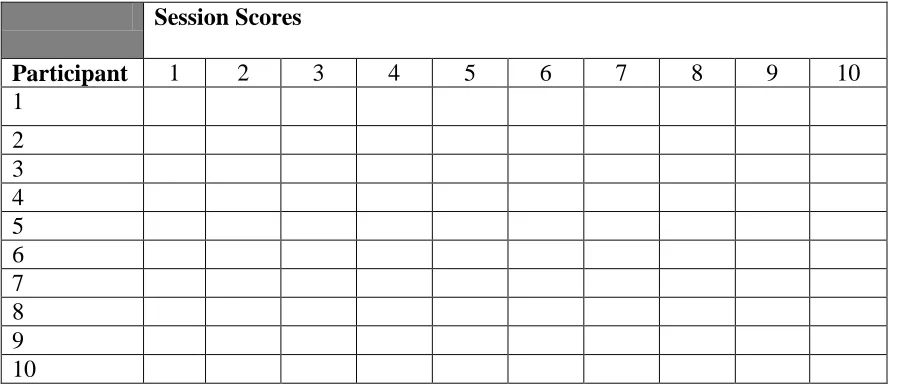
Assessment was also conducted using the OI system during intervention. The OI tracked individual participant progress. Weekly student reports were downloaded and printed for data analysis and were maintained using the LL software program. The OI was also used to track the participants‟ performance for each session and overall results on a weekly basis by the researcher. Up to 45 data points were collected using the OI system for each participant in the study because the intervention took place five times per week for 9 weeks. The data obtained through the student reports were entered onto a data collection spreadsheet (see Figure 1).
A subset of the CWG (Easterbrooks, 2010) was also used as an informal
assessment of written grammar. The subset of CWG (Easterbrooks) was administered by showing the participant an English sentence with three pictures from which to choose. The pictures contained characteristics that require comprehension of the morphosyntax in the sentence. Fifteen key grammatical structures were selected that had overlapping
Session Scores
Participant 1 2 3 4 5 6 7 8 9 10
[image:39.612.102.553.499.692.2]1 2 3 4 5 6 7 8 9 10
morphosyntax between the LL software program and the CWG (Easterbrooks). The subset of the CWG (Easterbrooks) was administered by the researcher and three graduate students in Deaf Education with ASL proficiency. Four baseline probes were
administered in randomized order over the course of 2 weeks to establish the participants‟ level of English grammar present prior to the intervention and classroom curriculum. Weekly probes were administered during intervention to serve as an ongoing assessment of fidelity of the LL software program‟s OI system. Each participant‟s baseline and
weekly probes were graphed to establish whether or not there was a pattern of
consistency of the fifteen sentences on the CWG (Easterbrooks) graph (see Figure 2).
Intervention Procedures
A total of 8 teachers administered the software intervention in their classrooms every day for 9 weeks. The period of intervention was selected based on the fact that students are expected to make progress on their Individualized Education Plan objectives and academic grades which are distributed via report cards every 9 weeks in the
clipboards, along with timers. The researcher reviewed the procedures for intervention. The teachers were given directions that the teacher script (Appendix C) should be read to the participants using ASL. During the second session the researcher reviewed the
schedule of intervention with the teachers, discussed implementation issues with teachers who did not have all students in the class participating in the current study, and had the teachers log in to the software program to practice the intervention before training the participants. During the third training session the researcher explained that fidelity checks of their implementation of the intervention sessions would be conducted by the researcher during 20% of the intervention period (approximately nine times during the 9 week period). The teachers were asked to train the participants as a group on how to use the software program for the first intervention session. For each of the up to 45 intervention sessions the participants worked on the computers as a group, or individually, depending upon the classroom teacher‟s preference and number of computers per classroom during
the 10-minute sessions as a supplemental classroom activity.
28
level (1-6) (see Appendix B) that matched his or her current ability level. All participants began with module one, level one and the OI system advanced the participants to the next module after mastery of each skill. As previously stated, teacher monitoring of participant logins was necessary when advancing to a new level. Timers were also used to ensure fidelity of implementation because the software timers were individually set for each 10- minute session, but the software would stop prior to 10 minutes if the participant
advanced to the next level. After mastery of all six modules the participant was allowed to advance to the next level by selecting the appropriate level from the login screen. If this occurred prior to the end of a 10-minute session the teachers were instructed during the teacher training sessions on how to check the student report for mastery of a level and instructed the participants how to choose the next level from the drop down menu and continue working until the 10-minute session was complete, as noted by the timers. The participants were instructed on the procedures of how to log off the computer when the software program stopped after 10 minutes and/or when the 10-minute timer stopped. Three out of 26 participants completed all the modules and levels in the program before the completion of the study and their teachers allowed them to work on a math website during the intervention sessions. The OI system generated student reports that recorded the amount of time each participant spent on each session. The researcher monitored these reports to assure the fidelity of time that each participant spent on the computers daily and provided feedback to the teacher if proper timing was not followed.
Materials
obtained gratis from the publisher, Laureate Learning Systems, Inc.; 2) 22 computers equipped with keyboard and mouse controls; 3) participant records of degree of hearing loss, age at the time of this research study, and his or her most recent BRI (Johns, 2008) scores; 4) the examiner manual, stimulus manual and record forms for each participant from the DELV-NR (Seymour et al., 2005); 5) stimulus manual for the subset of the CWG (Easterbrooks, 2010) and participant scoresheets (see Appendix F) and 6) teacher clipboards that included teacher scripts (Appendix C), problem sheets (Appendix D), weekly checklists (Appendix E), and digital timers.
Specific settings in the LL software program are important for replication
purposes and fidelity of intervention with participants who are DHH who utilize ASL as their primary mode of communication. Four important program settings (see Appendix G) in the LL software were used with the participants in this study. First, the „interface‟ option in the program settings was set to „scanning‟(see Appendix G). The sentences voiced on the software program were printed on the screen so no captioning of the software was necessary. Directional words were voiced but not printed on the computer screen. The „scanning‟ accommodation gave visual cues in place of the directional words.
Second, the „duration of session‟ option was set to 10 minutes (see Appendix G). After 10 minutes the software stopped and asked the participant to log off the program. To assist with fidelity and ease of implementation for the teacher a timer was provided to control for interruption of the intervention when participants advanced to a new level or for when technical difficulties occurred. For example, one classroom experienced a computer that „crashed‟ during the middle of a session and the participant was able to
30
because the timer let the teacher know how much longer he needed to work on the intervention during that session. The third accommodation was the „scans per item‟ setting option which was set at „infinite‟ so that the participants had extended time to read the sentence and match it to the correct object on the screen (see Appendix G). This was consistent with the program‟s intent to provide self-paced instruction. The fourth
accommodation was that the scan delay setting was set to 5 seconds for the participants 5 to 9 years of age and 3e seconds for the participants 10 to 12 years of age (see Appendix G). The rationale for the difference in scan delay was that the researcher noted some of the older participants in the study responded faster to the questions than the younger participants. The older participants‟ attention to the computer screen also began to
decrease, as noted by the researcher during the initial training/intervention session and during the first week of the intervention. Therefore, the scan delay setting was changed after the first week for participants 10 to 12 years of age, to enhance attention to the computer screen and decrease lapses in attention by the older participants in the study.
Additional accommodations were made to the computers and tables in the
for selection because if they selected a picture with the mouse and the red circle was around the other picture on the screen, then the picture with the red circle would be counted as their answer.
Data Collection
The timeline for executing the research plan was 9 weeks, every school day for 10 minutes per session. The scores for each participant from the OI student reports were compiled on the student report data collection spreadsheet (Figure 1). Instrumentation to account for validity and reliability included a procedural fidelity checklist (Appendix H) for 20% of the intervention sessions which consisted of nine observations, or once a week for the entire study. The researcher assessed treatment fidelity of the intervention by the teachers by comparing teacher weekly checklists (Appendix E) to the student reports from the OI system to monitor how many times participants logged onto the system per week and the duration of their sessions. The researcher also requested a general schedule of when teachers were using the software program in their classrooms and conducted spontaneous treatment fidelity checks to ensure teacher compliance with the script and procedures explained during the training session.
Interobserver reliability (IOR) of the pre- and postassessments of the syntax and semantic subtests of the DELV-NR (Seymour et al., 2005) were completed. IOR was conducted by four graduate researchers with majors in Deaf education, with
Collaborative Internal Review Board Training Initiative certification, and who were all proficient in ASL. During these assessment fidelity checks, the second researcher
32
expressed by the participant. IOR was conducted for 20% of the fidelity assessments and calculated using point-by-point agreement on both the DELV-NR (Seymour et al.) pretests and posttests.
Social validity was assessed using a short answer teacher questionnaire (Appendix I) that was distributed a week after the intervention was completed. The social validity of the intervention was enhanced since the intervention was administered by a teacher in a typical classroom environment, and not by the researcher. In addition, a 5-point Likert scale questionnaire (Appendix J) was distributed to the students who served as
participants in the study 1 week after the intervention was complete during posttesting. The researcher read the questions on the questionnaire to the participants in ASL. These questionnaires served as an informal and subjective evaluation (Wolf, 1978) to examine the social validity of using the intervention in the classroom setting.
Data Analysis
Two HLM growth curve analyses, one on the LL scores and one on the CWG (Easterbrooks, 2010) scores, were used to examine the same outcome variable at multiple times in order to investigate a pattern of change over time as evidenced by a change in level and slope. Each participant was measured multiple times in order to create a nested data structure. The data points from the OI reports of the LL scores and the data points from the subset of the CWG (Easterbrooks) were nested within the participants. Time was used as a level-1 predictor of the outcome of the dependent variable of the LL and CWG (Easterbrooks) scores over time on the slope of the growth curve.
intercept. Other level-2 predictor variables included the DELV-NR (Seymour et al., 2005) pretest scores on the semantic and syntax subtests and the BRI (Johns, 2008) scores. These scores served as predictors of change over time because they examined the influence of language and reading scores on the level-2 slope. The level-1 equation was
Yti = 0i + 1iTimet + eti (1)
The level-2 equation was
0i = b00 + b01Age1i + b02Hearing Loss2i + r0i, and 1i = b10 + b11BRI1i + b12DELV-NR2i + r1i
(2)
The combined equation was
Yti = b00 + b01Age1i + b02Hearing Loss2 + b10Timet + b11BRI1iTimet + b12DELV-NR2iTimet + r0i + Timet∙r1i + eti
(3)
The researcher analyzed the data using these equations and the HLM 6
(Raudenbush, Bryk, Cheong, & Congdon, 2008) and SPSS (2008) software programs. The same equation was used to run both HLM growth curve analyses on the LL software program data and the subset of the CWG (Easterbrooks, 2010) data.
34 CHAPTER 4
RESULTS
The purpose of this study was to determine if the frequent use of the LL software program as a supplemental classroom activity affected morphosyntax in participants who are DHH. Two HLM growth curve analyses were used to examine the influence of LL on the comprehension of three components of morphosyntax (determiners, tense, and
complementizers) based on two dependent variables: 1) the software program‟s OI (Wilson, 2003) report data; and 2) data from a subset of the CWG (Easterbrooks, 2010). In addition, a dependent t-test was used to examine the comprehension of morphosyntax based on the third dependent variable of the DELV-NR (Seymour et al., 2005)
assessment. Fidelity and social validity were also assessed using observations and questionnaires.
LanguageLinks HLM Growth Curve
Time spent per module was a statistically significant predictor of progress, t(25) = 4.510, p < .001, with participants averaging an increase of 0.4 modules per time period, or approximately half of a module per session. The level-2 predictor variables, Age, t(23) = 1.867, p = .074, and Degree of Hearing Loss, t(23) = -0.102, p = .920, were not
statistically significant predictors of where participants began on the level-1 intercept. The DELV-NR (Seymour et al., 2005) syntax, t(22) = -0.713, p = .483 and pre-semantic, t(22) = 1.722, p = .099, subtest scores were not statistically significant
of language and reading scores on the level-2 slope, the results indicated that the participants‟ BRI (Johns, 2008) scores, t(22) = 3.522, p = .002, were statistically
significant predictors of change over time on the LL software program modules.
Comprehension of Written Grammar HLM Growth Curve
Time was a statistically significant predictor of progress, t(25) = 4.750, p < .001, on the scores from the subset of the CWG (Easterbrooks, 2010), averaging .148 sentence structures per weekly assessment. The level-2 predictor variable Degree of Hearing Loss, t(23) = -0.964, p = .346, was not a statistically significant predictor of the beginning
score. Age was a statistically significant predictor of the beginning score, t(23) = 2.182, p = .039. The DELV-NR (Seymour et al., 2005) pretest syntax subtest, t(22) = -0.234, p = .817, and pretest semantic subtest, t(22) = 1.830, p = .080, scores were not statistically significant predictors of change over time on the subset of the CWG (Easterbrooks). The BRI (Johns, 2008) scores, t(22) = -0.037, p = .971, were not statistically significant predictors of change over time on the weekly CWG (Easterbrooks) scores.
Diagnostic Evaluation of Language Variation Results
Pre- and post- syntax subtests.A dependent t-test was conducted to compare the pretest scores of the syntax subtest of the DELV-NR (Seymour et al., 2005) assessment and the posttest scores of the syntax subtest of the DELV-NR (Seymour et al.)
36
Pre- and post- semantic subtests. A dependent t-test was conducted to compare
[image:51.612.104.547.320.531.2]the pretest scores of the semantics subtest of the DELV-NR (Seymour et al., 2005) assessment and the posttest scores of the semantics subtest of the DELV-NR (Seymour et al.) assessment with alpha set at .05. There was not a statistically significant difference between the scores on the pretest semantic subtest (M = 20.384, SD = 7.228) and the posttest semantic subtest (M = 22.153, SD = 5.661), t(25) = -2.004, p = .056. A summary of the results is presented in Table 1.
Table 1
Results of DELV-NR Subtests
M N SD
Pre-syntax subtest 10.884 26 5.778
Post-syntax subtest 12.769 26 4.966
Pre-semantic subtest 20.384 26 7.228
Post-semantic subtest 22.153 26 5.661
T Df Sig (2-tailed)
Syntax subtest -2.394 25 .024
Semantic subtest -2.004 25 .056
Inter-Observer Reliability and Procedural Fidelity
recorded the participant responses on a separate, identical protocol record sheet. The data on both protocols were compared for agreements and disagreements for 20% of the pretest and posttest sessions (5 participants for the pretest and 5 participants for the posttest). The DELV-NR (Seymour et al.) pretest point-by-point agreement was 98% and the DELV-NR (Seymour et al.) posttest point-by-point agreement was 94%.
Weekly procedural fidelity checklists (Appendix H) were completed for 20% of the intervention sessions for 9 weeks. Nine fidelity checks were conducted, one per week for 20% of the 45 intervention sessions. The results of the procedural fidelity checklists indicated that the teachers complied with the scripts during intervention for 100% of the observed sessions. The researcher observed that the teachers followed the teacher script (Appendix C) to ensure that the participants logged onto the system correctly.
Social Validity
Teacher social validity questionnaires (Appendix I) were completed by 5 out of 8 teachers who participated in the study. These consisted of five questions that were qualitative in nature. The responses varied among the teachers and results were mixed regarding the motivational nature of the multimedia software format. For the responses to the question regarding motivation (question 4) the teachers were asked to circle “Better”, “Same”, or “Worse” regarding whether or not they believed this task was more or less
motivating than other direct instruction of language skills they previously used in their classroom and explain their answer. Three teachers answered “Worse” and 2 teachers answered “Better”. For the responses to the question regarding student perception of the
38
“Negatively” and explain their answer. Two teachers answered “Positively”, 1 teacher answered “Neutral”, and 2 teachers answered “Negatively”.
Participant social validity questionnaires (Appendix J) were completed during posttesting and all questions were read to the participants in ASL. There were six
questions in the survey. A Likert scale from 1-5 measured participant responses, where 1 indicated “strongly agree”, 2 indicated “agree”, 3 indicated “unsure”, 4 indicated
[image:53.612.109.549.349.553.2]“disagree”, and 5 indicated “strongly disagree”. Results are presented in Table 2.
Table 2
Social Validity Questionnaire Results
Questionnaire Item
strongly
agree agree unsure Disagree
strongly disagree
1. I enjoyed using LanguageLinks. 22 2 2 0 0
2. I learned a lot using LanguageLinks.
18 1 6 0 1
3. LanguageLinks was fun. 18 0 8 0 0
4. I make fewer mistakes writing now.
11 2 5 1 7
5. I would use LanguageLinks at home.
12 1 2 1 10
6. I would recommend LanguageLinks to a friend.
39 CHAPTER 5 DISCUSSION
The present study determined if the frequent use of the LL software program as a supplemental classroom activity affected the morphosyntax of participants who are DHH. The research question was: Does daily use of the LL software program as a supplemental classroom activity affect morphosyntax in participants who are DHH as measured by HLM growth curve analyses? The results indicated that LL did affect the morphosyntax in participants who are DHH and use ASL, as measured by the HLM growth curve analysis of the OI scores. These results were supported by the statistically significant HLM growth curve analysis of the subset of the CWG (Easterbrooks, 2010) scores. The subset of the CWG (Easterbrooks) was administered as an additional measure of whether the results of the OI scores were due to the LL software program or language instruction in the classroom setting during the course of this research study. The corroboration of these statistically significant results indicated that the software program was partially responsible for the increase in morphosyntax of the participants in this research study. These results were also supported by the statistically significant results of the dependent t-test on the DELV-NR (Seymour et al., 2005) pre- and post- syntax subtest scores of the
40
LanguageLinks Results
The results of the HLM growth curve analysis of the scores on the LL software program showed that participants in the study progressed through the program‟s six levels and six modules at an average increase of 0.4 modules per time period. This is equivalent to completing half of a module per session, per day. Each module allowed for practice and assessment of one of three concepts of morphosyntax (determiners, tense, and/or complementizers). Therefore participants either reviewed, or initially practiced, approximately half of a lesson on one of these concepts of morphosyntax within a 10- minute session on a daily basis. The speed of acquisition and/or reinforcement of these morphosyntax concepts suggest that this program may be a promising evidence-based, supplemental classroom strategy for participants who are DHH and use ASL.
supporting time on task. Davey, LaSasso, and MacReady (1983) found that TODs spent very little time on task in reading instruction and so one might speculate that teachers also spend little time on the task of language instruction. Perhaps the LL software program is an option that would increase the amount of time students could spend on direct instruction of morphosyntax if they were given a choice between the software program and typical paper and pencil tasks.
The participants‟ scores on the BRI (Johns, 2008) were statistically significant predictors of their ability to progress through the modules and levels of the LL software program. In previous studies of this software the participants were able to listen to the prompt and could have ignored the printed sentence (Finn et al., 2005). In this study the participants did not have access to the voiced prompts so they tended to pay more attention to the printed sentences, which may account for why the BRI (Johns) scores were so predictive of progress. Therefore, the participants used their reading ability to comprehend the printed sentences and the directions in the software program on the screen. Prior research (Allen, 1986; Ewoldt, 1990; Kelly, 1996; Schirmer & McGough, 2005) supports the finding that participants with more complex vocabulary knowledge were more successful at applying the rules of morphosyntax when reading sentence prompts.
Comprehension of Written Grammar Results
42
knowledge of morphosyntax from the intervention to this assessment. Although the actual acquisition of structures appeared small (i.e., 1.5 sentence structures during the course of the study), this acquisition was statistically significant. This is important because there are no other research studies available that document rate of access of morphosyntax in children who are DHH. While this may appear on the surface to be minimal progress, it is consistent with what we know about the rate of progress in the literacy of students who are DHH (Marschark & Wauters, 2008).
Age was the only statistically significant predictor variable for this HLM growth curve analysis and therefore appears to have influenced the ability of the participants to transfer their knowledge from the intervention to the assessment. The selection of which subset of sentences was used in the CWG (Easterbrooks) may have influenced the results of this HLM analysis as they were chosen to match the structures from the LL software program. The high level of vocabulary in the sentences may have influenced the results. This is consistent with research showing that grammar ability correlates highly with reading ability (Macaluso, 2007; Verhoeven &Van Leeuwe, 2008).
Diagnostic Evaluation of Language Variation Results
may be useful with students who are DHH and utilize ASL is that their first language is not MAE and the morphosyntax of ASL does not follow MAE (Lane et al., 1996). Few assessments are available in Deaf education because a majority of the previous research has focused on the oral/manual controversy. The assessment of MAE may prove to be a mutually beneficial tool for both hearing students and students who are DHH.
The DELV-NR (Seymour et al., 2005) pre- and post- semantic subtest scores were not statistically significant. This may indicate that the four subdomains of the assessment did not overlap to the extent originally estimated when constructing the research design of this study. The „verb contrasts‟ present in the DELV-NR (Seymour et al.) assessment were a measure of the corresponding concept of tense in the LL software program. The subdomains of „preposition contrast‟, „quantifiers‟, and „fast mapping‟ were not overtly taught in the LL software program (see Appendices A and B). These subdomains measure the participants‟ ability to organize vocabulary, contrast prepositions,
comprehend quantifiers, and retain new meanings from the context of a sentence (Seymour et al.). Although some of these concepts are necessary for comprehension of the sentence structures throughout the modules and levels of the program, the lack of direct instruction in particular modules may account for the lack of gain between pre- and posttest scores in this study. Including all four subdomains of the semantics subtest in this study may have washed out the effects of the one subdomain that overlapped with the LL software.
Social Validity
44
activity. The teachers‟ responses were mixed and appeared to be dependent upon the
grade level of the students participating in the study. Although not all grade level teachers completed a questionnaire, which restricts the interpretation of the results, it appeared that the fifth grade classroom teachers felt the program was not motivating for their students. This may be due to their students‟ age and may be an indication that some of the programs‟ activities, pacing, and feedback are better designed for younger students.
The 2 kindergarten teachers reported that the program was too difficult for their students without direct teacher instruction of the concepts and suggested that the intervention might work better as a supplemental activity after direct instruction.
Additionally, both kindergarten teachers felt that their students‟ limited skills in reading and vocabulary knowledge may have impeded their ability to comprehend all the sentences presented in print on the computer screen. They also commented that if they used the software in the future they would prefer to read the sentences to the students using ASL. Had this been done, it would have added a confounding factor to the study as the grammars of English and ASL differ greatly.