C A S E R E P O R T
Open Access
Soy isoflavones inducing overt
hypothyroidism in a patient with chronic
lymphocytic thyroiditis: a case report
Yuya Nakamura
1,2, Isao Ohsawa
1*, Yoshikazu Goto
1, Mayumi Tsuji
2, Tatsunori Oguchi
2, Naoki Sato
2, Yuji Kiuchi
2,
Motonori Fukumura
3, Masahiro Inagaki
4and Hiromichi Gotoh
1Abstract
Background:Many people have thyroid conditions that make them susceptible to hypothyroidism. If the foods
they eat may interfere with the production of thyroid hormone, which can lead to development of serious hypothyroidism. The danger of health drinks should always be noted.
Case presentation:A 72-year-old Japanese woman was previously diagnosed with chronic lymphocytic
thyroiditis caused by a goiter and had an elevated thyroid-stimulating hormone level (6.56 μIU/ml), a high anti-thyroid peroxidase antibody level (>600 IU/ml), and a high antithyroglobulin level (> 4000 IU/ml) but normal levels of free triiodothyronine (3.08 pg/ml) and thyroxine (1.18 ng/ml). She presented to our hospital with sudden-onset general malaise, edema, and hoarseness with an elevated thyroid-stimulating hormone (373.3 μIU/ml) level and very low triiodothyronine (< 0.26 pg/ml) and thyroxine (0.10 ng/ml) levels. It was determined that for 6 months she had been consuming a processed, solved health drink (“barley young leaf”) in amounts of 9 g/day, which included soybean and kale powder extract. Hypothyroidism might be affected by ingredients of health drinks. She discontinued consumption of the health drink immediately and began taking 12.5 μg of levothyroxine. The amount of levothyroxine was gradually increased every 3 days up to 100 μg. At day 61, her thyroid-stimulating hormone level had decreased (6.12 μIU/ml), her free triiodothyronine (2.69 pg/ml) and thyroxine (1.56 ng/ml) levels had increased, and her general condition was improved. Among risky foods lowering thyroid function, some experimental studies have revealed that isoflavones reduce thyroid function. Therefore, we measured the presence of isoflavones in the patient’s frozen serum with thin-layer chromatography. After she discontinued consumption of the health drink, two components quickly disappeared, and the other three components gradually decreased. On the basis of developing solvent composition and a positive ferric chloride reaction in thin-layer chromatography experiment, the five ingredients that disappeared or decreased were highly suspected to be soy isoflavones.
Conclusions: This case emphasizes that consuming health drinks that include soy isoflavone powder
extracts can lead to severe hypothyroidism.
Keywords: Isoflavones, Soybean, Barley young leaf, kale, Hypothyroidism, Chronic lymphocytic thyroiditis,
Thin-layer chromatography
* Correspondence:[email protected]
1Department of Internal Medicine, Saiyu Soka Hospital, 1-7-22 Matsubara,
Soka City, Saitama 344-0041, Japan
Full list of author information is available at the end of the article
Background
Many people have thyroid conditions that make them susceptible to hypothyroidism. For example, 10% of a disease-free population was reported to have positive results for anti-thyroid peroxidase antibodies (TPOAb) or antithyroglobulin (anti-Tg) [1], indicating that many patients have potentially chronic lymphocytic thyroiditis. However, there are many exogenous foods influencing the thyroid. If the foods interfere with the production of thyroid hormone, they can cause serious hypothyroidism.
We report a case of a patient with severe hypothyroidism induced by consuming a health drink. To the best of our knowledge, there are almost no other reports of patients with severe hypothyroidism induced by isoflavone. The components of the sub-stances suspected to be isoflavones disappeared or de-creased along with the clinical impairment of our
patient. To the best of our knowledge, this is the first report of the presence of isoflavone in the serum of a patient with severe hypothyroidism.
Case presentation
[image:2.595.58.541.331.680.2]A 72-year-old Japanese woman had been followed be-cause of chronic lymphocytic thyroiditis be-caused by a goiter. She had an elevated thyroid-stimulating hor-mone (TSH) level (6.56 μIU/ml), a high TPOAb level (> 600 IU/ml), and a high anti-Tg level (> 4000 IU/ml) but normal levels of free triiodothyronine (T3; 3.08 pg/ml) and thyroxine (T4; 1.18 ng/ml). Her past medical history included only hypertension. She did not have any fever or neck pain suggestive of sub-acute or painless thyroiditis during recent months, and she had not taken any medication that would reduce thyroid function. Her social, family, and envir-onmental histories were also unrevealing.
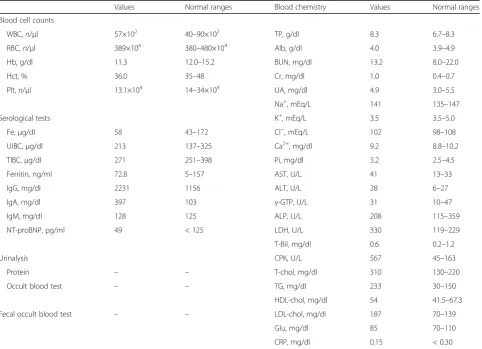
Table 1Patient’s laboratory findings on admission
Values Normal ranges Blood chemistry Values Normal ranges
Blood cell counts
WBC,n/μl 57×102 40–90×102 TP, g/dl 8.3 6.7–8.3
RBC,n/μl 389×104 380–480×104 Alb, g/dl 4.0 3.9–4.9
Hb, g/dl 11.3 12.0–15.2 BUN, mg/dl 13.2 8.0–22.0
Hct, % 36.0 35–48 Cr, mg/dl 1.0 0.4–0.7
Plt,n/μl 13.1×10⁴ 14–34×104 UA, mg/dl 4.9 3.0–5.5
Na+, mEq/L 141 135–147
Serological tests K+, mEq/L 3.5 3.5–5.0
Fe,μg/dl 58 43–172 Cl−, mEq/L 102 98–108
UIBC,μg/dl 213 137–325 Ca2+, mg/dl 9.2 8.8–10.2
TIBC,μg/dl 271 251–398 Pi, mg/dl 3.2 2.5–4.5
Ferritin, ng/ml 72.8 5–157 AST, U/L 41 13–33
IgG, mg/dl 2231 1156 ALT, U/L 28 6–27
IgA, mg/dl 397 103 γ-GTP, U/L 31 10–47
IgM, mg/dl 128 125 ALP, U/L 208 115–359
NT-proBNP, pg/ml 49 < 125 LDH, U/L 330 119–229
T-Bil, mg/dl 0.6 0.2–1.2
Urinalysis CPK, U/L 567 45–163
Protein – – T-chol, mg/dl 310 130–220
Occult blood test – – TG, mg/dl 233 30–150
HDL-chol, mg/dl 54 41.5–67.3
Fecal occult blood test – – LDL-chol, mg/dl 187 70–139
Glu, mg/dl 85 70–110
CRP, mg/dl 0.15 < 0.30
Abbreviations: AlbAlbumin,ALPAlkaline phosphatase,ALTAlanine transaminase,ASTAspartate transaminase,BUNBlood urea nitrogen,Ca2+
Calcium,Cl−Chloride, CPKCreatine phosphokinase,CrCreatinine,CRPC-reactive protein,FeIron,γ-GTPγ-Glutamyltransferase,GluGlucose,HbHemoglobin,HctHematocrit,HDL-chol High-density lipoprotein cholesterol,IgAImmunoglobulin A,IgGImmunoglobulin G,IgMImmunoglobulin M,K+
Potassium,LDHLactate dehydrogenase,LDL-chol Low-density lipoprotein cholesterol,Na+
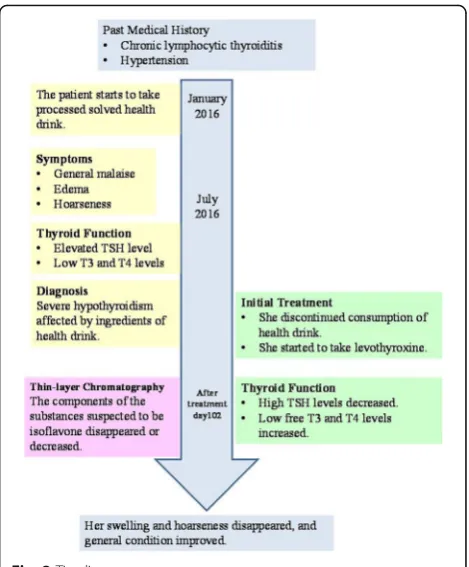
The patient had been taking a processed, solved health drink (“barley young leaf”) in amounts of 9 g/ day, which included soybean and kale powder ex-tract, for 6 months. She had gradually developed general malaise, edema, and hoarseness. She pre-sented to our hospital with sudden-onset elevated TSH (373.3 μIU/ml) level and very low T3 (< 0.26 pg/ml) and T4 (0.10 ng/ml) levels. Her levels of total cholesterol, triglyceride, lactate dehydrogenase, aspartate transaminase, creatine phosphokinase, and immunoglobulin G were increased. These laboratory findings are shown in Table 1. Her goiter was swol-len with mild hardness; her blood pressure at admis-sion was 123/77 mmHg; her body temperature was 36.0 °C; and her pulse rate was 55 beats/minute. Computed tomography (Fig. 1) and thyroid ultra-sound revealed bilateral thyroid enlargement. In addition, her uptake rate of 99mTc-pertechnetate was reduced. On the basis of these findings, we diag-nosed severe hypothyroidism affected by ingredients of the health drink. She discontinued consumption of the health drink immediately and began taking 12.5 μg of levothyroxine. The amount of levothyrox-ine was gradually increased every 3 days up to 100 μg. After oral administration of levothyroxine, her high TSH levels decreased gradually, and her low free T3 and T4 levels increased. Her swelling and hoarseness disappeared, and her general condi-tion improved. Her free T3 and T4 levels did not decrease in the follow-up period of the subsequent 6 months. The time line of this patient’s clinical course is shown in Fig. 2. Her TSH, free T3, and T4 levels are shown in Table 2.
There are many risky foods lowering thyroid function, such as soybean and cruciferous vegetables, especially in a patient with chronic lymphocytic thyroiditis. Among these foods, some experimental
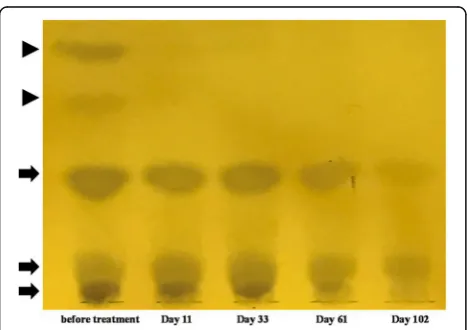
studies have shown that isoflavone reduces thyroid function [2, 3]. It was suspected that isoflavones might be the reason for our patient’s hypothyroidism. Therefore, we measured the presence of isoflavone in the patient’s frozen serum at 5 points from before admission to day 102 for further investigation. A blood sample was pretreated as described previously [4]. The sample was analyzed with thin-layer chromatography on precoated silica gel 60 F254 or RP-18 WF254 plates (Merck Millipore
Corporation, Darmstadt, Germany), with detection achieved by spraying with iron(III) chloride solution. After she discontinued consuming the health drink, two components quickly disappeared, and the other three components gradually decreased (Fig. 3). On the basis of developing solvent composition and a positive ferric chlor-ide reaction in thin-layer chromatography experiment, the five ingredients that disappeared or decreased were highly suspected to be soy isoflavones.
Discussion
Isoflavone, one of the isoflavonoids, is associated with breast cancer, prostate cancer, cerebral infarc-tion, and myocardial infarction [5–7]. Moreover, some researchers have reported that soy isoflavone might reduce thyroid function by suppressing thyroid peroxidase [2, 3]. In our patient, the components of
Fig. 2Timeline
Fig. 1Computed tomographic scan showing thyroid
[image:3.595.305.540.86.370.2] [image:3.595.58.291.561.702.2]the substances suspected to be isoflavones had disap-peared or decreased along with her clinical impair-ment. To the best of our knowledge, this is the first case report in which the presence of isoflavone has been examined in the serum of a patient with severe hypothyroidism. This point is unique; to the best of our knowledge, there have been almost no other re-ports in which the presence of isoflavone has been examined in patient serum. The other following two mechanisms of hypothyroidism by soybean are con-sidered: (1) An alcohol-soluble component in soybean inhibits iodide uptake [8], and (2) phytic acid salt in soybean chelates the essential minerals, especially zinc, for thyroid hormone production [9, 10]. Our pa-tient presented with severe hypothyroidism after 6 months of regular consumption of a health drink. Because the thyroid contains several months’ storage of thyroid hormone [11], overt hypothyroidism might present late. It is necessary to investigate further the detailed mechanisms of hypothyroidism caused by soy isoflavones.
Conclusions
This case emphasizes that consuming health drinks that include soy isoflavone powder extract can lead to severe hypothyroidism.
Acknowledgements
Not applicable.
Funding
None.
Availability of data and materials
All data generated or analyzed for this report are included in this published article.
Authors’contributions
YN, IO, MF, and MI conceived of and designed the laboratory measurements. YN, IO, MF, and MI analyzed the data. YN wrote the first draft of the manuscript. IO critically revised the manuscript. YG, MT, TO, NS, YK, and HG jointly developed the structure and arguments for the paper. IO and YK made critical revisions and approved the final version of the manuscript. All authors read and approved the final manuscript.
Ethics approval and consent to participate
Not applicable.
Consent for publication
Written informed consent was obtained from the patient for publication of this case report and any accompanying images. A copy of the written consent is available for review by the Editor-in-Chief of this journal.
Competing interests
The authors declare that they have no competing interests.
Publisher’s Note
Springer Nature remains neutral with regard to jurisdictional claims in published maps and institutional affiliations.
Author details
1
Department of Internal Medicine, Saiyu Soka Hospital, 1-7-22 Matsubara, Soka City, Saitama 344-0041, Japan.2Department of Pharmacology, School of
Medicine, Showa University, Shinagawa-ku, Tokyo, Japan.3Division of Natural
Medicine and Therapeutics, Department of Clinical Pharmacy, School of Pharmacy, Showa University, Shinagawa-ku, Tokyo, Japan.4Department of Chemistry, College of Arts and Sciences, Showa University, Fujiyoshida City, Yamanashi, Japan.
Received: 17 May 2017 Accepted: 4 August 2017
References
1. Hollowell JG, Staehling NW, Flanders WD, Hannon WH, Gunter EW, Spencer CA,et al.Serum TSH, T4, and thyroid antibodies in the United States population (1988 to 1994): National Health and Nutrition Examination Survey (NHANES III). J Clin Endocrinol Metab. 2002;87:489–99.
[image:4.595.58.540.100.155.2]Fig. 3Results of the thin-layer chromatography. After discontinuing health drink, two components (arrow heads) quickly disappeared and the other three components (arrows) gradually decreased. From the composition of the developing solvent and the positive findings of ferric chloride, these ingredients were speculated highly likely for soy isoflavone
Table 2Patient’s clinical course based on laboratory findings after discharge
Before treatment Day 11 Day 33 Day 61 Day 102 Normal range
TSH,μIU/ml 373.7 341.3 40.66 6.12 11.68 0.50–5.00
fT3, pg/ml < 0.26 0.55 2.47 2.69 2.58 2.30–4.00
fT4, ng ml 0.1 0.28 1.41 1.56 1.45 0.90–1.70
[image:4.595.57.291.500.665.2]2. Chang HC, Doerge DR. Dietary genistein inactivates rat thyroid peroxidase in vivo without an apparent hypothyroid effect. Toxicol Appl Pharmacol. 2000;168:244–52.
3. Munro IC, Harwood M, Hlywka JJ, Stephen AM, Doull J, Flamm WG,et al.
Soy isoflavones: a safety review. Nutr Rev. 2003;61:1–33.
4. Kaneko H, Yamato Y, Teramura Y, Fujiwara T, Suzuki A, Kawamura A,et al.
Metabolites of micafungin in rats and dogs. Jpn J Chemother. 2002;50:88–93. 5. Yamamoto S, Sobue T, Kobayashi M, Sasaki S, Tsugane S. Japan Public
Health Center-Based Prospective Study on Cancer Cardiovascular Diseases Group. Soy, isoflavones, and breast cancer risk in Japan. J Natl Cancer Inst. 2003;95:906–13.
6. Kokubo Y, Iso H, Ishihara J, Okada K, Inoue M, Tsugane S, JPHC Study Group. Association of dietary intake of soy, beans, and isoflavones with risk of cerebral and myocardial infarctions in Japanese populations: the Japan Public Health Center-based (JPHC) study cohort I. Circulation. 2007;116:2553–62.
7. Kurahashi N, Iwasaki M, Sasazuki S, Otani T, Inoue M, Tsugane S, Japan Public Health Center-Based Prospective Study Group. Soy product and isoflavone consumption in relation to prostate cancer in Japanese men. Cancer Epidemiol Biomarkers Prev. 2007;16:538–45.
8. Tran L, Hammuda M, Wood C, Xiao CW. Soy extracts suppressed iodine uptake and stimulated the production of autoimmunogen in rat thyrocytes. Exp Biol Med (Maywood). 2013;238:623–30.
9. Zhou JR, Erdman Jr JW. Phytic acid in health and disease. Crit Rev Food Sci Nutr. 1995;35:495–508.
10. Szkudelski T. Phytic acid-induced metabolic changes in the rat. J Anim Physiol Anim Nutr (Berl). 2005;89:397–402.
11. Ingbar SH, Woeber KA. The thyroid gland. In: Williams RH, editor. Textbook of endocrinology. 6th ed. New York: Saunders; 1981. p. 117–247.
• We accept pre-submission inquiries
• Our selector tool helps you to find the most relevant journal
• We provide round the clock customer support
• Convenient online submission
• Thorough peer review
• Inclusion in PubMed and all major indexing services
• Maximum visibility for your research
Submit your manuscript at www.biomedcentral.com/submit