T.
Submitted in Partial Fulfillment of the
for the
Institute of
Flood Control District under ef ""'~'·""""il"'"
C. H. for the financial side of
to state here his
The writer
of the many made the course of his
Professor R. T. and Professor Th. von deal of credit is due if this
a s forward in the science of
Mr.
E.
was connected with the constructionand the first of Messrs.
J.
M.
Fox and T.w.
werelatter of work and. in the evaloo,tion on the amount
Of
data.and. was members
of
the Los
• to mean
of
on.
the
and
SUMMARY
In the theory of flow in open channels two stages of flow with principall;:r different characteristics have to be considered, streaming flow and shooting flow. The velocity of flow in the first case is smaller than the velocity of propagation of trans-latory waves, in the latter case it is larger. The phenomena
occurring in streaming flmnr are well known and theoretically solved, if i'lre neglect the influence of friction. This latter simplification means that the velocity has a constant value for each point of
the cross-section. For this assumption also the theory of the hy-draulic jump has been successfully attacked, where the stage of
flO'w· changes i'rom the shootil1g to the s·treaming condition. The present paper, however, deals with problems of flow of the shoot-ing stage only and extends the theory of hydraulics to all cases of supercritical flow, where the variation of depths and velocities due to cha.11ges in the direction of' f'lovr is desired.
B. Analytical St::_dy. of Supercritical Flow
I. !_upercritical Flo'~
a. Definition of Supercritical Flow and Wave
Velocity b. Properties of Flow at Supercritical
Velocities c. Boundary of Disturbances
a. Derivation of Wave .Angle
b. ~:'he Influence of a Change in the Direc-tion of Flow
c ..
d.
1.
GeneralLaw
2. Conditions for Application to Flow in Curves Derivation of Elevation Procluced by Change
in Direction
1. Discussion of Possible Assmnptions
2. Derhni:tion on the Basis of Constant Energy
3. Derivation on the Basis of Constant ·velocity Derivation of Location and Magnitude of
First ]\[J.aXimturL
1. Location of Beginning of First Maximum 2. Depth in Zone of First Maximum
I. Experimental Procedure
II. Schedule of Tests
III.
Graphical Resultsa. Water Surface Contour Maps
b. Water Surface Profiles Along Channel
Walls
c. Water Surface Profiles Along Outer
Chan-nel Vi.alls
d. Cross-Sections of Flow and Velocity Distribution
2 .. 20
2 - 5
2
4
5
6 - 20
G
8
8
8
13 - 17
13
14
17
18 - 19 18
19
21 - 50
21 22
27 - 50
27 31
38
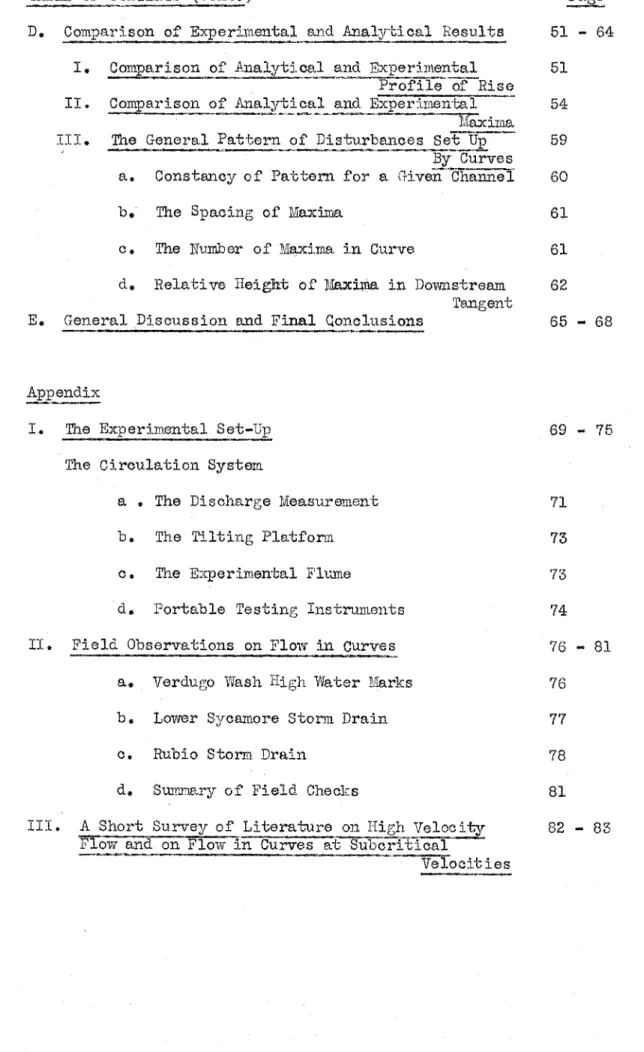
TABLE OF CONTENTS (cont.)
D. Comparison of Experimental and .Anal;rcical Results 51 - 64
I. Cow..parison of Jl..nalyti ce:?.- and Experimental 51 Profife .. ~Rise
II. Comparison of Analytical and Exper:i.mental - 54 - - - · ,,_ -~··-·-.. - · ~---· Maxima
III. The General Pattern of Disturbances Setup - - 59 - · - - - · - · · - - By-·curves
a. Constancy of Pattern for a Given-Chanr1e1 60
b. The Spacing of Maxima 61
c. The Number of Maxima in Curve 61
d. Relative Height of' Ma.x;4na in Dovmstrea.m 62 Tangent
E. General Dj_scussion and Final Conclusions 65 - 68
I. The Experimental Set-Up
The Circulation System
a • The Discharge Measurement
b. The Tilting Platfonn
c. The Experirnen·bal Flume
d. Portable Testing Instruments II. Field Observations on_Flow in curves
a. Verdugo Wash High Water IvTarks b. Lower Sycamore Storm Drain
c. Rubio Storm Drain
d. Summary of li'ield Checks
III. A Short Survey of Literature on High Velocity Flow and on Flovv- in Curves at Subcri
ti
calVelocities
69 - 75
71
73
'73
74
'76 - 81
76
77
78
81
1. Specific Energy Diagram 2
2. Paths of Yfave Fronts 6
3. Velocity Vector Dia.gram for Constant Energy 15
Assumption
4. Velocity Vector Diagram. for Constant Velocity 17 .Assumption
5. Dia.grrun for Derivation of Location of First 19 lfaximu:r!l
Water Surface Contour Maps
6. Runs 13 and 39, Runs 3 and 32 28
7. Runs 19c and 28, Run 26 29
8.
Runs
52, 57 and 71 30Water Surface Profiles Along Channel Yfalls
9. For 10 foot and 20 foot Radius of Curvature 32
10. For 40 foot Radius of Curve.ture 33
11.
For Runs
of l-l/2fa Slope 3412. Photographs of Run 13 35
13. Photographs of Runs 11 and 39 36
14. Photographs of Run 32 37
Water Surface Profiles Along Outer Channel W"alls
15. For 10 foot and 20 foot Radius of Curvature 39
16. For 40 foot Radius of Curvature 40
17. For
Runs
of l-l/2;1a Slope 41Cross-SectiOllll.s of Flow and Velocity Distributions
18. Runs 10 and 13 43
19. Runs 19c and 26 44
20. Runs 28 and 32 45
21 •• Run 39~ Runs 18 and 35-37 46
22. Runs 52 and 57 47
LIST OF FIGUP.ES .AND TlillLES
(cont.)Figure.
24. Photographs of Run 180 49
25. Photograp~s of Runs 35 - 36 50
26. Photogra.ph of Shape of Rise 51
27. Diagram of Approximate Solution for Long Radius 59 Curves
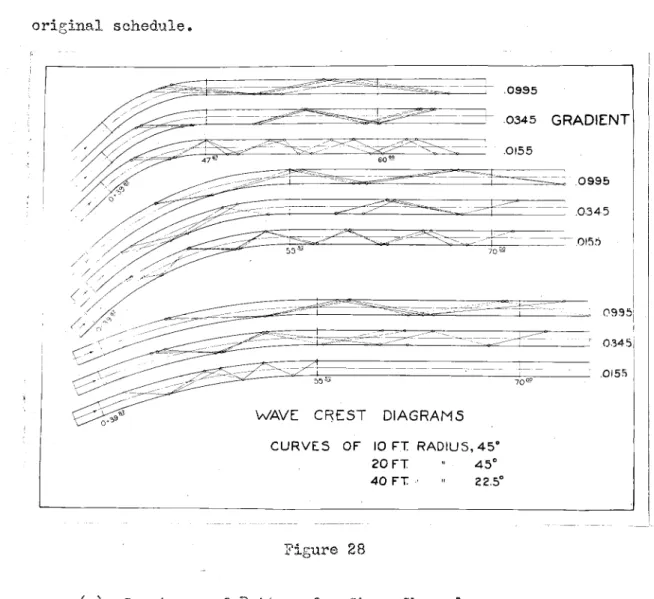
28. Ylave Crest Diagrams 60
29. Photogra~hs of Disturbance in Dovmstream Tan- 63
gent, Slope 3-1/2%
30. Photographs of Disturbance in DoTunstrerun. Tan- 64 g;ent, Slope 1-1/2~~
31. Water Surface Profiles Along Channel Vfo.lls, 66
Compound Curves
32. Water Surface Profiles Along Outer Charm.el 67 Walls, Compound Curves
33. Diagram of Experimental Set-Up 69
34. Scale Dravring; of' Experimental Set-Up 70
35. 10" Venturi Neter 71
36. Venturi Manometer and Regulcling Valves 72
37. Slope Adjustment 73
38. Entrance Nozzle 74
39. Point Gimge 74
40. Pitot Measurement 75
41. Wall Profiles of Rubio '\'Tash 80
Tables
I. Complete List of Runs end Corresponding
Hydraulic Data
II. Cornparison of Shape of Rise in Depth Along Outer Wall III. Comparison of Iv'Iaximum. Depths at Outer Wall
24 - 26
52 - 53
d
=
variable local depthd0
=
critical depthd0
=
average depth in the channel of approachh' • maximum depth at the outside wall of the curve
b
=
v-ridth of rectangular sectionp • wetted perimeter
m
=
hydraulic radiusv0
=
average velocity in channel of approachv
=
varie.ble local velocityv0
=
c - critical velocity= vmve velocity or celerityQ
=
tote.l dischargeq
=
discharge per unit widths
=
slope of flume along centerlineg
=
acceleration of c;ravity=
32.2 ft/sec2n ::. Manning's coefficient of roughness
R • radius of cur-1rature of oenterli.ne of flume
9
=
e:ent~al angle of turn9
0
=
central angle from begi:nning of curve to first maximur1~ • variable local value of wave angle
1
A. INTRODUCTION
The investigation presented in the following started origin-ally as an experimental study, from which information was desired on the behaviour of flow at high velocities in curved sections of open channels. In order to simplify the approach to the problem, the cross-section of the channel vro..s chosen rectangular with zero cross-slope. The range of velocities to be considered was such that at any point the velocity stayed above the critical. For the latter condition, it was found, that the laws and formulae that are used and proven correct for lov; velocity flow failed to yield any resul-t;s consistent with the experimental outcome of the study.
The theory developed thus far for supercritical velocity deals only Vtli th straight flow and parallel streamlines or with the trans-_ition from the supercritical to the subcritical stage as encountered
in the hydraulic jump. In order to obtain a fundamentally correct basis for the analytical study of the problem of flow in curves at velocities which stay alvmys in the supercritical ran0e, the
B. ANALYTICAL STUDY OF SUPERCRITICAL FLOW
__
. . _ . . _ ...~~-I. Supercritical Flow
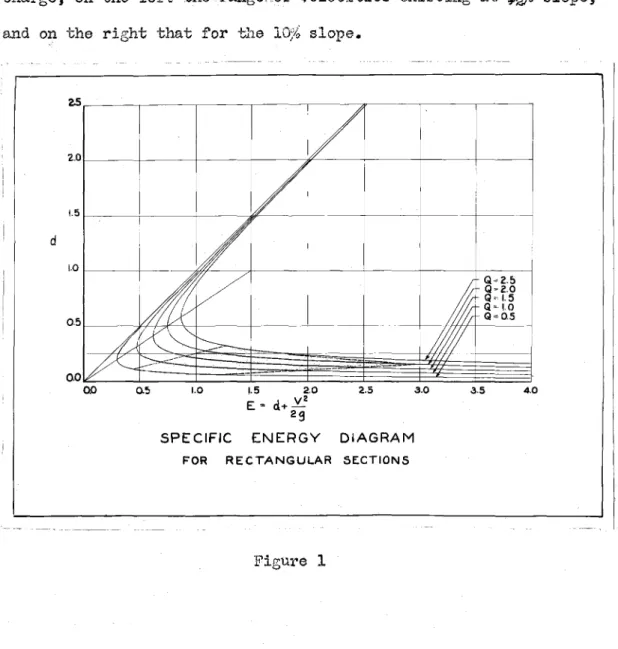
a. Definition of Supercritical Flow ~d ]~<:_!el?_<?_it~. The best illustration for the conditions existing at supercritical ve-locities is given in Fig. 1, which shows the v.rell-lplown specific energy diagram. plotted for the range of conditions as existed in the experimental investigation. The range covered by the experi-ments is indicated by the shaded area. The boundaries of this area are: On top and bottom the lines of :maximum and minimum dis-charge, on the left the range of velocities existing at
J.-?ffe
slope, and on the right that for the 10% slope.d
0.5 1.0 1.5 2.0
E = d+ v2 29
2.5
SPECIFIC ENERGY DIAGRAM
FOR RECTANGULAR SECTIONS
Figure 1
3.0
Q 2.5
Q Q 2.0
1.5
Q 10 Q 0.5
3
This diagram ;vas obtained by plotting the specific energy
defined as
£
a s a function of the depth d • The eA1?ress~on forE
can be modified, sinceq
=
vd, to(1)
E
=d
For constant discharges
q
the curves show.n in Fig. l can then bedravm. We find that above a certs.in line, where the slope of the
curves changes /1 all the curves approach as;ymptotically the stra.iGht
line E
=
d • The percentage of potential energy as expressed byd in the above relation is here apparently the larcer one. If ti~e
depth diminishes the value of E depends more and more on ·the
second term in. the relation or, in other words, on the velocity·
head. The point, -<:1£ whare. inf1:aiatim:i. of Hie slope. the curvesYis seen cha•'l~QS to give the
minimum value for the specific enerf;Y E • We therefore obtain
it by differentiating E with respect to d and by putting the
derivative equal to zero. This gives v •
Vi!f.
The values ofd and v obtained by this process are called the critical depth
and the critical velocity, respectively. They are defined
there-fore as the dep·th and velocity at which a certain discharge can
f'low ·with the minimum amount of energy.
The significance of critical velocity for hydraulic problems
is augmented by the fact ·!:;hat it is approximately equal to the
velocity of propagation of waves. Ii' we assume the wave height
infinitely small,, the velocity of propagation becomes equal to
c ::
fgcf •
This relation is arrived at by applying the principle.9...
v
9
+
+
If due to some disturbance the depth d is changed to D , the momentum v.rill be
=~
gO
+
•
equal, we have a state of equilibriu.r.i and the assumed disturbance, 11rhere we have the change from d to D , is stationary. We can
express this condition also in the followini; way: the velocity of propagation of the disturbance has become equal to the velocity of flo11v of the fluid entering into the zone of disturbance.
There-fore and since q •
d•v •
V·D(2)
We see that only for the relation ~ a I we obtain
theoret-ically a velocity of propagation v :: c :: ( gD which may also be
called celerit;y. However, practically the m.un.erical value of
differs from U...'1.i ty only for
larg~
values of~
• Therefore it is possible that for these cases a wave of large height as co:ntpared to the dep·bh ca:.'1 travel upst:rea:m even if thevelocity of flow is equal to a v somewhat above the critical value ir •
(id •
The critical velocity of flow and the veloci "bJ of propagation of shallow depth water waves coincide only if the wave height can be neglected with regard to the depth.
~-- P:i;:'?.12.~!..~~'.:..! of Flow at Supercritical Velocities. From the
5
of conclusions which are of' decisi-ve value for the problem in question. The most outstanding dif'ference between flows occurring above and below the critical stage is, that disturbances generally cannot be propagated upstream or, in other words, downs·trea,.'11
con-ditions cannot affect upstream. ones. The only exception to this rule are waves of large height for the reason discussed in the previous paragraph. Thus, for example, a pier or other obstruction in a stream flowing at superori ti cal veloc:U:;y cannot canse an
in-crease in depth at any point at any appreciable distance upstream
from the obstruction, unless it does so by causing the flow to
pass out of the supercritical range. When this does occur,
it
is shown by the presence of a hydraulic jump. Howeyer, if the flow does remain completely in the field of supercritical velocit"IJ, thedisturba...~ce is propagated in the direction of flow. This can be
represented by a disturbance propa{o;ated in all directions from the
obstruction with the wave velocity superimposed upon the velocit;y
of flow. Since this latter velocity is always greater than the
form.art there will be no resultant upstream. components. The limits
of the disturbance will be a V with the apeJc at the obstruction,
i.e. similar in appearance to the bow wave of a boat. The angle of. this
v
is equal to twice the wave angle.c. Bound~~is~~r~a::_~~· The significance of this
only the change in the corn.ponent perpendicular to the 'Wave front
can produce a change of elevation. 'rhese unique properties of
supercri·i:;ical .flow hold the key to the solution of many of' its problems, of which the flow around curves is one.
PATHS OF 'WAVE FRONTS
CURVED FLOW
c=f9d ~ 2.6
STRAIGHT FLOW
Figure 2
II. Lav.rs Pertaininp; to Supercritical Flow
- - - :
a. Derivation of Wave ~gle. We are now in a position to
an-alyze the interrelations which mus·!:; exist in the case of corabined
flow of 11ro.ter and wave propagation. We know that a stone dropped
into still water will cause a circular wave travelling from the
7
imagine that a rectil:l.near flow superimposed on this cifcular wave
will distort the circular pattern., since the part of the wave
travelling upstrea:m will proceed with a resul"l:dnt; celeri"t'J of
fga -
v and the part directed downstree.m with the sum of the t-wo,@
+
v If we accelerate the flow now to a point wheref"
id
=
v=
c,we see that the most the disturbance can do is to send a wave out
perpendicular to the direction of :Clow, while the celerity in the
downstream direction has become c
= 2
fid .
If the velocity of :flowincreases further, the disturbance will be propagated at an angle
P.,
to the direction of flow, given by the relation!Jin.('.>
=
V
•
If the disturbance is a pennanent one andthe flow conditions are constant, the angle {2> stays constant too$
and we obtain a straight wave front progressing from the source
of di sturba.nce at an ai.'1gle
p.
with the direction of flow·, till itis interfered with. If a wave hits a wall, it is reflected and travels back under the same angle
f-> •
If Jcwo waves cross eachother, they do not interfere, u11less the wa:l:;er flowing past a
wave front has suffered a change in direction or velocity due to a finite wave-height, then the wave crossing into a region of a
changed depth and velocity will proceed under a new angle deter-mined from the new values "{ gd and v •
In. the lower part of Fig. 2 is indicated a rectilinear flow
in a straight chaTu"J.el of constant velocity and depth. If we
cause e. small continuous disturba;."'1ce at the left entrance-section
these points will form. the diamond pattern indicated in the pic-ture.. Such patterns have been observed and photographed many times.
If nei~her the depth nor the velocity and its direction stay
constant, but vary as the wave progresses, the pattern of the waves is distorted accordingly and,, in the case of a curved flow, asslun.es the f'or:m shown in the upper part of Fig. 2.
b. The Influence of a Change in the Directio~-~·
1. General Law. The wave lines in Fig. 2 represent only waves of infinitely small size. If we have finite values of wave height,, the flow passing under such a wave will undergo a
change in velocity and depth in asreement with the law of con-servation of momentum. In this case the change of momentum of the
vmter passing the
wave
is therefore proportional to the change in depth. Further$ according to the derivation of the wave velocity, the direction of flow is perpendicular to the wave front, whichmeans that also the acceleration tL."lder a v:a-ve must be
perpendic-ular to the vvave front. If the direction of the flow is oblique
to the direction of the vmve front, only the component vn of the
velocity normal to the wave front can eni.~er into the problem,
while the tancential component vt remains unchanged. Expressing
these statements now in mathematical term.s, we have as a further
fundamental equation of our problem
( 3)
f
V-n. · 4 v"l't. - (' A cL2. Conditions :for Application to Flow in Curves. 'rhe
previous discussion o:f the fundamental facts of supercritical
flow and of the mechanics of pressure translation will be extended
to the case of' flow· through curves., In the literature of Hydraulics
9
or supercritical, flo'V'r in curves. Only the case of lower than critical velocities in curved channels and river bends has been attacked and solved for certain assmnptions satisfying within cer-tain limits average natural conditions. The basic assur1ptions for the formula normally applied to curved flow are the following:
(a) the velocity of f'low is constant throughout the cross-section
(b) the direction of the strea.i.lllines is parallel to the 1valls (c) the velocity of propagation of the disturbance is greater
than the velocity of flow.
For
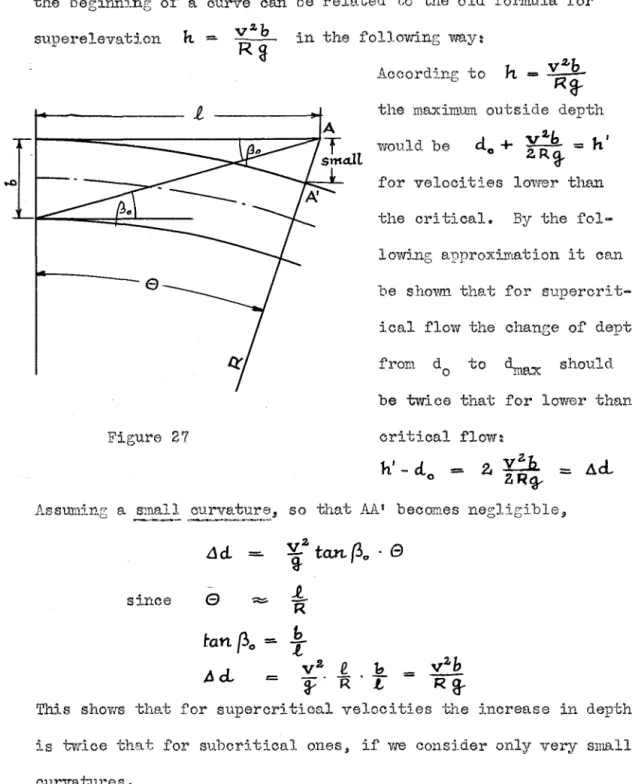
these assumptions we can arrive at a solution immediately11 since the only forces perpendicular to the flow in a curve a.re centrifugal force and counteracting it a static pressure force. Calling the difference of the depth at the outside and inside walls h 1 further assuming an average curvature of thestrewn-lines 1/R, we can write for a unit length of fluid the following
equa·!:;ion of' equilibrium: wherein h is
=
r·
ha
(4)
h
=We see that according to the derivation not only the previously stated three assumptions have to hold, but also the superelevation h must be smal 1 as compared to the tota.1 depth d and b must be small against R •
the relation h, =
~,,~
can be maintained. We may with even betteraccuracy introduce v • v $ since the velocity distribution mean
tends to become more a.~d more uni£orm with higher velocities.
The second assumption, however, of all the water moving par-allel to the walls cannot be :maintained any longer in the light of'
the previous discussion on the significance of the critical ve-locity a:nd wave velocity.
In changing the direction of a flowing stream we have to
accomplish a change of momentum. of the flowing vvater. This is
done by a pressure force proportional to a function of ·bhe angle of turn, £' (9) • This force is built up along the outside bank
of a stream, since the velocity vector there has a component
direc-ted toward the bank. The same happens a.long the inside ba.riJc with a :1egative sit_~ however, since the water has the tendency to flow
away from the bemlt. This is identical with ·!;he statement that
the beginning of a curve must be the beginning; of a ser:i.es of
in-fin.itesimal pressure disturbances near the two ·walls. Hemerr1bering that pressure changes ce.n only be tra.nsmit·ced to neighboring; sec-tions with a velocity equal to the 1;1J'ave v-eloci ty, we can express
the distinction between the cases of' curved flow above and below
the crit:i.cal velocity and find a new method of attack for curved
flovv at supe:rcri ti cal v·eloci ties.
11
stay approximately parallel to the bank and continue in curved
paths., The formul[1. derived above corresponds therefore to actual
conditions and gives.$ perhaps with some refinements, the true
value of h in this case.
In the ce.se of velocities of flow higher th.an the cri tica.l
we can state the problem. according to the foregoing discussion as
follows:
The pressure change along outer and inner vm.11 at the beginning
of a curve cannot be communicated over the entire section at once.
It
reaches neighboring strea:rr~ubes only at points dovmstream, lying along the imaginary wave front.$ which forms an angle(3
with thedirection of flow as discussed before. .Any particle in the stream
will therefore keep its direction of flow until
it
passes under a wave front, where it becomes subject to ar1 acceleration normal tothis wave front. The particles moving alon.e~ the centerline stay
longest undisturbed.
The acceleration force affecting a particle passing under a wave front can be negative or positive,,, the component, vn , norm.al
to the wave :t'ront can be increased or decreased and accordingly
the depth below the wave may be higher or lower. This depends only
on the boundary conditions.
It
is evident that a vro.11 curving toward the center of the stream, and therefore obstructing theflow, will cause deceleration of the flow and incree.se of depth,
while a wall curving avray from the stream_, allovtlng thereby an
depth. Correspondingly we may call these wave lines along v<l1ich
a constant impulse is transmitted from the boundaries,
"compres-sion" and 11depression waves". A curved channel will give rise to
both kinds; compression waves along the outer wall and depression
waves e.long the inner wall. Both compression and depression waves
cross the stream and ultimately reach the opposite walls. Since the compression waves give an acceleration toward the wave front
a..n.d ca.use an increasing depth, successive waves must converge and
the surface slope must become steeper. The depression vvaves have
the opposite properties and therefore successive vmves diverse,
and the su:d'ace slope becomes flatter. In the case of curved
channels the two kinds of waves are started on opposite sides and
therefore they both turn ·the streamlines in the same direction.
This means that after they intersect the effect of the direction
change of the streamlines is added up8 while the influence on the
depth by one wave is counteracted by that of the other.
The practical application of this to our problem is the
follow-ing: The depth ;vill rise along the outer wall and decrea.se along
the inner wall until the waves, which started due to the beginning
of curvature at the respective opposite ~~lls, have completed
cross-ing the strewn. From this point of intersection of wave and wall,, the depth change must continue with a. reversed sign.
According to this discussion and forraer statements we are now
in a position to determine by mathematical approach the following
• .i..
l. ... ems:
13
the curve (also the corresponding drop along inner wall)
(b) the location of the beginning of the maximum depth
range
(c) the magnitude of ·i:;he maximum depth to be expected at
the outer iNB.11 of a curve.
1. Discussion of' Possible Assumptions. Before we enter into the mathematical derivations, we must gain a somewhat clearer
conception of the r...ature and properties of the asstun.ptions on 1•rhioh
these derivations are going to be based. Theore,cical fluid
mech-anics usually deals with frictionless ideal fluid and therefore tile
next assumption is to neglect the i:ni'luence of friction.
Neglec-ting frictional i:ni'luences means to consider a tmif'orm initial
ve-locity over the entire cross-section. This e.ssumption holds in
high velocity flow phenomena. better than in ordinar'IJ cases s since
the velocity· gradient near the boundaries becomes very steep and
the mean velocity approaches more and more the value of the maximum -velocity. This can be easily seen from the velocity distributions
meazured e..nd presented in this report.. With frictionless flow
assumed,, it follovrn that the energy must be constant,, i.e •
.J
v,,
E = u..+:z.9-- is constant for every point in the curve. TMs
assump-tion impHcs that, for increasing depths d the velocity v must
decrease and vice versa. In the case of flow· in curves t.li.erefore,
the v-eloci ty becomes lower at the outer and higher near the inner
wall.
reverse eff'ect: i.e., for the same surf'a.ce roug:b.ness and bed
slope the velocity of' flow in a given section should increase
with increasing depth and v:Lce versa, as rnay be se<m from Chezyt s
simple equation of flo-w , (V
=
C1'llls)
Velocity measurements made in the course of the experiments all ~ndicate that these hvo opposing factors approxi."llatel~r cancel each other_. with the result tha'c the average velocj_ty re:mains
constant in magnitude around the curve. Therefore, as e..i1 alternate
to the condition of constant ener1.5y, it is logical instead to
as-sume a constant velocity. Thus ·there are tvro possible sets of assumptions upon vd1ioh to base the derivation.
(I) (a) Change in elevation due to change in component of velocity perpendicular to the ~~ve front
(b)
(c) (II) (a)
(b)
(c)
Frictionless flow
Energy constant
Change in elevation due to change in component of velocity perpendictilslr to the wave front
Flow with friction
Magnitude of' velocity remeJ.ns constant although direction changes
(2:_!_
Derivation on the Basis of Constant Energy(Set I)
Figure 3 shows t;he geometrical relations existing beti.reen the
velocities. Water floviring in the direction AB with a velocity
15
Figure 3
AC represents the wave front and vt and vn are the com-ponents of v 1 tangential and normal to AC. According to our
former statement (see equation 3)
V'"- AV..,_
=
Ad..
~1l!Jherein Vn : c
and fron'. Fig. 3 we ·obtain
(5) = Stn. A<3
sin. (90°-p. +Ae)
if vre assume the changes
Ae
and Ad. infinitesimal lW have therelations
AVtt.
-
~ d..d.v1'1.
AVn
-
v
d.8cos (3
Putting Vn -. v-si:n.p.,, we obtain from the tt.vo above relations the following differential expression for the depth chenge.
d.cL
must be expressed by these "l:;erm.s,, in order that the equation may be integrated. Frofl the above Fig. 3 we find
tan
(3
-
v'"-
=c
Vt
Tvz-
C..%.so that
dd.
=
v"Lc
cte
8'
fv:;,,-c.'L'Introducing the oondi tion that the total energy must stay consi.~ant,
i.e ..
v':l.
canst.
E.
-
cL
+
2._g,
=or
v
-
fis-C
£-ci.)
Iwe can transform the former expression into
(6)
a{E-cL)
U
1
:J.£ - .3cL Iwhich is integrable since E
=
const. If d is neglected against E the approximate form given above is obtained. The integrationof the approximate fonn results in
(7)
or
d.
e
=
(fJ;;
±
(Eh~·
e/''
- 11Z{(f -
ff-)
The exact integration gives
(8) B
+
K --1~
t.:> ·ta:n,
_,13
1f
f
2-
o/E.
3d.;£
(Sa) wherein K
- (3.
ta.n _,
6{
<L;E ,
2. -.3 ~~
ta.n, _,
r
do/ s.
2.. -..3 do/£The latter relation for Q and d may be solved best by plot·ting
Q 4"- k against d/E. K can be obtained from the same graph for Q
=
0 e The limiting cases are:and
[t)?tia~
=
i
(~)-min.
-
er
l'i'
~D_e_1."!.vation on the Basis of Constant Velocity. (Set II)
Figure 4
The figure is essentially the same as in case (I). The
difference is that in agreement v.r.i th the stated assumption V = V'
Vn - AV,,, V · si.n. {
f-' -
AS)(9)
~vn
=v · (sin
f-> -
sin((b-Ae))
From (5) and (9) we obtain for a new equation for Acl:
Jd..
=g2.
si.n(3
(sin(b - si.n(P,-
4ej)
A cl
=
;:i,
sin~~'
- eosAe)
si:n(3 -t-CO~·Sit't; A~
assu:ming again i1d. and A8 infinitesimal steps we obtain
correspond-ing to equation (6)
d.cl
= ;~
sh1.f>·c.osfo ·
cLeJ.cl
¥ ;'"
-d,4 .
fcf
(10) c:ie
The boundary conditions are for
e
=c-
,
d -c:l
0 a:n.d..fo
=foo
therefore
or since
(11)
(12)
e
2
sin
f.>
e
2,f>
cL
-==
. -·1~
Sl11,
fVL
fo - (30
.§.
+
13,,
2,
sin_,
f
'Ad..ov ,q
a
v2.
sin 2.
(foo
+ ~)~
d. Derivation of Location and J_!~nitude of' First Maximum.
1. Location of Eeginn.ing of :B'irst Maximum. Under o were
derived formulae which will give the shape and magnitude of the depth change along the outer and inner walls. These formulae hold only
as long as there is no influence from the opposite wall. We found
before tha-1:; the point where the first wiwe from the inner wall
reaches the outer is the location of the beginning of the zone of
maximum. depth. For nor.me.J. conditions, that is for channels
de-signed so that the depth at the inner wall does not become zero, a close appro:cim.ation for the location of ·bhe point of maxi:mu:m.
depth can be obtained by assuming that the vra.ve front starting from
the beginning of the curve from. the inner vro.11 crosses the stream
as a straight line to the point of intersection iri th the outer wall.
The angle between the direction of flow and the 1mve front is, of
course8 The total central e.ngle Q
0 from the start
A
of19
the outer wall can then be derived from. the geometrieal
relidion-ship given by Fig. 5.
Figure 5
(13)
In the triangle AOB
we know
CIA R -
bh
OB
=
R + b;z.goo +
{30
Vie can therefore express the unknown g
0 by these
knovm quantities with the
help of the law of sines.
R - b;,,,
R + 1'/z
from which
cos(~.+
eo)
C:OS
P,o
2. Depth in. Zone of First Maximum.. The maximun1 depth
at the outside vre.11 is now easily determined. Knovcing the aYerage
depth d
0 and the average velocity v0 at the entrance section
of the flume the first step is to determine ·the ·wave angle
p.,.,
T his angle
(3
0 and the proposed curve dimensions R and b are then introduced into relation (13), thus obtaining the centralang~le 90 to the point of maximtm1 depth h1 •
h' may then be calculated with consideration of the initial (
,','1'\
C,}')
remarks e..nd statements ma.de under (e.) of this chapter from any
( c
~) ~-~.of the equations derived under (a) by introducing the value of 9
0 • It will be found that e.11 of the eque.tions yield sensibly
the same result despite the discrepancy in the assumptions on which they are based,. This is easily explained When it is remem-bered that these are all oases of high velocity flow. This is necessarily true for supercritical velocities, because for such velocities v'L is larg;e in co:mparison to d therefore even under
2.
!t
'
the as sum.pt ion of constant energy changes in depth have little
21
C. EXPERD/fENTJlL S 'IUDY
The experimental program 1Nas laid out originally with the idea of making model studies of high velocity flood channels of
rectangular cross-section., However, s:i.nce the range of hydraulic conditions and of dimensions of the proposed prototypes was a
very large, one, the investigations had to be confined to typical
examples of such channels. The general layout of the experimental
set-up is clearly seen from the picture opposite the front page.
It consists mainly of a platform of 100 ft. length, which can be
adjusted to any slope desired frorn. zero to l : lOo This platform
supports the experimental flume. The technical dete.ils with illustrations are given in Appendix I of this paper. In order to
make clear the signif'ica.nce of' the experimental results as presented
mostly in graphical f'orm in the next paragraphs an outline of the
procedure and of the extent of the experh1ents is given here.
I.
Experimental_Procedu!._~The typical procedure followed in making an experimental run
(1) The platform was adjusted to the approximate slope. (2) 'I'he flume sections were assembled, the curved portion
under ·r.est being preceded by a straight run of 40 :E'eet in
length.
(3) The flume was then adjusted vrl th the help of an engineer's
transit, until the centerline 111ras at the proper gradient over
vms not permitted to exceed 5/1000 of a foot at any point of
the 100 foot platform. SimulteJ:1eously w-ith this' all cross
slope vm.s eliminated.
(4) All the joints were made tight and smooth.
(5) A certain flow \vas established and the movable tongue of
the rectangular nozzle was adjusted, until the depth at the
entrance of the flume corresponded toth:e equilibrium depth,
as measured just above the curved test section. This was an
added insurance that both the velocity and the velocity-dis-tribution were stabilized before the test section •w.s reached.
(6) Water surface profiles were then measured at the various stations: which included four stations above the our~red
sec-tion, 7 to 15 stations in the curved section depending upon its length, and about the same number in the straight section below the curve. This lower straig1rb section was from 20 - 30 ft. long,:l.e. from 20 - 30 times the channel width.
The above profile readings together with the lmown quani;i ty
of flow and channel slope comprised the necessary data. (7) The above 111as repeated for various rates of floiv.
(8) In addition to the above measuren1entsJ velooit-y distri-butions were taken during the maximun discharge run.
II. Schedule of Tests
Series of' runs si1nilar to that outHned above were made for
23
Schedule of Tests
Radius of
Slope Curvature Central .Angle
lo;,1a 40' 22.5° and 45°
20' 45°
10' 45°
3-1/2% 40' 22.~0
20' 45°
101 45°
1-1/2% 40' 22.5°
20' 45°
10' 45°
Table I is a brief summary of the experimental runs perforrned
TABLE I.
Run No.
Slope
Radius Discharge AverageAverage
RoughnessDepth Velo City
s
R Q. d vn
fe~t 0
feet a.
r.
s. feetl
.0995 20 1.02 .096 10.62 .00822 1.515 .124 12.33 .0082
3 l.988 .150 13.38 .0083
4 1.844 .138 13.3'7 .0080
5 1.475 .118 12.51 .0078
6 .960 .091 10.55 .0081
7 .480 .055 8.68 .0073
8 1;295 .103 12.54 .0073
9 .705 .070 10.07 .0073
11 10 1.380 .111 12.95 .0076
12 2.048 .14'7 14.03 .0078
13 2.037 .144 14.16 .0077
14 1.690 .124 13.68 .0074
15 1.015 .091 11.25 .0078
16 .538 .061 8.86 .0077
17 .338 .048 7.12 .0082
18a .399 .0825 10.23 .00?8
*
l8a .391 .180 lO.D5 .0078 "
18b .250 .062 8.07 .0081 -"
18b .242 .059 8.28 .0081
*
18c 1.010 .152 13.?0 .0083
*
18c .950 .145 13.20 .0083
*
l9e
40 1.985 .146 13:.58 .008120 1.725 .134 12.85 .0082
21 1.383 .111 12.49 .0076
22 1.000 .089 11.22 .0077
23 .'755 .076 9.92 .0077
24 .755 .078 9.62 .0080
25 1.723 .136 12.67 .0083
26 l.983 .146 13.62 .0081
28 .0345 l.Q73 .200 9.92 .0076
29 1.503 ~ae4 9.18 .0075
30 .950 .123 7.76 .0076
30a 20 1.584 .ll80 B.86 .0078
32 l.976 .202 9.78 .0078
33 1.015 .128 7.94 .0077
34 .755 .105 7.20 .OO?? I I
35 10.25 .517 .138 7.54
L
• 008~) ~.i
35 9.75 .508 .136 7.54 .0083 ~
J
36 10.25 ----··~---~---.990 --
...
1.-~~~l
9.45 .•QQ§_O_~.25
TABLE I ( Cont • )
Run ;,To. Slope Radius Discharge Average Average Roughness Depth Velocity
:'~ .< R Q d v n
feet c. f. s. feet 0 fee~
36 9.75 .995 .212 9.45 .0080*
37 10.25 .74o .105 8.98 • 0076 ¥
37 9.75 .732 .163 8.98 • 0076*
38 10 .767 .109 '7.04 .0079
39 l.980 .212 9.36 .0083
41 1.17'7 .140 8.40 .0074
42 1.500 .169 8.88 .0078
43 1.140 .140 8.17 .0077
44 1.38 .156 8.82 .0076
45 l.G85
I
.184 9.18 .007946 1.975 .208 9.48 .0081
47 1.985 • ~,:07 9.56 .0080
48 .~155 1.440 '.218 6.60 .0081
49 10 .990 .166 5.93 .0079
49 20 .990
50 10 1.21 .196 6.12 .0082
50 20 1.21
51 10 1.685 .243 6.94
.ooso
51 20 1.685
52a
lO
2.35 .304 7.73 .008052a 20 2.35
52 .0145 10 2.32 .302 7.68
.oooo
52 20 2.32
53 10 .500 .107 4.67 .0079
54 10 2.29 .302 7.58 .0081
55 10 2.145 .284 7.55 .0079
56 10 .74 .137 5.40 .0078
57a 20 2.295 .299 7.58 .0079
57 20 2.305 .298 7.73 .0078
57 10 2.305
58 20 2.305 .299 7.71 .0078
58 10 2.305
59 20
1.588
.227 '7.oo
.007759 10 1.586
60 20
.so
.146 5.49 .007960 10
.so
61 20 1.264 .197 6.42 .0078
61 10 1.254
62 20 l.995 • 273 ?.30 .0080
63 20 2.31 .307 7.50 .0082
63
io
2.31TABLE I (Cont.)
Run
:no.
Slope Radius Discharge Avera;:i;e Averar;e Roughness Depth Velocitys
R Q d 0 Vo nfeet c. f. s~c. fee'.:, ft. /sec
65
. 01!+5 20 1.650 ·.240 6,80 .008166
4o
1. 91-1- ,260·r.1v;
·.007S67
1'. )55 .1966.92
.007~68
o·.
725
.1111 5.1).oo._c3;,
. 69 1.115
.189
r, ()() .._, llO ,/·-..,, • 0081+70
l·.68
-.21w 7.00 ·.007971
2.,42 .;12l.
7:,
'. OOf\O72 2.22 ,)01
7·.
~:7 ·• 00(~275
2,01 ·. 235 7.05• co:V+
74
l'.687
.2506·. 75
.0085
75
l',)l
.2026.49
·. 007976 l', 00 ·.172 5.El2 .00.~1
77
o·.
75 • llJ.4 5'.21 .00837:-_,
• o;:.Irs
l+o (
7.
50) l',50 ·.1T5
8'.68 . 00:3279 +10(25°) 1.00 . l;;.1 7.65 .0080
80 2._40
·. 259
10,04 .0081Sl 1.975 .202 9. 70 .0078
82 O·. 50 "081+
5.95
,005185 10(25°) LOO .1;2 7.5P ,0081
84-
+40(7.5°) 2'.41 .237 10', 16 .008185 20( 15°) 1. 50 , 172 8. 72 • C:Q,30
86
+10(20°) 2,11 ',220 9·,60 ,OC).'.32B7 2'.4 ._243 9'.88 .008;
8'3 l'.00 . ·.1)5
7.42
.000589
1.975' .2049.68
.0079
90
20(1:)0)l'.97
·.210 9·,58 ,0Co291
+10(25°) 2-.1~0 ·.240 10·.oo .008292 l'. 5
"176
8-.5) .008)C)''
, ,I 1.02 .135
7.54
,00<?2-I -I -I e Gra.,.:e_hi cal _Re.s~l ts
The graphical results are presented in four series of
<lia-gra:m.s as follows ~
(a) Water Surface Contour Maps. Figures 6, 7, and 8 all
present the v.-ater surface contours in and below the ·test
curves for the various radii and gradients employed. It 27
should be noticed that all of the diagrruns are for high re.tea
of flow. In order to more clearly present the inf'ormations Zthe
relative width of the channel has been distorted six to one,
i.e. it has been increased to six times norm.al width. Special
notice should be paid to location and the even spacin3 of
SURFACE CONTOURS
RADIU5 OF CURVE= 10 FT
RUN 13 RUN 39
Q = 2.037 C.F.S. Q = 1.980 C.F.S.
b = I. FT.
RUN .32 GRADIENT·.0342
SURFACE CONTOURS RADIUS OF CURVE= 20FT
RUN 3 RUN 32
Q= 1.988 CF".S.
Q = 1.976 C.F.S. b= I FT.
RUN 26 GRADIENT=.0995
SURFACE CONTOURS RADIUS OF CURVE=40FT.
RUN 26 Q= 1.983 C.F".5. b = I FT.
RUN 28 GRADIENT• 0342
RFACE CONTOURS
SU OF
CURVE~
40 FT RADIUSRUN 19c RUN 28
Q = 1.985 C.F.5. Q = 1.s13 c.F.s.
b = I FT.
RUN .:.1
RADIUS 20 FT
DISCl~/-\RC,E-=? ",IC i~
so'
RLJr~ /I
RADIU~'S-40 FT
Dl.'~CtiARC,E '-" Z 42 CF:,
SURFACE CONTOURS
GRADIENT= .0155
31
(b) Water Surface Profiles Alone; Charmel Walls. Figures
9 J 10, and 11 show the water surface profiles alonr; the outer
and inner walls for the same runs whose contours a.re seen in
Figures 6$ 7, and 8. It will be found easier to observe the
relative depths from these profiles than f:rom the contours ..
Att:ention is called to the rela.tive heigh·cs of the maxim.a in
i;he dovmstream straight sec·cions in comparison to those in the
curves. Figures 12 and 13 are photographs of some of the typical
runs. Inspection of the pictures of figure 14 iNill show the
appear-ance of two maxima in the curved portion of the channel. These are
::1
70 60 50 4J 30z o - - - ~
10
----GRADIENT 0997
- ~
I
RUN 13 F"LOW 2..037 CF s
:---OUTSIDE ----INSIDE
\
39~40''-4-1'': 42~43''-'44\o..:45"-'46""'47~-- 51~ 5.3~ 56~ 64 67
I
d
~-1-1
~~-i---~--0----..._ ·o
I
/~' '
c, o · I
'9. I. . \ _ _.1'_
-"',, I
GRADIENT 0343 RUN 39 FLOW I 980 C.F.5.
00~---"----'D---·_0~_1
_ _ ..___ _ _
~-~---~---~TRAlGHT 5CCN~(uRVE:D 2iEcN. 4,0
, R• lO
+
5TRAJGHT 5ECTIONWATER SURFACE PROFILE5 ALONG CHANNEL WALLS RADIU5 OF CURVE 10 FT
I
/~
+
.STRAIGHT 5ECTION·---r--r--
!GRADIENT 0342 RUN 32 FLOW 1976 C :F S39"' 41
- - 1
--r-WATER SURFACE PROFILES
ALONG CHANNEL WALLS
RADIU5 OF CURVE 20 FT
- - - OUT:SIDE -·--INSIDE
Figure 9
0--35- .391!_'- 42"? 44~45~:: 48~ 5111
.?
-STRAIGHT 5E.C.N 1
- -CuRvED 5Ec.TroN • 22f, RA01us 4o'
-1-40 - - - , ---~
~-- .STRAIGHT 5EC Tl ON
I
GRADIENT
RU[l'L-2-8
.0345
FLOW 1:173.C_f.5_
-_/~~--'°'-~---'~ ---1- ---·'---0
-4>----·-t-·
" JO zo . + --1 42.8 : 44~'.45"'
40 30
WATER SURFACE PROFILES
ALONG CHANNEL WALLS
RADIUS OF CURVE 40 FT
---OUTSIDE - · - · - INSIDE
I
GRADIENT 0995
RUN 26 FLOWI 1983 C.F S.
CURVED 5£CTION, 45°, RAOIU5 40'
5TRAIGHT .SECTION-
--WATER SURFACE PROFILE5
ALONG CHANNEL WALLS
RADIU5 OF CURVE 40 FT
- - - OUTSIDE: - · -·INSIDE
Figure 10
63 66
33
69" 71 74"
AO --- -· ..
\
;! \20
_[ _ _,_,~,
RUN 52 ...
I
G9ADll;NT '101~5 IOOL__R_A_o_1_u_s _ _ _c__L_J____l_L._.L__J__L_L_~-'---'--~-~~~-'--'--~-'---D-1L..c_HL,A_R_G_EL' -'-'-'~\
LO
0+35°0 3982
L-STRAIGHT SEc.-J..
,40·~---.20
LO
RUN 57
0 RADIUS
0+35 00 398l
L STRAIGHT SEL.L
30
20
-10
RUN 71
.oo RADJU5 4Qi::-T
0.+35 398z
lSTRAIGHT SEC)..__
-47'°"
CURVED SECTION - l
- CURVED
SECTION----"
42 45Bl 4881
son 52a
"
51 CURVED SECTION
5523 58 b()i1
STRAIGHT SECTION
..l. · - - - S T R A I G H T SECTION
5750
GZ.5°
STRAIGHT SECTION
WATER SURFACE PROFILES
ALONG CHANNEL WALLS
- - - OUTSIDE - - - I N S I D E
Fit,>ttre 11
00
c
(c) Water Sur.face Profiles Along Out.er Channel Walls
Figures 15, 16 and 17 are also diagre.ms of the water surface profiles. In these, however,, only the 1)rofiles along the outer vV'dll are shovm. Each dia,~;ram consists of all the rlills taken with a given test section at one gradient. Each set covers a wide range of discharges. The most striking point brought out by this presentation is that the locations of the
ma."'Cima in one given channel setting vary very little with change in the :rate of flow. However, a gradient change also
changes the location of the maxima$ w"hich moYe dovmstrea..m as the gradient and the velocity are increased. It ·will also be noticed that, for the same gradient, the points of maxima
"'
00
10
60 50
GRADIENT 0997
~TRAIGMT .5ECN-CURVED 5Ec'N. 45°, R· 10'- .STRAIGHT SECTION
WATER SURFACE PROFILE5
ALONG OUTSIDE CHANNEL WALL
R =10 FT. b =I FT.
39
67
-5TRAtGHT .5EC.N"t- CURVED 5ECTION, 45°, RADIU.S•Z.O
t -
5TRAOGHT 5ECTOON- - - -
,-
-, 1,
-I-+
GRADIENT .0.342I
~----?--- _______.:-
---- ---- ---- ---- ---- ---- ---~-- ---.,
_____-"
~~~---'>---SURFACE PROFILE.S WATER
ALONG OUT.SIDE CHANNEL WALL
40'~---~---GRADIE:NT . 0997
- 5TRAIC:.HT SECTION
30
40 .30
-20
WATER SURFACE PROFILES ALONG OUTSIDE CHANNEL WALLS
R= 40FT. b•IFT.
..-.STRAIGHT SECN .... CURVED 5E:CTION, 45", RADIU5 40'
30
I I
---l---1
Figure 16
GRADIENT 0345
RUN DISCHARGE
19' \.98o L.r. 5.
ZO I. 7ZS ZI \.3~ z.z. \.00 .2..3 • 755
Z8 1.973
001--~~~~--+~~~-+-~~~~~~--~~--,~-~~~~--,~--,
0+3~00 3.98l 428'l 4582 4766
l STRAIGHT Se:cL----CuRVEO SECTION
5072 52u 5523
STRAIGHT SECTION
.OO•>-~~~~-+~~-,-'~-+-~~~~-+-cc---+-cc~~~-+-~---+-~-+---,~-'--< Q+3500 3982 41 8'1. 43 8'l 45Z'l 47R2 49.<!l 53Bl 5721
E)QOO
L STRAIGHT S E J . _ _ _ - - - C u R v E D S E C T I O N - - - _______...J.._ STRAIGHT
-.oo,_---,--,~~--,-,-,-~~~=--~~.--,,,-~-,-~~~-,-~~~~~--,
Q+.'.3500
39Bl 428
'- 45fll 48w,· 51 Fil 5411< 57.'.0
l5TRA1GHT SEcl CuRvED SECTION- -- __
___LSTRT-WATER SURFACE PROFILES
ALONG OUT51DE CHANNEL WALL
:F'igure 17
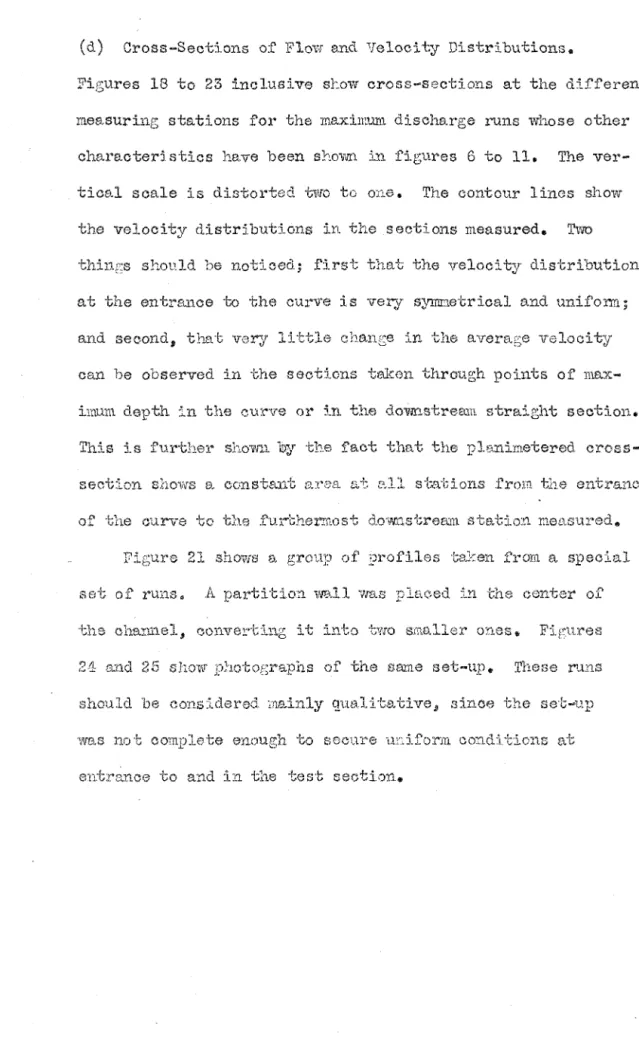
(d) Cross-Sections of Flow anct Velocity Distributions.
Figures 18 to 23 inclusive show cross-sections at the different
m.ea.surin1:; stations for the maximum. discharge runs whose other
characterj sties have been sho11v.n in figures 6 to 11. The
ver-tical scale i.s distorted two to or:.e. The contour lines show
the velocity distributions in the sections measured. Two
thin2:s shoPld be noticed; f:irst that the velocity distribution
at the entrance to the curve is very symmetrical and unifonn; and second, that very little change in the averaf:;e velocity
can be observed in -the sections taken through points of
m.a.x-im.um depth in the curve or in the downstream straight section.
This is further shovr.i by the fact that the plf~nimeterecl
cross-seci;ion sho1Ns a constarrt: r;.1,:rea a~.: all si.K.:'"l.tions :rrorn. t:i1e entrance
Figure 21 shows a group of' profiles ta.ken from a special
set of runs. A partition ·wall was placed in the center of
21 a"l'.ld 25 slwv.r pl-1otot;raphs of the mtme set-up. These runs
should be considered mF.J..inly qualitative,, since the sec-up
·wees nol; complete enough to secure uLiform concl:i.·'cions t'l.t
Q+l5oc
10
o,.,,39Bl
0+4772
~··
Q-+4911
z
.'0
U'b
0+55'"
O+~o''°
RUN 10 CROSS SECTIONS
AND
VELOCITY DISTRIBUTION
R 0 20 n.
s
~ .0995Q 0 192 CF 5. b ~ I FT
-Q+,398z
"'
0+44 8r
Figu.re 18
O-r4i"1
0+56°0
:td=:-J
0+6700 RUN 13CROSS SECTIONS
ANO
VELOCITY DISTRIBUTION
R" IV F'T.
,, " .0997 Q " 2.0~7 C.F. S.
b • I FT.
.. 1"==;$
I ..
~,11"W
10~00 I:!>•- - ,'":>
QT42st
0+45"'
0+67"
I
'°ct:J
:D~
0+74"
RUN 19c CROSS SECTIONS
ANO
VELOCITY DISTRIBUTION R = 40f'T
s = .0997
Q = 1.9e5 c.r.s.
b =I FT
0+15°0
Q-1-398Z
Q+44"'
J::='-j
0•")41!?Figure 19
0 '608~
30
00--:--:-;-:---r---J
0+71"'
RUN 26 CROSS SECTIONS
ANO
VELOCITY DISTRIBUTION
R = 40 f'T.
s
= .0995 Q = 1983 CFS.b = I FT
~---·---:~~
0+15°0'0-J-77-77,--~,..J-T-,-,;-,--.,--,,--j
oolL~JI
0+39el
30
'°
00
:-:--:;--+--_J
0+44ez
L1
0+48110+51~
Q+54.'H
0+1.._·-RUN 28 CROSS SECTIONS
AND
VELOCITY DISTRIBUTION Ru 40 FT
s
= .0345 Q = 1973 C.f5.b ~ I FT
:.klli~
0+15°0'°~
~=
Q+39!.Z..
Q+4182
0+43at
Fie;ure 20
l
Q..-478 ' 0+51112 0+555 "RUN .32 CROSS SECTIONS
AND
VELOCITY DISTRIBUTION
R= 20FT. 5 = 0342
Q = 1.976 C.F S. b = I FT.
""'
0+4240 0+44., 00--<---+---~ 0•46"' JO 00·-<---+---~ 0+47"1 0+63"'
RUN 39 CROSS SECTIONS
AND
VELOCITY DISTRIBUTION R~ IOFT.
s
= 0343 Q = 1.985 C.F'. 5. b ~ I FT.Figure 21
.•O
00'-'----+--...L---+---'
Q•. 492
'°
Q•.790
.30 20
RUN ISb
STA 0+42'1
RUN 18a
STA 0+42"7
00--L--...j.--...L----t---~
Q•l.960 RUN 18c
STA 0•43"
oo.~---1---~--.,....-~
(" 1025
Q•l.478
Q' 1985
RUN 35 5TA 0+46~
RUN 37 STA. 0+41"'
RUN 36
STA 0+-41'"1
CROSS SECTIONS OF FLOW OUTSIDE R
INSIDE R
WIDTH b
-10.2.5 FT
9.75 FT
0.50 FT
~~
-oo....L--0-,---4-4---~ ~H
'°
10
oo~---+---'-0+42. e'2.
30 20
00 0+45132.
40 ,o 20 ,0 oo-'---1---__!_ 0•.52" 00 30 20 10 00 20
Ni
0+53 9
~
I
0+5523
0+5817
RUN 52
CROS.S SECTIONS
R 0 10 FT.
S=.0159
Q = 2.32 c.r. s.
b= I FT
Figure 22
00
0•398z
30 20 10 00 0+43!1'2. 30 20 10 0+4982 0+538Z
0+55 .,~
I
0+571
:;
~
0+59°0
RUN 57
CROSS SECTIONS
R= 20 FT 5= .0155
Q = 2 31 C.F 5.
b= I FT
fl'>
---·~-.)() 10
-w-
10-0+39 '" 0+4682
30 30
20
10 10
00 00
0+413
/j 0+.528?.
30 30
20 20
10 10
00 00
0+44 82 0 ... 5750
RUN 71
CR055 SECTION R0 40 FT
20
5°0155
10 Q0 242 C.F.5.
b0 IFT
00
0+458
-I?.ESUl1TS
T
, L .
Three relations 1•rere obtained in
of flow.,
can be
to
determine of the water surface the walls of a curved channel. Tl1e first two$on the
of constant is exact
ob-of constant Table 2
the values obtained with these three
as the measured results of 1Nhich we saw
under C. The runs in the were
progre:rn.s
26
the the
TA."BLE 2.
Run Station Slope
I
Central ~ed Constant ConstantNo. Radius Angle Depth Energy Velocity
Discbar~e E> d d(equ.'7) d(equ.S) d(equ. l.Z)
radians feet fee>t feet feet
3 39.82 .0995 0 .150 .150 .150 .150
40.82 20' .05 .205 .201 .203 .198
41.82 1.988 .10 • 25~S .257 .258 .252
42.82 .15 .310 .321 .318 .313
43.65 .191 .349 ~ ~ ~
43.82 .20 .363
44.82 .25 .419
45.82 .30 ~
11 39.82 .0995 0 .11~ .111 .111 .111
40.67 101
.085 0190 .183 .183 .176
41.67 1.380 .185 .288 .293 .289 .278
42.67 .285 .392 .429 .417 .399
42.96 .314 .411 .470 .458 .445
.
43.67 .385 .48544.67 .485 .528
15 39.82 .0995 0 .091 .091 .091 .091
40.67 101
.085 .143 .149 .148 .148
41.67 1.015 .185 .231 .236 .233 .23;:s
42.67 .285 .321 .346 .337 .334
42.93 .311 .350 ~ .372 ~
43.67 .385 .407
44.67 .485 .412
26 39.82 .0995 0 .146 .146 .146 .146
40.82 401
.025 .170 .171 .171 c .170
41.82 l.983 .050 .185 .196 .198 .195
42.82 .075 .216 .223 .223 .222
43.82 .100 .267 .254 .253 .252
44.10 .107 .274 .d§g .263 .260
I
44.82 .125 .:1.§.Q
28 39.82 .0345 0 .200 .200 .200 .200
40.82 401
.025 .207 .221 .218 .219
41.82 l.973 .050 .227 .244 .240 .240
42.82 .075 .257 .266 .263 .261
43.18 .084 .268 ~ .272 .270
53
TABLE 2 (cont.)
Run Station Slope
l
Central Measured Constant ConstantNo. Ra.di us lulgle Depth Energy Velocity
Discharge
e
d d(equ.7) d(equ.S) d(equ.12) radians feet feet feet feet29 39.82 .0345 0 .164 .164 .164 .164
40.82 40' .025 .173 .182 .177 .179
41.82 1.50 .050 .189 .201 .199 .196
42.82 .075 .215 .221 .218 .213
43.28 .086 .225 .229 ~ .223
43.82 .100 ~
32 39.82 .0345 0 .202 .202 .202 .202
40.82 20' .05 .226 .245 .244 .241
41.82 lo976 .10 .285 .293 .290 .284
42.74 .146 .320 ~ .335 .325
42.82 .15 .323
43.82 .20 .329
39 39.82 .0345 0 .212 .212 .212 .212
40.67 101
.085 .277 .290 .286 .278
41.67 l.980 .185 .365 .392 .382 . 366
42.15 .233 .393 .444
.:.ill
..:.fil
42.67 .285 .426
43.67 .385 .429
55 39.82 .0145 0 .284 .284 .284 .284
40.82 101
.10 .351 .372 .366 .353
41.63 2.145 .181 .388 .:..1§.Q .443 .410
41.82 .200 .394
42.37 .255 .415
62 39.82 .0145 0 .273 .273 .273 .273
40.82 201
.05 .301 .313 .310 .304
41.79 1.995 .098 .314 .355
.d12
.33741.82 .100 .318
vdll be seen that the measured and the calculated values of depth are in very e;ood agreement. The three equations give very similar results. Hmvever equation 12 (constant velocity) appears to give values consistently closer to the observed points than do equations 7 and 8. Equations 7 and 8 differ hardly at all from each other 'vithin the range of practical applications. On the basis of simplicity and of closeness of agreement equation 12 is to be reco!!l:r'lendecl.
All three equations are applicable also to the profile along the inside wa.11 and in this case give the fall. For example, when used f'or the inside wall profile equation 12 becomes
(12a)
cl
=T
v.i . sina(
f-'., -
a
e)
9 has the negative sign lbiemrnse the wall i.s turning a:way from the flow.
Table 3 presents a. comparison of the values of the maxima calculated from the same three equations and the e:A.-perimental values. All of' the runs :made with simple curves are presented
in this table. It will be noted that in several cases there are