Middle-Secondary Education and Instructional Technology Dissertations
Department of Middle-Secondary Education and Instructional Technology (no new uploads as of Jan. 2015)
Fall 12-20-2012
"If I Am Losing Them, I'm Going to Change. So That's What We
"If I Am Losing Them, I'm Going to Change. So That's What We
Did!" Third Grade Teachers Contemplate the Literacy Needs of
Did!" Third Grade Teachers Contemplate the Literacy Needs of
Diverse Students Within A Teacher Study Group
Diverse Students Within A Teacher Study Group
Megan A. Nason Mrs. Georgia State University
Follow this and additional works at: https://scholarworks.gsu.edu/msit_diss
Recommended Citation Recommended Citation
Nason, Megan A. Mrs., ""If I Am Losing Them, I'm Going to Change. So That's What We Did!" Third Grade Teachers Contemplate the Literacy Needs of Diverse Students Within A Teacher Study Group."
Dissertation, Georgia State University, 2012. https://scholarworks.gsu.edu/msit_diss/107
11-19-12
“If I Am Losing Them, I’m Going to
Change. So That’s What We Did!”:
Third Grade Teachers Contemplate the
Literacy Needs of Diverse Students
Within a Teacher Study Group
Megan A. NasonACCEPTANCE
This dissertation, “IF I AM LOSING THEM, I’M GOING TO CHANGE. SO THAT’S WHAT WE DID!”: THIRD GRADE TEACHERS COMTEMPLATE THE LITERACY NEEDS OF DIVERSE STUDENTS WITHIN A TEACHER STUDY GROUP, by MEGAN A. NASON, was prepared under the direction of the candidate’s Dissertation Advisory Committee. It is accepted by the committee members in partial fulfillment of the requirements for the degree, Doctor of Philosophy, in the College of Education, Georgia State University.
The Dissertation Advisory Committee and the student’s Department Chairperson, as
representatives of the faculty, certify that this dissertation has met all standards of excellence and scholarship as determined by the faculty. The Dean of the College of Education concurs.
______________________________ _______________________________ Amy Seely Flint, Ph.D. Julie Rainer Dangel, Ph.D.
Committee Chair Committee Member
_______________________________ _______________________________ Peggy Albers, Ph.D. Katharine Simon Kurumada, Ph.D. Committee Member Committee Member
_______________________________ Date
_______________________________________ Mary Ariail, Ph.D.
Interim Chair, Department of Middle-Secondary Education and Instructional Technology
_______________________________________ Paul A. Alberto, Ph. D.
Interim Dean
AUTHOR’S STATEMENT
By presenting this dissertation as a partial fulfillment of the requirements for the advanced degree from Georgia State University, I agree that the library of Georgia State University shall make it available for inspection and circulation in accordance with its regulations governing materials of this type. I agree that permission to quote, to copy from, or to publish this dissertation may be granted by the professor under whose direction it was written, by the College of Education’s Director of Graduate Studies, or by me. Such quoting, copying, or publishing must be solely for scholarly purposes and will not involve potential financial gain. It is understood that any copying from or publication of this dissertation which involves potential financial gain will not be allowed without my written permission.
NOTICE TO BORROWERS
All dissertations deposited in the Georgia State University library must be used in accordance with the stipulations prescribed by the author in the preceding statement. The author of this dissertation is
Megan A. Nason 211 River Sound Lane Dawsonville, GA 30534 The director of this dissertation is
Dr. Amy Seely Flint
Department of Middle-Secondary Education and Instructional Technology College of Education
CURRICULUM VITAE
Megan A. Nason
ADDRESS: 211 River Sound Lane Dawsonville, GA 30534
EDUCATION:
Ph.D. 2012 Georgia State University Teaching & Learning
Concentration: Language and Literacy Education
M.Ed. 2005 Georgia State University
Reading, Language, & Literacy Education
B.S.Ed. 1999 University of Georgia Early Childhood Education
PROFESSIONAL EXPERIENCE:
2009–Present ASSISTANT PROFESSOR OF EARLY
CHILDHOOD AND SPECIAL EDUCATION. Department of Teacher Education, North Georgia College and State University, Dahlonega, Georgia.
2/07-8/09 ACADEMIC COACH/EIP/RTI COORDINATOR (GRADES K-5), Hightower Trail Elementary School, Rockdale County, Conyers, Georgia.
7/05-2/07 KINDERGARTEN TEACHER, Hightower Trail
Elementary School, Rockdale County, Conyers, Georgia.
78/04-6/05 4th GRADE TEACHER, Nickajack Elementary School, Cobb County, Smyrna, Georgia.
8/00 –7/04 KINDERGARTEN TEACHER, Hightower Trail
Elementary School, Rockdale County, Conyers, Georgia.
8/99-7/00 KINDERGARTEN TEACHER, McLendon Elementary, Dekalb County, Decatur, Georgia.
PUBLICATIONS:
PRESENTATIONS:
Nason, M. & Maxwell, N. (2012, October). Persevering through the prospectus. Online presentation for Conversations in Global Preparation at
http://globalconversationsindoctoralpreparation.wordpress.com. October 28, 2012.
Nason, M., Gilleland, N., Baldwin, P., & Zangara, L. (2012, July). Providing authentic literacy activities for students who live in poverty through promoting inquiry-based learning in the content areas. Session presented at Whole Language Umbrella Summer Institute, St. Louis, Missouri.
Nason, M. (2011, March). Teaching comprehension strategies through culturally-relevant picture books to English Language Learners. Session presented at Children’s Literature Conference, Athens, Georgia.
SERVICE:
2011-present Facilitator, Dawson County Professional Development School
Community, ECE/SPED Department, Teacher Education Department, NGCSU.
2011-present Coordinator, Reading Endorsement Program, Teacher Education Department, NGCSU.
2011-present Graduate research assistant, Middle-Secondary Instructional Technology Department, GSU.
2011-present Facilitator of professional development & instructional coach in Dawson County
HONORS AND ACADEMIC AWARDS:
2012 Invited to serve on a university consolidation committee. Department of Teacher Education. North Georgia College and State University, Dahlonega, Georgia.
2012 Selected as the Early Childhood & Reading Endorsement Program Consolidation Work Committee Chairperson. North Georgia College and State University, Dahlonega, Georgia.
PROFESSIONAL ORGANIZATIONS:
2010 International Reading Association
2011 Literacy Research Association
ABSTRACT
“IF I AM LOSING THEM, I’M GOING TO CHANGE. SO THAT’S WHAT WE DID!”: THIRD GRADE TEACHERS CONTEMPLATE THE LITERACY
NEEDS OF DIVERSE STUDENTS WITHIN A TEACHER STUDY GROUP
by
Megan A. Nason
According to Birchak, Connor, Crawford, Kahn, Kaser, Turner, & Short (1998),
Fang, Fu, & Lamme (2004), Kennedy & Sheil (2010), and Wiliam (2008), teacher study
groups can provide a supportive and collaborative professional development
environment. The purpose of this study was to examine the professional development
experiences of three third grade teachers working with culturally, linguistically, and
economically diverse (CLED) students in a high-needs school as they participated in a
teacher study group. The adoption of national standards and pressures for all students to
achieve high standardized test scores in math and reading due to Adequate Yearly
Progress (AYP) requirements mandated by the No Child Left Behind Act (2001) resulted
in increased stress, anxiety, and uncertainty for the teachers participating in this study.
The following research questions guided this qualitative, ethnographic case study: (1) In
what ways does participation in a teacher study group impact elementary teachers’
knowledge, beliefs, and understandings when teaching culturally, linguistically, and
economically diverse students in a high-needs school? (2) In what ways do teachers’
literacy practices shift as a result of engaging in teacher study groups focused on issues
related to culturally, linguistically and economically diverse student populations?
Bronfenbrenner’s (1979; 1994) ecological models, Vygotsky’s (1978; 1986) sociocultural
comparative analysis (Glaser and Strauss, 1967) of data collected through pre- and
post-interviews, bi-weekly teacher study group meetings, and classroom observations, the
teachers’ knowledge, beliefs, and understandings about how culturally, linguistically, and
economically diverse (CLED) students learn and develop literacy skills were explored.
The findings of this study demonstrate how teacher study groups can provide teachers
with a safe space to build trusting relationships so that they can discuss school and
classroom-related uncertainties, vulnerabilities, frustrations and successes. Shifts in
enacted curriculum, instruction, and beliefs occurred as the teachers in this study
attempted to negotiate their beliefs about how CLED children learn through engaging in
conversations related to integrated curriculum, higher-order thinking, inquiry-based
learning, literacy instruction, literacy development, and the diverse needs of their
students.
IF I AM LOSING THEM, I’M GOING TO CHANGE. SO THAT’S WHAT WE DID!”: THIRD GRADE TEACHERS CONTEMPLATE THE LITERACY NEEDS
OF DIVERSE STUDENTS WITHIN A TEACHER STUDY GROUP by
Megan A. Nason
A Dissertation
Presented in Partial Fulfillment of Requirements for the Degree of
Doctor of Philosophy in
Teaching and Learning in
the Department of Middle-Secondary Education and Instructional Technology in
the College of Education Georgia State University
ACKNOWLEDGMENTS
I feel truly grateful to have finally reached “the end of the tunnel” and to have successfully completed this journey. Thank you to my amazingly supportive dissertation committee: Dr. Amy Seely Flint, Dr. Peggy Albers, Dr. Julie Dangel, and Dr. Katharine Kurumada. It is because of your encouragement, guidance, and inspiration that I have now become a literacy researcher and educator. I view each of you as mentors for you supported me and provided me with encouragement when I needed it the most. Dr. Flint, as my chair, mentor, and friend, you have encouraged me to accomplish things that I never thought I could do. I also want to thank Nicole Maxwell for being a constant friend and mentor to me throughout this process. I could have never succeeded without you by my side.
Thank you, God, for blessing me with a wonderful husband and daughter during this process, for without them, none of this would have been possible. Thank you for providing my family with good health and for giving me the constant strength and encouragement I needed to continue to push forward.
I want to dedicate this dissertation to my daughter, Mackenzie Marie Nason, and husband, Josh Conner Nason. You have lived this journey with me and provided me with strength when I needed it the most. Mackenzie, your hugs, kisses, smiles, laughs, and constant questions about why I was going to become a doctor or why I was writing a “disstertation” always provided me with the encouragement that I needed to get to the next stage. You are truly a gift from God and I could not have achieved this dream without you. I hope that you will set many goals for yourself in life and work hard to achieve them. Josh, you were also a gift from God, for without you by my side, I could have never made it through this process or achieved this goal. I thank you for all of the times you took care of Mackenzie so that I could work and for all of the laundry you folded, dishes you washed, dinners you cooked, and housework you kept up with while I was immersed in my writing and research. I love you and I hope you know how thankful I am to have you in my life.
I also want to thank my amazingly supportive family. Your love, support, and friendship mean more to me than words can express. I want to especially thank my mom and dad and all of my family members for taking care of Mackenzie and sometimes, Josh, so that I could complete the work required in this program. Mom and Dad, you provided me with the work ethic, drive, confidence, strength, and encouragement needed to successfully complete this journey. I love you and I want to thank you for all that you do for me.
TABLE OF CONTENTS
Page
List of Tables ...v
List of Figures ... vi
Abbreviations ... iv
Chapter 1 Introduction ...1
Background ...1
Significance of and Rationale for My Study ...4
Research Purpose and Questions ...12
Theories that Situate My Study ...16
Conclusion ...25
2 Review of Literature ...27
Cultural, Linguistic, and Economic Diversity and the Achievement Gap ...28
Literacy Instruction in High-Needs Schools ...51
Research Related to Current Professional Development Models in Schools ...54
Conclusion ...71
3 Methodology ...74
Overview of Study ...74
Background Behind Study ...78
Participants ...79
Setting ...81
Role of the Researcher ...82
Data Collection ...83
Data Analysis and Organization ...92
Establishing Trustworthiness and Dependability ...96
Limitations of the Design and Issues of Bias ...100
Conclusion ...101
4 Setting and Context of Study ...103
Introduction to the Community ...103
Lakeside Elementary School ...108
Introduction to Lakeside’s Third Grade Teachers ...117
Concluding Thoughts ...137
5 Findings ...138
Teacher Study Groups as a Safe Place to Build Relationships and Trust ...139
6 Discussion ...257
Themes Embedded Within Ecological Theory, Sociocultural Theory, and a Sociocognitive Model of Reading ...262
Teacher Support Group ...266
Vulnerability of Difficult Topics ...268
Current Curricular Pressures Do Not Align with What Teachers Think Is an Effective Practice ...270
Learning How to Better Support Students from Diverse Backgrounds ...273
Limitations ...278
Implications for Further Research, Policy, Curriculum and Instruction, and Professional Development ...281
Final Thoughts ...286
References ...289
LIST OF TABLES
Table Page
1 Data Collection Summary ...85
2 Teacher Study Group Framework (Burchak et al., 1998) ...90
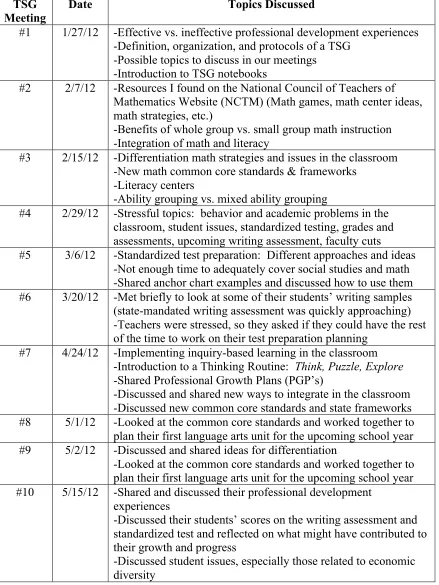
3 Topics Discussed in Teacher Study Group (TSG) Meetings ...114
4 Third Grade Daily Schedule ...115
LIST OF FIGURES
Figure Page
1 A teacher-created tree map containing facts and pictures exemplifying the four
types of productive resources associated with economics. ...196
2 A teacher-created circle map listing ideas and pictures related to “Things That Are
Magnetic” ...196
3 Example of a teacher-created sample “Elements of Historical Fiction” booklet ...201
4 Making mathematical thinking visible through using a teacher-created tree map to demonstrate examples of measurement ...212
ABBREVIATIONS
CLED Culturally, Linguistically, and Economically Diverse
ELL English Language Learner
ESOL English for Speakers of other Languages
LEP Limited English Proficiency
NCLB No Child Left Behind
NSDC National Staff Development Council
PDC Professional Development Community
PDS Professional Development School
CHAPTER 1
INTRODUCTION
Background
As a previous elementary school teacher and literacy coach, I had a passion for
working with culturally, linguistically and economically diverse students, but I often felt
that I did not have the adequate knowledge or skills needed to effectively meet the social,
cultural, linguistic, and academic needs of my students. Unfortunately, the school
facilitated professional development trainings that I attended did not help me feel more
confident about the literacy practices I was implementing in my classroom. Many of
these after-school professional learning sessions left me feeling empty, tired, and
frustrated. If they did not work for me, a self-driven, highly motivated educator who
loved to learn, how were they going to help teachers who were not highly motivated or
who became stagnant in their teaching practices and pedagogy?
My own personal experiences and frustrations with ineffective professional
development models and broader societal and school issues encouraged me to want to
learn more about how in-service teachers deepen their own literacy-related knowledge,
beliefs, pedagogical understandings, and practices. In the beginning of my doctoral
program, I took a course focused on teacher development that required my classmates
and I to learn more about teacher study groups through participating in one. As I
engaged in a teacher study group with fellow doctoral students, I became particularly
interested in this model because I liked that it allowed teachers to choose their own topics
and facilitate their own professional learning (Birchak, Connor, Crawford, Kahn, Kaser,
literacy coach at the time, I decided to attempt to organize teacher study groups based on
teachers’ interests in my school. Although at first I had the principal’s permission and
support, my plan quickly diminished due to a) district mandates requiring the teachers to
participate in mandatory training related to standards-based classrooms, leaving them no
time for teacher study groups and b) limited money in the budget to purchase books for
the teacher study groups.
Now that I am no longer a literacy coach, but instead an assistant professor who
teaches literacy and curriculum-focused courses, I have implemented teacher study
groups with many of my undergraduate and graduate students. Through my experiences,
I have found that my students seem to really enjoy their teacher study group learning
experiences. My graduate students often tell me that they cannot wait to implement them
in their own schools. Although this is my first official research study on this topic, I have
had the opportunity to implement this model of professional development with my
university students and to witness the positive results that it can have for teacher
collaboration and learning.
As a university supervisor who currently supervises undergraduate students in an
elementary school setting, I noticed that their mentor teachers’ stress levels continued to
increase due to a variety of contextual factors. One of these factors included increasing
pressures placed on them by school, district, and federal mandates to demonstrate student
achievement through higher standardized test scores. In August, the principal asked me
if I would facilitate professional learning sessions related to differentiation once a month
with her entire faculty during their planning periods. As I strengthened my relationships
that they were experiencing a great deal of frustration due to not only standardized testing
pressures, but also due to an increasing number of impoverished and linguistically
diverse students in the school and county. Additionally, the administrators began
requiring the teachers to participate in weekly school-facilitated training meetings
focused on the new standards and instructional frameworks due to changing curricular
mandates resulting from the adoption of nationally-created standards. Learning more
about the teachers’ frustrations and struggles related to these factors influenced me to
want to learn more about how a different, more collaborative professional development
model might provide more support for teachers working with an increasing number of
culturally, linguistically, and economically diverse students in a high-needs school.
My experiences caused me to become increasingly more interested in learning
more about whether teacher study groups could provide teachers with a safe and
supportive environment within their school that would allow them to openly discuss their
thoughts, feelings, opinions, and beliefs related to teaching and learning. My frustrations
related to standardized testing mandates influenced me to want to explore more about
how participating in a teacher study group might impact the learning experiences of
educators teaching in a “high stakes” testing grade level. Since third and fifth grade are
currently considered “high stakes” testing years due to the passing of the No Child Left
Behind Act (2001), I decided that I would like to focus my study on how a teacher study
group might impact the knowledge, understandings, and beliefs of third grade teachers as
they worked with culturally, linguistically, and economically diverse students in a
high-needs elementary school. Federally-mandated educational policies such as the No Child
teachers or resulted in improved academic achievement for culturally, linguistically, and
economically diverse children. Instead, teacher morale is down for many teachers and
schools are failing to meet the adequate yearly progress (AYP) requirements mandated by
the No Child Left Behind Act (NCLB). Consequently, many teachers feel unsuccessful,
overwhelmed, underpaid, and unsupported.
In the next section, an overview of current research is presented to further explain
the significance and rationale behind this qualitative research study. Teacher study
groups can provide classroom teachers who work in high-needs schools with a supportive
context within which to discuss the needs of their culturally, linguistically, and
economically diverse students as they continue to develop pedagogical practices in their
own classrooms. According to Wiliam (2008), teacher learning communities are the
most influential professional development model for they encourage teachers to take
action and make changes in their daily classroom practices.
Significance of and Rationale for My Study
Language and literacy education researchers continue to investigate school and
classroom related issues, especially in high-needs schools. Several researchers attest that
schools need to provide more effective professional development opportunities for
teachers (e.g., Anders, Hoffman, & Duffy, 2000; Darling-Hammond, Wei, Andree,
Richardson,& Orphanos, 2009; Fang, Fu, & Lamme, 2004; Gusky, 2000; Sheridan,
Edwards, Marvin, & Knoche, 2009; Wiliam, 2008). Others argue that schools are setting
culturally, linguistically, and economically diverse students up for failure through
Garcia and Kleifgen, 2010; Gutierrez, 2000; Gutierrez, Asato, & Baquendano-Lopez,
2000; Hicks, 2002; Olson, 2009; Santamaria, 2009; Tse, 2010).
Issues Related to Ineffective Professional Development Models Currently Employed
in Schools
The National Staff Development Council (NSDC) found that many teachers felt
dissatisfied with their professional development experiences in schools after analyzing of
data gathered from a Schools and Staffing Survey (SASS) given in the 2003/2004 school
year to approximately 130,000 public and private school teachers and a NSDC Standards
Assessment Inventory (SAI) given in the 2007/2008 school year to 150,000 teachers
nationwide (Darling-Hammond et al., 2009). Guskey (2000) adequately portrayed the
attitudes of many public school teachers about their in-school professional development
experiences when he stated, “They participate in professional development primarily
because of contractual obligations but often see it as something they must ‘get out of the
way’ so that they can get back to the important work of educating students” (p. 4).
Although it is understood that consistent, quality professional development will benefit
teachers and lead to increased student achievement, many schools lack the knowledge
and experience that it takes to plan and implement professional development that will
positively influence teachers (Fang et al., 2004). If the topic of the training does not
work right away, schools and districts will often move on to something new.
Many American schools do not provide teachers with adequate time to engage in
differentiated professional development experiences that pertain to their professional
needs (Darling-Hammond et al., 2009; Guskey, 2000; Sheridan et al., 2009). According
collaborate with each other about their curricular, instructional, and student needs.
“American teachers spend much more time teaching students and have significantly less
time to plan and learn together, and to develop high quality curriculum and instruction
than teachers in other nations” (Darling-Hammond et al., 2009, p. 6). Although teachers
receive less than sixteen hours of professional development, they need at least fifty hours
per year in order for it to positively impact their skills in the classroom and student
achievement. Several researchers claim that the professional development models and
processes most often employed in the United States are not as effective or internally
satisfying as those implemented by other globally competitive countries
(Darling-Hammond et al., 2009; Guskey, 2000; Sheridan et al., 2009). The NSDC recommended
that American schools model the professional development experiences provided for
teachers after the collaborative practices employed in European and Asian countries
because it is “intensive, ongoing, and connected to practice” and could lead to student
achievement (p. 5).
Guskey (2000) argued that the type of professional development typically
implemented in American schools does not encourage a “school culture of continuous
learning for all” (p. 15). In order for true change and reflection to occur in schools,
administrators should provide adequate time and space for teachers to engage in
collaborative professional learning communities (Anders et al., 2000; Birchak et al.,
1998; Darling-Hammond et al., 2009; Guskey, 2000; Gutierrez, 2000; Kennedy, 2010;
Kennedy & Shiel, 2010; Musanti & Pence, 2010; Sheridan et al., 2009; Wiliam, 2008) in
a safe and trusting place where they can support each other (Guttierez, Baquedano-Lopez,
professional learning communities, teachers can work together to help each other solve
problems and improve classroom practices so that they can better meet the needs of their
students. The next section is devoted to discussing some of the most significant issues
that currently exist in American schools related to teaching culturally, linguistically, and
socio-economically diverse children.
Concerns Related to Culturally, Linguistically, and Economically Diverse Students
in High-Needs Schools
A major problem that exists for teachers and students in schools is that current
teacher education programs and professional development models are not preparing
teachers to effectively teach children from different cultural, linguistic, and
socio-economic backgrounds (Gutierrez, 2000). While teachers admit that they do not know
how to provide adequate support for culturally, linguistically, and economically diverse
students, they also claim that they are not provided with effective training or professional
development support (Darling-Hammond et al., 2009; Hicks, 2002; Ladson-Billings,
2005; Teale, 2009). Teachers are struggling to support the diverse needs of the students
in the classroom, especially those working in high-needs schools with growing poverty
rates and ELL populations. As people from other parts of the world continue to migrate
to the United States, many public school educators are beginning to see a significant
increase in the diverse cultural and linguistic make up of the students attending their
schools (Garcia and Kleifgen, 2010; Kozol, 2005; Tse, 2001). In fact, the population of
English Language Learners (ELL) is growing faster than that of English-speaking
students (Garcia and Kleifgen, 2010). According to the National Center for Education
English in their home compared to 10.9 million children (or 21%) in 2008. During the
2007-08 school year, the percentage of ELL students who attended high-poverty schools,
or schools where more than seventy-five percent of the students are eligible for free or
reduced-price lunch, was five times greater than ELL students who attended low-poverty
schools (National Center for Education Statistics, 2010a). Forty-six percent of the
students in these high-poverty schools were Hispanic, thirty-four percent were black,
fourteen percent were White, four percent were Asian/Pacific Islander, and two percent
were American Indian/Alaska Native.
In addition to increasing cultural and linguistic diversity rates, our nation is
currently suffering from rising poverty and unemployment rates. In the United States, the
poverty rate is determined by “poverty thresholds” reported by the Census Bureau or
“…the annual amount of cash income minimally required to support families of various
sizes” (National Poverty Center, 2011). In 2007, the Center for American Progress
reported that 12.6 percent of people residing in the United States lived below the poverty
line. According to the National Poverty Center (2011), this rate increased to 15.1 percent
in 2010, the highest poverty rate since 1993. This organization also reports that the
poverty rate is highest for particular sub-groups, specifically blacks (27.4 percent),
Hispanics (26.6 percent), and single mothers (31.6 percent).
Hicks (2002) reminded her audience that while children from ethnically and
linguistically diverse backgrounds are often viewed by society as the students who live in
poverty, many white children also live in poverty. The National Poverty Center (2011),
reported that 9.9 percent of non-Hispanic whites are “poor”. Many researchers argue that
not meeting the academic or social needs of these children (Ballenger, 1999; Garcia and
Kleifgen, 2010; Gutierrez, 2000; Gutierrez, Asato, & Baquendano-Lopez, 2000; Hicks,
2002; Olson, 2009; Santamaria, 2009; Tse, 2010). They also believe that recent
educational policies and practices are designed so that they further homogenize
culturally, linguistically, and economically diverse students. In fact, some researchers
claim that many schools teach to the “middle class” and are structured so that they
maintain the cultural and social structures of society (Hicks, 2002; Kozol, 2005; Olson,
2009).
Teachers’ views about “class” can sometimes have a negative impact on students
(Gonzalez, Moll, Floyd-Tenery, Rivera, Rendon, Gonzales, & Amanti, 1993; Hicks,
2002; Levinson, Foley, & Holland, 1996, Panofsky, 2003). Gonzalez et al. (1993) stated,
Educational institutions do not view working-class minority students as
emerging from households rich in social and intellectual resources.
Rather than focusing on the knowledge these students bring to school
and using it as a foundation for learning, schools have emphasized what
these students lack in terms of the forms of language and knowledge
sanctioned by the schools. This emphasis on so-called disadvantages
has provided justification for lowered academic expectations and
inaccurate portrayals of these children and their families. (p. 3)
Hicks (2002) claimed that “… treatment in school systems and in society at large can be
oppressively hegemonic in ways that are submerged because of the hidden nature of class
consciousness in the United States” (p. 4). She also pointed out that although culturally
are also homogenized by the way that schools are currently structured. She explained
that “class” is often overlooked in the research and that students classified as being
members of the “working-class” are expected to adhere to “middle-class discourses” or a
“middle-class educational system” (p. 5).
Another issue that exists in today’s society is that many schools continue to put
both ELL and students from poverty in lower-level ability groups or in pull-out programs
where they commonly receive thirty minutes of instruction in an environment that is
completely isolated from their classroom. Many researchers feel that homogenous
grouping is not beneficial for learners (Garcia and Kleifgen, 2010; Kozol, 2005; Olson,
2009). In addition, lack of knowledge about second language acquisition on the part of
educators often leads to the misplacement or tracking of these students in speech and
language or special education programs. Often, tracking can occur due to the fact that
teachers lack knowledge about the histories and backgrounds of cultural groups.
According to Gutierrez and Rogoff (2003), teachers may feel that all members of a
particular cultural group share the same experiences, skills, and interests as they
unknowingly stereotype members from a certain cultural group as being a certain type of
learner and, therefore, place all of these students in a homogenous ability group. They
suggested that teachers should attempt to become more familiar with each individual
child’s cultural, community, and family history. More research is needed that explores
teachers’ beliefs and understandings about their students’ social classes (Hicks, 2002).
Since the passing of the No Child Left Behind Act (NCLB) in 2001, teachers have
experienced increased anxiety and stress due to the emphasis placed upon standardized
teacher morale, pedagogical freedom, and student achievement in culturally,
linguistically, and economically diverse (CLED) schools (Fang et al., 2004; Garcia &
Kleifgen, 2010; Gerstl-Pepin & Woodside-Jiron, 2005; Gutierrez, 2000; Kozol, 2005).
Many school administrators live in fear because they worry that they will not make AYP
(Adequate Yearly Progress), which is determined by their students’ standardized test
scores. If schools do not make AYP, they are placed on a “Needs Improvement” list and
will suffer severe consequences if they remain on this list for consecutive years.
Many schools in high-poverty areas purchase scripted, prepackaged programs that
are test-focused and skill-based to improve reading scores (Garcia & Kleifgen, 2010;
Gerstl-Pepin & Woodside-Jiron, 2005; Kozol, 2005). Gerstl-Pepin and Woodside-Jiron
(2005) claim, “Since high-stakes accountability requires the use of statistical tests and
measures, determinations of schooling effectiveness has been reduced to standardized test
scores” (p. 234). Collins (2003) refers to this phenomenon as “…a hegemonic view” and
argues that proponents of this view feel that “…poor children need highly regulated
forms of instruction and remediation” (p. 97). Other opponents of this phenomenon feel
that students receiving skill-based instruction typically do not learn to apply higher level
thinking skills, to become independent learners, or to see themselves as contributing
members to the classroom community (Gerstl-Pepin & Woodside-Jiron, 2005;
Ladson-Billings, 1995; Moll, Amanti, Neff, & Gonzalez, 1992; Woodside-Jiron & Gehsmann,
2009).
This type of scripted instructional method undermines the strengths and creativity
that many teachers possess for they are required to “read” exactly what is written (Fang et
Gutierrez (2000) argues, “…we want our teachers to help our children become
knowledgeable and informed learners’ and ultimately, citizens. Yet, we continue to
support reforms that often serve to further de-skill and devalue or teachers” (p. 290).
Practices such as these have both cognitive and social consequences for children.
In order for all students to have equitable educational opportunities, schools and
teachers need to change how they organize learning and their understanding of the role
that culture plays in learning (Garcia and Kleifgen, 2010; Gutierrez, 2000; Ruddell &
Unrau, 2001). In the next section, I explain how my research investigation investigated
some of these broader societal, political, and structural educational issues.
Research Purpose and Questions
Although a great deal of research has focused on the negative issues surrounding
professional development in the United States, more research is needed that demonstrates
the positive impact that particular types of professional development models and
processes can have on teacher growth and student achievement (Burbank and Kauchak,
2003; Darling-Hammond et al., 2009; Guskey, 2000; Kennedy, 2010; Kennedy & Sheil,
2010; Musanti and Pence, 2010; Sheridan et al., 2009;Wiliam, 2008). Most research
studies emphasize what schools in the United States are not doing and compare our
professional development programs, teachers, and students to the programs, teachers, and
students in other countries who appear to outperform us. Schools currently evaluate their
professional development practices through documenting the topics covered, time
allotted, credit-hours earned, and teachers in attendance, rather than how they influence
teachers and students (Darling-Hammond et al., 2009). Musanti and Pence (2010)
for teachers to interact, team teach, and educate each other, more research is needed that
explores how these interactions impact teachers’ roles and the way teachers negotiate
identities and construct knowledge” (p. 87). In this research investigation, I examined the
learning and teaching experiences of three third grade teachers working in a high-needs
school as they discussed systematic, societal, pedagogical, and instructional issues within
the context of bi-weekly teacher study group meetings. The following research questions
guided this qualitative case study:
v In what ways does participation in a teacher study group impact elementary
teachers’ knowledge, beliefs, and understandings when teaching culturally,
linguistically, and economically diverse students in a high-needs school?
v In what ways do teachers’ literacy practices shift as a result of engaging in
teacher study groups focused on issues related to culturally, linguistically and
economically diverse student populations?
According to the NSDC report, “Professional learning can have a powerful effect
on teacher skills and knowledge and on student learning if it is sustained over time,
focused on important content, and embedded in the work of professional learning
communities that support ongoing improvements in teacher’s practice”
(Darling-Hammond et al., 2009, p. 7). Effective professional development should focus on student
learning, relevant student population needs, curriculum content, and school improvement
goals and initiatives. It should encourage teachers to form strong relationships with each
other and give them time to collaborate so that they can support each other as they engage
in conversations about ways to improve their practice and support their students. More
development specialists understand how they can better support teachers and students
through providing effective professional development opportunities that are based on the
diverse needs of the students in the classroom. A critical need exists for additional
empirical studies that demonstrate how different professional development processes
within particular models impact the skills, behaviors, and dispositions of teachers and
how meaningful change can occur (Sheridan et al., 2009). Educational researchers need
to strive for a more comprehensive understanding of the beliefs, knowledge, skills, and
practices of teachers. Even more specifically, research is needed that demonstrates the
impact that collaborative professional learning communities focused on topics related to
cultural, linguistic, and economic diversity can have on teacher’s instructional practices
and student achievement (Darling-Hammond et al., 2009).
Throughout this research study, I relied on Bronfenbrenner’s (1979) Ecological
Models of Human Development to help me understand more about how the social forces
existing in today’s society impact students, teachers, and the overall classroom
environment. According to the International Encyclopedia of Education (1994),
“Ecological models encompass an evolving body of theory and research concerned with
the processes and conditions that govern the lifelong course of human development in the
actual environments within which human beings live” (p. 37). Situating my inquiry
within the context of this theoretical perspective helped me gain a more comprehensive
understanding of how various ecological factors impacted the participants’ professional
development and classroom experiences as they worked with culturally, linguistically,
and economically diverse students. An enhanced understanding about how particular
implications for helping middle-class teachers more effectively meet the needs of the
students in their classroom.
To complement Brofenbrener’s Ecological Model, I utilized Vygotsky’s (1978;
1986) sociocultural theory and Ruddell and Unrau’s (2004) sociocognitive model of
reading to help me gain a more comprehensive understanding about how teachers learn in
a socially-mediated environment and their beliefs related to student development in
literacy. Teachers from middle-class backgrounds should recognize that their
experiences, knowledge, thoughts, opinions, beliefs, and attitudes may differ from those
of their students (Hicks, 2002; Ruddell & Unrau, 2004). Throughout this qualitative
inquiry, I continued to make connections to the key ideas embedded within sociocultural
theory and a sociocognitive reading model as I attempted to interpret the teachers’
literacy-related knowledge, beliefs, understandings and practices.
The teachings of Paulo Freire (1998) in Pedagogy of Freedom: Ethics,
Democracy, and Civic Courage can inspire teachers to become “change agents” or
people who advocate for systematic changes in education. Freire’s teachings can remind
educators that they must continue to reflect on their own experiences, thoughts, beliefs,
attitudes, and pedagogical practices. Positive changes may occur if teachers remain
open-minded to new ideas. Freire writes, “Thinking critically about practice, of today or
yesterday, makes possible the improvement of tomorrow’s practice” (p. 44). Teachers
deserve and desperately need time to reflect on their practice, collaborate with colleagues,
and search for answers. Schools should provide them with the time and space to
participate in professional development opportunities that allow them to engage in critical
pertain to their own personal professional interests and needs. The teachers who
participated in my study negotiated and discussed their experiences, thoughts, concerns,
opinions, beliefs, and attitudes about literacy-related teaching and student learning.
This research study adds additional understanding and knowledge to the language
and literacy educational field through exploring the literacy-related experiences,
knowledge, beliefs, and understandings of elementary school teachers in a high-needs
school within the context of a socially-mediated teacher study group. Through this
qualitative inquiry, I explored how collaboration in a trusted and supportive space
allowed the teachers participating to engage in conversations about their beliefs about
CLED students and their knowledge and understandings related to literacy instruction in
their classrooms. The teachers engaged in conversations related to literacy instruction,
literacy development, and the diverse needs of their students. Conclusions were drawn
that explain how a teacher study group can provide a safe context for professional
learning so teachers can experience shifts in their beliefs, knowledge, understandings, and
overall classroom instruction. Teacher educators, school administrators, county officials,
and state and federal policy makers are provided with ideas for how they can support
teachers and students through providing time for teachers to participate in
socially-mediated teacher learning communities.
Theories That Situate My Study
Several important educational theories informed my research design and
questions. Bronfenbrenner’s (1979; 1994) ecological theories were used to help me more
comprehensively understand the impact that numerous contextual factors have on
Vygotsky’s (1978; 1986) sociocultural theory and Ruddell and Unrau’s (2004)
sociocognitive model were used to help me interpret the social nature of both teacher and
student learning processes. Teachers’ and students’ cultural, linguistic, and economic
backgrounds were taken into consideration as a means for making inferences about
literacy-related knowledge, beliefs, understandings, and practices. A sociocognitive
construct known as funds of knowledge (Moll, Amanti, Neff, & Gonzalez, 1992) was
used as a lens to view the social interactions and literacy practices occurring in my
participants’ classrooms.
Bronfenbrenner’s Ecological Theory
Bronfenbrenner’s (1979; 1994) ecological models of human development were
first developed in the 1970’s as a theory to describe the processes that occur as human
beings develop. In this particular theoretical framework, “The ecological environment is
conceived as a set of nested structures, each inside the other like a set of Russian dolls”
(Bronfenbrenner, 1994, p. 39). Bronfenbrenner used this model to describe how a child’s
interactions with multiple factors surrounding him or her in the world impact human
development.
According to Bronfenbrenner (1994), two underlying propositions are essential
for understanding how social factors impact human development. He explained that the
first proposition, or “proximal processes”, maintains that the interactions between a
person and the objects, symbols, or people in their immediate environment play a
significant role in impacting the development of the person. Children’s interactions with
parents or with another child play an important role in their development processes,
When this proposition is applied to a classroom setting, one can see that a students’
literacy development is impacted by the types of planned activities, the instructional
models employed, the amount and duration of social interaction between the students and
the teacher and the students, the amount of time provided for independent vs. group
reading, etc.
The second proposition in Bronfenbrenner’s (1994) ecological models of human
development states that “The form, power, content, and direction of the proximal process
effecting development vary systematically as a joint function of the characteristics of the
developing person; of the environment – both immediate and more remote” (p. 38). In
other words, factors in the child’s outside environment can have a considerable impact on
their development. These factors may not necessarily have a direct effect on the child,
but they can still impact the way that he or she functions in his or her immediate
environment. For example, outside environmental contexts such as their home,
neighborhood, peer group, or local religious community can significantly impact the
child’s experiences in their immediate environment.
Bronfenbrenner (1979; 1994) came up with five primary layers that exist in a
child’s environment. Each of these layers plays a primary role in the development of
children. The first and innermost layer of this model is the microsystem. This layer of the
child’s ecological environment includes the interactions that occur in his or her everyday
setting. These interactions may take place in a child’s school, home, neighborhood,
church, peer group, or in the parents’ workplace. Bronfenbrenner labeled the second
layer the mesosytem. This layer is composed of the interactions that occur between
parent and his or her school or peer group. The third layer of this model is called the
exosystem. In this layer, children may have interactions with their parents’
microsystems, such as with their parent’s friends or workplaces. The exosystem can also
include the child’s or parents’ interactions with the current economic system, political
system, educational system, government system, or religious system. A fourth layer is
called the macrosystem. The macrosystem includes the child’s and families’ values,
beliefs, customs, and social systems. A final layer, known as the chronosystem, includes
changes in personal and societal conditions that may occur throughout their lives.
The child’s interactions within each of these layers play a significant role in his or
her overall development. If teachers have a better understanding about how each of these
factors can influence a child’s development, then they can more effectively meet the
needs of the child in school. In addition, they can plan classroom experiences and
implement instructional practices that are more closely aligned to each student’s cultural,
linguistic, and economic experiences. In my research study, I considered
Bronfenbrenner’s (1979; 1994) propositions and environmental layers as I examined the
classroom activities and social interactions that occurred in the teachers’ and students’
immediate school environments.
Vygotsky’s Sociocultural Theory
Learning more about teachers’ professional development experiences within a
sociocultural theoretical framework could potentially lead to improved school
experiences for culturally, linguistically, and economically diverse students (Vygotsky,
1978; 1986). Throughout this research inquiry, connections were made to sociocultural
shared and discussed their school and classroom-related experiences within the context of
our teacher study groups. According to Gutierrez, Baqedano-Lopez, and Tejeda (1999),
teachers can construct knowledge through dialogue within a sociocultural construct. As
they socially interacted with each other, the teachers shared their experiences and
attempted to negotiate their beliefs and understandings about how their CLED students
developed literacy skills.
Although I made connections to sociocultural theory as I examined the learning
experiences of the teachers participating in this study, many researchers have relied on it
as they attempted to conceptualize the way that children learn and develop language and
literacy through their social interactions and experiences in the world (e.g., Au, 2000;
Heath, 1984; Jimenez, 2004; Kutz, 1997; Ladson-Billings, 1995). Vygotsky (1978)
claimed that “children grow into the intellectual life of those around them” (p. 88).
Children engage in social interactions within their family and community environments
from the moment they are born. Upon entering school, children continue to engage in
social interactions with their teachers and peers, but the rules, procedures, and language
used to guide these interactions may be very different from what they are used to
experiencing at home (Au, 2000; Heath, 1984; Hicks, 2002; Jimenez, 2004; Kutz, 1997).
Sociocultural theory can and should inform teachers’ instructional practices due to its
emphasis on providing students with many opportunities to engage in social interactions
with peers and to participate in conversation and dialogue about topics that are relevant
and meaningful to their lives. Experiences such as these will promote natural language
and literacy development for all children (Goodman and Goodman, 1990). In turn, it
observed in the teachers classrooms, I made connections between sociocultural theory
and the social-mediated literacy activities occurring in the classroom.
According to Panofsky (2003), most research related to Vygotsky’s sociocultural
theory has focused on the way that people engage in negotiation through social
interactions. Panofsky claimed that few research studies have focused on issues relating
to “…the dynamics of power, position, social locations in the social interaction of
learning” (p. 411). Therefore, she encouraged researchers to focus their studies on the
impact that social class can have on students’ relationships with peers and teachers,
self-confidence, language and literacy development, and overall learning experiences in
public schools. Panofsky’s ideas demonstrate how sociocultural theory can inform
research that is focused on learning more about the ways that teachers interact with and
treat culturally, linguistically, and economically diverse students in schools. She stated,
“For some children, the lived experiences of schooling constructs psychological
phenomena of negative emotions and motivations toward school and restricts access to
experiences that can promote the development of language, memory, logical reasoning
and intelligence” (p. 426). She implied that school structures and daily classroom
practices may restrict culturally, linguistically, and economically diverse students’ access
to learning experiences that may promote natural development of these skills. As the
teachers’ beliefs about CLED students were explored, conclusions were drawn regarding
how the teachers’ beliefs may have impacted the types of activities that they provided for
the students in their classrooms.
As I engaged in this research inquiry, I also made connections to the sociocultural
knowledge” as being the “…historically accumulated and culturally developed bodies of
knowledge and skills essential for household or individual functioning and well-being”
(p. 133). Several researchers argue that the type of cognitive knowledge that is expected
of students in schools in the U.S. is sometimes different than what they can demonstrate.
Consequently, a mismatch between the knowledge and experiences of the teacher and the
student sometimes exists (Au, 2000; Heath, 1983; Ladson-Billings, 1995; Ruddell &
Unrau, 2004). Many researchers also claim that many teachers do not value the “funds of
knowledge” that children bring into the classroom, especially the diverse linguistic
capabilities of some students (Garcia and Kleifgen, 2010; Gutierrez et al., 2000; Teale,
2009; Tse, 2001). As Au (2000) and Heath (1983) demonstrated, some children may
have different ways of socializing or interacting within the classroom due to their diverse
cultural and linguistic knowledge and experiences.
To help bridge the connection between the knowledge often expected in
American schools and that of diverse students’ families, cultures, and communities, Moll
et al. (1992) recommended that teachers find out as much as they can about their
students’ “funds of knowledge”. Santamaria (2010) supported this idea when she
proposed that students’ daily cultural and linguistic practices and home and community
literacy experiences have a considerable influence on their academic achievement in
school. Teachers should learn as much as they can about the daily experiences, literacy
practices, linguistic tools, and other family and community elements of their students so
that they can begin to use this knowledge as resources in the classroom (Gutierrez, 2000;
Gutierrez and Rogoff, 2003; Gonzalez et al., 1993). As Garcia and Kleifgen (2010)
to affirm their linguistic and cultural funds of knowledge even as they add to their
repertoire of knowledge and communicative practices in an additional language” (p. 121).
Throughout this study, I made connections to sociocultural constructs such as
culturally-relevant pedagogy, culturally-responsive teaching, and funds-of-knowledge as I
investigated the literacy-related experiences, knowledge, beliefs, understandings, and
practices of three third grade teachers as they participate in a teacher study group.
Ruddell and Unrau’s Sociocognitive Model of Reading
A final theory that informed my research inquiry was Ruddell and Unrau’s (2004)
sociocognitive reading model. Ruddell and Unrau suggested that teachers’ personal
sociocognitive values and beliefs about reading and schooling inform their instructional
practices, and thus the language and literacy development of students. This
sociocognitive model includes key concepts related to language development and
learning. One of the key concepts behind this model is that “Language and reading
performance is directly related to the reader’s environment” (p. 1463). This concept is
related to sociocognitive theory (Vygotsky, 1978; 1986) and was kept in mind as I
observed the established reading environment in my participants’ classrooms. Teachers
should establish learning environments that provide children with opportunities to use
both oral and written language to communicate, as well as authentic literacy experiences
that involve reading and listening to interesting books.
Another key concept of their reading model states, “The driving force behind
language performance and reading growth is the reader’s need to obtain meaning” (p.
1463). In order to encourage students to want to obtain meaning, teachers should find
essential that teachers provide students with opportunities to read real texts and support
them in making connections between the texts and their own background knowledge and
life experiences (Freeman and Freeman, 2000; Jimenez, 2004). Since students often rely
on their prior knowledge and beliefs when reading texts, teachers should build
background knowledge and be “highly sensitive to student understanding of four types of
meaning: text, task, source of authority, and sociocultural meanings” (Ruddell and
Unrau, 2004, p. 1466). Teachers should also incorporate texts that appeal to the cultural
and linguistic backgrounds of the students. I made connections to these concepts as I
observed the literacy activities and social interactions occurring in my participants’
classrooms.
One final key concept embedded in Ruddell and Unrau’s (2004) reading model is
that “Readers construct meanings not only of printed manuscripts but also of events,
speech, and behaviors as they ‘read’ gestures, images, symbols, signs, and signals that are
embedded in a social and cultural environment” (p. 1463). Teachers should incorporate
gestures, images, symbols, signs, and signals into their instructional practices to support
learners as they construct meaning (Fishkin, 2010; Freeman and Freeman, 2000). As I
observed the literacy practices of the teachers participating in my study, I made note of
the strategies that they incorporated as they supported students’ construction of meaning.
This research study investigated the impact that a teacher study group had on the third
grade teachers’ knowledge, pedagogical beliefs, and understandings about how children
develop language and literacy practices. Ruddell and Unrau’s sociocognitive model
served as a theoretical lens through which I viewed the literacy-related experiences,
Conclusion
Teachers in the United States need more time to engage in collaborative
professional learning environments with colleagues. This research study provides
information for policy makers that demonstrate why additional funding is needed to
provide teachers with more time to participate in collaborative, professional development
opportunities. If we are truly in a “race to the top”, then we need to vastly improve the
types and amount of professional learning opportunities that are currently provided for
teachers.
In upcoming chapters, I explain further how I explored the literacy-related
knowledge, beliefs, understandings, and practices of third grade teachers as they
participated in a teacher study group. I focused specifically on their perceptions related
to how culturally, linguistically and economically diverse students learn and develop
literacy skills. I explored the literacy practices and social interactions that occurred in
their classrooms to see if instructional shifts occurred. I also examined how the
collaborative processes occurring in their teacher study groups seemed to influence their
beliefs about CLED students and their knowledge and understandings about literacy
development and instruction. My research questions and case study design were
embedded within a theoretical framework guided by Bronfenbrenner’s (1979; 1994)
ecological models, Vygotsky’s (1978; 1986) sociocultural theory, and Ruddell and
Unrau’s (2004) sociocognitive model of reading.
In the next chapter, I highlight the need for this research study through reviewing
pertinent literature related to diversity and the academic achievement gap, issues related
economically diverse students, and recent research related to collaborative professional
development models. I also demonstrate how this qualitative case study addressed some
CHAPTER 2
REVIEW OF LITERATURE
My experiences as a previous elementary school teacher, former literacy coach,
and current teacher educator led me to develop a research inquiry that investigated the
professional development opportunities that elementary school teachers experience in
today’s climate of accountability and programs. A qualitative case study design was used
to investigate the experiences of three third grade teachers as they participated in a
collaborative professional development model in the form of a teacher study group.
Throughout this study, I explored the knowledge, beliefs, and understandings of these
teachers as they worked with culturally, linguistically, and economically diverse children
in a high-needs school. In addition, I examined their literacy-related classroom practices
and determined if any instructional changes occurred in their classrooms as a result of
participating in a teacher study group. The teachers discussed the needs of their
culturally, linguistically, and economically diverse students while participating in
bi-weekly professional development meetings.
Throughout this research investigation, I attempted to support elementary school
teachers who worked with children from diverse cultural, linguistic, and economic
backgrounds through providing them with a safe and supportive place to engage in
professional development that related to their own interests. The findings and
conclusions uncovered during this study provide educational researchers in the language
and literacy field with more information related to how teachers’ literacy-related
knowledge, beliefs, and understandings can shift as they participate in a teacher study
In the remaining parts of this chapter, I provide a thorough overview of research
related to issues that culturally, linguistically, and economically diverse children
currently face in schools. I include examples of relevant research that highlight the
widespread feelings of dissatisfaction that some educators have towards the literacy
practices and professional development models that are currently implemented in
high-needs schools. Additionally, I summarize current research studies that explored
professional learning communities that incorporate collaborative models such as teacher
study groups. I also make a claim for why further research is needed that focuses on this
topic. Finally, I explain how my research investigation informs language and literacy
researchers, educators, and policy makers about the implications that the implementation
of teacher study groups in schools can have for teachers and students in high-needs
schools.
Cultural, Linguistic, and Economic Diversity and the Achievement Gap
Several researchers maintain that a wide achievement gap continues to exist
between mainstream populations (consisting of White middle- and upper-class students)
and culturally, linguistically, and economically diverse student populations (e.g.,
Allington, 1983; Altschul, Oyserman, & Bybee, 2008; Ferri & Connor, 2005; Garcia &
Kleifgen, 2010; Kozol, 2005; Rothstein, 2004, Valenzuela, 1999). While some
researchers contribute this achievement gap to school structural issues (e.g., Collins,
2003; Fang et al., 2004; Garcia & Kleifgen, 2010; Gerstl-Pepin & Woodside-Jiron, 2005;
Gutierrez, 2000; Kozol, 2005; Levinson, Foley, & Holland, 1996; Portes & Salas, 2009;
Woodside-Jiron & Gehsmann, 2009), others claim that a cultural mismatch exists for
Heath, 1983; Hicks, 2002; Jimenez, 2004; Kutz, 1997; Ladson-Billings, 1995; Moll et al,
1992). Some researchers argue that English language learners are being set up for failure
in American schools and that this issue contributes considerably to the achievement gap
(e.g., Garcia and Kleifgen, 2010; Gonzalez, Moll, Folyd-Tenery, Rivera, Rendon,
Gonzales, & Amanti, 1993; Gutierrez, 2000; Gutierrez et al, 2000; Jimenez, 2004; Kozol,
2005; Olson, 2009; Tse, 2010; Valenzuela, 1999). Discrepancies between the
socio-economic statuses of middle-class teachers and the students that they teach may also
significantly attribute to this phenomenon (Allington, 1983; Garcia & Kleifgen, 2010;
Gerstl-Pepin & Woodside-Jiron, 2005; Hicks, 2002; Kozol, 2005; Portes & Salas, 2009;
Woodside-Jiron & Geshman, 2009). In the next section, I provide an extensive
explanation for each of these arguments and demonstrate how multiple factors continue
to contribute to the achievement gap that exists in schools in the United States.
Issues Related to the Way Schools Structure Literacy Curriculum
Multiple researchers have concluded that the way schools and classrooms
structure literacy curriculum is a major factor that contributes to the achievement gap and
school inequalities that exist in America’s current educational system (Collins, 2003;
Fang et al., 2004; Garcia & Kleifgen, 2010; Gerstl-Pepin & Woodside-Jiron, 2005;
Gutierrez, 2000; Hicks, 2002; Kozol, 2005; Ladson-Billings, 1995; Levinson, Foley, &
Holland, 1996; Moll et al., 1992; Portes & Salas, 2009; Woodside-Jiron & Gehsmann,
2009). Schools are not providing equal educational opportunities for all children,
especially children from diverse cultural, linguistic, or socioeconomic backgrounds.
skills they need to provide all children with equal opportunities in the classroom (Collins,
2003; Gutierrez, 2000; Hicks, 2002; Kozol, 2005; Olson, 2010; Portes & Salas, 2009).
In his studies of inner-city public schools in high poverty areas, Kozol (2005)
found that the teachers typically used scripted programs that incorporated
call-and-response type activities. He called these programs, “scripted rote-and-drill curricula” and
attested that urban schools “…embraced a pedagogy of direct command and absolute
control” (p. 64). He argued,
Teachers working in a school like this have little chance to draw
upon their own inventiveness or normal conversational abilities.
In the reading curriculum in use within the school, for instance,
teachers told me they had been forewarned to steer away from
verbal deviations or impromptu bits of conversation since each
passage of instruction needed to be timed…and any digression
from the printed plans could cause them problems if a school
official or curriculum director happened to be in the building
at the time” (p. 71).
Kozol argued that many people expect that children from middle class and upper-middle
class communities will go to college and do well in school. He explained that these
expectations are “…rooted in demonstrable advantages in what their schools provide to
them: experienced instructors, reasonably small classes, well-appointed libraries, plenty
of computers with sophisticated software…” (p. 62). He further noted that many people