IJPSR (2015), Vol. 6, Issue 12 (Research Article)
Received on 10 May, 2015; received in revised form, 25 September, 2015; accepted, 20 November, 2015; published 01 December, 2015
INVESTIGATION OF SPECTROPHOTOMETRIC METHOD FOR DETERMINATION OF CEFOTAXIME SODIUM IN DIFFERENT BRANDS OF PHARMACEUTICAL PREPARATIONS
Sajjad Ali Ilyas 1, Muhammad Imran *2, 3, Naresh Kumar 3, 4, Jasmin Shah 1, M. Rasul Jan 1, Srosh Fazil 2 and Muhammad Khalid 4
Institute of Chemical Sciences 1, University of Peshawar, Peshawar, Pakistan.
Department of Chemistry 2, University of Azad Jammu & Kashmir, Muzaffarabad, Pakistan. UCG Thar Project 3, Islamkot, Sindh, Pakistan.
Institute of Chemistrysome time 4, University of Sao Paulo, Sao Paulo Brazil. Division of Science and Technology 5, University of Education, Lahore, Pakistan.
ABSTRACT: A simple, precise, and robust spectrophotometric method for the determination of Cefotaxime sodium has been investigated and validated. The proposed chemical reaction involves the reaction of primary amine of Cefotaxime sodium with nitrite solution in acidic medium to form a diazotized product, followed by the reaction of the diazotized product with suitable coupling reagent resulting in a colored product. Cefotaxime sodium has shown λmax
500nm. The method was found linear obeying Beer Lambert law at concentration range of 1-20 ppm. In the method detection limits was observed 0.744 ppm with quantification limit of 2.48 ppm and standard deviation of 0.248. In the present work an attempt was made to develop a simple, less expensive and more reliable method for the determination of Cefotaxime sodium in pure and pharmaceutical preparations.
INTRODUCTION: Cefotaxime is third generation cephalosporin antibiotic with an extended spectrum of activity and increased potency against gram-negative bacteria including the enterobacteriaceae, haemophilus and influenza moroxella and is used in the treatment of infection specially serious and life threatening infections, they include brain abscess, gonorrhea, lyme disease meningitis, phenomena, surgical infections and typhoid fever. 1,
4
QUICK RESPONSE CODE
DOI:
10.13040/IJPSR.0975-8232.6(12).5202-10
Article can be accessed online on: www.ijpsr.com
DOI link: http://dx.doi.org/10.13040/IJPSR.0975-8232.6(12).5202-10
The structural formula of Cefotaxime sodium is given in Fig.1.
Chemical formula: C₁₆H₁₆N₅NaO₇S₂
Molecular weight: 477.4
FIG.1: STRUCTURE OF CEFOTAXIME SODIUM
Characteristics: A white or slightly yellow powder, hygroscopic, freely soluble in water and
Keywords:
Spectrophotometric method, Cefotaxime sodium, Azo dye,
diazotization
Correspondence to Author: Muhammad Imran
Department of Chemistry, University of Azad Jammu & Kashmir,
Muzaffarabad, Pakistan
sparingly soluble in methanol. It melts at about 163⁰C.
Method development strategy for the spectrophotometric determination of Cefotaxime sodium:
Cefotaxime sodium has an amine group in the molecule as shown in Fig.1 the proposed method for determination of Cefotaxime sodium is based on direct exploitation of the amine group for the formation of azo dye. The first step involves the reaction of Cefotaxime sodium with nitrite solution in acidic medium to form the diazotized. The second step is based on the reaction of the diazotized product with suitable coupling reagent to obtain the colored product. In this investigation the final product that is the colored azo dye was used further for the determination of Cefotaxime sodium.
Experimental:
Preliminary investigation of the possibility of diazotization and coupling for spectrophotometric determination of Cefotaxime sodium: Preliminary studies were conducted to investigate the possibility of the
formation of expected azo dye. Initially high concentration of Cefotaxime sodium (1000 ppm), relatively large volume of concentrated hydrochloric acid, sodium nitrite and various coupling reagents like aniline and β-Nephthol were tried to check formation of the expected and the sub sequent spectrophotometric determination on Cefotaxime sodium by this method. Further studies were focused on optimization of various parameters and are given below.
Investigation of optimum condition for spectrophotometric determination of Cefotaxime sodium:
Instrument:
UV/V is spectrophotometer and digital analytical balance was used during this investigation.
Reagents:
Analytical reagent grade sodium nitrite, β-Nephthol, hydrochloric acid 0.1N and Cefotaxime sodium were used during this work. Proposed chemical reaction for the determination of azo dye from Cefotaxime sodium is shown in Fig.2.
Solution preparation:
i. Nitrites solution: Nitrite solution (1000 ppm )was prepared by dissolving 0.15 g of sodium nitrite in distilled water and diluted to 100 mL with distilled water
ii. β-Nephthol solution: β-Nephthol (1000 ppm) solution was prepared by dissolving 0.1 g β-Nephthol in 0.1N sodium hydroxide and diluted to 100 mL with 0.1N sodium hydroxide
iii. Hydrochloric acid: hydrochloric acid (0.1N) was prepared by dissolving 8.2 mL of HCL in distilled water and diluted to 1000 mL with distilled water
iv. Standard Cefotaxime sodium solution: Cefotaxime sodium (1000 ppm) was prepared by dissolving 0.1 g of Cefotaxime sodium in distilled water and diluted to 100 mL with distilled water
Procedure: Cefotaxime sodium standard solution 1mL from 1000 ppm stock solution was transferred
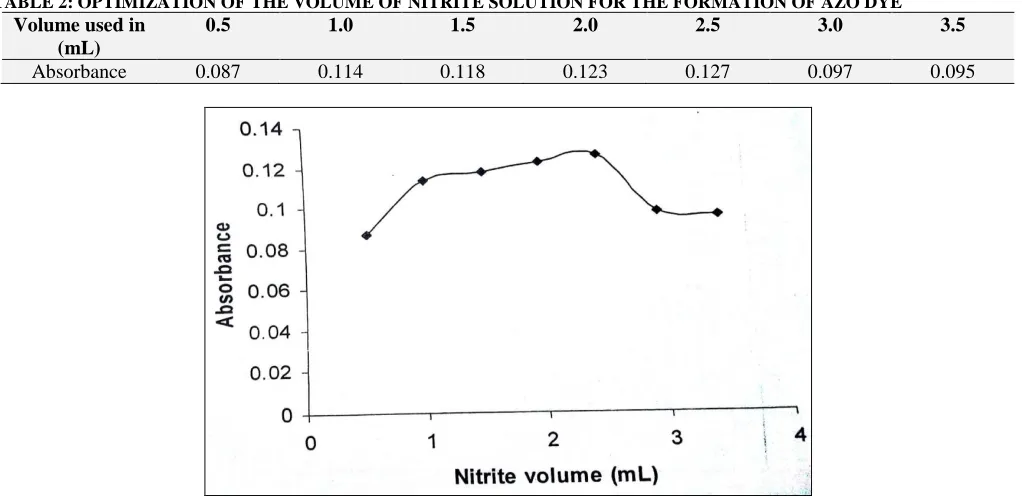
to a 50 mL volumetric flask, to this 1.0 mL of 0.1N HCL was added followed by the addition of 3.0 mL of (1000 ppm) sodium nitrite solution. This was kept for 5 minutes for the formation of the diazotized product. Then 1 mL of β-Nephthol (1000 ppm) was added as coupling reagent. Blank solution was prepared in the same manner without the addition of the Cefotaxime sodium. For optimization of wavelength the absorbance of the resulting color azo dye was measured from 390-590 nm using Genesys 5 spectrophotometer for finding out optimum absorption. Each time wavelengths were calibrated with blank solution. The results are given in Table 1 and are shown in Fig.3 for optimization of volume of nitrite solution, nitrite solution (1000 ppm) volume was varied in a range of 0.5-3.5 mL, and the absorbance was noted at optimum wavelength of 500 nm, While keeping all other conditions same. The results are given in Table 2 and are shown in Fig.4. Similarly for optimization of volume of hydrochloric acid (0.1N) and β-Nephthol (1000 ppm), Volume of (0.1N) hydrochloric acid was varied in a range of 0.5-3.0 mL and β-Nephthol (1000 ppm).
TABLE 1: WAVELENGTH OPTIMIZATION FOR SPECTROPHOTOMETRIC DETERMINATION OF CEFOTAXIME SODIUM
Wavelength (nm)
Absorbance Wavelength (nm) Absorbance Wavelength (nm) Absorbance
390 0.056 460 0.074 530 0.078
400 0.059 470 0.081 540 0.068
410 0.061 480 0.086 550 0.058
420 0.065 490 0.100 560 0.044
430 0.067 500 0.112 570 0.036
440 0.068 510 0.096 580 0.028
450 0.071 520 0.090 590 0.021
[image:3.612.46.566.436.736.2]TABLE 2: OPTIMIZATION OF THE VOLUME OF NITRITE SOLUTION FOR THE FORMATION OF AZO DYE
Volume used in (mL)
0.5 1.0 1.5 2.0 2.5 3.0 3.5
Absorbance 0.087 0.114 0.118 0.123 0.127 0.097 0.095
FIG.4: OPTIMIZATION OF THE VOLUME OF NITRITE SOLUTION FOR THE FORMATION OF AZO DYE
Conditions:
λ max varied Cefotaxime solution (1000 ppm) 1.0 mL β-Nephthol (1000 ppm) 1.0 mL Hydrochloric acid 0.1N 1.0 mL Sodium nitrite (1000 ppm) 3.0 mL
Conditions:
λ max 500 nm Cefotaxime solution (1000 ppm) 1.0 mL β-Nephthol (1000 ppm) 1.0 mL Hydrochloric acid 0.1N 1.0 mL
Conditions:
λ max 500 nm
Cefotaxime solution (1000 ppm) 1.0 mL Sodium nitrite (1000 ppm) 2.5 mL β-Nephthol (1000 ppm) 1.0 mL Conditions:
λ max 500 nm Cefotaxime solution (1000 ppm) 1.0 mL Hydrochloric acid 0.1N 1.0 mL Sodium nitrite (1000 ppm) 2.5 mL
Volume was varied in a range of 0.2-1.6 mL absorbance were noted at optimum wavelength of 500 nm. The results are given in table-3 and table-4 and are shown in figure-5 and figure-6 for HCL (0.1N) and β-Nephthol (1000 ppm) optimizations, respectively.
TABLE 3: OPTIMIZATION OF THE VOLUME OF HCL FOR THE FORMATION OF AZO DYE Volume used
in (mL)
0.5 1.0 1.5 2.0 2.5 3.0
Absorbance 0.089 0.116 0.090 0.085 0.088 0.083
TABLE 4: OPTIMIZATION OF THE VOLUME OF β-NEPHTHOL FOR THE FORMATION OF AZO DYE
Volume used in (mL)
0.2 0.4 0.6 0.8 1.0 1.2 1.4 1.6
FIG.5: OPTIMIZATION OF THE VOLUME OF HCL FOR THE FORMATION OF AZO DYE
FIG.6: OPTIMIZATION OF THE VOLUME OF β-NEPHTHOL FOR THE FORMATION OF AZO DYE
The effect of concentration of Cefotaxime sodium on the absorbance behavior at lower concentration using spectrophotometric method:
Instruments: The same as mentioned before Reagents: The same as mentioned before Solutions: The same as mentioned before Procedure:
Varied amount of standard Cefotaxime sodium solution with final concentration after dilution ranging from 1-20 ppm were taken in eleven separate 50 mL volumetric flasks. To each of these flasks 1.0 mL of 0.1N HCL was added followed by the addition of 2.5 mL (1000 ppm) sodium nitrite
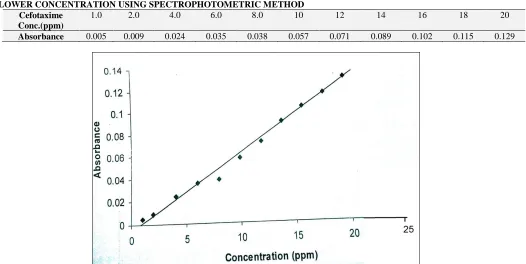
solution. The resulting solutions were kept for some time for the formation of the diazotized product. Then 1.2 mL of β-Nephthol (1000 ppm) was added as coupling reagent. Blank solution was prepared in the same manner without the addition of the Cefotaxime sodium. The absorbance of the resulting color azo dye was measured at 500 nm Genesys 5 spectrophotometer to find out absorbance behavior the results are given in Table-5 and are shown in Fig.7.
Conditions:
TABLE 5: THE EFFECT OF CONCENTRATION OF CEFOTAXIME SODIUM ON THE ABSORBANCE BEHAVIOR AT LOWER CONCENTRATION USING SPECTROPHOTOMETRIC METHOD
Cefotaxime Conc.(ppm)
1.0 2.0 4.0 6.0 8.0 10 12 14 16 18 20
[image:6.612.50.576.66.330.2]Absorbance 0.005 0.009 0.024 0.035 0.038 0.057 0.071 0.089 0.102 0.115 0.129
FIG.7: THE EFFECT OF CONCENTRATION OF CEFOTAXIME SODIUM ON THE ABSORBANCE BEHAVIOR AT LOWER CONCENTRATION USING SPECTROPHOTOMETRIC METHOD
Analysis of Cefotaxime sodium in various pharmaceutical preparations using investigated method and the comparison with official method:
Instruments: The same as mentioned before Reagents: The same as mentioned before Solutions: The same as mentioned before Standard preparation:
Procedure: For standard preparation and UV/Vis determination, 100 mg of reference water Cefotaxime sodium was dissolved in 100 mL volumetric flask with distilled water by continuous shaking. 1 mL of this solution was transferred into 50 mL volumetric flask. To this 1.0 mL of 0.1 N HCL was added followed by the addition of 2.5 mL Sodium nitrite (1000 ppm) solution. Solution was kept for some time for the formation of the diazotized product. Then 1.2 mL of β-Nephthol (1000 ppm) was added as a coupling reagent. Blank solution was prepared in the resulting radish color azo dye was measured at 500 nm using Genesys 5 spectrophotometer.
Sample preparation: Weigh the contents of 10 vials and take average weight of 10 vials. Weigh
out 100 mg of powder and dissolved it in 100 mL volumetric flask with distilled water. Shake vigorously and made up the volume with distilled water. Transferred 1 mL of the solution into 50 mL volumetric flask and proceed same as for standard preparation.
Calculations:
% age=Au/Sa x std wt/100 x 1/50 x 100/sp wt x 50/1 x potency of std/100 x avg wt
Au =Absorbance of standard solution As= absorbance of sample solution Std wt= weight of standard taken Sp wt= weight of sample taken Potency of std= potency of standard Avg wt= average wt of 10 sample
Determination of Cefotaxime sodium by official method (HPLC method)5
[image:6.612.51.575.69.334.2]Solution B: Prepared a mixture of 0.05 M phosphate Buffer and methanol (60:40) passed through a filter having a porosity of 0.05 µm. Mobile Phase: Used variable mixture of solution A and Solution B as directed in chromatographic system below.
Standard preparation:
Transferred about 40 mg of USP Cefotaxime sodium RS, accurately weighed, to a 50 mL volumetric flask, added about 40 mL of solution A, dissolved and diluted with solution A to volume. Sensitivity solution- mixed 1 mL of standard preparation, 7.0 mL of water, and 2.0 mL of methanol. Added 25 mg of sodium carbonate mix and allow to stand at room temperature for 10 minutes, with occasional swirling. Added 3 drops of glacial acid and 1 mL of standard preparation and mixed.7
Assay preparation:
Transferred about 40 mg of Cefotaxime sodium, accurately weight, to a 50 mL volumetric flask, and preceded same as for standard preparation.
Chromatographic system:
The liquid chromatographic is equipped with a 135 nm detector and a 3.9 mm x 15 cm column that contains 5 µm packing 1.1 and is maintained at a constant temperature of about 30⁰C. The flow rate is about 1mL/minute. The system is equilibrated with 100% solution A. Seven minutes after injection of the solution under test, the proportion of solution B is increased linearly from 0% to 20% at a rate of 10 % per minute and is maintained at that composition for 7 minute. The proportion of solution B is then increased linearly at a rate of 2.7 % per 5 minute until the proportion of solution A is increased linearly to 100% at a rate of 20 % per minute the retention time is about 14 minute for Cefotaxime.
Procedure:
Equal volume (about 10 µL) of the standard preparation and the assay preparation was separately injected into the chromatograph and chromatograms were recorded, measured for the
areas of major peak. The following formulas were used for calculation of Cefotaxime sodium.7
50(Cp/W) (ru/rs) C= Concentration in mg/mL
E= Cefotaxime equivalent, in microgram per mL W= weight in mg
Ru and rs= Cefotaxime peak response obtained from assay and standard preparation respectively. RESULTS AND DISCUSSION: The proposed chemical reaction involves the procedure as shown in figure-2 Cefotaxime have amine group in molecule. In this procedure the amine was directly exploited to form the formation of azo dye in the first step Cefotaxime was reacted in acidic medium to form the diazotized product, which was subsequently coupled with β-Nephthol. A colored azo dye was the final product.
Various optimization studies for the parameters like wavelength, hydrochloric acid volume, sodium nitrite concentration and β-Nephthol concentration were investigated for the formation of maximum azo dye. Calibration curve, limit of detection, limit of quantification, RSD, correlation coefficient, molar absorptivity, were also investigated for the proposed method.
After preliminary experiments, the azo dye formed was investigated for optimum wavelength. The results are given in table-1 and are shown in figure-3 the resulting azo dye has maximum absorbance at 500 nm and was used as optimum wavelength for further investigation of Cefotaxime sodium determination.
The volume of 0.1N hydrochloric acid was also optimized for the formation of maximum azo dye for 20 ppm Cefotaxime sodium. The result are given in Table 3 and are shown in Fig.5 as can be seen from Table 5; 0.1 N Hydrochloric acid 1.0 mL was found to be optimum volume and was used in further studied.
After optimization of the diazotizing agent the volume of the coupling reagent β-Nephthol (1000 ppm) was optimized for the 20 ppm of Cefotaxime sodium to form the maximum dye. The results are given in Table 4 and are shown in Fig.6 as can be seen from Table 4 that 1.2 mL of β-Nephthol solution was found to be the optimum volume of the coupling reagent and was used further for the studies of Cefotaxime sodium.
At optimum conditions, the effect of concentration at lowers level on the absorbance behavior of Cefotaxime sodium was investigated to calculate the limit of detection (LOD) and limit of quantification (LOQ). Cefotaxime sodium 2 ppm was selected for investigation of detection limit as
this was the minimum concentration for which the absorbance could be noted. Six replicate readings were taken for this concentration. The results are given in Table 6 molar absorptivity, LOD, LOQ were calculated and are given in Table 7 the following formulas were used for calculation of LOD, LOQ, S.D and R.S.D;
Limits of detection (for concentration) = 3x S Limits of quantifications (for concentration) =10 x S
Standard deviation S = √ n/n-1
Relative standard deviation R.S.D = S/X⁻ x 100 Where as
n= X - X⁻
X = Concentration in (ppm) found
X⁻= Average founded concentration (ppm) of six samples
TABLE 6: REPLICATE READINGS FOR 2 PPM CONCENTRATION OF CEFOTAXIME SODIUM
TABLE 7: QUANTITATIVE PARAMETERS
Λ max 500 nm
Celebration range 1-20 µg
Standard deviation 0.248
R.S.D 13.24
Slope 0.0056
Correlation coefficient 0.998
M 2.09 x 10⁻⁵
∑ 4.88 x 10⁺³
L.O.D 0.744
L.O.Q 2.48
Application of the investigated method for the analysis of Cefotaxime sodium in various pharmaceutical preparation and comparison with official method:
The investigated method was applied for determination of Cefotaxime sodium in different
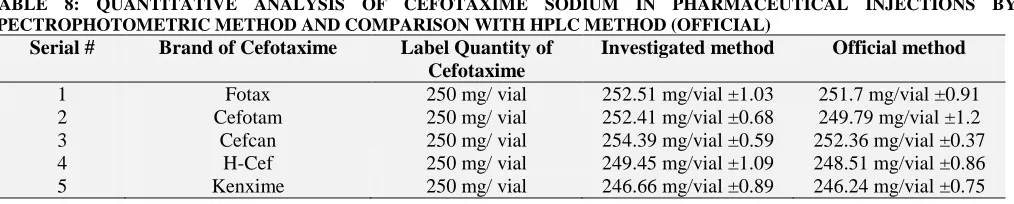
injection. The method used for determination and calculations has been discussed above and was compared with official method shown above while the results of comparison have been shown in Table 8.
Absorbance Concentration (ppm) found (X)
0.012 2.2
0.011 2.0
0.009 1.7
0.010 1.8
0.008 1.5
TABLE 8: QUANTITATIVE ANALYSIS OF CEFOTAXIME SODIUM IN PHARMACEUTICAL INJECTIONS BY SPECTROPHOTOMETRIC METHOD AND COMPARISON WITH HPLC METHOD (OFFICIAL)
Serial # Brand of Cefotaxime Label Quantity of Cefotaxime
Investigated method Official method
1 Fotax 250 mg/ vial 252.51 mg/vial ±1.03 251.7 mg/vial ±0.91
2 Cefotam 250 mg/ vial 252.41 mg/vial ±0.68 249.79 mg/vial ±1.2
3 Cefcan 250 mg/ vial 254.39 mg/vial ±0.59 252.36 mg/vial ±0.37
4 H-Cef 250 mg/ vial 249.45 mg/vial ±1.09 248.51 mg/vial ±0.86
5 Kenxime 250 mg/ vial 246.66 mg/vial ±0.89 246.24 mg/vial ±0.75
CONCLUSION: Spectrophotometric method for determination of Cefotaxime sodium is also based on direct exploitation of the primary aromatic amine group like Ceftriaxone, for diazotization followed by formation of azo dye with coupling reagent. Various analytical conditions like wavelength, nitrite solution hydrochloric acid volume and coupling reagent were optimized and were found to be 500 nm, 2.5 mL (1000 ppm), 1.0ml (0.1N) 1nd 1.2 mL (1000 ppm) respectively for 20 ppm of Cefotaxime sodium. The method was found linear in range of 1-20 ppm. The limit of detection and limit of quantification for the investigated method were calculated using authentic standard of Cefotaxime sodium and were found to be 0.744 ppm and 2.48 ppm respectively, while standard deviation was found to be 0.248. The method was validated and compare with the literature method for analysis of Cefotaxime sodium in pharmaceutical preparations, and was found in good agreement with labeled claim of preparation.
ACKNOWLEDGMENT: The authors gratefully acknowledge the financial support from the Institute of Chemical Sciences, University of Peshawar for the research project.
REFERENCES:
1. “British pharmacopoeia” Volume I. The stationary office London. 423,666-667,2007.
2. “The Merck Index. An encyclopedia of chemicals, Drugs and biological” 13th ed. White house station,: Merck and ci,inc, NJ.1965,2001.
3. USP 30 NF25. “The united state pharmacopeia the national formulary” volume 2. The united state pharmacopeial convention twin brooks parkway, Rockville, MD 20852. 1681-1682, 1664, 1922-1923, 2007. 4. A.R Gennaro, G, D. Chase, M.R Gibson, C.B Granberg, S.C. Harvey, R.E. king, A N. Martin, T. Medwick, E.A Swinyard, G.C Zink” Remington’s pharmaceutical sciences” .17th ed. united state of America, Easton pennylvania.1189, 1985.
5. European pharmacopoeia” 4th ed. Volume 2. Council of Europe Strasbourg. 1032,2001.
6. “British pharmacopoeia” Volume 1 The stationary office London. 631, 521,-522 2005.
7. USP 26, NF 21” The united state pharmacopeia. The national formulary” The official compendia of standards. Volume1. The united state pharmacopeial convention INC twin brooks parkway, Rockville, MD 20852. 595-596, 498-499, 2003.
All © 2013 are reserved by International Journal of Pharmaceutical Sciences and Research. This Journal licensed under a Creative Commons Attribution-NonCommercial-ShareAlike 3.0 Unported License.
This article can be downloaded to ANDROID OS based mobile. Scan QR Code using Code/Bar Scanner from your mobile. (Scanners are available on Google Playstore)
How to cite this article:
[image:9.612.55.562.58.160.2]