ISSN: 1992-8645 www.jatit.org E-ISSN: 1817-3195
177
PERFORMANCE IMPROVEMENT OF TRANSMISSION
SYSTEM USING TCSC WITH FIRING ANGLE CONTROL
1
MR.A.HEMA SEKHAR, 2DR.A.LAKSHMI DEVI
1
Research Scholar, Department of EEE, S.V.University College Of Engineering,Tirupati
2
Professor & HOD, Department of EEE ,S.V.University College Of Engineering,Tirupati E-mail: [email protected],[email protected]
ABSTRACT
In today‘s highly complex and interconnected power systems, mostly made up of thousands of buses and hundreds of generators, there is a great need to improve electric power utilization maintaining reliability and security. Available power generation, usually not situated near a growing load center, is subject to regulatory policies and environmental issues. The majority of the losses are occurred at the transmission level. So by controlling or managing the transmission system with FACTS the losses will be reduced. Although the voltage constraints are within limits but the reactive power losses are majorly high in transmission system. So by suitable placement of series FACTS devices i.e TCSC at the transmission system the reactive power losses are controlled. In this paper the concept of firing angle control for the series compensating device is introduced for flexible control of the device at transmission system. Simulation results are carried out on IEEE 14, 30, 57,118 bus test systems.
Keywords:Power System, Transmission System, FACTS, TCSC, Firing Angle, FVSI.
1. INTRODUCTION
The 21st century power system network faces lot of complexities in terms of stability and meeting the power crisis. Voltage stability plays an important role in the operation of power system and there are major concerns about it for better utilization of the system. This purpose can be achieved by installing FACTS devices in transmission lines. These devices can control the power flow and increase the performance in a power system without necessity of reorganizing the generation of system. And the need for analyzing and improving the stability is a challenging task. The need of controlling the power system especially transmission system is increases. So by including the Series Facts devices like TCSC , the reactive and real power losses will reduces and voltage profile of the system will be better. The placement of FACTS devices will be determined by using the load flow analysis i.e Newton raphson method and loss suitability indices. The literature mainly concentrated on the series compensation placement and its size based on the target value of the voltage (p.u) at the buses by selecting the suitable line.Finding out the proper location of
TCSC is obtained by using Fast Voltage Stability Index(FVSI).The FVSI is used to find out optimum location and settings of TCSC for enhance the Transmission line overloading issues. The TCSC should be placed on the line having most positive Voltage stability index. The voltage stability enhancement and loss minimization is evaluated for IEEE-14,30,57,118 bus systems incorporating TCSC at its optimal location obtained using FVSI technique This paper is divided in to four section. In section-I introduction to the power system and series compensation, section-II Load flow analysis for analyzing the steady state system, section –III introduces the firing angle control of TCSC and modeling of the TCSC with the Newton raphson method of load flow analysis and In section-IV the proposed method is adopted to the different test cases to analyses the power flows, voltage profile ,real and reactive power losses.
2. LITERATURE REVIEW
ISSN: 1992-8645 www.jatit.org E-ISSN: 1817-3195
178 Hadi Saadat Presented Real and Reactive Power flow equations in polar form by considering two bus power system. A Jacobean matrix is then constructed and Newton Raphson method is used to solve these equations[1].Ref.[2]-[6] Papers proposed in literatures for load flow analysis with incorporated FACTS controllers in multimachine power systems from different operating conditions viewpoint. There are different load flow analysis with incorporated FACTS controllers from different operating conditions in multimachine power systems for optimal power flow control. The Newton Raphson Methods have been proposed in literatures includes for different types of Modeling of Series FACTS controllers .Sahoo et.al (2007) proposed the basic modeling of the FACTS devices for improving the system performance[7].Zhang, X.P et.al explains Jacobian Matrix of Power flow Newton Raphson algorithm and Newton Raphson strong convergence characteristics [8].Gotham.D.J and G.T Heydt (1998) detailed about the power flow studies of the system with FACTS devices[9].Povh.D(2000) proposed the nice concepts of the modeling of the power systems and the impact of the FACTS devices on the transmission network [10].Modelling of the FACTS devices with various techniques with complete computer programming is proposed by Acha et.al. [11].The impact of multiple compensators in the system was proposed by Radman.G and R.S Raje [12].The important concepts of the power systems with different load flow was proposed by Stagg.G.W et.al(1968) [13]. Tong Zhu and Gamg Haung proposed(1999) the accurate points of the buses which were suitable for the FACTS devices installation [14].P.Kessal and H. Glavitsch(1986) proposed increase the transmission capability, improvement of stability by installing FACTS devices in transmission network [15].Hingorani N.G et.al presented about FACTS devices ,which are a family of high-speed electronic devices, which can significantly increase the power system performance by delivering or absorbing real and/or reactive power [16].Musirin and Abdul (2002), presented a paper on Fast Voltage Stability Index (FVSI). This paper demonstrates the use of line stability index termed as fast voltage stability index in order to determine the maximum loadability in a
power system. The bus that is ranked highest is identified as the weakest bus since it can withstand a small amount of load before causing voltage collapse. The point at which FVSI close to unity indicates the maximum possible connected load termed as maximum loadability at the point of bifurcations. [17].Hugo Ambriz-Perez et.al presented a novel power flow model for the thyristor-controlled series compensator (TCSC) in this paper. The model takes the form of afiring angle-dependant, nodal admittance matrix that is then incorporated in an existing Power flow algorithm [18].
3.. LOAD FLOW ANALYSIS
In large-scale power flow studies, the Newton– Raphson method has been proved most successful owing to its strong convergence characteristics.
Because of its quadratic convergence, Newton’s technique is mathematically superior to the Gauss-Siedel technique and is a smaller amount liable to divergence with ill-conditioned issues. For giant power systems, the Newton-Raphson technique is found to be additional economical and sensible. The quantity of iterations needed to get an answer is freelance of the system size; however additional purposeful evaluations are needed at everyiteration. Since within the power flow problem real power and voltage magnitude are nominal for the voltage-controlled buses, the power flow equations[1] are developed in polar type. For the standard bus of the facility system shown in Fig 1
Vi V1
V2
Ii
Vn
Vj yi0
Figure.1. A Typical bus of the power system
y
i1y
i2ISSN: 1992-8645 www.jatit.org E-ISSN: 1817-3195
179 The current entering bus i is given by
Ii = Vi
∑
=
n j 0
yij -
∑
=
n j 1
yijVj j = i (1)
This equation can be written in terms of the bus admittance matrix as
Ii =
∑
=
n j 1
Yij Vj (2)
In the above equation, j includes bus i. expressing this equation in polar form, we have
Ii =
∑
=
n j 1
|Yij| |Vj|∟θij+ δj (3)
The complex power at bus i
Pi-j Qi = Vi* Ii (.4)
Substituting from 2.3 for Ii in 2.4
Pi-jQi=|Vi|∟δi
∑
=
n j 1
|Yij||Vj|∟θij+δj (5)
Separating real and imaginary parts
P |V | V Y Cos θ δ δ
P |V|,δ 6
Q |V | V Y Sin θ δ δ
Q |V|,δ 7
The power mismatch equations ΔP and ΔQ are expanded around a base point (θ(0),V(0)) and, hence, the power flow Newton–Raphson[8] algorithm is expressed by the following relationship.
∆
∆
∂
∂
∂
∂
∂
∂
∂
∂
=
∆
∆
V
V
V
V
Q
Q
V
V
P
P
Q
P
θ
θ
θ
(8)
Where
P
∆
is the change of real power at the bus.Q
∆
is the change of reactive power at the bus.θ
∂
∂
P
is the change in real power w.r.t angle at the
buses
V
V
P
∂
∂
is the change in real power w.r.t change in
voltage magnitude at the buses
θ
∂
∂
Q
is the change in reactive power w.r.t angle at
the buses
V
V
Q
∂
∂
is the change in reactive power w.r.t
change in Voltage magnitude at the buses
∆
V is the change in voltage at the busθ
∆
is the change in angle at the bus4. SERIES COMPENSATION
FACTS controllers can be broadly divided into four categories, which include series controllers, shunt controllers, combined series-series controllers, and combined series-series-shunt controllers. Their operation and usage are discussed below.
ISSN: 1992-8645 www.jatit.org E-ISSN: 1817-3195
180 current and power flow in the system and to damp oscillations of the system.
4.1 Thyristor Controlled Series Capacitor (TCSC)
The basic conceptual TCSC [18] module comprises a series capacitor, C, in parallel with a thyristor-controlled reactor, LS, as shown in Fig. 2. However, a practical TCSC module also includes protective equipment normally installed with series capacitors. A metal-oxide varistor (MOV), essentially a nonlinear resistor, is connected across the series capacitor to prevent the occurrence of high-capacitor over- voltages. Not only does the MOV limit the voltage across the capacitor, but it allows the capacitor to remain in circuit even during fault conditions and helps improve the transient stability.
Also installed across the capacitor is a circuit breaker, CB, for controlling its insertion in the line. In addition, the CB bypasses the capacitor if severe fault or equipment-malfunction events occur. A current-limiting inductor, Ld, is incorporated in the circuit to restrict both the magnitude and the frequency of the capacitor current during the capacitor-bypass operation.
[image:4.612.314.548.259.723.2]An actual TCSC system usually comprises a cascaded combination of many such TCSC modules, together with a fixed-series capacitor, CF. This fixed series capacitor is provided primarily to minimize costs.
Fig 1. A Basic Module of TCSC
Figure 2 A Basic Module of TCSC
4.2. Operation Of The TCSC
(Firing Angle Power Flow Model)
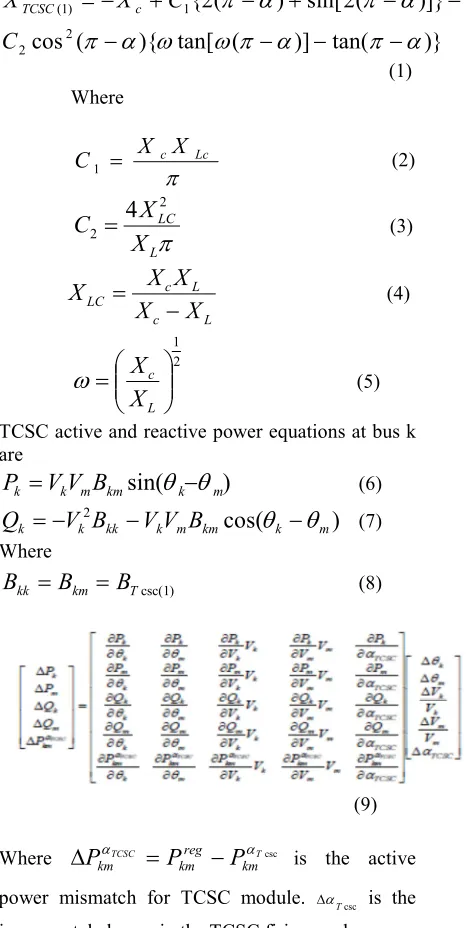
[image:4.612.94.290.477.535.2]The computation of the firing angle is carried out. However, such calculation involves an iterative solution since the TCSC reactance and firing angle are nonlinearly related. One way to avoid the additional iterative process is to use the alternative TCSC Variable Impedance Power Flow model presented in this section. The fundamental frequency equivalent reactance XTCSC(1) of the TCSC module [18] shown in Figure 3
Figure 3 fundamental frequency equivalent reactance XTCSC(1) of the TCSC module
)}
tan(
)]
(
tan[
){
(
cos
)]}
(
2
sin[
)
(
2
{
2 2
1 )
1 (
α
π
α
π
ω
ω
α
π
α
π
α
π
−
−
−
−
−
−
+
−
+
−
=
C
C
X
X
TCSC c(1) Where
π
Lcc
X
X
C
1=
(2)π
L LC
X
X
C
2
2
4
=
(3)
L c
L c LC
X
X
X
X
X
−
=
(4)2 1
=
L c
X
X
ω
(5)TCSC active and reactive power equations at bus k are
)
sin(
k mkm m k k
V
V
B
P
=
θ
−
θ
(6))
cos(
2
m k km m k kk k
k
V
B
V
V
B
Q
=
−
−
θ
−
θ
(7)Where
) 1 csc(
T km kk
B
B
B
=
=
(8)(9)
Where TCSC Tcsc
km reg km
km
P
P
P
α=
−
α∆
is the activeISSN: 1992-8645 www.jatit.org E-ISSN: 1817-3195
181 4.2.1 Advantage of firing angle of TCSC
In Reactance and Power Injection Model, The control power electronic devices like SCR, Thyristor, IGBT operates at static mode i.e at single firing angle condition. But in the Firing angle models, the amount of reactance is depends upon the firing angle. The amount of reactive power also vary depends upon Firing angle.
4.3 Fast Voltage Stability Index (FVSI)
Fast voltage stability index (FVSI) is formulated this as the measuring instrument in predicting the voltage stability condition in the system. Taking the symbols ‘i’ as the sending bus and ‘j’ as the receiving bus. Hence, the fast voltage stability index, FVSI [17] can be defined by:
ij i
j ij ij
X
V
Q
Z
FVSI
22
4
=
(10)Where: Zij= line impedance Xij = line reactance
Qj = reactive power at the receiving end Vi = sending end voltage
The value of FVSI that is evaluated close to 1.00 indicates that the particular line is closed to its instability point which may lead to voltage collapse in the entire system. To maintain a secure condition the value of FVSl should be maintained well less than 1.00.
5. TEST CASES
The proposed method is used to analyze the different standard IEEE transmission network. The important parameters that can be determined by proposed methods are power flows,voltage profile of the buses ,real and reactive power losses.
5.1 IEEE 14 Bus System
[image:5.612.320.525.67.208.2]The single line diagram of IEEE 14 bus system is shown in the figure 4.which consists of 5 PV buses, and 11 PQ buses. The voltage profile and the power flow losses results of IEEE 14 bus system without installing TCSC are shown in the fig 5,fig 6,fig 7 . The minimum voltage and maximum voltage in terms of p.u is shown in the table 1 without installing of TCSC to the system
Figure 4 The single line diagram of IEEE 14 bus
system
Table 1.Minimum and maximum voltages of IEEE 14 bus system
Minimum voltage(P.U) Maximum Voltage(p.u) 1.01 at bus 3 1.09 at bus 8
The Real power and reactive power losses of IEEE 14 bus system are 9.68 Mw and 50.22 Mvar. The maximum real and reactive power losses through the branches of IEEE 14 bus system are 2.42 Mw and 10.19Mvar at line 2-3.
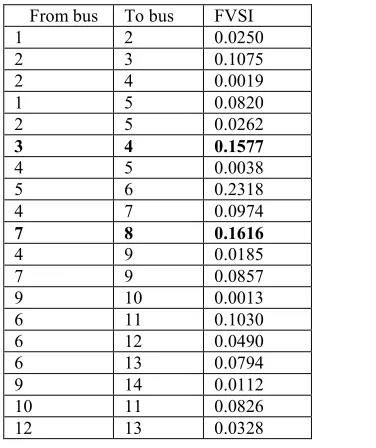
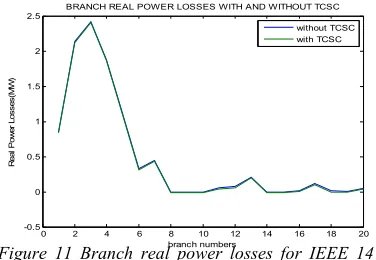
[image:5.612.325.513.514.738.2]The placement series FACTS devices i.e, TCSC are determined by FVSI which is given at section 3.3. The FVSI for IEEE 14 bus is shown in table 2. From the table 2, the placement of the TCSC is decided by the highest value in the table, which is line 7-8 for single TCSC placement and lines 7-8 and 3-4 for double placement of TCSC. The effect of placing TCSC for IEEE 14 bus is shown in the figure 8 and fig 9, 10, 11, and 12
Table 2 FVSI for IEEE 14 bus system
From bus To bus FVSI
1 2 0.0250
2 3 0.1075
2 4 0.0019
1 5 0.0820
2 5 0.0262
3 4 0.1577
4 5 0.0038
5 6 0.2318
4 7 0.0974
7 8 0.1616
4 9 0.0185
7 9 0.0857
9 10 0.0013
6 11 0.1030
6 12 0.0490
6 13 0.0794
9 14 0.0112
10 11 0.0826
ISSN: 1992-8645 www.jatit.org E-ISSN: 1817-3195
182
0 2 4 6 8 10 12 14
1.01 1.02 1.03 1.04 1.05 1.06 1.07 1.08 1.09 1.1 1.11 busnumbers v o lt a g e m a g n it u d e i n p .u
Voltage profile without tcsc device
13 14 0.1078
Figure 5 Voltage profile of IEEE 14 bus without TCSC
Figure 6 Branch real power losses for IEEE 14 bus without TCSC
Figure 7. Branch reactive power losses of IEEE 14 bus without TCSC
5.2 Single TCSC Placement
[image:6.612.62.522.63.467.2]The effect of single TCSC placement for the IEEE 14 bus system is detailed shown in the figure 8, figure 9, figure 10, figure 11 and figure 12
Figure 8 Comparative voltage profile of IEEE 14 bus with and without TCSC
The voltage profile of the system is standardized by placing single TCSC at line 7-8. The minimum voltage is 1.004 p.u at bus 13 and the maximum voltage is 1.05 at bus 2. The reduction of real and reactive power losses are shown in the fig 9 and fig 10.
Figure 9.Comparative analysis of Real power losses of IEEE 14 bus with and without TCSC
Figure 10. Comparative analysis of Reactive power losses of IEEE 14 bus with and without TCSC
Figure 11 Branch real power losses for IEEE 14 bus without & with TCSC
0 2 4 6 8 10 12 14
1 1.01 1.02 1.03 1.04 1.05 1.06 1.07 1.08 1.09 1.1 busnumbers v o lt a g e m a g n it u d e i n P .U
voltage profile with and without tcsc
without tcsc with tcsc 1 2 0 1 2 3 4 5 6 7 8 9 10
without tc sc with tcsc
re al p o w e r lo s s e s (M w ) w it h a n d w it h o u t tc s c
TOTAL REAL POW ER LOSSES WITH AND WITHOUT tcsc
1 2 0 10 20 30 40 50 60
without tc sc with tcsc
re a c ti v e p o w e r lo s s e s (M v a r) w it h a n d w it h o u t tc s c
TOTAL REACTIVE POW ER LOSSES W ITH AND W ITHOUT tc sc
0 5 10 15 20 25
0 2 4 6 8 10 12 branch numbers R e a c ti v e P o w e r L o s s e s (M V a r)
BRANCH REACTIVE POW ER LOSSES WITHOUT tcsc
0 5 10 15 20 25 0 0.5 1 1.5 2 2.5
branc h numbers
R e a l P o w e r L o s s e s (M W )
BRANCH REAL POW ER LOSSES W ITHOUT tcs c
0 2 4 6 8 10 12 14 16 18 20
-0.5 0 0.5 1 1.5 2 2.5 branch numbers R e a l P o w e r L o s s e s (M W )
BRANCH REAL POWER LOSSES WITH AND WITHOUT TCSC
[image:6.612.321.493.345.427.2] [image:6.612.79.281.359.459.2] [image:6.612.319.507.466.596.2] [image:6.612.98.300.584.709.2]ISSN: 1992-8645 www.jatit.org E-ISSN: 1817-3195
[image:7.612.89.530.68.248.2]183
Figure 12 Branch reactive power losses for IEEE 14 bus without & with TCSC
The firing angle, size and location of the TCSC is shown in table 3.
Table 3. Comparative analysis of IEEE 14 bus with and without single TCSC
Parameters Without TCSC With TCSC
Minimum Voltage(p.u)
1.01 at bus 3 1.004 at bus 13
Maximum Voltage(p.u)
1.09 at bus 8 1.05 at bus 2
Real power
losses(MW)
9.682 9.422
Reactive power losses(MVar)
50.04 49.48
Location of TCSC
--- 7-8 line
TCSC firing angle(deg)
--- 136.3
Size of
TCSC(kVar)
--- 2.43
With the inclusion of the another TCSC at the line 3-4 the power flows are further improved and losses are reduced which is shown in the table 4
Table 4. Comparative analysis of IEEE 14 bus with two TCSCs and without TCSC
Parameters Without TCSC With TCSC
Minimum Voltage(p.u)
1.01 at bus 3 1.006 at bus 10
Maximum Voltage(p.u)
1.09 at bus 8 1.048 at bus 2
Real power 9.682 9.282
losses(MW)
Reactive power losses(MVar)
50.04 48.2
Location of TCSC
--- 7-8 line 3-4 line TCSC 1firing
angle(deg)
--- 136.3
TCSC2 firing angle(deg)
--- 129.3
Size of
TCSC1(kVar)
--- 1.440
Size of
TCSC2(kVar)
--- 0.993
Figure 13 comparative voltage profile for IEEE 14 bus without & with two TCSC’s
Figure 14 Branch real power losses for IEEE 14 bus without & with two TCSC’s
0 2 4 6 8 10 12 14
1 1.01 1.02 1.03 1.04 1.05 1.06 1.07 1.08 1.09 1.1
busnumbers
v
o
lt
a
g
e
m
a
g
n
it
u
d
e
i
n
P
.U
voltage profile with and without TCSC
without TCSC with TCSC
0 2 4 6 8 10 12 14 16 18 20
-0.5 0 0.5 1 1.5 2 2.5
branch numbers
R
e
a
l
P
o
w
e
r
L
o
s
s
e
s
(M
W
)
BRANCH REAL POWER LOSSES WITH AND WITHOUT TCSC
without TCSC with TCSC
0 2 4 6 8 10 12 14 16 18 20
-2 0 2 4 6 8 10 12
branch numbers
R
e
a
c
ti
v
e
P
o
w
e
r
L
o
s
s
e
s
(M
V
a
r)
BRANCH REACTIVE POWER LOSSES WITH AND WITHOUT TCSC
[image:7.612.83.306.335.521.2]ISSN: 1992-8645 www.jatit.org E-ISSN: 1817-3195
184
Figure 15 Branch reactive power losses for IEEE 14 bus without & with two TCSC’s
[image:8.612.70.522.68.729.2]Figure 16.Comparative analysis of Real power losses of IEEE 14 bus with and without two TCSC’s
Figure 17.Comparative analysis of Reactive power losses of IEEE 14 bus with and without two TCSC’s
5.3 Test Case 2 :IEEE 30 Bus System
Figure18 Singleline diagram of IEEE 30 bus system.
[image:8.612.278.532.100.714.2]The proposed firing angle model of TCSC are applied to IEEE 30 bus system which is shown in the fig 18.The voltage profile, real and reactive power losses, branch real and reactive losses without placing of TCSC and with the placing of single TCSC and two TCSCs are shown in the fig 19,20 & fig 21 and table 5 respectively.
Figure 19 voltage profile of IEEE 30 bus without and with single TCSC
[image:8.612.309.533.389.708.2] [image:8.612.104.282.631.713.2]Figure 20 Branch reactive power losses for IEEE 30 bus without & with single TCSC
Figure 21 Branch reactive power losses for
IEEE 30 bus without & with single TCSC
0 2 4 6 8 10 12 14 16 18 20
-2 0 2 4 6 8 10 12 branch numbers R e a c ti v e P o w e r L o s s e s (M V a r)
BRANCH REACTIVE POWER LOSSES WITH AND WITHOUT TCSC
without TCSC with TCSC 1 2 0 1 2 3 4 5 6 7 8 9 10
without TCSC with TCSC
re a l p o w e r lo s s e s (M W ) w it h a n d w it h o u t T C S C
TOTAL REAL POWER LOSSES WITH AND WITHOUT TCSC
1 2 0 10 20 30 40 50 60
without TCSC with TCSC
re a c ti v e p o w e r lo s s e s (M v a r) w it h a n d w it h o u t T C S C
TOTAL REACTIVE POWER LOSSES WITH AND WITHOUT TCSC
0 5 10 15 20 25 30
0.96 0.965 0.97 0.975 0.98 0.985 0.99 0.995 1 1.005 busnumbers v o lt a g e m a g n it u d e i n P .U
voltage profile with and without tcsc
without tcsc with tcsc
0 5 10 15 20 25 30 35 40 45
-0.05 0 0.05 0.1 0.15 0.2 0.25 0.3 branch numbers R e a l P o w e r L o s s e s (M W )
BRANCH REAL POWER LOSSES WITH AND WITHOUT tcsc
without tcsc with tcsc
0 5 10 15 20 25 30 35 40 45
-0.5 0 0.5 1 1.5 2 2.5 branch numbers R e a c ti v e P o w e r L o s s e s (M V a r)
BRANCH REACTIVE POWER LOSSES WITH AND WITHOUT tcsc
ISSN: 1992-8645 www.jatit.org E-ISSN: 1817-3195
185
Table 5 Comparative system parameters of IEEE 30 bus with and without TCSC
Parameters Without
TCSC
With TCSC
With two TCSC Minimum
Voltage(p.u)
0.966 at bus8
0.966 at bus 8
0.964 at bus 8 Maximum
Voltage(p.u)
1.00 at bus1
1.005 at bus 1
1.003 at bus 1
Real power losses(MW)
2.44 1.911 1.624
Reactive power losses(MVar)
8.99 7.84 5.22
Location of TCSC
--- 12 -13line
12
-13line 4-12 line TCSC 1firing
angle(deg)
--- 144.3 149.3
TCSC2 firing angle(deg)
--- --- 114.8
Size of
TCSC1(kVar)
--- 2.72 1.94
Size of
TCSC2(kVar)
--- --- 1.35
[image:9.612.83.533.92.702.2]After placing the TCSC to the IEEE 30 bus system at 12-13 line with size of 2.72 kVar at 144.3 degrees of firing angle. The real and reactive power losses are reduced to much extent. The voltage profile is improve to which is shown in figure 19. The effect of placing to another TCSC at the line 4-12 is shown in the Table 5.
5.4 Test Case 3: IEEE 57 Bus System
Figure 22 single line diagram of IEEE 57 bus system
Figure 23 Voltage profile of IEEE 57 bus with and without TCSC
Table 6 Comparative system parameters of IEEE 57 bus with and without TCSC
Parameters Without
TCSC
With TCSC
With two TCSC Minimum
Voltage(p.u)
0.936 at bus 31
0.964 at bus 26
0.964 at bus 8 Maximum
Voltage(p.u)
1.06 at bus1
1.045 at bus 1
1.003 at bus 1
Real power losses(Mw)
27.864 26.824 26.264
Reactive power losses(Mvar)
121.67 119.43 114.31
Location of TCSC
--- 1-15line 1 -15line 1-17 line TCSC 1firing
angle(deg)
--- 128.7 129.9
TCSC2 firing angle(deg)
--- --- 127.8
Size of
TCSC1(Kvar)
--- 3.92 1.84
Size of
TCSC2(Kvar)
--- --- 2.95
After placing the TCSC to the IEEE 57 bus system the parameters are improved. The minimum voltage of the system is improved from 0.936 p.u at bus 31 to 0.964 p.u at bus 26 for single TCSC placement for 0.9618 at bus 26 for Two TCSCs. The reduction of power losses are shown in the table 6
5.5 Test Case 4 :IEEE 118 Bus System
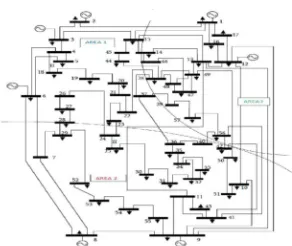
The proposed method is applied IEEE 118 bus system. The single line diagram is shown in the
0 10 20 30 40 50 60
0.92 0.94 0.96 0.98 1 1.02 1.04 1.06
busnumbers
v
o
lt
a
g
e
m
a
g
n
it
u
d
e
i
n
P
.U
voltage profile with and without tcsc
[image:9.612.97.243.544.667.2]ISSN: 1992-8645 www.jatit.org E-ISSN: 1817-3195
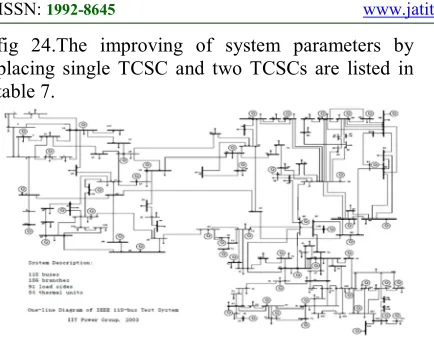
[image:10.612.300.528.69.264.2]186 fig 24.The improving of system parameters by placing single TCSC and two TCSCs are listed in table 7.
Figure 24 Single line diagram of IEEE 118 bus system.
Table 7 Comparative system parameters of IEEE 118 bus with and without TCSC
Parameters Without
TCSC
With TCSC
With two TCSC Minimum
Voltage(p.u)
0.943 at bus 76
0.957 at bus 55
0.955 at bus 55 Maximum
Voltage(p.u)
1.05 at bus10
1.047 at bus 9
1.045 at bus 9
Real power losses(Mw)
132.863 130.445 129.14
Reactive power losses(Mvar)
783.79 778.58 766.68
Location of TCSC
--- 25-27line 25 -27line 23-32 line TCSC 1firing
angle(deg)
--- 147.4 133.3
TCSC2 firing angle(deg)
--- --- 156.3
Size of
TCSC1(Kvar)
--- 4.672 2.74
Size of
TCSC2(Kvar)
--- --- 2.68
Figure 25 Voltage profile of IEEE 118 bus with and without TCSC
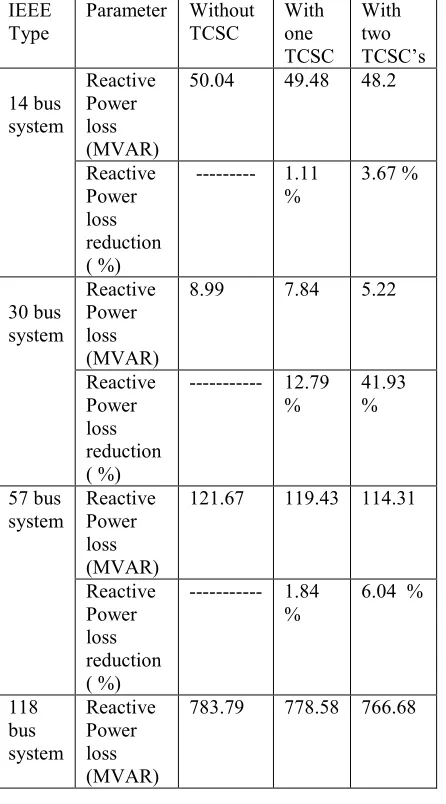
[image:10.612.92.309.77.247.2]The following tables shows the comparative analysis of Real and Reactive power loss and their reduction in percentage for various IEEE bus systems.
Table 8: Comparative Real Power Loss and their reduction in percentage for various bus systems with & without TCSC
IEEE Type
Paramete r
Without TCSC
With one TCSC
With two TCSC’ s
14 bus syste m
Real Power loss (MW)
9.682 9.422 9.282
Real Power loss reduction ( %)
--- 2.68 % 4.17 %
30 bus syste m
Real Power loss (MW)
2.44 1.911 1.624
Real Power loss reduction ( %)
--- 21.68 %
33.44 %
57 bus syste m
Real Power loss (MW)
27.864 26.824 26.264
0 20 40 60 80 100 120
0.94 0.96 0.98 1 1.02 1.04 1.06
busnumbers
v
o
lt
a
g
e
m
a
g
n
it
u
d
e
i
n
P
.U
voltage profile with and without tcsc
[image:10.612.79.529.319.731.2]ISSN: 1992-8645 www.jatit.org E-ISSN: 1817-3195
187 Real
Power loss reduction ( %)
--- 3.7 % 5.74 %
118 bus syste m
Real Power loss (MW)
132.863 130.44 5
129.14
Real Power loss reduction ( %)
[image:11.612.86.309.331.733.2]--- 1.81 % 2.80 %
Table 9: Comparative Reactive Power Loss and their reduction in percentage for various bus systems with & without TCSC
IEEE Type
Parameter Without TCSC
With one TCSC
With two TCSC’s
14 bus system
Reactive Power loss (MVAR)
50.04 49.48 48.2
Reactive Power loss reduction ( %)
--- 1.11 %
3.67 %
30 bus system
Reactive Power loss (MVAR)
8.99 7.84 5.22
Reactive Power loss reduction ( %)
--- 12.79 %
41.93 %
57 bus system
Reactive Power loss (MVAR)
121.67 119.43 114.31
Reactive Power loss reduction ( %)
--- 1.84 %
6.04 %
118 bus system
Reactive Power loss (MVAR)
783.79 778.58 766.68
Reactive Power loss reduction ( %)
--- 0.66 %
2.18 %
5. CONCLUSION
The Firing Angle Model of Thyristor controlled series capacitor (TCSC) using Newton Raphson method has been implemented on different IEEE test systems to investigate the performance of power transmission line in absence as well as in presence of single and double TCSC devices. It is found that during presence of single TCSC there is reduction of real and reactive power losses and also voltage profile improvement as compared to absence of TCSC and with double TCSCs also there is reduction in losses but voltage profile is more or less constant .Based on this firing angle model of single TCSC is sufficient towards voltage improvement
The results obtained by application of the N-R technique during firing-angle model based control are found to be very much similar with the reactance model. It is noted that as compared to Reactance method, the implementation of the firing-angle based control of TCSC using NR technique is much easier. It is also noted that the firing-angle calculation of TCSC using firing-angle model based control is much easier as compared to impedance model based control.and this proposed method is better than earlier published works like reactance models and power injection models.
REFERENCES:
[1] Power System Analysis - Hadi Saadat , Tata MC Graw Hill, Edition 2002
[2] Abdel-Moamen, M.A. Narayana Prasad Padhy, “ Power Flow Control and Transmission Loss Minimization Model with TCSC for Practical Power Networks”, Power Engineering Society General Meeting, 2003, IEEE, Vol.2, 13-17 July 2003, pp 880-884.
ISSN: 1992-8645 www.jatit.org E-ISSN: 1817-3195
188 Analysis Of Electric Network”, Electric Utility Deregulation and Restructuring and Power Technologies, 2000. Proceedings. DRPT 2000. International Conference, 4-7 April 2000 Page(s):191 – 196.
[4] Kumar, G.R.; Rao, R.K.; Ram, S.S.T., Power Flow Control and Transmission Loss Minimization model with TCSC and SVC for Improving System Stability and Security” Industrial and Information Systems, 2008. ICIIS 2008. IEEE Region 10 and the Third international Conference on 8-10 Dec. 2008 Page(s):1 – 5.
[5] M.O. Hassan, S. J. Cheng , and Z. A. Zakaria, “ Steady-state Modeling of Static Synchronous Compensator and Thyristor Controlled Series Compensator for Power Flow Analysis,” Information Technology Journal, Vol. 8, Issue 3, 2009, pp. 347-353.
[6] Xiao-Ping Zhang, ‘Advanced Modeling of the Multi control Functional Static Synchronous Series Compensator (SSSC) in Newton Power Flow”, Power Systems, IEEE Transactions on Volume 18, Issue 4, Nov. 2003 Page(s):1410 - 1416 .
[7] Sahoo, A.K., S.S. Dash, and T. Thyagarajan. 2007. “Modeling of STATCOM and UPFC for Power System Steady State Operation and Control”. IET-UK International Conference on Information and Communication Technology in Electrical Sciences (ICTES 2007).
[8] Zhang, X.P., C. Rehtanz, and B. Pal. 2006. Flexible AC Transmission Systems: Modelling and Control. Springer Verlag: Berlin, Germany [9] Gotham, D.J. and G.T. Heydt. 1998. Power
Flow Control and Power Flow Studies for Systems with FACTS Devices. IEEE Trans. Power Syst. 13(1): 60–66.
[10] Povh, D. 2000. Modeling of FACTS in Power System Studies. Proc. IEEE Power Eng. Soc. Winter Meeting. 2:1435–1439.
[11] Acha, E., C.R. Fuerte-Esquivel, H. Ambriz-Pe´rez, and C. Angeles-Camacho. 2004. FACTS: Modelling and Simulation in Power Networks. John Wiley and Sons: West Sussex, UK.
[12] Radman, G. and R.S. Raje. 2007. Power Flow Model/Calculation for Power Systems with Multiple FACTS Controllers. Electric Power Systems Research. 77:1521–1531.
[13] Stagg, G.W. and A.H. Ei-Abiad. 1968. Computer Methods in Power Systems Analysis. McGraw-Hill: New York, NY.
[14] Tong Zhu, Garng Huang, Find the accurate point of voltage collapse in real-time. in Proc. of the 21st IEEE International Conference on Power Industry Computer Applications, PICA '99, Santa Clara, CA, May 1999
[15] P.Kessal H.Glavitsch Estimating the voltage stability of a power system IEEE .Transaction on Power Delivary .vol.PWRD-1.N3.july 1986 [16] Hingorani, N.G. and L. Gyugyi. 2000.
Understanding FACTS: Concepts and
Technology of Flexible AC Transmission Systems. Wiley–IEEE Press: New York, NY. ISBN: 0-7803-3464-7.
[17] I. Musirin, T.K.A Rahman, “Novel Fast Voltage Stability Index (FVSI) for Voltage Stability Analysis in Power Transmission System,” 2002 Student Conference on Research and Development Proceedings, Shah Alam, Malaysia, July 2002
[18] Ambriz-Pérez H., Acha E., Fuerte-Esquivel CR “TCSC-firing angle model for optimal power flow solutions using Newton's method”, International Journal of Electrical Power & Energy Systems, Volume 28, Issue 2, February 2006, Pages 77-85.