1722
THE DIFFERENTIAL EFFECTS OF ONLINE CONTENT ON
HEALTHCARE ADOPTION: HIERARCHICAL MODELLING
1JAE-YOUNG MOON, *2JAE-WON HONG
1Division of Business, Dongseo University, 47011, Korea
2Dept. of Global Trade, Gyeongnam National University of Science and Technology, 52725, Korea
E-mail: 1[email protected], 2[email protected]
ABSTRACT
With increasing interest in health, the medical tourism market has become more important than ever. This study was to analyze the factors of consumer keywords used online search in healthcare. To this end, we based the amount of searches on the text mining by Google. We used hierarchical modeling to categorize consumer’s adoption of healthcare. The findings are as follows: First, medical tourism has positive effects on various categories of travel, health, beauty, social, and other categories as well. In particular, it is found that its impact on travel category was greater than the other categories and its impact on the social category was important as well among the online consumers. Second, the categories of healthcare, finance, business, government have positive effect on healthcare adoption. This study was intended to contribute to finding out consumer behavior patterns in healthcare industry using big data. In conclusion, it’s suggested that adoption strategy should be used differently according to the type of its content, in order to diffuse medial tourism.
Keywords: Keyword Analysis, Text Mining, Healthcare, IT content, Big Data, Adoption, Differential effect
1. INTRODUCTION
As the interest in health grows, the medical and healthcare market becomes more important. High-income consumers travel to countries with better medical quality than their own countries for their own health. Conversely, low-income consumers travel to countries with lower health care costs than their own to solve their health issues.
For this reason, the medical tourism market is getting larger and larger.
Goodrich [1] noted that medical tourism is a combination of medical services and tourism with the purpose of attracting tourists. Although there are no verifiable statistics regarding the magnitude of medical tourism, the available information suggests that a substantial number of patients travel to developing nations for healthcare [2].
Medical tourism is growing and diversifying. While estimates vary, McKinsey & Company and the Federation of Indian Industries have more than $ 40 billion in total medical tourism revenue in 2004. McKinsey & Company projected the total would rise to $100 billion by 2012 [3].
Connell [4] points out that tourist spending is high, medical care at destination is high, airfare and exchange rates are favorable, and medical
spending takes place in the destination country. Hall [5] said that medical tourism is a type of tourism, but its main point is related to health. Law [6] defines medical tourism as tourism and health care activities that occur either as an individual resident or as a resident.
Research on social listening through text mining in medical field has been done in many aspects in terms of methodology and content analysis [7-8]. Cole-Lewis et al. [9] suggested that to better understand trends in e-cigarette attitudes and behaviors, public health and communication professionals can turn to the dialogue taking place on popular social media platforms such as Twitter. Powell et al. [10] reported that social media listening is an important tool to augment post-marketing safety surveillance. Much work remains to determine best practices for using this rapidly evolving data source.
For this reason, social listening, conducted in collaboration with harm-reduction Web forums, offers a valuable new data source that can be used for monitoring nonmedical use of antidepressants [11].
1723
2. RESEARCH METHODLOGY
2.1 Research Data
This study is to analyze the factors of keywords searched online in healthcare area. To this end, we used the amount of searches based on the text mining by Google. We used keywords of healthcare area, “healthcare” and “medical tourism” in the web, image, and YouTube, and collected keywords by content category, such as health, finance, book, beauty, biz, government, sports, food, travel, community, social and hobby. Then we observed how the amount of keywords affected the expansion of healthcare area.
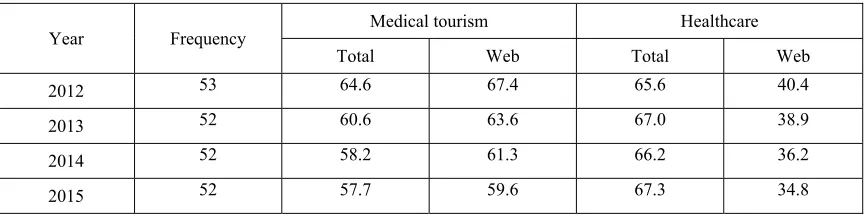
Table 1 shows average amount of the search by year where the total includes searches by the type of contents, such as, web, image, and YouTube, with the score 100 for the highest week. In terms of medical tourism, the highest average search traffic was in the year of 2012, with relatively high volume coming through the web. And in the area of healthcare, it was the 2015 that showed the highest average search traffic. But in the case of web area, it was 2012 that generated the highest level of search traffic.
Table 1 shows average annual volumes of keyword searches.
[image:2.612.91.524.291.398.2]The data was collected for the period of 4 years from January 2012 to December 2015.
Table 1: Average of Search Volume by Year
Year Frequency Medical tourism Healthcare
Total Web Total Web
2012 53 64.6 67.4 65.6 40.4
2013 52 60.6 63.6 67.0 38.9
2014 52 58.2 61.3 66.2 36.2
2015 52 57.7 59.6 67.3 34.8
2.2 Measurement
The operant definition of keyword search volume is defined as the size of expansion of keyword search in healthcare. Thus the dependant variable is the size of keyword searches in ‘medical tourism’ and ‘healthcare’. The factors affecting the size of the expansion of the keyword search are assumed to be the quantity and quality of the contents of a specific keyword. Therefore, the independent variable is defined as the quantity of contents search by its category.
Table 2 shows the items for the dependent variables and the independent variables.
The dependent variables is divided into total variable which considers all forms of related
keywords and the other variable which considers only the web form. And this is for aggregate analysis of all the other forms of contents than web contents because the other forms contents are small enough for aggregate analysis compared to the web contents. On the other hand, 12 types of variables are used as the independent variables which reflect functional nature of the contents, such as health, finance, book, beauty, biz, government, sports, food, travel, community, social and hobby.
Table 2: Definition of Variables
Variable Definition
Dependent Variables
Total Search volume of keyword: Total parts (web, image, video, etc.)
Web Search volume of keyword: Web part
Predictor Variables
Health Search volume of keyword: Type of “health”
Finance Search volume of keyword: Type of “finance”
1724
2.3 Research Model
To investigate the effect of the content category on the expansion of the healthcare, hierarchical liner regression is employed based on the following model [12-13].
And the effects on the expansion are investigated in the steps.
St = ɑ + ßXit (1)
St = ɑ + ßXit + ɣYit (2)
St = ɑ + ßXit + ɣYit + ɤZit (3)
Where, St is search volume of keyword at
time t, Xit, Yit, Zit are search volume of its keyword
in category i at time t. And ß, ɣ, ɤ are parameters to estimate with hierarchical linear regression model.
3. RESULTS
3.1 Statistics of Variable
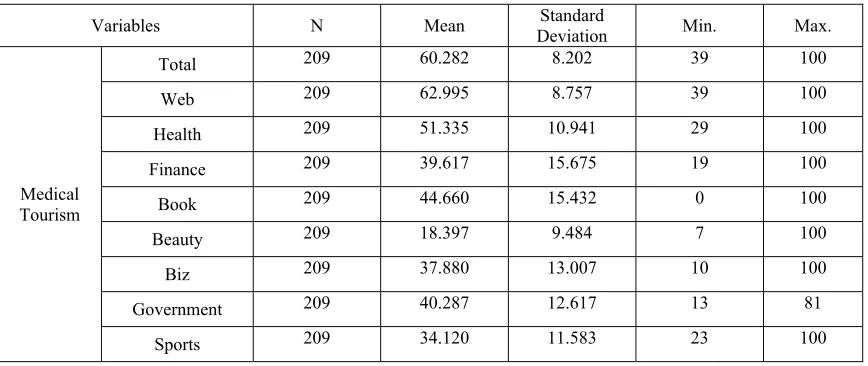
The findings of basic statistical analysis of the data collected are exhibited in the Table 3. That is, according to the findings of the analysis of the data of the 209 weeks, the highest dependent variable in the area of the medical tourism keywords was web type (M=62.995, STD=8.757) and the next highest one was total type (M=60.282, STD=8.202). Of the independent variables, the highest one was social variable (M=57.584, STD=15.849) and the next highest ones were the travel (M=52.426, STD=8.726), healthcare (M=51.353, STD=10.941) and the other variables, respectively.
[image:3.612.91.525.545.728.2]In the healthcare keywords, the highest dependent variables was the total variable (M=66.526, STD=6.623), whereas the order for the independent variables was the beauty (M=80.407, STD=7.170), biz (M=79.282, STD=6.870), sports (M=70.646, STD=9.057), food (M=69.110, STD=7.517), etc, respectively.
Table 3: Characteristic of Statistical Variable
Variables N Mean Deviation Standard Min. Max.
Medical Tourism
Total 209 60.282 8.202 39 100
Web 209 62.995 8.757 39 100
Health 209 51.335 10.941 29 100
Finance 209 39.617 15.675 19 100
Book 209 44.660 15.432 0 100
Beauty 209 18.397 9.484 7 100
Biz 209 37.880 13.007 10 100
Government 209 40.287 12.617 13 81
Sports 209 34.120 11.583 23 100
Beauty Search volume of keyword: Type of “beauty & fitness”
Biz Search volume of keyword: Type of “business & industry”
Government Search volume of keyword: Type of “government”
Sports Search volume of keyword: Type of “sports”
Food Search volume of keyword: Type of “food & beverage”
Travel Search volume of keyword : Type of “travel”
Community Search volume of keyword: Type of “online community”
Social Search volume of keyword: Type of “group & social”
1725
Food 209 28.904 10.320 20 100
Travel 209 52.426 8.726 33 100
Community 209 40.129 15.200 0 100
Social 209 57.584 15.849 24 100
Hobby 209 32.885 12.762 20 100
Healthcare
Total 209 66.526 6.623 39 100
Web 209 37.612 6.794 21 100
Health 209 64.254 6.666 36 100
Finance 209 62.751 9.149 41 100
Book 209 62.885 11.849 31 100
Beauty 209 80.407 7.170 46 100
Biz 209 79.282 6.870 46 100
Government 209 38.737 7.248 19 100
Sports 209 70.646 9.057 34 100
Food 209 69.110 7.517 44 100
Travel 209 73.933 7.389 43 100
Community 209 71.077 10.225 37 100
Social 209 47.502 7.778 24 100
Hobby 209 78.847 7.213 49 100
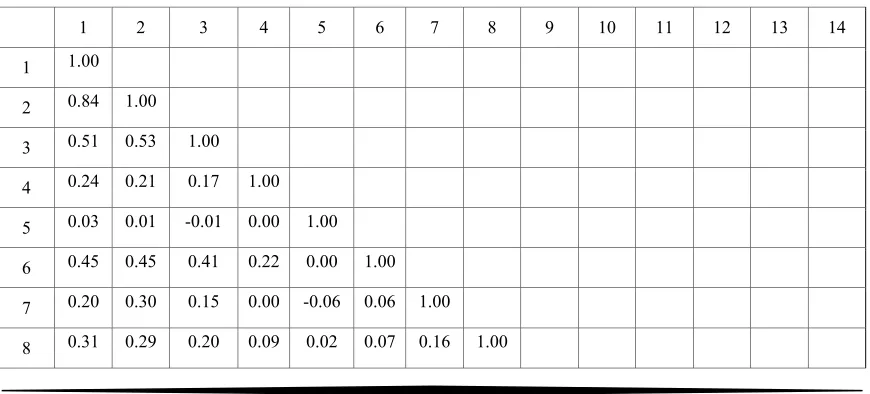
The correlations among the variables in the area of the medical keywords are exhibited in the Table 4. The findings of the analysis are as follows: The correlation between the dependent variable and independent appeared to be relatively high, whereas correlations between the independent variables are relatively low. It was, therefore, concluded that there was no issue of
[image:4.612.90.525.549.746.2]multicollinearity correlation among the independent variables. And the descending order of the items for the correlations between the dependent variables and independent variables was travel(r=0.75, p<0.01), health(r=0.53, p<0.01), beauty(r=0.45, p<0.01), the others, respectively.
Table 4: Correlation between Variables in Medical tourism
1 2 3 4 5 6 7 8 9 10 11 12 13 14
1 1.00
2 0.84 1.00
3 0.51 0.53 1.00
4 0.24 0.21 0.17 1.00
5 0.03 0.01 -0.01 0.00 1.00
6 0.45 0.45 0.41 0.22 0.00 1.00
7 0.20 0.30 0.15 0.00 -0.06 0.06 1.00
1726
9 0.22 0.21 0.24 0.08 0.06 0.15 0.13 0.02 1.00
10 0.26 0.31 0.30 0.08 0.01 0.02 0.19 0.14 0.18 1.00
11 0.75 0.71 0.41 0.18 -0.01 0.41 0.20 0.25 0.19 0.19 1.00
12 0.27 0.26 0.24 0.06 -0.05 0.07 0.09 0.16 0.14 0.25 0.15 1.00
13 0.32 0.37 0.16 0.05 0.12 0.08 0.10 0.32 0.00 0.21 0.23 0.09 1.00
14 0.21 0.16 0.17 0.00 0.07 0.04 0.14 0.01 0.23 0.24 0.10 0.17 0.11 1.00
1=Total, 2=Web, 3=Health, 4=Finance, 5=Book, 6=Beauty, 7=Biz, 8=Government, 9=Sports, 10=Food, 11=Travel, 12=Community, 13=Social, 14=Hobby
And the correlations between the healthcare keywords are presented in the table 5. The analysis is that correlations between the dependent variables and independent variables appeared to be at least 0.8(p<0.01), which is very high, whereas the correlations between the
independent variables appeared to be higher than the medical tourism keywords. So it is deemed necessary to check the issue of multicollinearity correlations among the predictors.
Table 5: Correlation between Variables in Healthcare
1 2 3 4 5 6 7 8 9 10 11 12 13 14
1 1.00
2 0.82 1.00
3 0.98 0.83 1.00
4 0.76 0.42 0.71 1.00
5 0.58 0.65 0.57 0.28 1.00
6 0.60 0.47 0.59 0.33 0.41 1.00
7 0.72 0.58 0.68 0.32 0.57 0.62 1.00
8 0.88 0.89 0.90 0.65 0.51 0.40 0.45 1.00
9 0.69 0.58 0.68 0.37 0.40 0.48 0.64 0.54 1.00
10 0.70 0.53 0.70 0.64 0.34 0.36 0.39 0.68 0.45 1.00
11 0.57 0.50 0.55 0.20 0.31 0.55 0.66 0.39 0.53 0.29 1.00
12 0.56 0.46 0.57 0.37 0.34 0.39 0.48 0.46 0.44 0.33 0.32 1.00
13 0.90 0.86 0.92 0.70 0.52 0.41 0.47 0.98 0.55 0.70 0.38 0.48 1.00
14 0.69 0.58 0.68 0.51 0.45 0.43 0.53 0.60 0.55 0.51 0.44 0.43 0.63 1.00
1=Total, 2=Web, 3=Health, 4=Finance, 5=Book, 6=Beauty, 7=Biz, 8=Government, 9=Sports, 10=Food, 11=Travel, 12=Community, 13=Social, 14=Hobby
3.2 Result of Empirical Test
1727 the study, hierarchical linear regression analysis is employed and the findings are exhibited in the Table 6 and Table 9.
First of all, medical tourism adoption is looked into with Model 1 from the total variable perspective, and it is observed that the variables that had significant effects on the adoption are Health (ß=0.177, p<0.01), Travel (ß=0.581, p<0.01), and Social (ß=0.074, p<0.01), in particular the travel item has the biggest effect. The findings of the model are that all the additional variables of beauty (ß=0.108, p<0.1),
community (ß=0.058, p<0.1) and hobby (ß=0.055, p<0.1) have significant effects on the adoption. And with the model 3, it appeared that only the government (ß=0.049, p<0.1) variable among the additional variables has significant effect on the adoption.
[image:6.612.89.524.253.453.2]The implication of the conclusion of the analysis is that the exposure of the contents in the categories of travel, healthcare and beauty is important for the expansion of the total medical tourism.
Table 6: Medical Tourism Adoption in Total
Predictor variables Model 1 Model 2 Model 3
Health 0.177** 0.123** 0.113**
Travel 0.581** 0.539** 0.522**
Social 0.074** 0.070* 0.060**
Beauty 0.108* 0.104*
Community 0.058* 0.052*
Hobby 0.055* 0.060*
Finance 0.035
Government 0.049*
R2 0.629 0.659 0.669
R2 change 0.629 0.03 0.01
*P<0.1, **P<0.01
The Table 7 is the findings of medical tourism adoption from the web perspective. The analysis with the model 1 shows that the variables that have significant effects on the adoption are Health (ß=0.214, p<0.01), Travel (ß=0.553, p<0.01), Social (ß=0.112, p<0.01), and the travel variable has the biggest effect like with the total variable. In the case of model 2, the additional variables Beauty (ß=0.129, p<0.01), Biz (ß=0.096, p<0.01) all appear to have effects on the adoption. With model 3, it is both the additional variables
Food (ß=0.066, p<0.1) and Community (ß=0.056, p<0.1) that has significant effect on the adoption.
[image:6.612.91.523.612.719.2]The implication of the findings is that it is important to expose the contents in the categories of travel, health, social and beauty for the expansion of medical tourism. Especially in the case of the web, a responsive measure is necessary for social category which deals with relationships among consumers.
Table 7: Medical Tourism Adoption in Web
Predictor variables Model 1 Model 2 Model 3
Health 0.214** 0.173** 0.139**
Travel 0.553** 0.488** 0.478**
Social 0.112** 0.111** 0.102**
Beauty 0.129** 0.143**
1728
Food 0.066*
Community 0.050*
R2 0.605 0.638 0.652
R2 change 0.605 0.033 0.014
*P<0.1, **P<0.01
In terms of total healthcare adoption, the finding of model 1 is that the variable health (ß=0.754, p<0.01), finance (ß=0.126, p<0.01), biz (ß=0.139, p<0.01) all have significant effect on the healthcare adoption. In particular, the Health variable appears to be the biggest influence. With model 2, the additional variables government (ß=0.133, p<0.01), travel (ß=0.039, p<0.01) had significant effects on the adoption. And in the case of the model 3, the variables book (ß=0.015,
p<0.1) and sports (ß=0.031, p<0.01) among the additional variables appear to have significant effects.
[image:7.612.90.524.317.515.2]So it can be concluded from the finding that the contents exposure in the categories of health, finance, biz, government is important for the expansion of healthcare in terms of the total variable.
Table 8: Healthcare Adoption in Total
Predictor variables Model 1 Model 2 Model 3
Health 0.754** 0.563** 0.515**
Finance 0.126** 0.143** 0.151**
Biz 0.139** 0.169** 0.146**
Government 0.133** 0.138**
Travel 0.039** 0.038**
Beauty 0.015
Book 0.015*
Sports 0.031**
R2 0.982 0.986 0.987
R2 change 0.982 0.003 0.001
*P<0.1, **P<0.01
Lastly, the findings from web perspective for healthcare adoption are exhibited in the Table 9.
Model 1 shows that the variables finance (ß=-0.188, p<0.01), Book (ß=0.143, p<0.01), government (ß=0.875, p<0.01) had significant effect on the adoption. In particular, the government appears to be the biggest effect. In model 2, the additional variables biz (ß=0.132, p<0.01), travel (ß=0.061, p<0.1), social (ß=-0.036, p<0.01) have significant effect on the adoption.
And under the model 3, the additional variables health (ß=-0.232, p<0.1), sports (ß=0.045, p<0.1) and food (ß=-0.062, p<0.1) have significant effects.
A conclusion derived from the analysis is that the contents exposure in the category of government is especially important and it also implies that contents management is necessary for the categories of finance, book, biz and health.
Table 9: Healthcare Adoption in Web
Predictor variables Model 1 Model 2 Model 3
Finance -0.188** -0.166** -0.128**
1729
Government 0.875** 1.128** 1.143**
Biz 0.132** 0.159**
Travel 0.061* 0.063*
Social -0.306** -0.181
Health -0.232*
Beauty 0.039
Sports 0.045*
Food -0.062*
R2 0.889 0.913 0.919
R2 change 0.889 0.024 0.006
*P<0.1, **P<0.01
In previous research, researchers explored insights by keyword analysis of literature [14]. Or qualitative content analysis [15], systematic review and meta-analysis [16], efficiency and productivity [14, 17-18], and health care failure mode and effect analysis [19] were searched.
This study is an empirical study that examines the effect of content types on healthcare diffusion through hierarchical modelling.
First, previous studies [17] examined the between effects of keywords related to the healthcare industry. In this study, however, we examined the within effects of keywords related to the healthcare industry. As a result, it was found that there are effects by type within the keyword. It is not only important to include relevant keywords in managing a specific keyword, but it is also important to manage the keyword itself.
Second, in this study, we tried to grasp hierarchical effects by classifying content types into clusters. As a result, the effect of diffusion on the type cluster was differentiated. In other words, there was a type cluster with relatively large effect on diffusion, while a small type cluster with relatively small effect was also present. This suggests that companies are more efficient when they are more focused on key content type clusters in managing specific keywords.
Therefore, this study is different from previous researches in research methods and research results.
4. CONCLUSIONS
In this study, factors affecting consumer keyword searches are looked into from the perspective of online contents, thus extending existing studies on the effect of keyword
categories [17-18] to investigate behavioral patterns though online big data which reflect consumer desire, in contribution to the development of the healthcare sector.
To this end, text mining-based search volume provided by Google is analyzed and the effects of content search by category on consumer adoption of the healthcare are investigated with hierarchical modeling. As for the adoption of the healthcare, the analysis is carried out in two different ways, total which includes all types of contents such as web, image, and YouTube and the other way where the web contents are separated from the other contents. And this is because the volume of the other types of contents than web contents is comparatively small enough for aggregate analysis.
The findings are as follows:
First, the content categories that affect the total medical tourism adoption are health, travel, social, beauty, community, hobby, and government. In particular, the effects of travel, health, and beauty appear to be large. And this implies that the exposure of contents in the categories of travel, health, beauty is important in promoting the adoption of total medical tourism.
1730 Third, major categories that affect the total healthcare adoption appear to be health, finance, biz and government. Thus it tells that contents exposure in the categories of health, finance, biz and government is important in promoting the adoption of total healthcare.
Fourth, the categories that affect the adoption of web healthcare are fiancé, book, and government contents; in particular, the government category is the biggest effect. The influence of biz, travel, social and health is also confirmed even though it is not big. And this implies that content exposure in the government category is particularly important and the management of finance, book, biz, health categories is necessary. This study provides an important point in terms of content category, in promoting consumer adoption of healthcare by analyzing big data based on consumer online search, but it has limitation that it does not consider industry characteristics and consumer characteristics when selecting keywords that represent respective fields. Therefore, more detailed efforts to reflect their representativeness will be necessary in the future researches.
REFRENCES:
[1] J. N. Goodrich, “Health-care tourism - an exploratory study,” Tourism Management, Vol.
8, No. 3, 1987, pp. 217-222.
[2] Horowitz, Michael D., Jeffrey A. Rosensweig, and Christopher A. Jones, “Medical tourism: globalization of the healthcare marketplace,” Medscape General Medicine ,
Vol. 9, No. 4, 2007, pp. 33.
[3] Herrick, Devon M. “Medical tourism: Global competition in health care,” National Center
for Policy Analysis (NCPA), Policy
Report, Vol. 304, 2007, pp. 19-20.
[4] J. Connell, “Medical tourism: Sea, sand, and surgery,” Tourism Management, Vol. 27, No. 6,
2006, pp. 1093-1100.
[5] C. M. Hall, Adventure, Sport, and Health Tourism, In B Weiler & C. M Hall(Ed). Special-Interest Tourism, Bellhaven Press, London, 1992.
[6] E. Law, Health and the International Tourist, Health Tourism: A Business Opportunity Approach. Ins, Cliff & S. J. Page(eds.), London: Routledge, 1996.
[7] Raja, Uzma, Tara Mitchell, Timothy Day, and J. Michael Hardin, “Text mining in healthcare. Applications and opportunities,” J Healthc Inf
Manag , Vol. 22, No. 3, 2008, pp. 52-6.
[8] Lim, Tong-Ming, and Angela Siew Hoong Lee, “Mining “What they talk about” for a Private Healthcare Service Provider,” Archives of
Business Research, Vol. 5, No. 5, 2017.
[9] Cole-Lewis, Heather, Jillian Pugatch, Amy Sanders, Arun Varghese, Susana Posada, Christopher Yun, Mary Schwarz, and Erik Augustson, “Social listening: a content analysis of e-cigarette discussions on Twitter,” Journal
of medical Internet research, Vol. 17, No. 10,
2015.
[10] Powell, Gregory E., Harry A. Seifert, Tjark Reblin, Phil J. Burstein, James Blowers, J. Alan Menius, Jeffery L. Painter et al., “Social media listening for routine post-marketing safety surveillance,” Drug safety, Vol. 39, No.
5, 2016, pp. 443-454.
[11] Anderson, Laurie S., Heidi G. Bell, Michael Gilbert, Julie E. Davidson, Christina Winter, Monica J. Barratt, Beta Win et al., “Using Social Listening Data to Monitor Misuse and Nonmedical Use of Bupropion: A Content
Analysis,” JMIR Public Health and
Surveillance, Vol. 3, No. 1, 2017.
[12] McNeish, Daniel, Laura M. Stapleton, and Rebecca D. Silverman, “On the unnecessary ubiquity of hierarchical linear modeling,” Psychological Methods, Vol. 22,
No. 1, 2017, pp.114-140.
[13] Vaughn, Brandon K., “Data analysis using regression and multilevel/hierarchical models, by Gelman, A., & Hill, J.,” Journal of
Educational Measurement, Vol. 45, No. 1,
2008, pp. 94-97.
[14] Emrouznejad, A., Parker, B. R., & Tavares, G., “Evaluation of research in efficiency and productivity: A survey and analysis of the first 30 years of scholarly literature in DEA,”
Socio-economic planning sciences, Vol. 42, No.
3, 2008, pp. 151-157.
[15] Elo, S. and Kyngäs, H., “The qualitative content analysis process,” Journal of advanced
nursing, Vol. 62, No. 1, 2008, pp.107-115.
[16] Royal, S., L. Smeaton, A. J. Avery, B. Hurwitz, and A. Sheikh, “Interventions in primary care to reduce medication related adverse events and hospital admissions: systematic review and meta-analysis,” Quality and Safety in Health Care, Vol. 15, No. 1, 2006, pp. 23-31.
1731 [18] Moon, J. and J. Hong, “The Differential Effect
of Keywords on Content Type in Medical Tourism,” International Conference on Computing Convergence and Applications 2017(August), Saipan, USA, 2017.
[19] Van Tilburg, C. M., I. P. Leistikow, C. M. A. Rademaker, M. B. Bierings, and A. T. H. Van Dijk, “Health care failure mode and effect analysis: a useful proactive risk analysis in a pediatric oncology ward,” Quality and Safety