Predictive Modelling of Heavy Metal-Metal Interactions
in Environmental Setting: Laboratory
Simulative Approach
Ezeonyejiaku Chigozie Damian
1, Obiakor Maximilian Obinna
2,*, Okonkwo Chidumeje Ndidi
21Department of Zoology, Nnamdi Azikiwe University Awka, Anambra Nigeria
2School of Environmental and Rural Science, University of New England, Armidale, NSW, 2351, Australia
*Corresponding Author: [email protected]
Copyright © 2014 Horizon Research Publishing All rights reserved.
Abstract
Aquatic ecosystem pollution by heavy metals is a global problem and requires proactive measures and techniques in tackling the scourge. Exposure to multiple contaminants in water environment now displaces the single action of pollutants and creates a challenge for complex mixture contact management. Heavy metals at individual low acting concentrations can elicit higher toxicity on interactions with other environmental toxicants. In this study,Clarias gariepinus was exposed to the mixture of zinc and copper at predetermined ratio of 1:1 and 1:2 based on 96hLC50 index and binary interactive dynamics of the two metals calculated using the synergistic ratio model. Following the exposure, the 9hLC50 values were 84.683 mg/l and 45.875 mg/L for ratios 1:1 and 1:2, respectively. Physiological responses such as rapid opercula movement, frequent gulping of air and neurological symptoms like jerking movements, frightening and loss of balance were observed throughout the experimental period. There were antagonistic and synergistic reactions between the metals at the two combinatorial ratios. Antagonism occurs when the metals were mixed at the ratio of 1:1 and synergism at the ratio of 1:2. We therefore recommend that joint action toxicity of metals should be taken into consideration in fixing environmental safe limits for heavy metals in order to have a complete protection of aquatic ecosystems.
Keywords
Joint action, Toxicity, Antagonism, Synergism, Clarias gariepinus, Synergistic ratio model1. Introduction
Extensive uses of metals, the legacies of past contamination and new technologies continue to pose an important ecological risk in aquatic environment[1]. Metals such as Cu, and Zn are released from natural sources as well as human activities and impact of these metals to the environment is an increasing problem worldwide [2].
In recent years, toxicological studies have gained a fresh momentum and have emerged as a major field of research owing to the magnitude of the position and growing diversity of aquatic pollutions [3]. Assessment of toxicity on particular organisms exposed to a particular toxicant will reveal facts regarding the health of given ecosystem and would eventually help us to propose policies to protect the ecosystem. Toxicity tests will reveal the organism’s sensitivity to a particular toxicant that would help us to determine the permissible limit of a toxicant in an ecosystem [3].Although aquatic organisms are usually exposed to an expansive spectrum of toxicants in the environment, water quality criteria are generally derived from single action toxicity only, neglecting possible joint effects as synergism, antagonism and additivity[4]. Predicting environmentally safe limits from single toxicity assays however is highly debatable as the occurrences of interactive effects among the constituents of metal mixtures, both in a positive and negative sense has been reported [5].
A potential threat for aquatic organisms is contamination arising from being exposed to significant amounts of heavy metals, which at high concentrations can cause harmful effects on metabolic, physiological and biochemical systems of fishes together with long term ecotoxicological effects [6]because toxicity studies quantify an organism’s response to a biologically active material [7] and are useful in determining water quality criteria. It is therefore fundamental to restore and resolve metal pollution through environmental monitoring. Fish absorb dissolved or available metals and can, therefore, serve as reliable indication of heavy metal contamination in an aquatic ecosystem. This study was therefore designed to investigate the acute joint actiontoxicity of zinc and copper on the local and aqua-cultural test fish species Clarias gariepinus
2. Materials and Methods
2.1. Collection of test organisms and acclimatization to laboratory conditions
Healthy fingerlings of Clarias gariepinus with an average weight of 3.4g were collected from a commercial fish farm. The reason for the choice of the farm was based on whether their water quality are monitored regularly and shielded from the full impacts of pollutants and their fish species are of known stock history. It is often preferred to use such fish species in culture for toxicological bioassays, since those from the wild, where the medium is contaminated may have acquired increased tolerance to pollutants over years of exposure to sublethal concentrations. Procured fish samples were transported to the laboratory in oxygenated plastic container and kept in holding tanks of about 40-litre capacity filled with dechlorinated tap water for fifteen days to allow them acclimatize to laboratory conditions. The aquaria were aerated and the fish were fed with commercial feed pellets twice a day during the acclimatization period. Water was changed on daily basis and the process stopped and switched to static system on commencement of the 96h toxicity experimental demonstrations. The fish were not fed during the 96h experimental period. Care was taken to keep the mortality rate of fish not more than 5% in the last four days before the experiment started. Twenty fish were randomly distributed to 500ml test vessels for the bioassay per toxicant concentration of two replicates and control.
2.2. Test chemicals
Chemically pure salts of zinc sulphate (ZnSO4 .7H20) and Copper sulphate (CuS04.5H20) used as toxicants were procured and mixed in the ratio of 1:1 and 1:2. Mixtures of these metals were done in equitoxic concentrations following their toxicity index values of 96hLC50. The metals were in the same levels of its single action concentrations (50, 60, 70, 80, 100mg/l)for both copper and zinc.
2.3. Single Action toxicity of Copper and Zinc
Since this paper is a follow-up of our earlier studies of 2011 on the single action toxicity of zinc and copper, the96hLC50valuesof the two chemicals observed were as follow: zinc – 78.178mg/l and copper 70.135mg/l[8, 9].
2.4. Joint action toxicity test of binary mixture of zinc and copper
A predetermined volume of each chemical was mixed together in the ratio of 1:1 and 1:2. These were taken as stock solutions and serially diluted with dechlorinated tap water.
2.5. Assessment of quantal response (mortality)
Fish were considered dead when there was a lack of both
opercula and body movements on prodding with a glass rod [10].
2.6. Physicochemical analysis
Physiochemical parameters (pH, dissolved oxygen and temperature, hardness)of the test media used in the experiment were measured following the procedure of APHA [11].
2.7. Statistical analysis
Assessment of mortality response of the binary heavy metal exposures of the test species was determined by the use of Finney’s Probit Analysis LC50 Determination Method [12] and test of significance achieved by Chi-square at an alpha error of 0.05.Joint action toxicity data were analyzed based on synergistic ratio (S.R) model after Hewlett and plackett[13]:
S.R=LCLC50 of a chemical acting alone 50 of chemical + additive mixture Interpretation of results;
S. R =1, defines additivity S.R<1, defines antagonism S.R> 1, defines synergism.
Toxicity factor, TF (this is used to measure the relative potency ratios) was calculated using the formula below:
TF=LCLC50 of a compund X 50 of another compound Y
3. Results
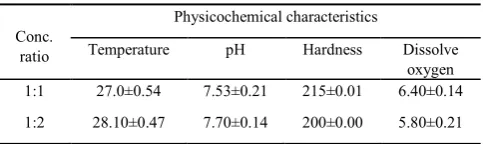
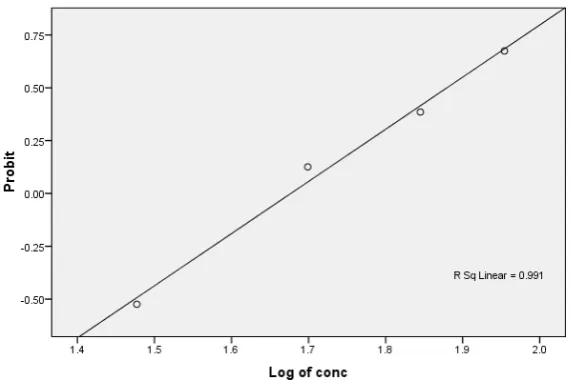
The selected physicochemical parameters measured in the aquaria for the toxicity testing of the fish are shown in Table 1 while Table 2 presents the mortality response of the test species to the two combination ratios of zinc and copper on exposure. Table 3provides the relative joint acute toxicity of two ratios of mixtures for zinc and copper to Clarias gariepinus and Figures 1 and 2 displaying the probit line graphs of the Zn:Cu acute toxicity. In both ratios of the metals, the 96hLC50 values were not significant.
[image:2.595.312.554.680.752.2]There was synergism in the mixture at 1:2 ratio for both metals and antagonism for both metals at the ratio of 1:1 (Table 4) when the results were compared with the single action LC50 values of the metals when acting alone [8, 9].
Table 1. The mean values of the physicochemical parameters of the aquaria for the joint action toxicity of zinc and copper at the ratio of 1:1 and 1:2.
Conc. ratio
Physicochemical characteristics
Temperature pH Hardness Dissolve
oxygen
1:1 27.0±0.54 7.53±0.21 215±0.01 6.40±0.14
Table 2. Mortality response of Clarias gariepinus (cells counts and residuals)to the two combination ratios of zinc and copper after 96h exposure
Number Concentration Number of
subjects Observed responses Expected responses Residual Probability
Zn:Cu 1:1
PROBIT 1 1.699 20 3 3.957 -0.957 0.198
2 1.845 20 9 7.589 1.411 0.379
3 1.954 20 11 10.782 0.218 0.539
4 2.000 20 12 12.113 -0.113 0.606
5 2.176 20 16 16.433 -0.433 0.822
Zn:Cu1:2
PROBIT 1 1.477 20 6 5.355 0.645 0.268
2 1.699 20 11 11.000 0.000 0.550
3 1.845 20 13 14.625 -1.625 0.731
4 1.954 20 15 16.745 -1.745 0.837
[image:3.595.170.447.304.499.2]5 2.000 20 20 17.444 2.556 0.872
[image:3.595.164.450.544.735.2]Figure 1. Probit line graph of joint acute toxicity of the mixture of zinc and copper at ratio of (1:1) to Clarias gariepinus.
Table 3. Relative 96hLC50 joint acute toxicity of two ratios of mixtures for
zinc and copper to Clarias gariepinus
Zn: Cu 96hLC50 (mg/l) S.E Toxicity Factor
(TF)
1:1 84.683 (70.098-101.336) 1.749 1.85
1:2 45.875 (33.744-55.406) 1.338 1.00
S.E: standard error
Table 4. Synergistic ratios (S.R) of the binary action toxicity of Zn:Cu compared to toxicity of their single actions
Concentration ratio 96hLC50 (mg/l) Synergistic ratio
1:1 84.683 Zn 0.923
Cu 0.828
1:2 45.875 Zn 1.704
Cu 1.529
4. Discussion
Acute toxicity test is an essential tool in assessment of biological effects of chemical toxicants both in the laboratory and field, and is also crucial to evaluate the potential toxicological effect of toxicants on living organisms [14]. The most widely adopted technique for short term bioassay is the evaluation of a median tolerance limit 96hLC50. It is generally applied to determine the toxicity levels of xenobiotic materials to various aquatic organisms under laboratory conditions. The toxicity tests are necessary to predict the safe concentrations of the chemicals in the environment [15].In the current work, observations were made on the mortality responses of Clarias gariepinus to different ratios of zinc and copper on exposure. However, the exposed fish showed suffocating tendency throughout the experimental period. Fish are exclusively confined to the aquatic habitats and constitute the group most vulnerable to heavy metal toxicity [3]. There were physiological responses like frequent gulping of air and rapid opercula movement exhibited by the exposed fish during the trial demonstrations. Neurological symptoms like jerking movements, frightening and loss of balance were also witnessed. These reactions to the metal exposure confirm toxicity not to be merely confined to systemic but could trigger other biological responses as the organisms strive to compensate the bio-compromise.
On classification of the interactions between zinc and copper based on synergistic ratio model after Hewlett and Placekett[13], there were antagonistic and synergistic reactions. Antagonism was observed in this study at the ratio of 1:1 against the test animals. According to Bryan and Gibbs [16], the mechanism responsible for antagonistic interaction between constituent metal components in a mixture can be attributed to the competition for uptake /binding sites in the biological interface between the various types of metals. A well-documented example of such complexation reaction between metal ions in mixture is that involving mercury and selenium [17]. In this instance,
selenium was observed to antagonize the toxic effects of mercury by reacting at the cellular level with mercury to form mercury selanide (Hgs) which is easier for the organisms to excrete, thereby reducing or eliminating mercury effect and burden in the tissues of the exposed organisms. Antagonistic interaction mixture of pollutants Zn: Cu in this study where it exists could be an advantage in environmental management. Antagonism implies that there is interaction between the constituents which result in the lowering of one or all the constituent of mixtures against the living species. Observation of synergism was at the ratio of 1:2 against the test animals. The observations could theoretically be placed that the metals formed complexes, which may have greater penetrability with respect to the tissues of the exposed animals than the individual metals acting alone and in such instances, the resultant toxicity of the mixture could be higher than the toxicity of the individual metals acting alone. Certain concentrations of heavy metals apparently considered to be minimal and of little effect could elicit more toxicity on mixture with other chemicals and/ or substances. This trend was traceable in the current work. Correspondingly, basis on synergism annotations, it will be more realistic and effective to take into consideration toxicity levels of mixture of pollutants that occurs together in a local ecosystem and not just levels of single action toxicity of individual pollutants in deriving safe limits, standard aimed at protecting organisms in the environment.
REFERENCES
[1] Luoma, N. & Rainbow, P. S., 2008. Metal contamination in aquatic environment. Science and lateral management New York, NY, USA: Cambridge University Press.
[2] Shuhaimi-Othman, M., Nadzifah, Y. &Ahmad, A.K., 2010. Toxicity of copper and cadmium to freshwater fishes. World Academy of Science, Engineering and Technology 4, 714-716.
[3] Mary, J. R.,Johmilton M. C., Uthiralingam M. &Azhaguraj R., 2011. Acute toxicity of mercury and chromium to Clarias
batrachus (Linn). Bioresearch Bulletin 1, 104 – 108.
[4] Verslycke, T., Vangheluwe, M., Heijerick, D., De Schamphelaere, K., Van Sprang, P., & Janssen, C. R., 2003. The toxicity of metal mixtures to the estuarine mysid Neomysis integer (Crustacea: Mysidacea) under changing salinity. Aquatic Toxicology 64, 307-315.
[5] Vranken, C. &Tire C. H., 1988. The toxicity of paired metal mixtures to the nematode Monhystera disjuncta (Bastian, 1865). Marine Environmental Research 26, 161 – 179. [6] Strmac, M. &Braunbeck, T., 2000. Isolated hepatocytes of
rainbow trout (Oncorhynchus mykiss) as a tool to discriminate between differently contaminated small river systems. Toxicology In vitro 14, 361-377.
[image:4.595.56.299.194.269.2]33-9.
[8] Ezeonyejiaku, C.D., Obiakor, M. O&Ezenwelu, C.O., 2012. Lethal influence of zinc exposure to Clarias
gariepinus(Burchell, 1822, Pisces, Clariidae). Journal of
Animal Science Advances 2, 177-183.
[9] Ezeonyejiaku, C.D., Obiakor, M.O. &Ezenwelu, C.O., 2011. Toxicity of copper sulphate and behavioural locomotor response of tilapia (Oreochromis niloticus) and catfish
(Clarias gariepinus) species. Online Journal of Animal and
Feed Research 1, 130-134.
[10] Reish, D. L. &Oshida, P. S., 1986. Manual of methods in aquatic environment research Part 10 – short term static bioassays. FAO Fisheries Technical Paper 247.
[11] APHA (American Public Health Association), 1995. Standard methods for the examinations of water and wastewater, 16th Ed. American Public Health Association. APHA. Am. Water works Assoc, and water pollution .Control Fed, Washington DC.
[12] Finney, D.J., 1971. Probit analysis. Cambridge University
Press, New York, 337.
[13] Hewlett, P. S. &Plackett, R. L., 1959. A unified theory for quantal responses to mixtures of drugs: non-interactive action. Biometrics 15, 591-610.
[14] Rand G.M &Petrocelli, S.R., 1985. Fundamentals of Aquatic Toxicology: Methods and Applications. Hemisphere Publishing Corporation, New York
[15] Johnson R. D. & Bergman H. L., 1983. Use of histopathology in aquatic toxicology – a critic. in: contaminant effects on fisheries (Eds): Chaims V. W., Hadson P. V. and Nriagu, J. O. 19 – 36.
[16] Bryan, G.W. & Gibbs, P.E., 1983. Heavy metals in the Fal estuary, Cornwall: A study of long term contamination by mining waste and its effects on estuarine
organisms. Occasional Publications. Marine Biological
Association of the United Kingdom (2) 112p.