RECEIVER BANDWIDTH ENHANCEMENT DESIGN FOR HIGH SPEED OPTICAL SYSTEM
INTAN SHAFINAZ BINTI MOHAMMAD
A project report submitted in partial fulfilment of the requirement for the award of the
Degree of Master of Electrical Engineering
Faculty of Electrical and Electronic Engineering Universiti Tun Hussein Onn Malaysia
ABSTRACT
ABSTRAK
Teknologi sistem gentian optik kini semakin berkembang pesat dari hari ke hari. Selaras dengan perkembangan sistem komunikasi jarak jauh yang mencapai kadar data gigabit per saat dalam komunikasi serantau, sistem gentian optik kini telah mula menembusi rangkaian kawasan tempatan, saluran video, pengedaran, pengesan dan beberapa teknologi lain secara meluas. Kepelbagaian aplikasi telah menimbulkan pelbagai masalah teknikal dan konflik dalam penerima optik. Penerimaan aras isyarat yang lemah pada penerima hadapan perlu diperbaiki dengan rekaan teknologi yang lebih jitu dan sesuai. Keupayaan penerima boleh dicapai secara optimum bergantung kepada peralatan dan rekabentuk teknik yang digunakan. Projek ini akan mengkaji semula rekabentuk penerima optik menggunakan beberapa kaedah seperti penguat transimpedan asas, penguat transimpedan lata dan penguat transimpedan pelbagai peringkat. Rekabentuk penerima penguat ini disimulasi melalui perisian seperti P-Spice dan Micro-Cap sebelum difabrikasi kepada litar prototaip. Kaedah Penguat
Lata Transimpedan telah mencapai 4.568MHz untuk ‘cutoff frequency’, manakala kaedah Penguat Pelbagai Peringkat telah mencapai 4.4956MHz untuk ‘cutoff frequency’ . Penguat Transimpedan yang dihasilkan menggunakan transistor BJT dan penyambungan lata (cascade connection) serta teknik struktur suapbalik (feedback structure technique), berjaya mencapai objektif untuk meningkatkan kadar jalur lebar penerima hadapan supaya mencapai frekuansi Giga Hertz iaitu 1.189 GHz.
TABLE OF CONTENTS
TITLE i
DECLARATION ii
DEDICATION iii
ACKNOWLEDGEMENT iv
ABSTRACT v
ABSTRAK vi
TABLE OF CONTENTS vii
LIST OF TABLES x
LIST OF FIGURES xi
LIST OF ABBREVIATIONS xiv
LIST OF SYMBOLS xv
LIST OF APPENDICES xvi
CHAPTER 1 INTRODUCTION 1
1.1 Project Background 1
1.2 Problem Statement 2
1.3 Project Objective 3
1.5 Thesis Outline 5
CHAPTER 2 LITERATURE REVIEW 7
2.1 Basic Concept of Fiber Optic System 7 2.1.1 Architecture of Optical front-End 9 2.1.1.1 Low-impedance Voltage Amplifier 10 2.1.1.2 High-impedance Voltage Amplifier 11 2.1.1.3 Transimpedance Amplifier 12
2.2 Gain Bandwidth Product 14
2.3 Transistor Amplifier Analysis and Small Signal Model 15
2.3.1 Hybrid- π Model 16
2.3.1 T Model 18
2.4 Previous Research Review 20
2.4.1 First Review 20
2.4.2 Second Review 22
2.4.3 Third Review 24
2.4.4 Fourth Review 25
2.5 Summary of Previous Research Review 28
CHAPTER 3 METHODOLOGY 29
3.1 Receiver Front-end Amplifier Simulation And Analysis 29 3.2 Cascade Transimpedance Amplifier (TIA)using LMH6642 30 3.2.1 Mathematical Analysis and Simulation Result 31
for Cascade Transimpedance Amplifier (TIA)
3.3 Multiple Stage Gain Transimpedance Amplifier (TIA) 32 Using LMH6642
3.3.1 Mathematical Analysis and Simulation Result 33 for Multiple Stage Gain Transimpedance Amplifier 3.4 Transimpedance Amplifier(TIA) Using BJT Transistor 34
3.4.1 Mathematical Analysis and Simulation Result 35 for Transimpedance Amplifier(TIA) Using
BJT Transistor
3.5 Comparing the Simulation Result 40
CHAPTER 4 HARDWARE FABRICATION & EXPERIMENTAL 41 SETUP PROCESS
4.1 Schematic and Layout Design 41
4.2 Printed Circuit Board (PCB) 42
4.3 PCB Developing Process 43
4.4. Etching Process 44
4.5. Experimental Setup 45
CHAPTER 5 TESTING MEASUREMENT OF DEVELOPED CIRCUIT 46
CHAPTER 6 CONCLUSION AND RECOMMENDATION 50
6.1 Recommendations 51
REFERENCE 52
LIST OF TABLES
TABLE TITLE PAGE
3.1 Summary table for simulation result 42
LIST OF FIGURES
FIGURE TITLE PAGE
1.1 Block diagram of fiber optic system 4
2.1 Block Diagram of a fiber system 8
2.2 Optical Receiver Front-End 10
2.3 AC coupled low-impedance voltage amplifier 11
2.4 High-impedance amplifier 12
2.5 Typical circuit configuration of TIA 13
2.6 The transimpedance feedback amplifier 14
2.7 Simplified response curve where fc1 is negligible 15
(assume to be zero) compare to fcu
2.8 The amplifier circuit with dc source VBE and VCC 17
eliminated (short circuit)
2.9 (a) BJT as a voltage-controlled current source- 18 ( a transconductance amplifier)
(b) BJT as a current-controlled current source- (a current amplifier)
2.10 Hybrid-π Model with the resistance r0 included 19
2.11 (a) BJT as a voltage-controlled current source 20 (b) BJT as a current-controlled current source 20
2.13 Topology of the proposed MA 22
2.14 Topology of the uniform 2-stage CMA 23
2.15 (a) Circuit schematic of C-peaking transimpedance 24 amplifier
(b) Equivalent open-loop circuit of transimpedance 24 amplifier with and without a peaking capacitor.
2.16 Frequency Response of Series-Shunt Bootstrap 26 2.17 The op amp based transimpedance amplifier 27
2.18 Frequency response of the op-amp 28
2.19 Shunt bootstrap photodiode preamplifier 29
2.20 Practical frequency responses of the shunt circuit 29 and standard transimpedance amplifier
3.1 Cascade Transimpedance amplifier using LMH6642 32 3.2 Frequency Response for Cascade TIA circuit 33 3.3 Multiple Gain Stage Transimpedance Amplifiers (TIA) 34 3.4 Frequency Response for Multiple Gain Stage TIA circuit 35 3.5 Transimpedance Amplifier (TIA) Used of BJT transistor 37 3.6 Simplified circuit of TIA usingHybrid-π Model 39
3.7 Simplified circuit of TIA with closed loop 40 3.8 Frequency Response for TIA Used of BJT transistor 41 4.1 PCB layout design of the front-end receiver 43
circuit amplifier.
4.2 UV exposure machine 44
4.3 Developing process 44
4.4 Etching machine 45
4.5 PCB circuit of the proposed front-end receiver amplifier 45
4.6 (a) Signal Generator of 9 kHz- 6 GHz 46
(b) Oscilloscope (c) Power Supply
5.1 (a) input waveform at 100kHz 49 (b) output waveform at 100kHz
5.2 Gain versus frequency response 50
LIST OF ABBREVIATIONS
BW - Bandwidth FSO Free Space Optic
GBW - Gain Bandwidth Product BJT - Bipolar Junction Transistor
Hz - Hertz
LIST OF SYMBOLS
GHz - Giga-Hertz
MHz - Mega Hertz
Rf - Feedback capacitor
Cf - Feedback capacitance
- Upper critical frequency - Lower critical frequency - Output resistance
- Small-signal input resistance between base and emitter (Looking into the emitter)
- Small-signal input resistance between base and emitter (Looking into the base)
- Transconductance
LIST OF APPENDICES
APPENDICES TITLE PAGE
Appendix A1 BFR540 data sheet 56
CHAPTER 1
INTRODUCTION
1.1 Project Background
The emergence of fiber optic and free space optics (FSO) technologies nowadays has made it as a base in the communication field, replacing the electrical transmission medium. This is because of the demand for higher speed and wider bandwidth in a data communication network. If the fiber optic and FSO system had a bad configuration of optical receiver, it will cause the system to be slow, noisy and a lot of disturbance. All potential disturbances and noise can be addressed through the appropriate network design and planning. The weakest signal level is determined at the front-end receiver and it should be improved by appropriate design. The optimum receiver performance can be achieved depends on the devices and design techniques used [1].
This project aims to use Transimpedance Amplifier using BJT transistor with a cascade connection and feedback structure technique, to enhance the bandwidth for front-end receiver, due to successful storey using this technique by various researcher.
1.1 Problem Statements
The weakest front end means that is too noisy and too slow or both. The performance of the optical front end receiver has a significant impact on the overall optical system performance .In order to reduce shot noise in the detector due to ambient light an optical filter is required, whilst the preamplifier should allow shot-noise limited operation. The signal level in an optical receiver is weakest at the front end of the receiver due to the photodetector capacitance. In addition, there are high path loss and background noise in the environment system.
1.2 Project Objectives
The objectives of this project are as follows:
a) To improve front-end receiver performance and enhance the receiver bandwidth.
b) To design the receiver amplifier with the bandwidth enhancement in the range of approximately in Giga hertz using existing Software such as P-spice and Micro-Cap.
c) To develop and fabricate a prototype of the designed receiver amplifier.
1.3 Project Scopes
This project focused on the concept of fiber and wireless optical receiver amplifier communication. The circuit will be designed to meet the objective of having a receiver with bandwidth enhancement capabilities. There are several scopes for this project:
a) The main scope concentrates on this project towards the front-end receiver in a red box, refer to Figure 1.1 below which contains only preamplifier circuit.
b) There are several methods proposed in designing the front-end receiver for this project to improve receiver performance and bandwidth enhancement to perform high gain-bandwidth which are the basic transimpedance amplifier, cascade transimpedance amplifier and multiple gain stage transimpedance amplifier. The simulation results for each technique will be compared where the best performance receiver for wider bandwidth and high gain is chosen to be fabricated as prototype. The proposed design will used of the BJT transistor (BFR540) and amplifier IC(LMH6642).
Figure 1.1: Block diagram of fiber optic system [3]
c) The design of receiver amplifier circuit will be simulate using Micro-cap electronic software and Orcad P-spice.
1.5 Thesis Outline
This thesis presents an overview study of several application techniques on designing a front-end optical receiver to improve the receiver performance and bandwidth enhancement in order to obtain high gain-bandwidth. The summaries of each chapter in this project are as follows:
Chapter 1
The objectives and scopes for this project are explained in Chapter1.
Chapter 2
This chapter will present the entire concept or technique that has been used by previous researcher and the theory that will be used in designing this project.
Chapter 3
Chapter 3 will focus on the techniques that will be used in designing this project such as TIA, cascade and multistage technique. This chapter will also present the simulation output of the proposed design circuit using Micro-cap software and Orcad Pspice.
Chapter 4
This chapter will focused on the procedure on how to fabricated the prototype circuit. The fabricated prototype circuit is based on the selected circuit that has been chosen depending on the simulation result which is discussed in Chapter 3. A brief description on the equipments used in experimental work and method used for measurement in this project will be explained in this chapter.
Chapter 5
Chapter 6
CHAPTER 2
LITERATURE REVIEW
2.1 Basic Concept of Fiber Optic System
Figure 2.1: Block Diagram of a fiber system [4]
[image:21.595.146.489.116.441.2]2.1.1 Architecture of Optical Front-End
Theoretically, the front-end of an optical receiver responds to an optical signal by generating a photocurrent with a photodetector. The photocurrent is then converted into voltage. In order to extract the desired information, the recovered voltage had been process on the electronic signal processing stages. The dimensions of the transfer function associated with the front-end will consequently be volts per amp or ohms. Therefore, the transfer functions of virtually all optical receivers are actually transimpedance in nature.
Figure 2.2: Optical Receiver Front-End [2].
[image:22.595.225.451.341.482.2]An optical receiver’s front-end design can usually be grouped into three basic configurations [2]:
a) Low-impedance voltage amplifier b) High-impedance amplifier
c) Transimpedance amplifier
Any of the configurations can be built using contemporary electronic devices such as operational amplifiers, bipolar junction transistors, field-effect transistors, or high electron mobility transistors. The receiver performance that is achieved will depend on the devices and design techniques used.
2.1.1.1 Low-impedance Voltage Amplifier
[image:23.595.221.417.582.695.2]A simple optical receiver front-end consists of a photodetector, a load resistor and a low input-impedance voltage amplifier. The photodiode can be either AC coupled or DC coupled to the amplifier as shown in Figure 2.3. In the AC coupled amplifier, a separate load resistor is used to derive a voltage proportional to the photocurrent and to provide a path for the DC photocurrent to flow. The low-frequency components of the photocurrent see a load resistor Rl while the high-frequency see a load resistance that is the parallel combination of Rl and the amplifier input impedance Zin. There are a wide variety of commercially available high gain wideband amplifiers that are AC coupled.
2.1.1.2 High-impedance Voltage Amplifier
The high-impedance amplifier is an approach that substantially reduces the effect of the thermal-noise of the load resistor, resulting improved sensitivity. The high-impedance receiver is based on a technique that has been successfully used over other capacitive current sources such as silicon tubes and is descended from vacuum tube amplifiers. Figure 2.4 shows a simple high-impedance amplifier configuration.
[image:24.595.203.435.442.597.2]The basic design principle is to load the current-source with as large impedance as possible. This will maximize the amount of voltage developed at the input of the amplifier, since the voltage is maximized, the effects of any amplifier noise sources will be reduced. In general, the high-impedance receiver results in the lowest noise baseband front-end that can be realized without extraordinary effort where the low-noise is obtained by making the load resistor as large as possible.
2.1.1.3 Transimpedance Amplifier
Bandwidth is a high priority in transimpedance amplifiers (TIA). Unlike conventional microwave amplifiers, these amplifiers have to maintain an acceptable response down to very low frequencies and still perform satisfactorily at high frequencies. The low frequency response must extend as close as possible to zero Hz. This aspect of the transimpedance amplifiers is usually the primary focus in the design. It is very difficult to maintain a flat gain versus frequency response at low frequencies when the upper frequency goes into the GHz region. Device inadequacies and bias networks commonly limit the lowest achievable frequency.
[image:25.595.234.442.502.640.2]The transimpedance design uses a feedback to reduce input impedance, where this will permit fast response due to the low effective input RC-time constant and low thermal noise since Rf can be made large. The result is that the RC-time constant limitation is multiplied by the amplifier gain and the signal output is a function of the size of the feedback resistance. The transimpedance amplifier has a wide range but is limited in noise performance or frequency response.
The standard transimpedance amplifier comprises an op-amp of gain A(s) with feedback resistor, Rf and feedback capacitor, Cf as shown in Figure 2.6. The signal source is represented by a current generator, Id in parallel with a capacitance, Cin and resistance, Rs. The capacitance, Cin, represents both the source capacitance (photodiode capacitance, Cd) and the input capacitance of the op-amp (Cs). Negative feedback causes the op-amp to look at its input terminals and swing its output around so that the external feedback network brings the input differential to zero [6]. The output voltage required to do this is the voltage across the feedback resistor, Rf, this being set by the input current, the majority of which flows through Rf. The advantage of this circuit is that the inverting input is a virtual ground, thus the circuit presents almost zero load impedance to the current source.
Figure 2.6: The transimpedance feedback amplifier [6]
The transimpedance amplifier comprises of an op-amp of gain, A with feedback resistor, Rf and feedback capacitor, Cf. The gain of the transimpedance amplifier can be expressed as below:
2.2 Gain Bandwidth Product
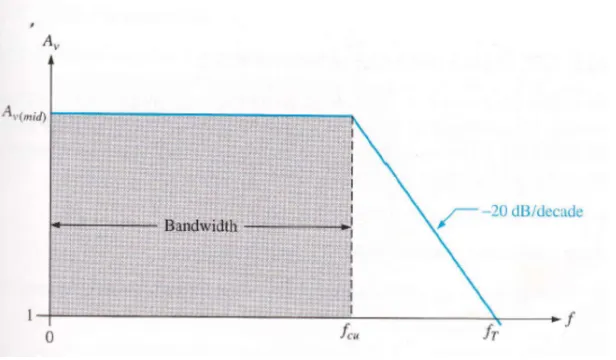
One character of amplifier is that the product of the voltage gain and the bandwidth is always constant when the roll- off is -20dB/decade. This characteristic is called the gain-bandwidth product. Let’s assume that the lower critical frequency of a particular amplifier is much less than upper critical frequency, fcl << fcu.
The bandwidth can then be approximated as BW ≅
The simplified Bode plot for this condition is shown in Figure 2.7 below.Notice that fcl is neglected because it is so much smaller than fcu, and the bandwidth approximately equal fcu. Beginning at fcu, the gain rolls off until unity gain (0 dB) is reached. The frequency at which amplifier’s gain is 1 is called the unity gain frequency, fT. The significant of fT is that it always equal the product of the midrange voltage gain
times the bandwidth and is constant for given transistor [7].
[image:27.595.167.475.455.635.2]Av mid BW (2.2)
2.3 Transistor Amplifier Analysis and Small Signal Model
Small signal model is using to determine the transistor amplifier characteristic such as Gain. The ability of small-signal BJT circuit models makes the analysis of transistor amplifier circuits a systematic process. The process consists of the following steps [8]:
1. Determine the dc operating point of the BJT and in particular the dc collector current Ic.
2. Calculate the values of the small-signal model parameters : g and !" ≅
# ≅
$
3. Eliminate the dc source by replacing each dc voltage source with a short circuit and each dc current source with an open circuit.
4. Replace the BJT with one of its small-signal equivalent circuit models. Although any one of the models can be used, one might be more convenient than the others for the particular circuit being analyzed.
5. Analyzed the resulting circuit to determine the required quantities (e.g., voltage gain, input resistance).
There are two type of basic small-signal model which is ‘Hybrid-π Model’ and ‘T
2.3.1 Hybrid-π Model
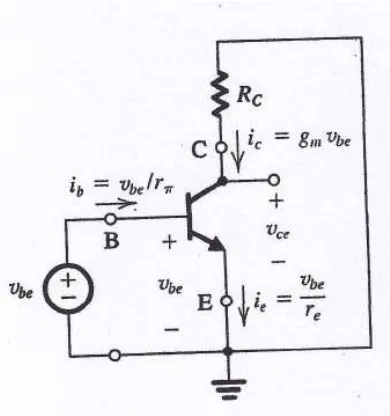
Figure 2.8: The amplifier circuit with dc source VBE and VCC eliminated (short
circuit) [8].
An equivalent circuit model for BJT is shown in Figure 2.8. This model represents the BJT as a voltage-controlled current source and explicitly includes the input resistance looking into the base, rπ. The model obviously yields % = g &'" and () = *+,
-.. Not so obvious, however, is the fact that the model also yields the correct expression for ie. This can be shown as follow;
Emitter node:
%" = &!'"
/ + g 0'" =
&'"
!/ (1 + g !/)
%" = *-+,. (1 + 1) = *2.+, 345
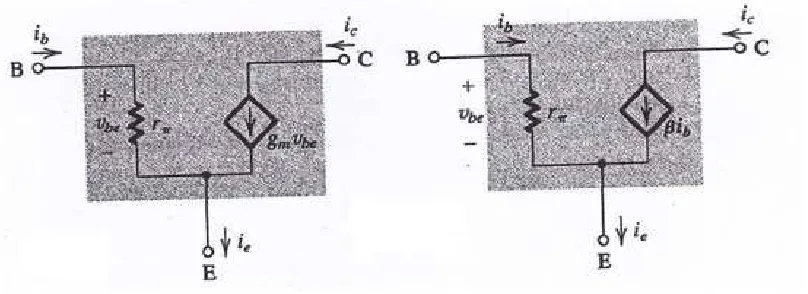
[image:29.595.221.416.160.368.2]A slight different equivalent circuit model can be obtained by expressing the current of the controlled source (g &'") in terms of the base current ib as follows:
g &'" = g (%'!/) = (g !/)%' = 1%' (2.4)
This results in the alternative equivalent circuit model show in Figure 2.9(b). Here the transistor is represented as current-controlled current source, with the control current being ib. The two model of Figure 2.9 are simplified version of what is known as
the Hybrid-π Model. This is most widely used model for BJT [8].
Figure 2.9: (a) BJT as a voltage-controlled current source ( a transconductance amplifier) (b) BJT as a current-controlled current source (a current amplifier)[8].
It is important to note that the small-signal equivalent circuits of Figure 9 model the operation of BJT at a given bias point. This should be obvious from the fact that the model parameters g and !/ depend on the value of the dc bias current ic. Finally, although the models have been developed for an npn transistor, they apply equally well to pnp transistor with no change of polarities.
The output resistance ro should be added if the circuit amplifier is considering the
[image:30.595.116.520.305.452.2]2.10 .Its value is given by !6 ≅ 07/% , where VA is the early voltage and ic is the
collector dc bias current.
The output voltage becomes;
[image:31.595.219.445.179.357.2]06 = −g &'"(9 //!:) (2.5)
Figure 2.10: Hybrid-π Model with the resistance r0 included [8].
2.3.2 T Model
Although the hybrid-π model can be used to carry out small-signal analysis of all
transistor circuit, there are situations in which an alternative model, shown in Figure 2.11. This model, called the T model. The T model of Figure 2.11 (a) represents the BJTas a voltage-controlled current source with the control voltage being &'". However, the resistance between base and emitter, looking into the emitter, is explicitly shown. From the Figure. 2.11(a)we see clearly that the model yields the correct expressions for ic and ie. For ib we note that at the base node we have;
%' = &!'"
" + g &'" = &'"
!" (1 − ; !")
[image:32.595.120.484.118.409.2]
(a) (b)
Figure 2.11: T model of BJT (a) BJT as a voltage-controlled current source (b) BJT as a current-controlled current source[8].
If in the model Figure 2.11 (a) the current of the controlled source is expressed in terms of emitter current as follows:
g &'" g %" !" g !" %" <%" (2.7)
obtained the alternative T-model shown in Figure 2.11(b). Here the BJT is represented as current-controlled current source but with the control signal being ie [8].
The Hybrid-Π and the T circuit models are equivalent, because they both will
2.4 Previous Research Review
This section present the past research based on bandwidth enhancement. Previous design method and technique have been developed by designer had been compared as a guided to design the front-end receiver and in order to achieved the project objective.
2.4.1 First Review
Author: Reza Samadi and Aydın Ilker Karsilayan.
Project Title: Uniform Design of Multi-Peak Bandwidth Enhancement Technique for Multistage Amplifiers
Summary: This paper introduces a new technique for designing uniform multistage amplifiers (MAs) for high-frequency applications is introduced. The proposed method uses the multi-peak bandwidth enhancement technique while it employs identical, simple and inductorless stages. The intrinsic capacitances within transistors are exploited by the active negative feedbacks to expand the bandwidth. While all stages of the proposed MA topology are identical, the gain-bandwidth product can be extended several times. Using the proposed topology, a six-stage amplifier in TSMC 0.35- m CMOS process was designed. Measurement results show that the gain can be varied between 16 and 44 dB within 0.7–3.2-GHz bandwidth with less than 5.2-nV Hz noise. Die area of the amplifier is 175 m 300 m.
Performance of these systems is usually affected by bandwidth and gain limitation of amplifiers. High voltage gain from dc to several gigahertz frequencies is acquired by cascading several gain stages in the form of multistage amplifiers (MAs).
can be implemented uniformly. Due to active feedback, amplifier sections can be designed with low quality factors and with no inductors. In addition, CMA exploits the intrinsic capacitance within the transistors to push output pole of each stage to a higher frequency. The topology of CMA offers several advantages such as improved performance and gain-bandwidth product that make the proposed structure suitable for optical communications.
Figure 2.12: Three-stage conventional MA
A typical MA can be designed by cascading simple gain stages. Figure 2.12 above illustrates a three-stage MA consisting of three forward amplifiers with gains of g1, g2 and g3 where the overall
gain is g1g2g3.
Topology of the proposed amplifier is illustrated in Figure 2.13. The overall structure consists of identical forward amplifiers with identical active feedbacks . The transfer function of the uniform -stage CMA can be obtained as shown as Figure 2.14 where L(s) = g(s)f(s) is the loop gain [9].
Figure 2.13: Topology of the proposed MA[9].
2.4.2 Second Review
Author: Feng-Tso Chien and Yi-Jen Chan
Project Title: Bandwidth Enhancement of Transimpedance Amplifier by a Capacitive-Peaking Design
Summary: From the research paper the author is proposing a capacitive-peaking (C-capacitive-peaking) technique, instead of inductive capacitive-peaking, to increase the bandwidth of a transimpedance amplifier. The reports of a peaking technique using capacitors are very few. Although some different types of the capacitance peaking have been proposed previously. An optoelectronic receiver, which usually consists of a photodetector and a transimpedance amplifier, is used to convert the optical signals into electrical signals in the front end of optical fiber communication. Based on that fact, we can design a larger bandwidth of a transimpedance amplifier. From thispaper, they only discuss the idea of capacitor peaking technique and also derive an analytical method to predict the amplifier performance.
A TZ amplifier can be represented as a shunt shunt feedback amplifier, and the transfer function of this circuit is given by:
Where A(s) is the open-loop transfer function of the TZ amplifier and
transfer functions before and after adding the respectively. Figure 2.15(b) shows the equivalent open-loop circuit of a TZ amplifier.
[image:36.595.107.534.108.650.2](a) (b)
Figure 2.15: (a) Circuit schematic of C-peaking transimpedance amplifier. (b) Equivalent open-loop circuit of transimpedance amplifier with and without a peaking capacitor [10].
2.4.3 Third Review
Author : Siti Sara binti Rais, UTM
Project Title: Optical Receiver Bandwidth Enhancement Using Bootstrap Transimpedance Amplification Technique
[image:37.595.103.539.136.704.2]Summary: In this project, modeling and analysis the bootstrap transimpedance amplifier (BTA) of front-end receiver for input capacitance reduction has been simulated. This technique improved TIA bandwidth up to 1000 times with an effective capacitance reduction technique for optical wireless detector. Shunt-series BTA model produced 982MHZ bandwidth for large Cd (100pF).
REFERENCES
1. Ramli,A. Idrus, S. M.Supa'at,A.S.M & Rais,S.S (2008). Bandwidth
Enhancement Technique using Series-Shunt Bootstrapping for Front-End Optical Wireless Receiver. IEEE. pp.52-56
2. Iniguez, R. R.Idrus,S. M. & Sun,Z.(2007).Optical Wireless Communications: IR for Wireless Connectivity. Auerbach Publications. Taylor and Francis Books Inc, New York.
3. Keiser, G. (2000).Optical Fiber Communications. 3nd.USA: MCGraw-Hill.
4. Alexander S, B. (1997) .Optical Communication Receiver Design. Bellingham, Washington: SPIE The International Society for Optical Engineering.
5. Rais,S.S. (2006) Optical Receiver Bandwidth Enhancement Using Bootstrap Transimpedance Amplification Technique. Universiti Teknologi Malaysia:
Master.Thesis
6. Steve Hranilovic (2004).Wireless Optical Communication Systems.Assistant Professor, Department of Electrical and Computer Engineering, McMaster University, Hamilton, Ontario, Canada, Springer Science+Business Media, Inc.
8. Sedra,A.S & Smith,K.C.(1998). Microelectronic Circuits.4nd.New York :Oxford University Press.
9. Samadi,R. & Karsilayan, A.R.(2007).Uniform Design of Multi-Peak Bandwidth Enhancement Technique for Mutlistage Amplifiers. Transaction On Circuits And Systems,54(7),pp1489-1499.
10. Chien,F.T & Chan.(1999). Bandwidth Enhancement of Transimpedance Amplifier by a Capacitive-Peaking Design.Solid-State Circuits,34(8),pp 1167-1170.
11. Hoyle, C. and Peyton, A.(1999). Shunt Bootstrapping Technique To Improve Bandwidth Of Transimpedance Amplifiers. Electronics Letters. 35(5), pp 369 – 370
12. Abdullah,M.F.L. & Green,R.J.(2011).Receiver Front-End Bandwidth Enhancement Design.Telecomunication,Electronic and Computer Engineering.3(1,pp.69-78
13 Boylestad,R & Nashelsky,L.(1996). Electronic Devices And Circuit Theory. 6nd.New Jersey :Prentice Hall International.
14 John, M.Senior,L.(2009). Optical fiber Communications Prinsiples and Prectice. 3nd. England : Person Education.
15 Palais,J.C.(2005). Fiber Optic Communicatios. 5nd. New Jersey : Person Education.
16 Palais,J.C.(2005). Fiber Optic Communicatios. 5nd. New Jersey : Person Education.
17 Ahmad,M.F. (2010). Optical Wireless Receiver Amplifier Using Hybrid
Bandwidth Enhancement. Universiti Tun Hussein Onn Malaysia: Degree.Thesis.
18 Mahat,M. (2009). Automatic Bandwidth Control Receiver Using Bootstrap Transimpedance Amplifier Technique. Universiti Tun Hussein Onn Malaysia:
Degree.Thesis.
19. Ramli,A. Idrus, S. M.Supa'at,A.S.M & Rais,S.S (2008). Modeling of a Series Bootstrapping Pre-amplifier Circuit for Free Space Optics. Telecommunication Technologies and IEEE 2008 2nd Malaysia Conference on Photonics. pp.37-41
![Figure 1.1: Block diagram of fiber optic system [3]](https://thumb-us.123doks.com/thumbv2/123dok_us/8774081.900425/17.595.133.458.106.376/figure-block-diagram-fiber-optic.webp)
![Figure 2.1: Block Diagram of a fiber system [4]](https://thumb-us.123doks.com/thumbv2/123dok_us/8774081.900425/21.595.146.489.116.441/figure-block-diagram-fiber.webp)
![Figure 2.2: Optical Receiver Front-End [2].](https://thumb-us.123doks.com/thumbv2/123dok_us/8774081.900425/22.595.225.451.341.482/figure-optical-receiver-front-end.webp)
![Figure 2.3: AC coupled low-impedance voltage amplifier [4]](https://thumb-us.123doks.com/thumbv2/123dok_us/8774081.900425/23.595.221.417.582.695/figure-ac-coupled-low-impedance-voltage-amplifier.webp)
![Figure 2.4: High-impedance amplifier [4]](https://thumb-us.123doks.com/thumbv2/123dok_us/8774081.900425/24.595.203.435.442.597/figure-high-impedance-amplifier.webp)
![Figure 2.5: Typical circuit configuration of TIA [4].](https://thumb-us.123doks.com/thumbv2/123dok_us/8774081.900425/25.595.234.442.502.640/figure-typical-circuit-configuration-tia.webp)
![Figure 2.6: The transimpedance feedback amplifier [6]](https://thumb-us.123doks.com/thumbv2/123dok_us/8774081.900425/26.595.217.424.361.506/figure-the-transimpedance-feedback-amplifier.webp)