Journal of Chemical and Pharmaceutical Research
__________________________________________________
ISSN No: 0975-7384 CODEN(USA): JCPRC5
J. Chem. Pharm. Res., 2011, 3(6):950-960
Batch Biosorption Studies of Cr (VI) by Using Zygnema (Green Algae)
Rajbala Soni* and Asha Gupta
Vaish College of Engg. Rohtak (Haryana) India
Deptt. of Environment Sciences, Guru Jambeshwar University, Hissar(India)
______________________________________________________________________________
ABSTRACT
Biosorption of hexavalent chromium onto green alga (Zygnema) was studied from aqueous solutions. Alga was collected from pond of village Thaska near Hissar ,Haryana and from this alga two type of biosorent was prepared (a)-Treated Zygnema (soaked in 1/ formaldehyde solution) (b) -Untreated Zygnema . Biosorption equilibrium was established in about 80 min. The surface properties of the microalgae preparations was varied with pH 2 -12 and maximum absorption of chromium ions on the microalgae preparations was obtained 80 % at pH 2 with treated alga and 63% with untreated alga . The biosorption of chromium ions by the microalgae preparations increased as the initial concentration of chromium ions increased in the medium. The maximum biosorption capacities of both alga was treated at optimum pH 2 with different concentration 10-50 ppm with variable dose 0. 2-1.2 gm with variable time 20-80 min. Equilibrium concentration (qm) and dissociation constant (Kd) were calculated by fitting the experimental data with the Langmuir isotherms. The chromium adsorption data were analysed using the first- and the second-order kinetic models. The experimental results suggest that the second-order equation is the most appropriate equation to predict the biosorption capacities of all the biosorbents.
Keywords: Biosorption, Langmuir isotherm.
______________________________________________________________________________
INTRODUCTION
even hazardous .The metals having specific gravity more than 5g/cm3 are considered as heavy metal [Hollenman and Wiberg,1985].
These heavy metal ions and their complexes exhibit a wide range of toxicity to the organism that ranges from sub-lethal to lethal depending upon the time of exposure and amount of dose. Mechanism of lethal or sub-lethal toxicities may take place in a number of ways. Metals bind to the –SH group and nitrogen containing group in the enzymes thus they block the active sites. Many metals bind to lipid soluble organelles thus impairing their functions. The mechanism of lethal toxicity for short term exposure of a high concentration of heavy metal may be different in the way that they disrupt the respiratory surface while in long term exposure the metal accumulate in internal organs. The presence of heavy metals in the environment has been of great concern because of their increased discharge, toxic nature and adverse effect on human being. All heavy metal cause various disorders in human being [Ucan et al., 2002]. And biosorption is the best technique to absorb the heavy metals and control pollution.
EXPERIMENTAL SECTION
The study has been divided into following parts to achieve the objectives of the present work- (a) Preparation of biosorbent
(b) Characterization of biosorbent (c) Biosorption studies
(d) Adsorption kinetics
a. Preparation of Biosorbent-Preparation of algal biosorbent
Zygnema is the fresh water algae it was collected from water box of Hissar and pond of Thaska village . After collection of biomass of the species was washed several times with tap water followed by rinsing with distilled water for 5 to 6 times to remove all dirt and unwanted materials. Then biomass was soaked in distilled water for 24 hours to remove salt and metal ion present in these algae, dried in sunlight for 5-6 days. Then the dried biomass of each species was ground and sieved to obtain the standard sieve size 1mm. Biomasses of both the species were used in the treated as well as in untreated form. For treatment biomass was soaked in 1% formaldehyde solution for colour removal and after this it was washed with distilled water to remove impurities and excess formaldehyde. After this treated biomass was dried again in sunlight for 5-6 days and then ground and used as biosorbent.
b. Characteristics of Biosorbent
Various characteristics of prepared biosorbent was studied by adopting the standard procedure [APHA, 1995]. pH, Conductivity, Bulk density, particle density, Moisture content, Solubility in water, Solubility in acid, porosity was measured by using different formulas.
c. Biosorption Studies
Batch adsorption studies
All the batch adsorption experiments were carried out at room temperature. Batch experiments were carried out in 250 ml conical flask at room temperature. Synthetic Cr (Vl) solution solution of 10 ppm were taken for optimization . Rotatry shaker was used for agitation. After desired contact period, then solutions were filtered through Whatman filter paper 41 and filtrate of both the solution were analyzed for Cr (Vl) concentration at 540nm concentration at 445 nm spectrophotometrically according to the standard methods (APHA,1995).
In these studies pH, adsorbent dose, contact time and initial concentration were optimized.
Effect of pH
Experiments were performed to found out effects of varying pH on removal of Cr (Vl) from their respective solution of concentration 10 ppm at contact time and adsorbent dose. pH value were varied from 2-12 pH was adjusted using 0.1 N HCl and NaOH solution. After agitation, solutions were filtered and filtrate was analyzed for Cr (Vl) concentration.
Effect of adsorbent dose
To explore the effect of varying adsorbent dose , 100ml synthetic Cr (Vl) solutions of 10 ppm were treated with different adsorbent doses (0.2-1.2gm) for Cr (Vl) and (0.2-1.2gm)for at optimized pH for 1 hour and at room temperature. The samples were withdrawn after 1 hour, filtered analyzed for residual Cr (Vl) concentration.
Effect of Time
Keeping the optimum pH and optimum dose obtained from above experiments, time was optimized .The optimum dose were taken for the metals Cr (Vl) and contact time was varied from 20 to 80 minutes .The samples were withdrawn after 1 hour filtered and analyzed for residual Cr (Vl) concentration.
Effect of Initial Concentration
These studies were conduct by agitating the Cr (Vl) solutions at optimized pH, adsorbent dose and contact time for different concentrations ranging from 10-50 ppm .The samples were withdrawn, filtered and determined the residual Cr (Vl) concentrations spectrophotometrically at 540 nm and 445 nm.
d. Adsorption Kinetics Rate Constant Study
The kinetics for adsorption of Cr (Vl) on algae was studied for its utilization in the treatment of industrial effluent. Rate constant for adsorption of Cr (Vl) on above said adsorbent from aqueous solutions has been studied with the help of Lagergran’s equation.
Log (qe-q) = log q –k 2.303×t
Where qe= the amount of metal adsorbed at equilibrium (mg/g), t= Time (minute)
Plot of log (qe-q) vs. t, if results in liner graphical relation, including the applicability of equation and first order nature of process. Values of rate constants were also calculated from slopes of these plots.
Intra –particle diffusion study
The adsorption of adsorbate on any porous material by secondary process of adsorption through intra –particle diffusion is accompanied. The evidence to recurrence of such process in the present investigation was obtained graphically. A plot of “Amount of Cr (Vl) adsorbed Vs”t½” results in linear–particle diffusion. Rate constant’ Kp”was also calculated from slope of liner plots.
Intra-particle diffusion study confirmation
The occurrence of intra-particle diffusion during adsorption of Cr (Vl) by Zygnema may further be confirmed from behaviors of solution with respect to different adsorbent doses. A plot of “Log % Cr (Vl) adsorption “Vs.” Log time” resulting in a linear relation may confirm the process of intra-particle.
1. Adsorption Isotherms
Langmuir Equation: Ce/qe=1/Q 0 b+Ce/Q0
Where, Ce=equilibrium concentration (mg/l)
Qe = amount adsorbed at equilibrium (mg/g) Q0 and Q0 b Langamiur constants related to adsorption capacity and energy of adsorption.
The linear plots of Ce/Qe Vs suggest the applicability of Langamiur isotherm. Values of Q0 and were determined from slope and intercept of plots.
2. Freundlich isotherm: It is expressed as (Weber, 1972)
X/m=KCe1/n
The logarithmic form of equation is expressed as-
Log x/m=log K+1/n log Ce
Where,
x/m= amount adsorbed (mg/g), X = amount of metal ion adsorbed (mg/l) Ce =equilibrium concentration (mg/l), m=Adsorbent dose (gm/l)
K=Freundlich constant (measure of adsorption capacity) {mg/g (l/mg )} n=emperical constant (a measure of adsorption intensity)
A high K and high n value is indication of high adsorptions throughout the concentration range.
RESULTS
Batch biosorption studies
To estimate removal of Cr (Vl) from their respective synthetic solution, experiment were conducted out at concentration of 10 ppm and was studied on biosorption of Cr (Vl) in batch mode.
For Chromium (Vl)
i. Effect of pH
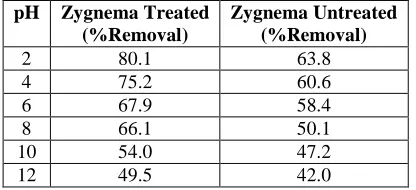
The removal of Cr (Vl) by biosorbent Zygnema treated as well untreated at different pH of the test sample is given in table 4.1 and fig 4.1
To investigate the effect of pH on the removal of Cr (Vl) initial concentration , biosorbent dose and time duration for both algae were kept constant i.e.10 ppm,0.2gm/100ml and 1hour. pH was varied from 2-12. As evident from the results, progressive decrease in Cr (Vl) biosorption was observed with increases in pH from 2-12 and maximum biosorption was obtained at pH 2 i.e. 80 % and 63.8 % for TZ and UTZ respectively and therefore, pH 2 was considered as an optimum pH for future experiments. Thus overall Cr (Vl) removal was found high at low pH in experiment. At acidic pH, the biosorption capacity of biosorbent may be explained by electrostatic binding to positively charged group (Amino gps.) on algal cell wall surface. Thus due to increase in pH overall surface charge on the cellwall becomes negative and biosorption decreases [Arica et al, 2005].
ii. Effect of Dose
Cr (Vl) removal by algal sp. as a function of biosorbent dose is given in table 4.2 & fig 4.2. Experiments were conducted at optimum pH 2, initial concentration 10 ppm and contact time 1 hour. During the experiment, dose was varied from 0.2gm to 1.2gm/100ml for both biosorbents. It was observed that percentage removal of Cr (Vl) increased with increase in biosorbent dose up to a certain extent and after this further increase in biosorbent dose, there was no appreciable increase in percentage removal. The removal of Cr (Vl) was found to be increased from 50 % to 84.5 % for TZ & 46.6 % to 81.5 % UTZ respectively.
Optimum dose for removal of Cr (Vl) was observed to be 0.8 g/100 ml for TZ & UTZ with 79.8 % & 81.1% removal respectively. The increase in the efficiency of Cr (Vl) removal with increase in the adsorbent dosage was only due to increase in the number of adsorption sites [Arica et al., 2005]. Increased uptake of Cu (ll) with increase of alga quantity is due to formation of biosorbent aggregates at higher biomass concentration, which in turn could reduce the effective surface area available for the biosorption [Karthikayan et al, 2006].
iii. Effect of Contact Time
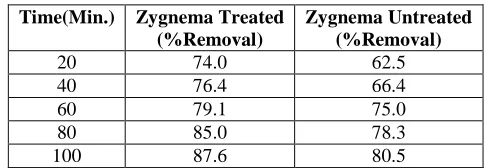
Experiments were conducted at optimized pH 2, initial concentration 10 ppm and optimized dose of biosorbent. During the experiment, contact time was varied from 20 to 80 min for Zygnema. It was observed that the percentage removal of Cr (Vl) increased with increase in contact time. The removal of Cr (Vl) was found to be increased from 74 % to 87.6 % for TZ & 62.5 % to 80.5 % UTZ. From the results, optimum time observed was 100 minutes for both TZ & UTZ. There was no appreciable increase in percentage removal of Cr (Vl) after these optimum times. Deo and Ali (1992) reported that there was very little increase in percentage removal after optimum time. , this may be due to intra-particle diffusion process.
Biosorption got slowed in later stages, because initially a number of vacant surfaces site may be available for biosorption and after some time, the remaining vacant surfaces sites may be exhausted due to repulsive forces between the solute molecule of solid and bulk phase [Chand, 1999 and Vishwanathan et al, 2000].
iv. Effect of Initial Concentration
[image:6.595.195.403.426.521.2]To study the effect of initial concentration, experiment was conducted at optimum pH, contact time and dose of biosorbent and concentration was varied from 10-50 ppm. Results of Cr (Vl) removal at different chromium concentration are presented in table 4.7and fig. 4.7 It was observed that biosorption of Cr (Vl) decreased with increase in metal ion concentration from 10-50 ppm. This was due to the increase in number of metal ions competing for available binding sites and also due to lack of binding sites for complexation of higher concentration levels.
Table 1 Effect of pH on Cr(Vl) removal by Zygnema algae
pH Zygnema Treated (%Removal)
Zygnema Untreated (%Removal)
2 80.1 63.8
4 75.2 60.6
6 67.9 58.4
8 66.1 50.1
10 54.0 47.2
12 49.5 42.0
Initial conc.=10ppm,Dose=0.6gm/100ml,Agitation speed=150rpm
Table 2 Effect of dose on Cr(Vl) removal by Zygnema algae
Dose(gm) Zygnema Treated (%Removal)
Zygnema Untreated (%Removal)
0.2 50.1 46.6
0.4 70.0 51.6
0.6 79.1 73.0
0.8 79.8 81.1
1.0 83.2 81.5
1.2 84.5 81.5
Initial conc.=10ppm,pH=2 ,Agitation speed=150rpm
[image:6.595.184.415.576.683.2]UTZ it was 65.2 % . At higher concentration more chromium ions are left unabsorbed in the solution due to saturation of adsorption sites [Bai and Abrahim, 2003].
Table 3 Effect of Time on Cr(Vl) removal by Zygnema algae
Time(Min.) Zygnema Treated (%Removal)
Zygnema Untreated (%Removal)
20 74.0 62.5
40 76.4 66.4
60 79.1 75.0
80 85.0 78.3
100 87.6 80.5
[image:7.595.175.425.164.248.2]Initial conc.=10ppm,pH=2, Dose=0.6gm/100ml,Agitation speed=150rpm
Table 4 Effect of Initial concentration on Cr(Vl) removal by Zygnema algae
Initial Concentration
Zygnema Treated (%Removal)
Zygnema Untreated (%Removal)
10 68 65.2
20 66.0 60.0
30 55.6 51.3
40 43.6 40.2
50 42.5 38.4
pH=2, Dose=0.6gm/100ml,Agitation speed=150rpm
Fig.1
Effect of pH on Cr(Vl) removal by Zygnema algae species
0 20 40 60 80 100
1 2 3 4 5 6
pH
%
R
e
m
o
v
a
l
Zygnema treated (%Removal)
Zygnema untreated (%Removal)
The rate constant for adsorption of Cr (Vl)and Ni (ll)by biosorbent from aqueous solution was studied with the help of Lagergran’s equation-
Log (qe-q) =logq-K/2.30. t Where,
A straight –line plot of log (qe-q) vs. t indicated the applicability of above equation, which confirmed that the reaction taking place is of first order. Table and Fig .The value of k were also calculated from slopes of these plots.
Fig2
Effect of dose on Cr(Vl) removal by Zygnema sp. 0 20 40 60 80 100
1 2 3 4 5 6
Dose % R e m o v a l Zygnema treated (%Removal) Zygnema untreated (%Removal) Fig3
Effect of Time on Cr(Vl) removal by Zygnema sp. 0 20 40 60 80 100
1 2 3 4 5
Time % R e m o v a l Zygnema treated (%Removal) Zygnema untreated (%Removal Fig4
Effect of initial conc. on Cr(Vl) removal by Zygnema sp.
0 20 40 60 80
1 2 3 4 5
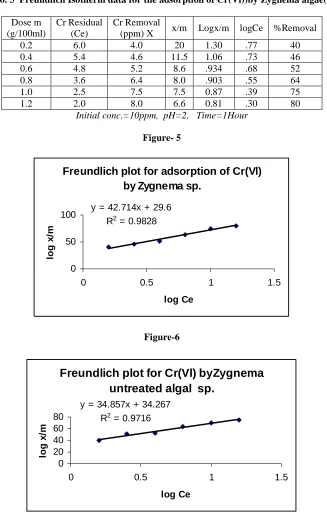
Table No. 5 Freundlich Isotherm data for the adsorption of Cr(Vl))by Zygnema algae(60BSS)
Dose m (g/100ml)
Cr Residual (Ce)
Cr Removal
(ppm) X x/m Logx/m logCe %Removal
0.2 6.0 4.0 20 1.30 .77 40
0.4 5.4 4.6 11.5 1.06 .73 46 0.6 4.8 5.2 8.6 .934 .68 52 0.8 3.6 6.4 8.0 .903 .55 64 1.0 2.5 7.5 7.5 0.87 .39 75 1.2 2.0 8.0 6.6 0.81 .30 80
Initial conc.=10ppm, pH=2, Time=1Hour
Figure- 5
Freundlich plot for adsorption of Cr(Vl) by Zygnema sp.
y = 42.714x + 29.6
R2 = 0.9828
0 50 100
0 0.5 1 1.5
log Ce
lo
g
x
/m
Figure-6
Freundlich plot for Cr(Vl) byZygnema untreated algal sp.
y = 34.857x + 34.267
R2 = 0.9716
0 20 40 60 80
0 0.5 1 1.5
log Ce
lo
g
x
/m
Quantification of Adsorption results Adsorption Isotherm
Freundlich isotherm is derived from empirical considerations and is expressed [Weber, 1972]
Adsorption isotherm followed Freundlich model (Table)
This data shows high value of correlation coefficient (r2) as shows in table. Values indicated a positive relationship in data. R2 range varies .Plot between log x/m and Log Ce yields a linear Freundlich isotherm.
CONCLUSION
Following conclusion were drawn from the present study: Zygnema (treated & untreated), both are suitable biosorbents for removing Cr (Vl) ions from the dilute synthetic solutions.
Biosorption for Cr (Vl) were found to be highly pH dependent process. The optimum pH for Cr (Vl) was observed to be 2. At pH 2, maximum Cr (Vl) removal took place while optimum pH for Cr (VI) was observed to be 8. and maximum biosorption took place at this pH. The rate of biosorption increased with increase in dose and time up to 80 min for Cr (Vl) after which it attained constant value in both the cases. The observed decrease in percentage removal of Cr (Vl) with increase in metal ion concentration (10-50ppm) may be due to the increase in the number of ions competing for available binding sites in the biosorption and also due to lack of binding sites for Complexation at higher levels.
The rate of biosorption of Cr (VI) obeys first order reaction rate as the data was fitted well in Lagergran rate equation following a linear pattern. As the data gave a linear slope, so it confirmed intraparticle diffusion.The biosorption equilibrium of Cr (VI) and Ni (II) followed Freundlich Adsorption Isotherm.
REFERENCES
[1] Agarwal R K; Anand Chand RA, P. A. Fathima, T.R. Shanti and A.A.Mohamed Hatha : Poll Res.; 2005 , 24 (2):247-251.
[2] Arica M. Yakup and Tuzun Ilhami : Process Biochemistry; 2005 ,40:2351-2358.
[3] Bishnoi. N.R.; Pant Anju and Garima : Journal of Scientific &Industrial Research; 2004, 63:813-816.
[4] Chonjacka, K; Chojanki Andrzej and Gorecka Helena : Chemosphere; 2005, 59:75-84. [5] Gang,R.;Ding,Y.;Liu,H.J.;Chen,Q. and Z. Liu : Chemosphere; 2005, 58:125-130. [6] Hashim, M.A. and K.H. Chu : J. Chem. Engg.; 2004, 97 (2-3):249-255.
[7] Hsuan-Liang Liu, Bor-Yann Chen, Yann-Wan Lan,Yang-Chu Chang: Chem. Engg.Journal ;
2004, 97: 195-201.
[8] Ismail Kiran, Tamer Akar, Sibel Tunali Process : Process biochemistry; 2005 ,40: 3550-3555.
[9] Kalayani,S.;Rao S.P.and A.Krishaniah : Chemosphere; 2004, 57:1225-1229.
[10]Karthikeyan, S.; R. Balasubramanian and C.S.P. Iyer: Biores. Technol; 2006 (In Press) [11]Madani,A.;Selatnia,A.;Bakhti,M.Z;Kertous,L,:Mansouri,Y.and R.Yous : Minerals Engg.;
2004 , 17: 903-911.
[13]Pinaki Sar, Sufia K.Kazy, S.F.D’Souza : International Biodeterioration & Biodegradation;
2004 , 54: 193-202.
[14]Rai, A. S : J. IJEP; 2004, 24 (7): 530-533.
[15]Rajenderan, P.; Murthukrishna, J. and P. Gunasekaran : Indian J.Exp.Bio.; 2003, 41:935-944.