Implementation of Network-based Smart Order System
Mohd Helmy Abd Wahab
1, Herdawatie Abdul
Kadir
2, Nadiah Ahmad
31,2,3
Faculty of Electrical and Electronic
Engineering
Universiti Tun Hussein Onn Malaysia
{Helmy},{
watie}@uthm.edu.my
Ariffin Abdul Mutalib
4, Mohd Farhan Mohd
Mohsin
54,5
Faculty of Information Technology
Universiti Utara Malaysia
{
am.ariffin}
,{
farhan}@uum.edu.my
Abstract
This paper presents the development of smart order system in restaurant. The development of the system is primarily concerned to integrate and provide network system rather than the stand alone system which indicates the use of networking capabilities could provide efficient data communication as well as improved the management in restaurant. The development of the system strictly follows the system development life cycle. Generally, the system can be divided into 2 main components which are hardware design which are not discussed in details here and system development which primarily goals of the paper. The results indicate that the system works fine with the data communication works as planned.
1. Introduction
Restaurants are one of favorite premises. With no regard to the actual reasons for visiting restaurants, customer will make orders and wait for the ordered meals. However, it is common if customers complain for not feeling satisfied about the services offered. There are many reasons leading to the feeling of dissatisfaction including being entertained late in terms of order taking by the waiter and meals serving. The issue of being late entertained could be solved with help of the advancement in the technologies of communication.
In accordance, this study initiates an integrated and networked system, with the focus is on its ability to solve the above-described limitations in order taking. This study names the system as Smart Order System in Restaurants (SOSIR). In definition, SOSIR is an integrated system, developed to assist restaurant
management groups by enabling customers to immediately make orders on their own selves. This will minimize the number of minutes to wait for the meal serving. An overview of SOSIR in provided in the following paragraph.
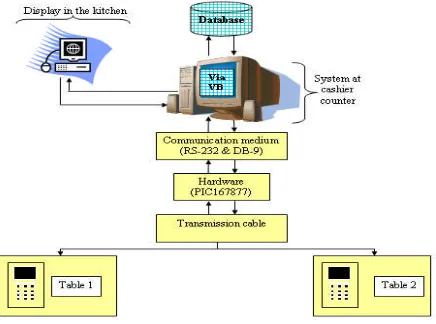
[image:1.595.312.530.439.601.2]SOSIR was developed with the emergence of RS-232, DB-9, a set of keypads, microcontroller, display panels, and transmission cables. Besides, Microsoft Visual Basic 6.0 was used for programming and Microsoft Access for the database. Figure 1 illustrates the system architecture.
Figure 1. SOSIR highest architecture
one at the cashier counter and another at the kitchen for different reasons. The display at the kitchen is used by the cook to prepare the meals, while the display at the counter is important for calculating the total prices.
This study aims at (1) investigating the information flow in restaurants between customers and the management, (2) developing a prototype, and (3) testing the prototype in terms of its functionalities. There were some works developed for similar reasons, and are described in the next section.
2. Related Work
The works to develop systems serving as smart ordering assistants have been revealed in literatures of previous studies. This paragraph and the subsequent describes about the works. In October 2002, Charlie Hogg built an order system in restaurants, which was promoted by PixelPoint Technologies in Ontario, known as PixelPoint 2000[1]. The similarity between this system and the developed system is it allows customers to make orders and all calculation processes were performed by the system. In contrast, it was working in wireless Local Area Network (LAN) environment.
LRS Restaurant Server Pager Starter Kit [2] is another example of similar system. Similarly, it improves service quality and reduces customers’ waiting time, however it needs batteries, transmitters, pager and pager server to work, and available in UHF frequency range at 467 MHz. This technology has some limitations because current communication technologies could be much simpler without need to subject to frequency range.
According to ABCS International [3], they developed a Billpro Pocket® for similar purposes. This system takes orders directly from the customers table and it could manage tables in real time with the ability to enter and store orders information from any other stationary or handheld workstations. It also immediately fires orders out to one or more remote printers in the kitchen. It will send orders and comments back and forth between the dining room and kitchen. Furthermore, the system requests checks and payment right from the Pocket PC and controls orders flows more effectively. The system runs on Windows and takes orders directly from the customers’ tables, which are similar to SOSIR. Meanwhile, it is dissimilar in terms of the hardware specifications, in which it uses Pocket PC, touch-screen handhelds, and the wireless WIFI 802.11x network.
Business Plus Accounting Restaurant 8.0 is a system developed by Business Software Solution Inc.. It is a
point-of-sales system that combines with account of business software package ‘Business Plus Accounting’ [4]. The combinations include almost the entire facilities in restaurant management. The operation between this system and SOSIR is same but a waiter is required for entering orders at the server station to be automatically printed in the kitchen.
Another attempt isAbacre Restaurant POS 2.0[5], in which it performs all similar functions as SOSIR but it integrates the complete restaurant operations and life cycle. AMIGO Restaurant P0S 4.10 [6], which was developed for restaurants, pizzerias, grocery stores, retail outlets and quick service franchises has some additional functions to accept credit card processing, unlimited bar tabs, and redesigned quick pay screen for fast food.
Billpro POS for Restaurant 6.65 H[3]is complete professional Point-Of-Sale and Back Office software. In this system, customers can keep their access authenticated by setting appropriate password, can personalized the display and language, and payments can be edited such as for making discounts.
The work by [7] demonstrates a system designed to quickly take orders and send orders’ information wirelessly. Similarly, the system uses keypad to transmit the data, place every keypad at each table, and uses two personal computers. However, it uses wireless RF transmission for data transmission. The work in [8] uses Microsoft Access to develop the database, while Visual Basic was used to develop the system interface. It also displays information at the counter and in the kitchen, similar to SOSIR. In customer division, PIC 16F84 needs to program for keypad functionality moreover customer can enter the order through the keypad at each customer table.
Kanyaboina [9] provides a software infrastructure to the restaurant management automation. When customer arrives it looks at the current state of the restaurant and finds out the perfect match according to the preferences of the customer. If seats are not available it indicates the approximate amount of waiting time to the customer and at the same time utilizes his waiting time by allowing customer to browse through the interactive menu provided on the iPAQ1wireless [3] and make order.
The works described in the above paragraphs have demonstrated that it is possible to have a computerized restaurant ordering system for handling the issues of being late entertained for order taking and meal serving. This supports the work to develop SOSIR strongly, especially SOSIR development requires small
1
budget yet the data transmission is highly reliable because it implements client-server technology. The next section describes the works involved in developing SOSIR.
3. Methodology
[image:3.595.317.533.206.489.2]The processes of developing SOSIR were divided into five phases, as is always suggested in traditional information systems development life cycle. Figure 2 depicts the stages of works in this study.
Figure 2. Methodology
It started with investigation phase, where observations on the current system together with an initial investigation on customer feedbacks were carried out. The problem as stated in the early section was formulated. Also in this phase, literature studies were carried out to search for related works in previous attempts. The previous section describes some of the outcome, in which they support the development of SOSIR. In addition, in this phase, the system requirement was identified. Limitations in existing system as elaborated in the previous section were noted as guidance, to ensure data loss is minimized and development and implementation cost is low.
Having determined the problem and gathered sufficient resources, the analysis of information flow were carried out in the analysis phase. Five restaurants were visited for observing the nature. In normal practice, all restaurants apply similar steps; starts with the waiter take order and customers have to wait for the meal. In the mean time, the particular waiter will inform the cook about the order (in preferred way), and the cook prepares the intended meals based-on first-in-first-prepared basis. Having finished having the meal,
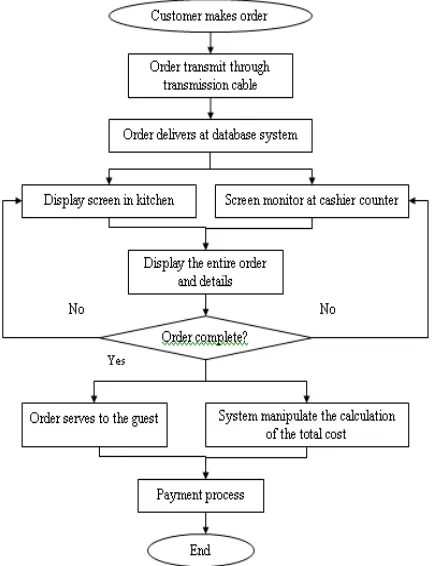
[image:3.595.107.221.241.423.2]customers go to the cashier, and the total price is calculated. The customers leave the restaurant after paying the bill. All transactions with the correct order were listed for later reference in the designing phase. Those processes in the normal system are changed in SOSIR. The first section has elaborated the processes and is depicted illustratively in Figure 3.
Figure 3. Information flow with SOSIR in a restaurant
In Figure 3, the processes starts with the customers make order after having seated. Then the order is transmitted into the database, and simultaneously displayed at two display panels located in the kitchen and at the cashier counter. The display panels list the latest order at the bottom of the current list. If the order is complete, then the cook will start preparing the meals, and simultaneously the computer at the cashier counter calculated for the total price. The transaction ends with the payment processes which include the receipt issuance.
In the designing phase, the researchers focused on the interaction design and database design. Figure 4 depicts the entities involved in SOSIR, while Figure 5 presents the relational model for SOSIR. The underlined attributes in Figure 5 are primary keys. Investigation Phase
Analyzing Phase
Design Phase
Implementation Phase
Figure 4. Entity relationship diagram
GuestTable (TableId)
Order (OrderId, TableId, Quantity, Total, Data, FoodId)
Food( FoodId, FoodName, FoodType, Unitprice)
Figure 5. Relational model
The development and maintenance stages include the tasks to develop and test the SOSIR. The diagrams outcomes from activities in the previous stage were translated into programming codes. Having the system ready, some tests for checking the functionalities as outlined in Figure 3 were carried out.
This section outlines the research methodology, and presents some diagrams related for developing the SOSIR. The next section describes the development of SOSIR at length.
4. Development
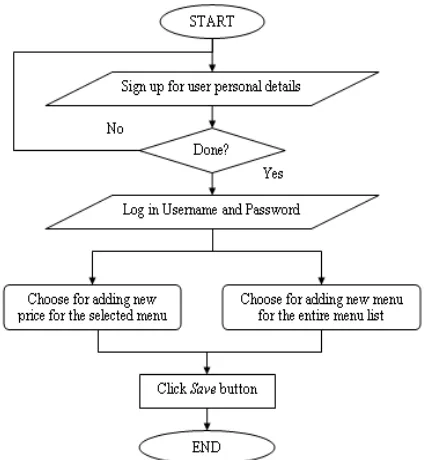
[image:4.595.314.526.112.342.2]As stated earlier, SOSIR has been developed with Microsoft Access and Visual Basic 6.0. From the diagrams in Figures 3, 4, and 5, it is sufficient to divide SOSIR into two different modules; (1) administration module, and (2) restaurant module. Administration module is only accessible by registered personnel, where they could do modification to the existing data such as the meal prices. Meanwhile, the restaurant module is accessible by customers and all personnel, in which customers make orders and the staffs entertain to the orders and calculate the total prices. Figure 6 depicts the flow charts for administration module.
Figure 6. Flow chart for administration module
In Figure 6, the system administrator must be registered first to have access to the module. The registered administrators need to enter their username and password during login. They can perform two functions in administration module, i.e. to update the price for existing meals and to add, delete, or update the meals’ descriptions.
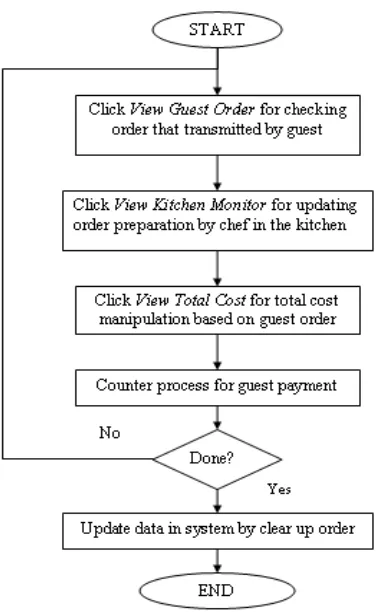
The flow for restaurant module starts with customer enters their orders. The orders are then be sent to the server and stored in the database. At the display panels, the restaurant staffs can click the “View Guess Order” button to view all existing orders. Next, the staffs can click the “View Kitchen Monitor” button to view current status of any order. This is important, because sometimes customers would want to cancel their orders, and this is possible if the status shows that the order has not yet been prepared. At the counter, the cashier will click the “view Total Cost” button to view the total prices. After payment is made, the staff could delete the order from the database. These steps are shown in Figure 7.
GuestTab le
Order
Figure 7. Flow for restaurant module
Functions in SOSIR have been tested, to investigate whether they work as intended. The results of the test are elaborated in the next section.
5. Results
In SOSIR, there were three aspects tested to investigate its functionality, whether they work well, they are (1) the configuration for the connection between computers at the counter and in the kitchen, (2) connection for both in the software system, and (3) the interface.
To test the first function, hardware matter was the main concern. When customers send orders, the orders will first reach the machine at the counter. Then the orders will be displayed and simultaneously transmitted for display at the monitor in the kitchen. The settings were prepared, with the connection using Ethernet crossover technology. Figure 8 illustrates the setting.
The settings were successful, in which the signal is received on both computers. The Ethernet crossover could be used for this type of application, and the result is provided with real image in Figure 9.
Figure 8. Connection of computers
Figure 9. Signal is received at both computers
[image:5.595.84.272.109.415.2]In testing the second function, where the software was the major focus, SOSIR was run completely. There is a sharing folder to enable both computers to communicate in real time. The sharing folders on both computers were opened and SOSIR was run on both computers. It was intended to have updated SOSIR display appears on both computers in real time. The results can be seen in Figure 10, in which both computers display updated SOSIR display simultaneously. This can be deduced that testing the connection for both computers in software system generate positive result.
Figure 10. SOSIR is viewed on both computers
Finally, the third function was tested. In SOSIR, customers’ orders can be viewed on system interfaces after the orders are transmitted through the hardware part. However, this phase only focused for the customer orders inserted manually by customers for testing its functionality through the networking. Once the customers’ orders received at cashier computer, the orders are also received at kitchen computer. The computer in the kitchen displays only the ‘View Kitchen Monitor’ option, while the computer at the counter displays all options for more transactions management.
[image:5.595.323.511.454.529.2]customers’ orders are received at ‘Guest Table’ interface, it also appears at‘Kitchen Monitor’interface simultaneously on the computer in the kitchen as illustrated in Figure 11.
(a) (b)
Figure 11. (a) Guest order and (b) queued order in kitchen
The cook prepares the orders on the first-in-first-prepared basis. After the customers’ orders have been prepared, the cook must click the ‘Done’ button to send a message that the meals are prepared for serving. This will also result in automatic calculation for the total prices. TheStatusremains‘0’until payment processes are done. Part of the payment processes, a valid receipt is generated after an authorized staff clicks ‘Print’ button. After that, thestatusis changed to‘-1’. Figure 12 provides some screenshots for these states.
(a) (b)
Figure 12. (a) The status completed at kitchen (b) Completed cook is sent to cashier
(a) (b)
Figure 13. (a) Payment at counter, (b) Receipt of payment
The results of third test were good enough as evidences to claim that SOSIR is functionally working well. In short, this section provides a set of testing procedure for SOSIR, and found that all test come out with good results. In addition, there are some discussions about SOSIR and recommendations for enhancement, and provided in the next section.
6. Discussion and Recommendation
SOSIR has demonstrated a successful system for restaurant transaction management. It also requires only a small budget, with common easily findable hardware technology, making all restaurants able to implement. However does not cater for major business issues, especially in supporting business strategies. In relation, a business initiative is an important strategy for company growth, as well as customer relationship management. Currently, SOSIR does not look into these aspects. It is good for a restaurant to have SOSIR able to store information about their customers. In a big restaurant, the top management would need SOSIR to be able to help them coming out with certain kinds of planning, including promotion during certain seasons, membership discounts, and so on.
7. References
[1] C. Hogg (October 2002) “The Wireless Gourmet”
http://www.sybase.com(6 March 2007)
[2] Advanced Analytical, Inc (October 2004) “LRS Restaurant Server Pager”http://www.foodsoftware.com
(6 March 2007)
[3] ABCS International “Billpro Pocket®” and “Billpro POS for Restaurant 6.65 H” http://abcs-international.com(6 March 2007)
[4] Business Software Solution, Inc “Business Plus Accounting Restaurant Profesional 8.0” (2003)
http://www.businesssoftware.com(9 March 2007)
[5] Abacre, SARL “Abacre Restaurant Point Sales of Sales 2.0”http://www.abacre.com(9 March 2007)
[6] Amigo “AMIGO Restaurant POS 4.10”
http://www.amigopos.com(9 March 2007)
[image:6.595.75.291.165.304.2] [image:6.595.71.299.438.701.2][8] Farah Azura Binti Abdul Rahman, “Smart Order System in Restaurant (Software)”, Batu Pahat, Kolej Universiti Teknologi Tun Hussein Onn, 2005