Sensitivity and Uncertainty Analysis on the Keff
Produced by the
1
H,
16
O,
239
Pu and
240
Pu
Cross Sections Uncertainties
Abdulaziz Ahmed*, H. Boukhal, T. El Bardouni, O. Hajjaji, M. Makhloul, S. EL Ouahdani, M. Kaddour
Radiations and Nuclear Systems Laboratory, Faculty of Sciences of Tetuan, University Abdelmalek Essaadi, Morocco
Copyright©2017 by authors, all rights reserved. Authors agree that this article remains permanently open access under the terms of the Creative Commons Attribution License 4.0 International License
Abstract In criticality and stability studies of the nuclear reactor, it is important to evaluate the impact of the uncertainties of the basic nuclear data (cross sections) on the different neutron parameters. So this work is interested in the analysis of the sensitivity and uncertainties due to the nuclear data of 1H, 16O, 239Pu and 240Pu Isotopes in the ENDF/B-VII.1 cross sections processed by the latest version of NJOY code on the effective multiplication factor. Different rapid and thermal cases of the different IHECSBE benchmarks have been studied to calculate the sensitivity vectors for 1H, 16O, 239Pu and 240Pu Isotopes. These sensitivity vectors are calculated by using the adjoint-weighted perturbation method based on the Ksen card of the Monte Carlo code MCNP6.1. Thus, the uncertainties induced by nuclear data have been calculated by combining the sensitivity vectors with the covariance matrices that are generated by the ERRORJ module of NJOY2016. We found several cross sections and covariance matrices lack the adjustment: The capture and fission cross sections of the 239Pu and their covariance matrices lack the adjustment in the thermal energies. And all of the four cross sections (elastic, inelastic, capture and fission) and their covariance matrices for the same isotope lack the adjustment in the rapid energies. For 16O; the elastic cross section and its covariance matrix lack the adjustment in the thermal energies. The elastic and capture cross sections of the 1H and their covariance matrices lack the adjustment especially in the thermal energies.
Keywords
Cross Section, Sensitivity, Covariance Matrix, Nuclear Uncertainty, MCNP6.1, NJOY20161. Introduction
Recently, there are several continuous-energy Monte
Carlo codes developing capabilities of computing eigenvalue sensitivity coefficients with regard to nuclear data, including MONK , Mc CARD, MCNP6 ,the continuous-energy version of TSUNAMI-3D in SCALE 6.2 ,RMC, SERPENT [1] , etc. The key point to compute sensitivity coefficients is to compute the change in keff (the effective multiplication factor) caused by a small perturbation in the nuclear data. The sensitivity with continuous energy spectrum has no problem of the self-shielding effect than the sensitivity with multigroup energy spectrum [2]. For this, we used the adjoint-weighted technique with continuous energy spectrum to calculate the sensitivity profiles. A sensitivity and uncertainty analysis have been performed in this work for certain cases of the different IHECSBE (International Handbook of Evaluated Criticality Safty Benchmark Experiments) [3] benchmarks using the MCNP6.1 and the recently updated of the nuclear data processing system NJOY2016 [4] codes. Two previous studies were performed in our laboratory (Radiations and Nuclear Systems Laboratory, University Abdelmalek Essaadi-Morocco) [2,5] to validate the calculation of the sensitivities coefficients by the adjoint-weighted technique in the code MCNP6. These studies were adopted on the calculation of sensitivity vectors for 1H, 16O, 235U and 238U isotopes using the card
KPERT/MCNP6 “reactivity perturbations” which cannot give the overall sensitivity of the cross section of an isotope that exists in several cells of a benchmark with different densities in one cell to another, That's why they calculated, separately. Our study is performed using the new card KSEN/MCNP6.1 “keff sensitivity coefficients” that solves the problem of the isotopes that exist in several cells of a benchmark, Firstly we calculated the sensitivity coefficients of (ENDF/B-VII.1) cross sections processed by the recently updated of the nuclear data processing system NJOY2016 to validate this new version, Then we estimate cross section uncertainties of 1H, 16O, 239Pu and
240
2. Methodology
This study will be restricted to the calculation of sensitivity profiles for some different criticality safety cases of IHECSBE benchmarks that were chosen because their relative differences between the experimental and calculated Keff are higher than their experimental uncertainties and their standard deviations [6]. Once the sensitivity vectors are obtained, they are used with the covariance matrices to study the impact of the cross sections uncertainties [7] on the effective multiplication factor uncertainty in each selected case. The selected isotopes are generally known by their important contribution in the effective multiplication factor calculation. Inputs are the MCNP6.1 input file and ENDF/B-VII.1 file containing the matrices of covariance. ENDF/B-VII.I file is processed by NJOY2016 in order to produce cross sections in the ACE format and covariance matrices used by program for calculating ΔKeff–nucl.
2.1. Sensitivity and Uncertainty Approach
MCNP/KSEN card can compute the sensitivity coefficients of the keff to nuclear data [8,9]. A method based on linear-perturbation theory using adjoint-weighting -the same method as used by TSUNAMI- is employed for this purpose. The adjoint weighting is performed in a single forward calculation using the Iterated Fission Probability method. An important limitation of the adjoint-based methods as implemented in MCNP is that they do not consider perturbations that may arise from scattering laws or from fission emission spectra. This limitation has been shown to lead to spurious results [7]. The only addition to the input files used for sensitivity calculations is the specific ‘‘KSEN” card. The default options for the ‘‘KSEN” card are used (especially for the ‘‘BLOCKSIZE” option, set to 5) [10]. Sensitivity vectors are calculated for different isotopes using two cases of energy groups:
1) 15 energy groups used in our sensitivity and uncertainty analysis.
2) 30 energy groups used in calculate the sensitivities coefficients for cross sections processed by NJOY2016 and comparison these sensitivities coefficients with the sensitivities coefficients which are in IHECSBE and calculated by the KENO code “validation NJOY2016”.
All of the “15 and 30” energy groups is distributed between “1.00E-11 and 1.96E+01” Mev.
Sensitivity profiles 𝑺𝒌𝒆𝒇𝒇,𝝈𝒙,𝒈 are defined as the relative change in a response Keff with respect to cross section𝝈𝒙 in a particular energy group g [11,12], it is defined as:
𝑺𝒌𝒆𝒇𝒇,𝝈𝒙,𝒈 = 𝝈𝒙,𝒈
𝒌𝒆𝒇𝒇 ∆𝒌𝒆𝒇𝒇
∆𝝈𝒙,𝒈
The covariance matrices generated by ERRORJ module of the NJOY2016 processing system based on the same discretization of the sensitivity energy. The values of the covariance were computed for fifteen energy groups by using a weighting flux that corresponds to the 1⁄𝐸 + fission spectrum + thermal maxwellian shape. For all cases, an infinite dilution condition was assumed ( 𝜎0=
1. 1010𝑏𝑎𝑟𝑛𝑠 ) and the temperature was considered to be
300K.
The uncertainty in the keff that results from the uncertainties in the nuclear data is computed as a combination of the sensitivity to a particular cross section and the uncertainty for that cross section. The total uncertainty is calculated by using the following equation [2]:
∆𝒌𝒆𝒇𝒇
𝒌𝒆𝒇𝒇 =�∑𝑖∑𝝈𝒙𝑖∑𝑔[ ∆𝒌𝒆𝒇𝒇
𝒌𝒆𝒇𝒇]𝑖2,𝝈𝒙,𝒈 𝑖: index of material
𝝈𝒙: index of reaction cross section
𝒈: index of energy group
The contribution of every nuclide-reaction in ∆𝒌𝒆𝒇𝒇
𝒌𝒆𝒇𝒇 is
calculated as follows:
⎩ ⎨
⎧ �𝑺𝒌𝒆𝒇𝒇,𝝈𝒙,𝒈𝑐𝑜𝑣�𝝈𝒙,𝒈,𝝈𝒚,𝒈`�𝑺𝒌𝒆𝒇𝒇,𝝈𝒚,𝒈`,𝑖𝑓𝑺𝒌𝒆𝒇𝒇,𝝈𝒙,𝒈𝑐𝑜𝑣(𝝈𝒙,𝒈,𝝈𝒚,𝒈`)𝑺𝒌𝒆𝒇𝒇,𝝈𝒚,𝒈` > 0
𝑐𝑜𝑣�𝝈𝒙,𝒈,𝝈𝒚,𝒈’�: Covariance matrix that comprises
covariance data for two cross sections (𝝈𝒙,𝝈𝒚) in the energy groups 𝒈 and𝒈’.
3. Comparison Sensitivity Coefficients
between MCNP6.1 and Keno Codes
“Validation NJOY2016”
Firstly we calculate the sensitivities coefficients of 239Pu fission, capture, inelastic and elastic scattering cross sections (ENDF/B-VII.1) processed by NJOY2016. And to validate it, we compared our results for sensitivities coefficients obtained by the code MCNP6.1 with the
sensitivities coefficients which are in IHECSBE and calculated by the KENO code. This comparison is used in 30 energy groups.
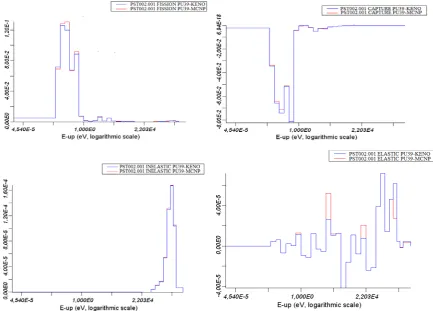
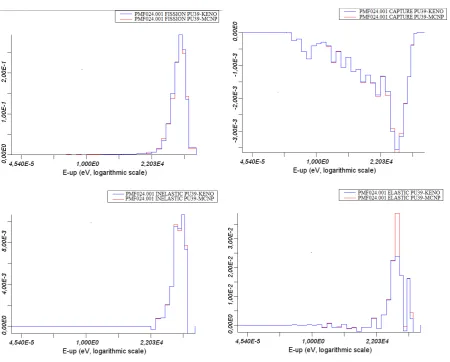
Figures ‘1, 2 and 3’ show the results of the sensitivity coefficients “in unit %/% versus energies in ev” for rapid experiments: pmf020.001 (SPHERE OF PLUTONIUM REFLECTED BY DEPLETED URANIUM), pmf024-001(Polyethylene-Reflected Spherical Assembly of PU239), and for thermal experiment pst002-001(WATER-REFLECTED 12-INCH DIAMETER SPHERES OF PLUTONIUM NITRATE SOLUTIONS); for 239Pu fission, capture, inelastic and elastic scattering cross sections.
[image:3.595.78.512.250.561.2]Figure 2. Sensitivities of 239Pu fission, capture, inelastic and elastic scattering cross sections in PMF024.001
Figure 3. Sensitivities of 239Pu fission, capture, inelastic and elastic scattering cross sections in PST002.001
The slight difference between the results of the two codes attributed to the following: The nuclear data evaluations used are different for the two codes.
The absence of thermal neutron scattering: 𝑆𝑆(𝛼𝛼,𝛽𝛽) in the KENO code. MCNP6.1 is a continuous energy code and KENO is a multigroup energy code.
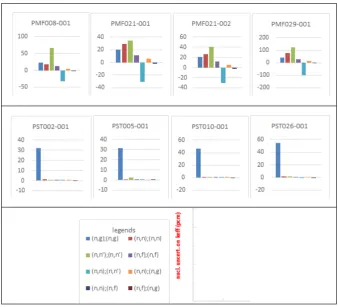
[image:4.595.68.515.77.242.2] [image:4.595.73.524.261.623.2]Figure 4. Uncertainties (pcm) produced by different cross sections of 239Pu for rapid (PMF) and thermal (PST) experiences
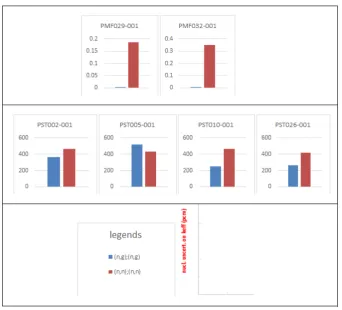
[image:5.595.128.467.414.721.2]Figure 6. Uncertainties (pcm) produced by different cross sections of 16O for rapid (PMF) and thermal (PST) experiences
[image:6.595.127.470.407.717.2]4. Uncertainty Analysis
4.1. Uncertainty on the Keff Produced by the Nuclear Data Uncertainties
Figures 4,5,6 and 7 show the effect of cross sections uncertainties related to 239Pu, 240Pu, , 16O and 1H isotopes respectively on the effective multiplication factor (nucl. uncert. On Keff or ΔKeff-nucl.) in different nuclear experiences.
The uncertainties on the Keff produced by capture, fission, elastic and inelastic scattering, cross sections and the effect of the correlation between them are represented by adjoint-weighted technique and by pcm (1pcm = 10-5).
4.2. Interpretation and Conclusion on the Results
The elastic, inelastic, capture and fission cross sections and the correlations between them for
239
Pu in the rapid experiences, they have large contribution of uncertainties in the effective multiplication factor uncertainties (ΔKeff-nucl.). Then, these four cross sections and their covariance matrices require the adjustment in the rapid energies. The capture and fission cross sections and the correlation between them for the same isotope in the thermal experiences have large contribution of uncertainties in the effective multiplication factor uncertainties (ΔKeff-nucl.), these two cross sections and their covariance matrices require the adjustment in the thermal experiences.
Regarding the 240Pu, the effect of elastic, inelastic, capture and fission cross sections uncertainties on the effective multiplication factor uncertainties is small in the both thermal and rapid experiences, except the inelastic scattering cross section uncertainty has great contribution on the Keff uncertainties in one rapid experience. Then, in this study, we can conclude that: these cross sections and their covariance matrices do not lack the adjustment in the thermal and rapid energies. The cross sections uncertainties related to 16O have
no effect on the effective multiplication factor (Keff) in all experiences, except the elastic scattering cross section uncertainty has the great contribution on the Keff uncertainties in the thermal experiences and in one rapid experience. Then, the elastic scattering cross section and its covariance matrix for 16O lack the adjustment especially in the thermal experiences.
For 1H; the cross sections uncertainties have no effect on the effective multiplication factor (Keff) in all experiences, except the elastic scattering and the capture cross sections uncertainties have the great contribution on the Keff uncertainties in the thermal experiences and the elastic scattering cross
sections in one rapid experience. Then, the elastic scattering and the capture cross sections and their covariance matrices for 1H lack the adjustment especially in the thermal experiences.
5. Conclusions
In this work we have analyzed the sensitivities and uncertainties on the effective multiplication factor (Keff) produced by ENDF/B-VII.1 nuclear data; especially the four cross sections: capture, fission, elastic and inelastic scattering, and their correlations in the239Pu, 240Pu, , 16O and 1H isotopes by the adjoint-weighted technique of the MCNP6.1 code. Firstly, we compared and validated our sensitivities coefficients of 239Pu- (ENDF/B-VII.1) cross sections processed by NJOY2016 in three experiences. After that, a series of critical experiences have been studied by using the Monte Carlo code MCNP6.1 and the ERRORJ module of NJOY2016 to calculate the sensitivity vectors and to process the covariance matrices. In the end, the sensitivity vectors and covariance matrices are combined in order to obtain final uncertainties. As a conclusion:
The four cross sections (elastic, inelastic, capture and fission) of the 239Pu and their covariance matrices lack the adjustment in the rapid energies. The capture and fission cross sections and their covariance matrices for the same isotope lack the adjustment in the thermal energies.
The elastic cross section of the 16O and its covariance matrix lack the adjustment especially in the thermal energies.
The elastic and capture cross sections of the 1H and their covariance matrices lack adjustment especially in the thermal energies.
REFERENCES
[1] Y. QIU et al. 2016 .“ Computing Eigenvalue Sensitivity Coefficients to Nuclear Data Based on the CLUTCH Method with RMC Code, ” Ann. Nucl. Energy, 88, 237. http://dx.doi.org/10.1016/j.anucene.2015.11.007.
[2] Kaddour et al. 2013 “Sensitivity and uncertainty analysis of the Keff due to ENDF/B-VII.0 cross sections uncertainties of the major isotopes in nuclear reactors” Advances in Energy and Power 1(1): 30-43.
[3] International Handbook of Evaluated Criticality Safty Benchmark Experiments, NEA/NSC/DOC (95)03/III, 2007.
[4] Macfarlane R, Muir D.W, Boicourt R.M, Kahler A.C and Conlin, J.L 2017. The NJOY Nuclear Data Processing System, Version 2016. Los Alamos National Laboratory (LANL).
the Keff due JENDL4 cross sections uncertainties of the 235U and 238U isotopes in nuclear reactors”, International Journal of Current Research, 5(12): 3682-3690.
[6] Kaddour M 2015."Analyse de sensibilité des problèmes de criticité du coefficient de température aux données nucléaires : contribution à l’amélioration des évaluations des sections efficaces et application à une maquette critique : le réacteur expérimentale EOLE".
[7] Romojaro P, Álvarez-Velarde F, Kodeli I et al 2017. “Nuclear data sensitivity and uncertainty analysis of effective neutron multiplication factor in various MYRRHA core configurations,” Annals of Nuclear Energy, vol. 101, pp. 330–338.
[8] Brown F.B, Rising M.E and Alwin J.L 2017. User Manual for Whisper-1.1. Los Alamos National Laboratory (LANL).
[9] Kiedrowski, B.C 2013. MCNP6. 1 k-Eigenvalue sensitivity capability: a user’s guide. Los Alamos National Laboratory (LANL).
[10]Kiedrowski, B.C, Brown, F.B, Conlin J.L, Favorite J.A, Kahler A.C, Kersting A.R, Parsons D.K. and Walker J.L 2015. Whisper: Sensitivity/uncertainty-based computational methods and software for determining baseline upper subcritical limits. Nucl. Sci. Eng. 181, 17–47.
[11]Blomeley L, Pencer J, Hyland B and Adams F.P 2014. Nuclear data sensitivity and uncertainty for the Canadian supercritical water-cooled reactor. Ann. Nucl. Energy 63, 587– 593. doi:10.1016/j.anucene.2013.08.