Waseda University Doctoral Dissertation
S a t i s f i c i n g - b a s e d F o r m u l a t i o n o f
F u z z y R a n d o m M u l t i - C r i t e r i a
P r o g r a m m i n g M o d e l s i n P r o d u c t i o n
A p p l i c a t i o n s
Nureize Binti ARBAIY
Graduate School of Information, Production and Systems
Waseda University
ii
Table of Content
Title Page i
Table of Contents ii
Abstract v
Publication lists vi
Acknowledgement vii
1. Introduction
1.1 Overview 1
1.2 The Objectives 4
1.3 Research Framework 5
1.4 Feasibility Investigation 6
1.5 Thesis Structure 8
2. Theoretical Concept
2.1 Treating the Fuzziness and Randomness 11 2.2 Fuzzy Goal Programming: An Additive Model 14
2.3 Possibilistic Programming 16
3. Multi-attribute Evaluation Model with Regression Analysis
3.1 Overview 19
3.2 Model Development 22
3.2.1 Fuzzy Regression for Fuzzy Hierarchical Evaluation Model 22 3.2.2 Fuzzy Random Regression for Multi-attribute Evaluation Model 25
3.3 Solution Approach 27
iii
3.4.2 Case II: Contractor Evaluation for Construction Industry with
Fuzzy Random Environments 37
3.5 Concluding remarks 40
4. Multi-objective Evaluation Model With Fuzzy Goal Programming
4.1 Overview 43
4.2 Problem Background 45
4.2.1 Parameter Values Estimation of the Multi-objective Problem in
Fuzzy Random Situation. 45
4.2.2 Multi-Level Multi-Objective Decision Making 46
4.3 Model Development 48
4.3.1 Building Interval Fuzzy Random Based Fuzzy Goal Programming
Model 48
4.3.2 Building Top-Down Multi-Objective Programming Model 50 4.4 Solution Approaches to Multi-objective Problem with Fuzzy Random
Coefficients 55
4.4.1 Two-Phase Interval Fuzzy Goal Programming 55 4.3.2 Fuzzy Random based Multi-Objective Top-Down Decision
Making 57
4.5 Numerical Experiments 60
4.5.1 Oil Palm Multi-objective Production Planning Problem 60 4.5.2 The Top-Down Multi-Objective Decision Making 66
4.6 Analysis and Discussions 69
4.6.1 Interval Based Additive Fuzzy Random Goal Programming 69 4.6.2 Top-Down Multi-Objective Decision Making 73
4.7 Concluding Remarks 76
5. Modality Optimization Model under Possibilistic Programming
5.1 Overview 79
5.2 Model Development 83
iv
5.3 Treating Uncertainties through Necessity Measure 84
5.3.1 Dealing the Constraints 85
5.3.2 Dealing the Objectives 86
5.4 Weighting Method for Multi-Objective Linear Fractional Problem 88
5.5 Solution Approaches 89
5.5.1 A Modality Optimization for Possibilistic Programming Problem 89 5.5.2 Fractional Programming in Modality Optimization for Multi-
Objective Possibilistic Problem 90
5.6 Numerical Experiment 94
5.6.1 Possibilistic Programming Decision Making with Fuzzy Random based Coefficient in Production Planning and Management Problem
94
5.6.2 Multi-Objective Production Planning Problem with Possibilistic Programming Evaluation Model
97
5.6 Analysis and Discussion 99
5.7 Concluding remarks 102
6. The Application to Oil Palm Fruit Grading
6.1 Overview of Malaysian Palm Oil Industry 105
6.2 Problem Statement 108
6.3 Capturing Fuzziness and Randomness in the Data 110 6.4 Mathematical Modeling and Evaluation 110
6.5 Concluding Remarks 117
7. Conclusions and Future Works
7.1 Conclusions 119
7.2 Future works 122
Bibliography 124
v
Abstract
1
Chapter 1
Introduction
1.1 Overview
Mathematical programming plays a pivotal role in explaining real-world problems and finding solutions. The most common method of applying mathematical programming to real-world concerns is to transform a practical problem into a model with numerical values. Conventionally, the mathematical programming problem model is developed with numerical values; neglects the uncertainties. However, providing precise values for mathematical problem models raises difficulties (Zeleny, 1981) because the nature of the decision-making process is inherently dependent upon the knowledge and professional experiences of decision makers (experts). Thus, fundamentally, decision making involves imprecision and uncertainty whenever human knowledge and evaluation are considered in the decision-making process. If such parameters are not appropriately determined as crisp values in the mathematical model, the formulated problem may yield an infeasible or improper solution (Inuiguchi and Sakawa, 1996). In fact, the measurement and evaluation of imprecise values of decision criteria are difficult (Li et al., 2005), and dealing with this imprecision is a challenging task in decision making.
2
uncertainties and can therefore play a significant role in dealing with such circumstances. Thus, fuzzy mathematical programming is valuable for dealing with uncertainties for cases in which the mathematical programming model’s parameters (i.e., coefficients and goals) cannot be estimated precisely from the real situation in question.
Decision-making theory has become one of the most important fields for real-world decision-making. The optimization methodology of decision-making theory is used to assess several criteria (attribute or objective) for a decision to obtain the best solution. There are two main research topics within criteria decision-making, namely, multi-attribute and multi-objective decision making. Within the various mathematical programming solutions for multi-criteria decision making problem, conventionally, the crisp values are used in the formulation of the problem model. However, the information available to a decision maker is often imprecise because of inaccurate attribute measurements and inconsistency in priorities. Until recently, the decision-making process still utilized subjective judgments when considering human evaluations for certain cases, such as resource planning problems. Therefore, a decision is often made on the basis of vague information or uncertain data. Moreover, extracting human judgment and personal subjectivity is difficult in the traditional decision-analysis models. Thus, certain approaches, such as probability distribution, fuzzy numbers, and different types of thresholds (Bouyssou, 1989), have been used to model uncertainty and imprecision, in the distinct occurrence of the uncertainty. Yet, few studies discuss on the hybrid uncertainty in the decision-making problem model, even though it is important to consider such situation while modeling real-world decision-making problem.
3
Thus, considering the aforementioned requirements, the problems can be summarized as follows:
a. A real-world decision making problem requires mathematical programming to find solution. The formulated model needs pre-determined and well-defined model parameters. In the literature, various models introduced are focusing on the solutions whereby the preliminary model setting (i.e., models parameter value) are not discussed or are assumed provided by the expert. However, the model parameters such as coefficient value are usually not precisely known, as relevant data are sometimes not given or difficult to obtain. Though some method can be used to generate the values, given the existence of fuzzy and random information that exist simultaneously in decision evaluation makes the existing problem solution approach is incapable to appropriately handle these hybrid uncertainty circumstances. Yet, decisions regarding these coefficients are crucial and influential for the accuracy of the model’s results, and the occurrence of errors in the determination of the model’s coefficients might ruin the model formulation.
b. Multi-criteria problem deals with attribute problem and multi-objective problem in real-world decision making situation. The existing problem model that conveys in multi-criteria evaluation scheme treats only particular occurrence of the uncertain situation, such as fuzzy set to capture the fuzziness in nature, and probability or stochastic to deal with probable situation. Thus, the available methods of evaluation scheme are unable to provide solution whereby the simultaneous fuzzy random information contained in real-life applications. Nevertheless, the ignorance of such hybrid uncertain information from real-life situation while modeling its mathematical programming model will produce misleading solution.
4
i. How a multi-criteria problem can be modeled if accepted (built-in) parameters contain hybrid uncertainties, such as ambiguous coefficients and/or vagueness, in the target(s) of the decision maker under fuzzy random circumstances?
a. How can mathematical model coefficient values be obtained from statistical data for which the hybrid uncertainties, namely, fuzziness and randomness, simultaneously co-exist?
b. How a multi-attribute and multi-objective problem be modeled in a situation containing above-mentioned hybrid uncertainties?
ii. To what extent does the mathematical programming model require the setting of an appropriate model through the accurate determination of the model’s coefficients?
1.2 The Objectives
Decision-making modeling and applications of these models will face significant difficulties if the initial model is set improperly and constrained by a fuzzy, random situation. In decision making, most of the existing multi-criteria problem solution available in the literature did not consider the fuzziness that occurs simultaneously with randomness; yet, only a few discuss the importance of setting the mathematical model in problem solving.
Thus, this thesis aims to discuss the modeling of the following three decision-making schemes where fuzziness and randomness co-existing concurrently:
i. the multi-attribute evaluation problem ii. the multi-objective evaluation problem iii. the multi-criteria evaluation problem
5
unable to achieve a solution that considers the several types of uncertainties that occurred. That is, in problem solving, it is important to ensure the uncertainties of relevant criteria being remained in the problem modeling to avoid information losses and inappropriate production of problem solution.
In accordance with the different decision-making structures discussed above, this study works on three types of mathematical programming algorithms: one to produce a general approximation of the system parameters, one to set up the problem model, and one to solve the problem by improving existing decision-making methods to enable them to address the solution difficulties. The schemes discussed in this work satisfy decision-maker intentions, addressing the fuzzy random circumstances using satisfaction-based optimization. Finally, a real-life application of production planning models is provided to showcase the applicability of the proposed algorithms to a practical case study.
The innovative point of this thesis is to present a new formulation of decision-making evaluation scheme to alleviate concurrent fuzzy random circumstances that apparently take places in real-world decision making. To make this point possible, the existing multi-criteria (multi-attribute and multi-objective) decision making evaluation scheme is enhanced and is improved. The new multi-criteria evaluation scheme includes the method that able to determine the models parameter value for which containing hybrid uncertainties, in order to develop mathematical programming model for the respective problem and to perform the evaluation under condition of such hybrid uncertainties. From the solution approaches, it contributes directly to the multi-criteria decision-making evaluation scheme that appropriately capable to deal with hybrid uncertainties, namely simultaneous fuzzy random circumstances.
1.3 Research Framework
An operational framework for the research conducted in this study is shown in
6
regression analysis is used to estimate model coefficients and further develop fuzzy random based mathematical programming model, for the three distinct multi-criteria problem model, namely multi-attribute, multi-objective, and possibilistic multi-objective evaluation model.
1.4 Feasibility Investigation
Feasibility study investigates the proposed problem solutions can address the problems and facilitate the best possible decisions and solution outcome. Fundamentally, various uncertainties inherently exist in the real-world decision making and capturing such uncertainty in the mathematical problem model is necessary. While the early solution approach to multi-criteria decision-making problem uses crisp numerical values representation in its mathematical model, neglecting the inherent uncertainties may yield the formulated model to produce inappropriate results. However, capturing such uncertainties is troublesome in some cases. Thus, existing multi-criteria decision-making approach should be able to capture and treat the uncertainties to strengthen its ability that addresses real-world uncertainty in the problem solution, mathematically.
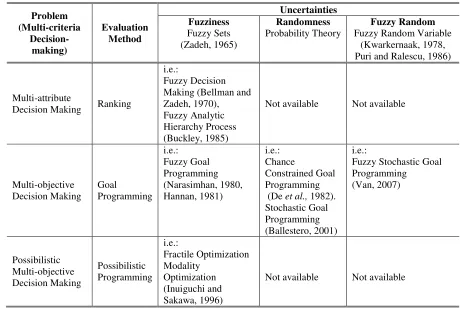
Table 1.1 tabulates the generic solution approach available in the literature, particularly in the two major groups of decision making problem; multi-attribute and multi-objective decision making. While multi-attribute problem perform ranking and selection method to find best alternative, multi-objective problem synthesize a number of objectives to find the best solution that satisfies all evaluated objectives. Based on the investigation, multi-criteria decision making takes an advantage of fuzzy theory to handle fuzzy information, and probability theory to handle random situation in the evaluation scheme. Some approaches have been also proposed to treat fuzzy random situation.
7
research has little concern with mathematical model setting, or are assumed determined by their expert; indeed it is significant and influential to the solution result.
[image:12.612.73.533.337.647.2]The proposed solution approach can be practically applied in the real-world decision making application. Encapsulates in the proposed solution approach (multi-criteria evaluation scheme) are the method to obtain the uncertainties from real-world and a method to generate model parameter values. Thus, to employ the proposed method, real-problem should be first determined whether it is under multi-attribute problem or multi-objective problem, depending on the objective of the decision maker of the subject problem. Then, model’s parameter such as decision variable, relationship and the objective can be formulated, before performing decision making evaluation scheme.
Table 1.1: Research Problem and Existing Solution Approach
Problem (Multi-criteria
Decision-making)
Evaluation Method
Uncertainties
Fuzziness Randomness Fuzzy Random
Fuzzy Sets (Zadeh, 1965)
Probability Theory Fuzzy Random Variable
(Kwarkernaak, 1978, Puri and Ralescu, 1986)
Multi-attribute
Decision Making Ranking
i.e.:
Fuzzy Decision Making (Bellman and Zadeh, 1970), Fuzzy Analytic Hierarchy Process (Buckley, 1985)
Not available Not available
Multi-objective Decision Making
Goal
Programming i.e.: Fuzzy Goal Programming (Narasimhan, 1980, Hannan, 1981)
i.e.: Chance
Constrained Goal Programming (De et al., 1982). Stochastic Goal Programming (Ballestero, 2001)
i.e.:
Fuzzy Stochastic Goal Programming (Van, 2007)
Possibilistic Multi-objective Decision Making
Possibilistic Programming
i.e.:
Fractile Optimization Modality
Optimization (Inuiguchi and Sakawa, 1996)
8
Since it is the main focus in this study to determine the model parameter values from historical data, such information is collected beforehand, where fuzzy importance rating is used to capture the expert preference, and the differences of the expert’s preference is random. Data collection process here might cost the time taken to undertake the collection, performing the data analysis, and computing the values to treat the fuzzy random uncertainties. However, the proposed solution approach may take benefit from this improvement towards the treatment of concurrent uncertainties, and improve the limitation of conventional solution approaches to determine the model parameter values in presence of such fuzzy random data.
This analysis concludes that it is worthwhile to pursue proposed solution approach to multi-criteria evaluation scheme, which addresses some limitation mentioned in prior. Thus, a result of this study addresses the shortage of determining model parameter in the conventional mathematical programming modelling; and whereby the proposed solution approaches is able to handle simultaneous fuzzy random data for multi-criteria evaluation scheme.
1.5 Thesis Structure
This thesis is arranged into several subsections. The main body of this dissertation is organized into four parts, as follows:
i) Multi-attribute evaluation problem model with regression analysis
ii) Multi-objective evaluation problem model with fuzzy random goal programming
iii) Multi-objective evaluation problem model with possibilistic optimization iv) Production applications
9
In Chapter 3, multi-attribute decision making in fuzzy environments and fuzzy random environments is discussed. Fuzzy regression analysis to solve a multi-attribute evaluation problem is constructed for fuzzy and fuzzy random information. The results include approximating the coefficient weight values for decision models and providing a solution to the multi-attribute decision-making problem (selecting the best alternative). The computation results are shown, and the two models are compared and discussed. In conclusion, a multi-attribute evaluation scheme under fuzzy random condition is proposed in this chapter.
Chapter 4 elaborates upon multi-objective decision making with a satisfaction-based optimization method in fuzzy random environments. Fuzzy random regression analysis is used to approximate the model’s coefficient values and to develop a goal constraint appropriate for the fuzzy random environment. Fuzzy goal programming, which is a satisfaction-based optimization method, is used to solve two problem models, namely, interval-based multi-objective evaluation, and top-down multi-objective decision making. Thus, two types of multi-objective decision making, each tailored to its appropriate requirements, are proposed. The computation results are shown and discussed.
Chapter 5 discusses an accompanied fuzzy random uncertainty in possibilistic programming method in the context of the multi-objective decision-making problem. The necessity measure is explained and used to treat the coefficient ambiguity and goal vagueness present in the problem model. A modality method that uses fractional programming is proposed to solve multi-objective problems for which the possibilistic programming models coefficients contain fuzzy random information.
A real-life application is discussed in Chapter 6. Specifically, this chapter conducts a case study employing the proposed evaluation method of that explained in the Chapter 3 to a planning problem in oil palm production. The problem formulation of oil – palm fruit grading and evaluation is described as multi-attribute problem, and was solved by considering the fuzzy random situations that exist while evaluating the fruit harvest.
10
Figure 1.1: Operational research framework
Multi-objective Evaluation (MOE)
Multi-objective Possibilistic Programming (MOPP)
Fuzzy Random based Mathematical Modeling
Linear Possibilistic Programming
Data preparation and experiment
Result and analysis Possibilistic Multi-objective Evaluation
Theoretical investigation and comparative study
Fuzzy Random based Mathematical Modeling
Data preparation and experiment Linear Programming
Fuzzy Goal Programming
Result and analysis
level Multi-objective Evaluation Interval
Multi-objective Evaluation
Modality Optimization
Multi-attribute Evaluation (MAE)
Fuzzy Random based Mathematical Modeling
Linear Programming
Data preparation and experiment
Result and analysis Multi-attribute Evaluation
Ranking Approach
Fuzzy Random Regression Analysis
(Approximating model’s coefficient)
handles simultaneous fuzzy random
Analysis and Conclusion
End
11
Chapter 2
Theoretical Concepts
2.1 Treating the Fuzziness and Randomness
In term of fuzzy random variable concept, the study is focused on considering the fuzziness and randomness simultaneously. Fuzziness is characterised as the absence of sharp boundaries of human perception while randomness is caused by mechanism of some chance. Thus, to address these uncertainties, fuzzy variable has become an important tool as standalone fuzzy theory or probability theory cannot be directly applied to the so-called hybrid uncertainties circumstances. Fuzzy random variables are defined as a measurable function linking a probability space to a collection of fuzzy numbers (Kwakernaak, 1978; 1979). Fuzzy arithmetic and fuzzy operations for fuzzy numbers have also been studied through the use of the extension principle that involves the concept of possibility (Nguyen, 1978; Zadeh, 1975a; Zadeh, 1975b; Zadeh, 1975c). In possibility theory, an impression is expressed by using a possibility distribution. Thus, the fuzzy parameters are associated with possibility distributions as opposed to the random variables that are associated with probability distributions. Then, the possibilistic concept is used with fuzzy random variables explanation.
Let us assume that Posis a possibility measure defined on the power set P
( )
Γ ofΓ in a universe Γ. Given ℜ as the set of real numbers, a function Y :Γ→ℜis said to be a fuzzy variable defined on Γ (see Nahmias, 1978). The possibility distribution µYof Yis defined byµY
( )
t =Pos{
Y =t}
,t∈ℜ, which is the possibility of event{
Y =t}
. For fuzzy variable Y with possibility distributionµ
Y, the possibility and necessity of event{
Y ≤r}
12
{
}
( )
{
Y r}
sup( )
t . Nec , t sup r Y Pos Y r t Y r t µ µ > ≤ − = ≤ = ≤ 1 (2.1)The expectation based on an average of possibility and necessity is defined based on Liu and Liu (2002). The possibility expresses a level of overlapping and the necessity articulates a degree of inclusion. The expected value of a fuzzy variable is presented as follows:
Definition 2.1: Let Y be a fuzzy variable. Under the assumption that the two integrals are finite, the expected value of Y is defined as follows:
∫ − ∫ −∞ > ≤ ∞ < ≥ − + − +
= 0 () ()
0 2 1 sup sup
1 ) ( sup ) ( sup 1 2 1 ]
[Y t t dr dr
E Y t
r t t Y r t Y r t Y r
t µ µ µ µ (2.2)
From Equation (2.2), the expected value of Yis defined as . 4 2 ]
[
r
l c a
a Y
E = + +
Definition 2.2: Suppose that
(
Ω,Σ,Pr)
is a probability space and Fv is a collection of fuzzy variables defined on possibility space(
Γ,P( )
Γ ,Pos)
. A fuzzy random variable is a map X:Ω→Fv such that for any Borel subsetBofℜ, Pos{
X( )
ω ∈B}
is a measureable function of
ω
.Let X be a fuzzy random variable on Ω. From the above definition, X
( )
ω
is afuzzy variable for each
ω
∈Ω. Furthermore, a fuzzy random variable X is said to be positive if for everyω, Xis almost surely positive.Let V be a random variable on probability space
(
Ω,Σ,Pr)
.( )
ω
=(
V( )
ω
−2,V( )
ω
+2,V( )
ω
+6)
∆13
The expected value of the fuzzy variable X( )ω is denoted by Ε
[
X( )
ω]
for anyfuzzy random variable X onΩ, which has been proved to be a measurable function of ω (Liu and Liu, 2003). Given this, the expected value of the fuzzy random variable X is defined as the mathematical expectation of the random variable Ε
[
X( )
ω]
.Definition 2.3: Let X be a fuzzy random variable defined on a probability space
(
Ω,Σ,Pr)
. The expected value of X is defined as( )( ) ( )( ) ( )
( )
( )( )
( )
ω µ µ µ µ ω ω ωω dr dr d
X E t Z r t Z r t t Z r t t Z r t t Pr sup sup 1 2 1 sup sup 1 2 1 ]
[
∫
0 0Ω −∞ ≤ >
∞ < ≥ ∫ − + − ∫ − + = (2.3)
Definition 2.4: Let X be a fuzzy random variable defined on a probability space
(
Ω,Σ,Pr)
with expected valuee
. The variance of X is defined as[ ]
[
( )
2]
varX =E X-e (2.4)
where e=E[X] given by Definition 3.3.
14
2.2 Fuzzy Goal Programming: An Additive Model
Classical goal programming is constructed with objective functions, constraint, and target values, which are all deterministic values. When the knowledge of experts is imprecise or unavailable, it is difficult to get the exact value for developing a model. In such uncertain and imprecise situations, fuzzy values are used in the goal programming description. The inexact values in the goal programming model reflect the vagueness or tolerance of the decision maker and also the imprecision of the knowledge of experts.
Tiwari et al. (1987) have created and implemented an additive model in the fuzzy goal programming context that aggregates the collective fuzzy goals. In their model, the aspiration levels for goals are assumed to be fuzzy. Despite the deviation variables used in the goal programming, a generalised fuzzy goal programming model is defined by a membership function as follows:
, 0 , subject to , , 1,2, , ~ ) ( fy satis to find ≥ ≤ = ≥ X b AX X X m i g
Gi i L
(2.5)
where
X
is a vector with components x ,x ,L,xn2
1 , and AX ≤bare the system
constraints in vector notation. The fuzzification of the aspiration level is denoted by ≥~. The ith fuzzy goal Gi
( )
X ≥~ giin (3) indicates that the decision maker is satisfied even if the value of the ith fuzzy goal Gi( )
X is less than gi up to a certain tolerance limit. Amembership function yields a degree of closeness of each goal to its desired attainment level using the interval
[ ]
0,1 to represent the degree of membership of each goal. The worst possible value for an objective function makes a grade of membership zero. A linear membership function ui for the ith fuzzy goal Gi(X)≥~ gi can be expressed according to Zimmerman (1987) as( )
( )
( )
( )
≤ ≤ ≤ − − ≥ = , if 0 , if , if 1 i i i i i i i i i i i i L G g G L L g LG G g
u X X X X (2.6)
15
In the case of the goalGi(X)~≤ gi, the membership function is defined as
( )
( )
( )
( )
≥ ≤ ≤ − − ≤ = , U G , U G g U GU G g ,
u i i i i i i i i i i i i X X X X if 0 g if if 1 (2.7)
where Ui is the upper tolerance limit for the fuzzy goalGi
( )
X .The additive model of the fuzzy goal programming (Tiwari et al., 1987) problem (2.8) is formulated by substituting all membership functions in the model (2.5) as follows: , m , , , i , , X , , L g L ) ( G ) ( V max i i i i i i i m i i L 2 1 0 1 subject to 1 = ≥ ≤ ≤ − − = =
∑
=µ
µ
µ
µ
µ
b AX X (2.8)where V(µ) is called the fuzzy achievement function or fuzzy decision function. Note that AX ≤b is the crisp system constraints in vector. This is the single objective
16
2.3 Possibilistic Programming
Possibility distributions are assumed to be obtained subjectively from the knowledge of experts, whereas probability distributions are estimated from observations. From the perspective of possibility concept (Zadeh, 1978), impression can be expressed in terms of a possibility distribution. For instance, an expression ‘about one million
dollars’ contains a fuzzy number. Furthermore, given a proposition ‘it is possible to
invest about one million dollars,’ it can be understood as the possibility of the investment.
Let us interpret the possibility concept and specify possibility distribution ∏F
( )
xas ∏F
( )
x ∆µF( )
x , with the knowledge F∆ ‘about’ as specified in the following:Definition 2.5:Given a possibility distribution ∏F
( )
x , the possibility measure of a fuzzyset A specified by µA
( )
x is defined as( )
A A( )
x( )
xx F
F =sup ∧∏
∏ µ .
In the possibilistic programming approach, a vague aspiration is represented by a fuzzy goalGi. A fuzzy goal Gi is fuzzy set whose membership function
i G
µ expresses a degree of satisfaction to a soft constraint such as ‘considerably larger thangi’ and ‘considerably
smaller thangi’.
The membership function of linear fuzzy goal Gi is as follows:
( )
− −=max min 1 ,1 ,0
i i G d g r r i µ (2.9) or
( )
− −=max min 1 ,1 ,0
i i G d r g r i µ (2.10)
where gi is the center value of the target goal and diis the width. The linear fuzzy goals
i
17
Example 2.1: The linear fuzzy goal that corresponds to the linguistic expression provided by decision maker as “significantly smaller than 5 million dollars” are defined by G1 =
]
5,0.002)
, with center value 5, and width 0.02.Meanwhile, the ambiguous data is represented by a possibility distributionπij. A possibility distribution is regarded as a fuzzy restriction that performs as a flexible constraint on the value that may be assigned to a variable. Thus, a possibility distribution
ij
π is defined in terms of a fuzzy set Aij presenting the linguistic expression such as ‘about aij’ as
ij A
ij µ
π = , where
ij A
µ is a membership function of ‘about aij’ Aij.
A symmetric triangular fuzzy number Aij = aij,dij is used to define a possibility distribution πij with the following membership function:
( )
− −= 1 ,0
d a r max r ij ij Aij µ (2.11)
Thus, under probabilistic programming perspective, the expressions are useful and meaningful to formulate the real-world problem that contains such uncertainty.
Example 2.2: Assume that machine capacity is expressed as a fuzzy number. The machine capacity of Product A a1 at Machine 1 is described with linguistic expression ‘about 4’. A fuzzy number is illustrated with the membership function
( )
− −
= 1 4 0
7 0 1 , r max r . A
µ . µA1
( )
r shows the possibility degree of the event of the machine capacity, for Product A at Machine 1 is r. So,1 A
µ can be regarded as a possibility distribution of the processing time of Product A at machine 1 and a1 can be considered as a possibilistic variable restricted by the possibility distribution
1 A
µ .
A possibilistic programming (Inuiguchi et al., 1994) is written as follows:
, n , , j , x , m , , i, g ~ x Y j n
18
where αijis a possibilistic variable restricted by a possibility distribution and defined by a triangular fuzzy number Aij = aij,dij with centre aijand width dij, and ≥~ is fuzzy
19
Chapter 3
Multi-Attribute Evaluation Models with Regression Analysis
3.1 Overview
In multi-attribute decision-making, an evaluation is performed based upon several decision attributes. An attribute is a measurable quantity with a value that indicates the degree to which a particular objective is achieved. A relevant measurement scale is used to assign an attribute value. The evaluation must therefore consider and satisfy all evaluation attributes. In multi-attribute decision-making, the rating of each alternative is performed with respect to each criterion and the weights given to each criterion. Most of the existing approaches in multi-attribute decision-making encompass two phases, namely, the aggregation of these ratings and the ranking of decision alternatives in accordance with the aggregated ratings. Because real-world making usually involves more than one attribute, a multi-attribute decision-making method has been applied to many decision processes. A multi-attribute decision-decision-making method has not only been employed in various applications but also been improved for different situations and requirements (Mavrotas, 2003; Ogryczak, 2000; Cardoso and Sousa, 2005; Tavana, 2010).
20
In this method, linguistic variables are used to capture fuzziness in the decision information and the decision-making processes using a fuzzy decision matrix.
In the past several decades, many techniques have been introduced to address multi-attribute problems, such as simple additive weighting (Malczewski, 1997), the analytic hierarchy process (Saaty, 1980), multi-attribute utility theory (Keeney and Raiffa, 1976), the ordered weighted average (Yager, 1988), the Preference Ranking Organisation Method for Enrichment Evaluation (Brans and Vincke, 1985), and Elimination and Choice Expressing Reality (Roy, 1968). In these methods, weighting factors play an essential role. Because the central aim of multi-attribute evaluation is to obtain the best alternative from among a set of evaluated alternatives, appropriate weighting of the alternatives plays a pivotal role in multi-attribute evaluation. Moreover, multi-attribute evaluation also requires accurate weight information for each attribute. However, determining an attribute’s weight is sometimes difficult if relevant data are either unavailable or difficult to obtain. Therefore, an appropriate method is required for determining these weights, as these decisions are crucial to the model’s performance.
21
neglects the inherent imprecision it its evaluation, although consideration of all inherent uncertainties is necessary in real-world decision-making.
An evaluation encompassing many inexact criteria is difficult to measure (Li et al., 2005). Such an evaluation is a challenging task due to its ambiguity and difficult formalization. However, if such imprecision is neglected, the formulated problem model may yield improper result. In real-world applications, statistical data may include both stochastic and fuzzy information at the same time. Fuzzy random variables can be explained by the use of a simple example. Assume that N experts are responsible for evaluating the jth product sample. Randomness occurs because it is not known which response may be expected from any given respondent. In addition, fuzziness results if the observed response given by the respondent contains imprecision. Furthermore, if multiple decision makers are involved in evaluating the same alternatives or objectives, the differences in the decision makers’ evaluations should also be considered. Such a situation may occur in real-life decision-making, and handling these types of data requires an appropriate approach. For these reasons, the observed statistical data may include both stochastic and fuzzy information, and thus, the decision-making analysis should provide an appropriate method of analysis to handle the presence of such hybrid uncertainty. Therefore, the combination of fuzziness and probability is important, and fuzzy random variables should be utilized as a basic tool for modeling optimization problems containing such uncertainties.
22
information. We highlight two main advantages of the proposed methods, namely, their ability to provide weight information and their consideration of hybrid uncertainties in the evaluation process.
3.2 Model Development
Two models were developed based on fuzzy data and fuzzy random data. The first model deals with only fuzzy data, and the latter model deals with fuzzy random data. The following explains the models development.
3.2.1 Fuzzy Regression for Fuzzy Hierarchical Evaluation Model (FHEM)
Over the past quarter century, various fuzzy regression models have been introduced to address fuzzy input-output data and to cope with the fuzzy environment of subjective human estimates. The concepts of fuzzy statistics, fuzzy numbers, and fuzzy arithmetic play a vital role in the design of fuzzy regression models (Watada and Tanaka, 1987). Tanaka et al. (1982) presented a linear regression analysis that considered fuzzy data instead of traditional statistical data. Subsequently, Tanaka et al. (1989) described a possibilistic regression analysis based on the concept of possibility theory, wherein a fuzzy regression model is reinterpreted in the context of possibility. Watada (1996) also addressed a fuzzy regression model for fuzzy data, which involved a heuristic method for determining the product of fuzzy numbers. Thus, a fuzzy regression model can also be called a possibilistic regression model when the interpretation of possibilistic concept is included (Tanaka and Watada, 1988; Yabuuchi and Watada, 1996; Watada and Toyoura, 2002).
The fuzzy regression is written as follows:
n j x x A x A x A Y j t j jn n j j j L L , 2 , 1 ; 1 ] [ ] [ 1 2 2 1 1 = = = + + + = = Υ Ax (3.1)
23
According to the extension principle, we can rewrite equation (3.1) as follows:
t j t j t j j
Y =Ax = ax ,h|x |
(3.2)
where |xj |=(|xj1|,|xj2 |,L,|xjK |) . The output of the fuzzy regression (3.1), whose coefficients are fuzzy numbers, results in a fuzzy number.
The regression model with fuzzy coefficients can be described using the lower boundary
, | | j t t
j h x
ax − centre axjtand upper boundary axjt +h|xj |t. A sample (yj,xj), j=1,2,L,n is defined for the total evaluation with centreyj, width dj as a fuzzy number yj = yj,dj , and a value vector of all criteriaxj, where the template membership function of fuzzy coefficients is set toL(α), and membership grade is
α
, which extends to a sample included in the regression model. The inclusion relation between the model and the samples should be written as follows:t j t j j j t j t j j j L d L y L d L y | ) ( ) ( | | ) ( ) ( 1 1 1 1 x | h ax x h ax α α α α − − − − − ≥ − + ≤ + (3.3)
In other words, the fuzzy regression model is built to contain all samples in the model. This problem results in a linear program.
Using the notations of observed data(yj,xj), yj = yj,dj , xj =[xj1,xj2,L,xjK] for
n
j =1,2,L, and fuzzy coefficients Ai = ai,hi for i=1,2,L,K, the regression model can be
mathematically written as the following linear programming problem:
. 0 , , , 2 , 1 , | ) ( ) ( , , , 2 , 1 , | ) ( ) ( subject to | | min 1 1 1 1 1 ≥ = − ≥ − = + ≤ + ∑ − − − − = h x | h ax x | h ax x h h a, n j a L d L j y n j a L d L y t j t j j t j t j j j t j n j L L α
α (3.4)
24
The fuzzy hierarchical evaluation model (FHEM) is the multi-attribute problem model which uses an importance scale as stated in conventional AHP method. However, straightforward rating is used in the FHEM instead of pair-wise comparison of AHP. Ordinary AHP uses a 5- to 9-point scale for the level of importance to compare the criteria with each other. Meanwhile, triangular fuzzy numbers are used instead of crisp numbers to describe the fuzzy importance level. A triangular fuzzy number is denoted by A= ai,hi , using central value a and width h. Table 3.1 shows the intensity of an importance scale for a crisp number (Saaty, 1980) and a fuzzy number.
A combination of crisp and fuzzy numbers is used based on the appropriateness for the criteria of the problem, and is assigned to the alternatives to measure their performance against each criterion. The mixture of crisp and fuzzy numbers can give flexibility and extension to an evaluation process, where a suitable judgment scale can be made that corresponds to the criteria.
Assume we have K attributes and n samples. Use i to indicate an attribute number and
j as a sample number. In order to build the hierarchical evaluation model, let us study the
extension principle that denotes a judgment matrix by A=[aji]n×K and a fuzzy weight vector of criteria selection byW=[Wi]1×K.
The total score vector R=[rj]n×1 of alternatives can be calculated with the following
expressions:
(
)
, ][
1
∑ ⋅ =
⋅ = =
= K
i ji i j
T j
w a r
R
W A R
(3.5)
where T is the transpose of matrix or vector. Applying the extension principle to arithmetic operations, it is possible to define fuzzy arithmetic operations. Let u and v be the operands, and
z be the result.
( )
z AB( )
u CD( )
v vu z CD
AB
µ
µ
µ
= ∨ ∧+ =
+ and
µ
ABz
=
z∨
=uvµ
Au
∧
µ
Bv
relations are124
Bibliography
[1]. M. A. Abo-Sinna, A bi-level non linear multiobjective decision-making under
fuzziness. Journal of Operational Research Society of India (OPSEARCH). Vol. 38, No. 5, pp. 484-495, 2001.
[2]. Z. Abbas, Y. K., Yeow, A. H. Shaari, K. Khalid, J. Hassan, and E. Saion,
Complex permittivity and moisture measurements of oil palm fruits using an open-ended coaxial sensor. IEEE Sensors Journal. Vol. 5, No. 6, pp. 1281 – 1287, 2005.
[3]. M. Z. Abdullah, L.C. Guan, and A. A. Karim, The applications of computer vision
system and tomographic radar imaging for assessing physical properties of food. Journal of Food Engineering. Vol. 61, No. 1, pp. 125 – 135, 2004.
[4]. M.Z. Abdullah, L.C. Guan, and B.M.N. Mohd Azemi, Stepwise discriminant
analysis for colour grading of oil palm using machine vision system. Institution of Chemical Engineers, Transaction of the IChemE. Vol. 79, No. C, pp. 223 – 231, 2001.
[5]. M. S. M. Alfatni, A. R. M. Shariff, H. Z. M. Shafri, O. B. Saaed, and O. M. Eshanta, Oil palm fruit bunch grading system using red, green, and blue digital
number. Journal of Applied Sciences. Vol. 8, No. 8, pp. 1444 – 1452, 2008. [6]. B. Aouni and O. Kettani: Goal programming: a glorious history and a promising
future. European Journal of Operational Research. Vol. 133, No. 2, pp. 225-231, 2001.
[7]. M. Arenas, A. Bilbao, B. Perez, and M. V. Rodriguez, Solving a multiobjective
possibilistic problem through compromise programming. European Journal of Operational Research, Recent Advances in Scheduling in Computer and manufacturing Systems. Vol. 164, No. 3, pp. 748-759, 2005.
[8]. M. Arenas, A. Bilbao and M.V. Rodrıguez, A fuzzy goal programming approach
125
[9]. E. Ballestero, Stochastic goal programming: A mean-variance approach. European Journal of Operational Research. Vol. 131, No. 3, pp. 476 – 481, 2001. [10]. Y. Basiron, Palm oil production through sustainable plantations. European
Journal of Lipid Science and Technology. Vol. 109, No. 4, pp. 289-295, 2007. [11]. Y. Basiron, and K.W. Chan, The oil palm and its sustainability. Journal of Palm
Oil Research. Vol. 16, No.1, pp. 1 – 10, 2004.
[12]. I.A. Baky: Solving multi-level multi-objective linear programming problems
through fuzzy goal programming approach. Applied Mathematical Modeling. Vol. 34, No. 9, pp. 2377-2387, 2010.
[13]. R. E. Bellman, and L. A. Zadeh, Decision making in a fuzzy environment. Management Science. Vol. 17, No.4, pp. 141 – 162, 1970.
[14]. JP. Brans, Ph. Vincke and B. Mareschal, How to rank and how to select projects:
The PROMETHEE method. Journal of Operational Research. Vol. 24, No.2, pp.228 – 238, 1986.
[15]. D. Bouyssou, Modeling inaccurate determination, uncertainty, imprecision using
multiple criteria. in Lockett, A.G. and G. Islei (eds.), Improving Decision Making in Organizations, Lecture Notes in Economics and Mathematical Systems. Vol. 335, pp. 78 – 87, Springer-Verlag, 1989.
[16]. J. J. Buckley, Solving possibilistic linear programming problems. Fuzzy Sets and Systems. Vol. 31, No. 3, pp. 329 – 341, 1989.
[17]. J.J. Buckley, Fuzzy Hierarchical Analysis. Fuzzy Sets and Systems. Vol. 17, No. 3, pp. 233 – 247, 1985.
[18]. D. M. Cardoso, and J. F. de Sousa, A multi-attribute ranking solutions
confirmation procedure. Annals of Operation Research. Vol. 138, No. 1, pp. 127-141, 2005.
[19]. A. Charnes and W.W. Cooper, Management models and industrial applications of
linear programming. Wiley, New York, 1961.
[20]. A. Charnes, and W. Cooper, Programming with linear fractional functions. Naval Research Logistics Quarterly. Vol. 9, No. 3-4, pp. 181-186, 1962.
126
[22]. P.K. De, D. Acharya, and K.C. Sahu, A chance-constrained goal programming
model for capital budgeting. Journal of Operational Research Society. Vol. 33, No. 7, pp. 1982.
[23]. D. Dubois, and H. Prade, Towards possibilistic decision theory, Fuzzy Logic In
Artificial Intelligence Towards Intelligent Systems. Lecture Notes in Computer Science, Springer-Verlag, London, Vol. 1188, No. ,pp. 240-251, 1997.
[24]. J. Figueira, S. Greco, and M. Ehrgott, Multiple criteria decision analysis: state of
the art surveys. Springer, Boston, 2005.
[25]. P.E. Green and V. Srinivasan: Conjoint analysis in marketing: new developments
with implications for research and practice. Journal of Marketing. Vol. 5, No. 4, pp. 3-19, 1990.
[26]. E.L. Hannan, On fuzzy goal programming. Decision Science. Vol. 12, No. 3, pp. 522 – 531, 1981.
[27]. E.L. Hannan, Linear programming with multiple fuzzy goals. Fuzzy Sets and Systems. Vol. 6, No. 3, pp. 235 – 248, 1981.
[28]. T. Hasuike and H. Ishii, Robust expectation optimization model using the
possibility measure for the fuzzy random programming problem. Applications of Soft Computing: From Theory to Praxis (Editors: J. Mehnen et al.), Advances in Intelligent and Soft Computing. Vol. 58, pp. 285 – 294, Springer, 2009.
[29]. Y. Ijiri, An application of input-output analysis to some problems in cost
accounting. Management Accounting. Vol. 15, pp. 49 – 61, 1968.
[30]. A. Ismail, MA. Simeh MA, and MM. Noor. The production cost of oil palm fresh
fruit bunches: the case of independent smallholders in Johor. Oil Palm Industry Economic Journal. Vol. 3, No. 1, pp. 1-7, 2003.
[31]. J.P. Ignizio: Introduction to linear goal programming. Saga, Beverly Hills, California, 1985.
[32]. M. Inuiguchi, and J. Ramik, Possibilistic linear programming: a brief review of
127
[33]. M. Inuiguchi, and M. Sakawa, Possible and necessary efficiency in possibilistic
multiobjective linear programming problems and possible efficiency test. Fuzzy Sets and Systems. Vol. 78, No. 2, pp. 231 – 241, 1996.
[34]. M. Inuiguchi, H. Ichihashi, and H. Tanaka, Fuzzy programming: A survey of
recent developments, in: R. Slowinski and J. Teghem, (Eds.), Stochastic versus Fuzzy Approaches to multiobjective mathematical programming under uncertainty, Kluwer Academics, Dordrecht, pp. 45- 68, 1990.
[35]. M. Inuiguchi, M. Sakawa, and Y. Kume, The usefulness of possibilistic
programming in production planning problems. International Journal of Production Economics. Vol. 33, No. 1-3, pp. 45-52, 1994.
[36]. M. Jiménez, M. Arenas, A. Bilbao and M.V. Rodrıguez, Solving a possibilistic
linear program through compromise programming. Mathware and Soft Computing. Vol. 7, No. 2–3, pp. 175–184, 2000.
[37]. B.S. Jalani, B. Yusof, D, Ariffin, K.W. Chan, and N. Rajanaidu. Prospects of
elevating national oil palm productivity: A Malaysian perspective. Oil Palm Industry Economic Journal. Vol. 2, No.2, pp. 1-9, 2002.
[38]. H. A. Jensen, S. Maturana, A possibilistic decision support system for imprecise
mathematical programming problems. International Journal of Production Economics. Vol. 77, No. 2, pp. 145-158, 2002.
[39]. D. Jones and M. Tamiz Practical goal programming, Series: International Series in Operations Research and Management Science, 141, Springer New York, Heidelberg, London, 2010.
[40]. D.F. Jones, and M. Tamiz, Goal programming in the period 1990-2000, in Multiple Criteria Optimization: State of the art annotated bibliographic surveys. M. Ehrgott and X.Gandibleux (Eds.), pp. 129-170. Kluwer, 2002.
[41]. A. Julien, An extension to possibilistic linear programming. Fuzzy Sets and Systems. Vol. 64, No. 2, pp. 195-206, 1994.
128
[43]. N.K. Kwak, M.J. Schniederjans, and K.S. Warkentin, An application of linear
goal programming to the marketing distribution decision. European Journal of Operational Research. Vol. 52, No. 3, pp. 334-344, 1991.
[44]. H. Katagiri, M. Sakawa, K. Kato, and I. Nishizaki, Interactive multiobjective
fuzzy random linear programming: Maximization of possibility and probability. European Journal of Operational Research. Vol. 188, No. 2, pp. 530 – 539, 2008. [45]. G.J. Klir, and T.A. Folger, Fuzzy sets, uncertainty, and information. Prentice Hall,
USA, 1988.
[46]. H. Katagiri, and M. Sakawa, A study on fuzzy random linear programming
problems based on possibility and necessity measure. In: T. Bilgic, B.D. Baets and O. Kaynak, Editors, Fuzzy Sets and Systems – IFSA 2003 (Lecture Notes in Computer Science), Springer, pp.725–732, 2003.
[47]. R.L. Keeney, and H. Raiffa, Decisions with multi-objectives. John Wiley & Sons, New York, 1976.
[48]. H. Kwakernaak, Fuzzy random variables–I. Definitions and theorems. Information Sciences. Vol. 15, No. 1, pp.1 –29, 1978.
[49]. H. Kwakernaak, Fuzzy random variables–II. Algorithm and examples. Information Sciences. Vol. 17, No. 3, pp. 253 – 278, 1979.
[50]. J. Kornbluth, and R. Steuer, Multiple objective linear fractional programming. Management Science. Vol. 27, No. 9, pp. 1024-1039, 1981.
[51]. R. Leisten, An LP-aggregation view on aggregation in multilevel production
planning. Annals of Operations Research. Vol. 82, No. 1, pp.413-434, 1998. [52]. Y.J. Lai, and C.L. Hwang, Fuzzy mathematical programming: Theory and
applications, Reidel, Dordrecht, 1992.
[53]. M. K. Luhandjula, Fuzzy approaches for multiple objective linear fractional
optimizations. Fuzzy Sets and Systems. Vol. 13, No. 1, pp. 11 – 23, 1984.
[54]. J. K. Lenstra, A. H. G. Rinnooykan and L. Stougie, A framework for the
129
[55]. D-F. Li, and T. Sun, Fuzzy linear programming approach to multi-attribute
decision-making with linguistic variables and incomplete information. Advances in Complex Systems (ACS). Vol. 10, No. 4, pp.505 – 525, 2007.
[56]. Y. Li, S. Chen, and X. Nie, Fuzzy pattern recognition approach to construction
contractor selection export. Fuzzy Optimization and Decision Making. Vol. 4, No. 2, pp.103 – 118, 2005.
[57]. Y-K. Liu, and B. Liu, Fuzzy random variable: A scalar expected value operator. Fuzzy Optimization and Decision Making. Vol. 2, No. 2, pp.143 – 160, 2003. [58]. A. Liu, and Y-K. Liu, Expected value of fuzzy variable and fuzzy expected value
models. IEEE Transactions on Fuzzy Systems. Vol. 10, No. 4, pp. 445–450, 2002. [59]. I-Y. Lu, C-B. Chen, and C-H. Wang, Fuzzy multi-attribute analysis for evaluating
firm technological innovation capability. International Journal of Technology Management. Vol. 40, No. 1-3, pp.114 – 130, 2007.
[60]. J. Malczewski, Propagation of errors in multicriteria location analysis: a case
study. Multiple Criteria Decision Making, Proc. of the Twelfth International Conference. Hagen (Germany): 1995. G. Fandel, and T. Gal. Berlin: Springer-Verlag. pp. 154 – 165. (1997).
[61]. G. Mavrotas, Diakoulaki, D. and Capros P. Combined MCDA–IP approach for
project selection in the electricity market. Annals of Operations Research. Vol. 120, No. 1-4, pp.159 – 170, 2003.
[62]. MPOB, Oil palm fruit grading manual. 2nd (Ed). Malaysian Palm Oil Board Publisher. Malaysia, 2003.
[63]. R.H. Mohamed, The relationship between goal programming and fuzzy
programming. Fuzzy Sets System. Vol. 89, No. 2, pp. 215-222, 1997.
[64]. B. Moller, W. Graf, and M. Beer, Safety assessment of structures in view of fuzzy
randomness. Computers and Structures. Vol. 81, No. 15, pp. 1567-1582, 2003. [65]. K.Y.K. Ng, Goal Programming, Method of Weighted Residuals, and Optimal
Control Problems, Systems, Man and Cybernetics, IEEE Transactions on, Vol. 17, No. 1, pp. 102 - 106, 1987.
130
[67]. S. Nahmias, Fuzzy variables. Fuzzy Sets and Systems. Vol. 1, No. 2, pp. 97 – 111, 1978.
[68]. A. Nureize, and Z. Suradi, Staff performance appraisal using fuzzy evaluation, in IFIP International Federation for Information Processing, Vol. 247, Artificial Intelligence and Innovations 2007: From Theory to Applications, eds. Boukis, C, Pnevmatikakis, L., Polymenakos, L., (Boston: Springer), pp. 195 – 203, 2007. [69]. A. Nureize and J. Watada, Approximation of Goal Constraint Coefficients in
Fuzzy Goal Programming. In Proc. Second International Conference on Computer Engineering and Applications. Vol. 1, No., pp. 161-165, 2010b.
[70]. A. Nureize and J. Watada, A fuzzy regression approach to hierarchical evaluation
model for oil palm grading. Fuzzy Optimization Decision Making. Vol. 9, No. 1, pp. 105-122, 2010.
[71]. A. Nureize and J. Watada, Constructing Fuzzy Random Goal Constraints for
Stochastic Fuzzy Goal Programming. V.-N. Huynh et al. (Eds.): Integrated Uncertainty Management and Applications. pp. 293-304, Springer-Verlag Berlin Heidelberg, 2010.
[72]. A. Nureize, and J. Watada, Building fuzzy random objective function for interval
fuzzy goal programming. In Proc. IEEE International Conference on Industrial Engineering and Engineering Management, pp. 980-984, 2010a.
[73]. H.T. Nguyen, A note on the extension principle for fuzzy sets. Journal of Mathematical Analysis and Applications. Vol. 64, No. 2, pp. 369 – 380, 1978. [74]. W. Ogryczak. Multiple criteria linear programming model for portfolio selection.
Annals of Operations Research. Vol. 97, No.1, pp.143 - 162, 2000.
[75]. A. Oliveira, and C.H. Antunes, Multiple objective linear programming models
with interval coefficients – an illustrated overview. European Journal Operation Research. Vol. 181, No. 3, pp. 1434–1463, 2007.
[76]. M. Parra, A. Bilbao, B. Gladish, and M. V. Rodriguez, Solving a multiobjective
possibilistic problem through compromise programming. European Journal of Operational Research, Vol. 16, No. 3, pp. 748-759, 2005.
131
[78]. L. Saaty, The analytic hierarchy process: planning, priority setting, resource
allocation, McGraw-Hill, New York, 1980.
[79]. M.S. Saati, A. Memariani, and G.R. Jahanshahloo, α-cut based possibilistic
programming. In Proc. First National Industrial Engineering Conference, Iran, pp. 1–10, 2001.
[80]. M. Sakawa, Fuzzy sets and interactive multi-objective optimization. Applied Information Technology, Plenum Press. New York, 1993.
[81]. M. Simaan and Jr. J.B. Cruz, On the stackelberg strategy in nonzero-sum games. Journal of Optimization Theory and Applications. Vol. 11, No. 5, pp. 533-555, 1973.
[82]. I.M. Stancu-Minasian, Stochastic programming with multiple objective functions, D. Reidel Publishing Company, Dordrecht, 1984.
[83]. H. Seki, H. Ishii and M. Mizumoto, On the monotonicity of fuzzy-inference
methods related to T-S inference method. IEEE Transactions on Fuzzy Systems. Vol. 18, No. 3, pp. 629-634, 2010.
[84]. J.K. Sengupta, Stochastic goal programming with estimated parameters. Journal of Economics. Vol. 39, No. 3-4, pp. 225–243, 1979.
[85]. M. J. Schniederjans, Goal programming. Methodology and Applications. Kluwer, Boston, 1995.
[86]. K. Sugihara, H. Ishii, and H. Tanaka, On conjoint analysis by rough
approximations based on dominance relations. International Journal of Intelligent System. Vol. 19, No. 7, pp. 671-679, 2004.
[87]. H. Tanaka, and J. Watada, Possibilistic linear systems and their application to the
linear regression model. Fuzzy Sets and Systems. Vol. 27, No. 3, pp. 275 – 289, 1988.
[88]. H. Tanaka, J. Watada and I. Hayashi, Three formulations of fuzzy linear
regression analysis. Transaction of the Society of Instrument and Control Engineers. Vol. 22, No. 10, pp. 1051 - 1057, 1986.
[89]. R.N. Tiwari, S. Dharmar, and J.R. Rao, Fuzzy goal programming an additive
132
[90]. R. A. Ribeiro, Fuzzy multiple attribute decision making: A review and new
preference elicitation techniques. Fuzzy Sets and Systems. Vol. 78, No.2, pp.155 – 181, 1996.
[91]. A. Roy, Classement et choix en présence de points de vue multiples (la méthode
ELECTRE). la Revue d'Informatique et de Recherche Opérationelle (RIRO) , Vol. No. 8, pp. 57–75, 1968.
[92]. T.L. Saaty, The analytic hierarchy process, McGraw-Hill: New York, NY, 1980. [93]. H. Tanaka, I. Hayashi, and J. Watada, Possibilistic linear regression for fuzzy
data. European Journal of Operational Research. Vol. 40, No. 3, pp. 389 – 396, 1989.
[94]. H.Tanaka, and J. Watada. Possibilistic linear systems and their Application to the
linear regression model. Fuzzy Sets and Systems. Vol. 27, No. 3, pp.275-289, 1988.
[95]. H. Tanaka, S. Uejima, and K. Asai. Linear regression analysis with fuzzy model. IEEE Transactions on Systems, Man and Cybernetics SMC. Vol. 12, No.6 , pp.903 – 907, 1982.
[96]. M. Tavana, M. A. Sodenkamp, and L. Suhl. A soft multi-criteria decision analysis
model with application to the European Union enlargement. Annals of Operations Research. Vol. 181, No. 1, pp. 393 – 421, 2010.
[97]. J. Watada and H. Tanaka, Heuristics fuzzy transition, Transaction of the Society of Instrument and Control Engineers, Vol. 17, No. 3, pp. 343 - 349, 1981.
[98]. J. Watada, Applications in Business, Multiattribute decision – making. In: Terano T, Asai K, Sugeno M (Eds), Applied Fuzzy System. AP Professional, pp. 244-252, 1994.
[99]. J. Watada, Possibilistic time-series analysis and its analysis of consumption. In: Dubois D, Yager MM (Eds), Fuzzy Information Engineering, John Wiley & Sons, pp.187 – 200, 1996.
133
[101]. J. Watada, and Y. Toyoura, Formulation of fuzzy switching auto-regression
model. International Journal of Chaos Theory and Applications, Vol. 7, No. 1&2, pp. 67-76, 2002.
[102]. J. Watada, Trend of fuzzy multivariant analysis in management engineering, In: R. Khosla, et al. (Eds): KES2005, LNAI 3682, Springer-Verlag Berlin, pp. 1283– 1290, 2005.
[103]. J. Watada, S. Wang, and W. Pedrycz, Building confidence-interval-based fuzzy
random regression model. IEEE Transactions on Fuzzy Systems, vol 17, No. 6, pp.1273 – 1283. 2009.
[104]. R. Yager, On ordered weighted averaging aggregation operators in multi-criteria
decision making. IEEE Transactions on Systems, Man, and Cybernetics. Vol. 18, No. 1, pp. 183 – 190, 1988.
[105]. Y. Yabuuchi, and J. Watada, Fuzzy robust regression analysis based on a hyper
elliptic function. Journal of the Operations Research Society of Japan. Vol. 39, No. 4, pp. 512-524, 1996.
[106]. B. Yusuf, and K.W. Chan, The oil palm and its sustainability. Journal of Palm Oil Research. Vol. 16, No. 1, pp. 1 – 10, 2004.
[107]. L.A, Zadeh, Fuzzy sets as a basis for a theory of possibility. Fuzzy Sets and Systems. Vol. 1, No. 1, pp. 3 – 28, 1978.
[108]. L.A. Zadeh, Fuzzy Sets. Information and Control. Vol. 8, No. , pp. 338–353, 1965.
[109]. L.A. Zadeh, Optimality and non-scalar-valued performance criteria. IEEE Transactions on Automatic Control. Vol. 8, No. 59, pp. 59-60, 1963.
[110]. L.A. Zadeh, The concept of a linguistic variable and its application to
approximate reasoning-I. Information Science. Vol. 8, No. 3, pp. 199 – 249, 1975a.
[111]. L.A. Zadeh, The concept of a linguistic variable and its application to