Journal of Chemical and Pharmaceutical Research
__________________________________________________
ISSN No: 0975-7384 CODEN(USA): JCPRC5
J. Chem. Pharm. Res., 2011, 3(2):226-233
226
Cold active lipase catalyzed production of biodiesel from Jatropha
oil in a solvent free system
Vinod Kumar, Babu Joseph*, Pramod W. Ramteke, Abin Mani, and Firdaus Jahan
Department of Microbiology and Fermentation Technology, Jacob School of Biotechnology & Bioengineering, Allahabad, Uttar Pradesh, India
Sam Higginbottom Institute of Agriculture Technology and Sciences, Allahabad, Uttar Pradesh, India
______________________________________________________________________________
ABSTRACT
Biodiesel production has received considerable attention in the recent past as a biodegradable and nonpolluting fuel. Jatropha oil containing 20 % saturated and 80 % unsaturated fatty acids, represents a potential source for producing biodiesel. Recently, enzymatic transesterification has attracted much attention for biodiesel production as it produces high purity product and enables easy separation from the byproduct, glycerol. Lipases (triacyl glycerol acylhydrolase EC 3.1.1.3) are hydrolytic enzymes that catalyze the hydrolysis and synthesis of variety of acylgcerols at interface of lipid and water. In the present study transesterification reaction of jatropha oil was carried out by using cold- active crude lipase and immobilized crude cold active lipase in a solvent free system. The effect of various parameters such as enzyme concentration, molar ratio, water content and temperature were optimized. A crude cold – active lipase concentration of 30 % (based on oil wt.), molar ratio of 1:4 (oil: methanol) and temperature 15-25 oC were found to be optimized for the production of biodiesel. Immobilized of crude lipase on sodium alginate enhanced conversion of fatty acid 92 %, time 48 h at 15 0C. The biodiesel obtained was qualitatively determined by thin layer chromatography. This approach might pave the way for industrial production of biodiesel equivalents from renewable resources by employing micro – organism, enabling a broader use of biodiesel – like fuel in the future.
Keywords: cold-active lipase, Jatropha oil, transesterification, immobilization, biodiesel.
______________________________________________________________________________
INTRODUCTION
227
stimulated the search for alternative renewable fuels that are capable of fulfilling an increasing energy demand and at the same time create less or no pollution. In recent decades, researches are being focused on developing renewable raw materials as sources of sustainable energy.
The biodiesel fuel from vegetable oil does not produce sulfur oxide and minimize the soot particulate one-third times in comparison with the existing one from petroleum. Because of these environmental advantages, biodiesel fuel can be expected as a substitute for conventional diesel fuel. In recent decades, research is being focused on developing renewable raw materials as sources of sustainable energy.
In this context, the concept of using vegetable oil as a fuel source in diesel engines is known, however, its development and utilization as biodiesel fuel has been limited until recently. Technically, biodiesel is defined as “the mono alkyl esters of long fatty acids derived from renewable lipid feedstock such as vegetable oils or animal fats for use in compression ignition (diesel) engines”. Biodiesel has recently become more attractive because of its environmental benefits and that it is made from renewable sources such as vegetable oil and animal fats [1]. The Jatropha seed kernel contains 40-60 % (w/w) oil, which is constituted of 20 % saturated and 80 % unsaturated fatty acids. Oleic acid is the most abundant (44.8 %) followed by linoleic acid (34 %), palmitic acid (12.8 %), and stearic acid (7.3 %) [2]. While composition of Jatropha oil is similar to other oils, which are used for edible purposes, the presence of some antinutritional factors such as toxic phorbol esters renders this oil unsuitable for use in cooking [3].
Although biodiesel is at present produced chemically, there are several associated problems which restrict its development, such as glycerol recovery and removal of inorganic salts. There may also be a risk of free acid or water contamination along with soap formation which makes the separation process difficult. Though this chemical process is cost effective and highly efficient but a problem arising in the downstream operations including separation of catalyst and unreacted methanol from biodiesel makes it necessary to search for alternative production pathways [4-6].
Transesterification or alcoholysis is the displacement of alcohol from an ester by another in a process similar to hydrolysis, except than alcohol is used instead of water. This process has been widely used to reduce the high viscosity of triglycerides. The transesterification reaction is represented by the general equation as reaction 1.
228
Recently, lipase (a hydrolytic enzyme) mediated direct transesterification of fatty acid and alcohol has become an attractive proposition. This enzyme mediated process not only decreases the operating costs associated with the conventional method but overcomes the problems associated with chemical production of biodiesel [7].
In the present work, solvent stable lipase – producing bacterium CAL - 14 screened from soil samples. Produced lipase subfamily reported to be capable of catalyzing the transesterification reaction of biodiesel production. Since lipase – mediated biodiesel production is normally carried out at 35-45 ºC; the availability of a highly active lipase with a low optimal temperature can provide substantial savings in energy consumption [8]. Thus, this psychrophilic lipase may represent a highly competitive energy - saving biocatalyst.
EXPERIMETNAL SECTION
Materials
Soil samples were provided by the department of microbiology & microbial technology, Allahabad Agricultural Institute Deemed University, Allahabad, Uttar Pradesh, India. Which were collected from Gangotri glacier. Jatropha oil was obtained from Utthan - Center for
Sustainable Development and Poverty Alleviation., Allahabad. Oil was extracted from jatropha
seed by mechanical pressing and used as such without any pretreatment or analysis. Sodium alginate was obtained from Central Drug House, Mumbai, India. Methanol used was of analytical grade (E. Merck, Mumbai, India). All other chemicals and solvents used were of analytical grade.
Preparation of Crude Enzyme
CAL-14 was subcultured on nutrient agar slants and in nutrient broth at 15 °C for 24 h.
Fermentation was carried out in a 500 ml flask containing 100 ml of culture medium at 15 °C,
250 rpm for 48 h. The culture medium composition (gl-1 ): jatropha oil 30 ml, peptone 70, NaNo3
1.2, K2HPO4 1.2, MgSO4.7H2O 0.5 [9]. The culture medium was centrifuged at 10000 rpm for
20 min at 4 ºC. The cell free supernatant was subjected to ammonium sulphate precipitation/ fractionation (20-80 %). The fraction having maximum activity was dialyzed against phosphate
buffer (pH 8.0)for 24 h at 4 ºC. This partially purified enzyme served as an enzyme source for
transesterification reaction.
Measurement of Lipase Activity
Enzyme activity was measured spectrophotometrically at 410 nm with p-nitrophenyl palmitate (pNPP) as substrate at 15 °C in 50 mM phosphate buffer pH 8.5, 0.1% (w/v) gum arabic and 0.2% (w/v) sodium deoxycholate according to the method of Winkler and Stuckmann [10]. One unit of enzyme activity was defined as the amount of enzyme that releases 1 mmol p-nitrophenol from pNPP per min.
Measurement of Protein Concentration
229
Immobilization of Crude Enzyme
Sodium alginate (stock solution of 3 % w/v) and Calcium chloride (0.2 M) were used to prepare the alginate beads containing partially purified crude lipase. Sodium alginate solution was prepared by dissolving sodium alginate in 100 ml warm water.
Sodium alginate and the partially purified lipase (12 mg/ml protein) were mixed well to obtain a
uniform suspension. The suspension was added drop wise into 0.2 M CaCl2 solution from
approximately 5 cm height, and kept for curing at 4 ºC for 2 h. The cured beads were washed with sterile water 3 to 4 times [12].
Enzyme catalyzed transesterification
Jatropha oil and methanol were taken in the ratio of 1:4 or 1:6 in screw – capped vial. Crude lipase (free and immobilized, 8 IU/mg) was added and incubated at 15 ºC with constant shaking at 200 rpm [13]. Sample (2 ml) were taken from the reaction mixture at specified times, centrifuged to obtain the upper layer, and analyzed by titration method.
Analysis of reaction product
Determination of the percentage conversion of fatty acid (%)
The percentage conversion (%) of methyl ester was measured by determine the remaining unreacted fatty acid in the reaction mixture by titration with 0.1 M NaOH by the pH-stat assay. All the samples were assayed in duplicates and the experiment was repeated twice [14].
Conversion of methyl ester (%) =
Analysis of methyl ester by Thin Layer Chromatography
The formation of methyl ester of jatropha oil in the reaction mixture was analyzed by thin layer chromatography with silica gel 60. The solvent system consisted of hexane/ethyl acetate/ acetic acid in the ratio of 90:10:1. The spot were detected by spraying 50 % alcoholic sulphuric acid and retention factor was calculated (Rf) [14].
RESULT AND DISCUSSION
Effect of crude lipases concentration
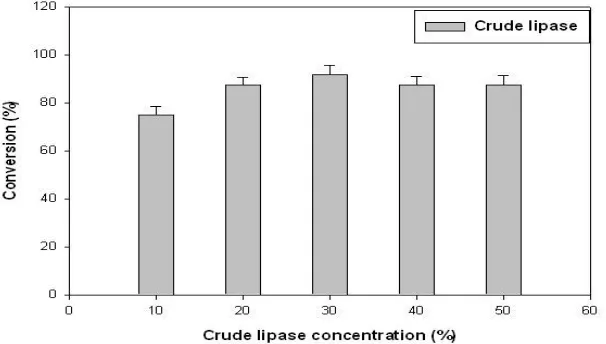
Fig. 1 and Fig. 2 show the percent variation when different amounts of crude lipase were used (10-50 % crude lipase; 100 - 500 mg immobilized lipase). Crude lipase at 30% concentration (wt. by oil) showed highest fatty acid conversion. Higher concentrations of lipase (>30 %) in fact decreased product yield. It is presumably due to increase in the viscosity of the reaction mixture. Immobilized enzymes are known to give better transformation rates in the organic media.
The excess enzyme did not contribute to the increase in the percentage conversion. It is similar to the results as reported by Torres and Otero [15], that excess of enzyme did not increase
Volume of NaOH used without enzyme – volume of NaOH used with enzyme
230
[image:5.595.133.436.182.354.2]percentage conversion and sometimes it would decrease the yield of the product. At saturation point, all the substrates were bound to the enzyme and added enzyme molecule could not find any substrate to serve as reactant. According to Aracil et al. [16] the most significant effect in enzymatic transesterification reaction is the initial catalyst concentration.
Fig. 1. Effect of crude lipase concentration on transestification reaction
Fig. 2. Effect of immobilized crude lipase concentration on transesterification reaction
Effect of molar ratio for transesterification
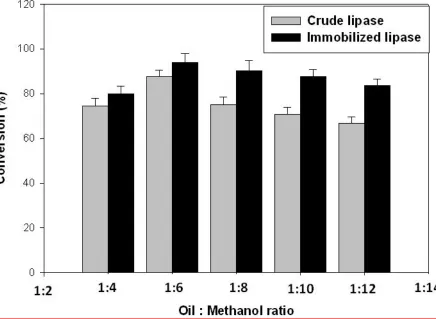
Methanol is the most commonly used alcohol in biodiesel production, mainly because of its reactivity. In addition, methanol is the most toxic and has the most deleterious effect on the biocatalyst activity in comparison to other alcohols. The effect was studied in the range of 1:2 to 1:12 molar ratio.
[image:5.595.144.436.408.589.2]231
to be 1:6. This was also found by Noureddini et al. [18]. although the ratio was higher (7.5:1). Proteins are generally unstable in short – chain alcohols such as methanol and ethanol.
Therefore, lipases are inactivated by contact with insoluble methanol, which existas drops in the
oil. Thus, to avoid this problem the amount of methanol used should be below its solubility limits in oil [17-19].
Methanol is highly polar and more hydrophilic, since they are capable of solubilizing large amounts of water and remove the layer of essential water from the enzyme, causing loss of the catalytic activity.
[image:6.595.82.518.247.566.2]
Fig. 3. Effect of molar ratio on transesterification reaction
Effect of reaction temperature
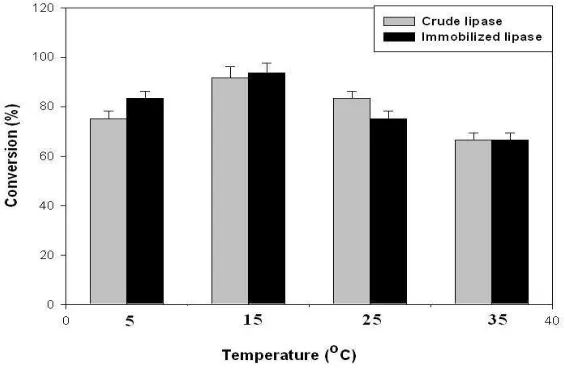
The effects of reaction temperature can be apportioned to its effect on oil and solvent solubility
as well as its direct influences on the reaction and the enzyme [20]. The effect of temperature on
this transesterification reaction was examined at the temperature range from 5 ◦C to 25 °C with
232
[image:7.595.138.421.199.385.2]and other bonds in the lipase structure. Hence, the enzyme molecule will unfold and alter its tertiary and quaternary structure or globular structure. Consequently catalytic power of the lipase will be reduced, because denaturation process has occurred [21]. According to Carta et al. [22], immobilization on lipase will alter its sensitivity to temperature. Change in the reaction temperature can affect the activity and stability of the enzymes and thus the rates of reaction [23].
Fig. 4. Effect of reaction temperature on transesterification reaction
Fig. 5. TLC analysis of the methyl esters produce during transesterification reaction catalyzed by lipase (Microbacterium sp.) lane 1-jatropha oil (control) lane 2- immobilized crude lipase reaction, lane 3- crude
233
CONCLUSION
Finally three parameters were chosen to optimize the production of biodiesel fuel, namely amount of enzyme, molar ratio of substrates and acyl acceptor and reaction temperature. Immobilized lipase catalysis proved as a powerful tool for rapid production of biodiesel from jatropha oil and obtained a maximum fatty acid conversion. The production of cold active lipase by solvent - stable cold adapted Microbacterium sp. owing to its low optimum temperature offers an advantage in industrial application. Over other enzyme (lipase) that require temperature range of 40-50 °C and cold – actives lipase show facilities the substitution of a mild and clean industry procedure for the conventional energy – costing and pollution – inducing chemical one.
Acknowledgment
Authors thank Mr. Mohd. Junaid of Department of Microbiology and Fermentation Technology, Jacob School of Biotechnology & Bioengineering, Sam Higginbottom Institute of Agriculture Technology and Sciences Allahabad for technical support.
REFERENCES
[1]M Mittelbach, J. Am. Oil Chem. Soc, 1990, 67:168–170.
[2] P.K, Meka, V.Tripathi, and R.P. Singh. J. Oleo Sci. 2007, 56:9-12.
[3] G.M, Gubitz, M. Mittelbach, and M. Trabi, Bioresour. Technol. 1998, 67:73-77.
[4]F. Ma and M.A. Hanna, Biores. Technol, 1999, 70:1–15.
[5]H. Fukuda, A. Kondo and H. Noda, J. Biosci. Bioeng, 2001, 92:405–416.
[6]B.K.Barnwal and M.P,Sharma, Renew Sust Energy, 2005, 9:363–378.
[7]K. Nie, F. Xie, F, Wang and T. Tan, J. Mol. Catal. B: Enz. 2006, 43:142–147.
[8]Yu. Luo, Y. Zheng, Z. Jiang, Y. Ma, D. Wei, Appl Microbiol Biotechnol, 2006, 73:349–355.
[9]K. Ban, M. Kaieda, T. Matsumoto, A. Kondo and H. Fukuda. Biochem. Eng, 2001, 8:39–43.
[10]U.K. Winkler and M. Stuckmann, Glycogen, J. Bacteriol, 1979,138:663–670.
[11]O.H, Lowery, N.J. Rosebrough, A.L. Farr and R.J,Randall, J. Biol. Chem. 1951,
193:265-275.
[12]M.A. Farid, E.L.Diwany and H.A. El- Enshasy, Acta Biotechnol, 1994, 14: 67-74.
[13]S. Shah, A. Sharma and M.N. Gupta, Energy and Fuels, 2004, 18:154-159.
[14]S.M. Radzi, M. Basri, A.B. Salleh, A. Ariff, R. Mohammad, M.B.A. Rahman, R.N.Z.R.A.
Rahaman, Electronic J. Biotechnol, 2005, 18:291-298.
[15]C. Torres and C. Otero, Enzy Microbial. Technol, 2001, 29:3-12.
[16]J. Aracil, T. Garcia and M. Martinez, Enzy. Microbial Technol, 1993, 15:607-611.
[17]Y. Shimada, Y. Watanabe and T. Samukawa, J. Am. Oil Chem. Soc. 2002,76: 789–793.
[18]H. Noureddini and X.R.S. Gao, Philkana – Biores. Technol, 2005, 96:769-777.
[19]A.M.P. Koskinen and A.M Klibanov, Blackie Academic and Professional, London. pp.
1996, 184-189.
[20]N.L. Facioli and D. Barrera – Arellano, J. Sci. Food Agri, 2001, 81:1193-1198.
[21]Y. Luo, Y. Zheng, J. Zhengbing, M.A. Yushu and W. Dongzhi, Appl. Microbial.
Biotechnol, 2006, 73:349-355.
[22]G. Carta, J.L. Gainer and A.H. Benton, Biotechnol. Bioeng, 1991, 37:1004-1009.
[23]R.W. Mcgilvery and G.W Goldstein,. 3rd editionj, Philadelphia, London, Toronto Mexico