REVIEW ARtICLE
▼
Memory, brain and aging: the good, the bad and the promising
by Beth A. Ober
A large body of evidence converges on the conclusion that episodic mem-ory (the recollection of personally experienced events) is the only long-term memory system that shows significant age-related deficits. More-over, the brain regions most likely to show age-related volume loss are those most critically involved in epi-sodic memory. Older adult brains may have much greater plasticity (capacity to change) than once believed; for example, neurogenesis (the birth of new neurons), increases in cognitive (including memory) performance, and increases in regional brain volume have all been shown to occur in older adulthood, as a result of physical or mental activity/training. The next wave of research will enhance our understanding of brain plasticity in adulthood and enable specific guide-lines for lifestyle or pharmacological treatments that optimize brain and memory functioning well into late adulthood.
W
hen middle-aged or elderly adults discuss their health and well-being, one of the most commonly expressed worries is memory problems, including the fear of Alzheimer’s dis-ease. This is not surprising, given that memory functions are at the core of our day-to-day intellectual and social activi-ties. Memory enables us to know who we are, as well as what our goals, values and beliefs are. Memory allows us to think about recent and remote events in our lives, and to plan for the future. Moreover, memory enables us to accu-mulate and make use of vast reservoirs of information about people, objects, places, social customs, language and individual domains of expertise (e.g., birds, wine, astronomy, neuroscience).Skills that we have acquired over our lifetimes, most of which can be exe-cuted in a fairly automatic manner (e.g., typing, driving, reading, swimming, knitting, playing a musical instrument) also depend on memory.
Adults over 65 years old comprise 11.2% (4.1 million) of Californians. Due in part to aging baby boomers, California’s elderly population is ex-pected to grow twice as fast as the total population to more than 8 million by 2020 (US Census Bureau 2010). Changes in memory function, or even the per-ception and interpretation of such changes by oneself or by others, can affect day-to-day functioning and well-being in a variety of contexts, including family, community and workplace. Each and every one of our actions, interac-tions, musings, decisions and plans critically depend on memory.
Memory myths vs. reality
A number of myths persist about memory and aging.
Myth: “Memory abilities will decline in older adulthood to a degree that will significantly affect day-to-day
function-ing.” Rather, about 85% of adults age 65
and older do not show significant de-clines in memory ability and are able to live independently.
Myth: “Alzheimer’s disease is
inevita-ble in old age.” In fact, Alzheimer’s
dis-ease, which accounts for about 50% of all dementia cases, occurs in 0.9%, 4.2% and 14.7%, of those 65, 75 and 85 years of age, respectively (Brookmeyer et al. 2007). Although the risk of Alzheimer’s disease and other dementias increases with age, a minority of older adults are affected.
Myth: “When memory problems oc-cur in normal aging, they involve all
aspects of memory.” Only one type of
long-term memory, known as episodic or event memory, undergoes significant decline in normal aging; other types of long-term memory either remain unaffected or show improvement. (“Normal aging” indicates the absence of dementia or other brain disease, and the ability to live independently.) This misunderstanding reflects the lack of awareness of scientific evidence for several separable types of long-term memory function, each with separable brain underpinnings.
Major types of long-term memory
Cognitive scientists define short-term memory as that which is available in consciousness (e.g., the sentence that was just spoken, the phone number just dialed), whereas long-term memory High levels of mental activity, such as playing games like bridge, are predictive of improved cognitive and brain outcomes in older adulthood.
iStockphoto/W
outer v
encompasses any memories that are still available after a brief period (30 to 60 seconds) of distraction or disen-gagement. Information in short-term memory will only be encoded into long-term memory and be available for retrieval after a delay if one is mo-tivated or interested in remembering it. Otherwise, it will quickly be forgot-ten. When information in short-term memory is manipulated in some way, for example in order to make linkages with information in long-term storage, or in the service of computations, this type of memory is referred to as work-ing memory.
There is general agreement among cognitive psychology and neuroscience scholars on the broad outlines of the behavioral and brain aspects for the following three major types of long-term memory (Schacter and Tulving 1994; Schacter et al. 2000; Squire and Knowlton 2000).
Episodic. Episodic memory involves
the conscious recollection of episodes or events, along with a personal context. Recalling a dinner party attended last week, including where the event took place, who was there, what you ate and what the conversations were about, ex-emplifies episodic memory.
Semantic. Semantic memory involves
“world knowledge” in the broadest sense: languages, objects, places, spatial relationships, social norms, facts/trivia, and all sorts of concepts from domains in which one may or may not be an expert. The knowledge brought to the dinner party about the names, back-grounds and interests of the guests is part of semantic memory.
Procedural. Unlike both episodic
and semantic memory, procedural memory is not easily accessible to con-scious awareness or verbal description and evaluation. Procedural memory includes: (1) sensory-motor skills such as typing, bicycle riding and piano playing; (2) learning and memory for procedures, sequences and rules to solve tasks and puzzles; and (3) repeti-tion priming, an increase in speed and/ or accuracy when identifying a word or picture on repeated presentation as compared to its initial presentation, even when the item is degraded and the presentations are separated by many days (fig. 1). Driving skills used to get to
the party exemplify the sensory-motor type of procedural memory.
Episodic recall and recognition
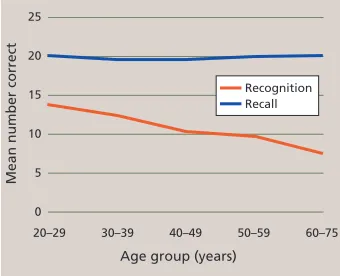
Laboratory tests of episodic memory generally involve a study phase for a set of to-be-remembered words (or pictures or sentences), followed by a test phase in which participants are asked to either recall or recognize the items that they recently studied. Recall tests can be either “free” (e.g., “Tell me everything you remember from the list”) or cued (e.g., “Tell me all animals that you can remember from the list”). Age-related declines in episodic recall are well documented (fig. 2). Recognition tests typically require a “yes” versus “no” response as to whether an item was in the previously studied list. Older adults show little or no deficit in memory per-formance for recognition, in contrast to significant deficits for recall (fig. 3). This reduction has been attributed to environmental support, which reduces the effort needed for retrieval processes. The dissociation between recall and recognition is why we often fail to recall the name of a movie we saw or a person we met several days ago, whereas we can easily recognize the name as correct when it is presented to us either alone or as one of several options. The older we are, the more often we have failures of recall. However, when recognition is successful for a name that cannot be recalled, this shows that the name is at least partially available in memory but not readily accessible.
The differential susceptibility of recognition versus recall perfor-mance in normal aging is consistent
20–29 30–39 40–49 50–59 60–69 70–79 80–89
Age groups (years)
Z scores
1.5 1 0.5 0 −0.5 −1 −1.5
Rey Benton Free recall Cued recall
20–29 30–39 40–49 50–59 60–75
Age group (years)
Mean number correct
25 20 15 10 5 0
[image:2.612.210.558.55.216.2]Recognition Recall
[image:2.612.390.558.255.418.2]Fig. 1. Increasingly complete versions of a given object are shown until the object is identified. Source: Snodgrass et al. 1987; reproduced by permission from Life Science Associates.
Fig. 2. Adult life span (cross-sectional) performance on four episodic memory tasks. “Benton” and “Rey” data are from clinical, pictorial, word-list learning tests named after the authors; “cued recall” and “free recall” data are from laboratory, word-list learning tasks created by the source author. Plotted Z scores are referenced to the entire age range, with an overall mean of zero; younger adults are above and older adults are below zero. Source: Park et al. 2002; © 2002 American Psychological Association.
[image:2.612.388.558.544.682.2]with dual-process models of episodic memory — recollection and familiarity (Light et al. 2000). Recollection is a rela-tively slow and deliberate process that involves memory access for the desired item/episode in tandem with informa-tion concerning the context in which it was experienced, such as when or where the episode occurred, the emo-tions experienced at the time, and so on. Familiarity, in contrast, is a relatively automatic process that provides a quick indication of the strength of the mem-ory for the item/episode, without any link to the context in which it was expe-rienced. For example, when you realize that you know the woman in front of you in a store’s checkout line but cannot recall her name or where or when you met her, you are exhibiting successful familiarity-based memory, along with a frustrating lack of recollection-based memory. For both everyday and labora-tory memory tasks, recollection plays a larger role in recall, whereas familiar-ity plays a larger role in recognition. Moreover, numerous studies indicate
that recollection is more negatively af-fected than familiarity, just as recall is more negatively affected than recogni-tion, in aging. These two components of episodic memory may reflect neuroana-tomically distinct memory processes, with recollection being more dependent on the brain’s hippocampus, and fa-miliarity being more dependent on the nearby entorhinal cortex.
Semantic memory improves with age
In contrast to the steady declines in episodic memory across all decades of adulthood, semantic memory is not only preserved, but also shows improvement until around the eighth decade of life, after which a gradual decline can be observed. Vocabulary and general knowledge tests are most commonly used to evaluate semantic memory (fig. 4). There is evidence that as we progress through middle and older age we acquire larger vocabu-laries and more extensive knowledge about the world around us, which is certainly good news regarding memory and aging. Increased world knowl-edge presumably can compensate to some extent for decreased facility in episodic memory. For example, linking to-be-remembered items and events in a meaningful way with information stored in semantic memory increases the likelihood of successful memory retrieval for these items; this type of semantic encoding strategy benefits older as well as younger adults (Froger et al. 2009).
Although our vocabulary knowledge is relatively protected from age-related loss, the ease with which we retrieve words is not. We are all familiar with the “tip-of-the-tongue” (TOT) phenom-enon in our everyday lives. It begins when we are attempting to come up with a word, generally a noun and sometimes a proper name, that we want to use in conversation. We fail to retrieve the desired word or name, and yet we are sure that we know the word, and sometimes can think of the first letter, the last syllable or some aspect of
the word’s meaning. Sometimes, when we are not trying to retrieve the word, it simply “pops” into consciousness. TOTs have been studied with naturalistic di-ary studies as well as controlled labora-tory methods (Burke et al. 1991; Heine et al. 1999). Findings indicate greater numbers of TOTs and longer resolution times for older compared to younger adulthood; however, without time pres-sure, older adults are as successful as younger adults in retrieving desired words. According to the widely favored incomplete activation (transmission def-icit) hypothesis (Burke et al. 1991), TOTs occur when there is not enough activa-tion from the semantic (meaning-based) knowledge about a desired word to lexical (word-based) and/or phonologi-cal (sound-based) knowledge, preclud-ing the ability to retrieve the complete phonology for the desired word. This incomplete activation from semantics to phonology is more likely to happen for words and names encountered in-frequently or not encountered recently, and for older as compared to younger adults. As frustrating as word-finding difficulties can be, the good news is that they are due to the slowing of access and retrieval, rather than the loss of knowledge.
20–29 30–39 40–49 50–59 60–69 70–79 80–89
Age group (years)
Z scores
1.5
1
0.5
0
−0.5
−1
−1.5
Vocabulary
[image:3.612.411.586.56.307.2]Shipley Synonym Antonym
Fig. 4. Adult life span (cross-sectional) performance on three semantic memory tasks. “Shipley” data are from a standardized, clinical vocabulary test, whereas “synonym” and “antonym” data are from laboratory-based vocabulary tests. Plotted Z scores are referenced to the entire age range, with overall mean of zero. Performance improves until about age 70, followed by minimal decline. Source: Park et al. 2002; © 2002 American Psychological Association.
As we progress through middle and older age we acquire larger
vocabularies and more extensive knowledge about the world
around us.
While episodic memory (the ability to remember things that happened) declines with age, semantic memory (one’s store of general knowledge) continually increases until about the eighth decade of life.
Alternate methods of assessing se-mantic memory do not require word retrieval and therefore are not affected by aging-related word-retrieval difficul-ties. These are referred to as implicit methods because the person being tested need not be consciously aware of the nature of the semantic knowledge being evaluated. A research method called “semantic priming” capitalizes on the fact that we are faster to process an item that follows an associated, semantically related item versus an unrelated item. For example, the word “truck” is processed more quickly when it follows “car” than when it follows “lion”; in this case the related words share features common to vehicles. The task required of the participants is most commonly a “word” versus “nonword” button press for each of a large number of letter strings (e.g., peach, salfay, car, truck). The timing of word presentation and recording of response times are computer controlled. The participant’s attention is focused on the required response, rather than possible linkages between adjacent words, especially if the number of semantic linkages within the list is low. A reduction in response time, when associative and semantic linkages are present versus absent, comprises the semantic priming effect. With semantic priming tasks, the pres-ervation of a wide variety of semantic knowledge about objects and their re-lationships has been demonstrated, not only for healthy elderly adults but also for patients with Alzheimer’s disease (Ober 2002; Ober et al. 1991).
Procedural memory preserved
Procedural memory seems to be quite well preserved in normal aging. For sensory-motor tasks such as knit-ting or bicycle riding, although memory for sequential components is preserved these tasks may be performed more slowly and/or awkwardly due to mo-tor performance issues associated with aging (e.g., arthritis, muscle weak-ness). For tasks that involve learning and memory for sequences or rules, but little or no motor skill, there is strong evidence for age-equivalent rates of learning and memory reten-tion. Examples include card games such as bridge or solving Sudoko puzzles. Finally, for procedural-memory tasks
that are more perceptual, such as pic-ture or word identification (e.g., from an incomplete picture; fig. 1), older and younger adults show equivalent in-creases in speed and accuracy in iden-tifying previously experienced pictures or words as compared to new ones.
Brain and memory
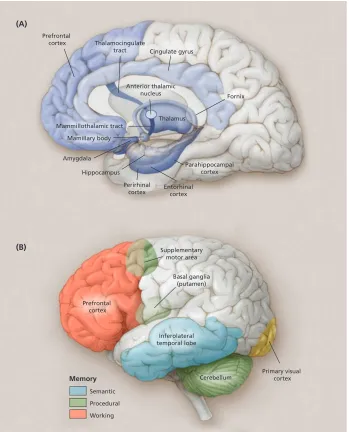
Multiple regions of the brain are involved in memory, with particular
regions playing key roles in particu-lar types of memory (figs. 5A and 5B). The episodic memory system depends critically on the medial temporal lobes (including the hippocampus and adja-cent entorhinal and parahippocampal regions). Evidence for the hippocam-pus’s critical role in episodic memory has come from neuroimaging studies of amnesia patients (e.g., post-stroke) showing damage to the hippocampus,
Prefrontal cortex
Supplementary motor area
Cerebellum Inferolateral
temporal lobe Basal ganglia
(putamen)
Primary visual cortex
Memory
Semantic Procedural Working Prefrontal
cortex Thalamocingulate
tract Cingulate gyrus
Fornix
Parahippocampal cortex Thalamus Anterior thalamic
nucleus
Mammillothalamic tract Mamillary body
Amygdala
Hippocampus Perirhinal
cortex Entorhinalcortex (A)
(B)
[image:4.612.211.560.205.637.2]as well as dementia patients with prominent episodic memory deficits (Alzheimer’s disease).
Even damage to a very small sec-tion of the hippocampus (such as can occur after CO2 poisoning or cardiac arrest) can result in significant episodic memory problems (Hopkins et al. 1995; Zola-Morgan et al. 1986). The hippo-campus is part of the limbic system, and when a lesion occurs in particular lim-bic structures (e.g., mammillary body, fornix, anterior thalamic nucleus; fig. 5A) episodic memory dysfunction may occur. The prefrontal cortex (the large, anterior portion of the frontal lobes) is another important brain area for epi-sodic memory; the hippocampal region needs to “work with” the frontal lobes (involving working memory processes). The hippocampal-frontal collaboration enables effective episodic encoding and retrieval, particularly for source (e.g., location, person, place) and time-related aspects of to-be-remembered events.
The semantic memory system is not dependent on the hippocampus or related structures, and world knowl-edge acquired prior to brain injury or disease is generally intact in amnesics. There is ample evidence that the vi-sual features of objects are stored in the visual processing centers of the brain, auditory features are stored in the auditory processing centers of the brain, and so on, such that the complete knowledge representations of objects are distributed throughout the cortical regions involved in object perception. Additionally, specific regions of the left prefrontal cortex and bilateral anterior temporal cortex seem to be involved in retrieving, maintaining and select-ing semantic information (Badre and Wagner 2002; Oliver and Thompson-Schill 2003).
Procedural memory, like seman-tic memory, is not dependent on the hippocampus or related structures; indeed, amnesic patients do not show impairments in the various types of procedural learning and memory tasks described earlier. The brain areas in-volved (e.g., motor cortex, visual cortex, prefrontal cortex and cerebellum; fig. 5B) are varied, and depend on the par-ticular type of procedural learning and memory task.
Structural brain changes
Based on autopsy data and low-resolution (in vivo) CT scans, the gross structural brain changes associated with normal aging include: overall shrinkage of the cortex (brain atrophy due to tissue/cell loss), enlargement of the cerebral ventricles (structures in the center of the brain filled with cerebral spinal fluid), and increasing size of the cortical sulci (convolutions of the cerebral cortex that form “hills” [gyri] and “valleys” [sulci]). High-resolution magnetic resonance imaging (MRI) has enabled increasingly precise quantifica-tion of not only general brain changes, but also age-related volume changes for particular brain regions and structures.
Raz et al. (2005) summarized struc-tural brain changes in normal aging. This cross-sectional study of adults ranging from about 20 to 80 years old also had a longitudinal component in that subjects were measured initially and after five years. For brain-volume changes both within individuals and across individuals of different ages, the hippocampus and subregions of the prefrontal cortex showed sizable reductions with age, whereas the ento-rhinal cortex and primary visual cortex showed minimal or no such reductions (fig. 5). The differential loss of volume for hippocampal versus entorhinal
cortex is in keeping with evidence for greater dependence of recollection as-pects of episodic memory (impaired in aging) on the hippocampus, versus greater dependence of familiarity as-pects of episodic memory (relatively preserved in aging) on the entorhinal cortex; however, the entorhinal cortex does show volume loss among 70-plus-year-olds. When the integrity of white matter tracks (bundles of axons, which are parts of nerve cells that transmit electrical signals to other neurons) is specifically evaluated, either via MRI or diffusion tensor imaging (a high- resolution imaging tool specifically tar-geted to white matter), the greatest defi-ciencies for older compared to younger adults are in the frontal lobes rather than the more posterior lobes (Head et al. 2004; Wen and Sachdev 2004).
To summarize, the structural brain changes associated with normal ag-ing consist of declinag-ing brain tissue volume, with the prefrontal cortex and hippocampus particularly affected. The hippocampus plays an essential role in episodic memory functioning, and also must “work with” the prefrontal cor-tex in order for episodic encoding and retrieval to work effectively. Moreover, among the three types of long-term memory, only episodic memory is nega-tively affected in normal aging.
Certain parts of the brain show volume reductions with age, especially the prefrontal cortex and hippocampus. Both are important to the functioning of episodic memory, which plays a critical role in remembering past events.
iStockphoto/Sean
W
Brain function and plasticity
Although there is ample evidence for decreases in tissue volume during the course of normal aging, three important facts greatly mitigate this bad news.
Atrophy. First, older adults are quite
heterogeneous and some will have minimal brain-tissue loss over time. The degree of brain atrophy in normal aging may have been overestimated in previous research, because sub-jects with preclinical dementia were not excluded due to lack of long-term follow-up evaluation. Burgmans et al. (2009) began a longitudinal study with cognitively healthy adults (52 to 82 years old), and after three years an MRI brain scan accompanied cognitive test-ing. The subgroup of participants who had shown cognitive decline over the past three years exhibited a significant age-related decrease in brain tissue vol-ume (for parahippocampal, cingulate gyrus and prefrontal cortex), but the subgroup who remained cognitively stable showed no age-related decreases. This promising finding will hopefully be replicated and extended.
Plasticity. Second, brain plasticity,
which enables changes in brain struc-ture and function due to experience and learning, occurs even in older adults. The brains of older as well as younger animals (rats and nonhuman primates) show increases in the number of neural synapses (by which neurons commu-nicate with one another), neurotrans-mitter activity, number of glial cells (which support neuronal functions) and capillary vascularization (blood supply for neurons and glial cells) as a function of “enriched environments” or specific learning experiences (Kramer et al. 2004; Markham and Greenough 2004). Using methodologies appropri-ate to human subjects (functional MRI), researchers have demonstrated long-lasting changes in regional brain activa-tion patterns as a result of “targeted” behavioral training.
The most exciting research on brain plasticity, however, provides evidence for neurogenesis (the “birth” of new neurons), not only in adult nonhu-man animals, but in older, as well as younger, adult human brains, as a func-tion of new learning (Kempermann 2006). The brain areas where
neurogenesis has been reliably demon-strated are the hippocampus, olfactory bulb (where primary odor processing occurs) and caudate nucleus (near the center of the brain and involved in feed-back-related aspects of learning and memory). Hippocampal neurogenesis is especially good news, given the critical role of the hippocampus in laying down new episodic memories, and given that the hippocampus is one of the most vul-nerable brain areas in terms of cell loss associated with normal aging (and to a much greater extent, with Alzheimer’s disease).
Bilaterality. Third, brain function
and the cognitive functions dependent upon it may not be in “lock-step” with decreases in brain tissue volume, due to age-related changes in the patterns of brain activation that are associated with particular types of cognitive tasks. One such age-related change is the increased bilaterality (activation in both hemispheres) of prefrontal activa-tions in older as compared to younger adults (Park and Reuter-Lorenz 2009). In younger adults, verbal memory tasks result in focal activations in the left pre-frontal cortex, whereas visual/spatial memory tasks result in right prefrontal activations. This strong laterality is not seen in older adults; instead, activation in the “appropriate” side of the brain is reduced, while activation in the “inap-propriate” side is increased. Increased bilaterality has been widely observed and it seems to be compensatory, en-abling improved performance: older adults who engage both the left and right prefrontal cortex on memory tasks have higher performance than those who don’t show bilateral activation (the improved performance is closer, but not equal to, that seen for younger adults).
Maintaining brain function
The question of how to maintain brain function into older age has cap-tured the attention of many thousands of biological and behavioral scientists nationally and internationally, who are obtaining large amounts of research funding from government sources, in-dustry and private foundations. In fact, UC scientists authored 1,885 articles on human brain aging and/or cognitive aging from 2000 to 2009, per the Web of Science (an online academic citation
index by Thomson Reuters). As the older adult population continues grow-ing at the state, national and global levels, there is increasing interest in interventions to minimize brain atro-phy, maximize brain functioning, and maintain adequate memory and other cognitive functions throughout later adulthood. The extent that memory and other cognitive functions can be maintained, or at least minimally im-paired, will have positive effects on day-to-day functioning and life satisfac-tion for older adults, as well as reduce caregiving costs and extend the years of independent living (i.e., fewer years in a nursing home).
Physical activity. There is increasing
support for the hypothesis that exercise as well as general physical fitness can improve cognitive (including memory) and brain function across the adult life span. Initial evidence was based mainly on observational studies. One particularly impressive correlational study (Erickson et al. 2009) showed that higher cardiovascular fitness signifi-cantly predicted greater MRI-measured hippocampal volume, as well as perfor-mance on an episodic memory task, in a large sample of 59- to 81-year-olds, even after controlling for age, sex and years of education.
In recent years, a number of exer-cise intervention studies have enabled the evaluation of causal links between exercise and cognition. These studies
Control Exercise
Executive Controlled Spatial Speed
Task type
Ef
fect size (g)
[image:6.612.388.559.491.628.2]0.8 0.7 0.6 0.5 0.4 0.3 0.2 0.1 0
involve the random assignment of par-ticipants to an exercise or control (no ex-ercise) group. Both before the start and at the end of treatment, various aspects of cognitive functioning are assessed. Most, but not all, individual studies have shown that exercise benefits cogni-tion. Fortunately, several meta-analyses have been carried out, which involve the calculation of exercise (vs. control) effects for many individual studies (meeting predetermined criteria) and then obtaining overall effect sizes for cognitive measures shared across
stud-ies. The upshot is that exercise posi-tively affects cognitive functioning in adults 55 and older, even those with early dementia (Kramer and Erickson 2007).
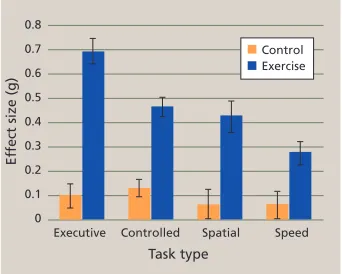
Overall effect sizes in these meta-analyses tend to be around 0.5, which is moderately robust, as in Colcombe and Kramer (2003) (fig. 6). For each of four cognitive tasks, the effect was statisti-cally significant for the exercise but not
control participants; episodic memory tasks were part of the “visuospatial” task domain. Additional findings in-cluded: a larger effect of exercise train-ing when the program duration was greater than 6 months, as opposed to 1 to 3 or 4 to 6 months; a much larger ef-fect for training sessions that were more than 30 minutes, as opposed to 15 to 30 minutes long; a somewhat larger effect for training that combined cardiovas-cular and strength training, as opposed to cardiovascular training alone; and finally, much larger training effects for the older age groups (66 to 70, or 71 to 80 years) as compared to the younger age group (55 to 65 years).
“Use it or lose it.” The “use it or
lose it” hypothesis is that increasing amounts of mental activity enable higher levels of cognitive functioning in middle and late adulthood; in other words, mental activity can counter-act the effects of normal aging. Early research on mental activity was dom-inated by correlational, observation-based studies. These studies involve the collection of self-report data from large numbers of older adults regard-ing their engagement in activities pre-sumed to be mentally stimulating (e.g., reading books, playing bridge, solving crossword puzzles), with follow-up over varying periods of time to assess cognitive status. The findings strongly support a positive correlation of mental
activity at baseline with overall cogni-tive function, including a reduced risk of Alzheimer’s disease, at follow-up evaluations spanning five or more years. For example, Wilson et al. (2007) found that a low mental activity group was 2.5 times more likely to develop Alzheimer’s disease than a high mental activity group over 5 years. Another example is a report by Valenzuela et al. (2008) that older adults’ scores on a life-time mental activity questionnaire were significantly predictive of MRI-assessed hippocampal atrophy over the follow-ing 3 years; that is, there is less atrophy with higher mental activity scores. Although encouraging, the correlational nature of these findings does not per-mit us to conclude that mental activity causes improved cognitive or brain out-come. It could be that more mentally ac-tive adults have healthier brains and/or have been more mentally active in the years prior to the start of the study than the less mentally active adults.
Increasing numbers of studies di-rectly manipulate cognitive activity via training sessions designed to improve episodic memory and other cognitive functions (Hertzog et al. 2009). There is ample evidence for the ability of older adults to show improvement on epi-sodic memory tasks (as well as many other cognitive tasks) with practice or training, especially when training in the use of strategies is involved. Evidence is limited and at times con-flicting regarding how long-lasting the effects of training are, the degree to which it can be generalized to non-trained but similar tasks, and whether the training is actually resulting in a reduction of age-related deficits on the trained task (as opposed to benefitting older and younger adults equally, thus maintaining the same degree of age-related deficits).
Among the “gold standard” type of cognitive intervention, the most ambitious is the ACTIVE (Advanced Cognitive Training for Independent and Vital Elderly) project, a multisite study in which 2,802 adults over 65 years of age were randomly assigned to a no-training (control) group or one of three cognitive training groups, with training taking place over 10 twice-per-week ses-sions. Each training group focused on one of the following: memory (episodic
the “use it or lose it”
hypothesis is that increasing
amounts of mental activity
enable higher levels of
cognitive functioning in middle
and late adulthood.
A recent study showed that higher cardiovascular fitness among 59- to 81-year-olds was correlated with greater volume in the brain’s hippocampus and better performance in an episodic memory task.
iStockphoto/T
list-learning), reasoning or speed of processing. All participants were tested in all three cognitive domains at the end of the training period, and yearly thereafter. Each of the three types of cognitive training yielded improved performance in the cognitive domain being trained (e.g., memory training im-proved memory performance); however, there was no transfer of these training effects to cognitive domains that were not trained (Ball et al. 2002). The larg-est training effects occurred for speed of processing, and the smallest were for memory. Five-year follow up data showed that the initial training benefi ts were still present, albeit much reduced (Willis et al. 2006).
Salthouse’s (2006) review of the mental activity literature concluded that although cognitive interventions can improve performance, there is a dearth of evidence for the transfer of training to untrained tasks (even within the same cognitive domain, such as episodic memory), or for long-lasting benefi ts. Based on a meta-analysis of randomized control trials of cognitive intervention, many of which included memory training, Papp et al. (2009) also concluded that there was no evidence for the generalizability or long-term benefi ts of training, with the important caveat that few studies have incorpo-rated long-term follow-up. However, the vast majority of cognitive intervention studies have entailed fewer than 10 training sessions; it is possible that with a larger number of training sessions, signifi cant, long-term benefi ts could be obtained.
On a more positive note, an intrigu-ing experimental fi eld study on cogni-tive training by Stine-Morrow et al. (2008) provided evidence that older adults who are immersed in a 6-month program of group-based, creative problem-solving (“Senior Odyssey,” modeled after the international “Odyssey of the Mind” program for children and young adults) show posi-tive changes in fl uid cogniposi-tive abilities (i.e., the processing and manipulation of information) that were not explicitly trained via the Odyssey program. More specifi cally, the Odyssey participants showed signifi cant increases in perfor-mance in comparison to controls for post-test (7 to 8 months after the start of
the Odyssey program) compared to pre-test (prior to the start of the program) assessments of the speed of informa-tion processing, inductive reasoning and divergent thinking (e.g., generating word associations or coming up with alternate/unusual uses of objects). The authors acknowledge that these im-proved cognitive abilities may not be maintained over a longer period of time in the absence of further engagement in the Odyssey or some similar program. Nonetheless, these fi ndings demon-strate the transfer of cognitive training/ engagement to thinking and reasoning skills that were not specifi cally trained.
Further work is needed to determine whether memory skills, especially episodic memory (not assessed in the Stine-Morrow [2008] et al. study) could also be improved by the type of group-based, intensive, cognitive training ex-emplifi ed by the Odyssey program.
Understanding memory, brain and aging
During the past 10 to 15 years, major advances have been made in our un-derstanding of the nature of memory changes that occur in normal aging, as well as the brain underpinnings for these changes. There have also been major advances in our understanding
tips for maintaining and, perhaps, improving brain and
memory functions in middle-to-older adulthood
• Get regular medical checkups and make it a lifelong goal to maintain healthy blood pressure, weight and cholesterol levels.
• Remind yourself, regularly, that “What is good for my heart is also good for my brain.”
• Engage in challenging and interesting cognitive activities (e.g., start learning, or re-learning, a second language).
• Exercise regularly (e.g., 30 minutes of brisk walking daily).
• Participate in social activities, via community organizations, special-interest clubs, etc. • Take up dancing (this activity
has physical, mental and social components) or some other “multicomponent” activity. • Eat a well-balanced diet with
plenty of fruits and vegetables
(supplying vitamins and minerals that are important for brain function).
• Eat fi sh that is high in omega-3 fatty ac-ids (e.g., salmon and trout) several times per week, or take a daily supplement for omega-3 fatty acids.
• Keep stress levels as low as possible (medi-tation, yoga and exercise can all help with stress reduction).
• Get 7 to 8 hours of sleep per night.
National Institutes of Health
iStockphoto/Steve Debenport
iStockphoto/Chris Rogers
of the variability in neurocognitive ag-ing, includag-ing, on the positive end of the continuum, documentation of older adults who show no brain or cognitive changes over several years (Burgmans et al. 2009). Evidence for brain plastic-ity in late adulthood continues to grow; this includes findings of neurogen-esis as well as age-related changes in patterns of brain activation that are associated with improved cognitive performance.
Generally, age-related increases in brain activations (e.g., frontal lobes) are interpreted as compensating for shrink-age in numerous brain structures (e.g., hippocampus) and declines in some
aspects of cognition (e.g., episodic mem-ory). Indeed, the Scaffolding Theory of Aging and Cognition is based on com-pensatory scaffolding, that is, the re-cruitment of additional neural networks to support declining networks whose functions have become inefficient and/ or noisy (Park and Reuter-Lorenz 2009). The challenge going forward is to fur-ther advance our understanding of the biological as well as psychological as-pects of memory functioning in normal aging, such that specific lifestyle (such as exercise regimen and dietary supple-ments) and pharmacological treatments can be recommended to middle-aged and older adults, with a high likelihood
of these treatments leading to satis-factory memory performance and relatively independent living well into the ninth and tenth decades of life. Successful treatments would presum-ably be those that result in increased brain scaffolding, made possible by the multiple mechanisms of neural plastic-ity that continue to function in older adulthood.
B.A. Ober is Professor, Department of Human and Community Development, UC Davis. The Guest Associate Editor for this article was Lisa M. Soed-erberg Miller, Associate Professor, Department of Human and Community Development, UC Davis.
References
Badre D, Wagner AD. 2002. Semantic retrieval, mne-monic control and prefrontal cortex. Behav Cogn Neu-rosci Rev 1(3):206 –18.
Ball K, Berch DB, Helmers KF, et al. 2002. Effects of cognitive training interventions with older adults: A randomized controlled trial. JAMA 288(18):2271–81.
Brookmeyer R, Johnson E, Ziegler-Graham K, Arrighi HM. 2007. Forecasting the global burden of Alzheim-er’s disease. Alzheimer Dementia 3:186–91.
Budson AE, Price BH. 2005. Current concepts — mem-ory dysfunction. New Engl J Med 352(7):692–9.
Burgmans S, van Boxtel MPJ, Vuurman EFPM, et al. 2009. The prevalence of cortical gray matter atrophy may be overestimated in the healthy aging brain. Neu-ropsychology 23(5):541–50.
Burke DM, MacKay DG, Worthley JS, Wade E. 1991. On the tip of the tongue — what causes word-finding failures in young and older adults? J Mem Lang 30(5):542–79.
Colcombe S, Kramer AF. 2003. Fitness effects on the cognitive function of older adults: A meta-analytic study. Psychol Sci 14(2):125–30.
Erickson KI, Prakash RS, Voss MW, et al. 2009. Aerobic fitness is associated with hippocampal volume in el-derly humans. Hippocampus 19(10):1030–9.
Froger C, Taconnat L, Landre L, et al. 2009. Effects of level of processing at encoding and types of retrieval task in mild cognitive impairment and normal aging. J Clin Exp Neuropsychol 31(3):312–21.
Head D, Buckner RL, Shimony JS, et al. 2004. Differ-ential vulnerability of anterior white matter in nonde-mented aging with minimal acceleration in dementia of the Alzheimer type: Evidence from diffusion tensor imaging. Cereb Cortex 14(4):410–23.
Heine MK, Ober BA, Shenaut GK. 1999. Naturally oc-curring and experimentally induced tip-of-the-tongue experiences in three adult age groups. Psychol Aging 14(3):445–57.
Hertzog C, Kramer AF, Wilson RS, Lindenberger U. 2009. Enrichment effects on adult cognitive develop-ment. Can the functional capacity of older adults be preserved and enhanced? Psychol Sci Public Interest 9:1–65.
Hopkins RO, Kesner RP, Goldstein M. 1995. Item and order recognition memory in subjects with hypoxic brain injury. Brain Cognition 27(2):180–201.
Kempermann G. 2006. Adult Neurogenesis: Stem Cells and Neuronal Development in the Adult Brain. New York, NY: Oxford Univ Pr. 448 p.
Kramer AF, Bherer L, Colcombe SJ, et al. 2004. Envi-ronmental influences on cognitive and brain plasticity during aging. J Gerontol: A-Biol Sci 59(9):940–57.
Kramer AF, Erickson KI. 2007. Capitalizing on cortical plasticity: Influence of physical activity on cognition and brain function. Trend Cogn Sci 11(8):342–8.
Light LL, Prull MW, La Voie DJ, Healy MR. 2000. Dual-process theories of memory in old age. In: Perfect TJ, Maylor EA (eds.). Models of Cognitive Aging: Debates in Psychology. New York, NY: Oxford Univ. Pr. Markham JA, Greenough WT. 2004. Experience-driven brain plasticity: Beyond the synapse. Neuron Glia Biol 1(4):351–63.
Ober BA. 2002. RT and non-RT methodology for semantic priming research with Alzheimer’s disease patients: A critical review. J Clin Exp Neuropsyc 24(7):883–911.
Ober BA, Shenaut GK, Jagust WJ, Stillman RC. 1991. Automatic semantic priming with various category relations in Alzheimer’s disease and normal aging. Psy-chol Aging 6(4):647–60.
Oliver RT, Thompson-Schill SL. 2003. Dorsal stream ac-tivation during retrieval of object size and shape. Cogn Affect Behav Neurosci 3(4):309–22.
Papp KV, Walsh SJ, Snyder PJ. 2009. Immediate and delayed effects of cognitive interventions in healthy elderly: A review of current literature and future direc-tions. Alzheimer Dementia 5:50–60.
Park DC, Lautenschlager G, Hedden T, et al. 2002. Models of visuospatial and verbal memory across the adult life span. Psychol Aging 17:299–320.
Park DC, Reuter-Lorenz P. 2009. The adaptive brain: Aging and neurocognitive scaffolding. Ann Rev Psy-chol 60:173–96.
Raz N, Lindenberger U, Rodrigue KM, et al. 2005. Re-gional brain changes in aging healthy adults: General trends, individual differences and modifiers. Cereb Cortex 15(11):1676–89.
Salthouse TA. 2006. Mental exercise and mental ag-ing: Evaluating the validity of the “use it or lose it” hypothesis. Perspect Psychol Sci 1(1):68–87.
Schacter DL, Tulving E. 1994. What are the memory systems of 1994? In: Schacter DL, Tulving E (eds.).
Memory Systems 1994. Cambridge, MA: MIT Pr. p 1–38.
Schacter DL, Wagner AD, Buckner RL. 2000. Memory systems of 1999. In: Tulving E, Craik IM (eds.). The Ox-ford Handbook of Memory. Oxford Univ Pr. p 627–43. Schonfield D, Robertson B. 1966. Memory storage and aging. Can J Psychol 20:228–36.
Snodgrass JG, Smith B, Feenan K, Corwin J. 1987. Fragmenting pictures on the Apple Macintosh com-puter for experimental and clinical applications. Beh Res Method Instrument Computer 19:270–4.
Squire LR, Knowlton BJ. 2000. The medial temporal lobe, the hippocampus and the memory systems of the brain. New Cognitive Neurosci:765–79.
Stine-Morrow EAL, Parisi JM, Morrow DG, Park DC. 2008. The effects of an engaged lifestyle on cognitive vitality: A field experiment. Psychol Aging 23(4):778– 86.
US Census Bureau. 2010. State and County Quick Facts. http://quickfacts.census.gov/qfd/states/06000. html.
Valenzuela MJ, Sachdev P, Wen W, et al. 2008. Life span mental activity predicts diminished rate of hippo-campal atrophy. PLoS One 3(7):e2598.
Wen W, Sachdev P. 2004. The topography of white matter hyperintensities on brain MRI in healthy 60-to-64-year-old individuals. Neuroimage 22(1):144–54.
Willis SL, Tennstedt SL, Marsiske M, et al. 2006. Long-term effects of cognitive training on every-day functional outcomes in older adults. JAMA 296(23):2805–14.
Wilson RS, Scherr PA, Schneider JA, et al. 2007. Rela-tion of cognitive activity to risk of developing Alzheim-er’s disease. Neurology 69:1911–20.