Proceedings of the International Conference on 17th – 19th November 2008 Information Technology and Multimedia at UNITEN (ICIMU’ 2008), Malaysia
Online Children Anthropometry Checking and Immunization Information
System
Norhalina bt Senan, Rahayu bt A.Hamid, Gan Hui Do
Faculty of Information Technology and Multimedia, Universiti Tun Hussein Onn Malaysia,
86400 Parit Raja, Batu Pahat, Johor, Malaysia.
[email protected], [email protected], [email protected]
Abstract
Online Children Anthropometry Checking and Immunization Information System was developed for the government clinics that assist in managing children healthcare via online. The system was developed to overcome the problem in the current legacy system where it is still paper-based in managing children’s healthcare record. This system applies the concept of online web application which involved client-server technology, MySQL database and Hypertext Preprocessor (PHP) as a web programming language. In addition, the development is based on Iterative Waterfall Model approach. Online Children Anthropometry Checking and Immunization Information System consists of several functions such as Patient Registration, Record Repository, Generation of Growth and Development Chart, Generation of Immunization Scheduling Table, Search function and also report generation. As a whole, the system is able to reduce workload and save time in managing children healthcare record. Thus, the quality of the government clinics management can be improved.
1. Introduction
Immunization is the process by which an individual is protected from getting a disease [1]. When someone is immunized, he or she is given a series of vaccines, which can be taken by mouth (orally) or injected. These vaccines help the body to fight disease such as diphtheria, pertussis, tetanus, poliomyelitis, tuberculosis, hepatitis B, measles, mumps, rubella and meningitis haemophilus influenzae type b [2]. In Malaysia, immunization is provided through the government network of health centre, hospitals as well as some private doctors and through schools.
Currently, the children’s healthcare process is begun after a child is registered and followed by an anthropometry checkup. Then, the child will be given a vaccine based on the Immunization Schedule. The process ends with the next predetermined appointment date given to the child caregiver. All of the information gathered during the checkup is recorded manually on paper.
However, the process of manually recording information suffers some disadvantages such as overlapping information, misplaced information, and difficulty of sharing/distributing children’s health information among health centre. Hence, a more systematic computerized system is needed in order to overcome these problems.
The paper is organized as follows Section 2 discuss the rationale of the proposed system. Section 3 surveys related work on children anthropometry checking and immunization. Section 4 describes the methodology used in the development of the proposed system. Finally, in Section5, we present the results of the system.
2. Rationale
Nowadays, healthcare is increasingly technology-driven. There is an immense array of new technologies in practically every aspect of patient management and health care. Most of these technologies have played important roles in improving the quality of health care delivered to populations, and in improving the quality of life and state of health of nations [3].
With that, we propose an Online Children Anthropometry Checking and Immunization Information System to ensure that children’s healthcare information is made easily available and accessible.
3. Related Work
This section discusses related work on immunization, current practice in Malaysia, and comparison with other medical information system.
3.1. Immunization
Immunizations are administrations of substances which protect a person from becoming infected by particular pathogens (bacteria, viruses, etc) [1]. Vaccine administrations can be given either orally or through injection. Two (2) types of immunization exist, active and passive. Vaccination is an active form of immunization [8].
Active immunization can occur naturally when a microbe or other antigen is received by a person who has not yet come into contact with the microbe and has no pre-made antibodies for defense. The immune system will eventually create antibodies for the microbe, but this is a slow process and, if the microbe is deadly, there may not be enough time for the antibodies to begin being used.
Passive immunization is where pre-made
elements of the immune system are
transferred to a person, and the body doesn't
have to create these elements itself. Currently,
antibodies can be used for passive
immunization. This method of immunization
begins to work very quickly, but it is short
lasting, because the antibodies are naturally
broken down, and if there are no B cells to
produce more antibodies, they will disappear.
Passive immunization can be naturally
acquired when antibodies are being
transferred from mother to fetus during
pregnancy, to help protect the fetus before
and shortly after birth.
In Malaysia, there are seven (7) types of vaccines given to a child i.e., BCG to prevent Tuberculosis,
Hepatitis B, Hib to prevent meningitis haemophilus influenzae type b, DPT/DT to prevent diphtheria, pertussis and, tetanus, MMR to prevent measles, mumps and rubella, OPV to prevent poliomyelitis and Measles to prevent measles restricted to children in Sabah.
3.2. Practice in Malaysia
The current immunization and anthropometry checkup is done manually with all information recorded in a specific form provided by the Ministry of Health. The forms include KKK 1/93A, KKK 1/93B, KKK 1/93P, KKK 1/93L, KKK 101 and KKK 103.
As mentioned previously, the children’s healthcare process is begun after a child is registered and followed by an anthropometry checkup. During the checkup, the child’s body weight, height, head and chest circumference is recorded. Besides that, the child’s development such as gross development (active movement of hands and legs, reaching an object), soft movement (focusing on an object, reciprocation of facial gestures), child’s psychosocial, hearing and spoken language. These measurements are recorded on KKK 1/93A and KKK 1/93B form, each for the caregiver and the health centre. This is followed by plotting the growth chart.
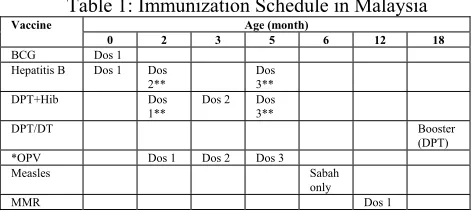
[image:2.612.312.548.450.556.2]During the checkup, should the child needs special treatment, an appointment with the doctor will be made. Then, the child will be given a vaccine based on the Immunization Schedule shown in Table 1.
Table 1: Immunization Schedule in Malaysia
Age (month) Vaccine
0 2 3 5 6 12 18 BCG Dos 1
Hepatitis B Dos 1 Dos 2**
Dos 3** DPT+Hib Dos
1**
Dos 2 Dos 3**
DPT/DT Booster
(DPT) *OPV Dos 1 Dos 2 Dos 3
Measles Sabah
only
MMR Dos 1
The processes end with the next predetermined appointment date given to the child caregiver and get the prescribed medicine at the pharmacy if necessary.
4. Methodology
In developing Online Children Anthropometry Checking and Immunization Information System, Iterative Waterfall Model is adapted. The model comprises of four (4) phases, i.e. planning, analysis, design and implementation and testing.
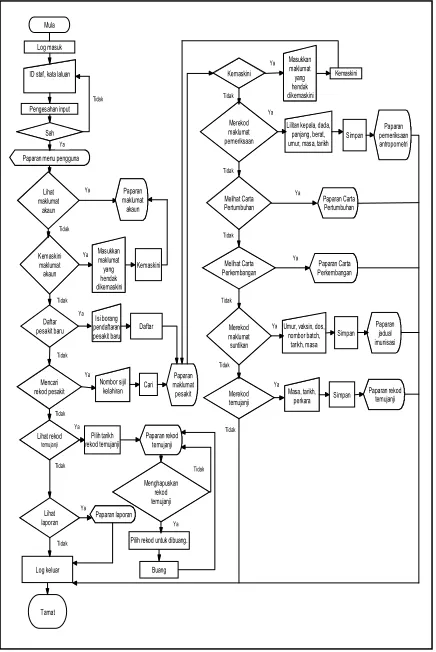
In the first phase, we identify the project objective, scopes, and problems that currently exist. We also conducted a feasibility study to determine the project's viability. Subsequently, system and user requirements were identified in the analysis phase. Based on the requirements, Data Flow Diagram (DFD) as in Figure 1 and Figure 2 and Entity Relationship Diagram (ERD) are modeled.
Mula
Tamat Pengesahan input
Log masuk
ID staf, kata laluan
Paparan menu pengguna
Kemaskini maklumat akaun Daftar Kemaskini Daftar pesakit baru Mencari rekod pesakit Kemaskini Lihat laporan Lihat rekod temujanji Melihat Carta Perkembangan Melihat Carta Pertumbuhan Merekod maklumat pemeriksaan Merekod temujanji Nombor sijil kelahiran Cari Paparan maklumat pesakit Paparan rekod temujanji Paparan laporan Log keluar Kemaskini
Lilitan kepala, dada, panjang, berat, umur, masa, tarikh Simpan
Umur, vaksin, dos, nombor batch, tarikh, masa Simpan Simpan Masa, tarikh, perkara Paparan pemeriksaan antropometri Paparan Carta Pertumbuhan Paparan Carta Perkembangan Paparan jadual imunisasi Paparan rekod temujanji Tidak Tidak Tidak Ya Ya Ya Ya Tidak Tidak Tidak Ya Ya Ya Ya Ya Ya Tidak Tidak Tidak Tidak Ya Merekod maklumat suntikan Sah Lihat maklumat akaun Ya Paparan maklumat akaun Pilih tarikh rekod temujanji
[image:3.612.316.537.60.235.2]Pilih rekod untuk dibuang. Menghapuskan rekod temujanji Buang Ya Tidak Ya Tidak Masukkan maklumat yang hendak dikemaskini Isi borang pendaftaran pesakit baru Masukkan maklumat yang hendak dikemaskini Tidak Tidak
Figure 1: Context Diagram
Staf Kesihatan Pesakit 0 Sistem Maklumat Pemeriksaan Dan Imunisasi Kanak-kanak Secara Dalam Talian Butiran maklumat pesakit
Butiran temujanji Maklumat temujanji
Maklumat suntikan imunisasi Maklumat pemeriksaan antropometri
Kata laluan, ID staf
Pemberitahuan Temujanji
Maklumat staf kesihatan Maklumat pesakit
Rekod pemeriksaan antropometri
Jadual Imunisasi Maklumat rawatan
Rekod Rawatan
Laporan Nombor sijil kelahiran
[image:3.612.76.294.266.592.2]Laporan Kesihatan
Figure 2: Data Flow Diagram – Level 0
In the design phase, four (4) types of designs were produced. These are, database design, architecture design, interface design and program design. For the interface, components such as menus, buttons, scroll bar, and display area are allocated appropriately. This is important in order to create an interactive and user friendly interface.
Finally, the actual development is done in the implementation phase. The testing process then involves three (3) different stages, i.e. unit testing, integration testing and user acceptance testing. This is conducted to guarantee that the system is error free and performed as required.
5. Results
[image:3.612.328.538.570.686.2]Figure 4: Main Interface
[image:4.612.333.524.176.302.2]Meanwhile, Figure 4 shows the main interface of the system. This page comprises of three (3) menus that are linked to Medical Staff Module, Administrator Module and Information Module. The Information Module displays general information regarding children anthropometry checking and immunization. The main functions of the system occur in the Medical Staff Module. Here, only authorized medical staff is allowed to access the system by providing staff id and password during log-in. Upon providing the valid id and password, the medical staff can then proceed to the next process.
Figure 5: Registration Form
Figure 6: Children Anthropometry Information
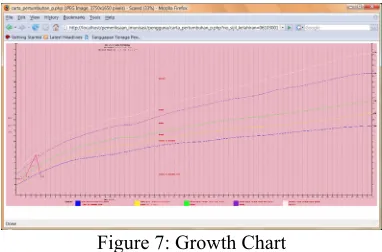
For new cases, the medical staff needs to fill in the registration form as shown in Figure 5. Then, anthropometry checkup is carried out. The details of the checkup will be recorded using the form in Figure 6. The interface also shows record of the patient’s previous checkup. The patient’s current weight is then feed into the next process, generating the growth chart. The growth chart can be seen in Figure 7.
Figure 7: Growth Chart
Finally, the patient’s immunization information is recorded as in Figure 8.
[image:4.612.325.525.348.473.2]
Figure 8: Immunization Table
.
6. Conclusion and Future Works
[image:4.612.87.280.368.623.2]7. References
[1] Kementerian Kesihatan Malaysia, “Fakta Imunisasi Kanak Kanak-kanak Bagi Kakitangan Kesihatan.”, Bahagian Pendidikan Kesihatan, 2002.
[2] Kementerian Kesihatan Malaysia. “Panduan Untuk Rancangan Imunisasi.”, Bahagian Pembangunan Kesihatan Keluarga, 2001.
[3] YB Dato’ Chua Jui Meng, Speech by the Minister Of
Health Malaysia, 2nd Asian Regional Health Technology
Assessment Conference, Kuala Lumpur, 16 December 2003.
[4] Degoulet, P., Marin, L., Lavril, M., Le Bozec, C., Delbecke, E., Meaux, J. J. and Rose, L., “The HEGP Component-Based Clinical Information System.”, Medical Informatics. 69, 2003, 115-126.
[5] Elberg, P. B., “Electronic Patient Records and Innovation In Health Care Services.”, Medical Informatics. 64.,2001, 201-205.
[6] Haux, R., “Health Information Systems - Past, Present, Future.”, Medical Informatics. 75, 2006, 268-281.
[7] Takeda, H., Matsumura, Y., Nakajima, K., Kuwata, S., Yang, Zhenjun., Ji, Shanmai., Zhang, Qiyan., Chen, Yufen., Kusuoka, H. and Inoue, M.,. “Health Care Quality Management By Means Of An Incident Report System And An Electronic Patient Record System.”, Medical Informatics. 69, 2003, 285-293.