A THEORETICAL PERSPECTIVE ADVANCEMENT OF 5G CELLULAR IN SIGNAL PROCESSING: SPECIAL REFERENCE TO SMART ANTENNA
Radhamma Erigela1, Dr. Phool Singh Chouhan2, Dr. Senthilkumar A3
Department of Electronics and Communication Engineering
1,2,3
OPJS University, Churu (Rajasthan)
ABSTRACT
The fourth generation wireless communication systems have been sent or are soon to be sent in
numerous nations. Be that as it may, with a blast of wireless mobile devices and administrations, there
are still a few difficulties that can't be obliged even by 4G, for example, the range emergency and high
vitality utilization. Wireless system architects have been confronting the consistently expanding interest
for high information rates and portability required by new wireless applications and in this way have
begun investigate on fifth generation wireless systems that are anticipated that would be sent past
2020. In this article, we propose a potential cell design that isolates indoor and open air situations,
what's more, talk about different promising advancements for 5G wireless communication systems, for
example, enormous MIMO, vitality productive communications, psychological radio systems, and
noticeable light communications. Future difficulties confronting these potential innovations are likewise
talked about.
INTRODUCTION
An Antenna in a Tele Communications system is
the gadget through which, in the transmission
mode, radio Frequency (RF) vitality is coupled
from the transmitter to the free space and
from free space to the beneficiary in the
accepting mode. In this section review of the
fundamentals, savvy reception apparatus ideas
are given alongside the characterization of keen
Antennas. Numerous allude to keen Antenna
systems as shrewd Antennas, yet as a general
rule reception apparatuses without anyone else
are not brilliant. It is the computerized signal
handling capacity, alongside the reception
apparatuses, which make the system brilliant.
CLASSIFICATION OF ANTENNAS
1. Omni-directional Antennas
2. Directional Antenna
1.1.2 Need for Smart Antenna
Wireless communication networks, as opposed
to their Wire line counterparts, pose some
unique challenges
1. The limited allocated spectrum result in
a limit on capacity
2. The radio propagation environment and
the mobility of users give rise to signal
fading and spreading in time, space and
frequency.
3. The limited battery life at the mobile
device poses power constraint
In addition, cellular wireless communication
networks have to cope with interference due to
frequency reuse. Examine endeavors exploring
viable technologies to alleviate such impacts
have been continuing for as long as a quarter
century, as remote interchanges are
encountering fast development. Among these
strategies are numerous get to plans, channel
coding and balance and brilliant reception
apparatus work. The wireless communication
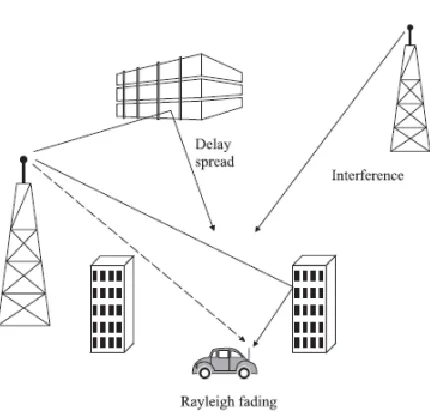
networks impairments that smart antennas are
challenged to combat.
Figure 1.3: Wireless Network Impairments
ADAPTIVE ANTENNA APPROACH
The versatile Antenna systems approach
imparts between a client and a base station
distinctively by including the measurement of
space. By acclimating to the RF environment as
it changes (or the spatial starting point of signs),
versatile reception apparatus technology can
improve the execution of the Wireless system.
Versatile exhibit systems give more degrees of
flexibility since they can adjust progressively the
radiation example to the RF signal environment;
as it were, they can coordinate the fundamental
shift toward the pilot signal or SOI while stifling
the reception apparatus design toward the
interferers or SNOIs.
Basically, versatile exhibit systems can alter a
suitable radiation design for every individual
client. The versatile idea is far better than the
execution of an exchanged bar system. The
exchanged pillar system is not ready to put the
wanted signal at the most extreme of the
fundamental flap, and it displays powerlessness
to dismiss the interferers completely. As a result
of the capacity to control the general radiation
design in a more prominent scope zone for
every cell site, versatile cluster systems can give
awesome increment in the limit.
Versatile cluster systems can find and track
signals (clients and interferers) and powerfully
confirm the Antenna example to improve
gathering while minimizing obstruction utilizing
signal preparing calculations. After the system
down believers got signs to baseband and
digitizes them, it finds the SOI utilizing the DOA
calculation, and it ceaselessly tracks the SOI and
SNOIs by progressively changing the intricate
weights (amplitudes and periods of the Antenna
components).
Fundamentally, the DOA figures the heading of
entry of the considerable number of signs by
registering the time delays between the
Antenna components, and a while later, the
versatile calculation, utilizing a cost work,
processes the fitting weights that outcome in an
ideal radiation design. Since Adaptive Array are
by and large more advanced preparing
escalated and require a total RF segment of the
handset behind every Antenna component,
they have a tendency to be more costly than
exchanged pillar systems.
REQUIREMENTS OF 5G WIRELESS NETWORKS
The 5G wireless network has not been
standardized yet. The detailed and exact
technical specifications of this network would
only be available in the near future. However,
the following technical requirements are
accepted by wireless industries and academia.
Coverage and Data rate: It is trusted
that the 5G ought to keep up network
at whatever time and anyplace with a
base client encounter data rate of 1
Gb/sec. As a rule, as the low portability
UEs channel changes much slower than
those of high versatility ones, these UEs
require more assets for CSI obtaining
(i.e., lessened successful data rate).
Hence, the pinnacle data rates required
5G network can be distinctive. The
network should likewise guarantee a
specific QoS for clients going at fast
(e.g., rapid trains going at 500 km/hr)
where the current networks can't
attractively bolster.
Latency: The latency prerequisite is
generally harder to accomplish
contrasted with that of the data rate as
it requests that the data be conveyed to
the goal inside a given timeframe. For
the 5G network, the end-to-end latency
necessity will be in the request of
1-5ms.
Connected devices: The future 5G
network is expected to incorporate
massive amount of connected devices
which may reach up to 100 times that
of the current wireless network. The
most potential use cases in this regard
are wearable computing, machine type
communications, wireless sensors, and
internet of things. Importantly, these
connected devices may have different
requirements in terms of
communication rate, delay and
reliability
Multiple RATs: The 5G network would
not be developed to replace current
wireless networks. It is rather to
advance and integrate the existing
network infrastructures with the new
one. In the 5G network, the existing
wireless technologies including Global
network for mobile communications
(GSM), 3G, High Speed Packet Access
(HSPA), LTE and LTE-advanced as well as
WI-FI will continue to evolve and be
integrated into a unified network.
Energy and cost efficiency: 5G wireless
technologies must be designed to
achieve significantly better cost
efficiency measured in bit/$ in order to
address the revenue flattening concerns
of mobile operators. In particular, the
energy efficiency measured in bit/Joule
of the 5G network may need to be
reduced by a factor of 1000 compared
to that achieved by current wireless
technologies.
A POTENTIAL 5G WIRELESS CELLULAR ARCHITECTURE FOR SMART ANTENNA
To address the above difficulties and meet the
5G system necessities, we require a sensational
change in the plan of cell engineering. We
realize that wireless clients stay inside for about
80 percent of time, while just stay outdoors
around 20 percent of the time. The current
ordinary cell engineering typically employments
an open air BS amidst a cell conveying with
mobile clients, regardless of whether they stay
inside or outside. For indoor clients imparting
experience building dividers, and this causes
exceptionally high infiltration misfortune, which
essentially harms the information rate,
phantom effectiveness, and vitality
effectiveness of wireless transmissions.
One of the key thoughts of planning the 5G cell
design is to isolate outside and indoor situations
so that infiltration misfortune through building
dividers can by one means or another be
maintained a strategic distance from. This will
be helped by conveyed reception apparatus
system (DAS) what's more, monstrous MIMO
innovation where geologically conveyed
reception apparatus exhibits with tens on the
other hand many reception apparatus
components is sent.
While most current MIMO systems use two to
four radio wires, the objective of monstrous
MIMO systems is to misuse the conceivably
extensive limit picks up that would emerge in
bigger varieties of receiving wires. Outside BSs
will be outfitted with extensive receiving wire
exhibits with some radio wire components.(too
extensive radio wire clusters) conveyed around
the cell what's more, associated with the BS by
means of optical strands, profiting from both
DAS and enormous MIMO advances.
CONCLUSION
In this article, the execution necessities of 5G
wireless communication systems have been
characterized as far as limit, ghostly proficiency,
vitality productivity, information rate, and cell
normal throughput. Another heterogeneous 5G
cellular architecture has been proposed with
isolated indoor and open air applications
utilizing DAS and enormous MIMO innovation.
5G networks are relied upon to fulfill quick
Wireless movement development. Monstrous
MIMO, millimeter wave communications, and
little cell advances are introduced to accomplish
gigabit transmission rates in 5G networks. In
this research, we concentrate on Impact of
Increment of Array in Antenna with Signal
Processing in 5G Cellular. Two regular little cell
situations are designed to break down the
Wireless backhaul activity in future 5G
networks.
Moreover, the vitality proficiency of Wireless
backhaul networks is thought about in two
regular little cell situations. Numerical results
suggest that the dispersion arrangement has
higher vitality proficiency than the focal
arrangement in 5G Wireless backhaul networks.
Be that as it may, a veritable test would without
a doubt develop if the new conveyance
organizes engineering is received in future 5G
Wireless backhaul networks. Fundamentals of
brilliant Antennas are examined in detail in this
part. Keen reception apparatus sorts are given
staged exhibits and versatile clusters. It is
exchanged pillar Antennas in view of the
accompanying reasons. The obstruction
dismissal ability of the versatile system is
essentially more than either the customary or
exchanged pillar system.
REFERENCES
• Han et al.,
"Green Disseminate: Broadcast Techniq
ues to Assent to Vigour Efficient
Wireless Networks," IEEE Commun.
Mag., vol. 49, no. 6, June 2011, pp. 46–
54.
• Nokia Siemens Networks,
"2020: Exceeding 4G: Proclaim Evolutio
n for the Gigabit Experience," white
paper, 2011.
• A. Bleicher, "Millimeter Waves May Be
the Lot of 5G Telephones," IEEE Field,
Aug. 2013.
• V. Chandrasekhar, J. G. Andrews, and
A. Accumulator, "Femtocell Networks: A
Survey," IEEE Commun. Mag., vol. 46,
no. 9, Sept. 2008, pp. 59–67.
• F. Rusek et al., "Scaling Less MIMO:
Opportunities and
Challenges nearby Very Large Arrays,"
IEEE Sig. Proc. Mag., vol. 30, no. 1, Jan.
2013, pp. 40–60.
• H. Haas,
"Remote Observations outlander Ever Li
ght Bulb," TED site, Aug. 2011;
http://bit.ly/tedvlc
• X. Hong et al., "Helper
Spectrum Entr Networks: Privately Deve
lopments on the Spatial Models," IEEE
Vehic. Tech. Mag., vol. 4, no. 2, June
2009, pp. 36–43.