A Decision Framework Model for Migration into Cloud:
Business, Application, Security and Privacy Perspectives
Shareeful Islam
School of Architecture, Computing and EngineeringUniversity of East London United Kingdom
[email protected]
Edgar R. Weippl
SBA Research Favoritenstraße 16 1040 Vienna, Austria[email protected]
Katharina Krombholz
SBA Research Favoritenstraße 16 1040 Vienna, Austria[email protected]
ABSTRACT
Cloud computing offers a different, affordable approach for supporting the IT needs of organisations. However, despite the unprecedented benefits cloud migration may bring, there are numerous difficulties involved in moving business criti-cal applications, legacy systems or corporate data into the cloud.It is necessary to consider a broad view over all ness areas, and taking into account the technical and busi-ness minutiae of a full scale cloud migration, as well as the wider concerns of security, privacy and other business and technical risks. A detailed understanding of all these areas is required in order to make the correct decisions concerning cloud migration. This paper aims to take a broad view of the issues relating to migration. We propose a process model to identify risks and requirements, as well as to provide control assurance during the migration decision. We also define an outline migration strategy by focusing on the context of the organisation.
Categories and Subject Descriptors
H.4 [Information Systems Applications]: Miscellaneous; D.2.8 [Software Engineering]: Metrics—complexity mea-sures, performance measures; D.2.9 [Software Engineer-ing]: Management—software process model
General Terms
Theory Cloud computing, Requirements, Process Model
Keywords
cloud migration, risk management, security, privacy
1.
INTRODUCTION
IT infrastructure is shifting from locally managed soft-ware enabled platforms and physical hardsoft-ware to outsourced virtual infrastructure managed byCloud Service Providers
Permission to make digital or hard copies of all or part of this work for personal or classroom use is granted without fee provided that copies are not made or distributed for profit or commercial advantage and that copies bear this notice and the full citation on the first page. To copy otherwise, or republish, to post on servers or to redistribute to lists, requires prior specific permission and/or a fee.
iiWAS2014,4-6 December, 2014, Hanoi, Vietnam. Copyright 2014 ACM 978-1-4503-3001-5/14/12 ...$15.00.
(CSP). Benefits such as cost reduction, reduced maintenance overheads and flexibility in computation provide a powerful motivation for an organisation to migrate into cloud. Or-ganisations are now quickly becoming reluctant to purchase more in-house hardware and software, even for business-critical functions. Both small and large organisations are seriously considering adopting cloud computing as a strate-gic decision, with new technology and business collabora-tion ([6, 3]). However the benefits and advantages of Cloud Computing must be balanced against the risks. In particu-lar, risks concerning security, privacy, financial aspects and the wider organisation are vital, and require serious con-sideration before a cloud migration. CSP may not provide adequate technical measures to manage and protect user’s data comparing to the traditional outsourcing. A recent cloud migration research review by [4] emphasises the ne-cessity of a comprehensive migration framework to support an organisation through the migration decision.
In order to efficiently come to the correct decision about cloud migration with respect to business needs, an organi-sation should be able to objectively consider the aggregated risks of cloud adoption as determined by [7]. Appropriate justification is necessary to align the cloud strategy with existing business models, potentially also revising the cur-rent business model, taking into account the new dimen-sion of collaboration, new dependencies and requirements, and dealing with customer needs in a cloud environment. The process of a cloud migration is therefore a complex un-dertaking, depending on many factors that contribute both for and against a decision to migrate. This work looks to move in this direction; in particular we develop a decision framework model that takes into account a much broader range of decision components, including business needs, se-curity, and privacy, and identifies a number of important attributes from each of them. The proposed process within the framework considers an organisation’s potential needs in the cloud, and analyses risks, requirements and assurances in support of those needs. This work looks to help provide a simpler, informed decision making process that is applicable to any size of organisation, and both those for whom the cloud may or may not be the best decision.
2.
RELATED WORK
concep-Decision components
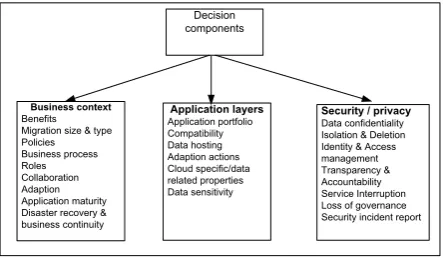
Business context
Benefits Migration size & type Policies Business process Roles Collaboration Adaption Application maturity Disaster recovery & business continuity
Application layers
Application portfolio Compatibility Data hosting Adaption actions Cloud specific/data related properties Data sensitivity
Security / privacy
[image:2.595.63.285.57.186.2]Data confidentiality Isolation & Deletion Identity & Access management Transparency & Accountability Service Interruption Loss of governance Security incident report
Figure 1: An Overview of Decision Components
tual model for comparing IT infrastructure costs and cloud computing viability, although the results of the use cases do not show the applicability of the model. [7] introduces cost, benefits and risk tools for public IaaS cloud migra-tion decisions. Risks are considered from organisamigra-tional, le-gal, security, technical and financial perspectives. however, most of the existing works focus on comparing the cost of hosting models between in-house and outsourced cloud con-texts without analysing critical decision components such as business context, security, and privacy. Jamshidi et al. [4] perform a systematic literature review of cloud migration research; the results show that there is a lack of works fo-cusing on a comprehensive decision framework for cloud mi-gration. In particular, a decision framework should support the organisations in undertaking their migration decision by analyzing requirements, feasibility and migration strategies, along with the execution, evaluation and cost cutting con-cerns of the move. This work contributes towards filling these gaps by proposing a decision framework taking into account an in-depth understanding of the business, security and privacy needs based on the organisational context.
3.
DECISION COMPONENTS
The decision framework components aid in the under-standing of the existing state of the organisation before any cloud migration. Their primary purpose is to extract key attributes and aid in the collection of data useful for the de-cision making process. We reviewed the existing literature based on six main keywords (cloud migration, application, security, privacy, business context and risks), along with our three inclusion criteria of decision factors for migration into the cloud, methods and tool support for migration, and risks before and after the migration. Based on our review, we can define three main decision components: business context,
application, andsecurity and privacy. Figure 1 shows the decision components with key areas. An overview of indi-vidual components is given below. This section provides a brief overview of each component.
Business Context.
Business context considers the issues based on the busi-ness and organisational needs; for example, organisation en-tities, IT usage, costs and benefits of migration, role and size of the migration, future business needs, and the cloud portfolio both before, during and after the migration deci-sion. The current state of the organisational and business
entities (goals, infrastructure provisioning, business and IT policies, access capabilities, SLA, upfront costs) are anal-ysed to understand the requirements of the migration. Such analyses support the understanding of how the migration affects the organisation, and whether existing policies, roles and responsibilities and the organisation´s business strategy will need to be revised. Business context determines the cloud portfolio, indicating the chosen cloud model and other necessary parameters to support the migration.
Application.
Before migrating an application to the cloud, it is nec-essary to understand the application´s characteristics with-out using any cloud technologies. Various factors must first be analysed, such as application type, in-house deployment and application maturity, a determination of the operation of the application in mixed in-house and cloud environments (Cloud-native or Cloud-enabled), along with looking at data storage, programming models, and quality assurance. Gen-erally, an application is structured upon presentation, busi-ness and data layer [2]. This layer based abstraction helps determine which part (or all) of the application could mi-grate into the cloud. The business layer is responsible for managing business functionalities using business process, ser-vices and their supporting infrastructure. A number of is-sues must be considered before any cloud migration: for instance, identification of business process logic, business service and application components, supporting infrastruc-ture, KPI and their adaptability into the cloud. The Busi-ness Layer communicates with the Database Layer located on both non-cloud and cloud data stores. It is clear that any amendment of cloud data stores and services should not affect the business layer. The Data Layer is responsible for data storage for an application through Data Access Layer (DAL) and Database Layer (DBL). Migrating the data layer into the cloud requires the migration of the DBL into cloud and adaption of DAL for managing the access control. Fur-thermore, it is also necessary to analyse compatibility issues such as database schema semantics and data types of the database so that there are no inconsistencies between the database layer before and after the cloud migration. It is for instance possible that the DBL could contain several in-stances, and parts of those instances could be migrated into the cloud. In that case, the synchronization of on-premises and off-premises parts can be achieved through the DAL.
Security and Privacy.
in-cident is discovered, users need to know the details of the incident. In particular, providers’ support for data layer mi-gration and associated applications is one of the driving fac-tors in the future expansion of cloud computing. Providers should ensure transparency of the data stored within their infrastructure. Furthermore, anonymity and pseudonymity of sensitive data stored in the public cloud must be ensured.
4.
DECISION FRAMEWORK MODEL
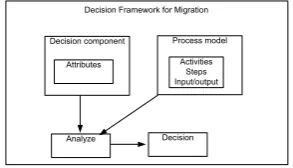
When users intend to migrate their in house application into the cloud, it is necessary to understand the needs of both the application and user in adapting to the cloud en-vironment, and how cloud provider supports these needs. We propose a systematic process to evaluate the users´needs and benefits, provider offers, risks and trade-off among these aspects. The proposed model provides a comprehensive un-derstanding of these issues. Figure 2 shows the two main elements of the framework. The decision component in-cludes attributes that need to be analysed for the migration decision. The process model includes activities and steps within the activity to support overall migration. The activ-ities require active involvement of various roles within the organization context such as senior executives,business man-agers,IT staffs, auditors (Internal or External), and cloud service provider.
Process model
Activities Steps Input/output Decision Framework for Migration
Analyze Decision
Decision component
[image:3.595.330.547.56.215.2]Attributes
Figure 2: Decision Framework Elements
Migration Process
.
A migration process is necessary to support a careful, sys-tematic plan for a cloud migration. It covers tasks to facil-itate major decision making, such as a study of migration feasibility, decisions as to which application sub-system is to be migrated, major risks to be controlled, and which cloud provider to choose. The process comprises four activities and each one has specific inputs and results in specific out-put artifacts. These artifacts should provide accurate infor-mation for the migration decision and process, and should be applicable within the existing business context. Figure 3 shows the steps involved within the activities.
Activity 1: Define Migration Portfolio: .
Thisactiv-ity deals with the existing organisation context so that the appropriate migration portfolio can be defined and imple-mented if decision for migration is undertaken.
Step 1.1: Understand Organisational Context: .
This [image:3.595.100.247.336.420.2]step analyses the existing organisational context by iden-tifying organisational entities such as actors, infrastructure, internal and external application, services, and data. There-fore, this step aims to define the extent of organisational entities that could potentially deployed into the cloud if the
Figure 3: Activities and Steps for the Migration
Process
migration decision is taken.
Step 1.2: Identify Migration Portfolio.
Migrationport-folio rationalizes the migration needs and helps to undertake the critical strategic migration decision. This step needs in-volvement of key organisational people through brainstorm-ing workshop(s) to identify key migration needs and to un-derstand the whether cloud supports the existing business context. This step identifies several properties for the mi-gration portfolio. They are given below:
• Migration goals: These goals are the main
ratio-nalization behind the cloud migration. This property emphasizes business value of the migration in terms of primary benefits.
• Business process: Business process amendment to
adapt to cloud based infrastructure.
• Policies: Amendment of existing business and
secu-rity policies due to new dependencies with the cloud provider.
• Organisational strength and knowledge gap: It
is necessary to identify the key organisational strengths and knowledge gaps before making the transition to cloud computing. Roles involved in the migration should be clearly identified if the migration plan is executed. Employees should have adequate skills to execute the adoption actions for both applications and data.
• Application & data profile: Applications and data
must be analysed to determine which of their parts should be migrated. Application criteria such as num-ber of integration points, external systems, HW de-vices, and application complexity must all be identi-fied and data size is also necessary to determine the migration cost.
• Migration and operational cost saving: The
Activity 2: Risks Identification .
This activity focuses on understanding the risks associated with the cloud migration so that appropriate control measures can be taken.Step 2.1 Define Risk Context.
This step defines the bound-ary of the risks management. In particular, the main focus is are the risks relating to business, security and privacy per-spectives. The context also determines how risky the cloud migration would be in terms of cost and schedule, CSP sup-port, adaption actions, security, privacy and other related factors. The riskiness can be determined in three different scales: high, medium and low. Generally, if in-house appli-cations need major amendment, employees lack the skills for the migration, security controls and CSP support are poor, PII data is to be migrated, then cloud migration could be a high risk project for the organisation.Step 2.2 Identify Risks.
This step identifies the potential risks both before and after the migration. The risks are caused by both internal and external users. In particular, malicious insiders such as CSP employees, contractors, or any other relevant stakeholder can misuse using the system resource in a way that could violate the confidentiality of user data. In case of the cloud, such a threat could be ex-ploited by a malicious application, system, virtual or host-ing administrator. We categorize the risks based on the attributes of the decision components. They are:• Cost/ Revenue: Uncertainty in Cloud utility billing
model due to actual resource used by the provider and deployment options, over-provision and under-provision of applications and inaccurate usage estimation
• Employee skill & roles: Employees have inadequate
experience with cloud technology and unclear roles for the adaption actions and maintenance with migrated entities.
• CSP Support & Compliance: Lack of CSP support
and non compliance with the relevant regulation and industry specific standards.
• Application Data Adaption Actions: Unclear
adap-tion acadap-tions such as business logic amendment and in-compatible data format for the application and data.
• Data Confidentiality: Leakage of user data for any
unintended usage.
• Isolation & Deletion: Isolation failure allows
mali-cious to obtain control over other tenant storage area and incomplete disposal of data.
• Identify & Access Management: Poor identity
ac-cess management pose for unauthorized acac-cess to the legitimate user resources.
• Services interruption: Unavailability of cloud
ser-vices pose interruption of critical business serser-vices and slower performance than expected.
• Transparency & Accountability: User critical
as-set is stored in an environment which is out of user control. Inadequate monitoring and auditing of user critical asset pose any potential risk and lack of user trust to the cloud provider.
• Loss of governance: Loss of control over collecting,
processing, sharing, and storing of data is a key con-cern for cloud adaption.
• Disaster recovery & business continuity : Poor
disaster recovery and business continuity plan and mis-match with the user and provider plan.
• Security incident report: No knowledge about
se-curity incident report
Activity 3: Requirement and Assurance Analysis.
Thisactivity assists in identifying the requirements for address-ing the risks and collects the evidences relataddress-ing to control measure to fulfill the requirements.
Step 3.1 Identify Requirements.
Requirements are the clouduser desire to support the migration goals and constraints. This step identifies business, application, and security and privacy requirements as criteria for undertaking the tion decision. These requirements aim to support the migra-tion goals. Similar to the risks, these requirements follow the main attributes of the decision components and emphasize to mitigate the risks. Therefore, the requirements are iden-tified by analyzing the risks and by following other sources such as migration portfolio, application context, organisa-tional goals, users needs, and existing security policies. The requirements types follow the risks types such as we need to identify requirements relating to cost/revenue, employee skill, CSP compliance, adaption actions, security and pri-vacy.
Step 3.2 Assurance of Control Measure.
This stepcol-lects the evidences for the assurance of control measures. Evidence originates from both user and CSP supports as-surance for fulfillment of the requirements and mitigation of the risks. The evidences are various types such as docu-mented report, approved policy, security and privacy mea-sure, list of any specific information, and any other relevant entities. Therefore both user and CSP are responsible for implementing their own evidence collection mechanism. It drives the users for making migration decision into cloud. The user should identify and review the evidences based on the key decision components attributes requirements.
Activity 4: Cloud Migration Decision and Strategy.
Thisactivity assists making the final decision once information re-lating to requirements and assurances have been identified, and the migration strategy is in favour of cloud migration.
Step 4.1 Decision for Cloud Migration .
The migrationthat both user and CSP impose adequate control measure and that the organisation should make the migration deci-sion with the chosen CSP. However, this case is not always possible. In the case of partial completeness, the user should make a decision depending on the fulfilment of the require-ments that are critical for the organisational context. Hence fulfilment of critical requirements helps to control the risks.
Step 4.2 Define Cloud Migration Strategy .
If thede-cision is to migrate into the cloud, then it is necessary to develop a migration strategy. The cloud migration strategy depends on several parameters and links with the migration portfolio. The parameters are given below:
• Migration type: Type I (replacement), Type II
(par-tial), Type III (whole stack migration), and Type IV (cloudification)
• Service/deployment model: Appropriate service
and deployment model.
• Migration assessment index: prioritized
applica-tion and data for migraapplica-tion.
• Data store & hosting type: centralized/distributes
and On-premises/ off-premises and single-tenanted / multi-tenanted hosting.
• Adaption actions: application adaption actions such
as extract/adapt service, adapt business process, and reconfiguration of application and data adaption ac-tions such as resolve incompatibilities, reconfigure data access layer, transform queries, and coupling data into cloud infrastructure.
• Migration testing: Test real resource usage by the
chosen application and migrated application and in house existing application functionalities to support the business continuity.
• Adaption constraints: key requirements and
assur-ance that need to be monitored.
• Roles and responsibilities: Assign roles to the
or-ganisation employee and agreed support from the CSP.
5.
CONCLUSIONS
The impact of cloud computing on business is huge. Or-ganisations should however not opt for cloud computing without analysing the factors involved in making migration decisions and the potential consequences after the migration. There are indeed considerable concerns regarding business, security, privacy issues that require adequate attention. This work supports an organisation in making an informed mi-gration decision in a systematic way. We consider risks, re-quirements and audit from the decision components. These allow on one hand an understanding of the potential risks both before and after the migration, and on the other hand allow requirements to be used as guiding constraints to ad-dress the risks and audit through evidence to fulfill require-ments. The process model supports the identification of the migration portfolio based on the organisation context. The portfolio then analysed through the risks, requirements and audit so that an accurate decision can be taken for the migra-tion, and migration strategy can be defined for a successful
migration. Therefore, the proposed approach provides an in-depth analysis of the issues that require adequate atten-tion for the migraatten-tion into the cloud. The next step of our work is to implement the process into a real business sce-nario context and to develop tool support for the decision making process. This allows us to understand the applica-bility of our approach as well as automate the activities to extract the artefacts.
6.
ACKNOWLEDGMENTS
This research was funded by the Austrian Science Fund (FWF): P 26289-N23 and COMET K1, FFG - Austrian Re-search Promotion Agency.
7.
REFERENCES
[1] T. B. C. Bruening P. J. Cloud Computing: Privacy, Security Challenges, Bureau of Nat’l Affairs. online, 2009. available at: http://www.hunton.com. [2] M. Fowler.Patterns of enterprise application
architecture. Addison-Wesley Longman Publishing Co., Inc., 2002.
[3] S. Islam, H. Mouratidis, and E. Weippl. A goal-driven risk management approach to support security and privacy analysis of cloud-based system.Security engineering for cloud computing: approaches and tools. IGI Global Publication, Hershey, 2012.
[4] P. Jamshidi, A. Ahmad, and C. Pahl. Cloud migration research: a systematic review. 2013.
[5] B. Johnson and Y. Qu. A holistic model for making cloud migration decision: A consideration of security, architecture and business economics. InParallel and Distributed Processing with Applications (ISPA), 2012 IEEE 10th International Symposium on, pages 435–441. IEEE, 2012.
[6] C. Kalloniatis, H. Mouratidis, M. Vassilis, S. Islam, S. Gritzalis, and E. Kavakli. Towards the design of secure and privacy-oriented information systems in the cloud: Identifying the major concepts.Computer Standards & Interfaces, 36(4):759–775, 2014. [7] A. Khajeh-Hosseini, I. Sommerville, J. Bogaerts, and
P. Teregowda. Decision support tools for cloud migration in the enterprise. InCloud Computing (CLOUD), 2011 IEEE International Conference on, pages 541–548. IEEE, 2011.
[8] M. Klems, J. Nimis, and S. Tai. Do clouds compute? a framework for estimating the value of cloud computing. InDesigning E-Business Systems. Markets, Services, and Networks, pages 110–123. Springer, 2009.