
http://dx.doi.org/10.4236/ahs.2015.43015
First Theoretical Constructions to the Fluid
Mechanics Problem of the Discharge
Sylvio R. Bistafa
Polytechnic School, University of São Paulo, São Paulo, Brazil Email: [email protected]
Received 20 May 2015; accepted 27 June 2015; published 30 June 2015
Copyright © 2015 by author and Scientific Research Publishing Inc.
This work is licensed under the Creative Commons Attribution International License (CC BY). http://creativecommons.org/licenses/by/4.0/
Abstract
After the publication of Hydrodynamics by Daniel Bernoulli in 1738, there was a fierce competition for priority with his father, Johann Bernoulli, and controversies with Jean le Rond D’Alembert, in which Leonard Euler seemed to have tacitly accepted the role of presiding over the disputes. These disputes were aroused by the almost simultaneous publications of Hydraulics by J. Bernoulli in 1743 and of Traité de l’équilibre et du mouvement des fluides by D’Alembert in 1744. It would be shown that despite the fact that the Bernoullis and D’Alembert used their own principles and ap-proaches to the fluid mechanics problem of discharge, they essentially reached the same end. None-theless, it was Euler who brought the fluid mechanics problem of discharge to a new and definitive level with two publications. In these publications, for the first time, the pressure force and the friction force appeared explicitly in the formulations. However, the friction force was built under the wrong assumption that, as for the case of solid friction, the fluid friction force was proportion-al to the pressure. Finproportion-ally, Lagrange’s memoir on the theory of fluid motion of 1781 is presented as a sequel to these first theoretical constructions.
Keywords
History of Fluid Mechanics, First Theories Applied to Fluid Flow, Torricelli’s Law, Bernoulli’s Law
1. Introduction
173
called at the time, gave the name hydrodynamics to the science of internal and external fluid motion in general, and reserved the name hydraulics for applied activities related to the motions of water. It was possible to say that at that time hydraulics was concerned with the practical and hydrodynamics with the theoretical aspects of the same subject.
The term hydrostatics, which today is reserved for the study of liquids at rest, was then often also associated with hydraulics, up to the point that Daniel Bernoulli (1700-1782) gave the following title to the 12th chapter of his 1738 Hydrodynamics book (Bernoulli, 1968a) “Which Shows the Statics of Moving Fluids, Which I Call Hy-draulico-Statics”. This book is in fact mainly concerned with the problem of water discharge from reservoirs through conduits, which can be considered as a typical hydraulic subject. This nomenclature was adopted by Johann Bernoulli (1667-1748), which entertained the same subject of the discharge in his 1743 Hydraulics book
(Bernoulli, 1968b). Since this book was in direct competition with that of his son D. Bernoulli, he had, of course, to give to it a different title, but revealing that he was treating essentially the same subject, however, using his own nomenclature and symbology based on his own principles and points of view.
Nowadays, fluid mechanics problems can be classified in internal and external flows, being the former, re-lated to formulations that allow the calculation of flow parameters such as flow-rate and pressure in conduits and vessels, and the latter, the calculation of pressure forces that arise in bodies immersed in fluids. Calero(2008)
called them “the problem of discharge”1 and “the problem of resistance”, respectively, and this seemed to be a
convenient historical divide for the purpose of the present work of revisiting the theoretical developments re-lated to the problem of discharge, in the second half of the 18th century.
The problem of discharge was also dealt with by Jean le Rond D’Alembert (1717-1783) in his book of 1744
(D’Alembert, 1744), although this author was more famous for having dealt with the problem of resistance in his book of 1752 (D’Alembert, 1752), which was concerned to the forces that external flows exerted on bodies im-mersed in fluids, and traced the origin of the famous D’Alembert paradox.
The developments then made were chosen because it was during that time that the first analytical approaches (theoretical constructions) to the problem of discharge were to appear, proposed by the aforementioned authors, namely the Bernoullis and D’Alembert, and also by Leonard Euler (1707-1783), in his 1754 paper (Euler, 1754). According to Truesdell (1955: p. XLV), this work may also contain the first solution of a theoretical design problem in engineering (hydraulics), as we shall see later on in the present work.
As we know, discharge problems can be solved nowadays by invoking the fluid mechanics equations of con-tinuity, momentum and energy. Although the equivalent of the equation of continuity was longer known even at that time, the concept of mechanical energy and its conservation was not. By the end of the 17th century and the beginning of the 18th century, the conservation of vis viva (“living force” mv2, akin to kinetic energy) and
conservation of momentum
mv
were mechanical principles under debate and not unanimously accepted by the savants of the time. Therefore, those involved in such undertaking who do not embrace such principles, have to find their own substitutes to undergird a Theory and to struggle in their approaches, which make most of the de-velopments to be presented here rather hard to follow by the modern reader.In the 17th century, body collisions were the main pattern of development of mathematical physics. Perhaps the most prominent author in this area was Huygens (1629-1695) who in 1669 submitted to the Royal Society a paper summarizing without proof rules of motion in the impact of bodies, which was printed in both the Philo-sophical Transactions and in the Journal de Sçavans (letter of March 18) of the same year (Huygens, 1669). Both the papers were excerpted from a work largely complete by 1656 but not published until 1703 after Huy-gens death, De Motu Corporum ex Percussione(Huygens, 1929). In these summaries, Huygens formulated sev-en rules for bodies whose sizes were to be estimated by their weights, which behaved as did elastic bodies. The conservation of momentum
mv
appears as rule 5, and the conservation of mv2 appears as rule 6. In assertingthis rule, Huygens did not apply it beyond the relative motion of bodies. It was Leibniz’s contribution to interp-ret this quantity as a measure of an “absolute”, existing in the universe as a measure of “force” (differing from Newton’s idea of force), which started the so-called vis viva controversy with a publication by Leibniz (1646- 1716) on the subject in 1686 (Iltis, 1971).
In the posthumous work, De Motu Corporum ex Percussione, Huygens had developed a more detailed theory of percussion, in which thirteen propositions were developed. In Proposition IV, Huygens shows that the relative velocities of the bodies before and after collision are the same; in Proposition VI, he refutes Descartes’
174
vation of quantity of motion
m v
. In Proposition VIII, Huygens uses the mv2 principle later known as livingforce relating the heights of fall to the velocities acquire, and by introducing the concept of a common center of gravity that cannot be raised, he shows that “…. When two bodies of which the velocities are inversely propor-tional to their sizes meet from opposite sides, each will rebound with the same velocity with which it approached”. The principle of the living force of a body and its relation to that body’s distance of fall were used by Leibniz in the demonstrations which initiated the controversy.
Huygens also used the conservation of the living forces in his derivation of the law of the compound-pendulum in the Horologium Oscillatorium (Huygens, 1673), where he showed in Proposition IV that “…. If a pendulum composed of several weights and released from rest were to traverse some part of its complete oscillation, and then its individual weights were imagined, under release from the common constraint, to convert their acquired speeds upward and to ascend as far as they can, when this has occurred, the center of gravity composed of all of them will have returned to the same height that it had before the oscillation began”.
In Proposition V, Huygens states the law of the compound-pendulum: “….Given a pendulum composed of any number of weights, if the individual weights are multiplied by the squares of their distances from the axis of oscillation, and the sum of the products is divided by the product of the sum of the weights times the distance of the center of gravity of all of them from the same axis of oscillation, the result is the length of a simple pendulum isochronous with the composite pendulum, or the distance between the axis and the center of oscillation of the composite pendulum itself”. Darrigol (2005: pp. 4-15)saw a pervasiveness of the compound-pendulum analogy in the works of the Bernoullis and D’Alembert, and this would be pointed out in due course on the detailed dis-cussions of the developments of these authors.
2. First Theoretical Constructions
All that was available as a principle for fluids in motion in vessels by the middle of the 18th century was celli’s law, which can be considered the first and the simplest problem of discharge. This law, derived by Torri-celli in 1644 (Torricelli, 1644), allows the determination of the jet velocity through an orifice, made at the wall of a vessel containing water at a known level. It was established from experimental observations by Torricelli, to which he applied Galileo’s universal law on free-falling bodies, and because of that, it can be considered as a theoretical construction.
The more elaborated discharge problem with a pipe connected to a water reservoir was treated by D. Bernoul-li in 1738 (Bernoulli, 1968a: pp. 291-296), which resulted in the relationship between velocity and pressure, known as the Bernoulli law.
Later on, in 1743, J. Bernoulli (Bernoulli, 1968b: pp. 391-401) considered the more general problem of non- stationary flows through pipes of varying cross-sections2, a problem also considered by D’Alembert in 1744. As
a matter of fact, the non-stationary flow formulation was proposed by D. Bernoulli as well, as we shall see later on in this paper.
In 1754, Euler (1754) presented the complete theory of a one-cylinder pump to deliver water through a piping system to an elevated reservoir, with a revolutionary and simple formulation. He complements his contribution to the discharge problem with a publication3, read in 1751, in which he presents a first attempt at a theory of the
friction of fluids in piping systems (Euler, 1761).
These works can be considered the main core of the first theoretical constructions to the problem of discharge, and will be revisited by considering the principles upon which the formulations were derived, the applications envisaged by these authors, followed by a discussion of these developments from the knowledge that we have today on the subject.
2.1. Torricelli’s Law
In 1644, Evangelista Torricelli (1608-1647) published the book Opera Geometrica (Torricelli, 1644), divided essentially into three sections: the first De sphaera et solidis sphaeralibus; the second containing De motu gra-vium naturaliter descendentium et projectorum (text dedicated to Galileo) and the third section on De dimen-sione parabolae. In De motuprojectorum, Torricelli dedicates a chapter to the motion of water (Torricelli, 1644:
2There are controversies about dates raised by J. Bernoulli, who claims having developed his theory as earlier as 1732. In fact, Hydraulics by J. Bernoulli was actually published in 1743, but it was pre-dated to 1732. For an account on the disputes between Daniel Bernoulli and Jo-hann Bernoulli, see the preface by Hunter Rouse on Hydrodynamics (Bernoulli, 1968a) & Hydraulics (Bernoulli, 1968b).
175
pp. 191-203). This chapter was considered so important that Ernst Mach proclaimed Torricelli the founder of hydrodynamics (Mach, 1919: p. 402). In this chapter, Torricelli’s goal was to determine the velocity of efflux of a jet of water, issuing from a small hole in a container. By experiment it was noted that when the jet is directed upward, it reaches a height less than the liquid level in the container (seeFigure 1). However, he assumed that if there was no resistance to the movement, the jet would reach the same height. Starting from this hypothesis, equivalent to the principle of conservation of mechanical energy, he deduced what is known today as the Torri-celli’s law: ‘The speed of a jet at a point is equal to efflux of a single drop of liquid would have if it could fall freely in the vacuum from the liquid level above the orifice’. Torricelli also showed that if the hole is made in the wall of a container, the fluid jet will have a parabolic shape. He then closes the paragraph with interesting observations of the flow breaking into droplets and the effects of air resistance.
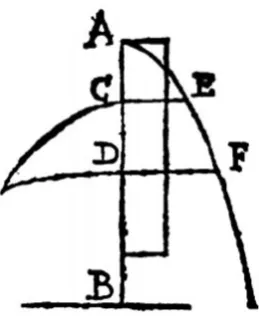
Torricelli expressed the square root of the height law using geometrical constructions and mathematically precise words, adhering to the standards of the day (it remained for others to re-express the law in algebraic terms). Referring to the water exiting from lateral orifices in a tank and based onFigure 2, he states that the re-lation of the quantity of water coming out of equal apertures are under the square root of the ratio of the sublimi-
ties4, or of their heights. That is: discharge from . discharge from
C CE AC
[image:4.595.273.352.301.445.2]D DF∝ = AD This result can be translated to:
Figure 1. Torricelli’s schematics of an upward jet issuing from an orifice in a horizontal pipe connected to the bottom of a container (a reproduction from Torricelli’s De Motv Aqvarvm).
Figure 2. Torricelli’s geometric association of the parabola with the water exiting from lateral orifices in different heights in a tank (a reproduction from Torricelli’s De Motv Aqvarvm).
[image:4.595.252.382.491.653.2]176
v∝ h , (1) where v is the velocity of the water exiting the orifice and h is the water height above the orifice5.
As was common in those days, mathematical expressions involving physical quantities were not written out explicitly, being the deductions, as we saw above, often based on Euclidean geometrical reasoning, in which proportions and equivalent lengths were related to physical parameters. Because of that, no concern would arise for the adoption of a system of units consistent with the physical quantities being addressed. This is the case of the law proposed by Torricelli, in which the quantity 2 g (where g is the gravity), once included under the square root sign, transforms this law into its present day form:
2
v= gh . (2) According to Darrigol (2005: p. 5), the concept of dimensional quantities would emerge only at the turn of the nineteenth century, and found its first systematic formulation in Fourier’s theory of heat.
2.2. Proofs, Disproofs and the Demonstrations of Torricelli’s Law by Reason
As show by Calero (2008: Part II, Chapter 6) and Blay (2007), Torricelli’s law was a subject that occupied the minds of many figures before and after Torricelli. Before Torricelli, Blay shows that father Mersenne (1588- 1648) had stated Torricelli’s law in the Harmonie universelle (Paris, 1636), and concludes that, no later than 1643, not only father Mersenne but also Decartes (Blay, 2007: pp. 26-30), the first more a experimenter, the other more a theoretician, had obtained the same law proclaimed by Torricelli in 1644.
Torricelli’s law implies two hypotheses: that the velocity is proportional to the square root of the height, and that this velocity is the same that a heavy body acquires by falling from a height equal to that from the free-surface of the water in the vessel to the orifice. Blay shows that father Mersenne could have demonstrated the first hypothesis of Torricelli’s law from experimental results (Blay, 2007: pp. 18-19). To this end, he repro-duces in his book a table containing the experimental results of father Mersenne (see Figure 3), in which the first column lists the eight equal parts of a vessel, and the second column lists the time in seconds that it takes to empty each part by an orifice at the bottom of the vessel. Here, by assuming that each exit velocity vi through the orifice is proportional to the respective height n hi of the water in the vessel, raised to the power n, that is
i i
v h
∝
, it can be shown that the relation between the time ∆Ti to empty the ith-part to its respective heighti
h is given by n 1
i i h
T
∝
∆ ; or
1n
i i
h
∝ ∆
T
−. Figure 3 shows also a curve fitting to Mersenne’s experimental
data that gives n=0.53; that is,
v h
i∝
i0.53, which is a result that is in very good agreement with Torricelli´slaw.
Figure 3. A curve fitting (to the right) of Mersenne’s experimental data of 1636 [table to the left (Blay, 2007: p. 18)] revealing that the time that it takes to empty each equal part of a vessel is inversely proportional to approximate-ly the square-root of its respective height.
It should be noted that the results of father Mersenne only give support to the exit velocity being under the square-root of the height, and not that this velocity would be capable of rising the jet back to this height; that is, he is not stating Toricelli’s law in “full”.
Although, as we saw above, it is rather easy to experimentally verify that the velocity is under the square-root of the height, the exit velocity being equal to the velocity acquired by a heavy body falling from this height is not, because it is strongly dependent on the particular experimental conditions. Therefore, as Calero proposes
(Calero, 2008: p. 275), the jet velocity would be more adequately described by v= 2ghe , where he is an equivalent height
(
h h
e<
)
, which is a height that depends on the particular apparatus being used and theadopted experimental procedures. As Torricelli himself had implied, he=h is a value to be expected only un-der ‘ideal’ conditions, and hence, a theoretical value.
By revisiting the experimental data of Mariotte (1686), Guglielmini (1690), and Poleni (1717, 1718), Calero (2008: pp. 275-283) confirmed from the experimental data of these authors, the proportionality between the ve-locity and the square root of the height, but not that this veve-locity would be equal to the fall of a heavy body from this height. Further analysis of these experimental data, allowed Calero to conclude that the jet velocity was that corresponding to equivalents heights of: he=0.5h, from Mariotte’s experimental results; he=0.26h, from Guglielmini’s results; and from Poleni’s results: he =0.73h (spouts), he=0.33h (orifice), he =0.81h (frus- tum-conical spout)—different apparatuses given different equivalent heights.
Torricelli’s law is not easy to accept because since it is based in the law of free-falling bodies, which predicts that a heavy body accelerates as it falls down, why the water does not accelerate inside the vessel as it moves from the upper surface to the orifice in the bottom of the vessel? As Blay shows (Blay, 2007: p. 124), this was exactly the proposal Varignon in 1695 “…. to examine what happens inside a conduit while the waters flows; it appears to me that the water being contiguous inside all its length, such that above it descends as fast as below; and by what consequence it does not had none acceleration inside the conduit”.After an attempt by Varignon to justify Torricelli’s law by the weight of the water column above the orifice, by 1703, he considers that the proof of Torricelli’s law “by reason alone” would be jointly from the axiom to which “the causes are always propor-tional to theirs effects”, from the principles of mechanics and from the general laws of motion. He thus attri-buted to mechanics a demonstrative perfection identical to that attriattri-buted to the Euclidean geometry (Blay, 2007: p. 130). As we shall see later on, the deduction of Torricelli’s law “by reason alone” had to wait the works of D. Bernoulli in 1738 and J. Bernoulli in 1743.
We cannot close this section without considering the works of Newton on the subject. As shown by Blay (2007: pp. 142-150), in the first edition of the Principia (1687), Newton had demonstrated that the outlet veloc-ity of the fluid was equal to the fall of a heavy body from half the depth—a counterdemonstration of Torriceli’s law by reason. The half-depth rule had been experimentally confirmed by the experiments of Edmund Halley, between 1691 and 1692, at the Royal Society, by Roger Cotes, the editor of the 2nd edition of the Principia (1713), who in 1710, had also experimentally confirmed the conclusion of Mariotte in favor of the half-depth rule. However, by 1710/1711, Newton had reconciled with Torricelli’s law with the notion of vena-contracta, which arises from the composition of the vertical motion with the horizontal motion of the water as it flows through the orifice, in the famous cataract flow-model. The vena-contracta is a result of the convergence of the flow stream-lines after the orifice, accompany by a constriction of the flow area, which accelerates the flow from v1 through the orifice to v2 through the vena-contracta, in a ratio of about 1 to 2 , as experimentally
found by Newton. However, he had not abondoned the half-depth rule; that is the velocity through the orifice continued to be given by v1= 2g2h to Newton. This velocity would be related to that at the vena-contract by
2
2
12
v
=
⋅ =
v
gh
; that is, Torricelli’s law is recovered at the vena-contractra thanks to the catarat flow-mod- el—a rather artificial approach, mainly because the half-depth rule is a flaw. This new demonstration of Torri-celli’s law appeared in the 2nd (1713) and 3rd (1726) editions of the Principia.2.3. Bernoulli’s Law
In 1738, Daniel Bernoulli published the book Hydrodynamics(Bernoulli, 1968a), in thirteenth chapters. In the 12th chapter, with the title: Which shows the Statics of Moving-Fluids, which I call Hydraulico-Statics, D. Ber-noulli proposes:
within vessels such as of water flowing through conduits to leaping fountains…, those who have spoken about the pressure of water flowing through aqueducts and the strength required of the latter for sustain that pressure did not hand down any laws other than those for extended fluids with no motion…”
“§2. It is singular in this hydraulico-statics that the pressure of water cannot be defined unless the motion has been known correctly…”
Firstly, from these quotations, it is clear, as it was already mentioned before, that there is a preoccupation in giving a proper denomination for the new area of study which he is venturing at, and secondly, that he is essen-tially seeking a relation between pressure and velocity for flows within conduits. As we will see, the relation thus derived is nothing more than Bernoulli’s law.
The pervasiveness of the compound-pendulum analogy is clearly seen in the work of D. Bernoulli, who adapted Huygens’s Proposition IV of the Horologium Oscillatorium (Huygens, 1673) to the problem of dis-charge in the following form:
“… If any number of weights begin to be moved in some way by the force of their own gravity, the velocities of the individual weights everywhere will be such that the products gathered from the squares of these velocities multiplied by their appropriate masses are proportional to the vertical height through which the center of grav-ity of the composite bodies descends multiplied by the masses of all of them…”
The equality between potential ascent and actual descent, a nomenclature also used by Huygens in Part 4 of the Horologium Oscillatorium (Huygens, 1673), was defined by D. Bernoulli as follows:
“… The potential ascent of a System, the individual portions of which are moved at any velocity whatever, in-dicates the vertical height to which the center of gravity of that System reaches if the individual particles, their motion having been turned upward with the proper velocity, are understood to ascend as far as they can; and actual descent denotes the vertical height through which the center of gravity descends after the individual par-ticles have come to rest…”;which is recognized as the modern equivalent to the principle of conservation of mechanical energy.
This principle, together with the principle of conservation of the living forces were applied by D. Bernoulli in various developments contained in Hydrodynamics. For instance, in §8 of the Third Chapter, by applying the equality between potential ascent and actual descent, D. Bernoulli develops a general expression for the motion of a homogeneous fluid flowing out of a given vessel through a given orifice in the form
d
d d d
nn N z zy x nnz x yx x
mm − + y = − . He then points out that when the lower surface is an orifice of area
nn
which is very small, then
z x
=
, showing that z, which is a height that produces the velocity of the water flow-ing out through the orifice, is equal to the height x of the uppermost surface. This can be considered a genuine proof of Torricelli’s law by reason, which as we saw earlier, was a much sought development since the appear-ance of this law in 1644.However, what is considered the most important development in Hydrodynamics appears in §5 of the Twelfth Chapter in the attempt to relate pressure and velocity, from where Bernoulli’s law supposedly had emerged.
The basis for this development is Figure 4, where D. Bernoulli assumes that the pressure at the horizontal pipe wall is proportional to the acceleration that the water in the pipe would receive if the entire obstacle to mo-tion would vanish, so that the water might be ejected instantly into the air; “… The pressure of the water against the walls of the pipe ED is sought…”
Considering that the pipe ED is suddenly broken at cd. The “particle” ac, infinitely small and about to flow is indicated by dx. At the same instant, an equal volume element enters the pipe at E while the volume acbd is ejected. The mass of this volume element is indicated by n xd , which acquires the velocity v and the living force nv x2d (here, n is the pipe area in relation to the orifice o area which is assumed equal to 1). To this living
force, D. Bernoulli adds the living force increment which the element Eb receives while the volume element ad flows out, namely, 2ncv vd =d
(
ncv2)
, where c Ec= . This sum is due to the actual descent of the volume
element n xd through the height BE or a. It follows then that nv x2d +2ncv v na xd = d , or d 2
d 2
v v a v
x c
− = .
Since to D. Bernoulli, pressure is proportional to acceleration, the increment in velocity dv divided by the differential time dx
v ; that is, the acceleration d d v v
Figure 4. The discharge from a tank through a horizontal pipe, from which
Bernoulli’s law was derived (a reproduction from Hydrodynamics).
sure at the pipe wall, hence the pressure is proportional to 2 2 a v
c
−
.
At the instant when the pipe is broken,
v
=
a n
(to estimate the velocity in the pipe D. Bernoulli uses Tor ricelli’s law for the velocity in the orifice a ) orv a n
=
2; therefore the pressure is proportional to 2 21 2
n a
cn
−
.
From this expression it follows that for the closed orifice
(
n
= ∞
)
the pressure would be proportional to 2a c. However, in this case, the pressure conforms to the total height a (which is equivalent to assume 2c=1); thus
in general, for any value of n, the pressure is found proportional to n221a n
−
. Hence, for the case when the ori fice is closed
(
n
= ∞
)
, the pressure is proportional to a, and for the case when the wall FD is missing(
n
=
1
)
, the pressure is zero.Since n221a n
−
can be written as a a2 n
− , which is equal to a v− 2, in §9 D. Bernoulli concludes:
“… It is not difficult to anticipate the laws of this hydraulico-statics if both the shape of the vessel and the ve-locity of the water flowing through the conduits are assumed at will as anything whatever. Indeed, the pressure of the water will always be a b− , where by a is understood the height due to the velocity at which water will flow out of an abrupt conduit and vessel kept constant full after infinite time, and by b the height due to the ve-locity at which the water actually flows through [the pipe]. It is clearly amazing that this very simple rule, which nature affects, could remain unknown up to this time…”
The result:
2
pressure a a
n
= − , (3)
became known as Bernoulli’s law. Surprisingly, Equation (3) does not resemble the usual form in which this equation is written.
1) When the conservation of mechanical energy is applied to D. Bernoulli’s flow model (with the kinetic
energy written as 1 2
2mv ) it furnishes
2 2
d d d
2 2
v v
n x nc gna x
ρ + ρ =ρ
. This expression written in terms of
physical parameters, the gravity g and the density ρ , is now dimensionally homogeneous. The factor 1/2 is associated with the kinetic energy, which does not appear when the energy of the moving masses is written in terms of the living force. This expression can be re-written as d 2 2
d 2
v v ga v
x c
−
= . This last result shows that the application of the principle of conservation of mechanical energy to D. Bernoulli’s flow model leads to the same equation obtained by D. Bernoulli when g=1 2.
2) As Truesdell (1955: p. XXVIII) pointed out: “… all appearances to the contrary, d 2 2
d 2
v v ga v
x c
−
= is not a differential equation, and the temptation to integrate it must be resisted…”
This is because v is a known constant and independent of x and, dx and dv are not differentials, but rather
finite increments. Therefore, d 2 2
d 2
v v ga v
x c
−
= is an algebraic formula, in which, according to D. Bernoulli,
pressure is proportional to d d v v
x , or else
2
2 2 ga v p
c
−
∝ . This proportionality is not dimensionally homogene-ous,
because the first term has units of pressure, whereas the second term has units of acceleration. However, this proportionality can be turned out dimensionally homogeneous by dividing the pressure p in the first term, by the mass of the water per unit of cross sectional area of the pipe ρc. Moreover, this inclusion is also physically plausible because the pressure force is the only force responsible for accelerating the water mass ρc within the horizontal pipe after it is broken. This allows rewriting the proportionality as an equality, resulting in the fol-lowing equation:
2 1 2
p+ ρv =ρga , (4)
which is a more familiar expression for Bernoulli’s law. It is seen that by a rather tortuous path and with some fixes, Bernoulli’s equation as it is known in the present-day, could be recovered from the Bernoulli’s rather pre-carious flow model for the problem of discharge.
A final note to D. Bernoulli’s is that he develops the relation between pressure and velocity in terms of the pressure against the wall of the pipe, which lead historians of fluid mechanics to believe that he did not have the concept of internal pressure of the fluid. This supposition must be seen with care because in §5 of the twelfth chapter of Hydrodynamics, D. Bernoulli considers that if the base FD were missing (see Figure 4):
“… The water in the pipe tends to a great motion, but its pressure is impeded by the added base FD. By this pressure and repressure the water is compressed, which very compression is confined by the walls of the pipe, and hence these sustain a like pressure…”
From these remarks, it seems that Bernoulli indeed conceive that the water itself was responsible for transmit-ting the pressure to the pipe walls, and hence he might have realized that this transmission would occur inter-nally, from one ‘drop’ of water to the other. Moreover, D. Bernoulli was known for using the piezometer (liquid column manometer) consisting in sticking glass tubes in small openings in pipes or in human arteries (D. Ber-noulli was trained as a doctor) to measure the wall pressure. Since he was considered a great experimenter, one can imagine he sticking the tube on the core of the flow, on purpose driven by curiosity or even by accident, and realizing that the elevation of the liquid (water or blood) in the tube, no matter in the core or in the walls (of the pipe or the arteries), was the same. It seems that there are other reasons for not reasoning in terms of internal pressure in his developments.
1) Perhaps he was more concerned with practical aspects related to the strength of the walls of aqueducts to sustain pressure (§1, chapter twelfth of Hydrodynamics):
of the latter for sustaining that pressure did not hand down any laws other than those for extended fluids with no motion. …”.
2) As we saw, the way that he equates his flow model of discharge, is different from the one used nowadays, in which the balance of forces is applied on an infinitesimal fluid element between any two cross-sections of the conduit, in which the internal pressure forces acting on these cross-sections would have to be taken into account. However, this approach had to wait Euler’s developments in 1754. So, it is here conjectured that he had no need to consider the internal pressure of the fluid in his developments, rather than not having its concept.
The publication of Hydrodynamics was an immediate success, which have raised envious criticisms of two great geometers of that time: his own father Johann Bernoulli, and D’Alembert. The works of both contenders will now be revisited.
2.4. Johann Bernoulli’s Approach
In 1743, the book Hydraulics (Bernoulli, 1968b) authored by Johann Bernoulli appeared in print, pre-dated 1732. A lot of controversy was involved with this publication. For a more detailed account on the dispute on dates etc., see the preface by Hunter Rouse to the translated version of Hydrodynamics & Hydraulics, from which this ex-cerpt was taken, regarding the claims on priority:
“… There is no record that Johann had written anything whatever on the subject of hydraulics until some months after his son’s treatise was off the press, when he stated in a letter to Euler that he was preparing a ma-nuscript on hydraulics which was already well along. Nevertheless, he indicated in the first part that it was written in 1732, a full year ahead of the Russian version of his son’s! The second part followed the first to St. Petersburg in 1740, and the two were eventually published, as Johann had requested, in the Memoirs of the Im-perial Academy of Science for 1737 and 1738(which were printed, respectively, in 1744 and 1747). They ac-tually first appeared in his collected works, published in 1743…”
In a letter from Euler to J. Bernoulli about the book, which was quoted in part in the foreword to the Swiss version of Hydraulics (with J. Bernoulli calling Euler ‘Most Sagacious Mathematician’), allows one to grasp, in Euler’s view, the contribution of J. Bernoulli over that of D. Bernoulli:
“… Your very renowned Son, who, however, defined pressure in a rather indirect manner only so far as the entire motion has already acquired the steady state, nevertheless, after the genuine method had been brought to light, You at once determined most accurately the pressure in every state of water, because of which Your most praiseworthy discovery I congratulate You from my heart…”
In 1743, D. Bernoulli wrote a letter to Euler, from which this quote is taken:
“… Your Excellence says that I have determined the pressure of fluids flowing through a conduit in no other way than for the steady state, whereas I show immediately on page 259 toward the bottom that generally the pressure is 2
2 a v
c
−
; and what, on the other hand, has my father done in this important new field?...” We shall now see what J. Bernoulli has done for the problem of discharge.
In the Preface of Hydraulics, J. Bernoulli claimed that the science of hydraulics has not been subjected to the laws of Mechanics, being the developments so far based on experience and theories that were uncertain, and with insufficient foundation, particularly the conservation of living forces, which he recognized as certainly true, and proven by him himself, but that still were not accepted by all philosophers. For him, the true foundations of hydraulics ought to be the principles of mechanics, namely Newton’s principles.
From Newton’s concept of an accelerative force impressed on a body, which is responsible for the velocity acquired by the body in the traveled space, J. Bernoulli wrote d 1 2
2 p x= mv
∫
, saying that this is a ‘well-known result’. This result is recognized as the work done by a variable motive force p acting on a body of mass𝑚𝑚 tra-velling a distance x being equal to the variation of the body kinetic energy. This and translated gravitation are the most significant of the eleven lemmata introduced by J. Bernoulli in the Preface of Hydraulics.ac-cording to J. Bernoulli, if a stratum of water from the lower regions of the vessel has an area m and a weight π, the translated gravitation to the uppermost surface will be hπ
m , where h is the area of the uppermost surface. According to Calero (2008: p. 329), J. Bernoulli does not identify pressure as force per unit of area; hence, the necessity of this force translation rule.
Darrigol sees here another pervasiveness of the compound-pendulum analogy (Darrigol, 2005: pp. 9-10), in which forces at any point of a system are replaced by equivalent forces at a particular point of the system. This can be traced to an earlier work by J. Bernoulli (Bernoulli, 1714: pp. 168-186) on the nature of the center of os-cillation, in which he confirms Huygens’s Proposition V, Part 4 of the Horologium Oscillatorium (Huygens, 1673), using the law of the levers, in which forces that have the same moment have the same effect.
From the Preface on, Hydraulics is divided in two parts: the first part is concerned with the motion of water through vessels and cylindrical conduits, and the second part contains a ‘direct and universal method for solving all hydraulics problems’. In the first part, one finds J. Bernoulli derivation of Bernoulli’s law, and in the second part, the derivation of a general expression for not necessarily steady flow in pipes of any form, which forms the basis of the remaining work.
In Section VIII, Part 1 of Hydraulics, J. Bernoulli considers the ‘crux of the whole matter’ for finding the law of acceleration according to which the liquid flows through a conduit; that is, the determination of the motive force which acts ‘in the throat necessary to change the lesser velocity to the greater’. J. Bernoulli defines the throat as the region right after the contraction enclosed by the curve IMF on the top and the length HG on the bottom (seeFigure 5). The motive force p (per unit of density) is responsible for accelerating the water as it passes through the throat from the larger area h to the smaller area 𝑚𝑚 of the conduit. From these considerations, he deduces that:
2 2 2
2 h m
p v
h
−
= , (5)
where v is the velocity in the conduit after the contraction.
Since this result was obtained for a liquid with unit density, then for a liquid with a general density ρ, the
former expression can be re-written as 2 2
2
1 1
2
p v m
h ρ h
= −
. In the first member, the motive force p, divided by
the upstream cross section area h is in fact the pressure that accelerates the water through the throat; it is actually the pressure differential p p1− 2 across the throat. This allows the recovering of Bernoulli’s law for a
horizon-tal pipe as:
2 2 2 1 1 2 v2 v2
p p− = − , (6)
where the indices 1 and 2 refers to the conditions upstream and downstream of the throat, respectively. The con-tinuity relation v h v m1 = 2 was here invoked to obtain this result. Although the historical evidences seems to
reveal that J. Bernoulli knew beforehand this result from his son’s, nonetheless he has the great merit of propos-ing in its derivation a model not only more physically consonant to reality, but simpler and straightforward than that adopted by D. Bernoulli.
[image:11.595.177.454.598.695.2]In Section X, Part 1 of Hydraulics, J. Bernoulli considers a vertical cylindrical vessel with area h, conti-
nuously full of water at a height a, and with an horizontal cylindrical conduit with area m connected at its base. For this case, and by substituting in Equation (5) p for 𝑔𝑔ℎ𝑎𝑎, where g is the gravity, and considering that
2
1
2v =gz, where z is the height for which the velocity v is due, then
2
1
1 m h
a z
−
= . For the case where the
area m of the conduit is very small, z a= , or v= 2ga. This is Torricelli’s law deduced from J. Bernoulli’s dynamic principles—this is another demonstration of Torricelli’s law by reason.
In Sections II–VIII, Part 2 of Hydraulics, J. Bernoulli develops a general expression for the non-stationary velocity of a liquid flowing out of a conduit of any shape, which may be inclined differently in its different parts (see Figure 6). The approach taken consists on finding the motive force responsible for maintaining a steady flow through the conduit of any shape, and the motive force responsible for the non-steady flow behavior. J. Bernoulli called the latter hydrostatic force and the former hydraulic force. These forces are responsible for what is known today as the convective acceleration and the local acceleration, respectively.
In Section IV of Hydraulics,the hydrostatic force—the force responsible for the convective acceleration— was obtained by translating the effects of vertical motive force from an elementary intermediate layer, given by
𝑦𝑦𝑦𝑦𝑦𝑦𝑦𝑦 for the layer Fm with the area𝑦𝑦, to the first area h at the top of the conduit, resulting in the equivalent d
hu u, where u is the velocity of the layer Fm in the direction of the conduit center line. By integrat ing from the last layer, with the area w and velocity v, to the top layer, with the velocity w v
h
β
α , J. Bernoulli
obtained 2 2 2 2 2
2
2
h w v
h
α β
α
−
, where
α
andβ
are the direction cosines between the conduit center line and the vertical, at the bottom and at the top of the conduit, respectively. This is the hydrostatic force, and accounts the required motive force to accelerate the liquid as the area of the conduit changes from h at the top to w at the bottom. This force is responsible for what is known today as the convective acceleration.Since in this case the gravitation force is the only motive force available, by translating the elementary gravi-tation forces (per unit of density) of the elementary layers to the first area h, and upon integration through the total height AB a= of the conduit, results in gha, which allows to finally write:
2 2 2 2 2
1 2
v w
ga
h β α
= −
[image:12.595.233.398.434.679.2] . (7)
184
If we contrast this result for α β= =1 against Bernoulli’s law (Equation 3), we see that from this law
2 2
pressure a 1 w
h
= −
, and from Equation (7)
2 2 2 2 1 v a g w h = −
, which shows that the behavior of the pressure
head is the opposite of the velocity head as the relation between the flow areas at the top and at the bottom changes, which is the essence of Bernoulli’s law.
In Section V of Hydraulics, the hydraulic force—the force responsible for the local acceleration—was equated by J. Bernoulli as follows. The displacement of the layer Fm when the elementary displacement at the exit is dx is given by d d
d w x s
y t
α , where dt is the thickness of the layer Fm; that is, the vertical projection of the
segment ds that links the faces of the element along the conduit center line. As before, the effects of the ver-
tical motive force of this layer, translated to the first area h gives the equivalent
( )
2
d d d d hwv v s
y x t
α , which upon
integration through the total length of the axis of the conduit, for any layer and for any acquired velocity v, noting
that herein not only h and w but also d d v v
x
α must be considered constant, gives
( )
2d d
d d
s hwv v
x y t
α
∫
. This is the hy-draulic force, and accounts the required motive force for the actual acceleration of the liquid flowing out. This force is responsible for what is known today as the local acceleration.
When the gravitation force gha, is the only motive force available to compose the hydrostatic force and the hydraulic force, in Section VI, J. Bernoulli finally obtains:
( )
22 2 2 2
2 2 d d d d 2 s
h w v hwv v gha
x y t
h
α β
α α
− + =
∫
, (8)for a liquid with unity density, claiming that this is the most general equation for the determination of the veloc
ity with which the liquid flows out at any moment. It is understood that
( )
2
d d s y t
∫
denotes the sum of all the( )
2d d s
y t contained between the two extremes of the conduit. Of course, this is a quantity that depends only on the geometry of the conduit under consideration.
Based on this general equation, J. Bernoulli shows with a numerical example that the transit time from rest to the steady state efflux, from rather wide vessels through narrow orifices is imperceptible, and can safely be con-sidered constant. This is an interesting conclusion regarding the importance of the hydraulic force in such prob-lems.
The remaining of Part II, is basically dedicated to other applications of the general equation in problems such as: the derivation of an expression for the pressure at the walls of the conduit (Sections XI & XII), the variation of the exit velocity during the emptying of vessels (Sections LI & LII)—to be seen in more details later on in the present work, the making of clepsydras (Sections LIV–LIX), the examination of Newton’s cataract (Section LX) etc.
In Section VII, Part 2 of Hydraulics, J. Bernoulli’swrites6
v
2=
2
gz
, where z is the height from which agiv-en body, by falling under natural gravity g, would acquire the velocity v. This allowed J. Bernoulli’s re-writing his general non-steady equation as:
(
α2 2h −β2 2w z x)
d +αMh w z2 d =α2 2h a xd , (9)where
( )
2
d d s M
y t
=
∫
.Equation (9), for the case where α β= =1; that is, when the cross-sectional areas are normal to the axis of the vessel reduces to:
(
h w z x Mh w z h a x2− 2)
d + 2 d = 2 d . (10)In Section X, Part 2, we also find for the first time the interpretation of internal pressure—called immaterial force by J. Bernoulli—:
“… in portions of fluid acting mutually on each other, the immaterial force lying between must be considered just as elastic air, which extends itself not only to opposite directions, but also into all surrounding regions; from which now it is easily understood that from this immaterial force itself the pressure, which is the subject here, develops. This certainly is exerted on the walls of a conduit, by which in turn it must be confined while it acts freely forward and backward on the portions of the liquid wherein it exists…”
J. Bernoulli approaches can be considered remarkable for the time for the following reasons.
1) For reaching the same law proposed by his son D. Bernoulli for steady sate flow with a physical model more attached to reality, that is, from the pressure developed for accelerating the fluid in the contraction of a conduit.
2) For writing expressions with dimensionally homogeneous quantities (such as Torricelli’s law), which were not the standard of the day.
3) For giving for the first time the correct interpretation for the internal pressure in a fluid.
For these reasons, his contributions to the problem of discharge can be considered far superior than that of D. Bernoulli, and he would naturally have deserved a place in the hall of the greatest contributors to fluid mechan-ics, and particularly to the problem of discharge, without the need to compete with his son for pioneering the work in the area. Therefore, it is not appropriate to say that J. Bernoulli predated the work of D. Bernoulli; what in fact might had happen, is that after the publication of Hydrodynamics he saw that he had missed a great op-portunity to be the pioneer in an area where he felt he had better approaches than those of his son’s, perhaps since an earlier time than that when Hydrodynamics appeared. As mentioned earlier, the superiority of J. Ber-noulli approach to the problem of discharge over that of D. BerBer-noulli was even recognized by Euler. Unfortu-nately for Johann, Bernoulli’s law was named after Daniel.
2.5. D’Alembert’s Approach
In the Preface of the Traité de l’ équilibre et du mouvement des fluides (D’Alembert, 1744), D’Alembert makes remarks to some results and approaches used by D. Bernoulli in Hydrodynamics. For example, he judged that the application of the principle of conservation of living forces, considering the fluid particles as elastic corpus-cles was an induction without force, and that it was in need of a more clear and exact demonstration. He claims that despite the fact that this was already done by him in his Traité de Dynamique (D’Alembert, 1743), he would prove it again in a more extended and detailed form.
In a letter to Euler of July 7, 1745, D. Bernoulli of d’Alembert’s work says (see Truesdell, 1955: p. XXXVII, footnote 2):
“… I have seen with astonishment that apart from a few little things there is nothing to be seen in his hydro-dynamics but an impertinent conceit. His criticisms are puerile indeed, and show that he is no remarkable man, but also that he never will be…”
Therefore, if D’Alembert was to produce something new and meaningful, of course he could not follow D. Bernoulli’s footsteps, at least as far as mechanical principles are concerned. In the Traité de Dynamique
To show the power of his principle, D’Alembert solves several dynamic problems, one which is Huygens’s cen-ter of oscillation for the compound-pendulum, without recoursing to the principle of the living forces.
If one denotes ma an applied force on the mass point m of a connected system, and ϕ the actual acceleration of this mass point, then ma m= ϕ+ma m− ϕ, in which ma m− ϕ corresponds to the destroyedforce, which is a fictitious force applied to the point mass 𝑚𝑚 that maintains the system in equilibrium. Therefore, for the equi- librium of a system of N point masses
∑
iN=1m ai(
i−ϕi)
=0. For the cases in which there are no impressed forces on the system, m ai i =0; and hence, 1 0N i i i=mϕ =
∑
. As we shall see in the following, for a continuous system of particles such as a fluid, the integral form of these summation expressions are used by D’Alembert in the Traité de l’ équilibre et du mouvement des fluides.A theorem presented by D’Alembert in §22 of the Traité de l’ équilibre et du mouvement des fluides
(D’Alembert, 1744), which is a geometric interpretation of his dynamic principle, forms the basis of the various developments presented in this Traité. By dividing the vessel to the right of Figure 7 into horizontal layers (tranches), each one submitted to a particular accelerative force represented in the left side of this figure (not necessarily the gravitational force), he says that ‘the fluid in such state cannot be in equilibrium, unless the area
𝑎𝑎𝑦𝑦𝑎𝑎𝑚𝑚𝑎𝑎𝑎𝑎𝑎𝑎 is not zero; that is, the sum of the positive areas equals the sum of the negatives.’
In §25 of the Traité de l’ équilibre et du mouvement des fluides(D’Alembert, 1744), by calling ϕ the un-determined accelerative force of each layer, d’Alembert deduces that the state of equilibrium would then require that
∫
ϕdx=0 (x is the co-ordinate along the vessel), which would correspond to d d 0d v x
t =
∫
, where dx anddv are the infinitesimal thickness and velocity of the layer, and dt is an infinitesimal time. This is recognized as the continuous form of d’Alembert’s dynamic principle for the case when there are no impressed forces on the system. By considering that the layer thickness dx can be associated with the mass of this fluid element
dm and d d v
t the acceleration a of the element, then d
d ~ d 0
d v
x a m
t ⋅ =
∫
∫
, which is recognized as Newton’ssecond law for the equilibrium.
[image:15.595.193.445.503.682.2]D’Alembert had rejected the concept of force and thought of mechanics as “the science of effects, rather than the science of causes”. “… All we see distinctly in the movement of a body is that it crosses a certain space and that it employs a certain time to cross it. It is from this idea alone that one should draw all the principles of me-chanics…” (D’Alembert, 1743: p. XVI). D’Alembert was born ten years before Newton died in 1727 and New-ton, in turn, was born in the year which Galileo died. According to Hankins (Hankins, 1970: pp. 152-153), when d’Alembert’s Traité de Dynamique was published in 1743, Newton’s general laws of motion were not yet re-garded as the major synthesis of all those that had gone before, up to the point that Newton is mentioned only
three times in the Traité de Dynamique, and not associated with any important principles. The search for me-chanical principles continued, particularly with d’Alembert, who rejected “obscure and metaphysical” entities— particularly “forces” and “motive causes”. This is way the expression d d
∫
v x⋅ =0, involving only kinematic quantities is basic and used throughout his Traité de l’ équilibre et du mouvement des fluides.In the remaining of Book I of the Traité de l’ équilibre et du mouvement des fluides,D’Alembert discuss var-ious cases o fluid equilibrium such as: fluid equilibrium with solids in it, pressure distribution in the fluid layers with gravity in a constant direction, equilibrium of fluids of different densities, law between gravity and density in different layers of a fluid with constant gravity in a given direction, equilibrium of a fluid where the layers vary in any way in gravity and density, “adherence” of fluids, equilibrium of a fluid with a curved upper surface (figure of the earth), the equilibrium of elastic fluids (various cases).
I will now focus on some paragraphs at the beginning of Book II of the Traité de l’ équilibre et du mouvement des fluides,entitled “On the Movement of Fluids Encircle in Vessels”. After have beginning Chapter I demon-strating two theorems, in §86 D’Alembert remarks that “it is evident that the fluid will remain in equilibrium, if each layer is not animated by an infinitesimally small velocity d dϕ t∓ v”. These two terms can be interpreted as what is now referred to local and convective infinitesimal increments in the velocity of the layer.
Before presenting the case “Movement of a portion of a fluid without weight inside an indefinite vessel”, d’Alembert presents as preparation, a vessel of any shape (to the left of Figure 8), and defines a corresponding curve (to the right of 2 Figure 8), constructed in such way that, as for example, the intermediate YX, is given by
GH KZ
, in which GH is a constant line in the upper part of the vessel. He then calls N the area FTVN, which is given by the integral N dx GH2y
⋅
=
∫
, where dx is the height and y is the width of any indeterminatelayer, for which the product dy x is constant (he is invoking continuity here). The infinitesimal area dN is then given by:
2 2 2 2
2 2
dN NVUn FTtf GH Ff CD GH Ff Ff GH CD PL
PL PL CD PL CD
× −
= − = × − × = ⋅ ⋅
⋅
. (11a, b, c)
[image:16.595.178.452.466.667.2]In §90, D’Alembert poses Problem I as follows: “… Suppose that a given quantity of Fluid CDLP (Figure 32) homogeneous and without weight, is put into movement by any cause such as by the impulsion of a piston, which moves according to AB inside an undefined vessel; it is required to find the velocity of this Fluid in each
Figure 8. Vessel (to the left) and representation of a curve given by 2
188
instant…” Since the velocity of the layer CD is given by u GH CD
⋅ then, from the velocity u of the layer GH,
it’s possible to find all others.
D’Alembert equilibrium condition requires that d d
∫
v x⋅ =0. From this expression, and by assuming that a moving layer has a velocity V in an instant, following that in which the velocity was v, it follows thatd d
y xVV= y xvv
∫
∫
. Since∫
y xvvd =constant, then y xVVd y x uu GHd 2 constantyy
⋅ ⋅
= =
∫
∫
, or2
dx GH constant
uu uuN
y
⋅
= =
∫
, andd
(
uuN
)
=
0
, where u is the velocity in the layer GH, which is fixed. Then, the velocity in any other layer such as CD, is the same as GH to CD. Sinced
(
uuN
)
=
2 d
Nu u uu N
+
d
, and from Equation (11c) he finally gets:(
)
2 2 2 2
2PL CD Nudu uuFf GH CD PL⋅ ⋅ + ⋅ − =0 , (12)
In §100, D’Alembert gives a solution to the problem for the fluid subjected to a gravity p. In this case, his ba-sic expression d d
∫
v x⋅ =0, transforms into∫
dx p t⋅(
d d− v)
=0. This is recognized as the continuous form of d’Alembert’s dynamic principle for the case when the impressed force on the system is the gravitational force. When written in the form d d∫
v x⋅ =∫
p t xd d⋅ , is equivalent to Newton’s second law of motion, where p is the external gravitational force acting on the fluid. For this case D’Alembert gets:(
)
d uuN =2Ff CD p AB⋅ ⋅ ⋅ ; (13)
which, according to d’Alembert, when combined with dt Ff CD u GH
⋅ =
⋅ , will give the value of u in each instant.
In §105, D’Alembert gives a solution for the velocity of the layer PL. This solution begins by rewriting Equa-tion (13) as 2 dNu u uu N+ d =2Ff CD p AB⋅ ⋅ ⋅ . Then, by substituting for dN the expression given by Equa-tion (11c), and by calling GH m PL K CD k AB q Ff= ; = ; = ; = ; = −d ,q uu=2ps, s is the subimity7; he finally
gets:
d d d d
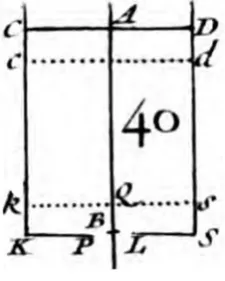
KKkN s kkmms q KKmms q− + = −KKkkq q . (14) In § 113, and based on Equation (14), D’Alembert gives the solution for a cylindrical vessel with an aperture made in its bottom (Figure 9), in which the water is subjected to the gravity p, as:
(
2 2)
2KKqu u uu k q K qd − d − d = −2kkpq qd . (15)8
When PL is a very small aperture KK kk1, and then
u
=
2
pq
; that is, Torricelli’s law is recovered not only for cylindrical vessels, but for all vessel shapes, when PL is a very small aperture.D’Alembert claims that Equation (14) is the same found by D. Bernoulli, via the principle of living forces. Indeed, this is the same equation developed by D. Bernoulli in §8, Third Chapter of Hydrodynamics, in which it is written as N vd mmvy x mmv xd d yx xd
nn y
− + = − . This equation can be rewritten as
d
d d d
nn N v vy x nnv x nn yx x
mm − + y = −mm . In fact, apart from the differences in nomenclature and symbology, these equations are all equal to J. Bernoulli’s general non-steady flow equation [Equation (10)] as well.
By calling z mmv nn
= , which corresponds to the velocity of the water flowing out, then the above equation
Figure 9. Vessel with an aperture made in the bottom, for which Equation (15) was developed (a reproduction of Figure 40 from the Traité de l’ équilibre et
du mouvement des fluides).
reduces to nn N z zy xd d nnz xd y xxd
mm − + y = − . As we saw before, when the lower surface is an orifice of area 𝑎𝑎𝑎𝑎 which is very small, then z x= ; that is, Torricelli’s law is recovered in this case. Also, as D. Bernoulli points out quite correctly: “…. when the orifice is not very small, by no means the shape of the vessel can be neg-lected…” Of course, this conclusion is valid for the non-steady flow cases, since the exit velocity for steady-flows, depends only on the ratio of the lower to the upper cross-sectional areas.
In most of the developments in Book I & II of the Traité de l’ équilibre et du mouvement des fluides, D’Alembert essentially replicates problems already dealt with by Daniel and Johann Bernoulli, but using his own principles and approaches instead. He criticizes D. Bernoulli for using the principle of the conservation of living forces when the change in velocities is not infinitesimal (D’Alembert, 1744: p. 109), where he might be wrong, particularly when D. Bernoulli breaks the pipe in the development of his law because, as we saw earlier, the conservation of living forces was derived by Huygens for elastic impacts, and the breaking of the pipe can be considered a sudden impact in the water initially at rest in the pipe. D’Alembert also saw the approaches of J. Bernoulli with some reserves. For example, he remarks that various points in the Theory of J. Bernoulli needed demonstrations, and criticizes him by using a “very complicated method’ for determining the pressure at the bottom of the vase (D’Alembert, 1744: pp. 159-160)”.
In the Traité de l’ équilibre et du mouvement des fluides there are rare moments that d’Alembert talks about pressure, and worse, he did not seem to have realized and grasped the very important basic relation between pressure and velocity in fluid flows, as was done very explicitly by D. Bernoulli in Hydrodynamics. This is per-haps a consequence of his aversion to forces, and particularly to pressure forces. We will only find for the first time a specific development of the relation between pressure and velocity much later in his Essai d’une nouvelle théorie de la résistance des fluides (D’Alembert, 1752: p. 24), in a result that apart from differences in nomen-clature and symbology, resembles J. Bernoulli’s (Equation (5)); that is, Bernoulli’s law.
2.6. A Non-Steady Flow Application Example
The shape of the vessel is only important in non-steady flows and has a direct impact in the value of M (see Eq uation 10), which for vessels with cross-sectional areas normal to the vertical axis is given by M dx
y
=
∫
, wherex is the vertical axis and y is the cross-sectional area of the vessel at the x co-ordinate. However, in Equation (10), we see now time dependence appearing explicitly in this equation. The following application by J. Ber-noulli will show how the time dependence is recovered from this equation.
The influence of the vessel shape, which appears equally in the Bernoullis and D’Alembert formulations, can be seen in the problem given by J. Bernoulli in Section XXVII, which concerns the calculation of the time that it takes for the exit velocity to reach the steady-state value from rest.




![Figure 10. Euler’s sketch of a one-cylinder pump to deliver water through a piping system to an elevated reservoir [a reproduction from Sur Le mouve-ment de l’eau par dês tuyaux de conduite (Euler, 1754: p.148)]](https://thumb-us.123doks.com/thumbv2/123dok_us/8105521.789288/20.595.207.426.417.681/figure-cylinder-deliver-elevated-reservoir-reproduction-conduite-euler.webp)
![Figure 11. Vessel used by Euler in the formulation of his pipe wall friction theory [a reproduction of Figure 2 from Tenta-men theoriae de frictione fluidorum (Euler, 1761)]](https://thumb-us.123doks.com/thumbv2/123dok_us/8105521.789288/21.595.211.418.511.682/vessel-formulation-friction-reproduction-figure-theoriae-frictione-fluidorum.webp)
![Figure 12. Vessel made by a composition of piecewise straight tubes, which was used by Euler as a model of a vessel of any shape [a reproduction of Figure 4 from Tentamen theo-riae de frictione fluidorum (Euler, 1761)]](https://thumb-us.123doks.com/thumbv2/123dok_us/8105521.789288/22.595.198.418.317.682/figure-composition-piecewise-straight-reproduction-tentamen-frictione-fluidorum.webp)
