http://dx.doi.org/10.4236/jss.2015.36010
An Exploration into the Implementation of
Student Research Training Programs
Mi Fang, Qi Gong, Weibin Zhou, Xiaohui Li Teaching Affairs Office, Anhui University, Hefei, China Email: [email protected]
Received December 2014
Abstract
Talent cultivation is the priority of China’s talent strategy, which necessitates the education of in-terdisciplinary innovative talents that meet social needs. This paper presents the possible partic-ipation of Anhui University undergraduates in various research training programs and discusses recent exploration of the implementation of Student Research Training Program. It deals with a program management system that conforms to development of Anhui University and describes its effect by tracking employments of the students involved in the program.
Keywords
Student Research Training Program, Training of Innovative Talents, Scientific Research
1. Introduction
According to Outline of National Medium and Long-Term Program for Education Reform and Development (2010-2020), “education for all-round development” must be implemented and emphasis should be placed on developing students’ “learning ability, innovative spirit and practical ability”. Anhui University launched the Student Research Training Program in 2011 to achieve the following objectives: to further develop university students’ innovative spirit and practical ability, to apply teachers’ scientific research to talents cultivation, to help students receive more elementary training in scientific research earlier, to provide platforms for excellent talents to shine, and to successfully combine scientific research resources with undergraduate talent cultivation.
Student Research Training Program (hereinafter referred to as SRTP) is a research project financing program designed for undergraduates. This work pays close attention to students’ participation in the research, which com-bines education with research [1], and aims at equipping undergraduates with innovative awareness, spirit and ability. SRTP is carried out as a project, with the application done by the instructor and mutual selection between the instructor and students. With the help of existing project resources, students can browse through reference materials, carry out surveys, perform experiments and data analysis, etc. It enables the students to experience and comprehend the essence of scientific research and promote their research competence and capabilities [2].
2. Implementation and Management of SRTP
2.1. Effective Guidancepostgraduates, undergraduates have more assignments and their knowledge is to be accumulated; however, they are more willing to innovate, whose potential is largely motivated by their interest. Therefore, in addition to guidance, it is more important to develop their interest in scientific research, which helps them understand the process of research. During the research process, the instructor’s patient guidance, encouragement and demon-stration are very important. The instructor’s guidance enables students to study for the purpose of research, en-hances their self-study ability and acquaints them with scientific research earlier. Students can come into contact with the frontier of the discipline and understand the development trend of the discipline to establish reasonable knowledge structure.
Led by research subjects, students can accumulate confidence in the participation of scientific research. Be-cause of undergraduates’ limited knowledge, the subjects selected should be different from that required for postgraduates. In order to impose less psychological stress and protect their enthusiasm, the selected subjects should be easier and shorter in span. The purpose of SRTP is to develop students’ innovative consciousness and ability to innovate; therefore, the selected subjects shall be research-centered, feasible, innovative and practica-ble, which make them interesting. The research may be experimental research or survey and the subjects should be chosen from projects led by the instructor on the provincial level or above.
2.2. Process Management
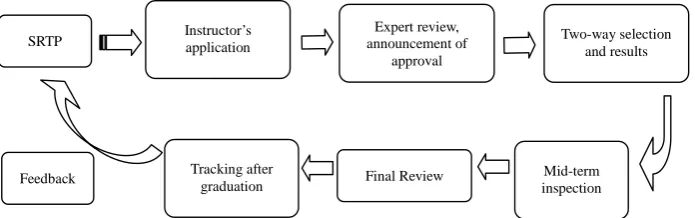
Process management shall be standardized, striving for macro control. Anhui University has set up a whole range of management systems for thorough monitoring of the approved projects and hereby realizes the macro management and control, as shown in Figure 1. First, only qualified instructor shall apply, the university will organize experts to choose from the applications, which will be announced openly. Second, students will submit materials proving their abilities to the instructor of the project which they want to participate in. It is a two-way selection. Third, the university will summarize results of the two-way selection and announce the results after approval as a confirmation for implementation. After project initiation, the university will organize experts to carry out mid-term inspection and concluding review. When the project is completed, students involved in the project are required to publish at least one thesis in the core journal or apply for one patent. By standardizing process management, the university does its best to fully mobilize the instructor and students, encourage the in-structor to invite outstanding students to participate in his project, stimulate students to take an active part in scientific researches, technological production, inventions as well as the writing of research paper and establish a mechanism that the instructor and students interact with the combination of self-study and guidance. In this way, the students’ innovative interest is developed and their innovative enthusiasm is motivated [3].
Exercise strict control over progress and implement micro advancing. Instructor responsibility system is adopted for project research. The instructor will accomplish various jobs according to plan, accept the universi-ty’s monitoring, mid-term inspection and concluding review of the project, and shall submit work report and concluding report. After a student selects the subject, the instructor will instruct the overall process of the re-search, including project design, technical scheme, experimental practice and results submission, etc., based on his understanding of the student’s basic knowledge. The instructor shall exercise strict control over the progress, ensure that the research can be completed efficiently with high quality within the time specified. The instructor shall encourage students to participate in team discussion, help the student study and think independently, help the student to find problems, raise questions and solve them. The instructor will give full play to student’s initia-tive and develop his innovainitia-tive spirit.
Instructor’s
application Two-way selection and results
Feedback Tracking after
graduation Final Review
Mid-term inspection Expert review,
[image:2.595.140.488.595.704.2]announcement of approval SRTP
Improve evaluation system and realize end incentive [4]. After the project is completed, the project team shall fill in Anhui University Concluding Report of SRTP and submit a summary report, with published paper (de-sign), patent, award certificate, etc. The department will carry out primary review of the project and after that the university will organize expert review. The project will be rated as Excellent or Acceptable with certificates. The instructors will be granted 20 credit hours per project and the members of qualified project team will be granted 2 innovative credits.
Track and analyze timely, striving for constant feedbacks. The university carries out tracking and investiga-tion of the students involved in the project after graduainvestiga-tion for timely statistics and analysis. By comparing and analyzing how SRTP promotes student employment and enrollment, feedbacks can be provided for the im-provement of implementation and management of SRTP.
2.3. Guarantee of Conditions
Software. The university has formulated Anhui University SRTP Management Method, which standardizes its organization, application, project management, funds management as well as support and rewards, etc. SRTP is combined with other relevant activities too. The university actively organizes undergraduates to participate in various academic competitions at all levels, hear academic lectures in related fields, join academic activities and discussions in laboratories, and so on. In this way the students can be nurtured by all-round multi-layer scientific researches in an academic atmosphere.
Hardware. The university finances SRTP, with a maximum of 10,000 RMB for social sciences and a maxi-mum of 20,000 RMB for science and engineering. From 2011 to 2014, about 100 SRTPs are approved every year, the funds totaling 7.2 million RMB. In the meantime, the university provides all possible conditions for SRTP and the labs and libraries of all departments are accessible to SRTP students.
3. Achievements and Effects
Now we take the first batch of SRTP initiated in 2011 as an example to illustrate the effects of the project. Stu-dents involved in the projects are systematically exercised in diversified projects at different levels, which greatly improve their research abilities and achieve fruitful results. According to statistics, the students involved in projects have, as the first author, published 60 academic papers (of which 14 papers in SCI, 1 in EI, 2 in CSCD journals), and have, as co-author, published 24 papers (of which 7 papers in SCI, 4 in EI, 6 in CSCD journals). The students have applied for 7 patents and obtained 1 patent for utility models. The quality of papers published by the students has reached all-time high since the university was founded.
Wang Chunchang, Professor of College of Physics and Material Science, applied for a SRTP entitled Re-search of Giant Dielectric Property of A(Fe0.5Nb0.5)O3 (A = Ba, Sr) on the basis of his project funded by Chinese
first author, entitled “Polaronic relaxation in LaFeO3” and “Polaronic relaxation in La0.8Bi0.2Fe0.7Mn0.3O3” in
Materials Letters and Materials Chemistry and Physics, which were collected by SCI. Now the two students are both studying for a master in USTC.
According to statistics, as shown in Figure 2, among 146 students participating in SRTP in 2011, 85 students are admitted to foreign universities, Chinese Academy of Sciences or universities of 211 Project for master de-gree, which accounted for 58% of total students involved in SRTP. 55 students are admitted for master degree to universities of 985 Project including Zhejiang University and People’s University of China, which accounted for 38% of total students involved in SRTP. 61 students are employed in scientific research institutions and enter-prises.
Most students participating in the SRTP wrote in the summarizing report: after receiving scientific research drills in relevant projects, I not only improved my ability of discovering problems and solving practical prob-lems, but developed my innovative ability of combining theory with practice. Moreover, while conducting re-search, I obtained an interest of research-oriented study. All these students were highly rated by their tutors in master enrollment and employers in interviews, because of their participation in SRTP and the results they achieved. Wan Jingjing, a student majoring in environmental science enrolled in 2010, who participated in the project of “Research on biological denitrification effect and mechanism of ZVI intensified wastewater with high ammonia-nitrogen” said, “after one year of research drill, with the instruction of our instructor, we got to know how to consult information by using key words, write experiment scheme, adjust experimental design and pre-pare for experiment. Though there were many unexpected problems in the process, research drills benefited us a lot. We learned the experimental skills and more importantly we learned knowledge in addition to those on the books. We greatly improved our ability to conduct experiment independently.” Wan Jingjing is now studying for a master degree in Department of Environmental Science and Engineering of Fudan University.
Instructors also benefited a lot from their interaction with students in research drills. Prof. Tao Liang, an in-structor of School of Computer Science and Technology, said, “While we were instructing the student and achieved the expected results, we were inspired a lot in the process of project implementation. First of all, the undergraduates are the most innovative group who needs instructor’s positive guidance. Second, to teach is to learn. Only in communication and interaction can we accurately find problems and instruct timely and solve them. Finally the win-win goal of increasing students’ ability of combining theory with practice and improving instructors’ instruction has been reached. Real Gabor Transform-based Whispered Voice Understandability In-tensifying Project, instructed by Prof. Tao Liang, was completed with excellent results. One student participat-ing in the project was admitted to USTC for master degree and another student was employed by a sci-tech company.
Others, 11
Colleges and universities of “9 85 Project”, 55
Advanced to higher school, 85
Scientific research academies and enterprises and institutions,
50
Going abroad, 2
Colleges and universities of “2 11 Project”, 28
4. Conclusion
Innovation is rooted in practice and developed in practice. To cultivate innovative talents, practice is the foundation. SRTP is an effective way to increase students’ innovative ability, practicing ability, teamwork spirit and social competitive edge. Moreover, SRTP plays an important role in developing students’ theoretical knowledge, over-all practical ability and way of thinking required for scientific research. Through SRTP, Anhui University de-velops students’ innovative thinking, inspires their innovative potential, further improves their practical ability and innovative spirit and enhances the quality of innovative talents.
References
[1] Ma, J., Sun, R.F. and Peng, F.Y. (2008) Combine Study, Teaching and Research, Develop Innovative Personnel— Retrospect and Prospects of 12-Year SRTP of Tsinghua University. China Education Innovation Herald, 14, 64-66.
[2] Li, Y.F. and Zhu, X.D. (2011) Research Training Program and Development of Students Innovation Ability. China
University Teaching, 4, 24-25.
[3] Dong, D.Y. and Shi, B.S.H. (2012) Analysis of Factors Affecting Execution Effect of SRTP. China Higher Education, 29, 65-73.
[4] Li, J.L., Hou, Y., Song, F., Zhang, T.B. and Ji, D.F. (2014) Analysis of Incentive Strategies in Execution of SRTP.