http://dx.doi.org/10.4236/opj.2014.48021
How to cite this paper: Saito, K., et al. (2014) Terahertz Wave Generation via Nonlinear Parametric Process from ε-GaSe Single Crystals Grown by Liquid Phase Solution Method. Optics and Photonics Journal, 4, 213-218.
http://dx.doi.org/10.4236/opj.2014.48021
Terahertz Wave Generation via Nonlinear
Parametric Process from
ε
-GaSe Single
Crystals Grown by Liquid Phase
Solution Method
Kyosuke Saito1*, Yuki Nagai1, Kunihiko Yamamoto1, Kensaku Maeda1, Tadao Tanabe2,
Yutaka Oyama1
1Department of Materials Science, Graduate School of Engineering, Tohoku University, Sendai, Japan
2Institute of Multidisciplinary Research for Advanced Materials, Tohoku University,
Sendai, Japan
Email: *[email protected]
Received 12 June 2014; revised 8 July 2014; accepted 1 August 2014
Copyright © 2014 by authors and Scientific Research Publishing Inc.
This work is licensed under the Creative Commons Attribution International License (CC BY). http://creativecommons.org/licenses/by/4.0/
Abstract
Terahertz (THz)-wave generation has been conducted based on difference frequency mixing (DFM) process with phonon-polariton excitation of ε-GaSe single crystals implemented with liquid-phase solution growth using the temperature difference method under controlled vapour pressure for the first time. The type-eoo phase matching condition for the DFM process at around 10 THz is sat-isfied by changing the incident angle into the crystal. The maximum conversion efficiency in the present DFG process is about 10−6 J−1 using a 0.1-mm-thick GaSe single crystal with the only ε- phase polytype, which can be greater than that of the commercially available Bridgman grown GaSe crystal including both ε- and γ-phase polytypes.
Keywords
Terahertz Wave, Nonlinear Optics, Semiconductor Material, Liquid Phase Solution Growth
1. Introduction
Recently, terahertz (THz) waves, which locate above micro-wave frequency regions, have gathered much
tion because of their unique features, such as high transmittance through non-metallic materials, low photon en-ergies that correspond to thermal enen-ergies of room temperature and weak molecular bonding, especially the hy-drogen bonding. These features can be applied for non-destructive inspection, label-free identification of bio- molecules, environmental polluting gas monitoring, and high speed wireless communication, etc. [1]-[3].
Monochromatic THz sources based on the nonlinear optical (NLO) effect such as optical parametric oscilla-tion and difference-frequency generaoscilla-tion (DFG) are promising methods due to their characteristic features such as high power, widely tuneable frequency and room temperature operation. NLO crystals based on the semi-conductor material (GaAs [4], GaP [5] [6], and GaSe [7]-[9], etc.) are attractive materials because of their high NLO coefficient, high transparency in both infrared and THz regions, and the controlled growth methods to produce high quality single crystals. Especially, GaSe crystals are attractive materials because of the capability of high NLO coefficient (d = 54 pm/V) [10] and THz wave generation in the wide frequency range which covers not only the THz frequency region but also mid-infrared regime (0.1 - 100 THz) [9]. In addition, it is noted that the birefringence of bulk GaSe enables collinear phase matching conditions for THz generation via DFG process
[7]-[9].
Most of commercially available GaSe crystals are grown using Bridgman method which introduces non- stoichiometric composition due to dissociation of Se atoms and introduction of point defect at the thermal equi-librium condition by high crystal growth temperature [11] [12]. Additionally, it has been shown that GaSe single crystals grown by this method possess several poly types. Therefore, not only the stoichiometry control but also the poly type control of GaSe single crystal is the serious problem for the fabrication of high quality NLO mate-rials. We have successfully fabricated ε-GaSe single crystals for the first time using liquid phase solution growth based on temperature difference method under controlled vapour pressure (TDM-CVP) [13] [14]. This growth method can provide high quality NLO materials with low optical absorbance in both infrared and THz regions by precise stoichiometry control at lower growth temperature because the grown GaSe crystal possesses the sin-gle ε-phase polytype compared with that grown by Bridgman method which contains ε- and γ-phase polytypes.
In this paper, it is shown that we conducted THz generation via DFG process using single polytype ε-GaSe single crystals grown by liquid phase solution method based on the TDM-CVP. Then, THz output characteristics were obtained by satisfying type-eoo phase matching conditions under the collinear phase matching conditions in the crystal.
2. Experimental Section
2.1. Sample Preparation Procedure
GaSe single crystal was prepared by the liquid phase solution method using TDM-CVP. Single poly type of ε-GaSe has been confirmed by X-ray diffraction (XRD) method and backward Raman scattering spectroscopy
[13]. The input and output surfaces of the grown ε-GaSe were prepared by cleaving on (0001) plane by Scotch
tape peeling-off method. Figure 1 shows typical optical microscope photograph (Nomarski differential interfer-ence contrast microscopy) of GaSe surface morphology after peeling. It is shown that the smooth surface mor-phology after the surface treatment can be obtained. The crystal thickness in c-axis direction was adjusted to be 0.1 mm by this peeling method, and anti-reflection coating was not applied to both input and output faces.
2.2. Optical Setup for THz-Wave Generation
Figure 1. Optical microscope photograph of treated GaSe surface on (0001) plane after treated by Scotch-tape peel-ing method (Nomarski differential interference micro-scopic method).
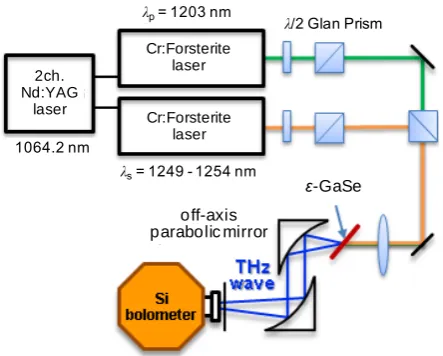
Figure 2. Schematic diagram of THz generation setup based on DFM process.
3. Results and Discussion
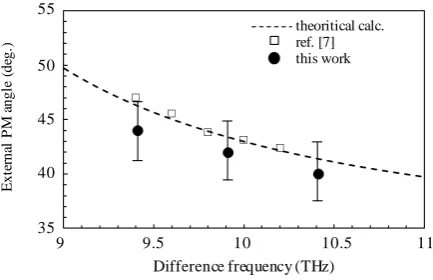
THz-wave generation was achieved on the basis of type-eoo PM condition using the c-axis cleaved ε-GaSe sin-gle crystal with 0.1-mm-long. Figure 3 shows external phase matching angle as a function of the difference frequency between two infrared sources. The external PM angles were measured as about 43, 42, and 41 degrees in the difference when the difference frequency was set to 9.41, 9.95, 10.41 THz, respectively. The type-eoo phase matching condition for THz-wave generation is expressed by,
( ) ( ) ( )
,
e o o
p p s s THz THz
n ω −n ω = n ω (1)
where n( )pe and ns( )o (i = s and THz) are extraordinary refractive index at the pump wavelength and ordinary refractive index at signal and produced THz-wave for GaSe crystal. The dispersion relationships of refractive indices for GaSe n( )e and n( )o obey following equations [15],
( )2 2 2
2 4 6 2 2
0.4050 0.0186 0.0061 3.1436 0.017
7.437
2193.8 262177.5577
o
n λ λ
λ λ λ λ λ
= + + + + +
− − , (2)
( ) 2
2 4
2
6 2
0.3879 0.2288 0.1223 0.4206
5.760
17804
e
n λ
λ λ λ λ
= + − + + , (3)
atomically flat terrace steps
λp= 1203 nm λ/2 Glan Prism
Cr:Forsterite laser
Cr:Forsterite laser 2ch.
Nd:YAG laser
1064.2 nm
λs= 1249 - 1254 nm
ε-GaSe off-axis
[image:3.595.204.426.297.475.2]Figure 3. External phase matching (PM) angles as a function of the difference frequency of two infrared sources. Dashed line corresponds to the theoretical calculation for type-eoo
PM, dots with error bar and open squares are experimental data obtained in this work and previous work using Bridg-man method grown GaSe crystal (5-mm-long) in Ref. [7].
( ) ( ) ( )
2
2 2
2
2
1 sin cos
, ( )
e e e
n
n n
θ θ
θ = + (4)
where θ is angle between the propagation direction and c-axis of the GaSe crystal. Dashed curve in Figure 3 corresponds to the calculated results on the basis of Equations (1)-(4). The PM angles obtained from the ex-periment show slight deviation with and calculated results. The 100-µm-thick GaSe crystal shows large accep-tance angle for PM condition (shown as error bar in Figure 3) compared with 5-mm-thick GaSe crystal [7]
(shown as open square in Figure 3).
Figure 4(a) shows the THz output power as a function of the external PM angle between c-axis of the crystal and the incident direction of the optical beams. For the type-eoo PM condition, monochromatic THz-waves with linewidth of about 0.5 GHz were generated effectively above upper phonon-polariton branch at 9.41 THz, 9.91, and 10.41 THz, respectively. Maximum THz output power at each fixed frequency position decreased when the THz frequency increased because water vapour absorption exist around 10 THz [15] [16]. Periodical THz output power variations in association with the PM angle change were observed in this figure. The reason of this phe-nomenon is expressed due to the interference of each incident infrared source and output THz-wave. The calcu-lated result at difference frequency at 9.41 THz by taking into account for the interference contribution was shown in Figure 4(b), which is consistent with the experimental result.
The THz output peak power was estimated with the calibrated Si bolometer and black polyethylene filter, which blocked the pump and signal beams. Power calibration of Si bolometer used was carried out by using black body radiation [17]. The highest THz peak power of 3 mW was achieved when the external phase match-ing angle was set to 44 degrees the difference frequency of THz-wave was set to 9.41 THz. The correspondmatch-ing conversion efficiency was estimated to be about 1.2 × 10⁻⁶ J−1 by using the 0.1-mm-long crystal. This estimated conversion efficiency can be comparable with the THz output from the commercially available 2-mm-long GaSe crystal grown by Bridgman method (in the order of 10−7 J−1) [7]. The improvement of THz conversion efficiency can be supported by the decrease of absorption coefficient for the incident infrared sources associated with the energy state of deep level in the ε-GaSe single crystal [13] [14].
4. Conclusion
In conclusion, THz-wave generation via DFG process has been realized using pure ε-GaSe single crystals fabri-cated by liquid phase solution growth, using the temperature difference method under controlled vapour pressure (TDM-CVP). The type-eoo phase matching condition is satisfied by changing the incident angle into the crystal. The maximum conversion efficiency in the DFG process is about 10−6 J−1 using a 0.1-mm-long ε-GaSe single crystal. Our growth method is able to provide high quality NLO crystals and develop the efficient monochro-matic THz sources.
theoritical calc. ref. [7] this work
Difference frequency (THz)
[image:5.595.108.518.82.236.2]
(a) (b)
Figure 4. (a) THz output power and corresponding conversion efficiency as a function of the external PM angle at fixed frequency of 9.14, 9.91, and 10.41 THz, respectively. (b) Calculated THz output at 9.41 on the basis of Equations (1)-(4) (broken line), and that result which was taken into account contribution of the interference of each three interacting waves (solid line).
Acknowledgements
Authors would like to thank the organization of Nishizawa Memorial Research Centre for its support of the GaSe crystal growth. This work was supported by KAKENHI (23360025) of Grant-in-Aid for Scientific Re-search (B) and KDDI Foundation Grant Programs.
References
[1] Tonouchi, M. (2007) Cutting-Edge Terahertz Technology. Nature Photonics, 1, 97-105. http://dx.doi.org/10.1038/nphoton.2007.3
[2] Laman, N., Harsha, S.S., Grischkowsky, D. and Melinger, J.S. (2008) High-Resolution Waveguide THz Spectroscopy of Biological Molecules. Biophysical Journal, 94, 1010-1020. http://dx.doi.org/10.1529/biophysj.107.113647
[3] Schaar, J.E., Vodopyanov, K.L. and Fejer, M.M. (2007) Intracavity Terahertz-Wave Generation in a Synchronously Pumped Optical Parametric Oscillator Using Quasi-Phase-Matched GaAs. Optics Letters, 32, 1284-1286.
http://dx.doi.org/10.1364/OL.32.001284
[4] Song, Q., Zhao, Y., Redo-Sanchez, A., Zhang, C. and Liu, X. (2009) Fast Continuous Terahertz Wave Imaging System for Security. Optics Communications, 282, 2019-2022. http://dx.doi.org/10.1016/j.optcom.2009.02.019
[5] Tomita, I., Suzuki, H., Ito, H., Takenouchi, H., Ajito, K., Rungsawang, R. and Ueno, Y. (2006) Terahertz-Wave Gen-eration from Quasi-Phase-Matched GaP for 1.55 μm Pumping. Applied Physics Letters, 88, 071118.
http://dx.doi.org/10.1063/1.2174832
[6] Tanabe, T., Suto, K., Nishizawa, J., Kimura, T. and Saito, K. (2003) Frequency-Tunable High-Power Terahertz Wave Generation from GaP. Journal of Applied Physics, 93, 4610-4615. http://dx.doi.org/10.1063/1.1560573
[7] Dezaki, H., Tanabe, T., Haiyan, J. and Oyama, Y. (2012) Wide Frequency Tunable GaSe Terahertz Emitter under Col-linear Phase Matching Condition. Key Engineering Materials, 500, 58-61.
http://dx.doi.org/10.4028/www.scientific.net/KEM.500.58
[8] Nishizawa, J.-I., Sasaki, T., Oyama, Y. and Tanabe, T. (2007) Aspects of Point Defects in Coherent Terahertz-Wave Spectroscopy. Physica B, 401-402, 677-681. http://dx.doi.org/10.1016/j.physb.2007.09.050
[9] Shi, W. and Ding, Y.J. (2004) A monochromatic and High-Power Terahertz Source Tunable in the Ranges of 2.7 - 38.4 and 58.2 - 3540 μm for Variety of Potential Applications. Applied Physics Letters, 84, 1635-1637.
[10] Dmitriev, V.G., Gurzadyan, G.G. and Nikogosyan, D.N. (1997) Handbook of Nonlinear Optical Crystals. Springer, Berlin, 166-169.
[11] Cardetta, V.L., Mancini, A.M. and Rizzo, A. (1972) Melt Growth of Single Crystal Ingots of GaSe by Bridg-man-Stockbarger’s Method. Journal of Crystal Growth, 16, 183-185. http://dx.doi.org/10.1016/0022-0248(72)90112-1 [12] Singh, N.B., Suhre, D.R., Balakrishna, V., Marable, M. and Meyer, R. (1998) Far-Infrared Conversion Materials:
Gal-lium Selenide for Far-Infrared Conversion Applications. Progress in Crystal Growth and Characterization of Mate-rials, 37, 47-102. http://dx.doi.org/10.1016/S0960-8974(98)00013-8
[13] Onai, T., Nagai, Y., Dezaki, H. and Oyama, Y. (2013) Liquid Phase Growth of Bulk GaSe Crystal Implemented with w/o interference
w/ interference
External phase matching angle (deg.) 30 35 40 45 50 55 60 1
0.8
0.6
0.4
0.2
0
T
H
z in
te
n
sity
(
a.
u
the Temperature Difference Method under Controlled Vapor. Journal of Crystal Growth, 380, 18-22. http://dx.doi.org/10.1016/j.jcrysgro.2013.05.027
[14] Nagai, Y., Maeda, K., Suzuki, K. and Oyama, Y. (2014) Comparative Study of Shallow Acceptor Levels in Non-In- tentionally Doped P-Type GaSe Crystals Prepared by the Bridgman and Liquid Phase Solution Growth Methods.
Journal of Electronic Materials, 43, 3117-3120.
[15] Chen, C.W., Tang, T.T., Lin, S.H., Huang, J.Y., Chang, C.S., Chung, P.K., Yen, S.T. and Pan, C.L. (2009) Optical Properties and Potential applications of ε-GaSe at Terahertz Frequencies. Journal of Optical Society of America B, 26, A58-A65. http://dx.doi.org/10.1364/JOSAB.26.000A58
[16] Kauppinen, J., Kärkkäinen, T. and Kyrö, E. (1978) High-Resolution Spectrum of Water Vapor between 30 and 720 cm−1. Journal of Molecular Spectroscopy, 71, 15-45. http://dx.doi.org/10.1016/0022-2852(78)90073-5