White Rose Research Online URL for this paper:
http://eprints.whiterose.ac.uk/721/
Article:
Garcia-Garcia, J., Martin, F. and Miles, R.E. (2004) Optimization of micromachined relex
klystrons for operation at terahertz frequencies. IEEE Transactions on Microwave Theory
and Techniques, 52 (10). pp. 2366-2370. ISSN 0018-9480
https://doi.org/10.1109/TMTT.2004.835975
[email protected] https://eprints.whiterose.ac.uk/ Reuse
See Attached
Takedown
If you consider content in White Rose Research Online to be in breach of UK law, please notify us by
Optimization of Micromachined Reflex Klystrons
for Operation at Terahertz Frequencies
Joan Garcia-Garcia, Ferran Martín, and Robert E. Miles
, Member, IEEE
Abstract—New micromachining techniques now provide us with the technology to fabricate reflex klystron oscillators with dimensions suitable for operation in the terahertz region of the electromagnetic spectrum. For the success of these devices, accurate designs are required since the optimization of certain parameters is critical to obtaining useful amounts of ac power. Classical models for device design have long been in existence, but these are no longer valid at terahertz frequencies. For this reason, we have developed a simulation tool, specifically aimed at the design of terahertz frequency reflex klystrons. The tool, based on the Monte Carlo algorithm, includes loss mechanisms and takes into account the main peculiarities expected for device operation at terahertz frequencies. In this study, the tool is used to study the influence of the electron beam aperture angle and cavity dimensions (particularly the grid spacing) on ac power generation. The results demonstrate that aperture angles of less than 10 are necessary for the optimization of output power. It is also found that the power output is highly sensitive to the distance between the grids.
Index Terms—Micromachining, Monte Carlo (MC) simulation, reflex klystrons, terahertz sources.
I. INTRODUCTION
A
WIDE variety of scientific and commercial applications that rely on the physical properties of terahertz radiation are either currently under investigation or are forecast [1]. These include imaging of biological tissue, spectroscopic identification of complex molecules, and broad-band com-munications. These systems require compact and inexpensive terahertz power sources, and several techniques for their imple-mentation are under investigation. Some of them (classified as indirect) are based on frequency conversion from microwave or optical sources [2]–[8]. In these techniques, power delivered by a fundamental source is converted to the desired terahertz frequency with an inevitable conversion loss. Direct generation of terahertz radiation is more difficult. The sources that do exist are either fragile vacuum tube devices, which require high-voltage power supplies and magnetic fields or deliver very small amounts of power. Typical of the latter category is the resonant tunnelling diode (RTD) [9]–[11] oscillator, which has achieved a maximum frequency of 712 GHz, but withManuscript received April 30, 2003. This work was supported in part by the Dirección General de Investigación under Contract BFM2001-2001.
J. Garcia-Garcia and F. Martín are with the Departament d’Enginyeria Electrònica, Universitat Autònoma de Barcelona, 08193 Bellaterra, Barcelona Spain (e-mail:[email protected]).
R. E. Miles is with the Institute of Microwaves and Photonics, School of Electronic and Electrical Engineering, The University of Leeds, Leeds LS2 9JT, U.K.
Digital Object Identifier 10.1109/TMTT.2004.835975
power levels that are too low to be useful in real applications [9]. Quantum cascade lasers, based on radiative intersubband transitions in quantum-well structures and developing a few milliwatts of terahertz power, have been reported recently, but these devices do not yet operate at room temperature and are difficult to tune [12].
It is well known that the direct generation of terahertz frequency radiation can be achieved by scaling down the dimensions of the klystron (a vacuum tube device originally developed in 1939 [13] and still in use as a high-power mi-crowave source) [14]. However, progress in this direction has been stalled because of the limitations of conventional ma-chining, but with recent advances in micromama-chining, resonant cavities with the dimensions required for terahertz operation (typically tens of micrometers) can now be fabricated. This technology, allied with that of micromachined Si cold cathode field emission electron sources [15], [16], which are capable of producing higher beam current densities than heated filaments (and at much lower temperatures), suggests that it should be possible to achieve useful power levels in the region of 1 mW at terahertz frequencies. In order to optimize the performance of a klystron oscillator, apart from a detailed understanding of its operating principle (see [17]), it is also necessary to develop accurate simulation tools where losses and the main peculiarities derived from operating conditions and device dimensions are taken into account. Although there are many available codes devoted to the simulation of vacuum electron devices (see [18]), they are limited in their application to terahertz frequency devices. We have, therefore, recently developed a simulation tool, based on the Monte Carlo (MC) technique, which has been specifically designed for the analysis and optimization of the micromachined reflex klystron. The MC approach describes microscopically electron motion and is able to provide us valuable information on the dynamics of the device such as the formation of bunches (which are critical for device operation). It takes into account the finite transit times of electrons (across the velocity modulation region) in the device and is, therefore, appropriate for the analysis of terahertz and near terahertz reflex klystrons. The main aim of this paper is to analyze the effects of two parameters that have a direct influence on ac power generation and have important implica-tions from a technological point-of-view, i.e., the angle of the emitted electrons and the distance between grids. The former is related to the quality of field emitters, which, desirably, should provide dispersionless electron beams. Grid separation is also critical since, at terahertz frequencies, the transit time of electrons across the cavity can be comparable or even longer than the period of the signal, and ac power generation can be
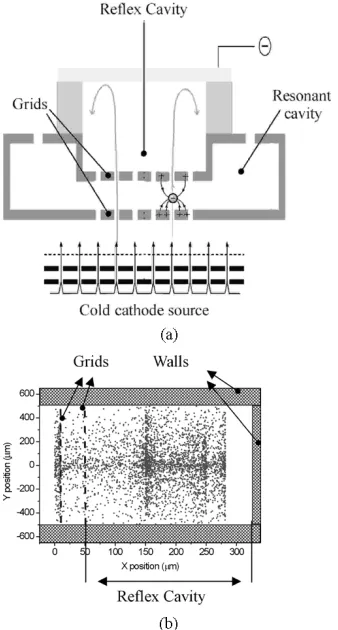
Fig. 1. (a) Structure of the simulated reflex klystron. (b) Typical representation of the positions of electrons in the repeller obtained by means of our simulator. Bunching of electrons is clearly visible in the central region.
inhibited. As will be seen, in order to obtain terahertz signals, it is necessary to design cavities with precise (frequency-de-pendent) dimensions, which are in the range of several tens of micrometers or less. These dimensions are also a technological challenge. From this analysis, we expect to obtain design rules for the optimization of reflex-klystron oscillators operating as terahertz sources.
II. REFLEX-KLYSTRONOPERATION
Fig. 1(a) shows a schematic diagram of a reflex klystron. The principle of operation of this device is based on velocity modu-lation of the electrons in a beam generated by an electron gun. After emission, the electrons pass through a pair of metal grids, which form part of a tuned cavity. On emerging from the second grid, the electrons enter a “drift region,” where they are reflected back along their original path by a negatively charged “repeller” electrode. Random fluctuations in the beam current give rise to an oscillating electromagnetic field in the cavity, which, in turn, produces a fluctuation in the potential difference between the grids. This potential variation slows down the faster elec-trons and speeds up the slower ones as they travel through the cavity, causing them to emerge in bunches into the drift region (see Fig. 1(b) as an illustrative example). If, after reflection, the bunches return to the cavity at the correct point in the cycle, i.e., when the potential of the right-hand-side grid is positive, power is transferred to the cavity and the bunching effect is enhanced. Under these conditions, a feedback mechanism exists and the
ac power at the resonant frequency of the cavity will increase until a steady state is set up where the rate of power generation is equal to the rate of dissipation. It is, of course, necessary that the power transferred from the electron beam to the cavity is suf-ficient to compensate for the losses in the cavity and the useful power delivered to an outside load.
III. SIMULATIONTOOL
A detailed description of the three-dimensional time-domain MC klystron simulation has been presented in [19]. Essentially, electron motion is calculated from the electrical forces using classical dynamics. These forces derive from: 1) the repeller voltage; 2) the field in the cavity; 3) the Coulomb interactions between electrons; and 4) the cavity walls. It is worth men-tioning that, in contrast to analytical models, our tool allows the electric field to vary in the cavity during electron transit. This is necessary for the simulation of terahertz reflex klystrons since, for typical grid separations and particle velocities, the transit time of electrons between the grids is comparable to the period of the oscillating voltage. The simulator also takes into account an important cause of device losses, i.e., the opacity of the grids. Those electrons intercepted by the grid are not transmitted and, therefore, cannot contribute to the formation of bunches. Simi-larly, a fraction of the electrons returning from the reflex cavity are collected by the grid and, hence, do not deliver power to the resonant cavity. The consequence of this opacity is, therefore, a degradation in output power. Energy interchange between the electrons and cavity is based on the induced current in the cavity walls [20], which is due to the positive (image) charge gener-ated by electrons on both grids during transit (see Fig. 1). As an electron moves across the cavity, the charge induced on the back grid decreases, while that on the front grid increases, causing a transfer of positive charge from one grid to the other (i.e., an in-duced current) through the cavity wall. The contribution of each individual electron to the current is given by
(1)
where is the electron velocity. The total induced current can be found by summing the contribution of all electrons present in the cavity. From this, the voltage between the grids can be calculated simply by modeling the resonant cavity as a RLC parallel circuit, where is the shunt resistance of the loaded cavity. Since is easily calculated from the geometry of the cavity and the loaded factor is a measurable parameter, and can be computed following
(2)
(3)
Fig. 2. Startup of current and voltage oscillations obtained by including grid losses (transparency factor of the gridg = 0:5). A dc current voltage appears as a consequence of the opacity of the grids. Device and simulation parameters are: energy of incident electronsqV = 80eV, repeller voltageV = 110V, electron beam currentI = 1mA, reflex cavity dimensionsd = 400 m, and grid distanced = 30 m,Q = 300,C = 0:1pF, andf = 92GHz.
it is important to verify the ability of the feedback mechanism to initiate oscillations. To this end, we have carried out several simulations with different levels of electron beam current , and we have observed that, in agreement with classical klystron theory, a minimum is required to initiate the oscillations. Fig. 2 shows the initial stages of a typical simulation where the generation of an ac voltage and current at the frequency of the cavity ( GHz) is clearly visible. The dc current compo-nent is due to the opacity of the grids, which causes an asym-metric number of electrons traveling in opposite directions. The simulation parameters (device dimensions and voltages) have been chosen to guarantee that electron bunches return to the cavity when the grid voltage opposes their motion, i.e., the av-erage transit time in the repeller region has been selected to be in the vicinity of cycles, where is an integer.
IV. OPTIMIZATION OFMICROMACHINEDREFLEXKLYSTRONS
The main technological challenges in the fabrication of ter-ahertz reflex klystrons are the resonant cavities and electron guns. Typical cavity dimensions for terahertz operation are sev-eral tens of micrometers. With the recent advances in micro-machining, these sizes are achievable. However, it is important to know how critical these dimensions are since the fabricated prototypes are subjected to size tolerances related to the fabri-cation process. Therefore, it is interesting to study the depen-dence of ac power generation on the dimensions of the resonant cavity, in particular, the distance between grids, which is the relevant parameter. It is also important that the electron beam is as monochromatic and focused as possible since this favors the formation of bunches and, hence, ac power generation. To this aim, field emitters are a good choice. However, it is important to carry out an analysis to study the limiting effects of disper-sion since this is present in actual field emitters and can degrade device behavior. Let us now consider the effects of the aperture and cavity dimensions separately.
A. Aperture of the Electron Beam
[image:4.594.352.499.64.425.2]If electrons enter the grid region with a component of their velocity parallel to the grid plane, a nonnegligible velocity dis-persion in the direction of the electric field is expected. The ef-fect of this can be to widen the bunches (which means power degradation) or to preclude their formation. Since one of the
Fig. 3. Influence of the electron beam aperture angle on the power delivered to the resonant cavity.I = 1mA,qV = 80eV,V = 300V,Q = 350,
C = 0:02pF.
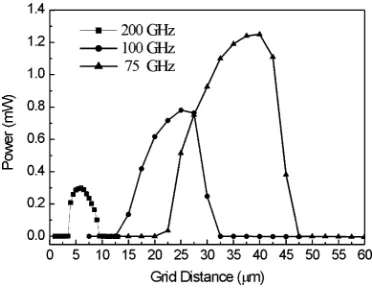
Fig. 4. Dependence of output power on grid distance for a 75-GHz, 0.1-THz, and 0.2-THz reflex klystron.d = 727:5 m.,I = 1mA,qV = 80eV, V = 300V, cavity quality factor:Q = 350, grid transparency: 0.7. The grid radius (which, together with the grid distance, determineC) is 470m for the 75 and 0.1 GHz, and 300m for the 0.2-THz results.
Fig. 5. Extreme values of electron velocities in the grid closer to the reflex cavity as a function of grid distance for an externally forced 9-V sinusoidal potential at 200 GHz. Reflex cavity: d = 727:5 m, I =input current1mA,qV = 80eV, andV = 300V.
very critical in real devices since cold cathodes have disper-sion angles in this range. Therefore, efforts must be focused on the development of field emission tips with aperture angles no higher than 10 .
B. Cavity Dimensions
The effect of the grid separation on output power is shown in Fig. 4 for 75-GHz, 0.1-THz, and 0.2-THz reflex klystrons where it can be seen that the output power is very sensitive to this parameter, and that there is an optimum grid separation. This behavior can be understood as follows: if the grids are too close together, there is insufficient space for the bunches to be located inside the cavity when they cross the grid region. There-fore, ac voltage generation is inhibited and bunches are indeed not formed. Therefore, a minimum grid distance is required to start up oscillations. However, if the distance between the grids is too large, then power is degraded since velocity modulation for the electrons emerging at the second grid is reduced, and the formation of bunches is precluded. This is shown clearly in Fig. 5, which shows the extreme values of electron velocities at the second grid as a function of grid separation for an externally forced sinusoidal potential with GHz. At grid
dis-tances given by (where is an integer and is the velocity of incident electrons), there is no velocity modu-lation and particle behavior is the same as if the resonant cavity was not present. To obtain significant ac power, must be within the first interval provided that the induced current in the cavity (in a closed-loop configuration) is inversely proportional to this parameter. Since this interval decreases with frequency, the optimum grid separation (which can be inferred by means of the simulator) is expected to decrease also with frequency. This is in agreement with the results of Fig. 4. It is also important to note that the velocity of incident electrons and, hence, their en-ergy, has a direct influence on the optimum grid separation. This is because the extension of the first interval is proportional to and, therefore, an increase of the optimum grid separation with the energy of impinging electrons is expected. Nevertheless, the main conclusion with regard to the distance between grids is that this parameter is critical to the success of these device as sources of terahertz power. For this reason, a simulation tool to aid device design and optimize its performance is of interest.
V. CONCLUSIONS
In conclusion, an MC-based physical simulation has been used to study two aspects that are relevant to the performance of micromachined reflex klystrons as terahertz sources: the aper-ture angle of the incident electron beam and the distance be-tween grid walls in the resonant cavity. It has been found that to generate significant ac power ( 1 mW), field emitters must provide electron beams with dispersion angles no higher than 10 . Above this angle, output power is severely degraded due to significant dispersion in the component of electron velocity parallel to the electric field. Simulations carried out for sev-eral klystrons tuned at different frequencies demonstrate that ac power is very sensitive to the grid separation and there is an optimum values that depends on the frequency of the resonant cavity. The results of the work demonstrate that the developed tool can be of help for the design and optimization of microma-chined reflex klystrons operating in the terahertz region of the electromagnetic spectrum.
REFERENCES
[1] IEEE Trans. Microwave Theory Tech. (Special Issue), vol. 48, Apr. 2000. [2] E. Kollberg and A. Rydberg, “Quantum barrier varactor diodes for high efficiency millimeter wave multipliers,”Electron. Lett., vol. 25, pp. 1696–1698, Dec. 1989.
[3] E. Carman, M. Case, M. Kamegawa, R. Yu, K. Giboney, and M. J. W. Rodwell, “V-band andW-band broad-band, monolithic distributed fre-quency multipliers,”IEEE Microwave Guided Wave Lett., vol. 2, pp. 253–255, June 1992.
[4] J. R. Thorpe, P. Steenson, and R. Miles, “Non-linear transmission lines for millimeter-wave frequency multiplier applications,” inProc. IEEE 6th Int. Terahertz Electronics Conf., Sept. 1998, pp. 54–57.
[5] M. Li, K. Krishnamurthi, and R. G. Harrison, “A fully distributed het-erostructure barrier varactor nonlinear transmission line frequency mul-tiplier and pulse sharpener,”IEEE Trans. Microwave Theory Tech., vol. 46, pp. 2295–2301, Dec. 1998.
[6] J. Thornton, C. Mann, and P. Maagt, “Optimization of a 250 GHz Schottky tripler using novel fabrication and design techniques,”IEEE Trans. Microwave Theory Tech., vol. 46, pp. 1055–1061, Aug. 1998. [7] X. Melique, A. Maestrini, R. Farré, P. Mounaix, M. Favreau, O.
[8] H. Yoneda, K. Tokuyama, K. Ueda, H. Yamamoto, and K. Baba, “High power terahertz radiation with diamond photoconductive antenna array,” in25 Int. Infrared and Millimeter Waves Conf. Dig., S. Liu and X. Shen, Eds., Sept. 2000, pp. 61–62.
[9] E. R. Brown, J. R. Söderstrom, C. D. Parker, L. J. Mahoney, K. M. Molvar, and T. C. McGill, “Oscillations up to 712 GHz in InAs/AlSb resonant-tunneling diodes,”Appl. Phys. Lett., vol. 58, pp. 2291–2293, May 1991.
[10] E. R. Brown, C. D. Parker, S. Verghese, and M. W. Geis, “Resonant-tunneling transmission-line relaxation oscillator,”Appl. Phys,. Lett., vol. 70, pp. 2787–2789, May 1997.
[11] H. Eisele and G. I. Haddad, “Two-terminal millimeter-wave sources,”
IEEE Trans. Microwave Theory Tech., vol. 46, pp. 739–746, June 1998. [12] R. Köhler, A. Tredicucci, F. Beltram, H. E. Beere, E. H. Linfiled, A. G. Davies, D. A. Ritchie, R. C. Iotti, and F. Rossi, “Terahertz semiconductor heterostructure laser,”Nature, vol. 417, pp. 156–159, May 2002. [13] R. H. Varian and S. F. Varian, “A high frequency oscillator and
ampli-fier,”J. Appl. Phys., vol. 10, pp. 321–327, May 1939.
[14] R. E. Miles, J. García-García, J. R. Fletcher, D. P. Steenson, J. M. Cham-berlain, C. M. Mann, and E. J. Huq,Proc. 8th Int. Terahertz Electronics Conf., Sept. 2000, pp. 55–58.
[15] K. L. Jensen, “Field emitter arrays for plasma and microwave source applications,”Phys. Plasmas, vol. 6, pp. 2241–2253, May 1999. [16] S. E. Huq, G. H. Grayer, S. W. Moon, and P. D. Prewett, “Fabrication and
characterization of ultrasharp silicon field emitters,”Mater. Sci. Eng., vol. B51, pp. 150–153, Feb. 1998.
[17] M. J. Smith and G. Philips,Power Klystrons Today. Taunton-Somerset, U.K.: Res. Studies Press Ltd., 1995.
[18] T. M. Antonsen, A. A. Mondelli, B. Levush, J. P. Verboncoeur, and C. K. Birdsall, “Advances in modeling and simulation of vacuum electron devices,”Proc. IEEE, vol. 87, pp. 804–839, May 1999.
[19] J. García-García, F. Martín, R. E. Miles, D. P. Steenson, J. M. Cham-berlain, J. R. Fletcher, and J. R. Thorpe, “Parametric analysis of micro-machined reflex klystrons for operation at millimeter and submillimeter wavelengths,”J. Appl. Phys., vol. 92, no. 11, pp. 6900–6904, Dec. 2002. [20] K. R. Spangenburg,Vacuum Tubes. ser. Electron. Elect. Eng., F. E.
Terman, Ed. New York: McGraw-Hill, 1948.
Joan Garcia-Garciawas born in Barcelona, Spain, in 1971. He received the Physics and Ph.D. degrees from the Universitat Autònoma de Barcelona, Barcelona, Spain, in 1994 and 2001, respectively.
He then became a Post-Doctoral Research Fellow with the Institute of Microwaves and Photonics, The University of Leeds, Leeds, U.K., under the INTERACT European Project. In 2002, he was a Post-Doctoral Research Fellow with the Universitat Autònoma de Barcelona, where he was involved with the Ramon y Cajal Project of the Spanish Gov-ernment. In November 2003, he become an Associate Professor of electronics with the Departament d’Enginyeria Electrònica, Universitat Autònoma de Barcelona.
Ferran Martínwas born in Barakaldo (Vizcaya), Spain, in 1965. He received the B.S. degree in physics and Ph.D. degree from the Universitat Autònoma de Barcelona, Barcelona, Spain, in 1988 and 1992, respectively.
Since 1994, he has been an Associate Professor of electronics with the Departament d’Enginyeria Electrònica, Universitat Autònoma de Barcelona. In recent years, he has been involved in different re-search activities including modeling and simulation of electron devices for high-frequency applications, millimeter-wave and terahertz generation systems, and the application of electromagnetic bandgaps to microwave and millimeter-wave circuits. He is also currently very active in the field of metamaterials and their application to the miniaturization and optimization of microwave circuits and antennas.
Robert E. Miles(M’82) was born in Kettering, U.K. He received the B.Sc. and External Ph.D. degrees from Imperial College, London University, London, U.K., in 1964 and 1972, respectively.