An Advanced Door Lock Security System using Palmtop
Recognition System
Kawser Wazed Nafi
Lecturer Stamford University Dhaka, Bangladesh
Tonny Shekha Kar
Department of Computer Science and Engineering
Khulna University of Engineering and Technology
Khulna, Bangladesh
Sayed Anisul Hoque
Department of Computer Science and Engineering Chittagong University of Engineering and Technology
Chittagong, Bangladesh
ABSTRACT
Biometric technology is used to identify a person based on his/her physical behavioral characteristics. One of the extensive uses of biometric technology is a fingerprint recognition system. The technology has broad use mainly for its easiness, reliability and accuracy in human identification process. This paper presents work done on minutiae based palmtop recognition system for automatic door open and locking system. Here, the palmtop recognition system works by taking an image of the person, partitioning it, processing it and finally verifying the person. This system provides input for an electric circuit. The circuitry system consists of two unique states; door open and door lock. The whole system basically uses extensive Image processing for minutiae based palmtop recognition. Thus reducing the probability of error in human recognition and solves maximum problems of fingerprint recognition. This paper shows a better solution for recognizing people, which helps to solve security related problems in human life.
Keywords
Biometric recognition, Fingerprint recognition, Minutiae extraction, Palmtop recognition.
1.
INTRODUCTION
Biometric systems work with behavioral and physiological biometric data for identifying or verifying a person [1, 2]. Signature, gait, speech and keystroke are behavioral biometric parameters [3]. However, these parameters changes with the change of age, environment, accident, etc. On the other hand physiological characteristics such as face, fingerprint, palm print, iris remain unchanged for the full lifetime of a person [4]. The biometric system works in mainly two modes: - one is verification mode, another is identification mode [5]. Different biometric applications decide basically in which mode they will work. The verification mode works with the validation process of a person’s identity by comparing captured biometric data with a ready-made template [6]. On the other hand, identification mode works by recognizing process of a person’s identity by performing matches against multiple finger biometric templates [7]. Fingerprints are widely used in daily life for more than 100 years due to its feasibility, distinctiveness, permanence, accuracy, reliability and acceptability [8]. The fingerprint is a pattern of ridges, furrows and minutiae [9]. A good quality fingerprint contains 25 to 80 minutiae depending on sensor resolution, finger placement on the sensor, the quality of the input device, etc. [10]. The false minutiae are the false ridge breaks due to insufficient amount of ink and cross connections due to over
linking. It is difficult to extract reliably minutiae from poor quality fingerprint impressions. This may arise from very dry fingers [11] and fingers mutilate by scars, scratches due to accidents, injuries [12]. Very often sensors are not clear because of environments dust, heat and so on. As for this quality, the image becomes very distorted and it becomes hard to find the features of fingerprint at that time. This is the main reason, due to which extract features and identify the person becomes hard. Again, there is a probability of error identification of people during the time of fingerprint recognition system’s execution period because of two quite same fingerprints and fractioned or damped fingerprint [13]. Again, the old person’s fingerprint is not clear all the time [14]. These are some of the many factors for which it becomes hard to identify people accurately. Again, for identification system some percentage of errors are overlooked which sometimes cause an error at time of differentiating between two people’s single fingerprint. For these reasons, if the inputs are given into the electronic circuits of the room or building entrance door, it doesn’t work properly and becomes complicated [15].
The accuracy of feature extraction and recognition of a palmtop, means the fingers and some other portion of a palm print, depends fully on the quality of the input fingerprint image. Direct binarization [16] using standard technique renders images for the extraction of fine and subtle features such as the minutiae points. For this reason, it is necessary to improve the quality of ridge structures of palmtop images. Also need to maintain their integrity and retain the connectivity of the ridges. As the distance between minutiae is normalized [17] by the ridge frequency at each minutiae, the distance variation by nonlinear deformation is minimized. The performance of palmtop recognition highly depends on the preprocessing steps, where various ways to extract and represent distinguishable features among classed can be applied [18]. The main purpose of palmtop recognition is to facilitate the management of large palmtop databases and to speed up the process of palmtop matching. As the database of palmtop increased, manual identification became monotonous and automated methods became more widespread.
This paper is organized in the following parts: - section 2 describes the related work of palmtop recognition system; section 3 discusses the basic features and theory of palmtop recognition process; section 4 describes the proposed model, its architecture and processes; section 5 discusses the instruments require, and execution steps for the proposed model; section 6 describes the results or output of the proposed model from different directions and section 7 shows contribution of this paperwork and the future interests.
2.
RELATED WORK
Various methods are proposed for this minutiae based fingerprint recognition [21-35]. Research also takes on non-minutiae based fingerprint features [36, 37]. But these models sometime fail to recognize persons perfectly because of the environments and quite similar fingerprints. For this reason, one fingerprint of each person is not enough for minutiae based fingerprint recognition system. More than one fingerprint of each person can give best results.
Fuzzy logic based fingerprint recognition are also mentionable [38-44]. Here fuzzy logic is used for taking decision up to a level to find whether a fingerprint is related with the person of interested in minutiae based recognition. But this model takes much time and very often fails to recognize the fingerprint. For this reason, this model is used to some extent but not broadly. Neural Network based fingerprint recognition system is another important research topic at present [45-50]. Here, Neural Network is used to search out the weight of the fingerprint and then recognize it with the help of those which are calculated at time of training the computer [51-53]. But the training process takes considerably huge time for computers. In this process fixed position image is necessary. If the image is not positioned properly, the result will produce a large scale of errors. It also fails to give the right results because of quite same fingerprints. Again, 2 layer training process or ensembles takes huge time and memory for collecting weights. For this, a good amount of time is required for identifying a person. Such cases required to take more than one fingerprints to get good results. With the goal of removing this time complexity and make efficient fingerprint recognition system, people are now researching of finding out singular point based fingerprint recognition system. Every person has two singular points in his/her fingerprint: - Core and Delta [54-61]. Every person hasone or highest two cores and delta each in his/her fingerprint.With the help of extracting features of core and delta of one’s fingerprint the person can be recognized. In this process, the first orientation of minutiae and ridges are first calculated and then an algorithm for finding out the core and delta is applied. But this model is not effective all the time because of calculation error. Though it is rare but giving the same result for two fingerprints is seen. At that time, the authenticating process can be hampered and thus right person cannot be recognized. This process also required more than one fingerprints for recognizing the authenticated person. Research has also taken on genetic algorithm based fingerprint recognition system [62-65]. But again same fingerprint problems may generate here because of one quite same fingerprints. Some other methods and processes are also available now a day to extract features of fingerprints and try to recognize the people [66-69]. Some works have also taken place on a fingerprint recognition system in an efficient way. Ways and methods for recognizing the fingerprint with the help of different methodologies are also available nowadays [70-75]. However, all of these approaches deal with only one fingerprint. Most of the cases single finger is used to take the
print. But due to aging effect and the troubles present in the input devices these approaches sometimes provide wrong results. For this reason, verification or identification process fails to give actual result..
The automatic door lock system is now a day very familiar to all of the people of the world. In many departmental shops, offices, multinational organizations, etc. are using an automatic door opening and locking system]. Research works are taking place on newer automatic door lock systems which are cost effective. This paper has worked with a circuit for automatic door opening and locking system. Here, different low cost and effective electronic materials are used for developing the circuit for the automatic door opening and locking system. This gives the whole work more practical touch.
3.
BACKGROUND
In order to describe the proposed methodology more clearly, descriptions of few technical and important terms and points of palmtop recognitions are required. The basic features of one fingerprint are: - minutiae, ridge, core, delta and so on. The image and features of a fingerprint are shown below –
Fig 1. Features of a fingerprint
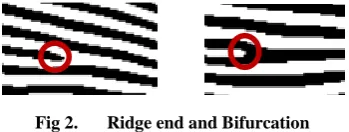
Discontinues of ridge is known as minutiae. These minutiae are used for fingerprint recognition. There are more than 150 types minutiae in this world. Two features of these minutiae are used for fingerprint recognition process. They are: - bifurcation and termination, means ridge ends. The patterns of these two features of minutiae are given in figure 2: -
[image:2.595.355.507.325.445.2]Fig 2. Ridge end and Bifurcation
After taking the image of fingerprint from the people it is first converted to grayscale and then searching algorithm is applied for finding out the matched minutiae. Here, mainly the minutiae are tried to find out and then make those detached from the actual one. Then algorithm is applied on the detached points for finding out the features of the minutiae taken and then keeps them in memory for future identification, recognition or verifies the persons. The verification process needs the following process:
[image:2.595.342.517.523.589.2]of the fingerprint. It is mainly done to take out the minutiae from the fingerprints. The most common minutiae patterns, which are tried to search out, are given in figure 3: -
Fig 3. Very common minutiae patterns
4.
PROPOSED METHODOLOGY FOR
FEATURE EXTRACTION
[image:3.595.55.298.253.351.2]The main steps for minutiae extraction are given in figure 4.
Fig 4. Basic steps of minutiae extraction and verification
At first, palmtop images are taken with the help of input device. After taking the images, the proposed methodology tries to find the ridge pattern (as shown in Figure 3) in different portions of palmtop. For this, the methodology follows the steps shown in Figure 4.
Normalization to ridge orientation processes are completed under the image processing process. These processes are done after taking the fingerprint image. Filtering and thinning are done for getting actual result and get the purified patterns for minutiae so that the image pattern matching result become good. Pre-steps for minutiae extraction are stated in following discussion: -
Step 1 is taking image with the help of input devices like camera, sensors, etc. Step 2 is normalization. This process includes grayscale conversion of the image of the fingerprint. Step 3 is filtering. The sensor with which the image is taken may be old or pore with dust. Again, the age old persons fingerprint is not clear at all, because the ridges of his/her fingerprints become into broken parts. So, for better calculation this fingerprints need to be redrawn and filter for getting approximate full ridge print. Step 4 is Thinning. After normalizing and filtering the images they are thinned for removing noises and make the ridges thinned. This is done for getting the proper ridge orientation and minutiae features. Next step is Ridge Orientation. The image is first converted into binary format. Here, RBG color is checked. If RBG is (0, 0, 0) then it is black. For this reason one pixel is put For this reason color match. If RBG is (255, 255, 255) then it is white point. Nothing is needed to do for it. The direction-field of ridges is taken for getting the angle of minutiae in the fingerprint. Joining of points on ridges, which are created at time of filtering and thinning give the directional field for ridges. This also helps to find out the minutiae points. Step 6 is Minutiae Extraction. Patterns of probable minutiae are extracted from the fingerprint for getting information of that
fingerprint which will be used for future verification or identification. Then, last step, step 7 is Minutiae Triplet Matching. It is done only at the final stage when the two fingerprints are matched. Here with the previous extracted features are compared with the new fingerprint image and after that the matched results are used for taking decision about the two fingerprints.
After getting the results of minutiae based palmtop recognition system, the door lock system can take decision whether it opens the lock or not. For this reason circuit is needed to design. Microcontroller is used for taking decision, means sending pulse to the gate circuit. If it is one, the gate is opened. If it is zero, the door remain closed and the warning bell will be ranged. Here, the main theme is to protect the electrical circuits from being damaged. For this reason, some resistance and extra circuitry is used For this reason protection.
5.
EXPERIMENTAL SETUP
This paper works with more than one fingerprint of every person for get much accuracy in the fingerprint verifying security system. Features are extracted for every portion of the palmtop and these results are kept in memory. Finally, the combination of all the results give the final output, means the decision whether the fingerprint is verified or not. The steps which we have followed for our work is given below: -
Fig 5. Steps for proposed work
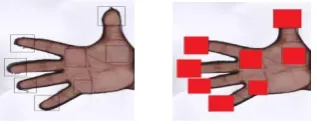
As we have worked with minutiae based fingerprint matching process the basic steps described in figure 5 are all followed in our work. At first the fingerprints are taken with the help of scanner. Then five fingers’ prints are detached from it. Then step by step process for minutiae extraction are executed for getting minutiae. Every time one fingerprint is taken into execution process and finally all the calculation are combined. The systematic execution processes are stated in following figures.
Fig 6. Fingerprint Detestation
Insert Passwo rd
Input Finge rprint
Retrieve image from database
Match the new image and the retrieved one
Co mbi ne all the resu lts
Verificatio n for matched or
not 0 or 1 Decision
taken by microcontrol ler, door open or close
(Loops for 5 times for 5 fingers) Taking
Image of fingerpri nt
Normaliz ation
Ridge Orientatio
n Filter
ing
Thin ning
Minutia e Extracti
on
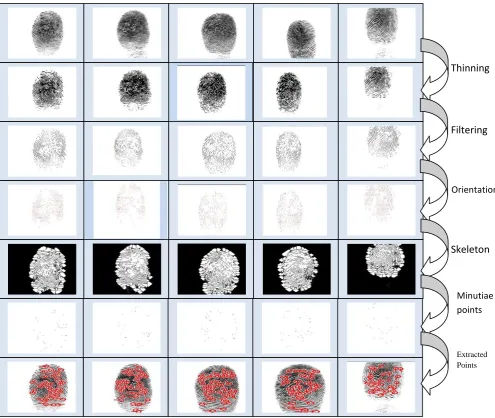
[image:3.595.325.538.398.546.2] [image:3.595.351.510.681.743.2]Figure 7: - Systematic Minutiae Extraction Process Output on each steps
After taken the palmtop and detached the fingerprints the processes described in figure 5 are executed and the following results are achieved. We use Hit and Miss class to extract the minutiae points and the scale it in the main feature:
At last stages on every step we get the minutiae of each fingerprint. We calculate the position and the angle of the minutiae points with each other and then save them in files. These results are used for second time verification processes.
After getting the fingerprint images the person is asked to give a password. Password works as the identification no of the fingerprint images extracted features. When a person wants to insert in a room which is secured with fingerprint recognition process, he needs to insert his password and then his palmtop print. The processor will extract the features from that image like figure 7. After verification this will work as input for the circuit which has developed for automatic door lock and open process for secured gate opening and closing process. The circuit is developed with the help of microcontroller, hex buffer IC, extra circuitry for microcontroller execution, electric magnet and so on.
Here, after verification process, the signal is sent by the serial port [74] to the microcontroller. We use Atmel 89c51 [75] in our work. But, as there is direct communication between serial port and microcontroller, max 233 [76] is used For this reason communication. After taking the output from max 233 it goes to microcontroller and then Hex Buffer IC. Here, input value 1 turns to 0. Relay [77, 78] is used in this circuit for switching from one stage to other. There are two relays in our circuit. Relay’s input’s one point has 6V input for switching and other point is attached with Hex buffer IC. In relay, one slot is connected with 220V AC for sending signal to the automated door for unlock and after sometimes locked again. It is mainly an electromagnet [79, 80]. Another relay is connected with warning bell. Here, 10W 10-Ohm resistance is used with the circuit so that the circuit does not destroy in high voltage. This circuit needs both DC and AC power supply. So we need to convert the AC voltage to DC voltage for our work.
From the block diagram of figure 8 we can see that the output from the serial port goes to the input of MAX 233. MAX 233 converts the input and makes it readable for the
Filtering
Thinning
Orientation
Skeleton
Minutiae points
Microcontroller. The microcontroller has two pin for serial port communication.
Fig. 8: - Block Diagram for Automatic Secured Door Operation
So, connecting the output of MAX 233 to the input pin of microcontroller passes the signal from serial port to serial port to microcontroller. According to the input of microcontroller, it will take decision and generates it signal. The output pins of microcontroller are connected with the input pins of inverter buffer IC. Two pins of the IC work as output result for the whole circuit. If any input of the IC is 1, the output of the buffer IC becomes 0. Here, the ground portion of the relays’ connection is connected and the input portion is connected with a 6V DC power supply. So, when O comes in output then the circuit for relay switching becomes active. In relay, one point is connected with ground and another is connected with 220V power supply. Normally the relay stays in ground connected state. When the relay becomes active it switches to 220V supply and the door opens or the bell rings up. These two states are vice versa. This switching mainly works with an algorithm which is loaded in microcontroller and on the basis of serial port data which is sent by PC after verifying the fingerprint. The pseudo code of the algorithm is given in figure 9.
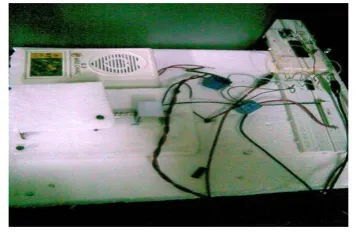
The block diagram of the circuit has applied in our work. It works very well in lab environment. We also perform high voltage test for finding better results. The automatic door system which we have used in lab is shown in figure 10.
The full proposed model will ensure a high security for an organization, a house and so on. It is also cost effective and easy to use. The work is mainly developed with the help of following platforms: -
1. Visual Studio (C#)
2. Core 2 duo (2.9 GHz Processor), 2 GB RAM 3. Atmel 89c51 microcontroller
4. Relays (6V, 220V)
5. Electromagnet ( Automatic Door System)
All the combination of this works within a very short time to execute the whole program. Among them some results are shown in table I.
6.
EXPERIMENTAL ANALYSIS
[image:5.595.53.295.105.299.2]At first we have taken palmtop input from 20 persons. We examine the execution time for the whole process of their palmtop and also for the second time insertion process.
Fig. 9:- Flow Chart of Microcontroller Based Circuitry System
[image:5.595.319.538.139.427.2]Fig. 10: - Automatic door open and lock system
Table 1. Table captions should be placed above the table
Person No Number of fingerprints Input
Feature Extraction time
Second phase recognition time 1 5 5 sec 9 sec 2 5 7 sec 12 sec 3 5 6 sec 10 sec 4 5 7sec 11 sec 5 5 6 sec 11 sec
Receive verification process information O for not verified
1 for verified
Check whethe r O or 1
Ring The bell
Manually off the bell
Open the Door
After 3 sec the door locked
Go to initial state State=
= 0
State= = 1
M ax 23 3
Atmel
89C51
Micro control ler
He x- Bu ffe r
IC
Re lay
Re lay
Electro magnet for Openin g Door
Warni ng Bell
6
V
6 V 220
V
[image:5.595.337.515.478.598.2]It is seen that execution process of our process is high than other models, but it’s accuracy for recognize a person is higher than any other model. Here security is also high than other models, because here has less probability of error in our work. In our work in lab we have extracted about 20 people’s fingerprint features. Some of them are shown in table III.
Table 2. Number of Extracted features for each person
Person No Number of Minutiae in a palmtop
Average in one fingerprint
1 74 19
2 79 21
3 72 19
4 59 14
5 76 20
From the observation of table III we can see that only one fingerprint minutiae extraction process is not enough for taking decision about verification. There remains a probability of same fingerprints and minutiae numbers in time of examining with one fingerprint. But working with a palmtop shows good result and less probability of error.
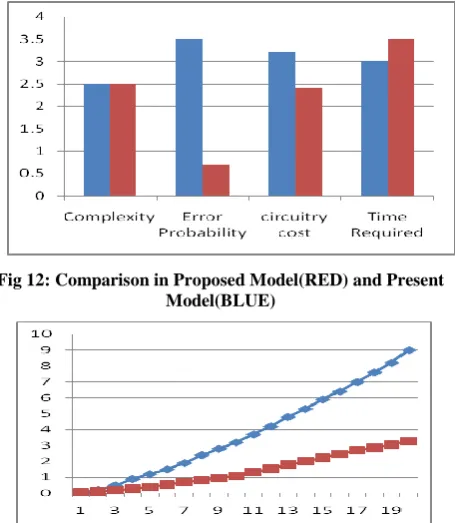
[image:6.595.318.547.125.250.2]From 20 people observation, in which every edge of people are included, we see that probability of error in results is increasing in every insertion of new persons with quite similar fingerprints in different models which work with only one fingerprint. In our model probability of error is less than others because here five fingerprints are taken for verifying one person. So accuracy becomes high. Figure 12 shows this:
Fig. 12 Probability of Error Proposed Model(RED) and Present Model(BLUE)
From figure 12 we can see that there is much less probability of occurring error in our proposed model. Though this model needs little bit higher time for execution than other models, but its accuracy gives much time better results than the previous ones’. Again, the circuitry for automatic door system is much cost effective than other processes. A simple comparison is shown in figure 13.
From the above observation and results, we have seen that the model on which we have told in this whole paper is much better than the previous models, which are now running in the whole world. The model proposed for automated door open lock system is also cost effective and can be applied in different organizations.
7.
Conclusion
In this paper we have shown a model for palmtop recognition system which mainly works with five fingerprints of each person. It is useful for verification of people at any environment and in any situation. It has much good response
[image:6.595.49.285.167.240.2]than others. The automatic controlled door circuit is also useable in any position and condition because of its parts availability and lower cost. But sometimes it fails to obtain its full performance because of sensor.
Fig 12: Comparison in Proposed Model(RED) and Present Model(BLUE)
Fig. 13: - Probability of error in Proposed Model(RED) and Present Model(BLUE)
As we use low resolution scanner in our work so we get some error. But if high resolute scanner is used with the proposed model then probability of error will become quite zero which is highly required for any security ensuring system. Though the proposed model works with minutiae based palmtop recognition system, any types of fingerprint recognition system can be used with this model. Output result will not vary much for this reason.
In future we want to work with the circuit system of the proposed work to find out more cost effective circuit and want to reduce time and complexity of our palmtop print verification system. We also want to work with different processes of palmtop recognition system for finding out more efficient and less execution time required algorithm for increasing efficiency of the proposed biometric user authentication architecture, means palmtop recognition system of the proposed model. If we can work with high resolute scanner in future then we hope we can easily increase the efficiency of the program which will help to execute the proposed model with less time than the present one.
8.
ACKNOWLEDGMENTS
Our thanks to the experts who have contributed towards development of fingerprint recognition. And also to them, who have developed microcontroller based program for different devices for making the working environment smooth than the previous.
9.
REFERENCES
[1] Bowman, M., Debray, S. K., and Peterson, L. L. 1993. Reasoning about naming systems.
[image:6.595.55.271.411.517.2][2] Zdenek Ríha and Václav Matyáš, “Biometric Authentication Systems” , FI MU Report Series, November, 2000
[3] Zdenˇek, Ríha, “Integrating Biometric Application into Multiple Applicants”, Master Thesis, University of Pretoria, October 2005.
[4] James Wayman, Anil Jain, Davide Maltoni and Dario Maio, “An Introduc tion to Biometric Authentication Systems”, Chapter 1 • An Introduction to Biometric Authentication Systems, 2004
[5] S V Sheela and K R Radhika, “Boimetric Authentication using Nonparametric Methods”, International Journal of Computer Science and Information Technology, Volume 2, Number 3, June 2010
[6] Uwe Bubeck, Dina Sanchez, “Biometric Authentication - Technology and Evaluation -”, San Diego State University, Spring 2003
[7] Sheng Zhang, Rajkumar Janakiraman, Terence Sim, and Sandeep Kumar, “Continuous Verification Using Multimodal Biometrics”, Springer-Verlag Berlin Heidelberg, ICB 2006 LNCS 3832, pp. 562–570, 2005.
[8] Eric J. Lerner, “Biometric Identification”, American Institute of Physics, 2000
[9] Subcommittee of Biometrics, “Fingerprint Recognition”, National Science and Technology Council, August, 2006
[10]Anil Jain, Sharath Pankanti,” Fingerprint Classification and Matching”, 2000
[11]RAVI. J, K. B. RAJA, VENUGOPAL. K. R, “FINGERPRINT RECOGNITION USING MINUTIA SCORE MATCHING”, International Journal of Engineering Science and Technology, Vol.1(2), 2009, 35-42
[12]Hourieh Fakourfar, Serge Belongie “FINGERPRINT RECOGNITION System Performance in the Maritime Environment”, ONR MURI Grant #N00014-08-1-0638 and NSF CAREER Grant #0448615, 2008
[13]NEETA MURMU, ABHA OTTI, “FINGERPRINT RECOGNITION”, M.ScThesis, National Institute of Technology, 2008
[14]Jonathan J. Koehler, “Fingerprint Error Rates and Proficiency Tests: What They Are and Why They Matter”, HASTINGS LAW JOURNAL [Vol. 59:1077], pg 1077-1100.
[15]Muhammad Sheikh Sadi, Shaikh Anisuzzaman and Manik Bhakta, “A NEW ALGORITHM TO COMPUTE DIRECTIONAL FIELDS AND SINGULAR POINTS FROM A FINGERPRINT”, 3rd International Conference on Electrical & Computer Engineering, ICECE 2004, 28-30, December 2004, Dhaka, Bangladesh
[16]Ron F Stewart, Matt Estevao, Andy Adler, “Fingerprint recognition performance in rugged outdoors and cold weather conditions”, 2008
[17]Doo-Hyun Kim and R ae-Hong Park, “Fingerprint Binariza tion Using Convex Threshold”, 2003
[18]Anil Jain, Karthik Nandakumar, Arun Ross, “Score normalization in multimodal biometric systems”, 2005 Pattern Recognition Society. Published by Elsevier Ltd, Pattern Recognition 38 (2005) 2270–2285
[19]Raffaele Cappelli, Dario Maio, James L. Wayman, and Anil K. Jain, “Performance Evaluation of Fingerprint Verification Systems”, IEEE TRANSACTIONS ON
PATTERN ANALYSIS AND MACHINE
INTELLIGENCE, VOL. 28, NO. 1, JANUARY 2006
[20]Łukasz WIĘCŁAW, “A MINUTIAE-BASED MATCHING ALGORITHMS IN FINGERPRINT RECOGNITION SYSTEMS”, JOURNAL OF MEDICAL INFORMATICS & TECHNOLOGIES Vol. 13/2009, ISSN 1642-6037
[21]Lin Hong, Anil Jain, Sharath Pankanti, Ruud Bolle, “Identity Authentication using fingerprints”, 1999
[22]Sebastian Abt, “Assessing Semantic Conformance of Minutiae-based Feature Extractors”, M.Sc Thesis, 2011
[23]DHOLE S.A. AND PATIL V.H., “MINUTIAE BASED FINGERPRINT IDENTIFICATION”, ISSN: 0976-8882 & EISSN: 09768890, Volume 3, Issue 3, 2012, pp. -122-125.
[24]Kai Cao, Xin Yang, Xunqiang Tao, Peng Li, Yali Zang, Jie Tian, “Combining features for distorted fingerprint matching”, Journal of Network and Computer Applications 33 (2010) 258–267
[25]R. N. Verma, D.S.Chauhan, “Effect of Pressure Variation on the Fingerprint Minutiae Based Feature Vector Matching”, World of Computer Science and Information TechnologyJournal (WCSIT), ISSN: 2221-0741, Vol. 1, No. 9, 376-379, 2011
[26]Dibyendu Nath, Saurav Ray, Sumit Kumar Ghosh, “Fingerprint Recognition System : Design & Analysis”, 2011
[27]Tudor BARBU, “FINGERPRINT MATCHING APPROACH USING A NOVEL METRIC”, U.P.B. Sci. Bull., Series A, Vol. 73, Iss. 2, 2011, ISSN 1223-7027
[28]Davit Kocharyan, Hakob Sarukhanyan, “Feature Extraction Techniques and Minutiae-Based Fingerprint Recognition Process”, Young scientists’ research support program – 2010.
[29]Naser Zaeri, “Minutiae-based Fingerprint Extraction and Recognition”, Thesis paper, Arab Open University, Kuwait, 2011
[30]Kai Cao, Xin Yang, Xinjian Chen, Xunqiang Tao, Yali Zang, Jimin Liang, Jie Tian, “Minutia handedness: A novel global feature for minutiae-based fingerprint matching”, Pattern Recognition Letters 33 (2012) 1411– 1421
[31] Sozan Abdullah Mahmood, “Fingerprint identification Based on Skeleton Minutiae extraction”, ICGST Conference, Dubai, UAE, 12-14 April 2011 AIML-11
[32]Krithika Venkataramani , Vaibhav Kumar Singh, “Fingerprint Identification : A brief literary review”, 2011
[33]Uday Rajanna,Æ Ali Erol ,Æ George Bebis, “A comparative study on feature extraction for fingerprint classification and performance improvements using rank-level fusion”, Pattern Anal Applic DOI 10.1007/s10044-009-0160-3.
Minutiae-Based Fingerprint Recognition System”, IEEE SYSTEMS JOURNAL, VOL. 3, NO. 4, DECEMBER 2009, pg 418-427
[35]Jucheng Yang, “Non-minutiae Based Fingerprint Descriptor”, Biometrics, 79-98, 2010
[36]Shashi Kumar D R, K B Raja, R K Chhotaray, Sabyasachi Pattanaik, “DWT Based Fingerprint Recognition using Non Minutiae Features”, IJCSI International Journal of Computer Science Issues, Vol. 8, Issue 2, March 2011, ISSN (Online): 1694-0814
[37]Ion Iancu, Nicolae Constantinescu, Mihaela Colhon, “Fingerprints Identification using a Fuzzy Logic System”, Int. J. of Computers, Communications & Control, ISSN 1841-9836, E-ISSN 1841-9844, Vol. V (2010), No. 4, pp. 525-531
[38]Pravesh Kumar, “Use of fuzzy set and Neural network to extract Fingerprint Minutiae points and Location”, M.Sc Thesis, 2009
[39]K. Srinivasan, C. Chandrasekar, “An Efficient Fuzzy Based Filtering Technique for Fingerprint Image Enhancement”, American Journal of Scientific Research, ISSN 1450-223X Issue 43 (2012), pp. 125-140
[40]Radu Florin Miron, “Distributed Fingerprint Identification System”, Ph.D Thesis, 2010
[41]T.C. Raja Kumar, S. Arumuga Perumal, N. Krishnan, and S. Kother Mohideen, “Fuzzy-based Histogram Modeling for Fingerprint Image Binarization”, International Journal of Research and Reviews in Computer Science (IJRRCS), Vol. 2, No. 5, October 2011, ISSN: 2079-2557
[42]S.M.S. Piyarathana and R.D. Yapa, “Fingerprint Image Segmentation using Fuzzy Logic”, Proceedings of the Peradeniya University Research Sessions, Sri Lanka, Vol. 16, 24th , November 2011
[43]Dr.S.Arumuga Perumal, T.C. Rajakumar, Dr.N.Krishnan, “Fuzzy based Filtering Approach on Histogram Specification for Fingerprint Image Enhancement”, International Journal of Computer Applications (0975 – 8887), Volume 23– No.8, June 2011
[44]Dimple Parekh, Rekha Vig, “Survey on Parameters of Fingerprint Classification Methods Based On Algorithmic Flow”, International Journal of Computer Science & Engineering Survey (IJCSES) Vol.2, No.3, August 2011
[45]DIMPLE A. PAREKH AND REKHA VIG, “REVIEW OF FINGERPRINT CLASSIFICATION METHODS BASED ON ALGORITHMIC FLOW”, Journal of Biometrics, ISSN: 2229–6689 & E'ISSN: 2229–6697, Vol. 2, Issue 1, 2011, PP'20'23
[46]M. H. Kondekar, U. V. Kulkarni, B. B. M. Krishna Kanth, “Extended Fuzzy Hyperline Segment Neural Network for Fingerprint Recognition”, International Journal of Biometrics and Bioinformatics (IJBB), Volume (5) : Issue (3), 2011
[47]Kondekar, Uday Kulkarni and Santosh Chowhan, “A Fuzzy Neural Clustering approach fo Fingerprint Recognition”, IJCSI International Journal of Computer Science Issues, Vol. 8, Issue 5, No 2, September 2011, ISSN (Online): 1694-0814.
[48]S.Uma Maheswari, Dr. E. Chandra, “A Review Study on Fingerprint Classification Algorithm used for Fingerprint Identification and Recognition”, IJCST Vol -3, Issue 1, Jan .- March 2012, ISSN : 2229-4333 (Print)
[49]Divyakant T. Meva, C. K. Kumbharana, Amit D. Kothari, “The Study of Adoption of Neural Network Approach in Fingerprint Recognition”, International Journal of Computer Applications (0975 – 8887) Volume 40– No.11, February 2012
[50]Josef Str¨om Bart˚unˇek, “Minutiae Extraction from Fingerprint with Neural Network and Minutiae based Fingerprint Verification”, M.Sc Thesis, 2005
[51]Divyakant T. Meva, C. K. Kumbharana, Amit D. Kothari, “The Study of Adoption of Neural Network Approach in Fingerprint Recognition”, International Journal of Computer Applications, Volume 40 - Number 11, 2012.
[52]Jha, A.K., Narasimham, S., Krishna, S.S., Pillai, V.P.M.,” A neural network based approach for fingerprint recognition system”, Ultra Modern Telecommunications and Control Systems and Workshops (ICUMT), 2010, pg: 808-812.
[53]Suksan Jirachaweng, Vutipong Areekul, Zujun Hou, Hwee-Keong Lam and Wei-Yun Yau, “Singular Region Tracking for Fing erprint Singular Point Detection”, 2010 The 3rd International Conference on Machine Vision (ICMV 2010), 572-575.
[54]Navrit Kaur Johal, Prof. Amit Kamra, “A Novel Method for Fingerprint Core Point Detection”, International Journal of Scientific & Engineering Research Volume 2, Issue 4, April- 2011, ISSN 2229-5518, pg 1-6
[55]M. Ezhilarasan, D. Suresh Kumar, S. Santhanakrishnan, S.Dhanabalan and A.Vinod, “Person Identification Using Fingerprint by Hybridizing Core Point and Minutiae Features”, (IJCSE) International Journal on Computer Science and Engineering Vol. 02, No. 09, 2010, 3075-3078.
[56]Kalyani Mali, Samayita Bhattacharya, “Fingerprint Recognition Using Global and Local Structures”, International Journal on Computer Science and Engineering (IJCSE), Vol. 3 No. 1 Jan 2011
[57]Zia Saquib, Santosh Kumar Soni, Sweta Suhasaria, Dimple Parek, Rekha Vig,” A Fault–Tolerant Approach for Detection of Singular Points in Noisy Fingerprint Images”, IJCSI International Journal of Computer Science Issues, Vol. 8, Issue 2, March 2011, ISSN (Online): 1694-0814
[58]H B Kekre, V A Bharadi, “Fingerprint Core Point Detection Algorithm Using Orientation Field Based Multiple Features”, International Journal of Computer Applications (0975 -8887), Volume 1 – No. 15
[59]Dawei Weng, Yilong Yin, Dong Yang, “Singular points detection based on multi-resolution in fingerprint images”, Neurocomputing 74 (2011) 3376–3388
[60]Tong Liu, Guocai Zhu, Chao Zhang and Pengwei Hao, “Fingerprint Indexing Based on Singular Point Correlation”, 2005 IEEE, pg: 293-296.
on Core Sub-Region”, JOURNAL OF INFORMATION SCIENCE AND ENGINEERING 25, 303-317 (2009)
[62]Matheus Giovanni Pires, Fernando Vieira Duarte, Adilson Gonzaga, “Genetic Optimization for Fingerprint Verification”, 2006
[63]Jihad jaam, Mohammad Rebaiaia, Ahmad hasnah, “A fingerprint minutiae recognition system based on genetic algorithm”, International Arab Journal of Information Technology, Vol 3, No 3, 2006
[64]P. Devi, M. Manju, V. Kavitha, “A hybrid Fuzzy rule based Neuro-Genetic approach for fingerprint recognition system”, Advanced Computing (ICoAC), 2010, pg – 1-8
[65]Wang Yongxu, Ao Xinyu, Du Yuanfeng, Li Yongping, “A Fingerprint Recognition Algorithm Based on Principal Component Analysis”, TENCON 2006, IEEE Region 10 Conference, pg 1-4
[66]Keming Mao, Guoren Wang, Yan Jin, Changyong Yu,“Using Genetic Algorithms for Fingerprint Core Point Detection”, International Conference on Fuzzy Systems and Knowledge Discovery, 2009, Volume: 4 pg: 20 – 24
[67]Yezeng Cheng and Kirill V. Larin, “Artificial fingerprint recognition by using optical coherence tomography with autocorrelation analysis”, APPLIED OPTICS, Vol. 45, No. 36, 20 December 2006
[68]Haiyun Xu and Raymond N.J. Veldhuis, “Complex Spectral Minutiae Representation For Fingerprint Recognition”, 2009
[69]Mauro Barni, Tiziano Bianchi, Dario Catalano, Mario Di Raimondo, Ruggero Donida Labati, Pierluigi Failla, Dario Fiore, Riccardo Lazzeretti, Vincenzo Piuri, Alessandro Piva, Fabio Scotti, “A Privacy-compliant
Fingerprint Recognition System Based on Homomorphic Encryption and Fingercode Templates”, 2010
[70]Xunqiang Tao, Xinjian Chen, Xin Yang, Jie Tian, “Fingerprint Recognition with Identical Twin Fingerprints”, PLoS ONE 7(4): e35704. doi:10.1371/journal.pone.0035704, 2012
[71]Shabana Tadvi, (Dr.) Prof. Mahesh Kolte, “A Hybrid System for Fingerprint Identification”, (IJCSE) International Journal on Computer Science and Engineering, Vol. 02, No. 03, 2010, 767-771
[72]Dayashankar Singh, Dr. P.K.Singh, Dr. R.K.Shukla, “Fingerprint Recognition System Based on Mapping Approach”, International Journal of Computer Applications (0975 – 8887), Volume 5– No.2, August 2010
[73]Arjun V Mane, Yogesh S Rode, K V Kale, “Novel Multiple Impression based Multimodal Fingerprint Recognition System”, International Journal of Computer Applications (0975 – 8887) Volume 27– No.8, August 2011.
[74]Chapter 22, Pc Serial port
[75]Datasheet, 8-bit Microcontroller with 4K Bytes Flash, AT 89c51
[76]Datasheet, MAXX Multichannel RS-232 Drivers/Receivers
[77]Kevin R. Sullivan, “Understanding Relays”, Auto shop 101.com
[78]DataSheet:- MIC2782 Relay
[79]Bo Fidé, “Electromagnetic Field Theory”, second edition.