Munich Personal RePEc Archive
Nonparametric estimation of
time-varying covariance matrix in a
slowly changing vector random walk
model
Feng, Yuanhua and Yu, Keming
Heriot-Watt University and Brunel University
2006
Online at
https://mpra.ub.uni-muenchen.de/1597/
Nonparametric Estimation of Time-Varying Covariance Matrix
in a Slowly Changing Vector Random Walk Model
Yuanhua Feng
Department of Actuarial Mathematics and Statistics, Heriot-Watt University
and Keming Yu
Department of Mathematical Sciences, Brunel University
Abbreviated Title: Slowly changing vector random walk
Summary. A new multivariate random walk model with slowly changing
pa-rameters is introduced and investigated in detail. Nonparametric estimation of
local covariance matrix is proposed. The asymptotic distributions, including
asymptotic biases, variances and covariances of the proposed estimators are
ob-tained. The properties of the estimated value of a weighted sum of individual
nonparametric estimators are also studied in detail. The integrated effect of
the estimation errors from the estimation for the difference series to the
inte-grated processes is derived. Practical relevance of the model and estimation is
illustrated by application to several foreign exchange rates.
Keywords: Multivariate time series; slowly changing vector random walk; local covariance matrix; kernel estimation; asymptotic properties; forecasting.
AMS 2000 subject classifications: Primary 62G08; Secondary 62M10
1
Introduction
Random walk models, including Weiner processes or Brownian motion arise in many
appli-cations, particularly in financial time series, statistical physics, genetics, graphs, modelling
of turbulent dispersion within the atmosphere and to geographic distributions of animal; see
Kijima (2002), Weiss (1994), Neigel and Avise (1993) and Lov´asz (1993). In these
applica-tions often an analysis of the relaapplica-tionships between more than one variable simultaneously
is required. Vector (also called multiple or multivariate) random walk is the simplest
1989). Such a model can be used for modelling financial difference or return series which
is also often used to built some more complex models. In Harvey et al. (1994) vector
random walk is used to model persistent movements in stochastic volatility models. Due to
slow change of economic or environmental situations however the means and variances, also
the covariances and correlations between the components of the innovation process may
all change slowly over time. In this paper a slowly changing vector random walk model is
hence introduced to model the slowly change multiple time series.
The paper is organized as follows. Section 1.1 reviews the existing literature on stochastic
time varying process. Section 1.2 presents a motivating example involving exchange rate.
The multivariate random walk model with slowly changing parameters is introduced in
Section 2. Nonparametric inference methods for time-varying covariance matrix are defined
in Section 3. Properties of the estimators are derived in Section 4, including asymptotic
mean square errors and optimal bandwidth. An optimal prediction of the future value of a
portfolio is developed in Section 5. Practical performance of the proposed methods through
an application to four daily foreign exchange rate is discussed in Section 6. Concluding
remarks are presented in Section 7 and the proofs can be found in Appendix.
1.1 A brief review of closely related research
Univariate locally stationary processes were first introduced and studied by Dahlhaus (1997,
2000). Nonparametric inference for the mean and variance functions in univariate stochastic
process has attracted much attention in statistics literature. We list few of a rich literature
using in this context. Kernel regression estimation with time series errors is studied e.g.
by Hart (1991) and Cs¨og¨o and Milnikzug (1995). Beran and Ocker (1999) and Beran and
Feng (2002) discussed nonparametric trend estimation in integrated processes. Fan and
Yao (1998) proposed nonparametric estimation of conditional variance function following
the idea of the ARCH (autoregressive conditional heteroskedasticity, Engle, 1982) model.
A¨ıt-Sahalia (1996) studied nonparametric estimation of time-varying drift and diffusion
coefficients of a Brownian motion.
In contrast to univariate models, which model each component independently,
vast literature on parametric multivariate GARCH (generalized ARCH) models for
condi-tional covariance matrix (see e.g. Bollerslev et al., 1988 and Engle, 2002) and on
nonpara-metric estimation of conditional covariance matrix (H¨ardle et al., 1998, 2003). However in
this paper we will focus on the estimation of covariance matrix in a slowly changing model.
The slowly change in the current model means some deterministic components which are
non-stochastic. The real examples in Section 1.2 clearly illustrate the phenomenon of slow
change. Actually, in the new model named SCVRW model the change in the means,
vari-ances, covariances and correlations is assumed to be deterministic not conditional. They
change smoothly over time and do not depend on the past information. This is what slow
change means. On the other hand conditional changes in such components are caused by
past observations. Conditional changes and local changes can not explained each other.
Despite a huge number of literature on the estimation of conditional covariance matrix,
little research on the estimation of local covariance matrix can be found in literature. Herzel
et al (2006) explores some ideas on volatility estimation under a non-stationary multivariate
return model, but assumes a constant drift term, lacks theoretical investigation and ignores
forecasting in depth. Wu and Pourahmadi (2003) discussed nonparametric estimation of
the covariance matrix of the observations of a univariate time series based on Cholesky
decomposition, where it is proposed to estimate the diagonal matrix with the variances as
its diagonal entries and the unit lower triangle matrix using local polynomial separately.
1.2 Motivation examples
The slow change economics phenomenon can be observed in finance such as the indices of
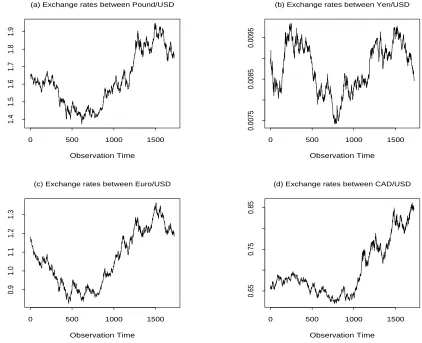
major stock markets and exchange rates. Figure 1 displays the scatter plots of four daily
foreign exchange rate series w.r.t. the US Dollar (USD). The data are those of the British
Pound (Pound), Japanese Yen (Yen), Euro and Canadian Dollar (CAD), from 4 January
1999 to 4 November 2005. Here the USD price per foreign currency is used. Figure 1
shows that there are clear non-constant drifts in these series which change slowly over time.
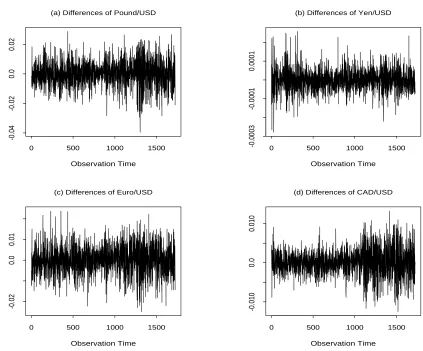
Figure 2 displays the difference series of the original data from which we can see that the
variances of the difference series change clearly over time. What cannot be discovered by
(see Figure 6 in Section 6). This can also be shown graphically by plotting two difference
series against each other piece by piece.
For this data and the content in finance, one is concerned
(a) how to model properly the slowly changing drifts, variance and correlation coefficients
of underlying stochastic process,
(b) what is the estimation of the mean and variance of a portfolio, and
(c) what is the effect of estimation errors in the short term forecasts.
Other slowly change multivariate time series include ice thickness series. It is widely
concerned that global warming results in quickly decreasing ice-thickness. However, the
ice thickness series are random walks (the sum of snow fall years after years). There is a
nonparametric trend in the differences of these data, because of the different strength of
press (or maybe also other reasons), the dependence between ice thickness in different years
(after removing the trend) is very weak. In all, different series of ice thickness may also be
able to be modelled using the SCVRW.
Global and hemispheric series of temperature anomalies can also be modelled by random
walks (Gorden, 1991). Similarly, statistical analysis for satellite-based global daily
tropo-spheric and stratotropo-spheric temperature anomaly and solar irradiance data sets shows that
the behavior of the series appears to be nonstationary with stationary daily increments
(K¨arner, 2002). The model proposed in this paper provides a useful tool for modelling
global warming as slow change in the increments of those series.
2
The model
Let Yt be a k-dimensional stochastic process, andY0 be the initial value ofYt. LetCbe
a constant vector, and let Zt be the increment of Yt.
The proposed slowly changing vector random walk (SCVRW) is defined by
Y0 = C,
Yt = Yt−1+Zt fort= 1,2, ..., n,
Zt = µ(xt) +Σ1/2(xt)Et,
where
Yt=
Y1t
.. . Ykt
, Zt=
Z1t
.. . Zkt
, Et=
ǫ1t
.. . ǫkt
are random vectors, xt=t/n is the re-scaled time,
µ(xt) =
µ1(xt)
.. .
µk(xt)
and Σ(xt) =
σ12(xt) · · · σ1k(xt)
..
. . .. ...
σk1(xt) · · · σ2k(xt)
(2)
are the vector of local mean functions and the matrix of local variances or cross-covariance
functions, respectively, and Σ1/2 denotes lower triangular Cholesky factorization of a
semi-positive definite matrix so that
Σ=Σ1/2Σ1/2′.
For convenience we will also denote σi2(xt) by σii(xt), i = 1, ..., k. It is assumed that
σii(·) are strictly positive for all i and that ǫit given i are i.i.d. N(0,1) random variables
for t = 1,2, ..., n, and that ǫit given t are also mutually independent for i = 1,2, ..., k.
Further smoothness conditions on the local mean and the local variances or cross-covariance
functions, i.e. µi and σij,i, j= 1, ..., k will be introduced later.
The difference series Zt of the slowly changing vector random walk Yt defined in the
above is non-jointly stationary, because each of its element is non-stationary. However, it
is easy to see that Zt is jointly locally stationary in the sense that, in a small interval of
x whose length tends to zero as n → ∞, the difference between Zt and another jointly
stationary processZ∗
t is negligible in probability.
Remark 1 When k = 1, Model (1) reduces to ∆Yt = µ(xt) +σ(xt)ǫt, which is the dis-cretized form of model (1.1) discussed by A¨ıt-Sahalia (1996). This univariate model is also a fixed design heteroscedastic regression model whose random design type was discussed by Fan and Yao (1998).
here, because the aim of the current paper is to obtain more detailed results under a basic model.
3
The estimators
Letyt,t= 0,1, ..., ndenote the observations andzt=yt−yt−1,t= 1, ..., n. In the following
two kinds of estimators, called single and joint estimators, will be introduced, which can
be used for forecasting the trend and variance of a single financial series or of a portfolio,
respectively. First consider p-th order local polynomial estimation (Fan and Gijbels, 1996)
of the mean function in the i-th series. Let Ki(u) denote a weight, i.e. a positive kernel,
function andai= (ai0, ..., aip)′. Solve the locally weighted least square problem
ˆ a′
i(x) = arg mina
i n
X
t=1
[zit−ai0−...aip(xt−x)p]2Ki
xt−x
hi
, (3)
where hi is the bandwidth used for estimating µi. Then the resulting estimator ofµi(x) is
given by ˆµi(x) = ˆai0(x), which is a linear estimator, i.e. a weighted sum ofzit. The vector
estimator ˆµ(x) = (ˆµ1(x), ...,µˆk(x))′ will be called a joint estimator of all mean functions, if
each of its element is estimated following (3) but using the same weight functionK(u) and
the same bandwidthh.
Let rit = zit−µˆi(xt), i = 1, ..., k, denote the residuals at time t calculated using either
the single estimators ˆµi(xt) or the joint estimator ˆµt. Let rt = (r1t, ..., rkt)′ denote the
residual vector. Then the variance and cross-covariance functions can be estimated from
the residuals. Consider first the estimation of the variance function in the i-th series by a
Nadaraya-Watson kernel (i.e. a local constant). Let Wi(u) denote the weight function and
bi the bandwidth. We have
ˆ
σ2i(x) =
n
P
t=1
Wi
xt−x bi
r2it
n
P
t=1
Wi
xt−x bi
. (4)
This type of variance estimators is used, e.g. by Feng (2004). ˆσ2i defined in this way is
Note that we do not define single estimators for the cross-covariances functions, because
the estimation ofΣobtained as a matrix of separate variance and cross-covariance
estima-tors may not be semi-positive definite. Instead, it is proposed to estimateΣin the following
joint way.
ˆ Σ(x) =
n
P
t=1
W xt−x b
rtr′t
n
P
t=1
W xt−x b
. (5)
ˆ
Σ(x) is simply a matrix kernel estimator of all σij(x),i, j = 1, ..., k, with the same kernel
function and the same bandwidth. Let Γ(x) =
ρij(x)
, where ρij(x) denotes the local
cross-correlation between ǫit andǫjt. Then Γ(x) can be estimated as follows.
ˆ
Γ(x) =diag( ˆΣ(x))−1/2Σˆ(x)diag( ˆΣ(x))−1/2. (6)
Proposition 1 Σˆ(x) defined in (5) is semi-positive definite at any point x ∈ [0,1] and hence Γˆ(x) defined in (6) is a correlation matrix.
Proof of Proposition 1 is omitted. ˆΣ(x) is semi-positive definite, because it is a Gram
matrix. Indeed ˆΣ(x) is a.s. (almost sure) positive definite, because rt are a.s. linear
independent of each other. Note that in practice we are mainly interested in estimating
Σ(x) at the current end of the time series, i.e. withx= 1. If a second order kernel is used,
kernel estimator has the so-called boundary effect, i.e. the bias in the interior is of a higher
order than that at the boundary point. To avoid this problem we only assume the existence
of the first derivatives and will focus on discussing the behaviour of Σ(x) at a boundary
point.
4
Main results
For the derivation of the asymptotic results the following assumptions are required.
Assumption A1. The weight function is assumed to be a symmetric density on [−1,1].
Assumption A2. The local mean functions µi(·), i= 1, ..., k, are at least p+ 1 times
continuously differentiable, and the local variance and cross-covariance functions σij(·),
Assumption A3. The assumptions on the error structure as described in the context
around equations (1) and (2) hold.
Assumption A4. Lethg denote a generic bandwidth used. It is assumed thathg → 0
and nhg→ ∞ asn→ ∞.
The smoothness conditions required in A2 adapt to the different definitions of the
esti-mators. Lower smoothness is required for σij(·) due to the use of kernel estimators. For
a goodness-of-fit criterion the MSE will be used. The normal assumption on ǫit is only
necessary, if interval prediction for future values is of interest. For the derivation of most
of the asymptotic results the existence of fourth moments of ǫit is enough. If automatic
bandwidth selection is considered, higher order of smoothness and the existence of E(ǫ8
it)
are required. A4 is a minimal requirement on the bandwidths in nonparametric regression.
Further restrictions on the bandwidths will be introduced later.
In local polynomial regression it is often assumed that p is odd so that the bias of the
estimator in the interior and at the boundary is of the same order. For the estimators of the
mean functions this restriction will be used. Let K∗
i(·) denote the equivalent kernel of the
local polynomial estimator of ˆµi(see e.g. Ruppert and Wand, 1994). ThenKi∗(·) is a (p
+1)-th order kernel. Denote by βi = R up+1Ki∗(u)du and Ri = R(Ki∗(u))2du. The following
theorem is given without proof, which summaries well known asymptotic properties of the
single estimator ˆµi (see e.g. Wand and Jones, 1995).
Theorem 1 Let x∈[0,1]. Assume that p is odd and that the assumptions A1 to A4 hold. Then we have
1. The bias of µˆi(x) is E[ˆµi(x)−µi(x)] =βiµ(ip+1)(x)hip+1[1 +o(1)]/[(p+ 1)!].
2. The variance of µˆi(x) is var[ˆµi(x)] = (nhi)−1Riσi2(x)[1 +o(1)].
3. The dominant part of the MSE of µˆi(x) is
M SE(ˆµi(x))=. βi2(µ
(p+1)
i (x))2h
2(p+1)
i [(p+ 1)!]−2+ (nhi)−1Riσi2(x). (7)
4. The right-hand side of (7) is minimizesd by the (asymptotically) optimal bandwidth
hopti =
Ti2
2(p+ 1)Ti1
1/(2p+3)
provided that Ti1 6= 0 and Ti2 = 06 , where Ti1 =βi2(µ
(p+1)
i (x))2[(p+ 1)!]−2 and Ti2 =
Riσi2(x).
Now consider the estimation of the mean in the returns of a given portfolio. Let S =
(S1, ..., Sk)′ denote the vector of shares in the portfolio with Si ≥0 and PSi >0. Then
the portfolio values and returns at time tare given by VP(xt) =S′Yt and ZP(xt) =S′Zt,
respectively. The unknown mean of ZP(xt) is S′µ(x) which can be estimated byS′µˆ(x).
Let K∗(·) denote the equivalent kernel of this estimator. Denote by β = R up+1K∗(u)du
and R=R(K∗(u))2du. The MSE of estimatingS′µ(x) is given by
M SEµSˆ(x) =E
( k
X
i=1
Si[ˆµi(x)−µi(x)]
)2
. (9)
The following theorem quantifies the properties ofM SES
ˆ
µ using the joint estimator.
Theorem 2 Under the same conditions of Theorem 1 we have
1. Results in 1 to 3 of Theorem 1 hold for each element µˆi(x) of µˆ(x) by replacing βi,
Ri and hi withβ, R and h respectively.
2. The covariance between µˆi(x) and µˆj(x) is given by
cov(ˆµi(x),µˆj(x)) =Rσij(nh)−1[1 +o(1)]. (10)
3. The M SESˆ
µ is dominated by
M SEµSˆ =. T1Sh2(p+1)+T2S(nh)−1, (11)
where
T1S = β
2
[(p+ 1)!]2
k
X
i=1
k
X
j=1
SiSjµ(ip+1)(x)µ
(p+1)
j (x) (12)
and
T2S =R
k
X
i=1
k
X
j=1
4. The optimal bandwidth which minimizes the asymptotic M SES
ˆ
µ is given by
hoptS =
T2S
2(p+ 1)TS
1
1/(2p+3)
n−1/(2p+3), (14)
provided that T1S 6= 0 and T2S 6= 0.
LetΣµˆ(x) andΓµˆ(x) denote the covariance respective correlation matrices of ˆµ. Following
(10) we have
Σµˆ(x)=. R(nh)−1Σ(x) and Γµˆ(x)=. Γ(x), (15)
whereΓis the cross-correlation matrix defined before. The result in the second part of (15)
shows that ˆµtakes over the correlations of the original data.
Remark 2 In the special case with S1 = ... = Sk = S0 > 0, Parts 3 and 4 of Theorem
2 show the properties of an unweighted (or equally weighted) portfolio. While in another extreme case with Si > 0 and Sj = 0 for all j 6= i, these results reduce to those given in Theorem 1. Similar statements apply to the results in Theorem 4 below.
It is well known that the bias of the kernel estimators ˆσ2
i and ˆΣ in the interior point
has different order from the boundary. In the following only asymptotic properties of these
estimators atx=n/n= 1 will be given, because we are mainly interested in the estimation
at the current endpoint. In this case the used weight function isWir(u) = 2Wi(u)1I[−1,0]. Let
αi =R−01uWir(u)duand Vi =R−01(Wir(u))2du. To simplify the derivation of the asymptotic
properties we will introduce the following assumption on ˆµi and the bandwidthshi and bi.
A4′. Assume that ˆµ
i is a local linear estimator obtained with a bandwidthO(n−1/3) <
hi < O(n−1/6). The bandwidthbi satisfiesO(n−2/3)< bi =o(1).
Condition A4′ ensures that the errors in ˆµ
i are negligible when discussing the asymptotic
properties of ˆσi2and ˆΣ(see the proofs of the theorems given in the appendix), which implies
A4. Note that bi > O(n−2/3) means thatbi should not be too small. This is a very weak
restriction. Results in Theorem 3 below show that the optimal order for bi is O(n−1/3).
The bounds forhiandbi in A4′ are chosen for convenience. Note however that they depend
on each other. The optimal order O(n−1/5) of h
part of A4′. If the stronger condition h
i =O(n−1/5) is used, then the allowed range of bi
becomes larger. The requirements in A4′ also depend on the special case considered. For
instance weaker restrictions can be used, if ˆµi is a high order local polynomial estimator.
The following results hold for the single estimator ˆσ2
i defined in (4).
Theorem 3 Suppose Assumptions A1 to A3 and A4′ hold. Then
1. The bias of ˆσ2i(1)is given by
E[ˆσi2(1)−σ2i(1)] =αi(σ2i)′(1)bi[1 +o(1)], (16)
where (σi2)′(1)denotes the first derivative of σ2
i(x) atx= 1.
2. The variance of ˆσ2i(1) is given by
var[ˆσi2(1)] = (nbi)−1Viγii2(1)[1 +o(1)], (17)
whereγii2(1) =var[(Zi(1)−µi(1))2] =σ4i(1)var(ǫ2in)which equals to2σi4(1)for normal
ǫit.
3. The MSE of σˆi2(1) is dominated by
M SEσˆ2
i(1)
.
=Di1h2i +Di2(nbi)−1, (18)
where Di1 =α2i[(σi2)′(1)]2 and Di2=Viγ2ii(1).
4. The optimal bandwidth which minimises the right-hand side of (18) is given by
bopti =
Di2
2Di1
1/3
n−1/3, (19)
provided thatDi1 6= 0 and Di2 6= 0.
Remark 3 At an interior pointx∈(bi,1−bi)the bias of a kernel estimator is of the order
O(b2i)and the order of variance stays unchanged. Now, we haveM SE=. O(b4i) +O[(nh)−1]
Remark 4 Asymptotic results for the left endpointx = 0are the same as given in Theorem 3. In practice the so called one-side kernel estimators, i.e. estimators defined using only observations on the left hand side, may be of interest. In this case any point is treated as a right endpoint. For one-side kernel estimators results in Theorem 3 hold for all x∈(bi,1].
Consider now the estimation of var [ZP(xt)] = var [S′Zt]. First we have
var [ZP(xt)] =S′Σ(xt)S, var [ˆ ZP(xt)] =S′Σˆ(xt)S
and the total estimated error in ˆvar [ZP(xt)] is
ˆ
var [ZP(xt)]−var [ZP(xt)] =S′
h
ˆ
Σ(xt)−Σ(xt)
i
S. (20)
Define the k×k random matrix
Ξ(x) = [Z(x)−µ(x)]T[Z(x)−µ(x)] =: (ξtij), (21)
i, j = 1, ..., k.
Note thatE(Ξ(x)) =Σ(x). Define (˜ǫ1t, ...,ǫ˜kt)′ = ˜Et=Γ1/2(xt)Et, where ˜ǫit ∼N(0,1)
with E(˜ǫit˜ǫjt) =ρij(xt),i, j= 1, .., k. Thecovariance matrixof Ξ(x) is given by
ΥΞ(x) :=E{[Ξ−Σ(x)]⊗[Ξ−Σ(x)]}=: (γij,lm) (22)
fori, j, l, m = 1, ..., k, where ⊗denotes the Kronecker product, and
γij, lm(xt) = cov (ξtij, ξtlm)
= σi(xt)σj(xt)σl(xt)σm(xt)cov (˜ǫit˜ǫjt,ǫ˜lt˜ǫmt) (23)
fori, j, l, m = 1, ..., k. The MSE of ˆvar [ZP(xt)], denoted byM SEVS(xt), is given by
M SEVS(xt) = E
n
S′hΣˆ(x
t)−Σ(xt)
i
So2
=
k
X
i=1
k
X
j=1
k
X
l=1
k
X
m=1
SiSjSlSmE{[ˆσij(xt)−σij(xt)][ˆσlm(xt)−σlm(xt)]}.(24)
Finally, let α = R−01uWr(u)du and V = R−01(Wr(u))2du, where Wr(u) = 2W(u)1I[−1,0].
Then the asymptotic biases, variances and covariances of ˆσij(1) and the formula ofM SEVS(1)
Theorem 4 Under the same conditions of Theorem 3 we have
1. The bias of ˆσij(1) is given by
E[ˆσij(1)−σij(1)] =ασij′ (1)b[1 +o(1)]. (25)
2. The covariance between σˆij(1) and σˆlm(1) is given by
cov(ˆσij(1),σˆlm(1)) =V γij,lm(nb)−1[1 +o(1)]. (26)
3. M SEVS(1) is dominated by
M SEVS(1)=. D1Sb2+D2S(nb)−1, (27)
where
D1S =α2
k
X
i=1
k
X
j=1
k
X
l=1
k
X
m=1
SiSjSlSmσij′ (1)σlm′ (1) (28)
and
DS2 =V
k
X
i=1
k
X
j=1
k
X
l=1
k
X
m=1
SiSjSlSmγij, lm(1). (29)
4. The optimal bandwidth which minimizes the dominant part of M SES
V(1)is given by
boptS =
D2S
2DS
1
1/3
n−1/3, (30)
provided thatDS1 6= 0 and DS2 6= 0.
Now letΓΞ(x) denote the standardized correlation matrix ofΞ(x), andΥΣˆ(x) andΓΣˆ(x)
denote the corresponding matrices of the joint estimator ˆΣ(x). Following (26) we have
ΥΣˆ(1)=. V(nb)−1ΥΞ(1) and ΓΣˆ(1)=. ΓΞ(1). (31)
We see ˆΣtakes over the correlations between the components of Ξ.
Remark 5 Using Taylor expansion it can be shown that the bias and variance of ρˆij(x),
i6=j, are of the same orders as those of σˆij(x).
5
Forecasting of future mean and standard deviation
We now discuss the forecasting of future mean and standard deviation at time n+T given
observations until time n. The most current estimation results, i.e. those with x = 1 will
be used. Under our model the optimal linear prediction for a single series at time n+T is
E(Yi(n+T)|Yin) =Yin+ T
X
t=1
µi(xn+t), (32)
which can be estimated by
ˆ
Yi(n+T) =Yin+Tµˆi(1). (33)
The optimal linear prediction for the value of a given portfolio S = (S1, ..., Sk)′ at time
n+T is
E(PnS+T|Yn) =E(S′Yn+T|Yn) = k
X
i=1
SiYin+ k
X
i=1
Si T
X
t=1
µi(xn+t), (34)
which can be estimated by
ˆ
PnS+T =
k
X
i=1
SiYin+T k
X
i=1
Siµˆi(1). (35)
Clearly, the forecasts should be at least consistent. To this end we need the following
assumption on T.
A5. Let hg denote a generic bandwidth for estimating the mean functions. T satisfies
T2h2(p+1)
g →0 andT2(nhg)−1 →0 as n→ ∞.
The following theorem describes the properties of ˆYi(n+T) and ˆPS
n+T.
Theorem 5 Suppose the assumptions of Theorem 2 and A5 hold. Then we have
1. Yˆi(n+T) is consistent with E[ ˆYi(n+T) −E(Yi(n+T)|Yin)]2 =. T2M SE[ˆµi(1)], which is minimized by µˆi(1) with hopti (1).
2. PˆnS+T is consistent withE[ ˆPnS+T −E(PnS+T|Yn)]2 =. T2M SEµSˆ, which is minimized by
ˆ
If a bandwidth of the optimal orderO(n−1/(2p+3)) is used, then A5 becomesT =o(n(p+1)/(2p+3))
which is the biggest allowed order of the forecasting period.
The variance of the future value of a single series is
var [Yi(n+T)|Yin] =
T
X
t=1
σi2(xn+t) (36)
which can be estimated by
ˆ
V[Yi(n+T)|Yin] =Tσˆ2i(1). (37)
The variance of the future value of the portfolio at time n+T is
var (PnS+T|Yn) =S′
" T X
t=1
Σ(xn+t)
#
S, (38)
which can be estimated by
d
var (PnS+T) =T S′Σˆ(1)S. (39)
Now we need the following assumption onT.
A5′. Letb
g denote a generic bandwidth for estimating the variance-covariance functions.
T satisfiesT bg →0 andT(nb2g)−1→0 as n→ ∞.
LetSDT denote the standard deviation ofYi(n+T)|Yinwith the estimate
√
Tσˆi(1) andSDST
the standard deviation of var (PnS+T|Yn) with the estimate √T
q
S′Σˆ(1)S. The following
holds.
Theorem 6 Suppose the assumptions of Theorem 3 and A5′ hold. Then we have
1. √Tσˆi(1)is a consistent estimator ofSDT withE
h√
Tˆσi(1)−SDT
i2
=O(T·M SE[ˆσi2(1)]),
which is minimized by that using bopti (1).
2.
q
T S′Σˆ(1)S is a consistent estimator of SDS
T with
E
q
T S′Σˆ(1)S−SDS
T
2
=O[T·M SEΣSˆ(1)], which is minimized by that usingboptS (1).
If a bandwidth of the optimal orderO[n−1/3] is used, then A5′ becomesT =o(n1/3) which
Both theorems show that the optimal bandwidths for estimating the local mean and local
variance functions respectively are also optimal for carrying future forecasting following the
random walks. This also holds for calculating the forecasting intervals, if the innovation
distribution is normal. The above results show that forecasts of future values should be
carried out for a very short time period T. Otherwise the MSE of the forecasts would be
enlarged very strongly so that the forecasts are no longer consistent or only converge very
slowly.
6
Data examples
The four daily foreign exchange rate series w.r.t. the US Dollar (USD) outlined in Section
1.3 are chosen to illustrate the practice usefulness of the proposed model. There are 1723
observations in each exchange rate series.
In the following, the mean functions will be estimated by local linear and the
variance-covariance functions by local constant regression. Bandwidth-choice methods in this
prob-lem would make a particularly interesting topic to study. Cross-validation is an obvious
approach, and would require no additional work other than development of theory.
How-ever, it would be interesting to develop alternative approaches, based on plug-in methods,
since cross-validation often results in highly stochastic variations in the selected bandwidth.
Nevertheless, it seems to us that this aspect of the problem is well outside the scope of the
present paper.
To this end our experiments found that we can use bandwidth selection rules developed
under univariate cases. The bandwidth for the estimation of the mean of a single series can
be selected following the iterative plug-in algorithm proposed by Gasser et al. (1991). The
bandwidth for estimating the variance by a single series can be selected by adapting the
iterative plug-in algorithm in Feng (2004). Hence, the bandwidths used in this paper are
selected according to the information obtained by bandwidth selection for each univariate
series. The rule gives abouth = 0.125 for estimating the means and b= 0.1 for estimating
the variances and covariances. Also the method of k-nearest-neighbours is used at the
the nearest integer to 2nh+ 1 or 2nb+ 1 in the two cases respectively. Through the paper
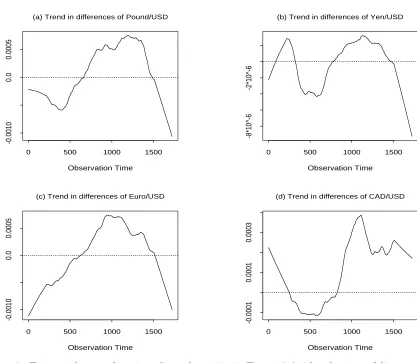
the Epanechnikov kernel is used as the weight function. The estimated local mean functions
are displayed in Figure 3 together with a horizontal line y = 0. Where negative values of
the estimated means correspond to weaker USD periods while positive estimate to strong
USD periods. We see at the current end the USD is stronger than all foreign currencies
except for the CAD, which reflects the current strong dollar policy of the US government.
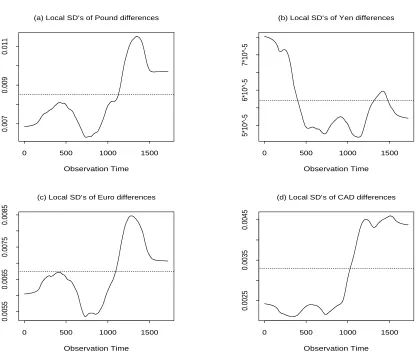
Figure 4 shows the estimated local standard deviations. We can see that the variance
of a difference series also change clearly during this period. The biggest relative change
happens by the CAD, the the ratio between the smallest and biggest values is bigger than
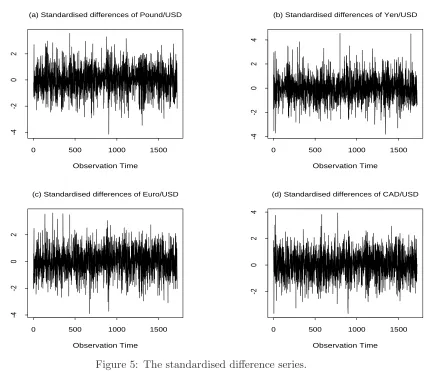
2. The standardized difference series are shown in Figure 5, from which we can see that the
change in the variances is well fitted and removed. Now each single series looks stationary.
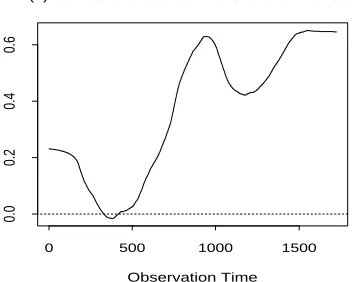
However they are still not jointly stationary, because the cross-correlation matrix changes
very strongly over this period. This is shown in Figure 6, where all of the correlation
coefficients show a clearly increasing pattern. This indicates that the dependence between
the main world economies becomes stronger and stronger in these years. Detailed analysis
shows that the dependence level between the two European currencies was still very high
at the beginning and becomes higher (about 0.8) at the end of the period. The other
correlation coefficients have been very slow at the beginning. Those between Pound and
CAD, and Euro and CAD are even slightly negative at that time. But they increase very
quickly during the observation period until about 0.5 at the current end. At this end the
cross-correlations between CAD and the other currencies seem to begin decreasing slightly
again, because all other currencies become weaker but the CAD is still stronger (cf Figures
1 and 3).
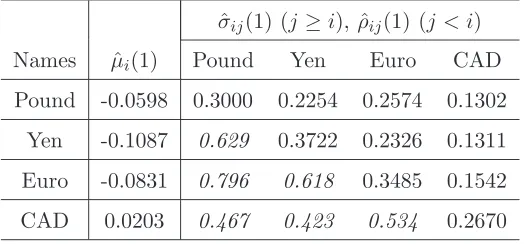
Results obtained following the proposed model are very useful for risk management and
portfolio optimisation. This will be explained briefly in the following. The estimated means,
variances, covariances and correlation coefficients at the current end (with x= 1) for each
currency (standardised for a 100 USD unit to keep them comparable) are shown in Table
1, where the diagonal elements in the second part are the estimated variances, those in
the upper triangular part are the estimated covariances while the estimated correlation
Table 1. ˆµi(1), ˆσij(1) and ˆρij(1) (italic) (for 100 USD).
ˆ
σij(1) (j≥i), ˆρij(1) (j < i)
Names µˆi(1) Pound Yen Euro CAD
Pound -0.0598 0.3000 0.2254 0.2574 0.1302
Yen -0.1087 0.629 0.3722 0.2326 0.1311
Euro -0.0831 0.796 0.618 0.3485 0.1542
CAD 0.0203 0.467 0.423 0.534 0.2670
weakest and the Euro the second weakest currencies. Following the variance (risk) the
Euro is the weakest and the Yen the second weakest currencies. Following both criteria the
CAD is the strongest and the Pound the second strongest currencies. This information is
very useful for decision making, for instance to calculate an optimal portfolio.
7
Concluding remarks
We see that this article provides a good practical model and estimation methods for slowly
changing drifts, variance and correlation coefficients of underlying stochastic process. It is
the first multivariate model in the literature for studying slow change stochastic process;
it develops effect estimation methods and asymptotic theory; and it assesses the effect of
errors in the short term forecasts. Also, any increase in the number of component of the
model does not increase the number of unknown parameters, nor the estimation burden,
hence the model and fitting method are suitable for jointly modelling any number of assets
in practice.
Some important open questions are still there and left for further study. These questions
include extension of the model to allow for autocorrelations, development of significant tests
and the need of robust estimation under asymmetric distribution and possibly outliers in
the data.
The data used in this paper are downloaded from the data releases of the US Federal
Reserve Bank under the address ‘http://www.federalreserve.gov/releases/h10/’. We are
grateful to Prof. Serguei Foss and Dr. George Streftaris, Heriot-Watt University, and Prof.
Winfried Pohlmeier, University of Konstanz, for useful discussions and comments. We are
also grateful to Miss Jiangjiang Yu and Mr Yao-Chih Chen who carried out some empirical
analysis using similar idea in their MSc project under the supervision of the first author.
Appendix:
Proofs of results
Proof of Theorem 2. 1) The results are just special cases of those given in Theorem 1.
2) Note that ˆµi(x) and ˆµj(x) are two linear estimators with the same weights generated
by the local polynomial approach. Let wt denote the weights. We have
ˆ
µi(x) = n
X
t=1
wtzit and µˆj(x) = n
X
t=1
wtzjt.
Note that, for t1 6=t2,zit1 are independent of zit2 andzjt2. Hence
cov (ˆµi(x),µˆj(x)) = cov
n
X
t=1
wtzjt, n
X
t=1
wtzjt
!
=
n
X
t=1
cov (wtzjt, wtzjt)
=
n
X
t=1
wt2cov (zjt, zjt)
=
n
X
t=1
wt2σij(xt). (A.1)
Under the conditions of Theorem 2 we have wt= 0 for|x−xt|> hand
σij(xt) =σij(x)[1 +O(h)] =σij(x)[1 +o(1)]
for |x−xt| ≤h. Following known results in nonparametric regression it is easy to show
thatPw2t = (nh)−1R[1 +o(1)] (see e.g. Wand and Jones, 1995 and Fan and Gijbels, 1996).
Hence,
cov (ˆµi(x),µˆj(x)) =
n
X
t=1
= σij(x)[1 +o(1)] n
X
t=1
w2t
= (nh)−1Rσ
ij(x)[1 +o(1)]. (A.2)
3) Results in this part can be shown by straightforward calculations. In the following we
will give an indirect proof to show more details. Denote by BSˆ
µ(x) andV
S
ˆ
µ(x) respectively
the bias and variance of the estimated portfolio returns. Then it is easy to show that
M SESˆ
µ(x) = [B
S
ˆ
µ(x)]
2+VS
ˆ
µ(x). (A.3)
Following results in part 1) we have
BSµˆ(x) = E
( k
X
i=1
Siµˆi(x)
)
−
k
X
i=1
Siµi(x)
= E
( k
X
i=1
Si[ˆµi(x)−µi(x)]
)
=
( k
X
i=1
Siµ(p+1)(x)
)
βhp+1
(p+ 1)![1 +o(1)]. (A.4)
Furthermore, following (A.2) we have
VµˆS(x) = var
( k
X
i=1
Siµˆi(x)
) = k X i=1 k X j=1
SiSjcov (ˆµi(x),µˆj(x))
= k X j=1
SiSjσij
R
nh[1 +o(1)]. (A.5)
Equation (11) is proved by inserting those in (A.4) and (A.5) into (A.3).
4) Now, note that both TS
1 and T2S are both non-negative. The dominated part of
M SESˆ
µ(x) given in (11) is concave inh, provided thatT
S
1 andT2S are both non-zero, which
is minimized by hoptS given in (14). ⋄
Proof of Theorem 3. Let wit denote the weights for ˆσ2i(1) andwitk,k= 1, ..., n, those
for |xk−xt| ≤ hi and zero otherwise. Let ξit =zit−µi(xt). We have ξit =σi(xt)˜ǫit and
ξijt =ξitξjt=σi(xt)˜ǫitσj(xt)˜ǫjt, where ξtij and ˜ǫit are as defined in the context of Theorem
4. Define ηit = ˜ǫ2it−1. Then, for given i,ηit are zero mean i.i.d. errors such that
ξit2 =σ2i(xt) +σi2(xt)ηit, (A.6)
which represents a special nonparametric regression model with independent errors and
scale change, where the scale function turns to be the same as the trend function. A key
point here is thatξit are unobservable. In the following we will show first Theorem 3 holds,
if µi(xt) is known, i.e. if ξit are observable. Define
˜
σ2i(1) =
n
X
t=1
witξit2, (A.7)
which is a kernel estimator of σ2i(1) but obtained under the assumption thatξit are
observ-able, i.e. µi(xt) are known. The asymptotic bias and variance of ˜σi2(1) can be obtained
by adapting well known results in nonparametric regression with a scale function. See e.g.
Fan and Gijbels (1995), Efromovich (1999) and Feng (2004). However, for a kernel
estima-tor at the endpoint, the weights are non-symmetric and the first order term in the Taylor
expansion of σi2(x) can hence not be cancelled. Denote the bias of ˜σi2(1) by B[˜σi2(1)]. We
have
B[˜σi2(1)] =
n
X
t=1
witE[ξit2]−σ2i(1)
= αi(σi2)′(1)bi[1 +o(1)] (A.8)
as given in 1) of Theorem 3.
The variance of ˜σi2(1) is given by
var [˜σi2(1)] =
n
X
t=1
w2itvar (ηit) =
n
X
t=1
w2itvar (ξit2)
.
= γii2(1)
n
X
t=1
wit2 = (nbi)−1Viγii2(1)[1 +o(1)] (A.9)
as given in 2) of Theorem 3, because Pnt=1w2
it
.
= (nbi)−1Vi.
We now show that the changes of the asymptotic bias and variance of ˆσi2(1) caused by
the error in ˆµi(xt) are both negligible under A4′. Note thatrit=zit−µˆi(xt) and
rit2 = zit2 −2zitµˆi(xt) + ˆµ2i(xt)
= ξit2 + 2ξit∆it+ ∆2it, (A.10)
where ∆it =µi(xt)−µˆi(xt) is the estimation error in ˆµi(xt), for which we have
∆it=O(h2i) +Op[(nhi)−1/2]. (A.11)
Following (A.10) we have
E[ˆσi2(1)−σi2(1)] =B[˜σi2(1)] +
n
X
t=1
wit[2E(ξit∆it) +E(∆2it)]. (A.12)
Furthermore,
E(ξit∆it) = E
"
ξit n
X
k=1
witkzik−µi(xt)
!#
= E
"
ξit n
X
k=1
witk[ξik+µi(xk)]−µi(xt)
!#
= wittσ2i(xt) =O[(nhi)−1], (A.13)
since ξit are i.i.d. with E(ξit) = 0 andE(ξit2) =σi2(xt), and
E(∆2it) = MSE[ˆµi(xt)]
= O[h4i + (nhi)−1]. (A.14)
Condition A4′ means that h4
i = o(n−2/3), (nhi)−1 = o(n−2/3) and bi > O(n−2/3). This
ensures that O[h4i + (nhi)−1] =o(bi) =o{B[˜σ2i(1)]}. Observe that
P
wit= 1 we obtain
E[ˆσ2i(1)−σ2i(1)] = B[˜σ2i(1)] +O[h4i + (nhi)−1]
= B[˜σ2i(1)][1 +o(1)]. (A.15)
Now we will analyze the effect of the error in ˆµi(xt) on var (ˆσi(1)). Note first that
Although cov (zit2
1, z
2
it2) = cov (ξ
2
it1, ξ
2
it2) = 0 for t16=t2, but cov (r
2
it1, r
2
it2)6= 0. Following
the first equation in (A.10) we have
cov (rit21, rit22) = cov (zit21 −2zit1µˆi(xt1) + ˆµ
2
i(xt1), z
2
it2−2zit2µˆi(xt2) + ˆµ
2
i(xt2))
= C1+C2+C3+C4+C5+C6+C7+C8+C9,
where C1 = cov (zit21, z
2
it2) = 0,C2 =−2cov (z
2
it1, zit2µˆi(xt2)), C3 = cov (z
2
it1,µˆ
2
i(xt2)),
C4=−2cov (zit1µˆi(xt1), z
2
it2), C5 = 4cov (zit1µˆi(xt1), zit2µˆi(xt2)),
C6 =−2cov (zit1µˆi(xt1),µˆ
2
i(xt2)), C7= cov (ˆµ
2
i(xt1), z
2
it2),
C8=−2cov (ˆµ2i(xt1), zit2µˆi(xt2)), C9 = cov (ˆµ
2
i(xt1),µˆ
2
i(xt2)).
It can be shown that C2 =C4 =C5 = 0. This will be shown for C2.
C2 = −2cov zit21, zit2
n
X
k=1
wit2kzik
!
= −2
n
X
k=1
wit2kcov (z
2
it1, zit2zik) = 0, (A.17)
because zit are i.i.d.,t16=t2 and hence cov (z2it1, zit2zik) = 0,for all k. Hence,
cov (rit21, r2it2) =C3+C6+C7+C8+C9. (A.18)
For C3 we have
C3 = cov zit21,
n X k=1 n X l=1
wit2kwit2lzikzil
! = n X k=1 n X l=1
wit2kwit2lcov (z
2
it1, zikzil)
= wit22t1var (zit21) (A.19)
due to the term with k = l= t1, because all other covariances are equal to zero. Similar
calculations lead to
C6 =−2wit1t1w
2
it2t1var (z
2
it1), C7=w
2
it1t2var (z
2
it2),
C8=−2w2it1t2wit2t2var (z
2
it2), C9 =
n
X
k=1
Observe the properties of the weights it is easy to see that C3 = O(C7) = O[(nhi)−2],
C6 =O(C8) =O(C9) =O[(nhi)−3] =o(C3). That is
cov (rit21, r2it2)=. w2it2t1var (zit21) +wit21t2var (zit22) =O[(nhi)−2]. (A.20)
We see cov (r2
it1, r
2
it2) =o(n
−1), ifh
i> O(n−1/2), which is implied by A4′. Hence we have
var [ˆσi2(1)] = var
" n X
t=1
witrit2
#
=
n
X
t=1
w2itvar (rit2) +
n
X
t1=1
n
X
t
2=1
t26=t1
wit1wit2cov (r
2
it1, r
2
it2)
.
=
n
X
t=1
w2itvar (rit2)
.
=
n
X
t=1
w2itvar (ξit2) = var [˜σ2i(1)]. (A.21)
Theorem 3 is proved. ⋄
Proof of Theorem 4. Note that the biases are of the same order as in Theorem 3. And
the variances and convariances are of the same order as the variances in Theorem 3. The
estimation errors in ˆµi(xt) are also negligible under A4′. In the following proof the residuals
rit will hence be simply replaced byξit.
By extending the ideas described at the beginning of the proof of Theorem 3 we can
obtain
ξtij =σij(xt) +σi(xt)σj(xt)ζtij, (A.22)
where ζtij = ˜ǫitǫ˜jt−ρij(xt) are i.i.d. zero mean random variables. This is again a special
nonparametric regression model with i.i.d. errors and a scale function, where the trend
is the corresponding covariance function. Of course (A.6) is a special case of (A.22) with
i=j.
1) As mentioned before, the bias of ˆσij(1) is not affected by the scale function and is the
same as in common nonparametric regression. The proof of this part is hence omitted.
by Wr(u) defined in Theorem 4 and the bandwidthb. We have
ˆ
σij(1) =
n
X
t=1
wtξijt
and
cov (ˆσij(1),σˆlm(1)) =
n
X
t1=1
n
X
t2=1
wt1wt2cov (ξ
ij t1, ξ
lm t2 )
=
n
X
t=1
wt2cov (ξijt , ξtlm)
= γij, lm n
X
t=1
wt2 (A.23)
following the definition before, since cov (ξtij
1, ξ
lm
t2 ) = 0 for t16=t2. Furthermore we have
cov (ˆσij(1),σˆlm(1)) =V γij, lm(nb)−1[1 +o(1)], (A.24)
becausePnt=1w2t =V(nb)−1[1 +o(1)], whereV =R0
−1(Wr(u))2duas defined in Theorem 4.
3) Denote byB the bias. It is easy to show that, for given i, j, l, m,
E{[ˆσij(1)−σij(1)][ˆσlm(1)−σlm(1)]} = B[ˆσij(1)]B[ˆσlm(1)] + cov [ˆσij(1),σˆlm(1)](A.25).
Using results in 1) we have
B[ˆσij(1)]B[ˆσlm(1)] =α2σ′ij(1)σ′lm(1)b2[1 +o(1)]. (A.26)
Insert these results and those in 2) into (24) we obtain the results in 3) of Theorem 4.
4) Results in this part follow from those in 3) directly.
Proof of Theorem 5. 1) Under the smoothness assumption onµi we have µi(xn+t) =
µi(1) +O(T n−1) for any t≤T. Following (32) and (33) we have
E[ ˆYi(n+T)−E(Yi(n+T)|Yin)]2 = E[Tµˆi(1)− T
X
t=1
µi(xn+t)]2
= T2E{[ˆµi(1)−µi(1)] +O(T n−1)]}2. (A.27)
Note that ˆµi(1)−µi(1) =O(h(ip+1)) +Op[(nhi)−1/2]. The conditionT2(nhi)−1 →0 results
in T =o(nh1i/2) andT n−1=o[n−1/2h1/2
i ] =o[ˆµi(1)−µi(1)]. Hence,
E[ ˆYi(n+T)−E(Yi(n+T)|Yin)]2 =. T2E[ˆµi(1)−µi(1)]2
Furthermore, A5 ensures that T2M SE[ˆµi(1)]→0, i.e. ˆYi(n+T) is consistent.
2) Similarly, under the conditions of Theorem 5 it can be shown that
E[ ˆPnS+T −E(PnS+T|Yn)]2 =. T2E
( k
X
i=1
Si[ˆµi(1)−µi(1)]
)2
= T2M SESˆ
µ, (A.29)
T2M SES
ˆ
µ→0 under A5 and ˆP
S
n+T is consistent. ⋄
Proof of Theorem 6. 1) Note that ˆσi(1) =
q
ˆ
σ2
i(1). Based on Taylor expension of
random variables it can be shown that
M SE[ˆσi(1)] =O(M SE[ˆσ2i(1)]). (A.30)
Analogously to the analysis in 1) of the proof of Theorem 5 we have σ2
i(xn+t) = σi(1) +
O(T n−1) for any t≤T and
E[√Tσˆi(1)−SDT]2 = E
√
Tσˆi(1)−
v u u t " T X t=1 σ2
i(xn+t)
#
2
.
= En√Thˆσi(1)−σi(1) +O(T1/2n−1/2)
io2
.
= T·E[ˆσi(1)−σi(1)]2
= O(T ·M SE[ˆσi2(1)]). (A.31)
Condition A5′ ensures thatT1/2n−1/2 =o[ˆσ
i(1)−σi(1)],T·M SE[ˆσ2i(1)]→0 and
√ Tˆσi(1)
is a consistent estimator of SDT.
2) Similarly, it can be shown that
M SE
q
S′Σˆ(1)S
.
=M SESˆ
Σ(1), (A.32)
E
q
T S′Σ(1)ˆ S−SDS
T
2
.
= T ·M SE
q
S′Σˆ(1)S
= T ·M SESˆ
Σ(1). (A.33)
AndT ·M SES
ˆ
Σ(1)→0 under A5
′ so that
q
REFERENCES
A¨ıt-Sahalia, Y. (1996) Nonparametric pricing of interest rate derivative securities,
Econo-metrica,64,527–560.
Beran, J. and Y. Feng (2002) SEMIFAR models – a semiparametric approach to modelling
trends, long-range dependence and nonstationarity. Comptat. Statist. & Data Anal.,40,
393–419.
Beran, J. and Ocker, D. (1999) SEMIFAR forecasts, with applications to foreign exchange
rates. J. Statistical Planning and Inference,80, 137–153.
Bollerslev, T., R. F. Engle and J. Wooldridge (1988) A capital asset-pricingmodel with
time-varying covariances. Journal of Political Economy, 96, 116131.
Cs¨org¨o, S. and J. Mielniczuk (1995) Nonparametric regression under long-range dependent
normal errors. Annals of Statistics,23, 1000–1014.
Dahlhaus, R. (1997) Fitting time series models to nonstationary processes. Annals of
Statistics,25, 1–37.
Dahlhaus, R. (2000) A likelihood approximation for locally stationary processes. Annals of
Statistics,28, 1762–1794.
Efromovich, S. (1999)Nonparametric curve estimation: Methods, Theory, and Applications.
New York: Springer.
Engle, R.F. (1982) Autoregressive Conditional Heteroscedasticity with Estimates of the
Variance of UK Inflation. Econometrica,50, 987-1008
Engle, R. (2002) Dynamic conditional correlation: A simple class of multivariate generalized
autoregressive conditional heteroskedasticity models. Journal of Business and Economic
Statistics,20, 339–350.
Fan, J. and I. Gijbels (1995) Data-driven bandwidth selection in local polynomial fitting:
Variable bandwidth and spatial adaptation. J. Roy. Statist. Soc. Ser. B,57,371–394.
Fan, J. and Q. Yao (1998) Efficient estimation of conditional variance functions in stochastic
Feng, Y. (2004) Simultaneously modelling conditional heteroskedasticity and scale change.
Econometric Theory,20,563–596.
Gasser, T., A. Kneip and W. K¨ohler (1991) A flexible and fast method for automatic
smoothing. J. Amer. Statist. Assoc.,86, 643–652.
Gordon, A.H. (1991) Global warming as a manifestation of a random walk. Journal of
Climate,4, 589-597.
H¨ardle, W., A.B. Tsybakov and L. Yang (1998) Nonparametric vector autoregression. J.
Statist. Plann. Infer., 68,221–245.
H¨ardle, W., H. Herwatz and V. Spokoiny (2003) Time inhomogeneous multiple volatility
modelling. J. Financial Econometrics,1,55–99.
Hart, J. D. (1991) Kernel regression estimation with time series errors. J. Roy. Statist.
Soc. Ser. B,53, 173–187.
Harvey, A. (1989) Forecasting structural time series models and the Kalman filter.
Cam-bridge: Cambridge University Press.
Harvey, A., Ruiz, E. and N. Shephard (1994) Multivariate stochastic variance models.
Review of Economic Studies,61, 247–264.
Herzel, S., C. Starica and R. Tutuncu (2006) A non-stationary multivariate model for
financial returns. Forthcoming in Statistics for dependent data, Ed. Patrice Bertail, and
P. Doukhan, Springer.
K¨arner, O. (2002) On nonstationarity and antipersistency in global temperature series.
Journal of Geophysical Research,107, doi: 10.1029/2001JD002024.
Kijima, M. (2002)Stochastic Processes with Applications to Finance, Cambridge: Chapman
and Hall.
Lov´asz, L. (1993) Random Walks on Graphs: A Survey,Mathematical Studies,2, 1–46.
Neigel, J. E. and J.C. Avise (1993) Application of a random walk model to geographic
Ruppert, D. and M.P. Wand (1994) Multivariate locally weighted least squares regression.
Annals of Statistics,22, 1346–1370.
Wand, M.P. and M.C. Jones (1995) Kernel Smoothing, London: Chapman & Hall.
Weiss, G.H. (1994) Aspects and Applications of the Random Walk, Amsterdam: North
Holland Press.
Wu, W. and M. Pourahmadi (2003) Nonparametric estimation of large covariance matrices
of longitudinal data. Biometrika, 90, 831–844.
0 500 1000 1500
1.4
1.5
1.6
1.7
1.8
1.9
(a) Exchange rates between Pound/USD
Observation Time
0 500 1000 1500
0.0075
0.0085
0.0095
(b) Exchange rates between Yen/USD
Observation Time
0 500 1000 1500
0.9
1.0
1.1
1.2
1.3
(c) Exchange rates between Euro/USD
Observation Time
0 500 1000 1500
0.65
0.75
0.85
(d) Exchange rates between CAD/USD
[image:30.595.95.517.265.608.2]Observation Time
0 500 1000 1500
-0.04
-0.02
0.0
0.02
(a) Differences of Pound/USD
Observation Time
0 500 1000 1500
-0.0003
-0.0001
0.0001
(b) Differences of Yen/USD
Observation Time
0 500 1000 1500
-0.02
0.0
0.01
(c) Differences of Euro/USD
Observation Time
0 500 1000 1500
-0.010
0.0
0.010
(d) Differences of CAD/USD
[image:31.595.94.517.203.554.2]Observation Time
0 500 1000 1500
-0.0010
0.0
0.0005
(a) Trend in differences of Pound/USD
Observation Time
0 500 1000 1500
-8*10^-6
-2*10^-6
(b) Trend in differences of Yen/USD
Observation Time
0 500 1000 1500
-0.0010
0.0
0.0005
(c) Trend in differences of Euro/USD
Observation Time
0 500 1000 1500
-0.0001
0.0001
0.0003
(d) Trend in differences of CAD/USD
[image:32.595.97.514.189.552.2]Observation Time
Figure 3: Estimated mean functions from the series in Figure 2 (with a horizontal line at
0 500 1000 1500
0.007
0.009
0.011
(a) Local SD’s of Pound differences
Observation Time
0 500 1000 1500
5*10^-5
6*10^-5
7*10^-5
(b) Local SD’s of Yen differences
Observation Time
0 500 1000 1500
0.0055
0.0065
0.0075
0.0085
(c) Local SD’s of Euro differences
Observation Time
0 500 1000 1500
0.0025
0.0035
0.0045
(d) Local SD’s of CAD differences
[image:33.595.101.517.198.555.2]Observation Time
0 500 1000 1500
-4
-2
0
2
(a) Standardised differences of Pound/USD
Observation Time
0 500 1000 1500
-4
-2
0
2
4
(b) Standardised differences of Yen/USD
Observation Time
0 500 1000 1500
-4
-2
0
2
(c) Standardised differences of Euro/USD
Observation Time
0 500 1000 1500
-2
0
2
4
(d) Standardised differences of CAD/USD
[image:34.595.92.519.201.572.2]Observation Time
0 500 1000 1500
0.1
0.3
0.5
(a) Correlations between Pound/Yen differences
Observation Time
0 500 1000 1500
0.0
0.2
0.4
0.6
(b) Correlations between Yen/Euro differences
Observation Time
0 500 1000 1500
0.55
0.65
0.75
(c) Correlations between Pound/Euro differences
Observation Time
0 500 1000 1500
0.1
0.2
0.3
0.4
0.5
(d) Correlations between Yen/CAD differences
Observation Time
0 500 1000 1500
0.0
0.2
0.4
(e) Correlations between Pound/CAD differences
Observation Time
0 500 1000 1500
0.0
0.2
0.4
0.6
(f) Correlations between Euro/CAD differences
[image:35.595.341.517.147.288.2]Observation Time