http://dx.doi.org/10.4236/ojic.2015.54011
Synthesis, Characterization and
Antibacterial Activity of Mixed Ligand (HL)
Complexes Mn(ll), Co(ll), Ni(ll), Zn(ll), Cd(ll)
and Hg(ll) with Azide (
N
3
−
)
Jassim S. Sultan, Sajed M. Lateaf, Dhuha K. Rashid
Department of Chemistry, College of Education for pure Sciences, Ibn Al-Hiatham, University of Baghdad, Baghdad, Iraq
Email: [email protected]
Received 12 June 2015; accepted 5 October 2015; published 8 October 2015 Copyright © 2015 by authors and Scientific Research Publishing Inc.
This work is licensed under the Creative Commons Attribution International License (CC BY).
http://creativecommons.org/licenses/by/4.0/
Abstract
The complexes of mixed ligand (HL) as primary ligand with azide ion (N3
−
)
as co-ligand with Mn(ll),Co(ll), Ni(ll), Zn(ll), Cd(ll) and Hg(ll) were prepared via reaction metal (ll) chloride salt with ligand (HL) and sodium azide (NaN3) using 1:2:2 mole ratio in ethanol solvent, respectively. The com-plexes of mixed ligand (HL) were characterized by elemental microanalysis (C.H.N), atomic ab-sorption chloride content, molar conductance, magnetic susceptibility, melting point, FTIR and UV-Vis spectral data. The anti bacterial activity with four kinds of bacteria, Staphylococcus aureus, Bacillus, Escherichia coli and Pseudomonas aureus was studied.
Keywords
4-Aminoantipyrine, Glyoxylic Acid, Sodium Azide, Schiff Base, Azido Mixed Ligand
1. Introduction
The chemistry of Schiff bases metal complexes is of interest because these species display a variety of reactivity mode and they possess catalytic and biological activity [1]. Metal complexes of nitrogen-oxygen chelating agents derived from 4-aminoantipyrine Schiff bases have been studied extensively due to their pronounced ap-plications in biological, clinical, analytical and pharmacological areas [2]-[4].
pharmacological, photographic, catalytic and liquid crystals applications [7] [8]. Glyoxylic acid and its deriva-tives play important roles in natural processes participating in the glyoxylate cycle which functions in plants and some microorganisms [9]. It has been widely used in organic synthesis for the manufacture of intermediate products in pharmaceutical [10]. The spectrophotometric methods are usually based on the reactivity of the al-dehyde group [11] [12]. Azido-mixed ligand complexes particular interest has been focused on the azido ligand
( )
N3− not only for its efficiency in ferromagnetic or antiferromagnatic coupling but also for its diversity in co-
ordination modes,µ-1, 1, (end-on EO),µ-1, 3 (end-end, EE),µ-1, 1, 1,µ-1, 1, 3 or still other modes and poly-metric bridging network, and a large number of azido-bridged complexes with different dimensionalities and various topologies have been reported in the literature [13] [14].Polynuclear complexes and coordination poly-mer in which paramagnetic metal ions are bridged by short ligands have attracted great attention in recent years. The studies focusing on better understanding fundamental magnetic applications, a large number of a zide- bridged transition metal complexes, have been reported [15].
2. Experimental
All chemicals were purchased from BDH, and used without further purifications.
2.1. Instrumentation
FTIR spectra were recorded in KBr on Shimadzu-8300 Spectrophotometer in the range of (4000 - 400 cm−1). The electronic spectra in H2O were recorded using the UV-Visible spectrophotometer type (spectra 190 - 900 nm) CECIL, England, with quartz cell of (1 cm) path length. The melting point was recorded on Gallen kamp Melting point Apparatus.
The Conductance Measurements were recorded on W. T. W. conductivity Meter. The metal contents of the complexes were determined by atomic absorption (A. A.) technique using a Shimadzu PR-5 with Orphic Printer atomic absorption spectrophotometer. Balance Magnetic Susceptibility model MSB-MLI was conducted for measuring the magnetic susceptibility.
The characterization of the new ligand (L) is achieved by 1H and 13C-NMR spectra were recorded by using a Bruker 300 MHZ (Switzerland). Chemical Shift of all 1H and 13C-NMR spectra were recorded in δ(ppm) unit downfield from internal reference tetramethylsilane (TMS), using D2O as a solvent. Elemental analysis for car-bon, hydrogen was performed using a Euro Vector EA 3000 A Elemental Analysis (Italy).
2.2. Synthesis of Ligand and Complexes
2.2.1. Synthesis of Ligand (1,5-Diemthyl-3-oxo-2-phenyl-2,3-dihydro-1H-pyrazol-4-ylimino) (HL) A solution of (4-AAP) (0.203 g, 1 mmole) in ethanol (20 ml), and a few drop of 48% of HBr, was added to a solution of (Glyoxylic acid) (0.074 g, 1 mmol) in ethanol (10 ml). The mixture was refluxed for (6 hr) with stir-ring. The resulting was an orange solution allowed to cool and dried at room temperature, then washed with ethanol and re-crystallization to the precipitate with methanol/H2O to give orange crystals during (24 hr), m.p. (128 - 132)˚C.
2.2.2. Synthesis of [Co(HL)2(N3)2]∙2H2O Complex
A solution of (HL) (0.518 g, 2 mmole) in ethanol (5 ml) and a solution of NaN3 (0.13 g, 2 mmol) in ethanol (5 ml) were added to a stirred solution of CoCl2∙6H2O (0.238 g, 1 mmol) in ethanol (5 ml). The resulting mixture was stirred for (1 hr). Then the mixture was filtered and dried then the precipitate was washed with an excess of ethanol and dried at room temperature during (24 hr). A pale green crystals were obtained, m.p. (116 - 121)˚C. A similar method was used to prepare of Mn(II), Ni(II), Zn(II), Cd(II) and Hg(II) mixed ligand complexes.
3. Results and Discussion
3.1. Characterization of Ligand (HL)
In this study, new Schiff base ligand (HL) type (NOO) donor atoms was synthesized according to the used me-thod shown in Scheme 1.
N N H3C NH2
O H3C
C C
O O
H OH
+ Ethanol
48% HBr NN
H3C N
O H3C
C C O
OH H
+ H2O
Ligand (HL)
Scheme 1. Synthesis route of ligand (HL).
3.1.1. 1H NMR Spectral Data
The 1H-NMR spectrum of ligand (HL) shows single peaks attributed to two methyl groups appeared at range (δ1.06 - δ2.91) ppm. The strong signal obtained at (δ3.35) ppm. due to DMSO-d6. The weak peak at (δ8.14) ppm was attributed to proton of azomethine group (-N=CH-). Single weak peak attributed to proton of (-COOH) appeared at (δ9.30) ppm. The multiple chemical shifts around (6.98 - 7.47) ppm may assigned to aromatic pro-tons. The two weak signals at δ(3.04) and δ(3.14) ppm refer to water molecule of DMSO [16].
3.1.2. 13C NMR Spectral Data
13C NMR spectrum of ligand (HL) shows chemical shifts at (15.54) ppm and (18.35) ppm refer to C
5 and C6 for two CH3 group respectively. The chemical shifts at (61.79) ppm and (88.32) ppm were attributed to C3 and C4 of C=C in 4-AAP ring respectively. Signals related to aromatic carbon (C7 - C12) were detected at range (126.04 - 130.89) ppm. The chemical shift of C1 for carboxylic group appeared as expected downfield at (170.25) ppm. The two chemical shift at (165.51) ppm and (135.47) ppm were attributed to C2 for azomethine group (-N=CH-) and C13 to C=O for 4-AAP respectively. Finally, the chemical shift at (40.86) ppm is due to DMSO d6[17].
3.2. Characterization of Mixed Ligand (HL) Complexes with Azide
(
𝐍𝐍
𝟑𝟑−)
The complexes of mixed ligand, (HL) as primary ligand with azide ion
( )
N3− as co-ligand with Mn(II), Co(II), Ni(II), Zn(II), Cd(II) and Hg(II) were prepared via reaction metal (II) chloride salt with ligand (HL) and sodium azide (NaN3) using 1:2:2 mole ratio in ethanol solvent respectively. The method of this synthesis shows inScheme 2and Scheme 3.
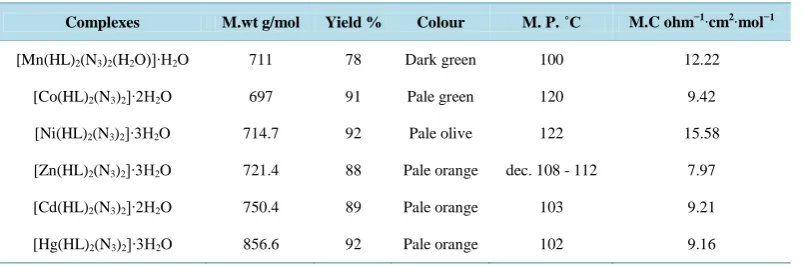
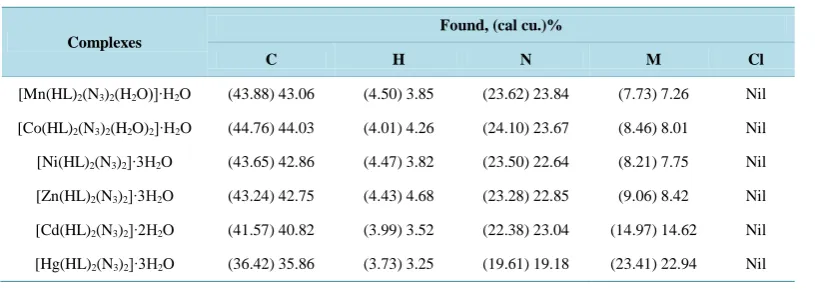
Spectroscopic methods [FT-IR, UV-Vis, A. A.] along with molar conductivity, elemental microanalysis C.H.N, Chloride content, magnetic susceptibility, melting point were used to characterize the prepared mixed ligandcomplexes. All mixed ligand complexes are stable in solution and soluble in methanol, ethanol, acetone, DMSO and DMF solvents. Some physical properties were listed inTable 1. Elemental microanalysis C.H.N, metal and chloride analysis are in a good agreement with calculated values, Table 2.
3.2.1. Molar Conductance
The molar conductance values, Table 1, of the soluble mixed ligand complexes in DMSO solvent in 10−3 M so-lution at room temperature refer to non-electrolytic nature [18].
3.2.2. Magnetic Susceptibility
The magnetic susceptibility for all complexes were measured at room temperature and the effective magnetic moment (μeff) values [19] were listed inTable 3.
3.2.3. FT-IR Spectral Data
The IR spectra of mixed ligand complexes Co(II), Ni(II), Zn(II), Cd(II), and Hg(II), exhibited band at (1616) cm−1, (1624) cm−1, (1614) cm−1, (1616) cm−1, and (1635) cm−1, respectively, refers to stretching frequency
υC=O of 4-AAP ring, which was shifted to lower frequency when its comparison with that of the free ligand (HL), showing that the coordination between oxygen atom of this group with metal ion has happened [20]. The IR spectrum of mixed ligand complex of Mn(II), showed no change in position of the stretching frequency of
N N
H3C N
O
H3C
C H COOH N M N N N N N N N CH3 N O CH3 C H COOH
H2O
+ 2NaCl mH2O
N N
N
H3C
C H
CO
OH2
H3C
O
2 mole
2NaN3 + MCl. 4H2O
2 mole 1 mole
ethanol reflux +
Where:M = Co, X=6, m=2
Ni, X=6, m=3
Zn, X=0, m=3 Cd, X=1, m=2 Hg, X=0, m=3
Scheme 2. Synthesis route of mixed ligand complexes for Co(II), Ni(II), Zn(II), Cd(II) and Hg(II).
N N
H3C N
O
H3C
C H COOH N M N N N N N N N CH3 N O CH3 C H COOH
H2O
+ 2NaCl H2O
N N
N
H3C
C H
CO
OH2
H3C
O
2 mole
2NaN3 + MCl. 4H2O
2 mole 1 mole
ethanol reflux
+
[image:4.595.115.517.587.720.2]Scheme 3. Synthesis route of mixed ligand (HL) complex for [Mn(HL)2(N3)2(H2O)2]∙H2O.
Table 1. Some physical properties and molar conductance (M.C) of mixed ligand (HL) complexes.
Complexes M.wt g/mol Yield % Colour M. P.˚C M.C ohm−1∙cm2∙mol−1
[Mn(HL)2(N3)2(H2O)]∙H2O 711 78 Dark green 100 12.22
[Co(HL)2(N3)2]∙2H2O 697 91 Pale green 120 9.42
[Ni(HL)2(N3)2]∙3H2O 714.7 92 Pale olive 122 15.58
[Zn(HL)2(N3)2]∙3H2O 721.4 88 Pale orange dec. 108 - 112 7.97
[Cd(HL)2(N3)2]∙2H2O 750.4 89 Pale orange 103 9.21
Table 2.Elemental microanalysis of mixed ligand (HL) complexes.
Complexes
Found, (cal cu.)%
C H N M Cl
[Mn(HL)2(N3)2(H2O)]∙H2O (43.88) 43.06 (4.50) 3.85 (23.62) 23.84 (7.73) 7.26 Nil
[Co(HL)2(N3)2(H2O)2]∙H2O (44.76) 44.03 (4.01) 4.26 (24.10) 23.67 (8.46) 8.01 Nil
[Ni(HL)2(N3)2]∙3H2O (43.65) 42.86 (4.47) 3.82 (23.50) 22.64 (8.21) 7.75 Nil
[Zn(HL)2(N3)2]∙3H2O (43.24) 42.75 (4.43) 4.68 (23.28) 22.85 (9.06) 8.42 Nil
[Cd(HL)2(N3)2]∙2H2O (41.57) 40.82 (3.99) 3.52 (22.38) 23.04 (14.97) 14.62 Nil
[image:5.595.113.521.98.243.2][Hg(HL)2(N3)2]∙3H2O (36.42) 35.86 (3.73) 3.25 (19.61) 19.18 (23.41) 22.94 Nil
Table 3.Magnetic susceptibility and µeff. (B.M) of some mixed ligand (HL) complexes.
Complexes* Xg× 10−6 XM× 10−6 XA× 10−6 µeff. (B.M) Suggested structure
[Mn(HL)2(N3)2(H2O)2]∙H2O 18.57 13204.65 12971.03 5.56 Octahedral
[Co(HL)2(N3)2]∙2H2O 14.08 9815.38 10049.0 4.88 Octahedral
[Ni(HL)2(N3)2]∙3H2O 4.50 3217.88 3451.50 2.86 Octahedral
group (-N=CH-) which were shifted to lower frequency when it compare with that of free ligand showing that the coordination with the metal ions was occurred via nitrogen atom of imine group (-N=CH-) [21]. The IR spectra of all mixed ligand complexes exhibited new strong splited band or new strong singlate band which wasn’t observed in the IR spectrum of free ligand (HL), this band was located at (2123 cm−1, 2058 cm−1) Mn(II), (2123 cm−1, 2102 cm−1) Co(II), (2121 cm−1, 2036 cm−1) Ni(II), (2125 cm−1, 2036 cm−1) Hg(II), (2065) cm−1 for Zn(II) and Cd(II), which was attributed to stretching frequency υasy.
( )
N3− . While the new band at (1311) cm−1
for Mn(II) Co(II) and at (1317) cm−1 for Zn(II), Cd(II) and at (1313) cm−1 for Hg(II), was attributed to stretching frequency υsy.
( )
N3− [22]. These values of υ
asy.
( )
N3− and υ
sy.
( )
N3− suggest the coordination between azide
ion
( )
N3− and metal ion. Further, the two bands observed at (1419) cm−1 and (1369) cm−1 in the IR spectrum of free ligand which are assigned to υasy. (COO−) and υsy. (COO−) respectively, parically no or slightly change on these frequencies at complexation was observed, indicating noninvolvement of this group in coordination with metal ion [23]. In the IR spectra of mixed ligand complexes of Mn(II), Co(II), Ni(II), Zn(II), Cd(II), and Hg(II) abroad band was observed around (3464) cm−1 to (3390) cm−1 which was assigned to hydrate water molecules [24], while the presence of coordinated water (aqua) in the structure of Mn(II) complex was suggested by a broad band at (3390) cm−1 and weak band at (931) cm−1 in the IR spectrum of Mn(II) complex, which refer toυO-H and δO-H for H2O coordination molecules [25]. The stretching frequency of υC=O for carboxylate group in IR spectra for all mixed complexes appeared as overlap with band of υC=O ring or as a weak band around (1735) cm−1. Two bands in the region (545 - 505) cm−1 and (505 - 445) cm−1 typical for the presence of M-N and M-O in the IR spectra for all mixed ligand complexes as new bands [26]. These Two bands were not present in the spectrum of free ligand (HL). Other bands in the IR for all complexes were listed inTable 4. These observa-tion in the IR spectra of free ligand and its mixed complexes indicate that the ligand (HL) coordinate with Co(II), Ni(II), Zn(II), Cd(II), and Hg(II) via oxygen atom of (C=O) ring and nitrogen atom of imine group (-N=CH-), behaving bidentate ligand. But its behaves as monodentate ligand when it coordinate with Mn(II) via nitrogen atom of imine group (-N=CH-) only. While the azide ion
( )
N3− coordinates with metal ion in all mixed ligand complexes as terminal ligand. According to these fact, the primary oxidation states of the metal ions Mn(II), Co(II), Ni(II), Zn(II), Cd(II), and Hg(II) ware satisfied by the presence of azide ion( )
N3− present inside the coordination sphere, that was proved by molar conductance values which were a good evidence for non-elec- trolytic complexes.3.2.4. UV-Vis Spectral Data
Table 4.The FT-IR spectral data (cm−1) of ligand (HL) and its mixed complexes.
Compounds υO-H υC=O
ring
υC=O carbox.
υN=C imine
υCOO− asy.
υCOO− sy.
υN3 −
asy.
υN3 − sy. υC=C arom. υC-H arom. υC-C aliph. υC-H
aliph. υM-N υM-O
(HL) 3421 1645 1724 1608 1419 1369 - - 1586 2939 1197 2900 - - [Mn(HL)2(N3)2(H2O)2]∙H2O 3390 1647 Overlap 1593 1417 1369 2123
2058 1311 1570 3064 1190 2927 543 505 [Co(HL)2(N3)2]∙H2O 3442 1616 Overlap 1591 1421 1371 2123 2102 1311 1573 Overlap 1197 2935 505 445
[Ni(HL)2(N3)2]∙3H2O 3390 1624 1735 1593 1417 1363
2121
2036 1311 1575 Overlap 1168 Overlap 545 475 [Zn(HL)2(N3)2]∙3H2O 3464 1614 1735 1591 1417 1373 2065 1317 1560 3066 1141 2933 542 445
[Cd(HL)2(N3)2]∙2H2O 3446 1616 Overlap 1591 1419 1375 2065 1317 1558 3064 1188 2930 505 460
[Hg(HL)2(N3)2]∙3H2O 3346 1635 Overlap 1591 1417 1369 2125
2036 1313 1558 3064 1188 2900 505 453
Table 5. Electronic spectral data of ligand (HL) and its mixed complexes.
Compound λnm υ− (cm−1) (εmaxmolar−1∙L∙cm−1) Electronic transition Suggested structure
(HL)
276 36,231 1885 π→π*
- 346 28,901 614 n →π*
362 27,624 500 n →π*
[Mn(HL)2(N3)2(H2O)2]∙H2O
297 33,670 2370 Intra-ligand
Oh 345 28,986 2042 Intra-ligand
359 27,855 1324 Intra-ligand 475 21,053 208 6
A1g →4T2g(G)
638 15,674 41 6A
1g →4T1g(G)
794 12,594 7 6A
1g →4Eg(D)
[Co(HL)2(N3)2]∙2H2O
286 34,965 2304 Intra-ligand
oh 345 28,986 2034 Intra-ligand
362 27,624 1228 Intra-ligand 650 15,387 13 4T
1g →4A2g
879 11,377 4 4T
1g →4T2g
[Ni(HL)2(N3)2]∙3H2O
281 35,587 2218 Intra-ligand
Oh 347 28,818 1152 Intra-ligand
365 27,397 842 Intra-ligand 426 23,474 323 3A
1g →3T2g(P)
792 15,942 10 3A
1g →3T1g
879 11,377 2 3
A1g →3T2g
[Zn(HL)2(N3)2]∙3H2O
286 34,965 2278 Intra-ligand
Oh 345 28,986 1489 Intra-ligand
354 28,249 962 Intra-ligand
[Cd(HL)2(N3)2]∙2H2O
286 34,965 2276 Intra-ligand
Oh 345 28,986 1485 Intra-ligand
354 28,249 960 Intra-ligand
[Hg(HL)2(N3)2]∙3H2O
284 35,211 2274 Intra-ligand
Oh 345 28,986 2085 Intra-ligand
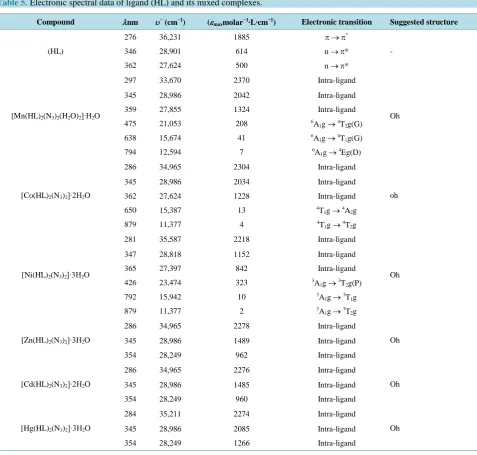
[image:6.595.60.538.272.727.2]transitions and suggested geometries. The electronic spectra for all mixed ligand complexes displayed three ab-sorption peaks in the ultraviolet region. The first peak at range (281 - 297) nm (35587 - 33670) cm−1 (εmax = 2370 - εmax = 2218) mol−1∙L∙cm−1, the second peak at (345, 347) nm (28986, 28818) cm−1 (εmax = 1152 - εmax = 2278) mol−1∙L∙cm−1, the third peak at (354 - 365) nm (28249 - 27397) cm−1 (εmax = 842 - εmax = 1324) mol−1∙L∙cm−1 were attributed to intra-ligand π→ π*, n → π*, and n → π*, respectively [25] which exhibited bath chromic shift or hypsochromic shift when it comparison with that of free ligand (HL).
3.2.5. [Mn(HL)2(N3)2(H2O)2]∙H2O
The UV-Vis spectrum of Mn(II) complex, displayed three additional absorption peaks. The first peak at (475) nm (21053) cm−1 (εmax = 208) mol−1∙L∙cm−1, the second peak at (638) nm (15674) cm−1 (εmax = 41) mol−1∙L∙cm−1, the third peak at (794) nm (12594) cm−1 (εmax = 7) mol−1∙L∙cm−1 were attributed to (d-d) spin-forbidden elec-tronic transition type 6A1g → 4T2g(G), 6A1g → 4T1g(G), and 6A1g → 4Eg(D), confirming octahedral geometry about Mn(II) [27].
3.2.6. [Co(HL)2(N3)2]∙2H2O
The electronic spectrum of Co(II) complex, showed two additional absorption peaks. The first peak at (650) nm (15,387) cm−1 (εmax = 13) mol−1∙L∙cm−1, and the second peak at (879) nm (11377) cm−1 (εmax = 4) mol−1∙L∙cm−1 were attributed to (d-d) spin-allowed electronic transition type 4T1g → 4A2g, and 4T1g → 4T2g, respectively, characteristic octahedral geometry around Co(II) [28].
3.2.7. [Ni(HL)2(N3)2]∙H2O
The UV-Vis spectrum of Ni(II) complex, displayed three additional absorption peaks. The first peak at (426) nm (23,474) cm−1 (εmax = 323) mol−1∙L∙cm−1, the second peak at (792) nm (15942) cm−1 (εmax = 10) mol−1∙L∙cm−1, the third peak at (879) nm (11,377) cm−1 (εmax = 2) mol−1∙L∙cm−1 were due to (d-d) spin-allowed electronic tran-sition type 3A1g → 3T1g(P), 3A1g → 3T1g, and 3A1g → 3T2g, respectively, which were a good agreement for oc-tahedral geometry of Ni(II) complexes [29].
3.2.8. [Zn(HL)2(N3)2]∙3H2O, [Cd(HL)2(N3)2]∙2H2O, and Hg(HL)2(N3)2]∙3H2O
The electronic spectra of Zn(II), Cd(II), and Hg(II), respectively show no absorption peaks in the visible region, indicating (d10-system) for Zn(II), Cd(II), and Hg(II), that is mean no d-d electronic transition happened [27].
3.3. Biological Activity of the Ligand (HL) and Mixed Ligand Complexes
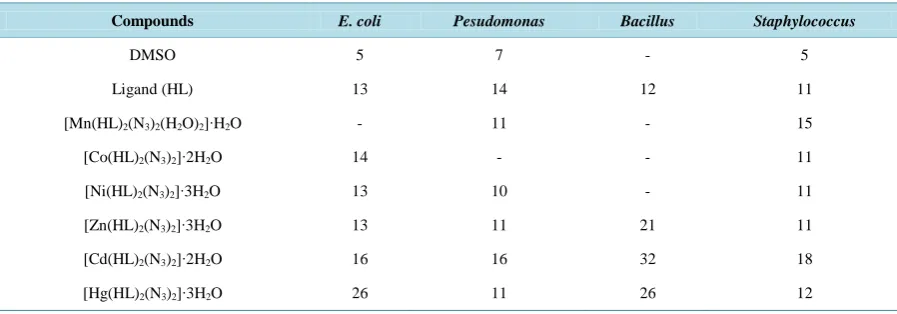
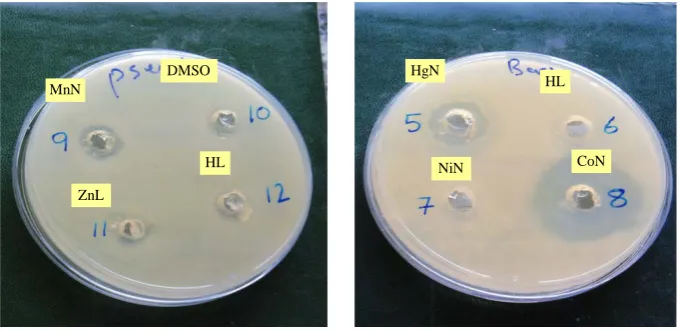
[image:7.595.88.537.560.717.2]Indicating that the new ligand and its mixed ligand complexes exhibited antibacterial activity against four kinds of bacterial: Staphylococcus aureus, Bacillus, Escherichia coli,and Pseudomonad aureus respectively, in Table 6,Figure 1 and Figure 2. The enhanced activity of the complexes can be explained on the bases of Overtone’s concept and Tweedy’s chelation theory [30] [31].
Table 6. Showed the inhibition circle diameter in millimeter for the bacteria after 24 hour in cubation paid (37˚C) for ligand (HL) and its mono and mated complexes.
Compounds E. coli Pesudomonas Bacillus Staphylococcus
DMSO 5 7 - 5
Ligand (HL) 13 14 12 11
[Mn(HL)2(N3)2(H2O)2]∙H2O - 11 - 15
[Co(HL)2(N3)2]∙2H2O 14 - - 11
[Ni(HL)2(N3)2]∙3H2O 13 10 - 11
[Zn(HL)2(N3)2]∙3H2O 13 11 21 11
[Cd(HL)2(N3)2]∙2H2O 16 16 32 18
CdN
CoN ZnN
MnN
CuL ZnN
DMSO
DMSO
[image:8.595.143.483.83.277.2]HL
Figure 1. Inhibition diameter for ligands and complexes E. coli = Escherichia coli, Staph =
Staphylococcus aureus.
HgN
CoN NiN
MnN
ZnL
DMSO
HL
HL
Figure 2.Inhibition diameter for ligands and complexes Pse = Pesudomonas, Bacil = Bacillus.
4. Conclusions and the Proposed Molecular Structure for All Prepared Complexes
According to the characterization data for new Schiff base (HL) derived from 4-aminoantipyrine with glyoxylic acid, and its mixed ligand complexes based Schiff base liagnd HL primary ligand and azide ion( )
N3− (co-ligand), by FT-IR, UV-Vis, atomic absorption, 1H NMR, 13C NMR, magnetic susceptibility, molar conduc-tivity, elemental microanalysis, chloride content alonge with melting point, we found that:1) The Schiff base (HL) in mixed ligand complexes behaved bidentatc ligand through its azomethine nitrogen, oxygen atom of C=O group of five member ring with the central metal ions: Co(II), Ni(II), Zn(II), Cd(II) and Hg(II) forming complexes with molecular formula: [M(HL)2(N3)2]∙mH2O where: (MII = Co, Cd; m = 2), (MII = Ni, Zn, Hg; m = 3), except in Mn(II) complex, Schiff base (HL) behaved monodentatc ligand via azomethine ni-trogen forming complex with molecular formula [Mn(HL)2(N3)2]∙H2O.
2) The octahedral geometrical structure was suggested for all prepared complexes based on the characteriza-tion data for all technique.
3) The antibacterial study showed that the complexes were more toxic to the strain of bacteria taken under study than the Schiff base ligand (HL).
References
[image:8.595.143.483.314.480.2]Base Metal Complexes. Research Journal of Chemistry and Environment, 15, 57-61.
[2] Raman, N., Raja, S.J. and Salkthivel, A. (2009) Transition Metal Complexes with Schiff-Base Ligands: 4-Aminoanti- pyrine Based Derivatives—A Review. Journal of Coordination Chemistry, 62, 691-709.
http://dx.doi.org/10.1080/00958970802326179
[3] Rosu, T. Pahontu, E., Maxim, C., Georgescu, R., Stanica, N. and Gulea, A. (2011) Some New Cu(II) Complexes Con-taining an on Donor Schiff Base: Synthesis, Characterization and Antibacterial Activity. Polyhedron, 30, 154-162.
http://dx.doi.org/10.1016/j.poly.2010.10.001
[4] Mohamed, G.G., Omar, M.M. and Ibrahim, A.A. (2009) Biological Activity Studies on Metal Complexes of Novel Tridentate Schiff Base Ligand. Spectroscopic and Thermal Characterization. European Journal of Medicinal Chemistry, 44, 4801-4812. http://dx.doi.org/10.1016/j.ejmech.2009.07.028
[5] Elemike, E.E. Oviawe A.P. and Otuokere, I.E. (2011) Potentiation of the Antimicrobial Activity of 4-Benzylimino-2,3- Dimetyl-1-phenylpyrazal-5-one by Metal Chelation. Research Journal of Chemical Sciences, 1, 6-11.
[6] Agarwal, R.K., Singh, I. and Sharma, D.K. (2006) Synthesis, Spectral, and Biological Properties of Copper(II) Com-plexes of Thiosemicarbazones of Schiff Bases Derived from 4-Aminoantipyrine and Aromatic Aldehydes. Bioinor-ganic Chemistry and Applications, 2006, 1-10.
[7] Acheson, R.M. (2009) Introduction to Heterocyclic Compounds. 4th Edition, Wiley, New York.
[8] Gopalakrishman, S. and Joseph, J. (2009) Antifungal Activities of Copper (II) with Biosensitive Macrocyclic Shiff Base Ligands Derived from 4-Aminoantipyrien Derivatives. Microbiology, 37, 141-146.
[9] Mishchenco, A.V. Lukov V.V. and Popov, L.D. (2011) Synthesis and Physico-Chemical Study of Complexation of Glyoxylic Acid Aroylhydrazones with Cu(II) in Solution and Solid Phase. Journal of Coordination Chemistry, 64, 1963-1976. http://dx.doi.org/10.1080/00958972.2011.585640
[10] Kramer, D.N., Klein, N. and Baselice, R.A. (1999) Quantitative Determination of Glyoxylic Acid. Analytical Chemi-stry, 31, 250-252. http://dx.doi.org/10.1021/ac60146a028
[11] Sokol, H.A. (1977) Determination of Pyruvic and Glyoxylic Acids in the Presence of Acetaldehyde. Analytica Chimica Acta, 89, 407-408. http://dx.doi.org/10.1016/S0003-2670(01)84741-3
[12] Tharmaraj, P., Kodimunthiri, D., Sheela, C.D. and Shanmugapriya, C.S. (2009) Synthesis, Spectral Studies and Anti-bacterial Activity of Cu(II), Co(II) and Ni(II) Complexes of 1-(2-Hydroxyphenyl)-3-phenyl-2-propen-1-one)N2-[(3,5- dimethyl-1H-pyrazol-1-yl)methyl] Hydrazone. Journal of the Serbian Chemical Society, 74, 927-938.
http://dx.doi.org/10.2298/JSC0909927T
[13] Suresh, M.S. and Prakash, V. (2010) Preparation and Characterization of Cr(III), Mn(II), Co(II), Ni(II), Cu(II), Zn(II) and Cd(II) Chelates of Schiffs Base Derived from 4-Aminoantipyrine. International Journal of Physical Sciences, 5, 2203-2211.
[14] Anupama, B., Padmaja, M. and Kumari, C.G. (2012) Synthesis, Characterization, Biological Activity and DNA Bind-ing Studies of Metal Complexes with 4-Aminoantipyrine Schiff Base Ligand. E-Journal of Chemistry, 9, 389-400.
http://dx.doi.org/10.1155/2012/291850
[15] Raman, N., Sobha, S. and Selvaganapathy, M. (2012) Probing the DNA Binding Mode of Transition Metal Based Bio-logically Active Compounds: Validation by Spectroscopic Methods. International Journal of Pharma and Bio Sciences, 3, 251-268.
[16] Manjula, B. and Antony, S.A. (2013) Arsenic Induced Biochemical Changes in Perna viridis as Potential Biomarkers in Metal Pollution. Asian Journal of Biochemical and Pharmaceutical Research, 3, 168-178.
[17] Wang, X.Y., Wang, Z.M. and Gao, S. (2008) Constructing Magnetic Molecular Solids by Employing Three-Atom Li-gands as Bridges. Chemical Communications, 2008, 281-294. http://dx.doi.org/10.1039/B708122G
[18] Ju, Z.F., Yao, Q.X., Wu, W. and Zhang, I. (2008) Strong Electron-Accepting Methyl Viologen Dication Confined in Magnetic Hosts: Synthesis, Structural, Characterization, Change-Transfer and Magnetic Properties, of [(MV)2[Ni- (SCN)5].Cl.2H2O]n and [(MV)[M(N3)2(SCN)2]] (M=Mn, Co). Dalton Transactions, 355-362.
http://dx.doi.org/10.1039/B710628A
[19] Belaid, S., Landreau, A., Djebbar, S., Benali-Baitich, O., Bouet, G. and Bouchara, J. (2008) Synthesis, Characterization and Antifungal Activity of a Series of Manganese(II) and Cupper(II) Complexes with Ligands Derived from Reduced N,N-O-phenylene bis(salicylideneimine). Journal of Inorganic Biochemistry, 102, 63-69.
http://dx.doi.org/10.1016/j.jinorgbio.2007.07.001
[20] El-Asmy, A.A., Al-Ansi, T.Y. and Shaiba, Y.M. (1989) Chelated Complexes of Cadmium(II), Cobalt(II), Copper(II), Mercury(II), Nickel(II), Uranyl(II) and Zinc(II) with Benzil bis(4-phenylthiosemicarbazone). Transition Metal Chemi-stry, 14, 446-452. http://dx.doi.org/10.1007/BF01092587
[22] Raj, K.D. and Sharad, K.M. (2011) Synthesis, Spectroscopic (IR, Electronic, Fab-Mass, and PXRD), Magnetic and Antimicrobial Studies of New Iron(III) Complexes Containing Shiff Bases and Substituted Benzoxazole Ligands.
Journal of Coordination Chemistry, 64, 2292-2301. http://dx.doi.org/10.1080/00958972.2011.594886
[23] Nakamoto, K. (1978) Infrared and Raman Spectra of Inorganic and CoordinationCompounds. 3rd Edition, Wiley, New York.
[24] Cowely, A.R. Dilworth, J.R. Donnelly, P.S. and Whilte, J.M. (2006) Copper Complexes of Thiosemicarbazone-Pyridyl- hydrazine (THYNIC) Hybrid Ligands: A New Versatile Potential Bifunctional Chelator for Copper Radiopharmaceut-icals.Inorganic Chemistry, 45, 496-498. http://dx.doi.org/10.1021/ic0514492
[25] Al-Hamdani, A.A.S. and Shaker, S.A. (2011) Synthesis, Characterization, Structural Studies and Biological Activity of a New Schiff Base-Azo Ligand and Its Complexation with Selected Metal Ions. Oriental Journal of Chemistry, 27, 835-845.
[26] Lever, A.B.P. (1984) Inorganic Electronic Spectroscopy. 2nd Edition, Elsevier, New York.
[27] Huheey, J.E. (1994) Inorganic Chemistry: Principles of Structure and Reactivity. Harper and Row Publisher, New York.
[28] Awetz, J., Melnick, P. and Delbrgs, A. (2007) Medical Microbiology. 4th Edition, McGraw Hill, New York.
[29] Priya, N.P., Arunachalam, S.V., Sathya, N., Chinnusamy, V. and Jayabalakrishnan, C. (2009) Catalytic and Antimi-crobial Studies of Binuclear Ruthenium(III) Complexes, Containing Bis-β-Diketones. Transition Metal Chemistry, 34, 437-445. http://dx.doi.org/10.1007/s11243-009-9214-z
[30] Jayablakrishnan, C. and Natarajan, K. (2002) Synthesis, Characterization, and Biological Activities of Ruthenium(II) Carbonyl Complexes Containing Bifunctional Tridentate Schiff Bases. Transition Metal Chemistry, 27, 75-79.
http://dx.doi.org/10.1023/A:1013437203247