Verifying Outsourced Replicated Data in Cloud
Computing Storage Systems
Ayad F. Barsoum
Computer Science Department St.Mary’s University San Antonio, Texas, USA
M. Anwar Hasan
Department of Electrical and Computer Engineering University of Waterloo
Ontario, Canada
ABSTRACT
Storage-as-a-Service offered by cloud service providers (CSPs) en-ables customers to store and retrieve almost unlimited amount of data by paying fees metered in GB/month. For an increased level of scalability, availability and durability, some customers may want their data to be replicated on multiple servers across multiple data centers. In this paper, we propose a pairing-based provable multi-copy data possession (PB-PMDP) scheme, which provides an evi-dence that all outsourced copies are actually stored and remain in-tact. Moreover, it allows authorized users (i.e., those who have the right to access the owner’s file) to seamlessly access the file copies stored by the CSP, and supports public verifiability. The proposed scheme is proved to be secure against colluding servers. We illus-trate the performance of the PB-PMDP scheme through theoreti-cal analysis, which is then validated by experimental results on a commercial cloud platform. The verification time of the proposed scheme is practically independent of the number of file copies. Ad-ditionally, we discuss how to identify corrupted copies by slightly modifying the proposed PB-PMDP scheme.
Keywords:
Cloud computing, outsourcing data storage, data replication, cryp-tographic protocols, data integrity, verification techniques.
1. INTRODUCTION
Cloud computing is a distributed computational model over a large pool of shared-virtualized computing resources (e.g., storage, pro-cessing power, memory, applications, services, and network band-width). Cloud computing represents a vision of providing com-puting services as public utilities like water and electricity. It can potentially offer a number of key advantages: cost effectiveness, low management overhead, immediate access to a wide range of applications, flexibility to scale up/down information technology (IT) capacity, and mobility where customers can access informa-tion wherever they are, rather than having to remain at their desks. Outsourcing data to a remote cloud service provider (CSP) allows organizations to store more data on the CSP than on private com-puter systems. Such outsourcing of data storage enables organiza-tions to concentrate on innovaorganiza-tions and get relief from the burden of constant server updates and other computing issues [31]. More-over, many authorized users can access the remotely stored data from different geographic locations making it more convenient for
them. A relatively recent survey indicates that IT outsourcing has grown by a staggering 79% as organizations seek to focus more on their core competencies and reduce costs [32].
However, the fact that data owners no longer physically possess their sensitive data raises new challenges to the tasks of data confi-dentiality and integrity in cloud computing systems. The confiden-tiality issue can be handled by encrypting sensitive data before out-sourcing to remote servers. As for data integrity, the owners need to have a strong evidence that cloud servers still possess their data and it is not being tampered with or partially deleted over time, es-pecially because the internal operation details of the CSP may not be known to customers.
Traditional cryptographic primitives for data integrity and avail-ability based on hashing and signature schemes are not applica-ble to outsourced data without having a local copy. It is imprac-tical for the owners to download all stored data to validate its in-tegrity; this would require expensive I/O operations and immense communication overheads across the network. Therefore, efficient techniques are needed to verify the integrity of outsourced data with reduced communication, computation, and storage overheads. Consequently, many researchers have focused on the problem of provable data possession (PDP), and proposed different schemes to audit the data on remote storage sites.
PDP is a technique for validating data integrity over remote servers. In a typical PDP model, the data owner generates some meta-data/information for a data file to be used later for verification pur-poses through achallenge-responseprotocol with the remote/cloud server. The owner sends the file to be stored on a remote server which may be untrusted, and deletes the local copy of the file. As a proof that the server is still possessing the data file in its original form, it needs to correctly compute a response to a chal-lenge vector sent from a verifier – who can be the original data owner or a trusted entity that shares some information with the owner. Researchers have proposed different variations of PDP schemes under different cryptographic assumptions; for example, see [5, 14, 17, 19, 24, 26, 28, 29, 33]. PDP schemes presented in [5, 14, 17, 19, 24, 26, 28, 29, 33] focus on asingle copyof the file and provide no proof that the CSP stores multiple copies of the owner’s file.
Volume 99 - No. 7, August 2014
who have the right to access the owner’s file) and the CSP was not considered in [13]. The MR-PDP scheme supports only private ver-ifiability, i.e., only the data owner can check data possession. Pub-lic verifiability is a key feature in remote data checking schemes to avoid disputes that may arise between the data owner and the CSP. Delegating the auditing process (without revealing secret keys) to a trusted third party for verifying the data integrity can resolve such disputes.
Main contributions. Our contributions can be summarized as fol-lows:
• We propose a pairing-based provable multi-copy data possession (PB-PMDP) scheme. This scheme provides an adequate guar-antee that the CSP stores all copies that are agreed upon in the service contract, and these copies are intact. The authorized users can seamlessly access the copies received from the CSP. The PB-PMDP scheme supports public verifiability.
• We justify the performance of the proposed PB-PMDP scheme through theoretical analysis, experimental results on Amazon cloud platform, and comparison with the MR-PDP model [13]. Moreover, we discuss a slight modification of the proposed PB-PMDP scheme to identify corrupted copies.
• We show the security of our scheme against colluding servers.
Paper organization. The remainder of the paper is organized as follow. Section 2 contains related work. Section 3 presents a basic provable multi-copy data possession, and a review of the MR-PDP scheme [13]. Our system and assumptions are presented in Section 4. Section 5 highlights our security model. The proposed scheme is elaborated in Section 6. The performance analysis is shown in Section 7. Section 8 presents the implementation and experimental results on Amazon cloud platform. How to identify the corrupted copies is discussed in Section 9. Concluding remarks are given in Section 10.
2. RELATED CONCEPTS 2.1 Single-Copy PDP Schemes
The key purpose of PDP schemes is to validate the integrity of data outsourced to remote servers. In PDP schemes, a verifier is allowed to efficiently, periodically, and securely validate that a re-mote server – which supposedly stores the owner’s potentially very large amount of data – is actually storing the data in its orig-inal form. A simple solution to tackle the problem of data in-tegrity over remote servers is by fragmenting the data fileF into blocks{b1, b2, . . . , bm}, computing a message authentication code
(MAC)σjfor each blockbj:σj =MACsk(j||bj)1≤j≤m, sending
both the data fileFand the MACs{σj}1≤j≤mto the remote/cloud
server, deleting the local copy of the file, and storing only the se-cret keysk. During the verification process, a verifier requests for a set of randomly selected blocks and their corresponding MACs, re-computes the MAC of each retrieved block usingsk, and com-pares the computed MACs with the received values from the re-mote server [33]. This approach suffers from a severe drawback; the communication complexity is linear with the queried data size, which is impractical especially when the available bandwidth is limited.
For efficient validation of outsourced data integrity, a number of PDP protocols have been proposed in the recent past [5, 14, 17, 19, 24, 26, 28, 29, 33], which focus on asingle copyof the file and pro-vide no proof that the CSP stores multiple copies of the owner’s file
(more details on various PDP schemes can be found in our techni-cal report [9]). Curtmola et al. [13] were the first to address the integrity of multiple data copies outsourced to remote servers. The MR-PDP scheme of [13] is based on the single-copy PDP model of [5].
Ateniese et al. [5] introduced an RSA-based PDP model in which the data owner fragments the fileF into blocks{b1, b2, . . . , bm},
and generates a tag for each block to be used later for verifica-tion purposes. The file and the tags are sent to be stored on remote servers. The scheme presented in [5] providesprobabilistic guar-antee of data possession, where the verifier checks for a random subset of file blocks with each challenge (spot checking).
In their work, Ateniese et al. [5] differentiate between the concept of public verifiability and private verifiability. In public verifiabil-ity, anyone who knows the owner’s public key can challenge the re-mote server and verify that the server is still possessing the owner’s files. On the other hand, private verifiability allows only the origi-nal owner to perform the auditing task. Two main schemes are pre-sented in [5]: sampling PDP (S-PDP) and efficient PDP (E-PDP) schemes. The E-PDP model provides a weaker guarantee of data possession; it guarantees possession of thesumof file blocks be-ing challenged and not necessarily possession of each one of these blocks.
2.2 Proof of Retrievability and Data Redundancy
Proof of retrievability (POR) is a complementary approach to PDP, and is stronger than PDP in the sense that the verifier can recon-struct the entire data file from the responses that are reliably trans-mitted from the server. This is due to encoding of the data file, for example usingerasure codes, before outsourcing to remote servers. Various POR schemes can be found in the literature, for exam-ple [10–12, 15, 20, 27].
Data redundancy can be achieved using replication or coding schemes, where the former is the simplest way that can be adopted by many storage systems. For a data file with size |F|bits, the storage cost forncopies over cloud servers isn|F|bits. In era-sure codes, the file is divided intom blocks and encoded into`
blocks, where` > m[1]. The encoded blocks are stored at` dif-ferent servers (one code block per server to prevent simultaneous failure of all blocks), and thus the storage cost is |Fm|`bits. The original file can be reconstructed from anymout of the`servers. In the context of this work, we are considering economically-motivated CSPs that may attempt to use less storage than required by the service contract through deletion of a few copies of the file. The CSPs have almost no financial benefit by deleting only a small portion of a copy of the file. Redundancy using erasure codes has less storage cost; however, duplicating data file across multi-ple servers achieves scalability in the sense that if the number of users grows, then with more copies of data the user access time can be kept below a certain threshold. Such scalability is a fundamen-tal customer requirement in cloud computing systems. A file that is duplicated and stored strategically on multiple servers – located at various geographic locations – can help reduce access time and communication cost for users. On the other hand, in responding to a data access request for coding-based systems, the CSP has to ac-cess at leastmservers to reconstruct the original data file, and thus increased time overhead (network latency and computation time to decode data blocks) occurs at the CSP side.
orig-inal data file; that is n`
. For replication-based systems, a server’s copy can be reconstructed even from a complete damage using du-plicated copies on other servers. As a result of the aforementioned reasons, in our work we do not apply erasure codes to the data file before outsourcing.
3. PROVABLE MULTI-COPY DATA POSSESSION SCHEMES
In this section, we consider the case of provable possession for mul-tiple data copies, for which we start with a basic provable multi-copy data possession scheme followed by a review of the MR-PDP scheme of [13].
3.1 Basic Provable Multi-Copy Data Possession Scheme
Suppose that a CSP offers to storencopies of an owner’s file on different servers for pre-specified fees according to the used storage space. Thus, the data owner needs a strong evidence to ensure that the CSP is actually storing no less thanncopies, all these copies are complete and correct, and the owner is not paying for a service that he does not get. A straightforward solution to this problem is to use a single-copy PDP scheme to separately challenge and verify the integrity of each copy on each server. This is not a workable solution, since the CSP can convince the data owner thatncopies of the file are stored, while there is only one copy. Whenever a request for a PDP scheme execution is made to one of thensevers, it is forwarded to the server which actually possesses the stored copy. The core of this cheating is that thencopies are identical making it trivial for the CSP to deceive the owner. Therefore, a step towards the solution is to leave the control of the file copying operation in the owner’s hand to create uniquedifferentiablecopies. In the basic provable multi-copy data possession scheme, the data owner createsndistinct copies by encrypting the file undern dif-ferent keys. Hence, the CSP cannot use one copy to answer the challenges for another. This natural solution enables the verifier to separately challenge each copy on the remote servers, and ensure that the CSP is possessing not less thanncopies.
Although the above basic scheme is a workable solution, it is im-practical and has the following drawbacks:
• Data access and key managementare serious problems with the basic scheme. Since the file is encrypted underndifferent keys, the owner has to keep these keys secret from the CSP, and share thenkeys with each authorized user for each data file. Moreover, when an authorized user interacts with the CSP to retrieve the data file, it is not necessarily to receive the same copy each time. According to the load balancing mechanism used by the CSP to organize the work of the servers, the authorized user’s request is directed to the server with the lowest congestion. Consequently, each copy should contain some indicator about its encryption key to enable the authorized user to properly decrypt and access the received copy.
• The computation and communication complexities of the verifi-cation task are linear with the number of copies.
3.2 Multiple-Replica Provable Data Possession Scheme
The MR-PDP scheme of [13] is based on the PDP model of [5]. In [13] distinct copies of a data files are created by first encrypt-ingthe file using one key, thenmaskingthe encrypted version (n
times) with different randomness generated from a pseudo-random function.
Initially, a fileFis fragmented into blocks{bj}1≤j≤m. The owner
encryptsF using a keyK to obtain an encrypted versionFe =
{˜bj}1≤j≤m, where˜bj =EK(bj). The owner generatesndistinct
copies{Fib}1≤i≤n, whereFib ={ˆbij}1≤j≤m,ˆbij= ˜bj+rij(added
as large integers inZ), andrij=fx(i||j).fxis a pseudo-random function keyed with a secret keyx. Fig. 1 gives a summary of the MR-PDP scheme.
In the MR-PDP scheme, if an authorized user interacts with the CSP to access an owner’s file, the CSP retrieves one of the avail-able copies. Upon receiving this copy, the authorized user has to know the copy index to properlyunmaskit before decryption. Due to the opaqueness of the internal operations of the CSP, the autho-rized users cannot recognize which copy has been received. Ifi
(the copy index) is attached with each copy forming the structure
(i||Fib), corrupting or swapping copy indices hinder the correct un-masking process. Thus, the authorized users are unable to access the data file.
For verification purposes, portion of the set{rij}is needed to be generated (rchal=P
j∈Arzjin Fig. 1). These random values
can-not be publicly known, otherwise the CSP can derive the encrypted versionFe, and store only one copy. Hence, only private verifiability is supported.
4. OUR SYSTEM AND ASSUMPTIONS
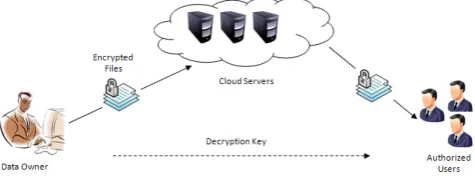
[image:3.595.319.557.419.508.2]System components. The cloud computing storage model consid-ered in this work consists of three main components as illustrated in Fig. 2: (i) a data owner that can be an individual or an organization originally possessing sensitive data to be stored in the cloud; (ii) a CSP who manages cloud servers and provides paid storage space on its infrastructure to store the owner’s files; and (iii) authorized users – a set of owner’s clients who have the right to access the remote data.
Fig. 2:Cloud computing data storage system model.
The storage model used in this work can be adopted by many prac-tical applications. For example, e-Health applications can be en-visioned by this model where the patients’ database that contains large and sensitive information can be stored on cloud servers. In these types of applications, the e-Health organization can be con-sidered as the data owner, and the physicians as the authorized users who have the right to access the patients’ medical history. Many other practical applications like financial, scientific, and ed-ucational applications can be viewed in similar settings.
In this work, we focus onsensitivearchived andwarehouseddata, which is essential in many applications such as digital libraries and astronomical/medical/scientific/legal repositories. Such data are subject to infrequent change, so we treat them as static.
Volume 99 - No. 7, August 2014 Setup
− N= ´pq´is the RSA modulus (p´&q´are prime numbers)
− ´gis a generator ofQRN(QRNis the set of quadratic residues modulo N)
− Public keypk= (N,g, e´ ), secret keysk= (d, v, x),v, x∈RZN, anded≡1mod(´p−1)(´q−1)
− πkis a pseudo-random permutation keyed with a keyk,fxis a pseudo-random function keyed with the secret keyx, andHis a hash function (H:{0,1}∗→QR
N)
− FileF ={bj}1≤j≤m, andEKis an encryption algorithm under a keyK Data Owner
− Encrypts the data fileFunder the keyKto obtain an encrypted versionFe={˜bj}1≤j≤m, where˜bj=EK(bj) − Uses the encrypted versionFeto create a set of tags{Tj}1≤j≤mfor all copies:
Tj= (H(v||j)·´g˜bj)dmodN
− Generatesndistinct copies{Fib}1≤i≤n,Fib ={ˆbij}1≤j≤mutilizing random masking:
aaafori= 1 tondo
aaaaaforj= 1 tomdo
aaaaaaa1. Computes a random valuerij=fx(i||j)
aaaaaaa2. Computes the replica’s blockˆbij= ˜bj+rij(added as large integers inZ)
− Sends the copyFib to a serverSi,i: 1→ n
Checking possession of a replicaFzb
Owner Remote ServerSz
1. Picks a keykfor the functionπ,c(# of blocks to be challenged), aaandgs´ = ´gsmodN(s∈
RZN)
a −−−−−−−−−−−−−−−−c, k,´gs →
a 2. Computes a setAof random indices:
a A={j}=πk(l)1≤l≤c
a 3. ComputesT =Y
j∈A
TjmodN
a 4. Computesρ= ´g
P j∈Aˆbzj
s modN
a ←−−−−−−−−−−−−−−−−−−−T , ρ
5. ComputesA={j}=πk(l)1≤l≤c
6. Checks( Te
Y
j∈A
H(v||j)·´g
rchal)s=? ρ, whererchal=X
[image:4.595.56.542.70.464.2]j∈A rzj
Fig. 1:The MR-PDP scheme by Curtmola et al. [13].
ofmblocks and the CSP offers to storencopies{Fe1,Fe2, . . . ,Fne} of the owner’s file on different servers – to prevent simultaneous failure of all copies – in exchange for pre-specified fees metered in GB/month. The number of copies depends on the nature of data; more copies are needed for critical data that cannot easily be repro-duced, and to achieve a higher level of scalability. This critical data should be replicated on multiple servers across multiple data cen-ters. On the other hand, non-critical, reproducible data are stored at reduced levels of redundancy. The CSP pricing model is related to the number of data copies.
For data confidentiality, the owner encrypts his data before out-sourcing to the CSP. An authorized user of the outsourced data sends a data-access request to the CSP and receives a file copy in an encrypted form that can be decrypted using a secret key shared with the owner. According to the load balancing mechanism used by the CSP to organize the work of the servers, the data-access re-quest is directed to the server with the lowest congestion, and thus the authorized user is not aware of which copy has been received.
We assume that the interaction between the owner and the autho-rized users to authenticate their identities and share the secret key has already been completed, and it is not considered in this work. Throughout this paper, the terms cloud server and cloud service provider are used interchangeably.
complex-ity of long-term large-scale data storage, it does not offer sufficient guarantee on data integrity. This problem, if not properly handled, may hinder the successful deployment and wide acceptance of the cloud paradigm. The goal of the proposed scheme is to detect (with
high probability) the CSP misbehavior by validating the number and integrity of file copies.
Underlying algorithms. The proposed scheme consists of five polynomial time algorithms:KeyGen,CopyGen,TagGen,Prove, andVerify.
− (pk, sk) ← KeyGen(1κ). This algorithm is run by the data
owner. It takes as input a security parameter1κ, and returns a
public keypk(publicly known) and a private keysk(kept secret by the owner).
− eF ← CopyGen(CNi, F)1≤i≤n. This algorithm is run by the
data owner. It takes as input a copy numberCNiand a fileF, and generatesncopieseF = {Fie}1≤i≤n. The owner sends the
copieseFto the CSP to be stored on cloud servers.
− Φ←TagGen(sk,eF). This algorithm is run by the data owner. It takes as input the private keyskand the file copieseF, and outputs tags/authenticators setΦ, which is an ordered collection of tags for the data blocks. The owner sendsΦto the CSP to be stored along with the copiesFe.
− P ←Prove(Fe,Φ, chal). This algorithm is run by the CSP. It takes as input the file copieseF, the tags setΦ, and a challenge
chal(sent from a verifier). It returns a proofP, which guarantees that the CSP is actually storingncopies and all these copies are intact.
− {1,0} ←Verify(pk,P). This algorithm is run by a verifier (orig-inal owner or any other trusted auditor). It takes as input the pub-lic keypk, and the proofPreturned from the CSP. The output is 1 if the integrity of all file copies is correctly verified or 0 other-wise.
5. SECURITY MODEL
Generally speaking, a remote data checking scheme is considered to be secure if (i) a polynomial-time algorithm that can cheat the verifier and pass the auditing procedure with non-negligible prob-ability does not exist; and (ii) there exists a polynomial-time ex-tractor that can repeatedly execute the challenge response protocol until it extracts the original data file.
Following [27], we would like the remote data checking scheme to becorrect and sound. These two requirements are defined as follows:
• Correctness requires that the verifier accepts valid server re-sponses.
• Soundness requires that any cheating server that passes the veri-fication process is actually storing the owner’s data intact.
The security of the proposed scheme can be stated using a ”game” that captures the data possession property [5, 27]. The data posses-sion game between an adversaryA(acts as a malicious CSP) and a challengerC(acts as a verifier) consists of the following:
• SETUP.Cruns theKeyGenalgorithm to generate a key pair (pk,
sk), and sendspktoA.
• INTERACT.Ainteracts withCto get the file copies and the ver-ification tags setΦ.Aadaptively selects a fileFand sends it to
C.Cruns the two algorithmsCopyGenandTagGento createn
distinct copiesFealong with the tags setΦ, and returns botheF andΦtoA.
Moreover,Acan request challenges{chali}1≤i≤Lfor some
pa-rameterL ≥ 1of his choice, and return proofs{Pi}1≤i≤Lto C.C runs theVerifyalgorithm and provides the verification re-sults toA. The INTERACTstep betweenAandCcan be repeated polynomially-many times.
• CHALLENGE.Adecides on a fileF previously used during the INTERACTstep, requests a challengechalfromC, and gener-ates a proofP←Prove(Fe0,Φ, chal), whereeF0isFeexcept that at least one of its file copies (or a portion of it) is missing or tampered with. Upon receiving the proofP,Cruns theVerify al-gorithm and ifVerify(pk,P)returns 1, thenAhas won the game. The CHALLENGEstep can be repeated polynomially-many times for the purpose of data extraction.
The proposed scheme is secure if the probability that any polynomial-time adversaryAwins the game is negligible. In other words, if a polynomial-time adversaryAcan win the game with non-negligible probability, then there exists a polynomial-time ex-tractor that can repeatedly execute the CHALLENGE step until it extracts the blocks of data copies.
File swapping attack. In this type of attacks, the remote server tries to prove the possession of the data using blocks from different files. A remote data checking scheme must be secure against such an attack.
6. PROPOSED PB-PMDP SCHEME 6.1 Overview and Rationale
Generating unique differentiable copies of the data file is the core to design a provable multi-copy data possession scheme. Identical data copies enable the CSP to simply deceive the owner by storing only one copy and pretending that it stores multiple copies. Us-ing a simple yetefficientway, the proposed scheme generates dis-tinct copies utilizing thediffusionproperty of any secure encryption scheme. The diffusion property ensures that the output bits of the ciphertext depend on the input bits of the plaintext in a very com-plex way, i.e., there will be an unpredictable complete change in the ciphertext, if there is a single bit change in the plaintext [30]. The interaction between the authorized users and the CSP is considered through this methodology of generating distinct copies, where the former can decrypt and access a file copy received from the CSP. In the proposed scheme, the authorized users need only to keep a single secret key – shared with the data owner – to decrypt the file copy, and it is not necessarily to recognize the index of the received copy.
6.2 Notations
− Fis a data file to be outsourced, and is composed of a sequence ofmblocks, i.e.,F={b1, b2, . . . , bm}.
− πkey(·) is a pseudo-random permutation (PRP): key × {0,1}log2(m)→ {0,1}log2(m).
Volume 99 - No. 7, August 2014 − Bilinear Map/Pairing. LetG1,G2, andGTbe cyclic groups of
prime orderp. Let¯gandgbe generators ofG1andG2,
respec-tively. A bilinear pairing is a mapeˆ:G1×G2 →GTwith the
following properties [22]:
(1) Bilinear:eˆ(ua, vb) = ˆe(u, v)ab ∀ u ∈
G1, v ∈ G2, and a, b∈Zp(pisaprimenumber)
(2) Non-degenerate:eˆ(¯g, g)6= 1
(3) Computable: there exists an efficient algorithm for comput-ingˆe.
− H(·)is a map-to-point hash function :{0,1}∗→ G1.
− EK is an encryption algorithm with strongdiffusionproperty and a keyK, e.g., AES.
Remark 1. Homomorphic linear authenticators (HLAs) [6, 15, 27] are basic building blocks in the proposed scheme. Informally, the HLA is a tag computed by the owner for each data block bj
that enables a verifier to validate the data possession on remote servers by sending a challenge vectorchalofcelements:chal= {r1, r2, . . . , rc}. As a response, the servers can homomorphically
construct a tag authenticating the valuePc
j=1rj·bj. The response
is validated by a verifier, and accepted only if the servers honestly compute the response using the owner’s file blocks. The proposed scheme utilizes the BLS (Boneh-Lynn-Shacham) HLAs [27].
6.3 PB-PMDP Procedural Steps
Key Generation. As earlier,eˆ:G1×G2 → GT is a bilinear
map andgis a generator ofG2. The data owner runs theKeyGen
algorithm to generate a private keyx ∈ Zp and a public key y=gx∈
G2along withselements(u1, u2, . . . , us)∈RG1.
Generation of Distinct Copies. The data owner runs the Copy-Genalgorithm to createndifferentiable copieseF={Fie}1≤i≤n.
The copyFie is generated by concatenating a copy numberiwith the fileF, then encrypting usingEK, i.e.,Fie =EK(i||F).Fie is divided into blocks{˜bij}1≤j≤m, and the block˜bijis further
fragmented into s sectors {˜bij1,˜bij2, . . . ,˜bijs}, i.e., the copy
e
Fi={˜bijk}1≤j≤m 1≤k≤s
, where each sector˜bijk∈Zpfor some large
primep.
The authorized users need to keep only a single secret keyK. Later, when an authorized user receives a file copy from the CSP, he decrypts the copy and removes the index from the copy header to reconstruct the plain form of the received file copy.
Generation of Tags. Given the distinct file copieseF = {Fie}, where Fie = {˜bijk}, the data owner runs the TagGen al-gorithm to generate a tag σij for each block ˜bij as σij =
(H(IDF||j). s
Y
k=1 u˜bijk
k )x ∈ G1 (i : 1 → n, j : 1 → m, k : 1 → s). In the tag computation, IDF = F ilename||n||m||u1||. . .||us is a unique fingerprint for each
fileF comprising the file name, the number of copies for this file, the number of blocks per copy, and the random values
{uk}1≤k≤s. Embedding theIDFinto the block tagσijprevents
the CSP from cheating by using blocks from different files (file swapping attack).
In order to reduce storage overhead on cloud servers and lower communication cost, the data owner generates an aggregated
tagσj for the blocks at the same indices in each copy Fie as
σj =Qn
i=1σij ∈G1. Hence, instead of storingmntags, the
proposed PB-PMDP scheme requires the CSP to store onlym
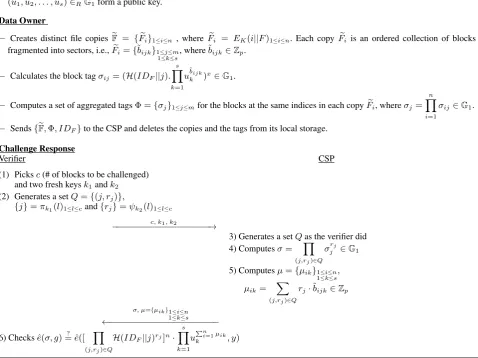
tags for the files copiesFe. Let us denote the set of aggregated tags asΦ ={σj}1≤j≤m. The data owner sends{eF,Φ, IDF}to the CSP, and deletes the copies and the tags from its local stor-age.
Challenge. For challenging the CSP and validating the integrity of all copies, the verifier sendsc(# of blocks to be challenged) and two fresh keys at each challenge: a PRP(π) keyk1 and a
PRF(ψ) keyk2.Boththe verifier and the CSP useπkeyed with k1 and theψ keyed withk2 to generate a set Q = {(j, rj)}
ofcpairs of random indices and random values, where{j}= πk1(l)1≤l≤cand{rj}=ψk2(l)1≤l≤c.
Response. The CSP runs theProvealgorithm to generate a set
Q = {(j, rj)}of random indices and values, and provide an
evidence that the CSP is still correctly possessing thencopies. The CSP responds with a proofP={σ, µ}, where
σ= Y
(j,rj)∈Q σrj
j ∈G1, µ={µik}1≤i≤n 1≤k≤s
, and
µik= X
(j,rj)∈Q
rj·˜bijk∈Zp.
Verify Response. Upon receiving the proofP={σ, µ}from the CSP, the verifier runs theVerifyalgorithm to check the following verification equation:
ˆ
e(σ, g)= ˆ? e([ Y (j,rj)∈Q
H(IDF||j)rj]n· s
Y
k=1
uPni=1µik k , y). (1)
In equation (1), the termPn
i=1µikis linear inn, while the term [·]ncosts one more exponentiation for any value ofn. If the
veri-fication equation passes, theVerifyalgorithm returns 1, otherwise 0. The correctness of verification equation (1) can be shown as follows:
ˆ
e(σ, g) = ˆe( Y (j,rj)∈Q
σrj j , g)
= ˆe( Y (j,rj)∈Q
[ n
Y
i=1
σij]rj, g)
= ˆe( Y (j,rj)∈Q
[ n
Y
i=1
(H(IDF||j)· s
Y
k=1 u˜bijk
k ) x
]rj, g)
= ˆe( Y (j,rj)∈Q
[ n
Y
i=1
H(IDF||j)· n
Y
i=1 s
Y
k=1 u˜bijk
k ] rj, y)
= ˆe( Y (j,rj)∈Q
n
Y
i=1
H(IDF||j)rj · Y (j,rj)∈Q
n
Y
i=1 s
Y
k=1 urj·˜bijk
k , y)
= ˆe([ Y (j,rj)∈Q
H(IDF||j)rj]n· s
Y
k=1 u
Pn i=1
P
(j,rj)∈Qrj·˜bijk
k , y)
= ˆe([ Y (j,rj)∈Q
H(IDF||j)rj]n· s
Y
k=1
Setup
− FileF ={b1, b2, . . . , bm}.
− ˆe : G1×G2 → GT is a bilinear map,gis a generator forG2, x ∈ Zp is a private key, and y = gx ∈ G2 along with (u1, u2, . . . , us)∈RG1form a public key.
Data Owner
− Creates distinct file copiesFe = {Fie}1≤i≤n , where Fie = EK(i||F)1≤i≤n. Each copy Fie is an ordered collection of blocks fragmented into sectors, i.e.,Fie ={˜bijk}1≤j≤m
1≤k≤s
, where˜bijk∈Zp.
− Calculates the block tagσij= (H(IDF||j). s
Y
k=1 u˜bijk
k ) x∈
G1.
− Computes a set of aggregated tagsΦ ={σj}1≤j≤mfor the blocks at the same indices in each copyFie, whereσj=
n
Y
i=1
σij∈G1.
− Sends{eF,Φ, IDF}to the CSP and deletes the copies and the tags from its local storage.
Challenge Response
Verifier CSP
(1) Picksc(# of blocks to be challenged) and two fresh keysk1andk2
(2) Generates a setQ={(j, rj)},
{j}=πk1(l)1≤l≤cand{rj}=ψk2(l)1≤l≤c
c, k1, k2
−−−−−−−−−−−−−−−−−−−−→
a 3) Generates a setQas the verifier did
a 4) Computesσ= Y
(j,rj)∈Q σrj
j ∈G1
a 5) Computesµ={µik}1≤i≤n
1≤k≤s ,
a µik=
X
(j,rj)∈Q
rj·˜bijk∈Zp
a
σ, µ={µik}1≤i≤n
1≤k≤s ←−−−−−−−−−−−−−−−−−−−−−−
6) Checkseˆ(σ, g)= ˆ? e([ Y (j,rj)∈Q
H(IDF||j)rj]n· s
Y
k=1
[image:7.595.67.546.110.468.2]uPni=1µik k , y)
Fig. 3:The proposed PB-PMDP scheme.
Remark 2. The proposed PB-PMDP scheme supports public ver-ifiability where anyone, who knows the owner’s public key but is not necessarily the data owner, can send a challenge vector to the CSP and verify the response. Public verifiability can resolve dis-putes that may arise between the data owner and the CSP regarding data integrity. If such a dispute occurs, a trusted third party audi-tor (TPA) can determine whether the data integrity is maintained or not. Since the owner’s public key is only needed to perform the verification step, the owner is not required to reveal his secret key to the TPA. The PB-PMDP scheme is presented in Fig. 3, and the security analysis is given in Appendix A.
6.4 Reducing the Communication Cost
One can attempt to change the PB-PMDP scheme to reduce the communication cost by a factor ofnby permitting the CSP to com-pute and sendµ={µkˆ }1≤k≤s, whereµkˆ =
Pn
i=1µik. However,
this modification enables the CSP to simply cheat the verifier as follows:
ˆ µk=
n
X
i=1 µik=
n
X
i=1
X
(j,rj)∈Q
rj·˜bijk= X (j,rj)∈Q
rj· n
X
i=1 ˜bijk.
Thus, the CSP can just keep the sectors summationPn
i=1˜bijknot
the sectors themselves. Moreover, the CSP can corrupt the block sectors and the summation is still valid. Therefore, the proposed scheme requires the CSP to sendµ ={µik}1≤i≤n
1≤k≤s
, and the
sum-mationPn
i=1µikis done on the verifier side.
A slightly modified version of the PB-PMDP scheme can reduce the communication cost by a factor ofsduring the response phase by allowing the CSP to compute and sendµ={µi}1≤i≤ninstead
ofµ ={µik}1≤i≤n 1≤k≤s
. In this version, a file copyFie is divided into
blocks, but the blocks are not fragmented into sectors, i.e., a copy
e
Fi = {˜bij}1≤j≤m, where˜bij ∈ Zp . A tagσij is generated for
each block˜bij:σij = (H(IDF||j).u˜bij)x ∈ G
1, where uis a
Volume 99 - No. 7, August 2014
whereσj = Qn
i=1σij. In this scenario, the CSP responds with σ = Q
(j,rj)∈Qσ rj
j ∈ G1 and µ = {µi}1≤i≤n, whereµi =
P
(j,rj)∈Qrj·
˜bij∈Zp. The verification equation (1) will be
mod-ified toˆe(σ, g)= ˆ? e([Q
(j,rj)∈QH(IDF||j)
rj]n·uPni=1µi, y).
This reduced communication cost will be at the expense of in-creased storage overhead on the CSP side, where each block˜bij∈
Zpwill be accompanied with a tagσij ∈ G1 of equal length. If
the block size is greater than|p|(the bit length of the primep), the CSP can simply cheat by storing˜bij modpinstead of the whole
block˜bij. Therefore, with this slightly modified version, to store
ncopies each of size|F|bits, the total storage over the CSP will be(n+ 1)|F|bits (using tag aggregation approach). The storage overhead equals the size of a complete file copy. The more stor-age space used over the CSP side, the more fees the customers are charged (pay-as-you-go pricing model).
7. PERFORMANCE ANALYSIS
In this section, we evaluate the performance of the presented schemes: MR-PDP and PB-PMDP. The fileF used in our perfor-mance analysis is of size 64MB divided in blocks of 4KB. With-out loss of generality, we assume that the desired security level is 80-bit. Thus, we utilize an elliptic curve defined over Galois field
GF(p)with|p|= 160 bits (a point on this curve can be represented by 161 bits using compressed representation [8]), and the size of the RSA modulusNis 1024 bits.
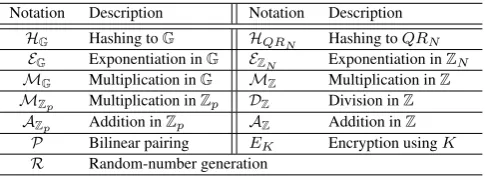
Similar to [7, 26], the computation cost for the MR-PDP and PB-PMDP is estimated in terms of used cryptographic operations, which are notated in Table 1.Gindicates a group of points over a suitable elliptic curve in the bilinear pairing, andQRNis a set of quadratic residues moduloN.
[image:8.595.55.298.477.565.2]Similar to [7, 26], the computation cost for the MR-PDP and PB-PMDP is estimated in terms of used cryptographic operations, which are notated in Table 1.Gindicates a group of points over a suitable elliptic curve in the bilinear pairing, andQRNis a set of quadratic residues moduloN.
Table 1. :Notation of cryptographic operations.
Notation Description Notation Description
HG Hashing toG HQRN Hashing toQRN
EG Exponentiation inG EZN Exponentiation inZN
MG Multiplication inG MZ Multiplication inZ
MZp Multiplication inZp DZ Division inZ
AZp Addition inZp AZ Addition inZ
P Bilinear pairing EK Encryption usingK
R Random-number generation
To perform a fair comparison between the PB-PMDP and the MR-PDP [13], we assume two small modifications to the model pre-sented in [13]. First, we assume that the indices of the blocks being challenged are the same across all copies (this assumption is an op-timization for the verification computations of the MR-PDP). Sec-ond, for the CSP to prove the possession of the blocks (not just only their sum), each block being challenged is multiplied by a random value. The second modification makes the S-PDP version of [5] to be the base of the MR-PDP scheme.
Letn,m, andsdenote the number of copies, the number of blocks per copy, and the number of sectors per block, respectively. Letc
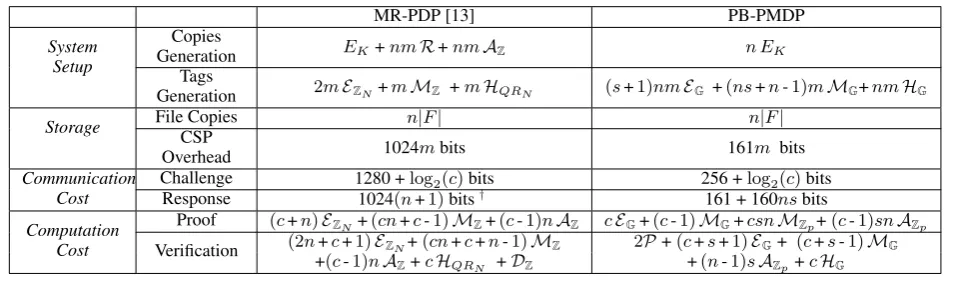
denote the number of blocks to be challenged, and|F|denote the size of the file copy. Let the keys used withπandψbe of size 128 bits. Table 2 presents a theoretical analysis for the setup, storage, communication, and computation costs of the two schemes.
7.1 Comments
Sytem Setup. As it can be seen in Table 2, the cost of generat-ing data copies in the proposed PB-PMDP scheme is much less than that of the MR-PDP scheme. On the other hand, Curtmolaet al.[13] efficiently reduce the computation cost of generating the block tags. This is due to the fact that the tags are generated from the encrypted version of the file before masking with some unique randomness to generate the differentiable copies. In general, the impact of setup computations on the overall system performance may be insignificant; setup is done only once during the life time of the data storage system, which may be for tens of years.
Storage overhead. Storage overhead is the additional space used to store necessary information other than the outsourced file copies
e
F. Both schemes require n|F|bits to storeeF, while the storage overhead for the PB-PMDP scheme is much less than that of the MR-PDP model. The overheads on the CSP are 2MB and 0.31MB for the MR-PDP and PB-PMDP schemes, respectively (about 84% reduction). Reducing the storage overhead on the CSP side is eco-nomically a key feature to lower the fees paid by the customers.
Communication cost. The communication cost of the MR-PDP scheme is less than that of PB-PMDP. For 20 copies of F, the communication costs for the MR-PDP and PB-PMDP schemes are about 2.8KB and 80KB, respectively. However, for smalls(n), the PB-PMDP will have less communication cost.
Computation cost. As observed from Table 2, the cost expression of the proof for the MR-PDP scheme has three terms linear in the number of copiesn, while the PB-PMDP scheme has two terms lin-ear inn. Moreover, there are three terms linear innin the verifica-tion cost expression for the MR-PDP scheme, while the PB-PMDP scheme contains onlyoneterm linear innin the corresponding ex-pression. These terms affect the total computation time when deal-ing with a large number of copies in practical applications. We note that since the cost of an addition is negligibly smaller than those of pairing and exponentiation, the verification time in the proposed PB-PMDP scheme is practically not affected by the value ofn.
8. IMPLEMENTATION AND EXPERIMENTAL EVALUATION
8.1 Implementation
We have implemented the MR-PDP and PB-PMDP schemes on Amazon Elastic Compute Cloud (Amazon EC2) [3] and Amazon Simple Storage Service (Amazon S3) [4] cloud platforms. Amazon EC2 is a web service that enables customers to lunch and man-age Linux/Unix and Windows server instances (virtual servers) in Amazon’s data centers. Customers can automatically scale up and down the number of EC2 instances according to their demands. Moreover, customers can upgrade and downgrade a specific EC2 instance to fit current requirements. Amazon S3 is storage for the Internet. It provides a simple web services interface that can be used to store and retrieve almost unlimited amount of data. Customers are allowed to choose the geographic locations where Amazon S3 will store the data.
Table 2. :Storage, communication, and computation costs for MR-PDP and PB-PMDP schemes.
MR-PDP [13] PB-PMDP
System Setup
Copies
Generation EK+nmR+nmAZ n EK
Tags
Generation 2mEZN+mMZ +mHQRN (s+1)nmEG +(ns+n-1)mMG+nmHG
Storage File Copies n|F| n|F|
CSP
Overhead 1024mbits 161m bits
Communication Cost
Challenge 1280 +log2(c)bits 256 +log2(c)bits
Response 1024(n+1)bits† 161 + 160nsbits
Computation Cost
Proof (c+n)EZN+(cn+c-1)MZ+(c-1)nAZ cEG+(c-1)MG+csnMZp+(c-1)snAZp
Verification (2n+c+1)EZN+(cn+c+n-1)MZ 2P+(c+s+1)EG+ (c+s-1)MG
+(c-1)nAZ+cHQRN +DZ +(n-1)sAZp+cHG
†There is an optimization for this response to be1024 + 160nbits using hashing.
VModule (verifier module). OModule, which runs on the owner side, is a library that includesKeyGen,CopyGen, andTagGen al-gorithms.CModuleis a library that runs on Amazon EC2 and in-cludesProvealgorithm.VModuleis a library to be run at the verifier side and includes theVerifyalgorithm.
In the experiments, we do not consider the system pre-processing time to prepare the different file copies and generate the tags set. Moreover, the time to access the file blocks is not considered in the implementation, as the state-of-the-art hard drive technology allows as much as 1MB to be read in just few nanoseconds [26]. Hence, the total access time is unlikely to have substantial impact on the overall system performance.
Implementation settings. In our implementation we use a ”large” Amazon EC2 instance to runCModule. This instance type pro-vides total memory of size 7.5GB and 4 EC2 Compute Units (2 virtual cores with 2 EC2 Compute Units each). One EC2 Compute Unit provides the equivalent CPU capacity of a 1.0 - 1.2GHz 2007 Opteron or 2007 Xeon processor [2]. TheOModuleandVModule are executed on a desktop computer with Intel(R) Xeon(R) 2GHz processor and 3GB RAM running Windows XP. We outsource copies of a data file of size 64MB to Amazon S3. Algorithms (encryption, pairing, hashing, etc.) are implemented using MIR-ACL library version 5.4.2. In the experiments, we utilize the MNT curve [23] defined over prime fieldGF(p)with|p|= 160 bits and embedding degree = 6 (the MNT curve with these parameters is provided by the MIRACL library).
8.2 Experimental Evaluation
[image:9.595.55.533.86.228.2]Timing measurements. The proposed PB-PMDP scheme is based on pairing and elliptic curve cryptography, while the MR-PDP scheme is based on RSA. To estimate the timing measurements for the cryptographic operations used in the implementations, we run the MIRACL library on the the used desktop computer. Table 3 presents the measured times (in milliseconds), where each reported measurement is an average of thousands of runs.
Table 3 shows three measurements forEZN: 68.92 ms, 2.15 ms, and 0.32 ms. The reason is that the exponent part differs during the im-plementation of the MR-PDP scheme. For example, the data owner performs´gEXPmodN, whereEXPis the exponent part of size 4KB
(32768 bits). The owner does this operation during the tag gener-ations and the verification phase. Utilizing the Fermat-Euler
theo-Table 3. :Timing measurements for the cryptographic operations
Operation Time (ms) Operation Time (ms)
HG 0.22 HQRN 0.34
EG 0.27 EZN 68.92/2.15/0.32
MG 0.01 MZ 0.02/0.004/0.0009
MZp 0.00025 DZ 0.00022
AZp 0.00017 AZ 0.009/0.00029
P 4.6
rem [25], the owner can reduce the exponent part, whereg´EXP ≡
´
gEXPmodφ(N) modN andφ(N) = (´p−1)(´q−1)is the Euler’s
totient function. On the other hand, the CSP cannot use this trick becauseφ(N)is not known in public. Therefore,EZNneeds 68.92
ms and 2.15 ms at the CSP and the owner, respectively. Besides, a random value of size 160 bits is used in our slight modification to the MR-PDP scheme to prove the possession of the data blocks not only their sum. Thus,EZN needs 0.32 ms when the exponent part is 160 bits. Similar scenarios arise forMZandAZoperations.MZ
needs 0.02 ms for 32768-bits×160-bits, 0.004 ms for 1024-bits×
1024-bits, and 0.0009 ms for 1024-bits×160-bits.AZneeds 0.009 ms for 32768-bits+32768-bits, and 0.00029 ms for 1024-bits+
1024-bits.
Experimental results. We compare the presented MR-PDP and PB-PMDP schemes in terms of both the proof computation times and the verification times. It has been reported in [5] that if the re-mote server is missing a fraction of the data, then the number of blocks that needs to be checked in order to detect server misbehav-ior with high probability is constant independent of the total num-ber of file blocks. For example, if the server deletes 1% of the data file, the verifier needs only to check forc= 460-randomly chosen blocks of the file so as to detect this misbehavior with probability larger than 99%. Therefore, in our experiments, we usec= 460 to achieve a high probability of assurance.
Volume 99 - No. 7, August 2014
Ϭ Ϭ͘Ϯ Ϭ͘ϰ Ϭ͘ϲ Ϭ͘ϴ ϭ ϭ͘Ϯ ϭ͘ϰ ϭ͘ϲ ϭ͘ϴ
ϭ ϱ
Pr oo f C om pu tat ion Ti me s ( Se
c) DZͲWW
WͲDWW
ϭϬ ϭϱ ϮϬ
# of Copies
W
(a)CSP computation times (sec) Ϭ͘Ϯϲ Ϭ͘Ϯϴ Ϭ͘ϯ Ϭ͘ϯϮ Ϭ͘ϯϰ Ϭ͘ϯϲ Ϭ͘ϯϴ Ϭ͘ϰ Ϭ͘ϰϮ
ϭ ϱ
Ve rif ica tio n T im es (S ec
) WDWWͲWDW
ϭϬ ϭϱ ϮϬ # of Copies
[image:10.595.318.556.73.348.2](b)Verifier computation times (sec)
Fig. 4:Computation costs of the MR-PDP and PB-PMDP.
Fig. 4b presents the verification times (in seconds). For 20 copies, the verification times for the MR-PDP and the PB-PMDP schemes are 0.40 and 0.29 seconds, respectively (about 27% reduction). More importantly, the verification timing curve of the PB-PMDP scheme isalmost unchanged for the range of number of copies considered in our experiments. This is due to the fact that although the term(n−1)sAZp in the verification cost of the PB-PMDP
scheme is linear inn(Table 2), in our experiments its numerical value is quite small compared to those of the other terms in the cost expression. This feature makes the the PB-PMDP scheme compu-tationally cost-effective and more efficient when verifying a large number of file copies.
9. IDENTIFYING CORRUPTED COPIES
Here we show how the proposed PB-PMDP scheme can be slightly modified to identify the indices of corrupted copies. The proof P={σ, µ}generated by the CSP will be valid and will pass the verification equation (1) only if all copies are intact and consistent. Thus, when there is one or more corrupted copies, the whole au-diting procedure fails. To handle this situation and identify the cor-rupted copies, a slightly modified version of the PB-PMDP scheme can be used. In this version, the data owner generates a tagσijfor each block˜bij, but does not aggregate the tags for the blocks at the same indices in different copies, i.e.,Φ ={σij}1≤i≤n
1≤j≤m
. During
the response phase, the CSP computesµ = {µik}1≤i≤n 1≤k≤s
as
be-fore, butσ= Y (j,rj)∈Q
[ n
Y
i=1
σij]rj ∈G
1. Upon receiving the proof
P={σ, µ}, the verifier first validatesPusing equation (1). If the verification fails, the verifier asks the CSP to sendσ={σi}1≤i≤n,
whereσi =Q
(j,rj)∈Qσ rj
ij. Thus, the verifier has two listsσList
={σi}1≤i≤nandµList={µik}1≤i≤n 1≤k≤s
(µListis a two dimensional
list).
Utilizing a recursive divide-and-conquer approach (binary search) [16], the verifier can identify the indices of corrupted copies. Specifically, σList and µList are divided into halves: σList→
(σLeft:σRight), andµList→(µLeft:µRight). The verification equa-tion (1) is applied recursively onσLeftwithµLeftandσRightwith
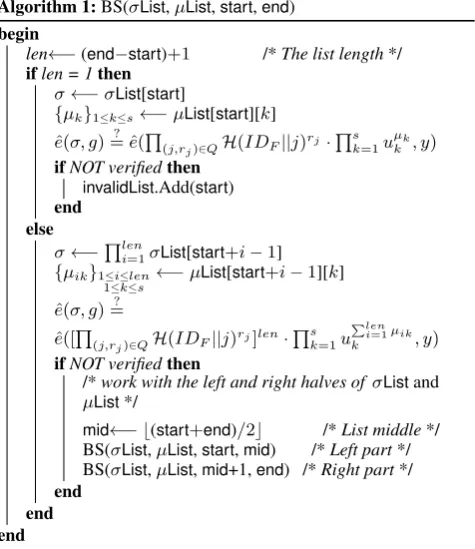
µRight. Note that the individual tags inσLeftorσRightare aggre-gated via multiplication to generate oneσthat is used during the recursive application of equation (1). The procedural steps of iden-tifying the indices of corrupted copies are indicated in Algorithm 1.
The binary search algorithm takes four parameters:σList,µList,
startthat indicates the start index of the currently working lists, andendto indicate the last index of the working lists. The initial
Algorithm 1:BS(σList,µList,start,end)
begin
len←−(end−start)+1 /*The list length*/
iflen = 1then σ←−σList[start]
{µk}1≤k≤s←−µList[start][k] ˆ
e(σ, g)= ˆ? e(Q
(j,rj)∈QH(IDF||j) rj·Qs
k=1u µk k , y) ifNOT verifiedthen
invalidList.Add(start)
end else
σ←−Qlen
i=1σList[start+i−1]
{µik}1≤i≤len 1≤k≤s
←−µList[start+i−1][k]
ˆ e(σ, g)=?
ˆ e([Q
(j,rj)∈QH(IDF||j)
rj]len·Qs k=1u
Plen i=1µik k , y) ifNOT verifiedthen
/*work with the left and right halves of σListand
µList*/
mid←− b(start+end)/2c /*List middle*/ BS(σList,µList,start,mid) /*Left part*/ BS(σList,µList,mid+1,end) /*Right part*/
end end end
call to the search algorithm takes (σList,µList, 1,n). The invalid indices are stored ininvalidList, which is a global data structure. This slight modification to identify the corrupted copies will be as-sociated with some extra storage overhead on the cloud servers, where the CSP has to storemntags for the file copieseF(mtags in the original version). Moreover, the challenge-response phase may be done in two rounds if the initial round to verify all copies fails. We have performed experiments to show the effect of identifying the corrupted copies on the verification time. We generate 100 copies, which are verified in 0.3 seconds when all copies are accurate. A percentage – ranging from 1% to 20% – of the file copies israndomlycorrupt. Fig. 5 shows the verification time (in seconds) with different corrupted percentages. The verification time is about 3.87 seconds when 1% of the copies are invalid. As observed from Fig. 5, when the percentages of corrupted copies are up to 15% of the total copies, the performance of using the binary search algorithm in the verification is more efficient than individual verification for each copy. It takes about 0.29 seconds to verify one copy, and thus individual verifications of 100 copies requires 100×0.29 = 29 seconds.
In short, the proposed PB-PMDP scheme can be slightly modified to support the feature of identifying the corrupted copies at the cost of some extra storage, communication, and computation overheads. For the CSP to remain in business and maintain a good reputation, invalid responses to verifier’s challenges are sent in very rare situa-tions, and thus the original version of the proposed scheme is used in most of the time.
10. SUMMARY AND CONCLUDING REMARKS
[image:10.595.58.292.74.159.2]Ϭ ϱ ϭϬ ϭϱ ϮϬ Ϯϱ ϯϬ ϯϱ
ϭй ϱй
Ve rif ica tio n T im es (S ec )
Corru
ϭϬй ϭϱй ϮϬй upted Percentages
[image:11.595.67.278.68.239.2]hƐŝŶŐdŚĞ^ůŐŽƌŝƚŚŵ /ŶĚŝǀŝĚƵĂůsĞƌŝĨŝĐĂƚŝŽŶ
Fig. 5:Verification times with different percentages of corrupted copies.
servers. We have proposed a pairing-based provable multi-copy data possession (PB-PMDP) scheme, which supports outsourcing of multiple data copies to untrusted CSP. The interaction between the authorized users and the CSP is considered in our scheme, where the authorized users can seamlessly access a data copy re-ceived from the CSP using a single secret key shared with the data owner. Moreover, the BP-PMDP scheme supports public verifiabil-ity, allows unlimited number of auditing, and provides possession-freeverification where the verifier has the ability to verify the data integrity even though he neither possesses nor retrieves the file blocks from the server.
Through theoretical analysis, experimental results, and comparison with the previously proposed MR-PDP scheme, we have showed the improved performance of the proposed scheme. The verification time of PB-PMDP is practically independent of the number of file copies, which makes the scheme computationally cost-effective and more efficient when verifying a large number of file copies. A slight modification can be done on the proposed scheme to sup-port the feature of identifying the indices of corrupted copies of data. The corrupted copy can be reconstructed even from a com-plete damage using duplicated copies on other servers. Our analysis has shown that the proposed PB-PMDP scheme is provably secure.
11. REFERENCES
[1] Marcos K. Aguilera, Ramaprabhu Janakiraman, and Lihao Xu. Using erasure codes efficiently for storage in a distributed system. InProceedings of the 2005 International Conference on Dependable Systems and Networks, DSN ’05, pages 336– 345, Washington, DC, USA, 2005. IEEE Computer Society. [2] Amazon EC2 Instance Types. http://aws.amazon.com/
ec2/.
[3] Amazon elastic compute cloud (Amazon EC2). http:// aws.amazon.com/ec2/.
[4] Amazon simple storage service (Amazon S3).http://aws. amazon.com/s3/.
[5] Giuseppe Ateniese, Randal Burns, Reza Curtmola, Joseph Herring, Lea Kissner, Zachary Peterson, and Dawn Song. Provable data possession at untrusted stores. InCCS ’07: Pro-ceedings of the 14th ACM Conference on Computer and
Com-munications Security, pages 598–609, New York, NY, USA, 2007.
[6] Giuseppe Ateniese, Seny Kamara, and Jonathan Katz. Proofs of storage from homomorphic identification protocols. In ASI-ACRYPT ’09: Proceedings of the 15th International Confer-ence on the Theory and Application of Cryptology and Infor-mation Security, pages 319–333, Berlin, Heidelberg, 2009. [7] Giuseppe Ateniese, Roberto Di Pietro, Luigi V. Mancini, and
Gene Tsudik. Scalable and efficient provable data possession. In SecureComm ’08: Proceedings of the 4th International Conference on Security and Privacy in Communication Ne-towrks, pages 1–10, New York, NY, USA, 2008.
[8] Paulo S. L. M. Barreto and Michael Naehrig. IEEE P1363.3 submission: Pairing-friendly elliptic curves of prime order with embedding degree 12. New Jersey: IEEE Standards As-sociation, 2006.
[9] Ayad Fekry Barsoum and M. Anwar Hasan. Provable pos-session and replication of data over cloud servers. Centre For Applied Cryptographic Research (CACR), University of Waterloo, Report 2010/32, 2010.http://www.cacr.math. uwaterloo.ca/techreports/2010/cacr2010-32.pdf. [10] Kevin D. Bowers, Ari Juels, and Alina Oprea. Hail: a
high-availability and integrity layer for cloud storage. InCCS ’09: Proceedings of the 16th ACM Conference on Computer and Communications Security, pages 187–198, New York, NY, USA, 2009.
[11] Kevin D. Bowers, Ari Juels, and Alina Oprea. Proofs of re-trievability: theory and implementation. InCCSW ’09: Pro-ceedings of the 2009 ACM workshop on Cloud computing se-curity, pages 43–54, New York, NY, USA, 2009. ACM. [12] Reza Curtmola, Osama Khan, and Randal Burns. Robust
re-mote data checking. InStorageSS ’08: Proceedings of the 4th ACM international workshop on Storage security and surviv-ability, pages 63–68, New York, NY, USA, 2008. ACM. [13] Reza Curtmola, Osama Khan, Randal Burns, and Giuseppe
Ateniese. MR-PDP: multiple-replica provable data posses-sion. In28th IEEE ICDCS, pages 411–420, 2008.
[14] Yves Deswarte, Jean-Jacques Quisquater, and Ayda Sa¨ıdane. Remote integrity checking. In Sushil Jajodia; Leon Strous, ed-itor,6th Working Conference on Integrity and Internal Con-trol in Information Systems (IICIS), pages 1–11, 2003. [15] Yevgeniy Dodis, Salil Vadhan, and Daniel Wichs. Proofs of
retrievability via hardness amplification. In TCC ’09: Pro-ceedings of the 6th Theory of Cryptography Conference on Theory of Cryptography, pages 109–127, Berlin, Heidelberg, 2009. Springer-Verlag.
[16] Anna Lisa Ferrara, Matthew Green, Susan Hohenberger, and Michael Pedersen. Practical short signature batch verification. InThe Cryptographer’s Track at RSA Conference, pages 309– 324, 2009.
[17] D´ecio Luiz Gazzoni Filho and Paulo S´ergio Liccia-rdi Messeder Barreto. Demonstrating data possession and uncheatable data transfer. Cryptology ePrint Archive, Report 2006/150, 2006.
[18] Nancy Gohring. Amazon’s S3 down for sev-eral hours. Online at http://www.pcworld.com/ businesscenter/article/142549/amazons_s3_down_ for_severalhours.html, 2008.
Volume 99 - No. 7, August 2014
complexity. InFC’02: Proceedings of the 6th International Conference on Financial Cryptography, pages 120–135, Berlin, Heidelberg, 2003.
[20] Ari Juels and Burton S. Kaliski. PORs: Proofs of Retrievabil-ity for large files. InCCS’07: Proceedings of the 14th ACM conference on Computer and communications security, pages 584–597. ACM, 2007.
[21] Brian Krebs. Payment processor breach may be largest ever. Online at http://voices.washingtonpost.com/ securityfix/2009/01/payment_processor_breach_ may_b.html, Jan. 2009.
[22] Alfred Menezes. An introduction to pairing-based cryptography. Lecture Notes 2005, Online at http://www.math.uwaterloo.ca/~ajmeneze/
publications/pairings.pdf.
[23] Atsuko Miyaji, Masaki Nakabayashi, and Shunzou TAKANO. New explicit conditions of elliptic curve traces for FR-reduction.IEICE Transactions on fundamental, pages 1234–1243, 2001.
[24] Einar Mykletun, Maithili Narasimha, and Gene Tsudik. Au-thentication and integrity in outsourced databases. Trans. Storage, 2(2), 2006.
[25] S. Porubsk et al. Fermat-Euler theorem in algebraic number fields.Journal of Number Theory, 60(2):254–290, 1996. [26] Francesc Seb´e, Josep Domingo-Ferrer, Antoni
Martinez-Balleste, Yves Deswarte, and Jean-Jacques Quisquater. Effi-cient remote data possession checking in critical information infrastructures.IEEE Trans. on Knowl. and Data Eng., 20(8), 2008.
[27] Hovav Shacham and Brent Waters. Compact proofs of retriev-ability. InProceedings of the 14th International Conference on the Theory and Application of Cryptology and Information Security: Advances in Cryptology, ASIACRYPT ’08, pages 90–107. Springer-Verlag, 2008.
[28] Mehul A. Shah, Mary Baker, Jeffrey C. Mogul, and Ram Swaminathan. Auditing to keep online storage services hon-est. InHOTOS’07: Proceedings of the 11th USENIX work-shop on Hot topics in operating systems, pages 1–6, Berkeley, CA, USA, 2007.
[29] Mehul A. Shah, Ram Swaminathan, and Mary Baker. Privacy-preserving audit and extraction of digital contents. Cryptol-ogy ePrint Archive, Report 2008/186, 2008.
[30] Claude Elwood Shannon. Communication theory of secrecy systems.Bell Syst.Tech. J., 28(4), 1949.
[31] Weichao Wang, Zhiwei Li, Rodney Owens, and Bharat Bhar-gava. Secure and efficient access to outsourced data. InCCSW ’09: Proceedings of the 2009 ACM Workshop on Cloud Com-puting Security, pages 55–66, New York,NY, USA, 2009. [32] Min Xie, Haixun Wang, Jian Yin, and Xiaofeng Meng.
In-tegrity auditing of outsourced data. InVLDB ’07: Proceed-ings of the 33rd International Conference on Very Large Databases, pages 782–793, 2007.
[33] Ke Zeng. Publicly verifiable remote data integrity. In Pro-ceedings of the 10th International Conference on Informa-tion and CommunicaInforma-tions Security, ICICS ’08, pages 419– 434, Berlin, Heidelberg, 2008. Springer-Verlag.
APPENDIX
A. SECURITY ANALYSIS
Here we present the security analysis for the PB-PMDP scheme. First, in the proposed scheme, we utilize PRP (π) and PRF (ψ) to compress the challenge, and thus reducing the communication cost. Instead of sending the setQofcpairs of random indices and values to the CSP, the verifier sends only two keysk1andk2(over
secure communication). Usingπandψin this manner is proved to be secure [6].
For the correctness security requirement, we have previously shown the correctness of equation (1)). For thesoundnesssecurity requirement, we will show that if a polynomial-time adversaryA
can win the data possession game (with non-negligible probability) with a challengerC, thenAis actually storing thendata copieseF in an uncorrupted state. For an adversaryAto cheat the verifier, he has to respond with a malicious proofP0 6=PandVerify(pk,P0) returns 1.
The soundness of the PB-PMDP scheme is based on the unforge-abilityof the used HLAs, which depends on the security of the com-putational Diffie-Hellman (CDH) and the discrete logarithm (DL) problems.
Definitions.
(1) CDH problem:giveng, gx, h∈
Gfor some groupGand
x∈Zp, computehx
(2) DL problem:giveng, h∈Gfor some groupG, findxsuch thath=gx.
The following theorem proves the unforgeability of the HLAs used in the proposed PB-PMDP scheme. Our approach to prove the theo-rem is by investigating all possible combinations of malicious CSP responsesh{σ0, µ0},{σ, µ0},{σ0, µ}i, and checking whether any of these combinations can pass the verification equation (1).
Theorem 1.Assuming the hardness of both the CDH and the DL problems in bilinear groups, the verifier of the proposed PB-PMDP scheme accepts a response to a challenge vector only if a correctly computed proofP={σ, µ}, whereµ={µik}1≤i≤n
1≤k≤s
is sent from the CSP.
Proof. We prove the theorem by contradiction. The goal of an ad-versary A(malicious CSP) is to generate a response that is not correctly computed and pass the verification process done by a challengerC(verifier). LetP0 ={σ0, µ0}beA’s response, where
µ0 ={µ0
ik}1≤i≤n 1≤k≤s
. LetP={σ, µ}be the expected response from
an honest CSP, whereσ =Q
(j,rj)∈Qσ rj
j ,µ ={µik}1≤i≤n 1≤k≤s
, and
µik=P
(j,rj)∈Qrj· ˜bijk.
According to the correctness of PB-PMDP scheme, the expected proofP={σ, µ}satisfies the verification equation,i.e.,
ˆ
e(σ, g) = ˆe([ Y (j,rj)∈Q
H(IDF||j)rj]n· s
Y
k=1
uPni=1µik k , y).
Assume thatσ0 6=σ, andσ0passes the verification equation, then we have
ˆ
e(σ0, g) = ˆe([ Y
(j,rj)∈Q
H(IDF||j)rj]n· s
Y
k=1 u
Obviously, ifµ0ik=µik∀(i, k), it follows from the above
verifica-tion equaverifica-tions thatσ0 =σ, which contradicts our assumption. Let us define∆µik=µ0ik−µik(1≤i≤n,1≤k≤s). It must be
the case that at least one of{∆µik}1≤i≤n 1≤k≤s
is nonzero. Dividing the
verification equation for the malicious response by the verification equation for the expected response, we obtain
ˆ
e(σ0·σ−1, g) = ˆe( s
Y
k=1 u
Pn i=1∆µik k , y)
ˆ
e(σ0·σ−1, g) = ˆe( s
Y
k=1
ux·Pni=1∆µik
k , g)
σ0·σ−1 = s
Y
k=1 ux·
Pn i=1∆µik
k .
We setuk=gαkhβkforαk, βk ∈Z
p, and thus
σ0·σ−1 = s
Y
k=1
(gαkhβk)x·Pni=1∆µik
σ0·σ−1 = s
Y
k=1
(yαkhx.βk)Pni=1∆µik
σ0·σ−1 = yPsk=1αk·Pni=1∆µik·hx·Psk=1βk·Pni=1∆µik
hx = (σ0·
σ−1·y−Ps
k=1αk·Pni=1∆µik)
1 Ps
k=1βk· Pn
i=1∆µik.
Hence, we have found a solution to the CDH problem unless eval-uating the exponent causes a division by zero. However, we noted that not all of{∆µik}1≤i≤n
1≤k≤s
can be zero and the probability that
βk= 0is 1
p, which is negligible. Therefore, ifσ
06=σ, we can use the adversaryAto break the CDH problem, and thus we guarantee thatσ0must be equal toσ.
It is only the valuesµ0 = {µ0ik}1≤i≤n 1≤k≤s
andµ ={µik}1≤i≤n 1≤k≤s
that
can differ. Assume that the adversaryAresponds withσ0=σ and
µ06=µ
. Now we have
ˆ
e(σ, g) = ˆe([ Y (j,rj)∈Q
H(IDF||j)rj]n· s
Y
k=1
uPni=1µik k , y) =
ˆ
e(σ0, g) = ˆe([ Y (j,rj)∈Q
H(IDF||j)rj]n· s
Y
k=1 u
Pn i=1µ0ik k , y),
from which we conclude that
ˆ e([ Y
(j,rj)∈Q
H(IDF||j)rj]n· s
Y
k=1
uPni=1µik k , y) =
ˆ e([ Y
(j,rj)∈Q
H(IDF||j)rj]n· s
Y
k=1 u
Pn i=1µ0ik k , y).
Thus,
1 = ˆe( s
Y
k=1
uPni=1∆µik k , y)
1 = s
Y
k=1
(gαkhβk)Pni=1∆µik
1 = gPsk=1αk.Pni=1∆µik·hPsk=1βk.Pni=1∆µik
h = g− Ps
k=1αk· Pn
i=1∆µik Ps
k=1βk· Pn
i=1∆µik.
Now, we have found a solution to the DL problem unless evaluating the exponent causes a division by zero. However, the probability thatβk= 0is1p, which is negligible. Therefore, if there is at least one difference between{µ0ik}1≤i≤n
1≤k≤s
and{µik}1≤i≤n 1≤k≤s
, we can use
the adversaryAto break the DL problem. As a result, we guaran-tee that{µ0
ik}must be equal to{µik} ∀(i, k). 2
Data Extraction. We have shown that if a polynomial-time ad-versaryAcan win the data possession game (with non-negligible probability) with a challenger C, then A is actually storing the data in an uncorrupted state. For the purpose of data extraction, the challenger C interacts with A to extract data blocks. Sup-pose thatC challengescblocks, namely the blocks with indices
{j1, j2, . . . , jc}, then A responds with a proof P that contains
σ = σrj1 j1 ·σ
rj2 j2 . . . σ
rjc
jc and µ = {µik}1≤i≤n 1≤k≤s
, whereµik =
rj1·˜bij1k+rj2·˜bij2k+· · ·+rjc·˜bijck. The challengerCcan
extract the actual data blocks{˜bijk}in polynomially-many interac-tions withA. If the challenge-response phase has been repeatedc
times (each time we challengecblocks), then there will becproofs
{P1,P2, . . . ,Pc}. Thus, a system of linear equations can be con-structed as follows.
µ1 11 = r
1
j1·˜b1j11+r 1
j2·˜b1j21+· · ·+r 1 jc·˜b1jc1
.. .
µc
11 = rcj1· ˜b
1j11+r c j2·
˜b
1j21+· · ·+r c jc·
˜b 1jc1
.. .
µcns = r c j1·
˜bnj 1s+r
c j2·
˜bnj
2s+· · ·+r c jc·
˜ bnjcs
Solving this system of linear equations yields the data blocks
{˜bijk}.
Finally, the PB-PMDP scheme is secure against file swapping at-tack. The file identifierIDF is embedded into the block tag, and thus the CSP cannot use blocks from different files and pass the auditing procedures even if the owner uses the same secret keyx
![Fig. 1: The MR-PDP scheme by Curtmola et al. [13].](https://thumb-us.123doks.com/thumbv2/123dok_us/8036290.770262/4.595.56.542.70.464/fig-mr-pdp-scheme-curtmola-et-al.webp)