Munich Personal RePEc Archive
Representative Time Use Data and
Calibration of the American Time Use
Studies 1965-1999
Merz, Joachim and Stolze, Henning
Forschungsinstitut Freie Berufe (FFB)
January 2006
Online at
https://mpra.ub.uni-muenchen.de/5856/
FFB
Freie Berufe
Fakultät II - Wirtschaft und Gesellschaft
Postanschrift:
Forschungsinstitut Freie Berufe Postfach 2440
21314 Lüneburg
[email protected] http://ffb.uni-lueneburg.de Tel: +49 4131 677-2051 Fax: +49 4131 677-2059
Universität
L Ü N E B U R G
Representative Time Use Data and Calibration of
the American Time Use Studies 1965-1999
Joachim Merz and Henning Stolze
Representative Time Use Data and
Calibration of the American Time Use
Studies 1965-1999
Joachim Merz und Henning Stolze
FFB Discussion Paper No. 54
January 2006
ISSN 0942-2595
Yale Program on Non- market Accounts: A Project on Assessing Time Use Survey Datasets
Research Institute on Professions (FFB), Department of Ec onomics and Social Sciences,
University of Lüneburg, Germany
________________________
Representative Time Use Data and
Calibration of the American Time Use Studies 1965 - 1999
Yale Program on Non- market Accounts: A Project on Assessing Time Use Survey Datasets
Joachim Merz und Henning Stolze
FFB Discussion Paper No. 53, December 2005, ISSN 0942-2595
Abstract
Valid and reliable individual time use data in connection with an appriate set of socio -economic background variables are essential elements of an empirical foundation and evaluation of existing time use theories and for the search of new empirical-based hypotheses about individual behavior. Within the Yale project of Assessing American Heritage Time Use Studies (1965, 1975, 19895, 1992-94 and 1998/99), supported by the Glaser Foundation, and working with these time use studies, it is necessary to be sure about comparable representative data. As it will become evident, there is a serious bias in all of these files concerning demographic characteristics, characteristics which are important for substantive time use research analyses.
Our study and new calibration solution will circumvent these biases by delivering a comprehensive demographic adjustment for all incorporated U.S. time use surveys, which is theoretically funded (here by information theory and the minimum information loss principle with its ADJUST program package), is consistent by a simultaneous weighting including hierarchical data, considers substantial requirements for time use research analyses and is similar and thus comparable in the demographic adjustment characteristics for all U.S. time use files to support substantial analyses and allows to disentangle demographic vs. time use behavioral changes and developments.
J EL: J22, J29, J11, Z0
Keywords: time use, calibration (adjustment re-weighting) of microdata, information theory, minimum information loss principle, American Heritage Time Use Studies, ADJUST program package
Zusammenfassung
Valide und zuverlässige individulle Zeitverwendungsdaten zusammen mit geeigneten sozio-ökonomischen Hintergrundvariablen sind essentiell für eine empirische Fundierung und Evaluierung bestehender Zeitverwendungs-theorien and für die Suche nach neuen empirisch fundierten Hypothesen über individuelles Handeln. Innerhalb des Yale Projektes ‘Assessing American Heritage Time Use Studies’ (1965, 1975, 19895, 1992-94 and 1998/99), das von der Glaser Foundation unterstützt wird, und der Arbeit mit diesen Zeitbudgetdaten ist es notwendig, sich auf die Repräsentativität mit vergleichbarer demographischer Struktur verlassen zu können. Wie ersichtlich wird, gibt es deutliche Abweichungen bei der Repräsentativität demographiacher Charakteristika in allen US Zeitverwendungs-studien, und zwar hinsichtlich demographischer Charakteristika, die bedeutend für die inhaltliche Analyse der Zeitverwendung sind.
Unsere Studie und die neue Hochrechnungslösung überwindet diese Verzerrungen mit einer demographischen Hochrechnung, die vergleichbar für alle US Files ist, theoretisch fundiert ist (hier durch die Informationstheorie und dem Minimum Information Loss Prinzip mit dem ADJUST Programmpaket), konsistent durch eine simultane Gewichtung ist, die hierarchische Daten beinhaltet, substantielle Anforderungen der Zeitverwendungsforschung unterstützt und es erlaubt, demographische Veränderungen von Verhaltensänderungen zu trennen.
J EL: J22, J29, J11, Z0
ii/120 Merz, Stolze: Calibration of American Time Use Studies 1965 - 1999
Contents
List of Tables
iv
List of Figures
v
Acknowledgements
vi
Executive Summary
vii
I
Introduction
1
II
The Adjustment/ Calibration of Microdata – Theory, Methods and ADJUST
software
3
The adjustment problem
4
Alternative adjustment procedures
4
The adjustment of microdata by the minimum information loss (MIL) principle
6
Absolute and relative adjustment factors
9
Multiple usages of re-weighting a sample
9
ADJUST software package
10
III
The Calibration of Time Diary Data – Particularities of Time Diary
Adjustments
10
Sample size considerations
11
Example: The German Time-Budget Study
12
IV
Choosing a Calibration Framework for Time Use Analyses
13
Dimensions of a calibration framework
13
Labor supply of women within the household context – The microeconomic
approach
14
Multiple market and non-market time use activities – socioeconomic analyses
16
Policy impacts of the tax and transfer system – Time allocation effects in the formal
and informal economy by microsimulation modeling
16
V
Adjusting Five American Time Use Studies
17
Heritage American time use data assessment and studies under investigation
17
Time use theory based and standardized calibration for all heritage files
18
Aggregate characteristics for the heritage files
20
Realization of the adjustment/calibration for all heritage files
26
Calibration results and experiences
31
VI
Disentangling demographic and behavioural changes – Re-calibration of the
US heritage files 1975-1999
35
Re-calibration results and experiences
35
VII Recommendations and Conclusions
37
References
39
Appendix A:
Adjustment Logfile 1965
45
Appendix B:
Adjustment Logfile 1975
50
Appendix C:
Adjustment Logfile 1985
55
Appendix D:
Adjustment Logfile 1985c
60
Appendix E:
Adjustment Logfile 1992-94
64
Appendix F:
Adjustment Logfile 1998/99
69
Appendix G:
Files containing new weights
74
Appendix DB:
Adjustment Logfile 1975-65
75
iv/120 Merz, Stolze: Calibration of American Time Use Studies 1965 - 1999
Appendix DD:
Adjustment Logfile 1985c-65
85
Appendix DE:
Adjustment Logfile 1992-94-65
90
Appendix DF:
Adjustment Logfile 1998/99-65
95
Appendix DG:
Files containing new weights -65
100
List of Tables
Table 1
Calibration procedures in different microsimulation models
5
Table 2
American time use studies under investigation
19
Table 3
Public holidays according to the U.S. code for the years of the heritage files
22
Table 4
Aggregates for the different heritage files
23
Table 5
Adjustment variables of the heritage files used to build the adjustment
microdata-matrix (S)
24
Table 6
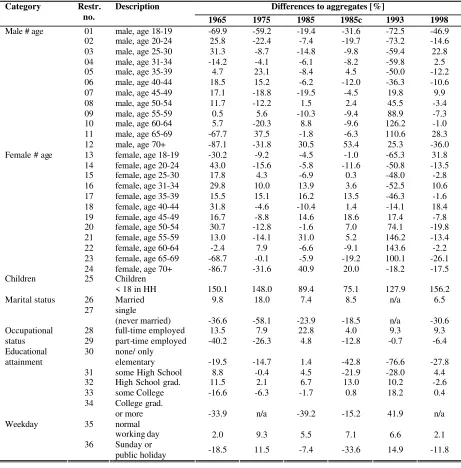
Differences to the aggregates before the calibration
27
Table 6c Differences to the aggregates 1965 before the calibration
37
List of Figures
Figure 1
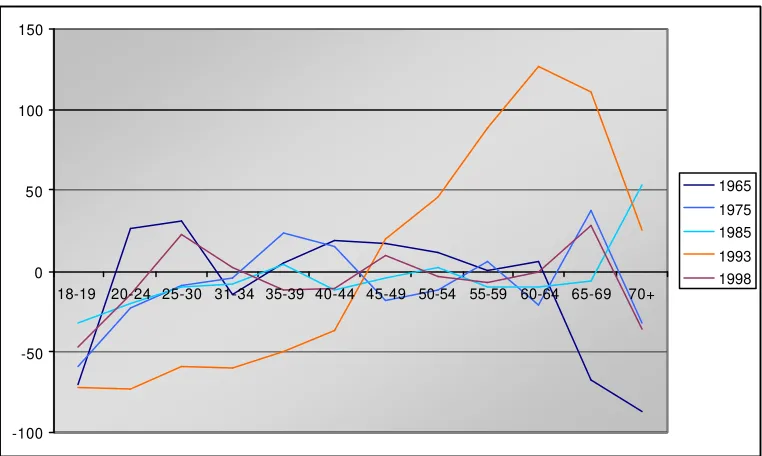
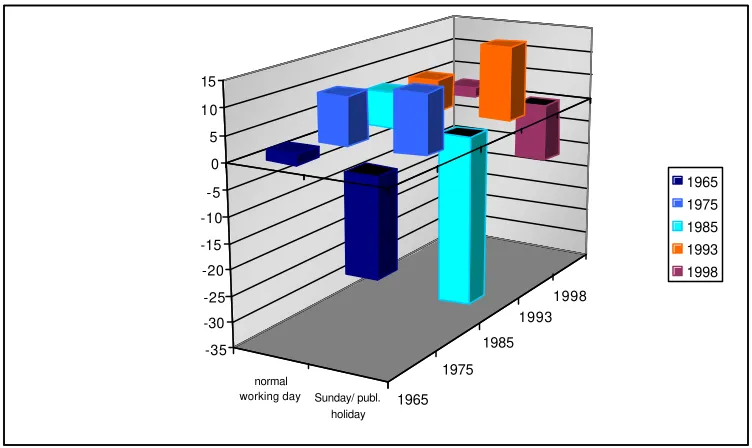
Representation of American Heritage Time Use Files 1965 – 1998/99 -
Over- and underrepresentation compared to desired totals in %: Males by
age classes
28
Figure 2
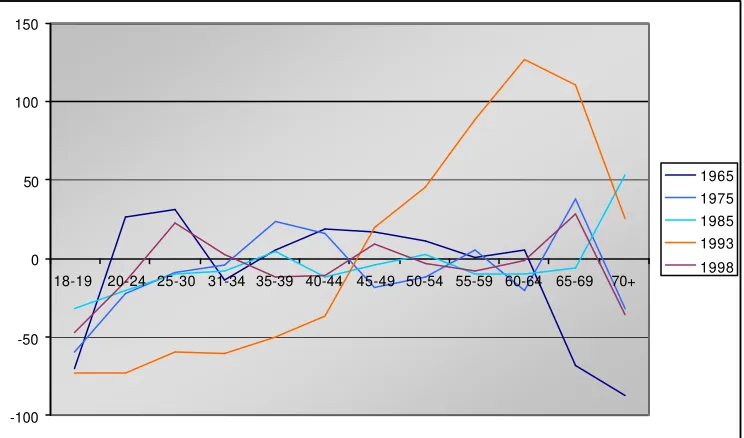
Representation of American Heritage Time Use Files 1965 – 1998/99 -
Over- and underrepresentation compared to desired totals in %: Females
by age classes
29
Figure 3
Representation of American Heritage Time Use Files 1965 – 1998/99 -
Over- and underrepresentation compared to desired totals in %: Family
status
29
Figure 4
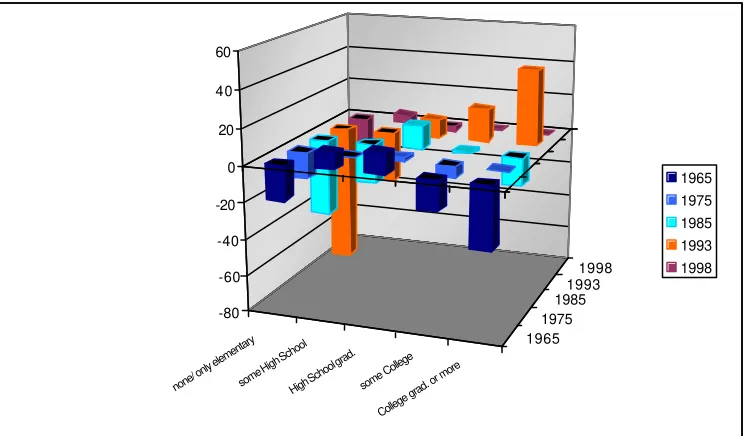
Representation of American Heritage Time Use Files 1965 – 1998/99 -
Over- and underrepresentation compared to desired totals in %:
Educational attainment
Figure 5
Representation of American Heritage Time Use Files 1965 – 1998/99 -
Over- and underrepresentation compared to desired totals in %:
Representation of days of the week
31
Figure 6
Frequency distributions of the old and new weight of the 1965 American
Time Use Survey
32
Figure 7
Frequency distributions of the old and new weight of the 1975 American
Time Use Survey
32
Figure 8
Frequency distributions of the old and new weight of the 1985 American
Time Use Survey
33
Figure 9
Frequency distributions of the old and new weight of the 1985c American
Time Use Survey
33
Figure 10
Frequency distributions of the old and new weight of the 1992-94
American Time Use Survey
34
Figure 11
Frequency distributions of the old and new weight of the 1998-99
American Time Use Survey
34
Acknowledgements
This paper is a part of the project
Assessing Time Use Survey Datasets
supported by Yale
University with Dr. Andrew S. Harvey (Project Head), Time Use Research Program (TURP), at
St. Mary’s University, Halifax, NS, Canada; Dr. Ignace Glorieux, Tempus Omnia Revelat
(TOR), Faculty of Economic, Social and Political Sciences, Vrije Universiteit Brussel, Brussels,
Belgium; Dr. Joachim Merz, Research Network on Time Use (RNTU), Research Institute on
Professions (FFB), Department of Economics and Social Sciences, Unive rsity of Lüneburg,
Lüneburg, Germany; and Klas Rydenstam, Statistics Sweden.
Many thanks to Diane Herz (Bureau of Labor Statsistics, USA), and her colleagues for providing
the CPS information and all the support. We also wish to thank participants of the IATUR 2005
vi/120 Merz, Stolze: Calibration of American Time Use Studies 1965 - 1999
Executive Summary
Valid and reliable individual time use data, in connection with a proper set of socio
-economicbackground variables, are essential elements for the empirical foundation and
evaluation of existing theories, and the search for new empirical-based hypotheses about
individual behavior in the household context. Several potentially useful time use heritage
datasets have been identified for use in developing an historical series of non-market accounts. In
order to evaluate the series of heritage U.S. time use surveys (1965, 1975, 1985, 1992-94,
1998-99), it is necessary to be certain about representativeness of the data.
As our analyses will show, the five U.S. heritage files - based on the given survey weights - are
seriously biased according to important demographic totals which in addition are of strategic
importance for substantial time use analyses. This study reports a solution that circumvents
several shortcomings in delivering a comprehensive demographic adjustment to all incorporated
U.S. heritage time use surveys. This adjustment is theoretically founded on information theory,
consistent by a simultaneous weighting including hierarchical data like personal and
family/household data, ensures desired positive weights, considers substantial requirements for
time use research analyses, and is similar in the demographic adjustment characteristics for all
heritage files thus facilitating substantial analyses and disentanglement of demographic vs. time
use behavior changes and develo pments.
First part of this study – calibration for representative US time use heritage files
The first part of the study describes the calibration/adjustment procedure and its theoretical
background, discusses and presents the demographic frame used for all five US heritage files,
computes, delivers and describes five sets of new sample weights which guarantee the respective
demographic totals.
Second part of this study – calibration io disentangle behavior from demographic changes
The second part provides four sets of alternative sample weights which allows to disentangle
changes in time use behaviour from changes in the population structure. These alternative sample
actual survey compared to the 1965 population, compute , deliver and describe the new
alternative weights for all remaining four time use surveys.
Our study has clearly shown that if using the Heritage US time use data with the given
old calibration, the bias in the results of substantial analyses would be not negligible. This holds
true in particular for characteristics with an obviously strong connection to individual time use
behavior (like the respondent’s age or the number of children); the results would be heavily
under- or overrepresented respectively. In general, relying on uncalibrated data would inevitably
lead to questionable conclusions.
With the available new five sets of consistent and similar structured weighting factors, it
is possible, in particular, to follow up American time use behavior for about 40 years based on a
reliable and valid demographic background delivering representative data for substantial time
use analyses.
In addition, the re-calibrated younger US heritage files all with the 1965 population
structure now are available for substantive analyses in disentangling demographic from time use
behavioral changes.
Based on our calibration experience we recommend above all that
•
For any new time use survey, the calibration procedure and the single substantial
definitions of the adjustment characteristics with their totals have to be documented
carefully.
•
A new adjustment of a new ATUS file should be as close as possible to the used
adjustment characteristics of the older ones to ensure a common demographic
background with no biased results if using a different approach.
•
Since the software Adjust can be operated easily on every desktop-computer, sensitivity
analyses with different totals resulting in different weighting sets will help further to
disentangle demographic effects from behavioural effects.
Without a proper calibration of the US heritage time use files, a necessary and important
prerequisite for any further substantive analyses would be missing and substantive results not
Merz and Stolze: Representative Time Use Data and Calibration of the American Time Use Studies 1965-1999 1/120
I
INTRODUCTION
Valid and reliable individual time use data, in connection with a proper set of
socio-economicbackground variables, are essential elements for the empirical foundation and
evaluation of existing the ories, and the search for new empirical-based hypotheses about
individual behavior in the household context. Several potentially useful time use heritage
datasets have been identified for use in developing an historical series of non- market accounts. In
order to evaluate the series of heritage U.S. time use surveys (1965, 1975, 1985, 1992-94,
1998-99), it is necessary to be certain about representativeness of the data.
As our analyses will show, the five U.S. heritage files - based on the given survey weights - are
seriously biased according to important demographic totals which in addition are of strategic
importance for substantial time use analyses. This study reports a solution that circumvents
several shortcomings in delivering a comprehensive demographic adjustment to all incorporated
U.S. heritage time use surveys. This adjustment is theoretically founded on information theory,
consistent by a simultaneous weighting including hierarchical data like personal and
family/household data, ensures desired positive weights, considers substantial requirements for
time use research analyses, and is similar in the demographic adjustment characteristics for all
heritage files thus facilitating substantial analyses and disentanglement of demographic vs. time
use behavior changes and develo pments.
First part of this study
The first part of the study describes the calibration/adjustment procedure and its theoretical
background, discusses and presents the demographic frame used for all five US heritage files,
computes, delivers and describes five sets of new sample weights which guarantee the respective
demographic totals.
Re-weighting of the heritage time use data was necessary for several reasons. First, due to
the lack of documentation, it was not possible to get sufficient information about the calibration
according to the weighting procedure and the totals (margins) to be achieved. Therefore, a
theoretically founded and transparent adjustment is needed.
Second, as far as we know, not all of the weightings of the different heritage files use an
(weighting, calibration), which simultaneously fulfills hierarchical information (e.g. Household
and personal information), is not assured. It is necessary to remedy this.
Third, the demographic information used in the adjustments should consider substantial
requirements of time use research analyses.
Fourth, a similar demographic adjustment scheme for all single heritage files was not
available. Such a scheme is desirable for concentrating on substantial behavioral changes
independently of further demographic developments.
To achieve representative results and to check whether five U.S. time use surveys (1965,
1975, 1985, 1992-94, 1998-99) fulfill the necessary requirements, we apply a consistent solution
of the microdata adjustment (calibration) problem: a proper (re-)weighting of microdata to fit
aggregate control data via the min imum information loss principle based on information theory
using the Adjust software.
Second part of this study
The second part provides four sets of alternative sample weights which allows to disentangle
changes in time use behaviour from changes in the population structure. These alternative sample
weights use the demographic totals from the oldest survey 1965 as the new demographic totals
for the younger files within the new calibrations. We describe the population changes of the
actual surve y compared to the 1965 population, compute , deliver and describe the new
alternative weights for all remaining four time use surveys.
This paper is divided as follows: In the first part, after briefly describing the
methodological background of our adjustment procedure based on the information theory,
including a survey of used alternative calibration procedures (chapter 2), we discuss
particularities of time use diary adjustments, and show a solution within the actual German Time
Use Survey (chapter 3). In chapter 4, a calibration framework for time use analyses is chosen,
sketching the microeconomic labour supply of women within the household context, household
production/time allocation, mult iple market and non-market analyses, as well as policy impacts
of tax and transfer systems, and alternatives. Chapter 5 provides the results of the new
Merz and Stolze: Representative Time Use Data and Calibration of the American Time Use Studies 1965-1999 3/120
The second part of this study is about disentangling demographic changes from changes
in time use behavior by re-calibrating the US heritage files 1975 – 1999 based on the
demographic structure of 1965 (chapter 6).
Chapter 7 presents study conclusions and gives some recommend ations.
II
THE ADJUSTMENT/CALIBRATION OF MICRODATA – THEORY, METHODS
AND ADJUST SOFTWARE
To adjust/calibrate microdata is to fit microdata to prescribed and known aggregate totals
(with synonyms as control data, restrictions, margins, population totals). For each microunit of a
(sample) microdata file, a suitable weight is searched so that the weighted sum of all microunit
cha racteristics will achieve their externally given aggregates.
A microdata matrix S consists of microunits such as persons, families, households, or
firms which are described by various characteristics. If, for example, these microunits are
per-sons, they would be described by age, gender, employment, or other characteristics which
correlate with the current topic under investigation.
The known population characteristics derived from, for example, a census, restrict the
microdata to their desired total values. Aggregate statistics will deliver single restrictions, or a set
of constraints, which could be given as a multidimensional cross tabulation. In general, the
restrictions may be given by official aggregate statistics, by other samples, or by other models.
Aggregate sample information, for example, may be given by a population census or a more
frequent microcensus with demographic variables, labour force participation information, etc. In
our application here, the American Current Population Survey (CPS) an ongoing monthly
household survey to provide demographic and labor force information is delivering the totals to
be achieved. Since the CPS is adjusted to the Census the calibration will fit the Census data.
The calibration of microdata is a common method in microsimulation models, where it is
used not only to extrapolate a data set (static aging), but also for sensitivity analyses using
alternative totals. Table 1 presents an overview of a selection of calibration procedures used in
microsimulation models.
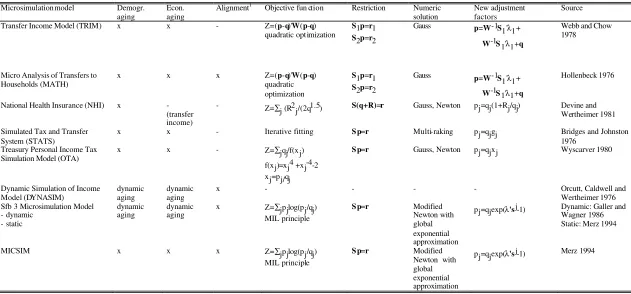
As Table 1 shows, there are different calibration procedures with different objective
functions, such as the CALMAR approach used in the SAS framework. However, most of them
and new weights) to be min imized resulting in possible zero or negative weighting factors. Since
non positive weights will further exclude microunits, only a procedure which provides positive
weights, such as the approach used in this paper, is appropriate.
The adjustment problem
In general, the adjustment problem is to find an n-vector p of adjustment factors
opti-mizing an objective function Z(p,q) - a function evaluating the distance between the new
adjustment factors p to be computed and the available factors q - satisfying the m re strictions
Sp=r:
(1)
Z(
p
,
q
) = min! s.t.
Sp
=
r
.
This adjustment problem is a simultaneous one where, for even a large number of
cha racteristics (n), only a single weighting factor has to be computed for each microunit which
after summing up, fulfils consistently all m hierarchical microdata totals (e.g. household, family
and personal information) simultaneously.
The objective function minimizes the distance between new adjustment factors p and the
given factors q in order to capture already available information and corrections due to
non-response, sampling errors, etc. If such corrections are not given in advance (or as a simple
microunit independent sampling ratio), q
jwould be equal for each microunit j (j=1,...,n). In the
case of demographic features in the sample information matrix S (and the restrictions), a single,
absolute adjustment factor for a sample micro unit j represents p
jtotal population microunits.
Alternative adjustment procedures
There are various procedures and functional forms in quantitative economics where an objective
function Z(
p
,
q
) weight the distance of two (adjustment) factors. In general, procedures with
quadratic (unweighted or weighted) and other objective functions (linear or nonlinear) are
conceivable. Within the Microsimulation context and its static aging (re-weighting by more
Merz and Stolze: Representative Time Use Data and Calibration of the American Time Use Studies 1965-1999 5/120
Table 1 Calibration procedures in different microsimulation models
Microsimulation model Demogr. aging
Econ. aging
Alignment1 Objective fun ction Restriction Numeric
solution
New adjustment factors
Source
Transfer Income Model (TRIM) x x - Z=(p-q)'W(p-q) quadratic optimization
S1p=r1 S2p=r2
Gauss p=W-1S 1'λ1+
W-1S1'λ1+q
Webb and Chow 1978
Micro Analysis of Transfers to
Households (MATH) x x x Z=(
p-q)'W(p-q) quadratic optimization
S1p=r1 S2p=r2
Gauss p=W-1S 1'λ1+ W-1S1'λ1+q
Hollenbeck 1976
National Health Insurance (NHI) x - (transfer income)
- Z=∑
j (R2j/(2q1.5) S(q+R)=r Gauss, Newton pj=qj(1+Rj/qj) Devine and Wertheimer 1981
Simulated Tax and Transfer System (STATS)
x x - Iterative fitting S p=r Multi-raking pj=qjgj Bridges and Johnston 1976
Treasury Personal Income Tax
Simulation Model (OTA) x x - Z=∑jqj/f(xj) f(xj)=xj4 +xj-4-2 xj=pj/qj
S p=r Gauss, Newton pj=qjxj Wyscarver 1980
Dynamic Simulation of Income Model (DYNASIM)
dynamic aging
dynamic aging
x - - - - Orcutt, Caldwell and
Wertheimer 1976 Sfb 3 Microsimulation Model
- dynamic - static
dynamic
aging dynamic aging x Z=MIL principle ∑jpjlog(pj/qj) S p=r Modified Newton with global exponential approximation
pj=qjexp(λ'sj-1) Dynamic: Galler and
Wagner 1986 Static: Merz 1994
MICSIM x x x Z=∑jpjlog(pj/qj)
MIL principle
S p=r Modified Newton with global exponential approximation
A solution based on a quadratic and unweighted objective function is used, for example, by
Galler 1977 to determine a consistent adjustment procedure for the Integrated Microdata File
(IMDAF-69) of the SPES project and its successor, the Sonderforschungsbereich 3 (Sfb 3)
'Microanalytic Foundations of Social Policy' at the Universities of Frankfurt and Mannheim,
Germany. Hollenbeck 1976 proposed a quadratic weighted objective function for the
adjustment of the micromodels of Mathematica Policy Research, Inc. (MPR) and The Policy
Research Group, Inc. A constrained quadratic loss function is also used for instance by Stone
1976 and extended by Byron 1978 in an input/output context to estimate large social account
matrices. Different algorithms may solve the quadratic programming approach (e.g. by Frank
and Wolfe 1956, Hildreth 1957 or Houthakker 1960). These operations research procedures,
however, become relatively inconvenient for large adjustment problems, particularly those
with many microunits and many characteristics.
Oh and Scheuren 1980 took a multivariate raking ratio estimation in their 1973 exact match
study to fit several types of sample units (design, analysis and estimation units) (see their
bibliography on raking). The raking ratio estimation, reaching back to Deming and Stephan
1940, uses proportional factors in each iteration to fit the marginals of a multi-way table (see
also 'iterative proportional fitting' in Bishop and Fienberg 1975 and the log linear approach
within contingency tables in Mosteller 1968); this approach will be simular to our weighting
procedure based on the minimum information loss principle..
Another, relative simple, weighting approach is the well known Horvitz-Thompson estimator
as the inverse of the sampling ratio. This weighting approach is only well suited for real
random samples, but not sufficient for the utimate non-random survey at hand. For a further
treatment of different approaches, like algorithms connected with input/output tables, and
procedures see Wauschkuhn 1982 and Merz 1986, Chapt. 7.
The adjustment of microdata by the minimum information loss (MIL) principle
.As seen above, there are many attempts to weight a sample However, those
procedures may produce negative adjustment factors, or zero factors when restricted. But
non-positive adjustment factors cannot be interpreted meaningfully in applied work because
an adjustment factor has to represent a certain number of households or persons. Therefore,
strictly positive weights are required to keep all sample microunits for further analyses.
Another prerequisite is to take care of adequate weights according to personal and
Merz and Stolze: Representative Time Use Data and Calibration of the American Time Use Studies 1965-1999 7/120
weights, as often used in survey weighting, will not ensure the simultaneous fit to the
aggregate personal as well household data.
A solution procedure is described which ensures the positivity constraint by an
appropriate objective function as well as the simultaneous requirements via appropriate
handling a set of hierarchical restrictions. Our objective function is theoretically based on
information theory, which optimizes a logarithmic function according to the Minimum
Information Loss Principle. In recent years, information theory - well known in engineering
sciences - has found some applications in economics. Theil's 1967 'information inaccuracy' is
used, for instance, to judge the forecasting accuracy of econometric models (Merz, 1980).
Measuring income inequality by an approach based on information theory is another example
(Theil, 1972; Foster, 1983). More recently, minimum information was used to estimate
microeconomic allocation models (Theil, Finke and Flood, 1984; Finke and Theil, 1984).
Based on the probability distribution p
jwith
p
= (p
1,...,p
n)’, (p
j>0),
∑
jp
j= 1,
(j = 1,...,n), the entropy or information content of
p
is defined as
(3a)
H(
p
) = H(p
1,...,p
n) =
∑
jp
jlog(1/p
j).
An extension of the entropy concept is the
information loss
(or gain) when a multinomial
distribution
q
= (q
1,...,q
n)' is substituted by a similar distribution
p
= (p
1,...,p
n)'
(3b)
I(
p
:
q
) =
∑
jp
jlog(1/q
j) -
∑
jp
jlog(1/p
j) =
∑
jp
jlog(p
j/qj),
with
(p
j,q
j>0),
∑
jp
j=
∑
jq
j= 1, (j=1,...,n).
Within this concept, the information loss is evaluated as the expected information
before, weighted by p
j, minus the expected information after substitution. For an axiomatic
derivation of the connected maximum entropy principle or principle of minimum
cross-entropy, see Shore and Johnson (1980), and Jaynes (1957) who first proposed entropy
maximization within engineering purposes.
The information theory based approach, as well as the approach with a quadratic
distance function, are specific cases of the generalized entropy class
1(3c)
I
α
(
p
,q) = [N
Σ
j(pj
α
q1-
α
-q)] / [
α
(
α
-1)],
with uniformly distributed adjustment factors qj=q=1/n, and where N is the number of all
microunits in the population. The quadratic objective function is given for
α
=2 with
1 As to Atkinson, Gomulka and Sutherland 1988 p. 230 who refer to the MIL adjustment procedure by Merz
I
2(
p
,q) = 1/2
Σ
j(p
j- q)
2divided by q. The information theory based approach is given for
α
=1. Since the derivative of 3c with respect to pj is Np
jα−1/ (
α-1), the information based
approach can be interpreted as that measure with the largest value of
α
, where the first
derivative approximates minus infinity, and the weight approximates to zero (satisfying the
positivity constraint).
With reference to the above information theory concept, the adjustment problem
under the minimum information loss (MIL) principle
is to minimize the objective function
(4a)
Z(
p
,
q
) = min
p{
∑
jp
jlog(p
j/q
j)}
(4b)
s.t.
Sp
=
r
.
where
p
j
= new adjustment factor for a microunit (e.g. household) j (j=l,...,n);
q
j
= available
(known) adjustment factor for each micro unit j, n=number of micro units, with
S
(m,n) = [sij]
sample information matrix (i=1,...,m; j=1,...,n),
r
(m) = [ri] vector of restrictions, m=number
of restrictions. The MIL-objective function minimization subject to the simultaneous set of
possible hierarchical restrictions fulfills the two main requirements of positive weights and
simultaneous consideration of hierarchical data.
As a solution condition, it is necessary that a) the number of micro units in a random
sample is higher than the number of characteristics (n
≥
m), and b) the matrix
S
is row regular,
meaning that the distribution of the individual characteristics in a random sample is linear
independent (rank
S
=m). Generally, the usual condition a) will be fulfilled; condition b) can
be guaranteed by omitting one respective characteristic from an exhaustive polytomuous
distribution.
The Lagrangean is
(5)
L(
p
,
λ
) =
∑
jp
j(logp
j- logq
j) -
λ
'(
Sp
-
r
),
which yields a nonlinear equation system
(6)
∑
js
ijq
jexp(
λ
'
s
j- 1) = r
i(i=1,...,m),
that has to be solved for the Lagrange multipliers
λ
k (k=1,...,m) iteratively.
The new adjustment factors
with the solution
λ
are
(7)
p
j= q
jexp(
λ
'
s
j- 1),
where
s
j are the respective characteristics of the microunit j.
Thus, the new adjustment factors can be calculated relatively simply: the single given
Merz and Stolze: Representative Time Use Data and Calibration of the American Time Use Studies 1965-1999 9/120
the respective microunit (e.g. household and personal) characteristics (
s
j) and the Lagrange
multipliers. Therefore, it is possible to determine the new adjustment factors after calculating
λ
independent of all other microunits and thus also independent from the sample size. This is
important for practical work with mass (micro) data.
Absolute and relative adjustment factors
Usually the above adjustment factors
p
j
and
q
j
are not formulated as probabilities
respectively relative frequencies with 0<p
j,q
j<1,
∑
jp
j=
∑
jq
j= 1, but rather in absolute terms.
The absolute adjustment problem,
(8)
Z(
p
,
q
) = min
p{
∑
jp
jlog(p
j/q
j), s.t.
Sp
=
r
}.
yields the same solution (8) as in the relative case and is only different according to the
interpretation with p
j= p
jN, q
j= q
jN and r
i= r
iN (N = number of all microunits in the total
population).
In the absolute case, a sample weight p
j(j=1,...,n) then represents the actual number
of microunits (say households if the weights correspond to this type of microunit) in the total
population. The restriction r
i(i=1,...,m) is then the absolute number of microunits with
characteristic i (e.g. households with three persons and a self-employed household head) in
the total population. The sample information matrix
S
remains the same in both cases and
describes the microunits' characteristics in the sample.
If there are no specific weighting factors given in advance (free adjustment) and/or
the sample under consideration would be a (pure) random one with an overall sampling ratio
w = [sample size(n)/population size(N)] (like w=1/100 in a 1% microcensus case), then the
old weights would be equal for each microunit j: In the relative case q
j= q = 1/n, and in the
absolute case q
j= q
jN = (1/n)N = N/n = 1/w as the inverse of the sampling ratio (w=n/N) (for
example q
j= q = 100 in a 1% microcensus case) for all microunits j (j=1,...,n).
Multiple usages of re-weighting a sample
The calibration of microdata can be used not only to adjust a specific sample to its totals
•
Achieving representative results for a given sample and its population
- Descriptive microanalyses
- Micreoeconometrics: weighted estimation
•
Sensititivity analyses with alternative artificial totals and respective weightings
•
Extrapolating/forecasting samples for an actual demographic situation
•
Microsimulation context: static aging (forecasting by re-weighting), weighting of
simulation files
ADJUST software package
Our program package ADJUST fulfils the above requirements in an efficient manner for
unlimited sample sizes. ADJUST has been proven to be successful in many applications: for
the adjustment of the recent Time Budget Survey of the German Statistical Office and a
refined adjustment of the German Socio-Economic Panel; within the framework of a
microsimulation analysis of financial and distributional impacts of the German Pension
Reform; a consistent adjustment for the microsimulation analysis of time allocation impacts
in the formal and informal economy of the recent German tax reform. In addition, ADJUST
has been used in applications at the London School of Economics (LSE, UK), at the
Australian Bureau of Statistics (ABS) with the National Centre of Simulation, and Economic
Modelling (NATSEM) at the University of Canberra (Australia). ADJUST is available via
http://ffb.uni-lueneburg.de/adjust
.
III
THE CALIBRATION OF TIME DIARY DATA – PARTICULARITIES OF
TIME DIARY ADJUSTMENTS
To increase the representativeness of a sample, the calibration has to be based on
variables which have a substantial influence on time use behavior. To find appropriate
aggregates to support substantial time use analyses, we refer to socio-demographic
backgrounds of ind ividuals based on human capital and performance characteristics as well
as to socio-cultural backgrounds of the families and households. In addition, day specific
information with expected time use influences via workdays or weekends should be
integrated within the calibration procedure. Thus a simultaneous calibration approach, which
Merz and Stolze: Representative Time Use Data and Calibration of the American Time Use Studies 1965-1999 11/ 120
To improve the quality and representativeness of survey data, a set of new (re-)
weighting factors has to be computed. In the first step, weights have to be found for each
observation which adjust the biased sample selection resulting from unproportional quotas
(e.g. from oversampling of highly interesting but small demographic groups) or not fulfilled
quotas. The second step builds upon the weights found in the first free adjustment procedure.
Its aim is to create adjustment factors in such a way that the weighted sums of variables meet
externally given aggregate values.
Due to the non-randomness of the sample (e.g. quoted samples) and missing
observation units etc., the demographic structure of the time-budget survey might differ from
the actual population measured by another official statistic (e.g. a micro-census or population
survey file). By using new adjustment factors, the differences between the aggregated survey
data and the preferred aggregates should vanish. This is especially important when dealing
with variables which might correlate with the time use-behavior. More specific details on
how to choose appropriate characteristics are discussed in the following chapter.
In addition to the demographic structure variables, the distribution of time data itself
(e.g. days over the week or the season of the survey) may be biased and is likely to influence
the time use behavior. It is expected that one will observe different activities in the summer
than in the winter, and that time use patterns will vary between working days and Sundays.
Public holidays should be taken into account as well. Even with quoted samples it is difficult
to match these aggregate distributions. As a result, date and time information should be
considered in the adjustment as well.
Sample size considerations
Though a deeply disaggregated multidimensional set of adjustment characteristics is
desired,, however, the size of the sample often limits the structure of the aggregates in that
mostly one or two-dimensional aggregate distributions can be used. Combining
characteristics would often result in classes with very few, if any observations, therefore most
of the aggregates can only be computed separately. This means, for example, that the
weighted sum of 2-person-households and the weighted sum of blue-collar-workers will both
The selection of characteristics used in the adjustment procedure underlies two major
considerations. First, the number of characteristics influences the quality of the results. If too
many variables are chosen, then the algorithm may not find a numerical solution and the
range between lowest and highest adjustment factor will grow rapidly. Additio nally, some
categories without observations may occur, so the sample file cannot meet the aggregates in
these aspects. Second, the chosen characteristics should be correlated with the time use
behavior and should include the characteristics used in the sample.
Example: The German Time-Budget Study
Due to the non-randomness of the sample (caused by over sampling of certain
subgroups) and missing observation units, the demographic structure of the time-budget
survey differs from that of the German micro-census. As a result, a calibration to correct
these biases (using the ADJUST-software approach and the approach used in our study here)
has been applied to both German time budget studies in 1991/92 and 2001/02. The fo llowing
characteristics have been used for this task:
(a) For households:
•
States
•
Phase of the survey crossed with region (West-/ East-Germany) code
•Social situation crossed with the region code
•
Size of the household crossed with region code
•
Size of the community crossed with region code
•
Household-type crossed with region code
•
Only for the adjustment of the episode data: Day of the week [Mon-Thu; Fri; Sat;
Sun]
(b) For persons:
•
States
•
Phase of the survey crossed with region (West-/ East-Germany) code
•
Social situation crossed with the region code
•
Size of the household crossed with region code
•
Size of the community crossed with region code
Merz and Stolze: Representative Time Use Data and Calibration of the American Time Use Studies 1965-1999 13/ 120
•
Only for the adjustment of structural data: occupational status crossed with region
code and with gender
•
Only for the adjustment of episode data: occupational status crossed with day of the
week and gender crossed with day of the week
With respect to information on the day of the week, the following calibration was
used: for each participant two days were observed so the adjustment factors for the episode
data project two days (8/7
thnormal workdays [Monday thru Thursday], 2/7
thFridays, 2/7
thSaturdays and 2/7
thSundays adding up to 14/7
thor 2 days).
IV
CHOOSING A CALIBRATION FRAMEWORK FOR TIME USE ANALYSES
There are two central dimensions of time use analyses: first is the time itself, which
can be spent in a multitude of market and non-market activities with an appropriate
measurement by main and secondary activities (endogenous variables). The second
dimension, which is at least as important as the first, encompasses the socioeconomic
background variables to explain ind ividual behavior (explanatory, exogenous variables).
Dimensions of a calibration framework
The aim is to find a calibration framework which allows valid demographic data to
analyze time use behavior based on different theoretical socioeconomic approaches. To find
such a calibration kernel, we briefly discuss the importance, necessity and application of time
use information in explaining behaviors for theoretically based empirical and integrated
economic and social research, as well as for a targeted economic and social policy.
As a basis, we sketch the economic framework of activity linked time dimensions: the
optimal allocation of goods and time with constrained goods and time resources. Within this
framework, the microeconomic allocation model, the optimal labor supply, and the household
production approach for a model of multiple market and non-market activities is of central
importance. Individual time use data, in connection with a proper set of background
variables, are essential for an empirical foundation and an evaluation of those theories (‘new
home econo mics’), as well as for the search of new empirical based hypotheses about
individual behavior in the household context.
1.
Labour supply of women within the household context – microeconomic analyses
2.
Household production/time allocation
3.
Multiple market and non-market time use activities – socioeconomic analyses
4.
Policy impacts of the tax and transfer system – time allocation effects in the formal
and informal economy by microsimulation modeling.
These examples and research areas will illustrate the need for and the spread of appropriate
background variables and demographic calibration requirements.
Labour supply of women within the household context – the microeconomic approach
Within the well known microeconomic allocation model, an individual/household is
maximizing his/her/its utility based on the amounts of goods. Facing a restricted income,
utility maximization under the money constraint yields an optimal allocation of goods in a
static or an intertemporal approach. Based on this microeconomic allocation model, the
individual’s paid working hours (labor supply) are incorporated in the preference
optimization model via leisure (full time minus leisure determines the working hours). Thus,
total time is divided into consumption time (leisure) and time for paid work to earn income.
Then, maximizing utility as a function of the market goods amounts and the consumption
time subject to full income (all expenditures plus wage weighted cons umption time equals
non-labor income and wage weighted total time) yields the optimal allocation equations for
the goods amounts as well for the working hours (labor supply).
Already within this classical approach socio-economic background variables are
necessary for
•
individual utility function dependent of the socioeconomic status
•
individual wage, including the potential wage of nonworkers, which has been
econometrically estimated by socioeconomic variables
•
non-labour income dependent of the socioeconomic status
•hours of paid work.
Within the last decade, empirically based labour supply research based on advanced
econometric methods has proven the importance not only of time use itself in paid work, but
also the need for proper socioeconomic background variables with regard to the mentioned
four microeconomic dimensions.
Merz and Stolze: Representative Time Use Data and Calibration of the American Time Use Studies 1965-1999 15/ 120
family dependent labor force participation) is important. [Useful literature includes the survey
concerning labor supply by Killingsworth, 1983; concerning female labor supply by
Killingsworth and Heckmann, 1986; as well as recent issues in scientific journals (e.g.
Journa l of Labor Economics)].
In brief: personal as well household characteristics have to be valid for following this
strand of time use research.
Household production/time allocation
With the ‘new home economics’ since the Nobel prize winner Becker (1965),
Lancaster (1966), Muth (1966), and Ironmonger (1972), the above microeconomic approach
has been broadened by household production and the connected time allocation. The utility
function is now based on the basic commodities which are produced by the househo ld with
its input of non-market time and market goods. Such commodities can be defined broadly
(e.g. childcare, homework, and do-it-yourself work). Shadow prices can be assigned for the
basic commodities, which have no market price per se, via the dual approach. Dependent of
the household technology the shadow prices are dependent or independent of the household
production output amount.
Within this approach, the optimal allocation problem is solved in three steps:
•
Modeling the efficient household technolo gy (duality between production and cost
function)
•
Modeling and calculation of the shadow price (price of the basic commodities,
duality of cost function, and valued production)
•
Utility maximized allocation with regard to output (with shadow prices) or with
regard to input (with explicit functionalized market goods and the necessary time
for the production).
In all three steps, an empirical sound model needs the appropriate personal and household
socioeconomic background variables in addition to the income restriction and the empirically
Multiple market and non-market time use activities – socioeconomic analyses
To explain and estimate a proper household production of different commodities,
different time inputs and their dependencies to the socioeconomic background are necessary.
If this approach is expanded by multiple paid market activities (multiple labour supply) –
possibly including tax and transfer evading black work – then a full multiple market and
non-market time use activity model can be formulated which will overcome the traditional
one-sided focus on paid work alone.
The theoretical modeling approach allows for the formulation of the impacts of
changing model parameters (like the income and substitution effects of a price/ wage
change). However, only an empirically based estimation and explanation with proven
socioeconomic hypotheses will finally quantify these effects and decide, for example,
whether the income or the substitution effect will be dominant – an important result in
explaining the final labor supply.
To do this, detailed time use information on multiple activities are necessary, and
above that, and this has to be underlined, the right set of socioeconomic background variables
are essential for all of the needed theoretically based above model variables. This is important
for testing given models with a multitude of preferences and background, and for finding new
hypotheses of what the people do via and connected by and with its time individual
dimension in the household and their regional labor market and economic context.
Policy impacts of the tax and transfer system – time allocation effects on the formal and
informal economy by microsimulation modeling
Explaining behavior is the basis for a targeted economic and social policy. For
example, at first glance, a new tax proposal has impacts on ind ividual (labour) income.
However, as has been proven, there are significant impacts on the broad range of household
production not only directly via the budget constraint, but also by the interdependencies of
substitution (opportunity costs) possibilities of market and non-market work, and activities
Merz and Stolze: Representative Time Use Data and Calibration of the American Time Use Studies 1965-1999 17/ 120
Citro and Hanushek, 1999a,b). Personal, family and household demographics have to be
available for targeted analyses.
To summarize: for testing given time use models, for finding new explanations and
policy impact analyses of individual time use behavior within the household/family context –
based either on a microeconomic or a psychological or sociological etc. theory – appropriate
socioeconomic background variables are an ultimate requirement.
To do this, the calibration procedure has to incorporate personal and household/family
information to ensure a valid demographic frame which forms the basic for substantial
research and analyses.
V
ADJUSTING FIVE AMERICAN TIME USE STUDIES
Heritage American time use data assessment and studies under investigation
The calibration of American Time Use Studies is part of the international project
‘Time use Data Assessment’, which is headed by the Time use Research Program (TURP),
Department of Economics, Saint Mary’s University, Halifax, Canada, Prof. Andrew Harvey
and done in cooperation with: Tempus Omnia Revelat (TOR), Faculty of Economic, Social
and Political Sciences, Vrije Universiteit Brussel, Brussels, Belgium, Prof. Dr. Ignace
Glorieux, Research Network on Time use (RNTU), Research Institute on Professions (FFB),
Department of Economics and Social Sciences, University of Lüneburg, Lüneburg, Germany,
Prof. Dr. Joachim Merz, and Klas Rydenstam from Satistics Sweden. This project is
supported by the Yale University and the Glaser Progress Foundation.
The following studies were identified and are the subject of the present investigation:
1.
1965: Multi-national Study: United States
Robinson, John P. (1977). How Americans Used Time in 1965, Institute for
Social Research, University of Michigan: Ann Arbor, Michigan
2.
1975: Time use in Economic and Social Accounts, 1975-1976: United States
Juster, T.F., Hill, M.S., Stafford, F.P. and J. Eccles Parsons (1983). 1975-1981
Time Use Longitudinal Panel Study, Survey Research Center, Institute for Social
Research, University of Michigan: Ann Arbor, Michigan
3.
1985: Americans’ Use of Time
1985c: Americans’ Use of Time
as above but created from mail episodes (see Harvey and St. Croix 2005)
4.
1992: EPA Time Use Survey, 1992-1994: United States
Triplett, Timothy. (1995). Data Collection Methods Report for Estimating
Exposure to Pollutants Through Human Activity Pattern Data, A National
Micro-behavioral Approach, Survey Research Centre, University of Maryland, College
Park, Maryland
5.
1998: Family Interaction, Social Capital, and Trends in Time use, 1998-1999:
United States
Robinson, John P., Bianchi, Suzanne M. and Stanley Presser. (1999). Family
Interaction, Social Capital, and Trends in Time use, 1998-1999, College Park,
MD: University of Maryland, Survey Research Center
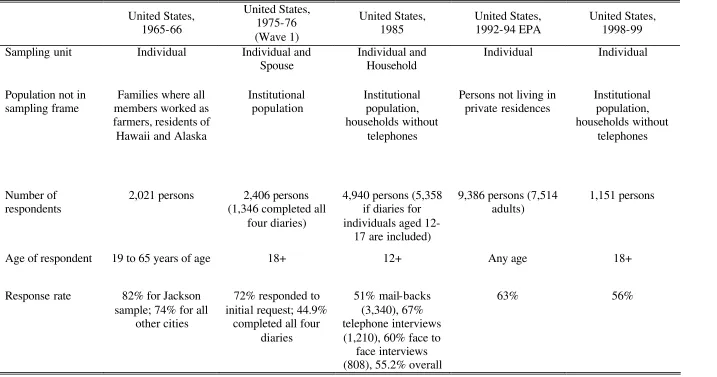
Details of each study are listed in Table 2. A comprehensive description and evaluation of
these American time use studies is given in Harvey and St. Croix (2005).
Time use theory based and standardized calibration for all heritage files
Computing new adjustment factors for the American Time Use Study (ATUS) will
improve subsequent research for two major reasons: first, for substantial analyses it is
important, that fundamental socio-demographic variables meet the given aggregates of
reliable demographic data such as the current population survey (CPS) or the Intercensal
Population Estimates of the U.S. Census Bureau. This increase in representativeness
concerning the socio-demographic structure of the sample also affects the representativeness
of the analysis of the episode data, if the socio-demographic variables are correlated with the
time use behavior. The selection of these variables is based on time use theory and the
individual-centered and social background-centered economic models discussed above.
Furthermore, time use-specific variables like the day of the week of an observation
should be considered in the adjustment factors as well, as these variables directly affect time
Merz and Stolze: Representative Time Use Data and Calibration of the American Time Use Studies 1965-1999 19/ 120
Table 2 American time use studies under investigation
United States,
1965-66
United States,
1975-76
(Wave 1)
United States,
1985
United States,
1992-94 EPA
United States,
1998-99
Sampling unit
Individual
Individual and
Spouse
Individual and
Household
Individual
Individual
Population not in
sampling frame
Families where all
members worked as
farmers, residents of
Hawaii and Alaska
Institutional
population
Institutional
population,
households without
telephones
Persons not living in
private residences
Institutional
population,
households without
telephones
Number of
respondents
2,021 persons
2,406 persons
(1,346 completed all
four diaries)
4,940 persons (5,358
if diaries for
individuals aged
12-17 are included)
9,386 persons (7,514
adults)
1,151 persons
Age of respondent
19 to 65 years of age
18+
12+
Any age
18+
Response rate
82% for Jackson
sample; 74% for all
other cities
72% responded to
initial request; 44.9%
completed all four
diaries
51% mail-backs
(3,340), 67%
telephone interviews
(1,210), 60% face to
face interviews
(808), 55.2% overall
Working with equally calibrated data will allow sensitivity analyses and disentangling
demographic changes vs. time use behavior changes. For this reason we will provide a
standardized calibration procedure for each of the American time use surveys.
Aggregate characteristics for the heritage files
When selecting variables for the adjustment, several considerations must be made.
The structure of the sample should reflect the U.S. population with respect to major
socio-demographic data. Additionally, to improve the representativeness of the data, variables
should be chosen which are correlated with time use behavior. These may be
socio-demographic variables or technical variables of the time use survey itself (like a certain day
of the week). Choosing appropriate aggregates will support substantial analyses. We refer to
demographic backgrounds and individual characteristics based on human capital and other
performance characteristics within the time use analyses framework discussed. In addition,
we take the socio-cultural background of families and household characteristics into account.
The sample size and the nature of the calibration algorithm limit the amount of
restrictions in such a way that if there are a growing number of variables it will become more
likely that the sample may not provide observations for all the categories of the desired
aggregates. Furthermore, if a large number of restrictions exist, this may lead to very high
variances in the adjustment factors. Finally, the data has to be available in the sample files as
well as in the CPS-files (providing totals) for all of the specified years. When dealing with
five samples simultaneously, the selection of the optimal set of restrictions is difficult and
may vary from one which would have been chosen for a single calibration. Finding a
compromise between the desired detail of restrictions, practical requirements, and the
availability of data in all sample-files is a challenging task.
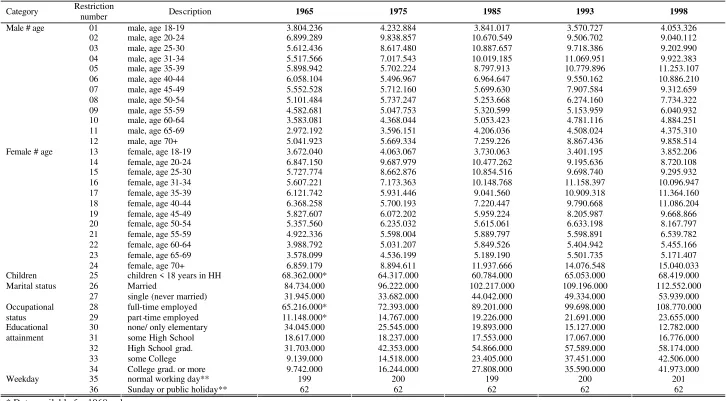
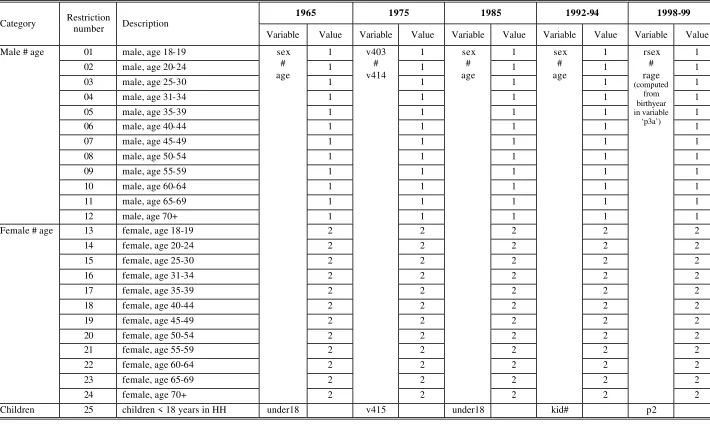
Considering the mentioned limitations, eligible structural variables in the heritage
files available for an adjustment to CPS key data and basic population estimates are:
•
Age (5-year-classes) crossed with gender
•
Educational attainment
•
Occupational status (full time/part time/unemployed, self-employed)
•
Marital status (single/married/divorced/widowed)
•