Public Health Theses School of Public Health
Summer 8-9-2016
Youth Alcohol Marketing Exposure and Sex Risk
Behavior: A Social Cognitive Perspective from
Uganda
Vinita Sangtani
Follow this and additional works at:https://scholarworks.gsu.edu/iph_theses
This Thesis is brought to you for free and open access by the School of Public Health at ScholarWorks @ Georgia State University. It has been accepted for inclusion in Public Health Theses by an authorized administrator of ScholarWorks @ Georgia State University. For more information, please contact [email protected].
Recommended Citation
Sangtani, Vinita, "Youth Alcohol Marketing Exposure and Sex Risk Behavior: A Social Cognitive Perspective from Uganda." Thesis, Georgia State University, 2016.
SOCIAL COGNITIVE PERSPECTIVE FROM UGANDA By
VINITA SANGTANI July 29, 2016
INTRODUCTION: Twenty four percent girls and 37.8% boys age 15-19 years were current drinkers of alcohol in Uganda in 2010 (World health organization (WHO), n.d.). Marketing of alcohol to youth in African countries, particularly Uganda, is very
aggressive (DeBruijn, 2011). Consequences of this are reflected in the high consumption rates among this population. Given the high rates of HIV (4-10%), the sex risk behaviors exhibited by this population have been linked to alcohol consumption (Swahn, Ali, Palmier, Sikazwe, & Mayeya, 2011). More evidence is needed.
AIM: To demonstrate the effect of alcohol marketing exposure on alcohol consumption by adolescents in the slums of Kampala, Uganda, and the consequent effect on the number of sex partners they have.
METHODS: A mHealth survey was conducted among 12-18 year olds in the slums of Kampala, Uganda, in 2014. Regression analysis was used to test the hypothesized relationships.
RESULTS: Exposure to alcohol advertising on TV, print media, and outdoor advertising was positively related to the frequency of alcohol consumption. The relationship was mediated by cognitions favoring the advertising. Alcohol consumption in turn predicted the number of sex partners.
DISCUSSION: The double jeopardy of alcohol marketing effects on youth is
YOUTH ALCOHOL MARKETING EXPOSURE AND SEX RISK BEHAVIOR: A SOCIAL COGNITIVE PERSPECTIVE FROM UGANDA
by
VINITA SANGTANI
Ph.D., GEORGIA STATE UNIVERSITY
A Thesis Submitted to the Graduate Faculty of Georgia State University in Partial Fulfillment
of the
Requirements for the Degree MASTER OF PUBLIC HEALTH
YOUTH ALCOHOL MARKETING EXPOSURE AND SEX RISK BEHAVIOR: A SOCIAL COGNITIVE PERSPECTIVE FROM UGANDA
by
VINITA SANGTANI
Approved:
Dr. Monica Swahn Committee Chair
Dr. Laura Salazar Committee Member
which this thesis would not have been possible. Dr. Swahn’s knowledge of and
commitment to the subject and context, her concern for the success of her students, and her unfailing optimism and cheerfulness have been a great source of inspiration. I would like to thank Dr. Laura Salazar for her guidance on the theory and analysis methods, which were invaluable to completing this thesis accurately.
In presenting this thesis as a partial fulfillment of the requirements for an advanced degree from Georgia State University, I agree that the Library of the University shall make it available for inspection and circulation in accordance with its regulations governing materials of this type. I agree that permission to quote from, to copy from, or to publish this thesis may be granted by the author or, in his/her absence, by the professor under whose direction it was written, or in his/her absence, by the Associate Dean, School of Public Health. Such quoting, copying, or publishing must be solely for scholarly purposes and will not involve potential financial gain. It is understood that any copying from or publication of this dissertation which involves potential financial gain will not be allowed without written permission of the author.
LIST OF TABLES………...viii
INTRODUCTION...1
REVIEW OF THE LITERATURE AND CONCEPTUAL MODEL...4
Alcohol effects on youth ………...4
Alcohol marketing exposure effects ……….4
Social cognitive theories and advertising exposure ………..6
Alcohol advertising related cognitions (cognitions), alcohol consumption, and the moderating role of normative beliefs ………8
Alcohol use and sex risk behavior ………11
METHOD …………..………... 12
Context of study ………...12
The study …..………...13
Measures …..………...14
Analysis …..………...15
Measure validation …..………...15
RESULTS...16
DISCUSSION ...18
Limitations ...22
Conclusions………....23
REFERENCES...32
APPENDICES………...31
Table 1. Percentage distribution of sample by gender and age ……….24
Table 2. Measures ...26
Table 3. Varimax rotated component matrix ...27
Table 4. Results of regression analyses ...28
Introduction
Nearly a third of adolescents in the United States (US) are said have tried alcohol before the age of 13 years and the age continues to decrease (Henriksen, Feighery, Schleicher, & Fortmann, 2008a). Twenty four percent girls and 37.8% boys age 15-19 years were current drinkers of alcohol in Uganda in 2010 (World health organization (WHO), n.d.). Globally, 5.9% of all deaths have been attributed to alcohol (WHO, 2015a), and in 2010, forty two percent youth between the ages of 15-19 worldwide were reported to be current drinkers of alcohol (WHO, n.d.). In general, alcohol consumption is directly related to the income level of the country, however, a diversity of factors such as religion, political stability, level of industrialization, and availability and acceptability of alcohol in Africa result in a wide variance in consumption levels by country
Direct negative effects of alcohol, i.e., morbidity and mortality due to alcohol, have been well established in the medical literature (De Bellis et al., 2000; Rohde, Lewinsohn, & Seeley, 1996). The cost to society of indirect effects, ranging from poor academic performance, job absenteeism, interpersonal violence, and unintentional injuries to risky sexual behavior, are of equal or greater importance (DeBruijn, 2011; Hoffman, Pinkleton, Weintraub, Austin, & Reyes-Velázquez, 2014; McClure et al., 2016; Saffer & Dave, 2006). WHO reports that human immunodeficiency disease (HIV) related deaths are the second leading cause of death among youth, which according to the WHO, could be alleviated by controlling alcohol consumption (WHO, 2014b).
Since the 1970s, when citizen action groups and the Federal Trade Commission (FTC) began raising concerns about advertising to children, research on marketing to children gained traction (John, 1999).While there is consensus that youth drinking behavior is a worldwide health problem, inconclusive research findings continue to fuel the debate about the relationship between alcohol marketing and youth drinking behavior (Jones & Magee, 2011; Mastro & Atkin, 2002; Saffer & Dave, 2006). Ambiguous
research findings for the effect of advertising on drinking behavior doesn’t imply there is no effect, but that the effect might evade detection (Parker, 1998). Nevertheless, with the increased pace of research in the area, the evidence supporting the relationship is getting stronger (Morgenstern, Isensee, Sargent, & Hanewinkel, 2011). In the meantime,
The purpose of this study is to show, based on social cognitive theories, the relationship between alcohol marketing and consumption and how consumption further accounts for sex risk behaviors in an African context. In so doing, this study makes several contributions to existing literature – 1) it provides further evidence for the
relationship between alcohol marketing exposure and alcohol consumption among youth. This is important because, as the literature suggests, earlier the initiation into alcohol, greater the consumption at a later age (Anderson, de Bruijn, Angus, Gordon, & Hastings, 2009). 2) It shows further that alcohol consumption is related to sex risk behavior among adolescents. Given the alarming prevalence of HIV worldwide, with Africa leading the way, it is important to put into place public policy and prevention interventions, if this link exists. 3) The model is tested in an African context. Most of the current research on the topic has been conducted in the developed west. There is a paucity of research related to the effects of alcohol marketing on African youth, whereas, given the
disproportionately high burden of disease related to alcoholism in Africa, the topic is perhaps of greater importance to Africa at this time. 4) It answers calls for greater focus on youth health, in general. As the Assistant Director-General for Family, Women and Children’s Health, WHO points out, “The world has not paid enough attention to the health of adolescents” (“WHO calls for stronger focus on adolescent health,” 2014).
Literature review and conceptual model Alcohol effects on youth:
Alcohol use at an early age has been linked to suicide ideation and attempts (Swahn & Bossarte, 2007; Swahn, Bossarte, & Sullivent, 2008). Being drunk before the age of 13 years was related to two times greater odds of having unplanned sex and 2.2 times greater odds of having unprotected sex (R. Hingson, Heeren, Winter, & Wechsler, 2003). Across multiple studies, Hingson, Heeren and their colleagues and Swahn and her colleagues have shown the adverse effects of alcohol on youth. Consistent with
sociological and psychological research that adult cognitions and behavior are shaped by childhood learning and experiences (Ward, 1974), alcohol use at an early age has been shown to be related to problem drinking at later ages (F. Harris, Gordon, MacKintosh, & Hastings, 2015; R. Hingson, Heeren, Zakocs, Winter, & Wechsler, 2003; R. W. Hingson, Heeren, & Winter, 2006).
Alcohol marketing exposure effects:
levels of impact of different forms of exposure to advertising on alcohol consumption and age at initiation. Salient were results reported by Stacy et al. (2004), who correlated one standard deviation increase in alcohol advertising exposure with increase in the odds of consumption of beer by 44%, wine/ liquor by 34%, and of three or more drinks on one occasion in the past month.
Television advertising may have the greatest influence on adolescents (Churchill Jr. & Moschis, 1979; F. Harris et al., 2015), which may be because the frequency of exposure to alcohol advertising is highest on TV, with over 94% participants reporting exposure in a study by Jones & Magee (2011). Austin, Chen, & Grube, (2006) report that adolescents’ favorable cognitions about portrayals in TV advertising increased
identification with the portrayals. Morgenstern et al., (2011) showed a clear positive relationship between exposure to alcohol advertising on TV and consumption measured as: ever tried, current alcohol use, and binge drinking. Paying attention to and believing alcohol advertising were positively related to beer drinking among adolescents (Faria, Vendrame, Silva, & Pinsky, 2011).
After controlling for other demographic variables, (Wills, Sargent, Gibbons, Gerrard, & Stoolmiller, 2009) showed that exposure to alcohol in movies at an earlier age is correlated with increased alcohol use at a later age among adolescents. African
bars, pubs, restaurants, and the like, in which alcohol can be consumed on premises (Chen, Grube, & Gruenewald, 2010).
Alcohol branded merchandize (ABM) has been found to have mixed impact on consumption, but has the potential to be very insidious for several reasons: 1) If
advertising exposure has an effect because of the modeling behavior it induces, ABM makes it easy to try on the persona of a drinker (Henriksen et al., 2008a). 2) Ownership of ABM may be reflective of receptivity to alcohol marketing (see Stoolmiller et al., 2012). 3) ABM, for the most part, carries only the brand name or logo or picture of the product and not peripheral celebrity stimuli. Hence, as per the elaboration likelihood model, ABM exposure probably stimulates the central route to processing as opposed to the peripheral route (Cacioppo & Petty, 1984). In a cross-sectional study among 15-20 year old youth conducted by random-digit dialing, McClure et al. (2013) demonstrate that exposure to ABM was correlated with having a favorite alcohol brand, which in turn correlated with current binge drinking.
Social cognitive theories and advertising exposure:
According to Bandura (1977), modeling of observed behavior is integral to the learning process and enables assimilation of vast amounts of normative social and cultural behaviors that would otherwise be impossible to learn by a formal teaching process. Observational stimuli activate cognitions and alter a person’s perception of the environment. Hence, there is a continuous reciprocal interaction between a person and the environment, which brings about learning.
stage of life, youth are very impressionable and look outward, especially at public
personalities, for guidance on establishing their self-identities and self-concept (Bandura, 1977; McClure et al., 2013). At the same time, youth are also being socialized as
consumers, where consumer socialization has been defined as: “processes by which young people acquire skills, knowledge, and attitudes relevant to their functioning as consumers in the marketplace” (Ward, 1974, p. 2). Adolescents, according to John (1999), are in the reflective stage of consumer socialization; a time when they are developing cognitively and socially, and relative to younger children, have more advanced information processing and social skills. They understand the social significance of product categories and brand names; they learn that to achieve social goals they need to acquire certain brands and products, which become manifestations of their self-identities (John, 1999; Ward, 1974).
portrayed in alcohol advertising (F. Harris et al., 2015). Alcohol advertisements in less developed countries, however, particularly rely more on fantasy cues to render alcohol users as virile and successful in professional life and with women (DeBruijn, 2011). Exposure to such alcohol advertising elicits a larger number of favorable cognitions among adolescents (Mastro & Atkin, 2002; Pasch et al., 2007), “who construct a lifestyle representing their unique interpretations of the consumption ideals (Englis, Solomon, & Olofsson, 1993, p. 21). Based on this, with a specific focus on advertising (instead of all forms of marketing), the first hypothesis of the conceptual model (figure 1) is proposed as:
[image:17.612.127.553.392.496.2]H1: Exposure to alcohol advertising will be positively related to cognitions about alcohol advertising
Figure 1: Antecedents of alcohol use and multiple sex partners
Alcohol advertising related cognitions (cognitions), alcohol consumption, and the moderating role of normative beliefs:
Regarding adolescents, Bandura (1997) holds that they must prepare themselves for adulthood in many respects, including deciding on and planning their future work and social roles and goals, all the while going through biological and emotional changes, making it a very crucial and challenging phase in their lives. At this point they are
In most cases, functional families provide the stability for adolescents to transition smoothly through this phase (Bandura, 1977). Dysfunctional or impoverished families that may be characterized by conflict or substance abuse or other ills, do not provide the requisite support and stability critical to transition to adulthood, endangering the
development of the adolescent into a productive citizen (Bandura, 1997). Having to concurrently deal with observable physical maturation requires external ratification of body image and self-identity. Impoverished situations, as in the slums of less developed countries, may not be conducive to development of a balanced self-identity. Friends and society fill the gap to become the sources of social-efficacy and role models for
emotional and psychosocial development instead.
assumed by models in advertising become coveted and emulated, becoming the self-identities of adolescents (Englis et al., 1993). Coupled with a tendency for youth to venture into dangerous and forbidden territory and egged on by peers, youth are driven to emulate and bring to life the fantasies they are exposed to in advertising. Hence,
advertising related cognitions will be positively related to alcohol use among adolescents. Some of the research discussed above also raises the question about the role of beliefs and norms in the development of an adolescent (see for example, Henriksen, Feighery, Schleicher, & Fortmann, 2008b; Pasch et al., 2007). The theories of reasoned action and planned behavior have held that normative beliefs are important precursors to behavior, especially in the context of substance use (McMillan & Conner, 2003).
Normative beliefs, also referred to as subjective norms, measure subjective beliefs of a person about what important reference groups consider as appropriate behavior
(McMillan & Conner, 2003). Subjective norms have been shown to predict 41% variance in intentions to drink (McMillan & Conner, 2003). Hoffman et al. (2014) argue that alcohol favoring norms have the ability to compound the effect of alcohol marketing exposure on drinking and that reinforcing positive norms should mitigate such effects. Hence, if favorable cognitions increase alcohol consumption, normative beliefs not in favor of alcohol should attenuate that effect, since they are held by important referents.
Accordingly, the following hypotheses are offered:
H2a: Alcohol advertising related cognitions (cognitions) will positively predict alcohol consumption
Alcohol use and sex risk behavior:
Alcohol use has been commonly associated with risky sexual behaviors among adolescents, such as sex with multiple partners and unprotected sex, with consequential sexually transmitted diseases (STD), especially HIV (Kiene, Simbayi, Abrams, & Cloete, 2015; Mitchell, Beals, & Kaufman, 2006; Voisin, DiClemente, Salazar, Crosby, & L., 2006). The relationship between alcohol use and risky sexual behavior is of great interest because there is no known antibody against HIV; hence, until such time as one is found or developed, preventive behaviors may be the best cure (Mitchell et al., 2006). Public health literature shows evidence of a strong relationship between substance use and sex risk behaviors. For instance, female adolescents abusing substances during sexual encounters were more likely to have multiple sex partners (Millstein & Moscicki, 1995; Voisin et al., 2006). Being drunk before the age of 13 years was related to two times greater odds of having unplanned sex and 2.2 times greater odds of having unprotected sex (R. Hingson, Heeren, Winter, et al., 2003).
Steele & Josephs (1990) offer the alcohol myopia theory to explain the relationship; it argues that the influence of alcohol elicits conflict within a person
between response to instigatory versus inhibitory cues. Seeking pleasure from sex with an available partner is the instigatory cue and desire for long-term health through avoidance of disease is the inhibitory cue. Under influence of alcohol, depending on the salience of the external cue, an example of which is partner characteristics, the internal inhibitory cue might be weakened or become distal and the instigatory cue strengthened or become proximal. Based on this discussion, the next hypothesis is proposed as follows:
Method Context of the study:
Four sectors account for alcohol production in Africa – global corporations, national and regional industrial producers, local industrial producers, and non-industrial producers making traditional alcohols (Jernigan & Babor, 2015). Effects of alcohol consumption are especially pernicious in Africa because of the purity of alcohol sold by local industrial and non-industrial producers, which is commonly 40-60%; and binge drinking levels (defined as consumption of 60g of pure alcohol on one occasion) even at that purity are reported to be 46% among female drinkers and 59% among male drinkers. Unlike tobacco advertising, which is regulated, most countries, particularly developing ones, rely on self-regulation by the industry for alcohol marketing (DeBruijn et al., 2014; McClure et al., 2016; Swahn et al., 2013). Serious competition in the industry and loose regulations mean marketing efforts through every medium are ratcheted up, particularly by global producers (Jernigan & Babor, 2015).
The study
A cross-sectional survey was conducted in the spring of 2014 among 12-18 year old youth living in the slums or on the streets of Kampala, Uganda. The sample was drawn by convenience sampling at Uganda Youth Development Link (UYDEL) centers located in five of the biggest slums of Kampala. UYDEL is a non-government
organization (NGO) providing various vocational training and preventive health services to an average of 650 disadvantaged youth per month. Participants were recruited from among and by word of mouth through youth who visit these UYDEL centers on a monthly basis from surrounding slums. Other than age, there were no exclusion criteria. In addition to commute expenses, if applicable, youth received snacks for participating in the survey. IRB approvals for the study were obtained from Georgia State University (GSU) and the Uganda National Council on Science and Technology. Participants had to first consent to the survey, which most of them did verbally. Parental consent had to be waived because most of these youth were street youth, who are responsible for their own livelihoods and are considered ‘emancipated’ in Uganda.
protocol, recruitment procedures, survey administration, and operation of tablet devices. A pilot test of the procedure was conducted by administering the survey on several youth present at the UYDEL center on that day, in presence of the GSU team. To further identify any residual methodological issues, the GSU and UYDEL teams later debriefed the interviewer and no issues surfaced. Upon completion of the day long training, these social workers recruited youth, obtained consent, and administered face-to-face surveys in Luganda, the local language, or in English. Each interview lasted about thirty minutes.
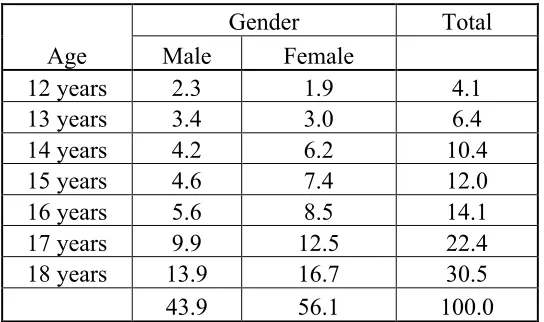
Of the 1628 youth who were approached for participation during the two-week survey, 131 declined and 1497 completed the survey for a response rate of 92%. Of these, 320 data points were lost due to technical issues in electronic transmission, for a final sample of 1134. In the final sample, 44% were girls and 56% were boys. Most (79.2%) were 15 years of age or older and 20.8% were between the ages of 12-14 years. Age distribution of the sample is in table 1. Figure 2 shows the frequency distribution of exposure to alcohol advertising through different media.
Measures:
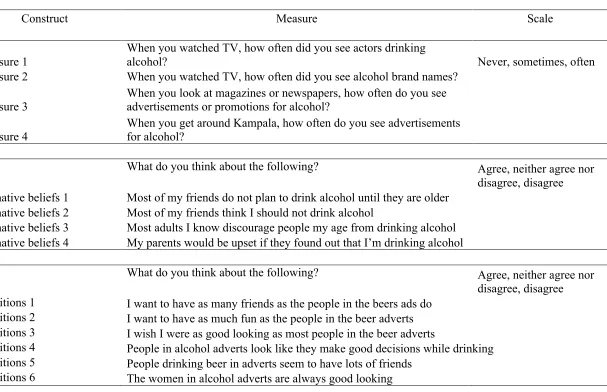
related beliefs of peers and parents on a 3 point Likert scale – agree, neither agree nor disagree, and disagree (1,2,3 respectively). Consumption of alcohol was measured as an absolute frequency: ‘In the past month, on how many days did you drink alcohol?’ (0 days, 1 or 2 days, 3-5 days, 6+ days). Multiple sex partners (risky sexual behavior) was measured as: ‘With how many different partners have you had sexual intercourse in the last 3 months?’ (none, 1-2 partners, 3-4 partners, 5-6 partners, more than 6 partners). Analysis:
Measure validation:
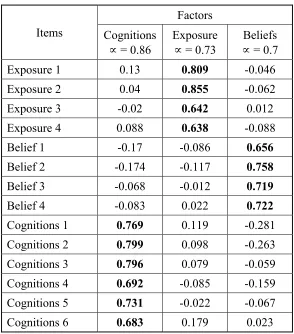
Although the scales used in the survey have been well established in the literature, it is appropriate to test the psychometric properties (Churchill Jr., 1979). Reliabilities for the three multi-item scales exhibited adequate psychometric properties (table 3), with Cronbach’s α above the recommended threshold of .70 (Nunnally, 1978). Next, all scale items were subjected to principal component analysis with a Varimax rotation.
Confirming discriminant and convergent validities, table 3 shows the resulting factor structure in which all items have substantial loadings on their intended factors and not on other factors.
with the largest contribution to variance in the model (variance explained = 24.6%), accounted for less than half the sum total of the variance explained by all 3 factors (Menon et al., 1999, p. 31).
Results
Interpreting the CFA conducted by structural equation modeling using Lisrel 8.72 based on guidelines from Hu & Bentler (1999), the measurement model had good fit statistics with CFI = 0.94 (>=.95), SRMR = 0.047 (<0.09), Chi-square = 683.84 (p=0.0) for 107 degrees of freedom. Every item had significant loadings on their respective factors confirming convergent validity, and discriminant validity was established at the same time since none of the items cross-loaded on other factors. An exploratory factor analysis using the principal component method with Varimax rotation also confirmed convergent and discriminant validities (table 3)
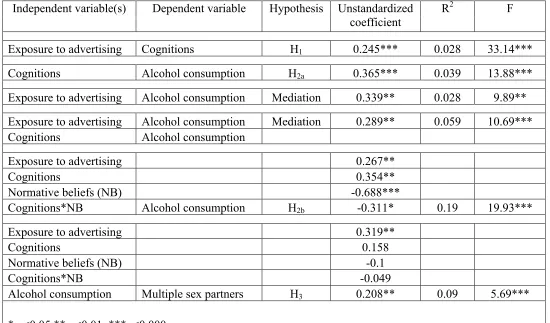
the relationship. The test for H1 above is the second and H2a the third step in the mediation test. Lastly, alcohol consumption was regressed on advertising exposure controlling for cognitions. In support of the mediation, the relationship between
advertising exposure and alcohol consumption was weakened in presence of cognitions. Since social phenomena have more than one explanation, the expectation should be for the coefficient to be weakened rather than reduced to zero (Baron & Kenny, 1986). The regression coefficient between advertising exposure and alcohol consumption, which was originally 0.339, p < 0.01 was weakened to 2.89, p < 0.01. As per recommended
procedure, the Sobel test was conducted to confirm this finding. A Sobel coefficient of 2.89, p < 0.01 supports mediation of the advertising exposure to alcohol consumption relationship by cognitions.
H2b proposed that normative beliefs would moderate the relationship between cognitions and alcohol consumption. To test this moderation, an interaction term was first created as a product of cognitions and normative beliefs; following this, alcohol
consumption was regressed on the interaction term while controlling for cognitions, normative beliefs, and exposure to advertising. As shown in table 4, the interaction was significant with a negative coefficient, supporting the hypothesis that normative beliefs of peers and parents not in favor of alcohol attenuate the relationship between cognitions and alcohol consumption (b = -0.311, p < 0.05). Lastly, H3 proposed that alcohol
consumption would be positively correlated with multiple sex partners. A beta coefficient of 0.208, p < 0.01 supported this final hypothesis. Following Aiken & West (1991), the conditional effect of cognitions on alcohol consumption at high and low levels of
mean centered normative belief scores and assessing the impact of the standardized regression coefficient associated with cognitions one standard deviation above and below the mean. Figure 3 confirms support for the interaction.
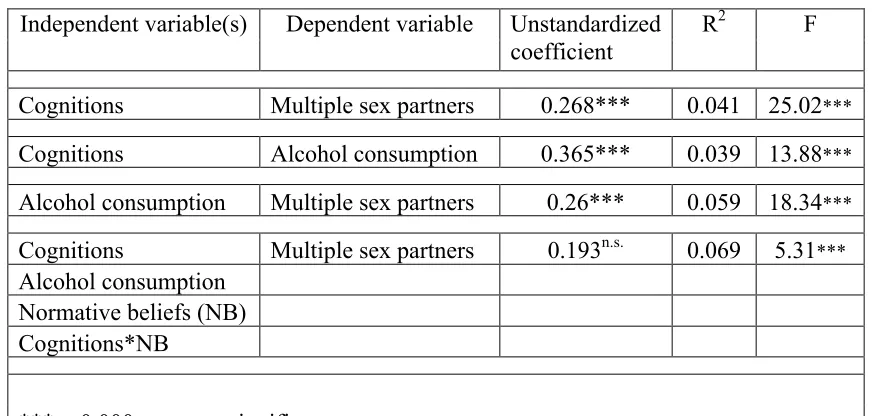
Once again, the model implied that alcohol consumption mediates the relationship between cognitions and multiple sex partners (MSP). Following the earlier described four step procedure, in the first step, the coefficient of the regression of MSP on cognitions was 0.268, p < 0.0 (table 5); step 2 tested in H2a yielded a regression coefficient of 0.365, p < 0.0; in step 3, MSP was regressed on consumption to obtain a beta of 0.26, p < 0.0. In the last step, the regression of MSP on cognitions while controlling for the interaction between cognitions and normative beliefs, normative beliefs, and alcohol consumption resulted in a non-significant regression coefficient of 0.193, in support of the mediation.
Discussion
Although extensive extant research has found support for the negative effects of exposure to alcohol marketing on youth, for instance, it has been related to drinking at an early age and problem drinking behavior, and possible sex risk behaviors (Swahn et al., 2011), an almost equal amount of research with mixed support has given the alcohol marketing industry an excuse to continue targeting youth. In an African context, this study found an unambiguously strong correlation between exposure of adolescents to alcohol advertising and alcohol consumption, mediated by cognitions favoring the fantasies portrayed in alcohol advertising. Higher frequency of exposure to alcohol advertising in three different media: TV, print media, and outdoor advertising resulted in a greater number of cognitions favoring such advertising.
Favorable cognitions were found to increase the frequency of alcohol
consumption by adolescents. Alcohol consumption in itself is very harmful to youth in a number of ways, including leading to cognitive impairment resulting in poor academic performance, getting into fights, and accidental injuries (DeBruijn, 2011; McClure et al., 2013; Saffer & Dave, 2006). An important contribution of this research is to show the role of normative beliefs, which attenuate the relationship between cognitions and alcohol consumption. This finding can be used to advantage in interventions as discussed later.
influencing the decision processes of adolescents to engage in sex with multiple partners via alcohol consumption, on being exposed to alcohol marketing.
The World Health Organization (WHO) has recognized the need to stop targeting adolescents with alcohol marketing (WHO, 2014a) and reducing youth access to alcohol (WHO, 2015b). Even though the same mass media have been successfully used in interventions to prevent risky behaviors associated with alcohol abuse (Romer et al., 2009) and otherwise (Kerr et al., 2015) more needs to be done by way of regulation to protect youth and prevent exposing them to untoward influences at an impressionable age. Although this study was conducted in Africa, it is of public policy concern to US policy makers because western country alcohol manufacturers are as aggressive, if not more so, in targeting youth in Africa. Billboards and television advertising portray good-looking youth as being champions by drinking alcohol (see pictures in appendix 1). Aggressive marketing by western companies makes it easy for African producers to sell their own product, which is easy for this vulnerable population to access and, at over 40% purity, can be lethal for children and youth. The United Kingdom (UK) and US have banned direct advertising of alcohol to children (F. Harris et al., 2015) but it doesn’t prevent marketers from advertising to children in other parts of the world.
In the US, some county health departments and non-profit organizations address the inherent risk taking and thrill seeking tendencies of bisexual men and African
American men who have sex with men (MSM) by conducting group sessions followed by booster sessions to educate and empower – a program called Men of African American Legacy Empowering Self (MAALES) (Harawa et al., 2013). Akin to this, an intervention that has been used is peer counseling and leadership training (PCLT) to strengthen self-esteem and perceived self-control among substance dependent women (R. M. Harris, Bausell, Scott, Hetherington, & Kavanagh, 1998). Similar sessions can be held by NGOs such as UYDEL to educate youth about the risks of alcohol consumption and unsafe sex.
An intervention that has been successfully implemented in certain parts of the world, and is easily replicable, is the promotion of safer sex and distribution of free condoms through barbershops, alcohol, and tobacco outlets (Raman, 1992). One of the promotion methods in this successful campaign was an advertising display contest (Yadav, 1978), which can be run among alcohol outlets that agree to carry educational advertisements about safer sex and free condoms.
Limitations:
Some inherent and some unexpected limitations restrict the generalizability of the findings of this research. Three hundred and twenty observations were lost due to a technical glitch in the electronic transmission of data. Although surveys were conducted in private, they were administered by an interviewer, which might have given rise to social desirability bias, privacy concerns, and embarrassment (Kalichman, Simbayi, Jooste, & Cain, 2007). This could have biased the responses to either inflate or
Social Desirability Scale (SDS) could be used to control for potential SD bias associated with illegal and stigmatized behaviors, such as, substance abuse (Wright, Squires, Goodness, Maisto, & Palfai, 2013). Due to the private nature of the topic, scales were subjective, relying on participant recall of events. Participants might not accurately recall the number of events being measured in the study, such as the frequency of exposure to marketing or alcohol consumption or number of sex partners. Some study participants were youth receiving services at UYDEL and others were their friends or acquaintances, raising questions about external validity.
Conclusions:
Table 1: Percentage distribution of sample by gender and age
Age
Gender Total
Male Female
12 years 2.3 1.9 4.1
13 years 3.4 3.0 6.4
14 years 4.2 6.2 10.4
15 years 4.6 7.4 12.0
16 years 5.6 8.5 14.1
17 years 9.9 12.5 22.4
18 years 13.9 16.7 30.5
Figure 2: Frequency of exposure to alcohol advertising through various media
0! 10! 20! 30! 40! 50! 60!
TV1! TV2! Print! Outdoor!
Table 2: Measures
Construct Measure Scale
Exposure 1
When you watched TV, how often did you see actors drinking
alcohol? Never, sometimes, often
Exposure 2 When you watched TV, how often did you see alcohol brand names?
Exposure 3
When you look at magazines or newspapers, how often do you see
advertisements or promotions for alcohol?
Exposure 4
When you get around Kampala, how often do you see advertisements
for alcohol?
What do you think about the following? Agree, neither agree nor disagree, disagree Normative beliefs 1 Most of my friends do not plan to drink alcohol until they are older
Normative beliefs 2 Most of my friends think I should not drink alcohol Normative beliefs 3 Most adults I know discourage people my age from drinking alcohol Normative beliefs 4 My parents would be upset if they found out that I’m drinking alcohol
What do you think about the following? Agree, neither agree nor disagree, disagree Cognitions 1 I want to have as many friends as the people in the beers ads do
Table 3: Varimax rotated component matrix
Items
Factors Cognitions
∝ = 0.86
Exposure ∝ = 0.73
Beliefs ∝ = 0.7
Exposure 1 0.13 0.809 -0.046
Exposure 2 0.04 0.855 -0.062
Exposure 3 -0.02 0.642 0.012
Exposure 4 0.088 0.638 -0.088
Belief 1 -0.17 -0.086 0.656
Belief 2 -0.174 -0.117 0.758
Belief 3 -0.068 -0.012 0.719
Belief 4 -0.083 0.022 0.722
Cognitions 1 0.769 0.119 -0.281
Cognitions 2 0.799 0.098 -0.263
Cognitions 3 0.796 0.079 -0.059
Cognitions 4 0.692 -0.085 -0.159 Cognitions 5 0.731 -0.022 -0.067
Table 4: Results of regression analyses
Independent variable(s) Dependent variable Hypothesis Unstandardized coefficient
R2 F
Exposure to advertising Cognitions H1 0.245*** 0.028 33.14***
Cognitions Alcohol consumption H2a 0.365*** 0.039 13.88***
Exposure to advertising Alcohol consumption Mediation 0.339** 0.028 9.89**
Exposure to advertising Alcohol consumption Mediation 0.289** 0.059 10.69***
Cognitions Alcohol consumption
Exposure to advertising 0.267**
Cognitions 0.354**
Normative beliefs (NB) -0.688***
Cognitions*NB Alcohol consumption H2b -0.311* 0.19 19.93***
Exposure to advertising 0.319**
Cognitions 0.158
Normative beliefs (NB) -0.1
Cognitions*NB -0.049
Alcohol consumption Multiple sex partners H3 0.208** 0.09 5.69***
Table 5: Mediation of cognitions to multiple sex partners link by alcohol consumption
Independent variable(s) Dependent variable Unstandardized coefficient
R2 F
Cognitions Multiple sex partners 0.268*** 0.041 25.02***
Cognitions Alcohol consumption 0.365*** 0.039 13.88***
Alcohol consumption Multiple sex partners 0.26*** 0.059 18.34***
Cognitions Multiple sex partners 0.193n.s. 0.069 5.31***
Alcohol consumption
Normative beliefs (NB)
Cognitions*NB
Figure 3: Interaction between cognitions and normative beliefs (NB)
$0.2! 0! 0.2! 0.4! 0.6! 0.8! 1! 1.2! 1.4!
1! 2! 3!
High!NB! Low!NB!
Alcohol!consumption!
References:
Aiken,!L.!S.,!&!West,!S.!G.!(1991).!Multiple(Regression:(Testing(and(Interpreting(
Interactions.!Newburry!Park,!CA:!Sage.!
Anderson,!P.,!de!Bruijn,!A.,!Angus,!K.,!Gordon,!R.,!&!Hastings,!G.!(2009).!Impact!of!
alcohol!advertising!and!media!exposure!on!adolescent!alcohol!use:!a!
systematic!review!of!longitudinal!studies.!Alcohol(and(Alcoholism((Oxford,(
Oxfordshire),!44(3),!229–243.!http://doi.org/10.1093/alcalc/agn115!
Austin,!E.!W.,!Chen,!M.XJ.,!&!Grube,!J.!W.!(2006).!How!does!alcohol!advertising!
influence!underage!drinking?!The!role!of!desirability,!identification!and!
skepticism.!Journal(of(Adolescent(Health,!38(4),!376–384.!
http://doi.org/10.1016/j.jadohealth.2005.08.017!
Austin,!E.!W.,!&!Knaus,!C.!(2000).!Predicting!the!potential!for!risky!behavior!among!
those!`too!young’!to!drink!as!the!result!of!appealing!advertising.!Journal(of(
Health(Communication,!5(1),!13.!
Bandura,!A.!(1977).!Social(learning(theory.!Englewood!Cliffs,!N.J.!07632:!PrenticeX
Hall,!Inc.!
Bandura,!A.!(1997).!SelfGefficacy:(The(exercise(of(control.!New!York:!W.!H.!Freeman!
and!Company.!
Bandura,!A.!(2006).!Toward!a!Psychology!of!Human!Agency.!Perspectives(on(
Psychological(Science :(A(Journal(of(the(Association(for(Psychological(Science,!
Baron,!R.!M.,!&!Kenny,!D.!A.!(1986).!The!moderatorXmediator!variable!distinction!in!
social!psychological!research:!Conceptual,!strategic,!and!statistical!
considerations.!Journal(of(Personality(and(Social(Psychology,!51(6),!1173.!
Cacioppo,!J.!T.,!&!Petty,!R.!E.!(1984).!The!elaboration!likelihood!model!of!persuasion.!
Advances(in(Consumer(Research,!11(1),!673–675.!
Chen,!M.XJ.,!Grube,!J.!W.,!&!Gruenewald,!P.!J.!(2010).!Community!alcohol!outlet!
density!and!underage!drinking.!Addiction,!105(2),!270–278.!
http://doi.org/10.1111/j.1360X0443.2009.02772.x!
Churchill!Jr.,!G.!A.!(1979).!A!Paradigm!for!Developing!Better!Measures!of!Marketing!
Constructs.!Journal(of(Marketing(Research((JMR),!16(1),!64–73.!
Churchill!Jr.,!G.!A.,!&!Moschis,!G.!P.!(1979).!Television!and!Interpersonal!Influences!
on!Adolescent!Consumer!Learning.!Journal(of(Consumer(Research,!6(1),!23–
35.!
De!Bellis,!M.!D.,!Clark,!D.!B.,!Beers,!S.!R.,!Soloff,!P.!H.,!Boring,!A.!M.,!Hall,!J.,!…!
Keshavan,!M.!S.!(2000).!Hippocampal!volume!in!adolescentXonset!alcohol!use!
disorders.!The(American(Journal(of(Psychiatry,!157(5),!737–744.!
http://doi.org/10.1176/appi.ajp.157.5.737!
DeBruijn,!A.!(2011).!Alcohol(marketing(practices(in(Africa:(Findings(from(the(Gambia,(
Ghana,(Nigeria(and(Uganda!(p.!100).!The!Netherlands:!World!health!
organization!(WHO).!Retrieved!from!
http://apps.who.int/iris/bitstream/10665/109914/1/9789290231844.pdf?
DeBruijn,!A.,!FerreiraXBorges,!C.,!Engels,!R.,!&!Bhavsar,!M.!(2014).!Monitoring!
outdoor!alcohol!advertising!in!developing!countries:!Findings!of!a!pilot!study!
in!five!African!countries.!African(Journal(of(Drug(and(Alcohol(Studies,!13(1),!
13–29.!
Englis,!B.!G.,!Solomon,!M.!R.,!&!Olofsson,!A.!(1993).!Consumption!Imagery!in!Music!
Television:!A!BiXCultural!Perspective.!Journal(of(Advertising,!22(4),!21–33.!
Faria,!R.,!Vendrame,!A.,!Silva,!R.,!&!Pinsky,!I.!(2011).!Propaganda!de!álcool!e!
associação!ao!consumo!de!cerveja!por!adolescentes.!Revista(de(Saúde(Pública,!
45,!441–447.!
Gibbons,!F.!X.,!Pomery,!E.!A.,!Gerrard,!M.,!Sargent,!J.!D.,!Weng,!C.XY.,!Wills,!T.!A.,!…!Yeh,!
H.XC.!(2010).!Media!as!social!influence:!racial!differences!in!the!effects!of!
peers!and!media!on!adolescent!alcohol!cognitions!and!consumption.!
Psychology(of(Addictive(Behaviors :(Journal(of(the(Society(of(Psychologists(in(
Addictive(Behaviors,!24(4),!649–659.!http://doi.org/10.1037/a0020768!
Harawa,!N.,!Williams,!J.,!McCuller,!W.!J.,!Ramamurthi,!H.,!Lee,!M.,!Shapiro,!M.,!…!
Cunningham,!W.!(2013).!Efficacy!of!a!culturally!congruent!HIV!riskXreduction!
intervention!for!behaviorally!bisexual!black!men:!!results!of!a!randomized!
trial.!
Harris,!F.,!Gordon,!R.,!MacKintosh,!A.!M.,!&!Hastings,!G.!(2015).!Consumer!
Socialization!and!the!Role!of!Branding!in!Hazardous!Adolescent!Drinking.!
Psychology(&(Marketing,!32(12),!1175–1190.!
Harris,!R.!M.,!Bausell,!R.!B.,!Scott,!D.!E.,!Hetherington,!S.!E.,!&!Kavanagh,!K.!H.!(1998).!
An!intervention!for!changing!highXrisk!HIV!behaviors!of!African!American!
drugXdependent!women.!Research(in(Nursing(&(Health,!21(3),!239–250.!
Henriksen,!L.,!Feighery,!E.!C.,!Schleicher,!N.!C.,!&!Fortmann,!S.!P.!(2008a).!Receptivity!
to!alcohol!marketing!predicts!initiation!of!alcohol!use.!The(Journal(of(
Adolescent(Health :(Official(Publication(of(the(Society(for(Adolescent(Medicine,!
42(1),!28–35.!http://doi.org/10.1016/j.jadohealth.2007.07.005!
Henriksen,!L.,!Feighery,!E.!C.,!Schleicher,!N.!C.,!&!Fortmann,!S.!P.!(2008b).!Receptivity!
to!alcohol!marketing!predicts!initiation!of!alcohol!use.!Journal(of(Adolescent(
Health,!42(1),!28–35.!http://doi.org/10.1016/j.jadohealth.2007.07.005!
Hingson,!R.,!Heeren,!T.,!Winter,!M.!R.,!&!Wechsler,!H.!(2003).!Early!age!of!first!
drunkenness!as!a!factor!in!college!students’!unplanned!and!unprotected!sex!
attributable!to!drinking.!Pediatrics,!111(1),!34–41.!
Hingson,!R.,!Heeren,!T.,!Zakocs,!R.,!Winter,!M.,!&!Wechsler,!H.!(2003).!Age!of!first!
intoxication,!heavy!drinking,!driving!after!drinking!and!risk!of!unintentional!
injury!among!U.S.!college!students.!Journal(of(Studies(on(Alcohol,!64(1),!23–
31.!
Hingson,!R.!W.,!Heeren,!T.,!&!Winter,!M.!R.!(2006).!Age!at!drinking!onset!and!alcohol!
dependence:!age!at!onset,!duration,!and!severity.!Archives(of(Pediatrics(&(
Adolescent(Medicine,!160(7),!739–746.!
http://doi.org/10.1001/archpedi.160.7.739!
Hoffman,!E.!W.,!Pinkleton,!B.!E.,!Weintraub!Austin,!E.,!&!ReyesXVelázquez,!W.!(2014).!
and!Their!Associations!With!AlcoholXRelated!Behaviors.!Journal(of(American(
College(Health,!62(5),!328–335.!
Hu,!L.,!&!Bentler,!P.!M.!(1999).!Cutoff!Criteria!for!Fit!Indexes!in!Covariance!Structure!
Analysis:!Conventional!Criteria!Versus...!Structural(Equation(Modeling,!6(1),!
1.!
Jernigan,!D.!H.,!&!Babor,!T.!F.!(2015).!The!concentration!of!the!global!alcohol!
industry!and!its!penetration!in!the!African!region.!Addiction,!110(4),!551–
560.!http://doi.org/10.1111/add.12468!
John,!D.!R.!(1999).!Consumer!Socialization!of!Children:!A!Retrospective!Look!at!
TwentyXFive!Years!of!Research.!Journal(of(Consumer(Research,!26(3),!183–
213.!
Jones,!S.!C.,!&!Magee,!C.!A.!(2011).!Exposure!to!alcohol!advertising!and!alcohol!
consumption!among!Australian!adolescents.!Alcohol(and(Alcoholism,!46(5),!
630–637.!
Kalichman,!S.!C.,!Simbayi,!L.!C.,!Jooste,!S.,!&!Cain,!D.!(2007).!Frequency,!quantity,!and!
contextual!use!of!alcohol!among!sexually!transmitted!infection!clinic!patients!
in!Cape!Town,!South!Africa.!The(American(Journal(of(Drug(and(Alcohol(Abuse,!
33(5),!687–698.!http://doi.org/10.1080/00952990701522716!
Kerr,!J.!C.,!Valois,!R.!F.,!DiClemente,!R.!J.,!Carey,!M.!P.,!Stanton,!B.,!Romer,!D.,!…!
Fortune,!T.!(2015).!The!effects!of!a!mass!media!HIVXrisk!reduction!strategy!
on!HIVXrelated!stigma!and!knowledge!among!African!American!adolescents.!
AIDS(Patient(Care(and(STDs,!29(3),!150–156.!
Kiene,!S.!M.,!Simbayi,!L.!C.,!Abrams,!A.,!&!Cloete,!A.!(2015).!Alcohol!Expectancies!and!
Inhibition!Conflict!as!Moderators!of!the!Alcohol–Unprotected!Sex!
Relationship:!EventXLevel!Findings!from!a!Daily!Diary!Study!Among!
Individuals!Living!with!HIV!in!Cape!Town,!South!Africa.!AIDS(and(Behavior,!
20(1),!60–73.!http://doi.org/10.1007/s10461X015X1157X0!
Mart,!S.!M.!(2011).!Alcohol!marketing!in!the!21st!century:!new!methods,!old!
problems.!Substance(Use(&(Misuse,!46(7),!889–892.!
http://doi.org/10.3109/10826084.2011.570622!
Mastro,!D.!E.,!&!Atkin,!C.!(2002).!Exposure!to!Alcohol!Billboards!and!Beliefs!and!
Attitudes!toward!Drinking!among!Mexican!American!High!School!Students.!
Howard(Journal(of(Communications,!13(2),!129–151.!
McClure,!A.!C.,!Stoolmiller,!M.,!Tanski,!S.!E.,!Engels,!R.!C.!M.!E.,!&!Sargent,!J.!D.!(2013).!
Alcohol!marketing!receptivity,!marketingXspecific!cognitions,!and!underage!
binge!drinking.!Alcoholism,(Clinical(And(Experimental(Research,!37(Suppl(1,!
E404–E413.!http://doi.org/10.1111/j.1530X0277.2012.01932.x!
McClure,!A.!C.,!Tanski,!S.!E.,!ZhiGang,!L.,!Jackson,!K.,!Morgenstern,!M.,!Li!ZhongZe,!&!
Sargent,!J.!D.!(2016).!Internet!alcohol!marketing!and!underage!alcohol!use.!
Pediatrics,!137(2),!e20152149–e20152149.!
McMillan,!B.,!&!Conner,!M.!(2003).!Using!the!theory!of!planned!behaviour!to!
understand!alcohol!and!tobacco!use!in!students.!Psychology,(Health(&(
Medicine,!8(3),!317.!
Millstein,!S.!G.,!&!Moscicki,!A.XB.!(1995).!SexuallyXtransmitted!disease!in!female!
of(Adolescent(Health,!17(2),!83–90.!http://doi.org/10.1016/1054X
139X(95)00065XZ!
Mitchell,!C.!M.,!Beals,!J.,!&!Kaufman,!C.!E.!(2006).!Alcohol!Use,!Outcome!Expectancies,!
and!HIV!Risk!Status!among!American!Indian!Youth:!A!Latent!Growth!Curve!
Model!with!Parallel!Processes.!Journal(of(Youth(&(Adolescence,!35(5),!726–
737.!
Morgenstern,!M.,!Isensee,!B.,!Sargent,!J.!D.,!&!Hanewinkel,!R.!(2011).!Exposure!to!
alcohol!advertising!and!teen!drinking.!Preventive(Medicine,!52(2),!146–151.!
http://doi.org/10.1016/j.ypmed.2010.11.020!
Obot,!I.!S.!(2015).!Africa!faces!a!growing!threat!from!neoXcolonial!alcohol!marketing.!
Addiction,!110(9),!1371–1372.!http://doi.org/10.1111/add.13019!
Parker,!B.!J.!(1998).!Exploring!Life!Themes!and!Myths!in!Alcohol!Advertisements!
through!a!MeaningXBased!Model!of!Advertising!Experiences.!Journal(of(
Advertising,!27(1),!97–112.!
Pasch,!K.!E.,!Komro,!K.!A.,!Perry,!C.!L.,!Hearst,!M.!O.,!&!Farbakhsh,!K.!(2007).!Outdoor!
Alcohol!Advertising!Near!Schools:!What!Does!It!Advertise!and!How!Is!It!
Related!to!Intentions!and!Use!of!Alcohol!Among!Young!Adolescents?!Journal(
of(Studies(on(Alcohol(&(Drugs,!68(4),!587–596.!
Raman,!S.!(1992).!Positive!reinforcement!to!promote!safer!sex!among!clients.!AIDS(
Health(Promotion(Exchange(/(World(Health(Organization,(Global(Programme(
on(AIDS,(Health(Promotion(Unit,!(1),!6–9.!
Rohde,!P.,!Lewinsohn,!P.!M.,!&!Seeley,!J.!R.!(1996).!Psychiatric!comorbidity!with!
Academy(of(Child(and(Adolescent(Psychiatry,!35(1),!101–109.!
http://doi.org/10.1097/00004583X199601000X00018!
Romer,!D.,!Sznitman,!S.,!DiClemente,!R.,!Salazar,!L.!F.,!Vanable,!P.!A.,!Carey,!M.!P.,!…!
Juzang,!I.!(2009).!Mass!Media!as!an!HIVXPrevention!Strategy:!Using!Culturally!
Sensitive!Messages!to!Reduce!HIVXAssociated!Sexual!Behavior!of!AtXRisk!
African!American!Youth.!American(Journal(of(Public(Health,!99(12),!2150–
2159.!
Saffer,!H.,!&!Dave,!D.!(2006).!Alcohol!advertising!and!alcohol!consumption!by!
adolescents.!Health(Economics,!15(6),!617–637.!
http://doi.org/10.1002/hec.1091!
Steele,!C.!M.,!&!Josephs,!R.!A.!(1990).!Alcohol!myopia:!Its!prized!and!dangerous!
effects.!American(Psychologist,!45(8),!921–933.!
http://doi.org/10.1037/0003X066X.45.8.921!
Stoolmiller,!M.,!Wills,!T.!A.,!McClure,!A.!C.,!Tanski,!S.!E.,!Worth,!K.!A.,!Gerrard,!M.,!&!
Sargent,!J.!D.!(2012).!Comparing!media!and!family!predictors!of!alcohol!use:!a!
cohort!study!of!US!adolescents.!BMJ(Open,!2,!e000543.!
http://doi.org/10.1136/bmjopenX2011X000543!
Swahn,!M.!H.,!Ali,!B.,!Palmier,!J.!B.,!Sikazwe,!G.,!&!Mayeya,!J.!(2011).!Alcohol!
marketing,!drunkenness,!and!problem!drinking!among!Zambian!youth:!
findings!from!the!2004!Global!SchoolXBased!Student!Health!Survey.!Journal(of(
Environmental(and(Public(Health,!2011,!Article!ID!497827–Article!ID!497827.!
Swahn,!M.!H.,!&!Bossarte,!R.!M.!(2007).!Gender,!early!alcohol!use,!and!suicide!
The(Journal(of(Adolescent(Health :(Official(Publication(of(the(Society(for(
Adolescent(Medicine,!41(2),!175–181.!
http://doi.org/10.1016/j.jadohealth.2007.03.003!
Swahn,!M.!H.,!Bossarte,!R.!M.,!&!Sullivent,!E.!E.!3rd.!(2008).!Age!of!alcohol!use!
initiation,!suicidal!behavior,!and!peer!and!dating!violence!victimization!and!
perpetration!among!highXrisk,!seventhXgrade!adolescents.!Pediatrics,!121(2),!
297–305.!http://doi.org/10.1542/peds.2006X2348!
Swahn,!M.!H.,!Palmier,!J.!B.,!&!Kasirye,!R.!(2013).!Alcohol!Exposures,!Alcohol!
Marketing,!and!Their!Associations!with!Problem!Drinking!and!Drunkenness!
among!Youth!Living!in!the!Slums!of!Kampala,!Uganda.!ISRN(Public(Health,!1–
9.!
Voisin,!D.!R.,!DiClemente,!R.!J.,!Salazar,!L.!F.,!Crosby,!R.!A.,!&!L.,!W.!(2006).!Ecological!
Factors!Associated!with!STD!Risk!Behaviors!among!Detained!Female!
Adolescents.!Social(Work,!51(1),!71–79.!
Ward,!S.!(1974).!Consumer!Socialization.!Journal(of(Consumer(Research,!1(2),!1–14.!
WHO.!(2014a).!Adolescents:(health(risks(and(solutions.!World!health!organization!
(WHO).!Retrieved!from!
http://www.who.int/mediacentre/factsheets/fs345/en/!
WHO.!(2014b,!May!14).!WHO!calls!for!stronger!focus!on!adolescent!health.!World(
Health(Organization((WHO)(News(Release.!Retrieved!from!
http://www.who.int/mediacentre/news/releases/2014/focusXadolescentX
WHO.!(2015a).!Alcohol:(Fact(sheet.!World!health!organization!(WHO).!Retrieved!
from!http://www.who.int/mediacentre/factsheets/fs349/en/!
WHO.!(2015b).!Youth(violence.!World!health!organization!(WHO).!Retrieved!from!
http://www.who.int/mediacentre/factsheets/fs356/en/!
WHO.!(n.d.).!15G19(years(old,(current(drinkers((%)(by(country.!World!health!
organization!(WHO).!Retrieved!from!
http://apps.who.int/gho/data/node.main.A1214?lang=en&showonly=GISAH!
WHO!calls!for!stronger!focus!on!adolescent!health.!(2014,!May!14).![Press!release].!
Retrieved!March!19,!2016,!from!
http://www.who.int/mediacentre/news/releases/2014/focusXadolescentX
health/en/!
Wills,!T.!A.,!Sargent,!J.!D.,!Gibbons,!F.!X.,!Gerrard,!M.,!&!Stoolmiller,!M.!(2009).!Movie!
exposure!to!alcohol!cues!and!adolescent!alcohol!problems:!a!longitudinal!
analysis!in!a!national!sample.!Psychology(of(Addictive(Behaviors :(Journal(of(
the(Society(of(Psychologists(in(Addictive(Behaviors,!23(1),!23–35.!
http://doi.org/10.1037/a0014137!
World!health!organization!(WHO).!(n.d.).!Global(health(observatory(data(repository:(
15G19(year(olds,(current(drinkers((%)(by(country.!Geneva.!Retrieved!from!
http://apps.who.int/gho/data/node.main.A1214?lang=en!
Wright,!L.!L.,!Squires,!L.!E.,!Goodness,!T.!M.,!Maisto,!S.!A.,!&!Palfai,!T.!P.!(2013).!Effects!
of!Alcohol!Cues!and!Alcohol!Intoxication!on!Drug!Use!Expectancies!Among!
Men!Who!Have!Sex!With!Men.!Addictive(Behaviors,!38(7),!2317–2320.!
Yadav,!J.!P.!(1978).!Make!Nirodh!as!important!as!food!and!water.!Centre(Calling,!