ISSN 2250-3153
Design and Simulation of Adaptive Traffic Light
Controller Using Fuzzy Logic Control Sugeno Method
Erwan Eko Prasetiyo, Oyas Wahyunggoro, Selo Sulistyo
Dept. of Electrical Engineering and Information Technology, Universitas Gadjah Mada, Yogyakarta, Indonesia
Abstract—Traffic congestion is a critical issue which must
be resolved. The concept of adaptive traffic lights controller needs to be developed to improve the traffic flow. This paper presents the design of an adaptive traffic light controller using fuzzy logic control Sugeno Method. This fuzzy logic control is used to determine the length of green time at an intersection. The purpose of this paper is to design an adaptive traffic light controller with three inputs, namely the number of queues, waiting time, and the traffic flow of vehicles. The design was applied in a simulation to observe the number of queues, waiting time, and the number of vehicles passing an intersection. The simulation results show that the traffic light using fuzzy logic control performs better than using fixed time control. The number of queues and waiting time are lower, and the number of departures is higher than using the fixed time controller for a traffic light.
Keywords— adaptive traffic controller; fuzzy logic; Sugeno Method; traffic simulator.
I. INTRODUCTION
Traffic congestion is an important problem which must be resolved [1]. High traffic congestion is caused by the number of vehicles increasing. Traffic congestion at an intersection was often found. The numbers of queues which pass a crossroad often cause traffic congestion. A lot of intersections have used traffic lights to regulate it. The goal of using the traffic lights at the intersection is to control the traffic flows so that congestions can be avoided. However, at certain moments often be found that queues of vehicles which would like to pass the intersection increase.
In Indonesia, most of the traffic light still using fixed time control system. The timing is decided by statistical methods based on research and observation of traffic flows which occur at the intersection [2]. The calculation of the duration is based on the Manual Kapasitas Jalan Indonesia (MKJI 1997). In fact, the traffic flow condition at the intersection is uncertain and unstable. It causes the traffic flow at the intersection is not effective, because often be found that the condition of green time is too short for a lot of queues on the road. In the other hand, there are conditions of a long green time but the vehicles queues are short. This causes the green time becomes ineffective.
An adaptive traffic light control system was developed to solve the traffic congestion problems. Favilla has made the design of adaptive traffic light control system with two strategies, those are statistical adaptive and adaptive fuzzy [3]. This system has two inputs, which are the number of vehicles
phase. Rhung has designed the concept of the two-level adaptive fuzzy inference system [4]. The first system was used to determine the phase sequence, and the second system was used to determine the decision of the extension. This system has two inputs to determine the decision, i.e. the queue length and the number of arrival. Teo has designed and developed an adaptive traffic light controller using two inputs, which are the number of vehicles and vehicles flow rate [5]. The purpose of this system is to optimize the waiting time at an intersection. An adaptive controller system considers unstable traffic condition when controlling the traffic lights. This system can optimize the performance of the traffic lights.
This paper proposes a design of an adaptive traffic light controller using fuzzy logic control Sugeno Method. This system will consider the traffic condition on the road as an input to determine the green time. The proposed system is expected to reduce the number of queues and increase the number of vehicles passing through the intersection. The purpose of this research is to develop the design of an adaptive traffic lights controller using fuzzy logic control Sugeno Method. The input consists of three states, i.e. the number of queues, the waiting time and the traffic flow of vehicles. This design was implemented in a simulation. The evaluation was done by comparing the performance of the proposed system with the fixed time based traffic light control system.
II. TRAFFIC LIGHT CONTROLLER SYSTEM
A. Fixed Time Controller
Traffic light control systems in most cities in Indonesia are still using fixed time based traffic light control system. Traffic lights are set to work by the fixed time without considering the change of the traffic flow [6]. A fixed time controller is determined based on a statistical calculation that is calculated based on the observation of traffic conditions. In Indonesia, the guidelines of this calculation refer to the Manual Kapasitas Jalan Indonesia (MKJI) 1997. The calculation of the cycle time in the fixed time control system is calculated using Equation (1) and the green time is calculated using Equation (2).
c
ua=
(1)gi=( cua-LTI)xPRi (2)
Where cua is the cycle time (second), gi is the green time at
i-phase (second), LTI is the number of lost time per cycle (second), IFR is the comparison of traffic flow and PRi is the
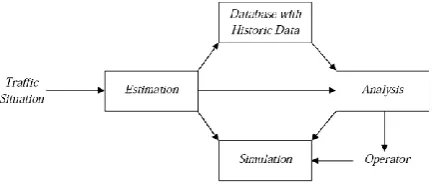
However, if the number of queues at every traffic light on crowded area is measured continuously and the information is sent to the control center, then this system becomes a closed loop [7]. On the other hand, a centralized traffic controller is one of the closed-loop system applications. Decision making in the traffic flow controller is determined based on the traffic data on some roads which is received by the control center. This system then guides the operators in the traffic control center when he/she is going to reduce congestion. That traffic control system is shown in Figure 1.
Figure 1: Decision Support System of Centralized Traffic Controller
III. FUZZY INFERENCE SYSTEM SUGENO METHOD The fuzzy inference system Sugeno Method was introduced in 1985. This method is almost the same as Mamdani Method. The fuzzification, fuzzy logic operation and implications are equal with Mamdani Method. The difference between the two of them is the type of output membership functions. The fuzzy inference system Sugeno Method uses output membership functions that are linear or constant [8].
The fuzzy inference system Sugeno Method has the form as shown in Equation (3).
If Input 1=x and Input 2= y, then Output is z=ax+by+c (3) The output of this rule is not in membership functions form, but in a number form that varies linearly to the input variables. If a = b = 0 then the fuzzy inference system is zero order, because the output is a constant number, that is z = c. The final output of Sugeno Method is calculated using Equation (4).
Output = (4)
[image:2.595.55.275.606.708.2]Where N is the number of rules. Rule in Sugeno Method is shown on the diagram in Figure 2.
Figure 2: Diagram of Rule in Sugeno Method
The inference as shown in Figure 2 is obtained from the set and correlation of inter-rules. There are three methods which are used to do fuzzy inference system which is max, additive (sum) and probabilistic OR (probor) [9].
A. Max Method (Maximum)
The solution of the fuzzy set in this method is obtained by taking the maximum value rule, then uses it to modify the fuzzy area, and applies it to the output by using the operation OR (union). If all propositions have been evaluated, then the output will contain a fuzzy set that reflects the contribution of each proposition. The equation for this method is shown below.
µsf[xi] ← max(μsf[xi], μkf[xi]) (5)
Where μsf[xi] is the membership value of fuzzy solution until
the i-rule, μkf[xi] is the membership value of the fuzzy
consequent i-rule.
B. Additive Method (Sum)
The solution of the fuzzy set in this method is obtained by bounded-sum of all output fuzzy area. The equation for this method is shown below.
μsf[xi] ← min(1,μsf[xi]+ μkf[xi]) (6) Where μsf[xi] is the membership value of fuzzy solution until
the i-rule, μkf[xi] is the membership value of the fuzzy
consequent i-rule.
C. Probabilistic OR Method (Probor)
The solution of the fuzzy set in this method is obtained by product for all the output fuzzy area. The equation for this method is shown below.
μsf[xi] ← (μsf[xi]+ μkf[xi]) - (μsf[xi] * μkf[xi]) (7)
Where μsf[xi] is the membership value of fuzzy solution until
the i-rule, μkf[xi] is the membership value of the fuzzy
consequent i-rule.
IV. DESIGN OF AN ADAPTIVE TRAFFIC LIGHT CONTROL SYSTEM
ISSN 2250-3153
Figure 3: Design of The Proposed Traffic Control System
This design is the development of an adaptive traffic light control system which has been designed before by Lai Guan Rhung and Kenneteh Tze Kin Teo. Adaptive traffic light control system is a control system which works based on traffic condition in the area of intersection [10]. The adaptive control systems are usually built by using fuzzy logic control.
[image:3.595.339.524.104.250.2]In this paper, the adaptive control system uses fuzzy logic control Sugeno Method. This system is used as a decision maker in controlling the traffic lights. The decision taken is the amount of green time. The amount of green time depends on the traffic flow condition at the intersection. The duration of the green time is a decision which is taken based on the rules in the fuzzy logic control system. The basic configuration of fuzzy logic control system is shown in Figure 4.
Figure 4: Basic Configuration of Fuzzy Logic Control System
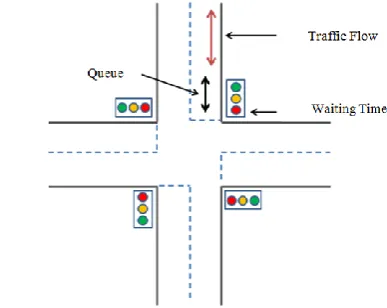
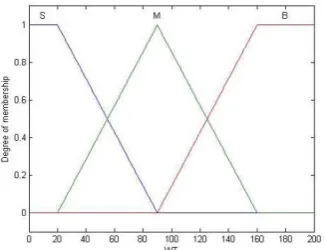
The input in the proposed system consists of three variables which are the number of queue (NQ) in smp or passenger car unit, traffic flow of vehicles which arrive to the intersection (TF) in smp per minute, and waiting time (WT) in seconds. The output of this system is green time duration (GT). The first input, NQ is divided into six membership functions i.e. neutral (N), very small (VS), small (S), medium (M), big (B) and very big (VB) with range [0:80]. The second input, TF is divided into three membership functions i.e. small (S), medium (M) and big (B) with range [0:20]. The third input, WT is divided into three membership functions i.e. small (S), medium (M) and big (B) with range [0:200]. The output, GT in a singleton form and it is divided into six
membership functions i.e. neutral (N), very small (VS), small (S), medium (M), big (B) and very big (VB) with range [0:50 ]. The design of the fuzzy systems is shown in Figure 5.
Figure 5: Fuzzy System with 3 Inputs and 1 Output using 30 Rules
Membership function of the number of queue as the first input is shown in Figure 6, traffic flow as the second input is shown in Figure 7, waiting time as the third input is shown in Figure 8, and membership function of the green time as the output is shown in Figure 9.
[image:3.595.348.511.347.467.2]Figure 6: Membership Function of Number of Queue (NQ)
[image:3.595.45.280.438.538.2]Figure 8: Membership Function of Waiting Time (WT)
Figure 9: Membership Function of Green Time (GT)
The proposed fuzzy system in this paper is built using 30 rules. The rules are shown in the list below.
Rules list of fuzzy traffic control system
1. If NQ is N then GT is N
2. If NQ is VS and TF is S then GT is N 3. If NQ is VS and TF is M then GT is N 4. If NQ is VS and TF is B then GT is N 5. If NQ is S and TF is S then GT is VS 6. If NQ is S and TF is M then GT is VS
7. If NQ is S and WT is S and TF is B then GT is VS 8. If NQ is S and WT is M and TF is B then GT is S 9. If NQ is S and WT is B and TF is B then GT is S 10. If NQ is M and TF is S then GT is S
11. If NQ is M and WT is S and TF is M then GT is S 12. If NQ is M and WT is M and TF is M then GT is M 13. If NQ is M and WT is B and TF is M then GT is M 14. If NQ is M and WT is S and TF is B then GT is M 15. If NQ is M and WT is M and TF is B then GT is M 16. If NQ is M and WT is B and TF is B then GT is B 17. If NQ is B and TF is S then GT is M
18. If NQ is B and WT is S and TF is M then GT is M 19. If NQ is B and WT is M and TF is M then GT is M 20. If NQ is B and WT is B and TF is M then GT is B 21. If NQ is B and WT is S and TF is B then GT is B 22. If NQ is B and WT is M and TF is B then GT is B 23. If NQ is B and WT is B and TF is B then GT is VB 24. If NQ is VB and TF is S then GT is B
25. If NQ is VB and WT is S and TF is M then GT is B 26. If NQ is VB and WT is M and TF is M then GT is B 27. If NQ is VB and WT is B and TF is M then GT is VB 28. If NQ is VB and WT is S and TF is B then GT is B 29. If NQ is VB and WT is M and TF is B then GT is VB
30. If NQ is VB and WT is B and TF is B then GT is VB
V. RESULT AND DISCUSION
In this paper, the simulation was done by creating an application. This application consists of two systems which are fuzzy system and fixed time system. The application is developed to compare the performance between the adaptive traffic light controller using fuzzy logic control Sugeno Method and traffic light control systems using fixed time. Figure 10 shows the simulation that was developed is used to measure the performance of both systems. The simulation uses provisions as follows:
1. The traffic light at intersection is designed into four phases
2. Each phase is assumed has the same width and considered ideal
3. The vehicle which arrives to the intersection in both of systems has same interval and considered ideal. The interval is randomized between 0 until 15 second
4. The vehicle which departs from the intersection in both of systems has the same interval and considered ideal. The interval is 1 second per vehicle
5. Phase in both of the system is regular and rotates in clockwise
6. The duration of the yellow time and the interval time inter-phase in both of the system is determined by the same parameters. The yellow time for 3 seconds and the interval time inter-phase for 2 seconds
[image:4.595.80.244.230.363.2]7. The duration of the green time in the fuzzy system is determined according to the output of the fuzzy logic control, while the duration of the green time in a fixed time system is determined by the values as follows: Phase 1 is for 31 seconds, Phase 2 is for 18 seconds, Phase 3 is for 29 seconds and Phase 4 is for 16 seconds The objective of this simulation is to observe the adaptive traffic light controller method which is proposed. This simulation results shows the performance comparison between traffic light controller using fuzzy logic Sugeno method and fixed time method. The duration of simulation is 3,600 seconds.
[image:4.595.308.560.541.685.2]ISSN 2250-3153
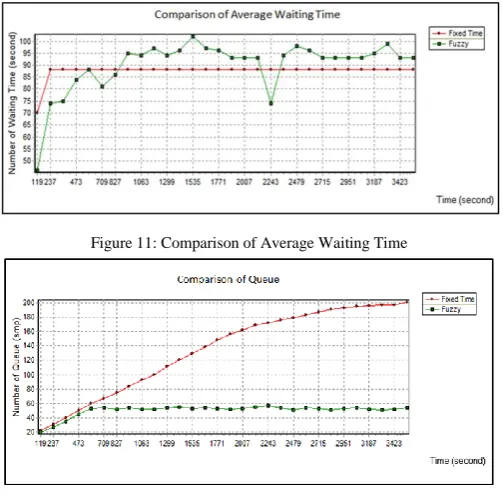
The performance of the system can be seen from the results of waiting time, number of queue and number of departure. The comparison results of both of the systems are presented in Table I. Data in Table I show that intersection using the fuzzy system can control the duration of the green time, the waiting time, the number of queues, and the number of departure relatively more balance in each phase when it is compared to the fixed time control system. The average of waiting time in the fuzzy system increased by 2.19 % when compared to the fixed time system. The comparison of the average waiting time is shown in Figure 11. The average number of queues on the fuzzy system has decreased by 62.48 % compared to fixed time system. Furthermore, the number of queues on fuzzy systems has reduced and stable. The comparison of average queue is shown in Figure 12.
[image:5.595.308.560.85.334.2]The performance of the proposed fuzzy system can also be seen from the number of departures from the intersection. In this simulation, both of the systems are given input by a number of vehicles with the same traffic flow. Data in Table I show that in a fixed time system, the number of departures is unbalanced on each phase, whereas fuzzy system shows balance result on each phase. The average number of departure has increased by 4.58 % compared to the fixed time system. The comparison of departure is shown in Figure 13.
TABLE I : COMPARISON OF AVERAGE WAITING TIME, NUMBER OF QUEUE AND NUMBER OF DEPARTURE PER CYCLE
Figure 11: Comparison of Average Waiting Time
[image:5.595.309.558.363.477.2]Figure 12: Comparison of Average Queue
Figure 13: Comparison of Average Departure
VI. CONCLUSION
The simulation results show that the system using fuzzy logic control Sugeno method can work adaptively according to the traffic condition around the intersection. The given random input can be responded by the fuzzy system. The fuzzy system provides output of the green time variously. Both of the traffic light control system which uses fuzzy logic control and fixed time control have different result in performance. If it is viewed from the waiting time, the proposed system in this paper has a lower performance compared to the fixed time based traffic light control system, because it has a longer waiting time than fixed time based traffic light control system. However, if viewed from the number of queues and the number of departures, the proposed system has better performance than the fixed time based traffic light control system. The proposed system can reduce the number of queues and can increase the number of departures.
REFERENCES
Variable Unit Phase Fixed Fuzzy % Comparison
Waiting Time (WT)
second
1 81 91.53 13.00
2 94 88.60 -5.74
3 83 90.30 8.80
4 96 90.37 -5.86
Average 88 89.93 2.19
Number of Queue
(NQ)
smp
1 109.87 56.90 -48.21 2 152.97 55.50 -63.72 3 124.27 56.33 -54.67 4 159.13 55.63 -65.04
Average 134.07 50.30 -62.48
Number of Departure
(NP)
smp
1 10.37 7.93 -23.53
2 6.03 8.20 35.99
3 9.77 8.03 -17.81
4 5.27 8.17 55.03
[image:5.595.38.292.381.599.2][1] L. Wu, X. Zhang, and Z. Shi, “An Intelligent Fuzzy Control for Crossroads Traffic Light,” 2010 Second WRI Glob. Congr. Intell. Syst., pp. 28–32, Dec. 2010
[2] M. G. H. Kulkarni and M. P. G. Waingankar, “Fuzzy Logic Based Traffic Light Controller,” no. August, pp. 8–11, 2007
[3] J. Favilla, “Fuzzy Traffic Control: Adaptive Strategies,” pp. 506–511 [4] L. G. Rhung, A. C. Soh, R. Z. A. Rahman, and M. K. Hassan, “Fuzzy
traffic light controller using Sugeno method for isolated intersection,” SCOReD2009 - Proc. 2009 IEEE Student Conf. Res. Dev., pp. 501– 504, 2009.
[5] K. Tze, K. Teo, K. Yeo, S. E. Tan, Z. W. Siew, and K. G. Lim, “Design and Development of Portable Fuzzy Logic based Traffic Optimizer,” pp. 7–12, 2013.
[6] I. B. Alit Swamardika, “Simulation of Detector Traffic Light Conrol System using PLC for Intersection of Waribang-Wr. Supratman Road Denpasar,” vol. 4, no. 2, pp. 1–5, 2005.
[7] A. Hegyi, B. De Schutter, S. Hoogendoornt, R. Babusw, H. Van Zuylent, and H. Schuurmant, “A Fuzzy Decision Support System for Traffic Control Centers,” pp. 358–363, 2001
[8] The Mathwork. Fuzzy Logic Toolbox User’s Guide, The Mathworks,Inc.2013.
[9] S. Kusumadewi, “Analist and Design of Fuzzy System Using Matlab Tool Box”,2002- Graha Ilmu
[10] W. Yong, “A cooperative fuzzy control method for traffic lights,” vol. 7, pp. 185–188, 2001
AUTHORS
First Author- Erwan Eko Prasetiyo, Universitas Gadjah
Mada, Yogyakarta, Indonesia, [email protected]
Second Author- Ir. Oyas Wahyunggoro, M.T., Ph.D.,
Universitas Gadjah Mada, Yogyakarta, Indonesia,
Third Author- Selo Sulistyo, S.T., M.T., M.Sc., Ph.D.,
Universitas Gadjah Mada, Yogyakarta, Indonesia,