JUNE-JULY, 2017, VOL. 4/22 www.srjis.com Page 5859 PICTURE EXCHANGE COMMUNICATION SYSTEM (PECS) TO
COMMUNICATE DAILY NEEDS -A CHILD WITH AUTISM
Usha. K
PhD scholar, Ramakrishna Mission Vivekananda University (RKMVU), Coimbatore
The present investigation is attempted to find out the effect of Picture Exchange Communication System (PECS) on improvisation of Functional Communication Skills in children with autism. Single case experimental research design was used in the present study. A 5 year old child with moderate autism having moderate communication ability was identified from the Care for Autism Center, Hyderabad. Indian Scale for Assessment of Autism (ISSA) was used to assess the level of autism and Childhood Autism Rating Scale (CARS) was used to assess the verbal and non verbal communication to find out the level of communication. Functional communication assessment checklist was used to determine communicative competence. Reinforcer assessment checklist was used to find out the reinforcer for food items, play items, activity materials, brushing and bathing, items. After prioritizing the items, 15 items which are necessary for functional communication purpose were selected for training by using PECS. After collecting the baseline, the PECS intervention was initiated. Everyday five sessions were conducted during snacks time, after lunch, and during play time and before leaving from the school for a period of 12 weeks. PECS training was implemented till Phase IV. PECS assessment checklist was used to collect the data on Functional Communication Skills. Pre, mid and post assessment was done. The Mid assessment was done at every 10th session and performance was recorded. Mean scores were computed for each domain The pre mean scores is 1.00 and post mean scores is 5.00. Gradual improvement was seen during the mid assessment. The result indicates that the PECS training was effective in improvement of functional communication skills in a child with autism.
Key terms: Picture Exchange Communication System (PECS), child with autism, functional communication skills
Introduction
Language and communication competency determines an individual’s functioning in many
aspects of life including education, employment, and general quality of life. A corollary is
that, persons who are not able to develop functional communication and
(Warren & Abbeduto, 2007). Competencies in communication enable individuals to realize
their goals for communication and to attain the “essence of their humanity” (Light, 1997, p.
Scholarly Research Journal's is licensed Based on a work at www.srjis.com
JUNE-JULY, 2017, VOL. 4/22 www.srjis.com Page 5860 1). Yet, research indicates that about 50% of persons with autism fail to develop adequate
speech and
---
Usha. K, PhD scholar, Ramakrishna Mission Vivekananda University(RKMVU), Coimbatore
language for their daily needs (Keen, Sigafoos, & Woodyatt, 2001; Light, Roberts, Dimarco,
& Grenier, 1998). Interventions designed to teach functional communication skills are
therefore very crucial for future outcomes of children with autism. Augmentative Alternative
Communication (AAC) strategies have been found successful for augmenting and/or
substituting
speech or communication for individuals with communication difficulties (Beukelman &
Mirenda, 2005). AAC strategies comprise unaided strategies such as sign language and
manual signs, and aided systems including synthetic speech generating devices and
picture-based strategies (Beukelman & Mirenda). The present study is aimed to improve the
functional communication skills in children with autism. The investigator has selected PECS
as a method to improve communication ability in children with autism.
Functional communication skills enable the individual to express basic needs and wants. It is
observed that functional skills are skills that are meaningful and useful in the person’s life. The present findings may have implications for practice for persons working with children
with autism who have functional communication needs. Communication skills provide a
foundation for social and personal relationships and exert powerful influences on behavior.
PECS requires few low-cost materials .It is simple to create PECS training It is a visually
based AAC system which employs direct reinforcement and motivates the learner to learn the
things in a natural environment. Significant impairment in communication manifested not
merely in the failure or delay in developing speech, but also non verbal modes of
communication such as eye contact, joint attention and pointing. As time goes by, a lack of
speech and /or a means of communication begins manifesting in the form of behavior
problems and tantrums and limits the socialization skills. Learning to communicate is
difficult for children with autism, so it is important to teach them to express their needs to
fulfill their needs. When they learn to communicate it will also help them to deal
appropriately in the situation. It helps them to interact with others which is also essential to
lead an independent life. The present study aimed at measuring the effect of Picture
Exchange Communication System (PECS) on improvisation in functional communication
skills in children with autism. Not many studies have been conducted in India. Therefore the
JUNE-JULY, 2017, VOL. 4/22 www.srjis.com Page 5861
communication skills need to be examined. If this system found to be effective, then it can be
used by the parents at home, teachers who are working with children with autism If the
training is given for sufficient duration, many other needs which are necessary to lead an
independent life can be taught easily.
Objectives of the study
1. To find out progress (pre, mid and post mean scores) in communicating for food items
(domain-1) by AN after teaching through PECS.
2. To find out progress (pre, mid and post mean scores) in communicating for play items
(domain-2) by AN after teaching through PECS.
3. To find out progress (pre, mid and post mean scores) in communicating for activity
materials(domain-3) by AN after teaching through PECS
4. To find out progress (pre, mid and post mean scores) in communicating for
brushing Items (domain-4) by AN after teaching through PECS
5. To find out progress (pre, mid and post mean scores) in communicating for
bathing Items(domain-5) by AN after teaching through PECS
6. To find out overall progress (pre, mid and post mean scores) in functional
communication skills (food items, play items, activity materials, brushing items and
bathing items) by AN after teaching through PECS
Review of Literature
Schwartz, Garfinkle and Bauer (1998) conducted two studies to evaluate the use of PECS.
The first study used 31 preschool aged children with communication needs and
developmental delays. Sixteen of these children had been diagnosed with autism. The result
of the study indicates all the 31 participants learned to use all five stages of PECS in 11
months. The second study employed 18 students (11 with autism) who had learned to use
PECS in the first study. This second experiment examined whether the children could use
PECS to communicate rather than just request simple items. All of the children could express
something they had experienced. Forty four percent of the children (33% of children with
autism) acquired spoken language. Their spoken language also generalized to other functional
settings. The result of the study encouraged to take up this study to find out the result in
Indian situation
Ganz and Simpson (2004) examined the role of PECS in improving the number of words
spoken, increasing the complexity and length of phrases, and decreasing the non-word
vocalizations of three young children with ASD and developmental delays (DD) with related
JUNE-JULY, 2017, VOL. 4/22 www.srjis.com Page 5862 increased distance, picture discrimination, and sentence construction). The results indicated
that PECS was mastered rapidly by the participants and word utterances increased in number
of words and complexity of grammar. The method of training while using PECS is clear in
this study.
Marckel, Neef and Ferreri (2006) conducted a preliminary analysis of teaching improvisation
with the picture exchange communication system to children with autism.Two young boys
with autism who used the picture exchange communication system were taught to solve
problems (improvise) by using descriptors (functions, colors, and shapes) to request desired
items for which specific pictures were unavailable. The results of a multiple baseline across
descriptors showed that training increased the number of improvised requests, and that these
skills generalized to novel items, and across settings and listeners in the natural environment.
Carr and Felce (2007) investigated the impact of mastery of the Picture Exchange
Communication System (PECS) to Phase III, on the communications of children with autism.
Children aged between 3 and 7 years, formed a PECS intervention group and a
non-intervention control group. The non-intervention group received 15 hours of PECS teaching over
5 weeks. Two hours classroom observations recorded communications between the children
and their teachers. These occurred: 6 weeks before teaching; during the week immediately
prior to teaching; during the week immediately following teaching. For the control group,
two hours observations for 5-week interval without PECS teaching. Communicative
initiations and dyadic interactions increased significantly between the children and teachers
in the PECS group but not for the control group.
Shahzadi Malhotra, Gaurav Rajender, Manjeet Bhatia, and Tej Singh (2010) studied the
process of using PECS along with other traditional behavioral approaches in managing
communication deficits and behavioral stereotypies in a seven-year-old male child diagnosed
as having childhood autism. The identified target behaviors of repeated head turning, flapping
his hands, poor communication skills were assessed using various rating scales including
visual analogue scale as per clinician observation and parental reports and managed using
PECS as an adjunct to traditional behavioral techniques of contingency management,
differential reinforcement, task direction and reprimand. Outcome was assessed using same
tools after thirty-two sessions of interventions spread over three months. Significant
improvements of around 60% were observed in the target behaviors. This study demonstrates
the utility of PECS as an important adjunct to traditional behavioral techniques in increasing
the independence levels in carrying out self help activities and significant enhancement in his
JUNE-JULY, 2017, VOL. 4/22 www.srjis.com Page 5863 Vijay Sagar ( 2011) review and discussed the aspects clinical profile, rating scales,
neurobiology, genetics, treatment and outcome of research done on ASD in India:. And
recommended for future research initiatives in the area of ASD on Large multi-centre
community prevalence studies, Outcome studies of well-defined cohort of subjects with
ASD, Exploration of neurobiological substrates using assessments like neuroimaging,
neuropsychological profile, eye movement recording etc. , setting up of clinic -based registry
at different Child Guidance Clinics across the country, development and validation of
effective screening and early intervention modules, development and validation of psycho
education and treatment manuals for parents of children with ASD.
Methodology
Single case experimental research design was used for the present study.
Tools and checklist
The following tools and checklist were used during the study.
1. Indian Scale for assessment of Autism (ISSA)
2. Childhood Autism Rating Scale (CARS)
3. Demographic data
4. Functional communication checklist
5. Picture exchange communication system assessment checklist
6. Reinforcer assessment checklist
Indian Scale for Assessment of Autism (ISSA): ISSA was used to assess the level of autism.
Childhood Autism Rating Scale (CARS): CARS was used to assess the verbal and non
verbal communication to find out the level of communication
Demographic data: The format was prepared by the investigator to collect the demographic
details of the case.
Functional Communication Assessment Checklist: The investigator has developed functional
communication checklist to assess the communication ability of the children.
Picture Exchange Communication System Assessment Checklist:Investigator has prepared
PECS assessment checklist to collect the data
Reinforcer Assessment Checklist: Investigator has prepared reinforcement assessment
checklist to find out the reinforcer for food, play and activity items for each children
Instructional materials
The following instructional materials were used during the study.
1. Communication folder with pictures
JUNE-JULY, 2017, VOL. 4/22 www.srjis.com Page 5864 Communication folder with pictures: The communication folder consists of three pictures
related to of food items.
Food items: The investigator has collected three items in food for training purpose.
Validation: The checklist prepared by the researcher and the pictures selected for the
intervention was distributed to the for selection/modification/ suggestions to experienced
special educators. According to their suggestions, modifications are made and again 90 to
100% consensus taken.
Data gathering Procedure.
The baseline data was collected through observation for 4days. PECS training were
conducted in several settings as the program progressed. Initial training were conducted in a
room, then in child’s classroom, playground at school, and at the child’s home. Intervention
was given for a total of 90 sessions for a period of 12 weeks upto phase IV
Phase I: Physical exchange
Phase II: Distance and Persistence
Phase III: Picture Discrimination
Phase IV: Sentence Structure
Phase I: Physical Exchange
The first phase of PECS teaches the user that icons can be used as communication tools
(Frost & Bondy, 1994, 2002). A communication partner, physical prompter along with the
child, were involved in the phase-I training. Individually identified items were displayed in
clear plastic containers or on a table, but they remained out of child’s reach until training
were conducted. A picture was kept in front of the child. A Communication partner showed a
item and provides gestural prompt by opening another hand, then the physical prompter
provided physical prompt to exchange the picture. Immediately after releasing, the picture
communication partner says the name of the item and verbally appreciates the child and
allows him to fulfill his need. If child tries to fulfill the need without exchanging the picture,
his responses were blocked. All the prompts were gradually faded and the communication
partner’s open handed prompt change to a close-handed one as the child demonstrates an
understanding of the association between giving the communication partner the picture and
access to the reinforcer. This process is repeated with other pictures in various settings, and
with various communicative partners. The second phase was started after reaching the criteria
JUNE-JULY, 2017, VOL. 4/22 www.srjis.com Page 5865 Phase II: Distance and Persistence
In phase two, the child is taught to independently retrieve icons and deliver them to a
communication partner who is not immediately available (Frost & Bondy, 1994, 2002).
Phase-II consists of placing one picture on the communication folder and placing in front of
the child. The child has to pick up the picture from the folder and release it to communication
partner. Immediately after releasing the picture communication partner says the name of the
item and verbally appreciates the child and allows him to fulfill his need. The distance
between the communication folder, then between the communication partner was gradually
increased from 0 to 9 inches and also to next room. In the beginning of this phase, pictures
were kept inside the first page of communication, slowly places of pictures were shifted to
next page. This is to make the child to search for the picture. Additionally, phase two used to
teach a child the important of persistence when communicating wants or needs. The child has
to give an item to a communication partner who initially has his or her back turned. This
process is repeated with other pictures in various settings, and with various communicative
partners. When the child exchanges the picture with distance and maintaining persistence
with 80 percent the third phase was introduced.
Phase III: Picture Discrimination
In phase three, the child learns that presenting his or her communication partner with
different pictures will result in different consequences and thus learns to discriminate
between icons and to select the icon for a desired object from a group of other icon
choices (Frost & Bondy, 1994, 2002). The phase III protocol for the PECS intervention
consisted of placing two pictures in the communication folder. The order in which these
pictures were placed on the board was altered randomly. One picture was highly desired item
while the other picture was less desired item. If the child picks the less desired picture, he
was given that item by the communication partner. When the child shows disinterest in it,
then the child was given with another chance to choose between the items. Once the child has
mastered this level of discrimination with two pictures , the number of pictures and items
presented was increased, and multiple pictures were introduced following the same
procedure. Until the child can discriminate between five pictures and look through multiple
pages in the communication the phase three ws continued .Once the child mastered with 80
JUNE-JULY, 2017, VOL. 4/22 www.srjis.com Page 5866 Phase IV: Sentence Structure
Phase four begins the next major phase of PECS training, in which the child is taught to
combine sentence strips with icons in order to form requests (e.g., “I WANT” sentence strip
plus the icon for “ball” in order to request the ball; Frost & Bondy, 1994, 2002)
Because they are naturally reinforcing, requests are taught first, with the child learning to
combine the “I WANT” sentence strip with an picture for the desired item. The child was
taught to construct the sentence and give the sentence strip to the communication partner,
The communication partner reads the sentence strip for example, saying “I WANT kurkure”
child will look at the sentence strip and by tapping the pictures tries to read the sentence
strip. The communicative partner allow the child to satisfy the need.
The same procedure was used to train all the eight cases by the investigator.
Result and Discussion
AN was 5 years old boy with moderate autism (as per ISSA) having moderate
communication abnormality (as per CARS) belongs to a middle class family, currently
attending Care for Autism Center at Hyderabad since from 6 months. During the observation
it was found that, he had a hard time in communicating with people and often fails to respond
when people are speaking to him. Whenever he wants to play he was getting the toy on his
own within his reach. If the toy or are not within his reach he used to cry. He was pampered
by his mother. Child was not given opportunity to express his needs. His mother was feeding
him. He easily gets distracted. Whenever his name was called he was responding to his
name. He was finding difficult to follow the direction either given visually or given orally.
Objective 1.
To find out progress (pre, mid and post mean scores) in communicating for food items
(domain-1) by AN after teaching through PECS.
Table: 1 Mean scores of AN in communicating for food items (domain-1) by using PECS
Food items (Domai n-1) Pr e Mid assessment Pos t M 1 M 2 M 3 M 4 M 5 M 6 M 7 M 8 M 9 M 10
Fryums 1.0
0 1. 00 2. 75 3. 25 3. 50 3. 75 3. 75 4. 00 4. 00 4. 50 5. 00 5.0 0 Cheese ball 1.0 0 1. 00 2. 75 3. 25 3. 50 4. 00 4. 00 4. 00 4. 00 4. 50 5. 00 5.0 0 Kurkur e 1.0 0 1. 00 2. 75 3. 25 3. 50 3. 75 4. 00 4. 00 4. 00 4. 50 5. 00 5.0 0
Total 1.0
0 1. 00 2. 75 3. 25 3. 50 3. 83 3. 92 4. 00 4. 00 4. 50 5. 00 5.0 0
JUNE-JULY, 2017, VOL. 4/22 www.srjis.com Page 5867 Table 1 depicts the result of AN in communicating for food items such as fryums, cheese ball
and kurkure by exchanging the correspondent pictures. The total pre mean scores is 1.00.
Initially AN is exchanging all the three picture of food items with physical prompt. A gradual
improvement was noticed during mid assessment. The total post mean scores of food items is
5.00. AN is exchanging the correct pictures of fryums, cheese ball and kurkure independently
to fulfill his need to get the food items when ever need arises. It indicates that intervention
given by using PECS is effective and it improved communication ability of AN in
communicating his needs for food items .Hence, the finding of the result is in accordance
with the objective – 1 that there is a progress (pre, mid and post mean scores) in
communicating for food items (domain-1) by AN after teaching through PECS.
Objective 2.
To find out progress (pre, mid and post mean scores) in communicating for play items
(domain-2) by AN after teaching through PECS.
Table: 2 Mean scores of AN in communicating for play items (domain-2) by using PECS
Play items (Domain-2) Pre Mid assessment Pos t M1 M2 M3 M4 M5 M6 M7 M8 M9 M1
0
Gyrotop 1.0
0 1.0 0 3.0 0 3.2 5 3.5 0 4.0 0 4.0 0 4.0 0 4.0 0 4.7 5 5.0 0 5.00
Bubbles 1.0
0 1.0 0 2.7 5 3.2 5 3.5 0 4.0 0 4.0 0 4.0 0 4.0 0 4.7 5 5.0 0 5.00
Fishing toy 1.0 0 1.0 0 2.7 5 3.2 5 3.5 0 4.0 0 4.0 0 4.0 0 4.0 0 4.7 5 5.0 0 5.00
Total 1.0
0 1.0 0 2.8 3 3.2 5 3.5 0 4.0 0 4.0 0 4.0 0 4.0 0 4.7 5 5.0
0 5.00
Mean score= Average of Phase I to IV scores
Table 2 portray result of AN in communicating for play items such as of gyrotop, bubbles
and fishing toy by exchanging the correspondent pictures. The total pre mean scores is 1.00.
Initially AN is exchanging all the three picture of play items with physical prompt. A gradual
improvement was noticed during mid assessment. The total post mean scores of play items is
5.00. AN is exchanging the correct pictures of gyrotop, bubbles, fishing toy independently
during play time and also whenever he want to go for play. It indicates that intervention
given by using PECS is effective and it improved communication ability of AN in
communicating his needs for play items . Hence, the finding of the result is in accordance
with the objective – 2 that there is a progress (pre, mid and post mean scores) in
JUNE-JULY, 2017, VOL. 4/22 www.srjis.com Page 5868 Objective 3
To find out progress (pre, mid and post mean scores) in communicating for activity
[image:10.595.83.510.177.293.2]materials(domain-3) by AN after teaching through PECS
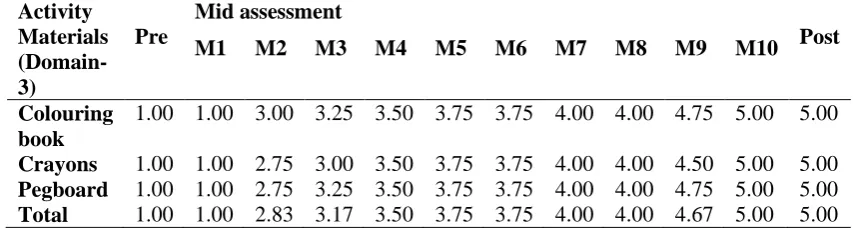
Table-3 Mean scores of AN in communicating for activity materials (domain-3) by using
PECS Activity Materials (Domain-3) Pre Mid assessment Post
M1 M2 M3 M4 M5 M6 M7 M8 M9 M10
Colouring book
1.00 1.00 3.00 3.25 3.50 3.75 3.75 4.00 4.00 4.75 5.00 5.00
Crayons 1.00 1.00 2.75 3.00 3.50 3.75 3.75 4.00 4.00 4.50 5.00 5.00
Pegboard 1.00 1.00 2.75 3.25 3.50 3.75 3.75 4.00 4.00 4.75 5.00 5.00
Total 1.00 1.00 2.83 3.17 3.50 3.75 3.75 4.00 4.00 4.67 5.00 5.00
Mean score= Average of Phase I to IV scores
Table 3 describe result of AN in communicating for activity materials such as colouring book, crayons and pegboard by exchanging the correspondent pictures. The total pre mean scores is 1.00. Initially AN is exchanging all the three picture of activity materials with physical prompt. The total mean scores of activity materials is 5.00.AN is exchanging the correct pictures of colouring book, crayons and pegboard independently during leisure time and also whenever he wants to do the activity. It indicates that intervention given by using PECS is effective and it improved communication ability of case-I in communicating his needs for activity materials. Hence, the finding of the result is in accordance with the objective – 3 that there is a progress (pre, mid and post mean scores) in communicating for activity materials by AN after teaching through PECS.
Objective 4
To find out progress (pre, mid and post mean scores) in communicating for brushing Items
(domain-4) by AN after teaching through PECS
Table: 4 Mean scores of AN in communicating for brushing items (domain-4) by using
PECS Brushing Items (Domain-4) Pre Mid assessment Pos t M 1 M 2 M 3 M 4 M 5 M 6 M 7 M 8 M 9 M 10
Brush 1.0
0 1.0 0 2.7 5 3.2 5 3.5 0 4.0 0 3.7 5 4.0 0 4.0 0 4.2 5 5.0 0 5.0 0
Paste 1.0
0 1.0 0 2.7 5 3.2 5 3.5 0 3.7 5 3.7 5 4.0 0 4.0 0 4.2 5 5.0 0 5.0 0
Towel 1.0
0 1.0 0 3.0 0 3.0 0 3.5 0 4.0 0 3.7 5 3.7 5 4.0 0 4.5 0 5.0 0 5.0 0
Total 1.0
0 1.0 0 2.8 3 3.1 7 3.5 0 3.9 2 3.7 5 3.9 2 4.0 0 4.3 3 5.0 0 5.0 0
JUNE-JULY, 2017, VOL. 4/22 www.srjis.com Page 5869 Table 4 illustrate result of AN in communicating for brushing items such as brush, paste and
towel by exchanging the correspondent pictures. The total pre mean scores is 1.00. Initially
AN is exchanging all the three picture of brushing items with physical prompt. The total
mean scores of brushing items is 5.00.AN is exchanging the correct pictures of brush, paste
and towel independently during brushing time It indicates that intervention given by using
PECS is effective and it improved communication ability of AN in communicating his needs
for brushing items. Hence, the finding of the result is in accordance with the objective – 4
that there is a progress (pre, mid and post mean scores) in communicating for activity
brushing items by AN after teaching through PECS.
Objective 5
To find out progress (pre, mid and post mean scores) in communicating for bathing Items
(domain-5) by AN after teaching through PECS
Table: 5 Mean scores of AN in communicating for bathing items (domain-5) by using
PECS
Bathing item (Domain-5)
Pre
Mid assessment
Post
M1 M2 M3 M4 M5 M6 M7 M8 M9 M10
Bucket 1.00 1.00 2.75 2.75 3.50 3.75 4.00 3.75 4.00 4.50 5.00 5.00
Mug 1.00 1.00 3.00 2.75 3.50 3.75 4.00 3.75 4.00 4.50 5.00 5.00
Soap 1.00 1.00 2.75 2.75 3.50 4.00 4.00 3.75 4.00 4.25 5.00 5.00
Total 1.00 1.00 2.83 2.75 3.50 3.83 4.00 3.75 4.00 4.42 5.00 5.00
Mean score= Average of Phase I to IV scores
Table 5 shows the result of AN in communicating for bathing items such as bucket, mug and
soap by exchanging the correspondent pictures. The total pre mean scores is 1.00.Iinitially
AN is exchanging all the three picture of bathing items with physical prompt. A gradual
improvement is noticed during mid assessment. The total post mean scores of bathing items
is 5.00 .AN is exchanging the correct pictures of bathing items such as Bucket, mug and soap
independently to fulfill his need to get the bathing items during bathing time . It indicates
that intervention given by using PECS is effective and it improved communication ability of
AN in communicating his needs for bathing items, Hence, the finding of the result is in
accordance with the objective – 5, that there is a progress (pre, mid and post mean scores) of
communicating for bathing items by AN after teaching through PECS.
Objective 6
To find out overall progress (pre, mid and post mean scores) in functional communication
skills (food items, play items, activity materials, brushing items and bathing items) by AN
JUNE-JULY, 2017, VOL. 4/22 www.srjis.com Page 5870 Table: 6 Overall Mean scores in functional communication skills of AN
Overall Functional communication skills
Pre
Mid assessment
Post
M1 M2 M3 M4 M5 M6 M7 M8 M9 M10
1.00 1.00 2.82 3.12 3.50 3.87 3.88 3.93 4.00 4.53 5.00 5.00
Mean score= Average of Phase I to IV scores
Table 6 shows overall mean scores of AN in functional communication skills. The overall
pre mean scores 1.00. Initially AN is exchanging all the pictures with physical prompt. A
gradual improvement is noticed during mid assessment. The post mean scores is 5.00. AN is
exchanging all pictures correctly to fulfill his needs. It indicates that intervention given by
using PECS is effective and it improved functional communication ability of case-I Hence,
the finding of the result is in accordance with the objective – 6, that there is overall progress
(pre, mid and post mean scores) in functional communication skills (food items, play items,
activity materials, brushing items and bathing items) by AN after teaching through PECS.
After the PECS training AN was discriminating the pictures , by constructing the sentence
independently exchanging all the fifteen pictures to communicate his need appropriately
according to the situation with variety of communicative partner with a distance of more
than 9 feet. It indicates the role of PECS training in improvisation of functional
communication skills in children with autism. Rapid learning to exchange pictures to request
items they wanted has been well documented in the literature (e.g., Ganz & Simpson,
2004)Thus, this study further supports the use of PECS with children with autism to promote
the use of a functional communication system.
Qualitative Analysis:
In addition to quantitative analysis qualitative analysis was also done. In was the first day of
intervention the child entered the room along with his mother. He was holding her hand and
not ready to live her. Investigator started talking to the child . he started crying and he
wanted to gout from the room. As the investigator already assessed highly preferred reinforce
for the child, investigator placed the fishing toy in front of the child. As soon as the child
heard the music and moving fishes in the toy. Suddenly he extended his hand to catch the toy.
Investigator started talking with the child and allowed the child to touch the toy. The child
started playing with the toy. After few minutes investigator switched off the toy. Again he
started crying immediately he was allowed to play with the toy.
Next day a picture and fishing toy was kept on the table. Both the mother and child entered
the room, investigator was sat on chair. she asked both of them to sit on the chair. Child
JUNE-JULY, 2017, VOL. 4/22 www.srjis.com Page 5871 the child to reach to the picture. Investigator was extended his open hand by providing
gestural clue. With the help of physical prompter child released the picture in the hand of
investigator. Immediately by naming the toy as “fishing toy” investigator allowed the child to
play with the toy and simultaneously investigator verbally reinforced the child. As other
pictures also introduced child learned to exchange the pictures in a faster way. The role of
communication partner and physical prompter was exchanged frequently.
Gradually he was motivated to exchange the pictures to get the item. He leant to exchange
the picture in a faster way.
After few sessions there was a change in the behavior of the child. Child was completing the
given task, he used to replace the items in its original place. In the classroom child started
sharing the things with others. He was following simple instruction .During the conversation,
to say yes and no he was nodding his head.
the physical prompter, while the researcher acted as the communicative partner.
These roles were alternated as training proceeded After few session of training it was
observed by the researcher that, his attention span was increased, he was sitting at one place
and completing the given task. He started giving eye contact and regular to the school.
As per the conversation with his mother she was happy that he was identifying his brush also
interested in doing brushing activity. He was not pulling any item from others hand he was
waiting for his turn to come. He started identifying other household itmes like glass, spoon,
plate, water in the kitchen. Like earlier he used to go to the needy place if it is reachable he
was taking the items without communicating with anyone. After the intervention it was
noticed by his mother that he started initiating to communicate with his mother. Mother was
very supportive throughout the study. She wanted to continued the PECS training to her
child.
There was an improvement in his academic skills he was learned to count the object till five.
He was showing interest in writing. Regular exposure to pegboard he identifies two shapes
circle and square. He identifies colours such as red and green.
The cooperation given by the mother and teaching in natural setting made the child to master
the functional communication skills. After the intervention AN was able to exchange all the
15 pictures independently in an appropriate situation.
Major findings
It was found that there was an improvement in communication skills by AN for
communicating his needs for food items, play items, activity materials, brushing and bathing
JUNE-JULY, 2017, VOL. 4/22 www.srjis.com Page 5872 Conclusion:
Result indicates that PECS training is effective in teaching functional communication skills in
children with autism. As a result of 90 sessions of intervention till phase IV increased the
level of communication skills . PECS can also used to teach other functional skills necessary
for daily living.
References
Schwartz, I. S., Garfinkle, A. N., & Bauer, J. (1998). The Picture Exchange Communication System: Communicative outcomes for young children with disabilities. Topics in Early Childhood Special Education, 18, 144 –159.
Ganz and Simpson (2004) Effects on communicative requesting and speech development of the picture exchange communication system in children with characteristics of autism. Journal of Autism and Developmental Disorders, 34, 395–409.
Marckel, J.M, Neef, N.A. & Ferreri, S.J. (2006). A preliminary analysis of teaching improvisation with the picture exchange communication system to children with autism. Journal of Applied Behavior Analysis, 39, 109-115.
Carr and Felce (2007) The effects of PECS teaching to phase III on the communicative interactions between children with autism and their teachers. Journal of Autism and Developmental Disorders, 37, 724–737.
Shahzadi Malhotra, Gaurav Rajender, Manjeet S. Bhatia, and Tej B. Singh (2010) Effects of Picture Exchange Communication System on Communication and Behavioral Anomalies in Autism Indian Journal of Psychological Medicine . 32(2): 141–143.