www.ijsrp.org
Simulation Analysis of AODV, DSR and ZRP Routing
Protocols in MANET using QualNet 5.0 Simulator
Mukesh Kumar Garg*, Dharam Vir**, Dr. S.K. Agarwal***
*
Department of Computer Engineering, YMCA University of Science & Technology, Faridabad,India
**, ***
Department of Electronics Engineering, YMCA University of Science & Technology, Faridabad, India
Abstract- Mobile Ad Hoc Networks are formed by devices that are able to communicate with each other using a wireless physical medium without having a route to a preexisting network infrastructure.Mobile means moving and Ad Hoc means temporary without any fixed infrastructure so mobile ad hoc networks are a kindof temporary networks in which nodes are moving without any fixed infrastructure or centralized administration. In this paper, we evaluate simulation and analysis based performance comparison of reactive and hybrid routing protocols: we use performance metric for simulation number of hop count, number of routes selected, RREQ packets forwarded, RREP packets received and number of update Packets/Messages receivedby above routing protocols has been carried out using QualNet 5.0 Simulator. The result shows that neither of the protocol is best in all situations. For some parameters one outperforms the other and vice-versa for some other parameters.
Index Terms- AODV, DSR, MANETs, ZRP, QualNet 5.0
I. INTRODUCTION
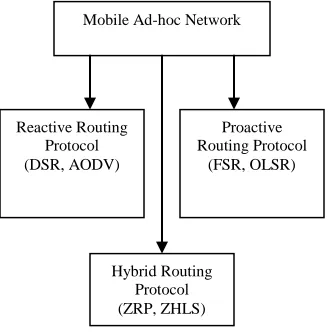
[image:1.612.81.245.545.712.2]obile Ad Hoc Networks (MANETs) [1][2] are wireless networks that continually re-organize themselves in response to their environment without the benefit of a pre-existing infrastructure. Several routing protocols have been developed to suit Ad Hoc networks. The routing protocols in MANETs are classified into three different categories according to theirfunctionality and performance: Proactive (Table driven) routing protocols, Reactive (On-demand) routing protocols and Hybrid routing protocols [3].
Fig. 1: Classification of routing protocols
Proactive Routing Protocols: In these protocols, therouting information is stored in the structure of tables maintained by each node. These tables need to be updateddue to frequent change in the topology of the network. These protocols are used where the route requests arefrequent. STAR, FSR, GSR, DSDV, CGSR, OLSR and WRP are the examples.
Reactive Routing Protocols: They involve discovering routes toother nodes only when they are needed. A route discovery process is invoked when a node wishes tocommunicate with another for which it has no route table entry. DSR, AODV, LAR, TORA, CBRP and ARA are the examples.
Hybrid Routing Protocols:Hybrid routing protocols which combine merits of both the proactive and reactive approaches. Such hybrid protocols offer means to switch dynamically between proactive and reactive parts of protocol. For instance, proactive protocols could be used between networks and reactive protocols inside the networks. ZRP, DST, DDR, ZHLS are the examples.
The rest of the paper is organized as follows: section- II gives a brief description and overview Manet routing protocols AODV, DSR and ZRP. Section IIISimulation setup and environment gives a detailed description of our proposed work. Section IV Simulation Result. Finally, conclusion and future work are presented in section V.
II. Brief Description and Overview of Routing Protocol of MANET (AODV, DSR, and ZRP)
Overview Adhoc ON Demand Distance Vector Routing Protocol (AODV):
The AODV Routing protocol [4] uses an on-demand move toward for finding routes, that is, a route is established only when it is required by a source node for transmitting data packets. It employs destination sequence numbers to identify the most recent path. The major difference between AODV and Dynamic Source Routing (DSR) stems out from the fact that DSR uses source routing in which a data packet carries the complete path to be traversed. However, in AODV, the source node and the intermediate nodes accumulate the next-hop information corresponding to each flow for data packet transmission. In an on-demand routing protocol, the source node floods the route request packet in the network when a route is not available for the desired destination. It may obtain multiple routes to different destinations from a single route request. The major difference between AODV and other on- demand routing protocols is that it uses a destination sequence number to determine an up-to-date path to the destination. A node updates its path information only if the destination sequence number of the current packet received
M
Mobile Ad-hoc Network
Hybrid Routing Protocol (ZRP, ZHLS)
Proactive Routing Protocol
(FSR, OLSR) Reactive Routing
www.ijsrp.org is greater than the last destination sequence number stored at the
node. A route request carries the source identifier, the destination identifier, the source sequence number, the destination sequence number, the broadcast identifier, and the time to live (TTL) field. Destination sequence number indicates the freshness of the route that is accepted by the source. When an intermediate node receives a route request, it either forwards it or prepares a route reply if it has a valid route to the destination. The validity of a route at the intermediate node is determined by comparing the sequence number at the intermediate node with the destination sequence number in the route request packet. If a route request is received multiple times, which is indicated by the broad cast indentation number pair, the duplicate copies are discarded. All intermediate nodes having valid routes to the destination, or the destination node itself, are allowed to send route reply packets to the source. Every intermediate node, while forwarding a route request, enters the previous node address and its broadcast identification number. A timer is used to delete this entry in case a route reply is not received before the timer expires. This helps in storing an active path at the intermediate node as AODV does not employ source routing of data packets. When a node receives a route reply packet, information about the previous node from which the packet was received is also stored in order to forward the data packet to this next node as the next hop toward the destination [5][10].
Overview of Dynamic Source Routing (DSR):
The Dynamic Source Routing protocol [6][7] is composed of two main mechanisms route discovery and route maintenance.
Route Discovery:It is the mechanism by which a source node wishing to send a packet to a destination node, obtains a source route to the destination.
Route maintenance:It is the mechanism by which a node wishing to send a packet to a destination is able to detect, while using a source route to the destination, if the network topology has changed. A routing entry in DSR contains all the intermediate nodes information of the route rather than just the next hop information maintained in DSDV and AODV. A source puts the entire routing path in the data packet, and the packet is sent through the intermediate nodes specified in the path. If the source does not have a routing path to the destination, then it performs a route discovery by flooding the network with a route request (RREQ) packet. Any node that has a path to the destination in question can reply to the RREQ packet by sending a route reply (RREP) packet. The reply is sent using the route recorded in the RREQ packet.
Need for route discovery: DSR allows nodes to operate their network interfaces in promiscuous mode and the all data packets sent by their neighbors. Since complete paths are indicated in data packets, snooping can be very helpful in keeping the paths in the route cache updated. To further reduce the cost of route discovery, the RREQs are initially broadcasted to neighbors only by zero-ring search, and then to the entire network if no reply are received. When an intermediate node forwarding a packet detects through Route Maintenance that the next hop along the route for that packet is broken, if the node has another route to the packets ΄s destination it uses it to send the packet rather than discard it [10].
Overview of Zone Routing Protocol (ZRP):
Zone Routing Protocol or ZRP[8] [9] was the first hybrid routing protocol with both a proactive and a reactive routing component. ZRP was first introduced by Haas in 1997. ZRP is proposed to reduce the control overhead of proactive routing protocols and decrease the latency caused by routing discover in reactive routing protocols. In ZRP, the distance and a node, all nodes within-hop distance from node belongs to the routing zone of node. ZRP is formed by two sub-protocols [11], a proactive routing protocol: Intra-zone Routing Protocol (IARP) is used inside routing zones and a reactive routing protocol: Inter-zone Routing Protocol (IERP) is used between routing zones, respectively. A route to a destination within the local zone can be established from the proactively cached routing table of the source by IARP; therefore, if the source and destination is in the same zone, the packet can be delivered immediately. Most of the existing proactive routing algorithms can be used as the IARP for ZRP.
III. SIMULATION SETUP AND ENVIORMENT
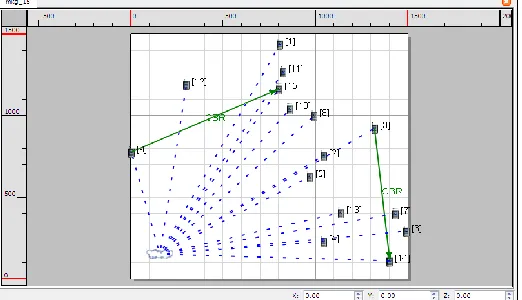
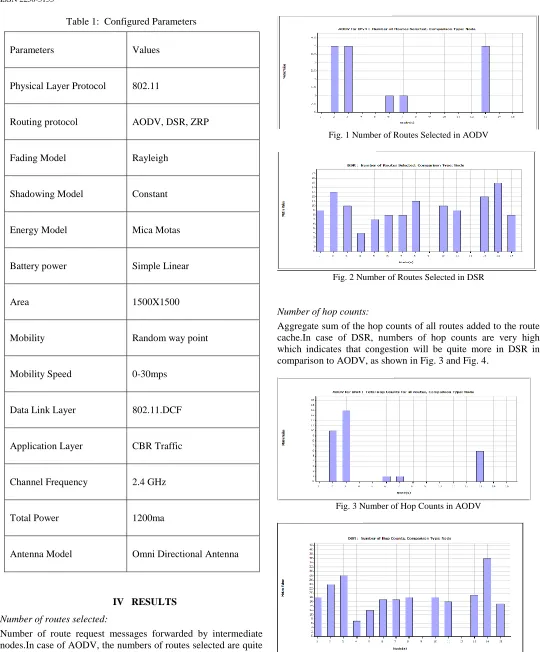
[image:2.612.316.577.561.711.2]The objective of this work is to simulate and analyzed the performance evaluation of various routing protocols by using QualNet 5.0 simulator [13]. A simulation can be very useful because it is possible to scale the networks easily and therefore to eliminate the need for time consuming and costly real world experiments. While the simulator is a powerful tool, it is important to remember that the ability to do predictions about the performance in the real world is dependent on the accuracy of the models in the simulator.The following parameters were configured as shown in Table 1. The parameters were configured different routing protocols like as AODV, DSR and ZRP are chosen for simulation [10][11][12] using the performance metrics like as number of hop count, number of routes selected, RREQ packets forwarded, RREP packets received and number of update Packets/Messages receivedwith different scenarios on 15 numbers of nodes.A scenario with 15 nodes with random nodes placement is shown in Fig. 1. The nodes were randomly distributed in 1500 X 1500 unit area. The nodes 3, 9 (as Source) and 14, 15 (as Destination) were connected and 1kb data was transmitted. The simulation time was run for 30 seconds. The routing protocols taken were AODV,DSR, ZRP and a comparison of the following parameters have been done.
www.ijsrp.org Table 1: Configured Parameters
IV RESULTS
Number of routes selected:
Number of route request messages forwarded by intermediate nodes.In case of AODV, the numbers of routes selected are quite less in comparison to DSR which indicates that redundant paths are more in route finding in case of DSR, as shown in Fig. 1 and Fig. 2.
[image:3.612.36.576.42.694.2]Fig. 1 Number of Routes Selected in AODV
Fig. 2 Number of Routes Selected in DSR
Number of hop counts:
[image:3.612.312.564.414.704.2]Aggregate sum of the hop counts of all routes added to the route cache.In case of DSR, numbers of hop counts are very high which indicates that congestion will be quite more in DSR in comparison to AODV, as shown in Fig. 3 and Fig. 4.
Fig. 3 Number of Hop Counts in AODV
Fig. 4 Number of Hop Counts in DSR
Parameters Values
Physical Layer Protocol 802.11
Routing protocol AODV, DSR, ZRP
Fading Model Rayleigh
Shadowing Model Constant
Energy Model Mica Motas
Battery power Simple Linear
Area 1500X1500
Mobility Random way point
Mobility Speed 0-30mps
Data Link Layer 802.11.DCF
Application Layer CBR Traffic
Channel Frequency 2.4 GHz
Total Power 1200ma
www.ijsrp.org Number of RREQ packets forwarded:
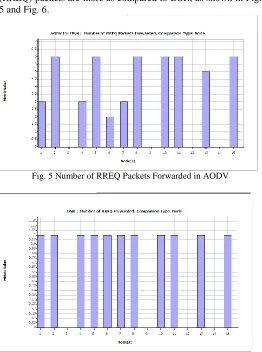
[image:4.612.314.561.55.211.2]Number of data packets forwarded between source nodes to destination.In case of AODV, the numbers of route request (RREQ) packets are more as compared to DSR, as shown in Fig. 5 and Fig. 6.
Fig. 5 Number of RREQ Packets Forwarded in AODV
Fig. 6 Number of RREQ Packets Forwarded in DSR
Number of RREP packets received:
[image:4.612.37.299.103.455.2]Number of route replies received by the source node to destination nodes. The numbers of route reply (RREP) packets are quite similar in both AODV as well as DSR, as shown in Fig.7 and Fig. 8
Fig. 7 Number of RREP Packets Received in AODV
Fig. 8 Number of RREP Packets Received in DSR
Number of RERR packets received:
[image:4.612.311.571.288.615.2]Number of route error packets received form source node to destination node.In case of AODV, the numbers of route error (RERR) packets are more as compared to DSR, as shown in Fig. 9 and Fig. 10.
Fig. 9 Number of RERR Packets Received in AODV
Fig. 10 Number of RERR Packets Received in DSR
Number of Periodic/Regular updates sent:
[image:4.612.39.291.556.684.2]www.ijsrp.org
Fig. 11 Number of Regular updates sent in ZRP
Number of update Packets/Messages received:
[image:5.612.37.290.319.468.2]Total number of periodic update messages received from source node to destination node. The numbers of update packets in ZRP, as shown in Fig. 12.
Fig. 12 Number of update messages received in ZRP
Table 2: Comparison between AODV, DSR and ZRP
V CONCLUSION
This paper compares and analyzes the performance of the three routing protocols AODV, DSR and ZRP in QualNet 5.0 Simulator. The evaluation shows that the number of possible routes selected is quite less in case of AODV in comparison to DSR. This implies that on using DSR we have more redundant paths. The hop count for a route is quite less in case of AODV in comparison to DSR indicating that it is less prone to network congestion. The congestion due to route reply is more in AODV than DSR. The number of route error messages is quite high in case of AODV implying that under given condition there are more chances of error in AODV in comparison to DSR. The main characteristics have been presented and a thorough evaluation has been carried out for ZRP against DSR and AODV. Regretfully ZRP was not up to the task and it performed poorly throughout all the simulation sequences, hence putting itself out of competition. AODV performed well in most of the network sizes (better than ZRP). Table 2 is very much useful for researcher because of resultant of reactive and hybrid protocols. The results also throw a challenge and an excellent opportunity to look deeper into ZRP protocol.
ACKNOWLEDGMENT
The authors wish to acknowledge Varinder Singh, YMCA University of Science & Technology, Faridabad, India, for his continual support to carry out this work.
REFERENCES
[1] M. Abolhasan, T. Wysocki and E. Dutkiewicz, “A review of Routing Protocols for Mobile Ad Hoc Networks”, Ad Hoc Networks, vol.2, issue1, pp.122, Jan.2004.
[2] Joseph Macker and Scott Corson, “Mobile Ad Hoc networks (MANET)”. http://www.ietf.org/proceedings/01dec/183.htm, December 2001.
[3] Jun-Zhao Sun, “Mobile Ad Hoc Networking: An Essential Technology for Pervasive Computing,” Proceedings of International conference on info-tech and info-net, Vol-3, pp. 316-321, 2001.
[4] C. Perkins and E. M. Royer, “Ad Hoc On-Demand Distance Vector (AODV) Routing”, Proceeding of IEEE workshop on Mobile Computing Systems and Applications 1999, pp. 90-100, February 1999.
[5] Vincent D. Park and M. Scott Corson, “Adhoc On demand Distance Vector (AODV)version 4: Functional specification,” Internet- Draft,draft-ietfmanet- AODV-spec-04.txt, July 2001
[6] D.B. Johnson and D.A. Maltz,”Dynamic Source Routing in Ad Hoc Wireless Networks”, Mobile Computing, Kluwer Academic Publishers, Vol. 353, pp.153-181, 1996.
[7] Johnson, D. A. Maltz, and Y.-C. Hu, “The Dynamic Source Routing Protocol for Mobile Ad Hoc Networks (DSR)", IETF Draft, April 2003, work in progress. [Online].
Available: http://www.ietf.org/internet-drafts/draft-ietf-manet-dsr-09.txt
[8] Z.J. Haas,”The Routing Algorithm for the Reconfigurable Wireless Networks”, Proceeding of ICUPC 1997, Vol.2, pp.562-566, October 1997. [9] Zygmunt J. Haas, Marc R. Pearlman,Prince Samar, “ The Zone Routing
Protocol (ZRP) for Ad Hoc Networks,” draft-ietf-manet-zone-zrp-04.txt, July 2002.
[10] C. Perkins, E.M. Royer, S.R. Das, and M.K. Marina, “Performance Comparison of Two On- demand Routing Protocols for Ad Hoc Networks,”
IEEE Personal Communications, pp. 16-28, Feb. 2001.
[11] Zygmunt J. Haas, senior member IEEE and Marc R. Pearlman, member, IEEE “The performance of query control schemes for the zone routing protocol” ieee/acm transactions on networking, vol. 9, no. 4, August 2001.
Parameters AODV DSR ZRP
Hop Count Normal Very High Medium
Possible Routes Selected Less More Medium
Congestion Medium More Medium
UpdatePackets/ Messages Received
Almost Same
Almost Same
Very Low
Error Messages More Less Medium
Routing Scheme Reactive Reactive Hybrid
[image:5.612.36.301.534.746.2]www.ijsrp.org [12] Sree Ranga Raju and Dr. Jitendranath Mungara, “ZRP Versus AODV and
DSR: A Comprehensive Study on ZRP Performance”, IJCA (0975-8887), Volume 1 – No. 12, 2010.
[13] The Network Simulator QualNet 5.0, [Online], Available:
http://www.scalable-network.com/products/qualnet/
AUTHORS
Mukesh Kumar Garg - receivedhis M.Tech. in Computer Engineering fromMD University, Rohtak, Haryana, India in the year 2010. He started his carrier as Field & Customer Support Engineer in the field of Computers and Networking since 1991. At present he is working with the Department of Computer Engineering, YMCA University of Science &Technology, Haryana, India.His research interests includeMobile Ad Hoc Networks and Software Testing. Email address: [email protected]
Dharam Vir-DharamVir received his M.Tech degree in Electronics Engineering form MDU Rothak in 2008. He started his carrier as R&D Engineer in the field of Computers and Networkingsince 1992. At present he is the part of YMCA University of Science & Technology as Head of Section (Electronics & Inst. Control) in the Department of Electronics Engineering. He is pursuing Ph.D in the field of MobilMobile Ad hoc Networks. Presently he is working in the field of performance improvement in MANET routing (Power
aware routing protocol). His current interests in power control in wireless network system, wireless communication and computer networks.
Email address: [email protected]
Dr. S.K. Agarwal- received the M.Tech Degree from Delhi Technical University. New Delhi and PhD degree in Electronics Engg. from Jamia Millia Islamia Central University. New Delhi in 1998 and 2008, respectively. Since 1990,he has been part of YMCA University of Science & Technology, Faridabad (Haryana), as Dean & Chairman in Department of Electronics and Communication Engineering. He has more than 20 publications in journals and conferences of repute. His current research interests are in the field of Control System, electronics and biosensors, Analog Electronics, wireless communication and digital circuits.