Design And Construction Of Amicro-Controller
Basedpower Conservation Device For Hall
Ahoro .O1 and Sogbaike C. O2
Delta State Polytechnic12
Otefe-Oghara Delta State
DOI: 10.29322/IJSRP.9.05.2019.p89109
http://dx.doi.org/10.29322/IJSRP.9.05.2019.p89109
ABSTRACT:
This paper presents the implementation of PIC microcontroller based Powerconservation device for large hall using thermal, temperature and illumination sensors with in/out counter at the entrance. The thermal sensor used for detecting human presence through infrared radiation of heat by human body, temperature sensor is used to continuously monitor the hall temperature in sub areas. The illumination sensors are used to measure the lux level. The multiple sensors outputs multiplexed on I2C communication protocol and extended with P82B715D to connect all the sensors in sub areas.The sensors output are in digital format which required no conditioning interface to PIC18F4550. The fans and lights control signals are multiplexed and isolated from AC high voltage. The Microcontroller preset values are compared with sensors readings to turn ON/OFF fans/lights. Light are turned off when lux is below
300lux and fans are turned on when temperature is above 200C when there is presence of human with that sub areas. The numbers of
persons are counted at the entrance and the system switches every appliance off with no person counted.
KEYWORDS: Thermal Sensor, Temperature Sensor, Link Extender, Ethernet CAT 5 cable, Multiplexer.
1.0
INTRODUCTIONElectricity is one of the most important resources in this century, we should conserve electricity proactively by way of automation.
Many times we come outside the room/hall and forget to turn off the light/fan, thus the electricity is wasted (1). Home automation is a
widely used and accepted automation system. There are many approaches to control the electrical and electronic home appliances
according to the attendance of persons [2], [3].
These project, “Microcontroller Based Power conservation device for hall” will address the challenge of energy wastage by
controlling lights and fans in entire or sub areaswithin the seminar hall or conference center where persons are not occupying. And
when number of persons inside the room is zero, power supply inside the hall can be cut using a relay interface.
This paper is aimed at creating a system that can control multiple appliances according to their locations’ variables of light intensity,
temperature and human presence in sub areas of the hall. We have proposed a large hall of (12m X 9m), partitioned into four zones of
location and geographical orientation, as the level of electric light and fan cooling varies even in sub areas within a zone [4]. Another
crucial challenge is choice of sensors, the parameters like distance, angle and coordinates are calculated using the position of the
sensing device for accurate human location in the field of view (FOV) or targeted location. IR sensors for concerning range, accuracy,
and FOV. This research work has proposed Omron D6T-44L-06 MEMS IR sensor which results 4x4 array pixel low-resolution
thermal image as graphical output.The number of required sensors is based on size of FOV and human count by avoid the interference
range between multiple sensors [5].
The number of ports required and the distances from MCU necessitate expanding the port and extending through Ethernet cable, and
output multiplexed such that the device can be scaled to handle large number of actuators.A prototype system was developed that
efficient, reliable and scalable in energy saving in hall
RELATED WORKS
Microcontroller based power conservation have been widely used in the past for home monitoringof electricity consumptionand
conservation. In [6] the system counts both the entering and exiting visitor of the auditorium or hall or other place, where it is placed.
Depending upon the sensors interruption, the system identifies the entry and exit of the visitor. The hardware part mainly consists of a
digital computer, an Arduino Uno board, Infrared Sensor module, LM358, 16x2 LCD. The same objective is also targeted in [7] and
[8]. Specifically
[7] Using Microcontroller AT89C51” is a reliable circuit that takes over the task of controlling the room fan and room lights as well
as counting number of persons / visitors in the room very accurately, while [8] an efficient automatic Fan speed control system that
automatically changes the speed level according to the change in environment / room temperature was implemented to solve the
problems associated in Fan speed manual control system as metabolic rate of one’s body decreases with falling asleep.To solve these
problems the system made use of; AT89C51 Microcontroller, temperature sensor (LM 35), Analog to Digital Converter (ADC) and
the Liquid Crystal Display (LCD. With the temperature sensor directly connected to the Analog to Digital Converter (ADC).The goal
of home Automation are power saving as well as reduces the complicacy of human work which is targeted in [9], where the authors
uses more effective and versatile components to proactively monitor and control home appliances including light, fan, (HVAC)
heating Ventilation and conditioning. Scaled to cover large room and appliances.
All the previous papers mainly focus on energy monitoring at small scale, while our work also addresses the problem of energy
communication technologies, also integrating more variable of human presence sensing and human temperature sensing, location
differential, in terms illumination and temperature variation within a hall. [10], [11]
System Overview
In this paper is a device for turning ON/OFF of multiple Ceiling Fans and Lights according to the zones temperatures and
illuminationswithin a hall. It senses the room temperature in sub areas, count the number of persons and displays it on the Liquid
Crystal Display (LCD) which serves as the output of the system.It requires the presence of person in the hall before these appliances
can be turn on. It reads the room temperature and visitor’s body thermal radiation through Omron D6T thermal sensor to control fans,
while the particular zone illumination are read from LDR to switch light ON/OFF, depending on the values set in the PIC 18F2550
microcontrollerwhich is the brain of this device. The visitors counter is placed at the entrance.
The hardware components employed in designing this device includes :- PIC18F4550 microcontroller, OMRON D6T Thermal
Sensor,TMP100 Temperature sensor, Light Dependent Resistor(LDR),Liquid Crystal Display (LCD), Relays Driver (ULN2803),
Thermal Sensor Switch (PCA9548AWD),Link Extender (P82B715D), Ethernet cat5 cable, Multiplexer (74HC595), resistors,
capacitors, , Ceiling Fan, light bulb and power supply. This is a wonderful breakthrough in digital control system and technological
advancement in general.
[image:3.612.58.494.449.598.2]System Architecture
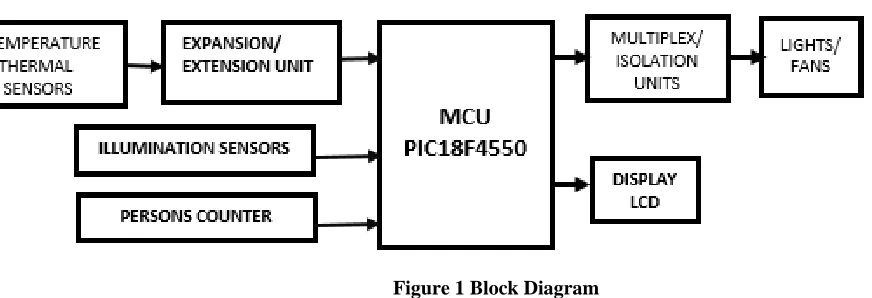
Figure 1 Block Diagram
The overall system architecture as shown in figure 1 is composed of three subsystems, namely the monitoring, the processing, and the
control subsystems. The monitoring reads; temperature, light intensity, presence of persons, and count persons. The processing units
exploit the data collected by the monitoring system and compare with the preset values to control the behavior of each single
appliance.
The System is based on the interruption of IR beam. An IR beam is used as the source of light beam. when people enters the hall the
counter will automatically get incremented by itself and on leaving the hall the counter will get decremented. Once the counter is zero
in other words once everyone leaves the hall the system will automatically turns off every appliances.
Figure2. Flow chart for the complete system
Conclusion and Future Work
The result indicates this control method can be scaled to cover large building from single location, provide energy conservation for
home appliances in the smart home environment. It approach home automation with digital output and I2C interface that simplifies
interfacing and data communication. It works effectively in term of energy saving compared to the existing limited input
variablescontrolling method. However, it has room for improvement in this project. In the future, the system will be integrated with
wireless interfacing of sensors and other functionality incorporated.
References
[1]. http://www.projectsof8051.com/automatic-room-light-controller-with- visitor-counter/
[2] Alex Joy, & et al, 2015,” Microcontroller Based Room Automation”, International Journal of Advanced Research in
Electrical, Electronics and Instrumentation Engineering, (IJAREEI ),ISSN:2278-8875
[3] Mohammad Arif Hossain, Md. Nazmul Hasan, 2014, “Modern Home Automation System Based On AVR
Microcontroller” International Journal of Scientific & Engineering Research, ISSN 2229-5518
[4] Roth, Dieckmann et al. 2006, Natural and hybrid ventilation." ASHRAE Journal 48(6): H37.
[5] M. Hein, & et al, 2017, “Sensor solutions for an energy-efficient and user- centered heating system”. Journal of
[6] SubhankarChattoraj, Aditya Chakraborty, 2016 “Bidirectional Visitor Counter with Automatic Room Light Controller and
Arduino as the master controller” International Journal of Scientific and Research Publications, Volume 6, Issue 7, ISSN
2250-3153
[7] PoonamLakra, Dr. R. P. Gupta, 2015,“Microcontroller Based Automatic Control Home Appliances” International
Journal of Innovative Research in Science, Engineering and Technology,ISSN: 2347-6710, Vol. 4, Issue 7.
[8] NwankwoNonso& et al, 2014, “Design and Implementation of Microcontroller Based Automatic Fan Speed
Regulator (Using Temperature Sensor)” International Journal of Engineering Research and Management (IJERM) ISSN:
2349- 2058, Volume-01, Issue-05,
[9] Mohammad Arif Hossain, Md. Nazmul Hasan, 2014, “Modern Home Automation System Based On AVR
Microcontroller” International Journal of Scientific &Engineering Research, Volume 5, Issue 1, ISSN2229-5518
[10] http// omron.com/Application Note 01, Usage of the D6T-44L / D6T-8L, Application Note No.MDMK-12-0274
[11] "Datasheet for D6T MEMS Thermal Sensors," OMRON Corporation,
31 August 2012. [Online]. Available: http://www.omron.com/ecb/products/pdf/en-d6t.pdf.
[12] Masood Anzar& et al, 2016, “Illumination Control using MEMS based Detection”, International Journal of
Engineering Research & Technology (IJERT) ISSN: 2278-0181 IJERTV5IS020080 Vol. 5 Issue 02, February-2016
[13] Dr. Kakelli Anil Kumar, OmkarDhadge, 2018, “A Novel Infrared (IR) Based Sensor System for Human Presence
Detection in Targeted Locations” Published Online December 2018 in MECS (http://www.mecs-press.org/) DOI:
10.5815/ijcnis.2018.12.04
[14] A. A. S. Mohammed, W. A. Moussa, and E. Lou., 2011.“High-performance piezoresistive MEMS strain sensor with low
thermal sensitivity. Sensors, 2011, 11(2):1819–1846.
[15] Ehab Abdul-Razzaq Hussein, 2013,“Design and Implementation of Digital Light Meter”, Journal of Babylon
University/ Engineering Sciences / No.(1)/ Vol.(21): 2013
[16] ArunRadhakrishnan, VuttaradiAnand, 2013,“DESIGN OF AN INTELLIGENT AND EFFICIENT LIGHT CONTROL
SYSTEM”International Journal of Computer Applications Technology and Research Volume 2– Issue 2, 117 - 120, 2013,
[17] Data sheet for Temperature Sensor TEXAS INSTRUMENT, TMP10x Temperature Sensor with I2C and SMBus Interface