Computer Science Dissertations Department of Computer Science
12-10-2018
Computational Complexity And Algorithms For
Dirty Data Evaluation And Repairing
Dongjing Miao
Follow this and additional works at:https://scholarworks.gsu.edu/cs_diss
This Dissertation is brought to you for free and open access by the Department of Computer Science at ScholarWorks @ Georgia State University. It has been accepted for inclusion in Computer Science Dissertations by an authorized administrator of ScholarWorks @ Georgia State University. For more information, please [email protected].
Recommended Citation
Miao, Dongjing, "Computational Complexity And Algorithms For Dirty Data Evaluation And Repairing." Dissertation, Georgia State University, 2018.
AND REPAIRING
by
DONGJING MIAO
Under the Direction of Dr. Yingshu Li and Dr. Zhipeng Cai
ABSTRACT
In this dissertation, we study the dirty data evaluation and repairing problem in relational database.
Dirty data is usually inconsistent, inaccurate, incomplete and stale. Existing methods and theories
of consistency describe using integrity constraints, such as data dependencies. However, integrity
constraints are good at detection but not at evaluating the degree of data inconsistency and cannot
guide the data repairing. This dissertation first studies the computational complexity of and
algo-rithms for the database inconsistency evaluation. We define and use the minimum tuple deletion to
evaluate the database inconsistency. For such minimum tuple deletion problem, we study the
rela-tionship between the size of rule set and its computational complexity. We show that the minimum
tuple deletion problem is NP-hard to approximate the minimum tuple deletion within 1716 if given
three functional dependencies and four attributes involved. A near optimal approximated algorithm
for computing the minimum tuple deletion is proposed with a ratio of 2− 1
2r, wherer is the number
of given functional dependencies. To guide the data repairing, this dissertation also investigates the
data repairing method by using query feedbacks, formally studies two decision problems, functional
dependency restricted deletion and insertion propagation problem, corresponding to the feedbacks
of deletion and insertion. A comprehensive analysis on both combined and data complexity of
and provided the efficient algorithm on these tractable cases. Two improvements are proposed, one
focuses on figuring out the minimum vertex cover in conflict graph to improve the upper bound of
tuple deletion problem, and the other one is a better dichotomy for deletion and insertion
propaga-tion problems at the absence of funcpropaga-tional dependencies from the point of respectively considering
data, combined and parameterized complexities.
AND REPAIRING
by
Dongjing Miao
A Dissertation Submitted in Partial Fulfillment of the Requirements for the Degree of
Doctor of Philosophy
in the College of Arts and Sciences
Georgia State University
AND REPAIRING
by
DONGJING MIAO
Committee Chair: Dr. Yingshu Li
Committee: Dr. Kai Zhao
Dr. Wei Li Dr. Zhipeng Cai
Electronic Version Approved:
DEDICATION
TABLE OF CONTENTS
LIST OF TABLES . . . vii
LIST OF FIGURES . . . viii
Chapter 1 INTRODUCTION . . . 1
1.1 Background . . . 1
1.2 Survey of Current Research . . . 3
1.3 Research context and contributions . . . 10
Chapter 2 DATA INCONSISTENCY EVALUATION . . . 12
2.1 Introduction . . . 12
2.2 Conflict graph and its vertex cover . . . 15
2.3 literature review of the vertex cover problem . . . 16
2.4 Complexity and Inapproximation . . . 18
2.5 A 2− 1 2r -approximation . . . 24
2.5.1 A basic approximation algorithm . . . 25
2.5.2 Improve the approximation by triangle eliminating . . . 27
2.5.3 Near optimality . . . 28
2.6 A modified linear program . . . 31
2.7 Conclusion . . . 36
Chapter 3 VIEW PROPAGATION FOR DATA REPAIR VALIDATION 37 3.1 Introduction . . . 37
3.2 Preparation . . . 40
3.3 Complexity results . . . 41
3.3.1 Deletion Propagation . . . 42
3.4 Conclusion . . . 57
Chapter 4 BOUNDED VIEW PROPAGATION . . . 58
4.1 Introduction . . . 58
4.2 definition, preparation and overview of results . . . 61
4.2.1 Preparation . . . 62
4.2.2 Overview of results . . . 64
4.3 Bounded Deletion Propagation . . . 65
4.4 Bounded Insertion Propagation . . . 73
4.5 Conclusion . . . 74
Chapter 5 RESILIENCE FOR DATABASE QUERIES . . . 75
5.1 Introduction . . . 75
5.2 related works . . . 79
5.3 Preparation . . . 82
5.4 Parameterized complexity results for different query classes . . . 84
5.4.1 Hard Cases . . . 84
5.4.2 Triangle query and refined characteristic . . . 90
5.5 Kernelization for triangle queries . . . 97
5.6 Conclusion . . . 100
Chapter 6 CONCLUSION . . . 101
LIST OF TABLES
Table 1.1 An instance of employee information . . . 2
Table 2.1 Results summary in this paper . . . 24
Table 3.1 Notations for this chapter . . . 41
Table 3.2 Results in this paper. . . 47
Table 5.1 Polynomial tractable cases of S-sef . . . 79
Table 5.2 Hard cases of S-sef . . . 79
Table 5.3 Polynomial tractable cases of V-sef . . . 79
LIST OF FIGURES
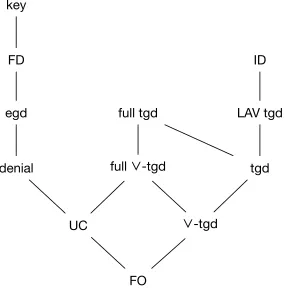
Figure 1.1 Relations of data dependencies . . . 4
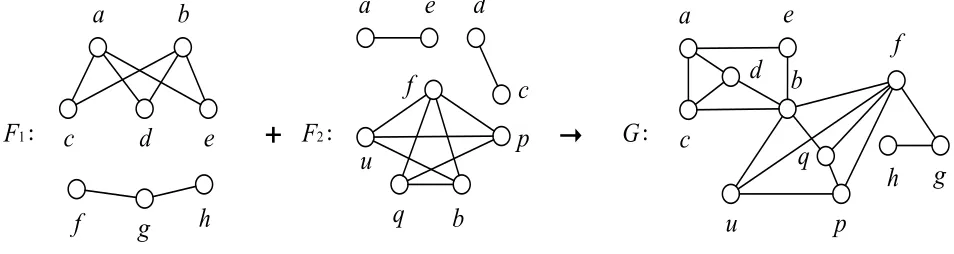
Figure 2.1 Example for a conflict graph built by two forests . . . 16
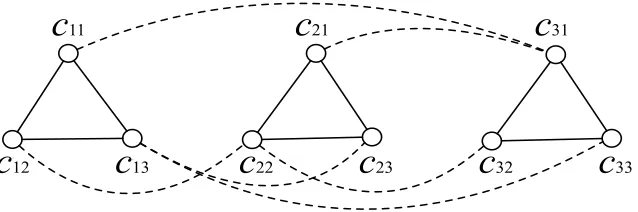
Figure 2.2 Reduction for the instance (x1+x2+x3) (x1+x2 +x3) (x1+x2+x3) . . 22
Figure 2.3 Example for a 3-local biclique coloring . . . 29
Figure 2.4 Conflict graph constructed in the proof of Proposition1. 3 . . . 30
Figure 2.5 limitation of linear inequality . . . 31
Figure 2.6 Example of a wheel complete multipartite . . . 32
Figure 3.1 Example for the reduction of Theorem 10 . . . 45
Figure 3.2 Example for the reduction of theorem 15. . . 52
Figure 3.3 Example reduction of Theorem 16. . . 55
Figure 4.1 Example data and the result of queryQ:−πf1.uid,f3.fid(σf1.uid=u0∧f1.fid=f2.uid∧f2.fid=f3.uid (f1×f2×f3)) which is finding all persons that user u0 is able to got in touch with by at most two men-in-middle, figure at right side shows the graph rep-resented by this database. (u0,u3) is the view deletion from the result of query Q. . . 59
Figure 4.2 The data complexity of bounded, general, fd-restricted deletion propagation 61 Figure 4.3 Example for the reduction of step i, ii and iii 17, input instance of SAT-UNSAT φ = (x1 + x2 + x3)(x2 +x3 +x4)(x4 +x5 + x6) and φ0 = (x01 + x02+x03)(x03+x04+x05)(x04+x06+x07). Gray shaded tuples is permitted source deletion. Underlined tuple is the view deletion. . . 67
Figure 5.1 Example database instance . . . 76
Figure 5.2 The witness graph for Example 4 . . . 92
Figure 5.3 The first possible gadget for the instance of g(u) . . . 93
Figure 5.4 The second possible gadget for the instance of g(u) . . . 93
Figure 5.5 The third possible gadget for the instance of g(u) . . . 93
Figure 5.6 The fourth possible gadget for the instance of g(u) . . . 94
Figure 5.8 Connecting the gadgets of two adjacent vertices . . . 94
Figure 5.9 Local view of connecting two gadgets . . . 96
Figure 5.10 Conflict resulting from odd circle of connecting gadgets . . . 96
Chapter 1
INTRODUCTION
Data is always not available in real database applications. This kind of data is usually called low
quality or dirty data, and shows up in general as inconsistent, inaccuracy, incomplete and stale.
These problems greatly decrease the usability of the data in practical application, damage the real
value of the data, and even lead to serious consequences in many fields. According to statistics,
in the US banking industry, credit card fraud caused $4.8 billion in losses in 2006 because the
inconsistent data was undetected. What’s worse, dirty data is not rare, but widespread. According
to the statistics of authoritative institutions, there are various errors and inaccuracies in 1% - 30% of
the data in American enterprise information system, and 13.6% - 81% of the key data in American
medical information system is incomplete or stale. A survey by Gartner, a leading international
technology consultancy, found that data from more than 25% of corporate information systems in
global fortune 1000 companies were inaccurate or incorrect. There are still data from dirty source
such as wireless sensor networks for data collecting always compress data [1–4]. In conclusion, the
low quality of data is an important and urgent problem.
1.1 Background
Inconsistent data is the most typical dirty data and has been long time studied. Recall the
development of traditional database management systems, it is always considered that how to design
the language to express queries and how to do the query evaluation and optimization. The quality
of the data is not considered, therefore whenever a user submits a query, the answer of the query
returned by database management system is always assumed correct. However, if the data is dirty,
no matter how carefully the query is designed and how good the query is optimized, the correctness
of the query result cannot be guaranteed.
In database community, data dependency rules are widely used in the study of data consistency,
and as the main way to improve the ability of describing data consistency. At first, functional
to normalize the relational schema [5]. While at the presence of large amount of dirty data, especially
the inconsistent data, it is more important to consider how to express and normalize data semantic
other than the relational schema normalization. Extending these classic data dependence rules in
form, especially functional dependencies, is still a good way to capture data semantic errors, such as
conditional function dependencies and so on. Based on these extensions, a number of methods has
been developed to improve the quality of data. In particular, in the case of relational data, that is,
a set of declarative semantic constraints (such as functional or conditional functional dependencies)
are first specified for the database, so that once inconsistent data occurs, some corresponding
constraints are violated. Compared with other methods, the method based on the data dependence
rules has several obvious advantages, such as it is essentially a declarative method, and can conduct
automatic reasoning. More important, this kind of rules depicts the semantics of data in essential,
so that it is capable to capture semantic errors in data. It is also expected in this way to provide
a systematic method to deduce the semantics of data, derive and discover data quality rules [6, 7].
For example, each employee is represented as a relation tuple including employee’s name (FN: first
name, LN: last name), work phone (CC: country code, AC: area code, phn: phone number), work
address (street, city).
Table 1.1. An instance of employee information
FN LN CC AC phn street city
t1: Mary Smith 01 908 7966899 MtnAve NYC
t2: Mary Luth 01 908 7966899 MtnAve MH
Consider an aggregation query Q asking the number of employees named “Mary” , note that
the answer of Q is 2. However, it is possible that both the tuples are recording the information of
a same person, so that the truth ground should be 1.
In this case, if set a functional dependency “fd : CC, AC, phn→ FN, LN” saying that each
phone number could be owned by only one employee, then the answer of query Qis known to be 1.
Such a rule-based method expresses the inconsistency data and improves the usability of
large-scale data. Unfortunately, this processing method based on the data dependency rules to describe
data consistency development is still not perfect enough, and the method itself has a lot of
inconsistency errors, but cannot provide an intuitive review on the degree of the inconsistency of
given data; (2) consistency rules cannot guide the data repairing, automatic repairing method based
on rules cannot ensure their repair derived is reliable, such as in the example above, even if the
function dependency rules is a strong constraint, still not sure how to fix the LN fields, namely
choose ”Smith” or ”Luth”; (3) it is difficult to establish sufficient consistency rules to fully detect
the consistency errors of data. As a result, more effective ways must be proposed to compensate for
these shortcomings, to develop and complement the data consistency evaluation and repair methods
based on dependency rules, make sure they are able to return the correct or at least with a certain
quality assurance.
1.2 Survey of Current Research
It has been a long history of research on data consistency, especially for the fundamental
theory, key techniques and systems on inconsistency detection, and repairing based on the semantic
constraints.
Semantic constraints. The first problem to improve data consistency is to define
inconsis-tency. Unified frameworks based on declarative semantic constraints (a.k.a, data quality rules) has
been introduced to deal with inconsistency problems by database and artificial intelligence
commu-nity. Roughly speaking, the widely applied constraint hierarchy can be shown as the figure 1.1 of
secondary relationship.
Given a relational schema R = {R1, . . . , Rc}, all the existing languages to define constraints,
excepting domain independent first order logic declarative sentences, can be written as a unified
form,
∀x¯(ϕ(¯x)∧β(x)→
n _
i=1
∃y¯iΦi(¯x,y¯i))
where ϕ and Φi is relational atoms like Rl(x1, . . . , xh), and the equality atoms like x = x0.
To define it strictly, x, x0, x1, . . . , xh should occur in the declarative sentences,β is a quantifier-free
formula embedded with predicates only. If a constraint or dependency has no existential quantifier in
it, then it is called full or universal constraint (UC). If theβ is empty in a constraint or dependency
FO
UC
∨
-tgd
denial
full
∨
-tgd
tgd
full tgd
LAV tgd
ID
[image:16.612.162.447.84.373.2]egd
FD
key
Figure 1.1. Relations of data dependencies
and if there is no equality atoms, e.g. n = 1, then it is called tuple generating dependency (tgd).
Besides this, if the right part of a dependency is a single equality atom, then it is called an equality
generating dependency (egd). If theϕcontains only two atoms with the same symbol in an equality
generating dependency, then it is the classical dependency, “functional dependency (fd)” [8].
On the other hand, if theϕin a tuple generating dependency is a single atom, then such type of
dependency is a Local-As-View tuple generating dependency (LAV tgd), correspondingly, there are
still other dual forms. If Φ1 is a single atom, the dependency is the classical dependency, “inclusion
dependency (ind)”. In addition, when the right part of the unified form is empty, i.e. the sentence
is now ∀x¯(ϕ(¯x)∧β(x)), then the dependency is a denial constraint (denial). More other types of
constraints could be found in literatures as [9].
Moreover, this dissertation is aware of the canonicity and arity of a dependency. A canonical
dependency is a dependency such that there is a column specifying schema, where each variable in
relation atoms only locates their position specified, and each equality atom contains only one pair
(Conditional) functional dependency. It is easy to observe that data dependencies above
is defined on relation atoms, variables and equalities, but not on constant. To capture errors
in real world data, a novel constraints, conditional functional dependency, proposed in literature
[6]. It modifies functional dependencies by adding a pattern tabular, advanced such well-developed
constraints, and has been widely used in database community. However, due to the high complexity
of related reasoning problems (e.g., it is EXPTIME-complete for full dependencies [5]), not all types
of dependencies can be modified in this way. The key point is the balance between expressive
abilities and computational complexities, conditional functional dependencies reach this point in
some degree, thus being widely applied. Formally, a conditional functional dependency defined on
schema R is a pair ϕ(x → Y, Tp), where X → Y is a canonical functional dependency as stated
in [8], Tp is table defined on attribute sets X and Y, called pattern tabular, where for each attribute
A ∈X∪Y and each pattern tupletp ∈ Tp, tp[A] is either a constant taken from the domain ofA,
or a nameless variable “ ” matching any possible value.
In order to guarantee the practical use of this kind of rule, the fundamental problem involved
here is that some classical decision problems related to conditional function dependencies need to
be solved.
For example, in the finite database instance, the increase of expressive abilities raises the
com-plexity of the reasoning problem, namely the finite inference problem [5, 8]. The second is the
satisfiable decision problem. When detecting inconsistency in real data using conditional function
depends, the first question is whether a given set of conditional functional dependencies is conflicting
or inconsistent with itself, if the set of dependencies is unsatisfiable or inconsistent, then it is
neces-sary to correct them in the data, and find out where the rules went wrong or why. The intractability
of satisfiability decision and reasoning problem has been shown in [10]. Finite axiomatization of
conditional functional dependencies has been proven in [11], and the completeness and correctness
of inference system are also proposed. Meanwhile, the tractable cases and approximation algorithms
are also provided, that is, for a set of arbitrary conditional functional dependencies defined on a
given schema R, in the case of infinite domain, it can be done in O(|Σ|2) to determine whether
the set Σ is satisfiable. Therefore, when we consider the data inconsistency related problems and
methods, key based constraints or (conditional) functional dependencies are always used as the
The problems studied in this dissertation are defined by (conditional) functional dependencies, and
so does the theory developed in this dissertation.
Data inconsistency detection. There is few work on the data inconsistency detection, the
detection method in the real world distributed system is provided in [12], and the incremental
detection method is studied in [13], aiming to find the minimum necessary data transmission to
detect the change of conflicting sets, in order to avoid the redundant computation. However, no
matter horizontal or vertical partitioning, this problem is proven to be NP-complete. Nevertheless,
the necessary data transmission has been bounded in [13], computation and transmit cost is linear
to the incremental of change and independent from database instance, and an optimized partition
method is provided.
Inconsistent data repairing Optimal data repairing and consistent query answer are the
most popular approaches to deal with violations of FDs and other integrity constraints. The former
aim to find a repair with a minimum modifications on the given database, including minimally
differs from the original one (e.g., [14], [15], [16], [17]), minimize the description length (e.g., [18])
and so on. The limitation of them is that there may be many different optimal repairs. The latter
aims to find answer of a query that are true in every possible repair. It usually employ techniques
of condensed representation of possible repairs(e.g., [19], [20]) or query rewriting (e.g., [21], [22])
to obtain consistent answer. Unfortunately, there are lots of classes of queries have to be answered
approximately. Sampling repairs is an alternative approach proposed to overcome several drawbacks
of optimal repairing and consistent query answering. It is to generate a sample of possible repairs of
the input database under some repair semantic, moreover, it will return empty query results when
no consistent answers are found, such as [23] proposed three classes of repairs and the corresponding
sampling algorithm.
Different from the existing work, this dissertation consider using user query feedback to guide
how to resolve conflicts so that a more reasonable sampling space could be obtained. Comparing
with the preferred repair in [24], query feedback restricted repair defined in this dissertation has a
stronger expressive ability. Another benefit is that source data could not be read by users directly in
this way, so that it avoids the difficulties by privacy protection mechanisms [25–32]. Moreover, we
existence problem not the repair checking problem that whether a given instance is a repair of the
input instance [33].
Another related problems is view update problem that given a view and an update against a
view, the problem is to translate the update into a corresponding update against the base data,
see [34]. There are several complexity bounds are known on relational view updates, [35], [36–
38] give out the tractability and intractability results of finding a minimal view complement for
relational views. Cong et al. [39] gave out the complexity of view update analysis under key
preserving condition which can not be extended to ours. There are lots of works on the algorithms
for translating view update to base table update, such as [40–42] and so on. In modern scenarios,
the update or query feedback comes from everywhere especially the crowd-sourcing [43, 44] and
the truthfulness could be guaranteed by lots of methods presented [28, 45, 46]. Their goal was to
define correctness properties of these translations and to characterize precisely the conditions for
the existence of translations possessing these properties. There are still similar works trying to
deal with more complicated queries, such as iceberg [47] and aggregation [48–50]. Different from
our work, the database they considered is consistent, it is not inconsistent, so that the presence of
FDs and other integrity constrains simplifies view update problem which it is in contrary to this
dissertation.
There have been some complexity results on the view side effect problem for insertion [51, 52]
and deletion propagation [39, 52–56], moreover, on the data complexity of deletion propagation,
B. Kimfield et. al [54] showed the dichotomy ‘head domination’ for every conjunctive query
with-out self joins, deletion propagation is either APX-hard or solvable (in polynomial time) by the
unidimensional algorithm, they also showed the dichotomy ‘functional head domination’ [55] using
functional dependencies to simply the general deletion propagation problem, further more, they
especially showed the trichotomy for group deletion a more general case [56]. On the combined
complexity of deletion propagation, [39, 52] showed the variety results for different combination of
relational algebraic operators and showed the tractable and intractable results on both data and
combined complexity aspects. All the previous results showed that, for general cases, the deletion
propagation is hard due to the huge searching space. Conclusions in these works are still not precise,
and no results for bounded case, while we will show the precise complexity class where the general
There are still related works including view update, data provenance, explanations in databases.
As a classical problem, view update research has been studied several decades ago [35,39,40,57–59].
It aims to find the set of operations that could modify the database in order to obtain a certain
update on the view exactly. Deletion propagation problem we studies actually is a special cases
of view updates. Nevertheless, the concern of previous research are mainly on find the exactly
operation set. When it comes to 2000s, data provenance has been studied the ways to model
relation between the input and output for database queries [60–63], mainly focusing on explaining
‘Why-provenance’ and ‘Where-provenance’. A variant of ‘Why-provenance’ is resilience [64], which
defined as the minimum set of source tuples whose deletion making the given query false. Causality
and responsibility are also based on similar idea [65–68].
In the applications dealing with data quality [67–75], they try to produce explanations for
query results, in order to trace errors in the source data, such as inconsistencies, incompleteness or
some other kind of errors. In fact, all the methods mentioned above can be used to do this, and
there are several existing frameworks [66, 76]. Some work not only try to provide explanation, but
also try to modify queries [77, 78], this kind of work actually deal with the view update problem
on low quality data. To deal with the incompleteness of data, some work [67, 68, 74, 75, 79] try to
explain the missing query results, it is also a variant of the insertion case studied in this dissertation.
The other relevant quality
Dependency propagation is another related problem, it is to determine that given a view defined
on data sources and a set of dependencies on the sources, whether another dependency is guaranteed
to hold on the view, e.g., [80], [81] which are the first to investigate dependency propagation. Fan
et al [82] extended [80], [81] by providing complexity bounds for FD propagation in the general
setting, and for CFD propagation. However, this is a problem different from ours.
Reviews on vertex covers The related work is vast, and its application is very wide [83],
however, we only mention those very related. For anyε >0, minimum vertex cover might be hard to
be approximated within 2−ε[84], this is its UGC-hardness. For anyε >0, 7/6−εinapproximability
for minimum vertex cover has been proved by Hast˚ad et al. [85], and this factor was improved by
Dinur and Safra [86] to 1.36, this is its NP-hardness. A practical 2-approximation algorithm of
minimum vertex cover was provided by Gavril et al. [87], it is to find a maximal matching of a
is always a 2-approximation of its minimum vertex cover. For complete multipartite graphs, there
are few works about computing its vertex cover or maximal matching. A formula of computing
maximum matching size has been developed in [88].
On the other side, the vertex cover problem on general graph is approximable within 2−log log2 log|V|V||
[89] and 2−ln ln2 ln||VV||(1−o(1)) [90]. Karakostas reduced the approximation factor to 2−Θ
1
√
log|V|
[91] instead of the previous 2−log log2 log|V|V||. We mention that several simple 2-approximation algorithms
are known. Half-integral solution [92] is a well-known approach to obtain a better approximation.
The algorithm uses a k-coloring of the subgraph induced by the half value vertices as input to
reduce approximation ratio into 2− k
2. For graphs with degree bounded by d, based on Brook’s theorem, this directly leads to a 2− 2
d
-approximation. As referred above, the basic approach has
been improved to 2−Θ
1
√
log|V|
[91] by replacing the LP relaxation to SDP relaxation. We also
mentioned the recent work on local biclique coloring given by F. Kuhn [93]. They generalize the
result on bounded degree obtained by SDP relaxation to bounded local chromatic number. It can
be guaranteed that any valid coloring with k colors also is a local k-coloring. Some other works on
dominating sets [94–96] are also related to this dissertation but solutions cannot be applied directly.
Brief summary The current work can be summarized as the following both sides. Firstly,
there is no work that can be applied to conduct the consistency evaluation of dirty data directly.
Modifying the existing method based on confidence of individual rule is a possible way to evaluate
the data consistency, but it can be severely restricted by locality. Secondly, for the inconsistent data
repairing, the existing methods which try to repair dirty data automatically are far more limited in
scope, the consensus in the data quality research community is that artificial feedbacks are the keys
to get high quality repair which should be introduced into repairing framework. However, some
work assumes that (1) the artificial answer is correct and can be used directly, (2) the artificial
feedbacks can be translated to the data without side effects, and (3) the given rules are correct.
These assumptions are unreasonable in practice.
Therefore, this dissertation studies an alternative way to evaluate the degree of data
inconsis-tency by ”minimum tuple deletion sets”, and then the computational complexity of the problem is
considered, and several linear programming based algorithms with good approximation ratios are
proposed to solve the data inconsistency evaluation problem. And then, this dissertation studies
solve this problem, two decision problems are formally formulated, namely the view deletion and
insertion propagation problems restricted by integrity constraints. Furthermore, the complexities
and corresponding decision algorithms of both problems are studied.
1.3 Research context and contributions
As stated above, improving inconsistent data is of great importance for increasing data
avail-ability and ensuring the use of large scale data. However, the existing processing method of data
consistency based on data dependency rules is not well developed, and there are many inherent
defects in this method as followings, (1) the integrity rules can be used to detect inconsistencies
only, but it cannot provide an intuition of the degree of data inconsistency; (2) consistency rules
cannot guide the repair completely, and the automatic repairing method based on the rules cannot
guarantee a reliable and complete repair of inconsistent data; (3) it is difficult to declare sufficient
rules enough to detect all the consistent errors in the dirty data.
To solve these problems, this dissertation studies the key problem of computational complexity
and algorithm for data evaluation and repairing. This dissertation first studies the computational
complexity of and algorithms for the database inconsistency evaluation. We define and use the
minimum tuple deletion to evaluate the database inconsistency. For such minimum tuple deletion
problem, we study the relationship between the size of rule set and its computational complexity.
We show that the minimum tuple deletion problem is still NP-complete, if given two conditional
functional dependencies and three attributes involved in them; And it is NP-hard to approximate
the minimum tuple deletion problem within 17
16 if given three conditional functional dependencies and
four attributes involved in them. We design a near optimal approximated algorithm for computing
the minimum tuple deletion, the ratio is 2− 1
2r, where r is the number of conditional functional
dependencies in the given rule set Σ. Under the unique gaming conjecture, this ratio is near optimal,
its hard to improve it with a constant independent of n.
To guide the data repairing, this dissertation also investigates the data repairing method by
using query feedbacks, formally studies two decision problems, functional dependency restricted
deletion and insertion propagation problem, corresponding to the feedbacks of deletion and
considering different relational operators and feedback types. We have identified the intractable
and tractable cases to picture the complexity hierarchy of these problems, and provided the
effi-cient algorithm on these tractable cases. Last but not the least, we propose the potential future
research topics in order to complete this dissertation. For the future work, we will study the precise
complexity of the constant b-DP problem. We believe it is in ∆P2-complete instead of PNP[O(logn)].
Furthermore, we will design an efficient practical algorithm for b-DP to improve the naive one on
Chapter 2
DATA INCONSISTENCY EVALUATION
Managing inconsistent data is a core problem in the area of data quality management. Inconsistent
data indicates that there is conflicted information in the data, which can be formalized as the
violations of given semantic constraints. For relational data, usually, dependencies are utilized to
capture the inconsistencies of data.
2.1 Introduction
There are many kinds of dependencies in database theory. Given a relational database schema
R = {R1, . . . , Rc}, a formal form of general dependency can be specified as a first-order logic
sentence as follows.
∀x1, . . . ,∀xn [ϕ(x1, . . . , xn)]→ ∃z1, . . . ,∃zkψ(y1, . . . , ym)
Here, the variables inψ are taken from{xi}and{zj}, bothϕandψare conjunctions of relation
atoms of the form Rl(w1, ..., wh) and equality atoms of the form w = w0, where Rl is a relation in
schemaRand each of thew, w0, w1, . . . , whis a variable appearing in the sentence. Furthermore, the
dependencies can be classified from following aspects. (i) Full versus embedded. Afull dependency
is a dependency that has no existential quantifiers. (ii) Tuple generating versus equality generating.
A tuple generating dependency (tgd) is a dependency in which no equality atoms occur, while
an equality generating dependency (egd) is a dependency for which the right-hand formula is a
single equality atom. (iii) Typed versus untyped. A dependency is typed if there is an assignment
of variables to column positions such that variables in relation atoms occur only in their assigned
position, and each equality atom involves a pair of variables assigned to the same position. (iv)
k-ary. A k-ary dependency contains k relation atoms in ϕ.
Several kinds of dependencies have been successfully applied in the area of inconsistent data
(CFD for short) [34] and so on. Most of them can be classified into full, equality generating, typed
and 2-ary dependencies, and the reason is easy to understand after observing that the
inconsis-tency is usually explained to be the conflict between specified tuples (usually 2 tuples) when some
conditions are satisfied. CFD is a typical example of such dependencies utilized in capturing
incon-sistencies. For example, a CFD constraint may say, for two tuples in relation R, if their values on
attribute A are both 1 and they have equal values on attributes B and C, they must have equal
values on attribute D also. Given the above CFD constraint, it is expected that the constraint is
valid on all possible data instances. Then,if two tuples t1 = {A : 1, B : x, C : abc, D : m} and
t2 = {A : 1, B : x, C : abc, D :n} are found in the real instance, it is easy to verify that t1 and t2
violate the given constraint. That is, inconsistent data are found according to the given semantic
constraints.
Example. An FD constraintAB→C defined over relation Rsays, “for two tuples in relation
R, if their have equal values on attributes A and B, they must have equal values on attribute C
also”. Given the above FD constraint, it is expected that the constraint is valid on all possible data
instances. Then, if two tuples t1 = {A : x, B : abc, C : m} and t2 = {A : x, B : abc, C : n} are
found in the real instance, it is easy to verify that t1 and t2 violate the given constraint. That is,
inconsistent data are found according to the given semantic constraints.
Based on dependency theory, many research works focusing on managing inconsistent data
have appeared. For example, [11], [13], [97] and [10] study the inconsistency detection problem,
and [14], [15], [16], [17] and [18] study the data repairing problem. However, one important problem,
called inconsistency evaluation, has not been well studied.
Rather than simply providing an consistency measure, the aim of evaluating inconsistency is to
figure out the lower bound of the cost one should pay for data repairing based on only dependencies.
In real life, given a (dirty) database instance and some consistency rules defined over its schema, it is
possible that all the tuples should be repaired if without any useful, that is, the upper bound of data
repairing is naive. However, if without enough knowledge on the dirty data, it is important to know
the lower bound of repairing the data, so as to help user select data sources, determine whether
defined over minimum number of tuple deletion, because any exact repair algorithm need to do
such many changes on data at least, in order to eliminate all violations no matter what strategies
applied. Essentially, it has a close relation with the conception tuple-deletion repair studied in
some previous work. This kind of definition has been investigated in the area of repairing data and
consistent query answering, and it is well known that it’s NP-hard to find minimum tuple deletion
based repair generally or even given two FDs [17, 98, 99], and have a constant approximation [16].
However, we note that to evaluate the inconsistency of database, it is important to give an accuracy
value of data inconsistency as much as possible, thus, we need to formally study the inconsistency
evaluation problem, give a more careful analysis on the complexity and approximation ratio of it.
An important task focusing on managing inconsistent data is to evaluate how inconsistent the
data is. A natural model is using the vertex cover size to show this value based on the input
dependencies. Concretely, for an inconsistent database instance with respect to several given FDs,
we model each tuple as a vertex in graph, and each tuple pair has an edge between them if they
are conflict with each other. Then we can see that each FD will generate a set of disjoint complete
multipartite graphs, because if a tuple has the same value on the left attributes with some other
tuples, it must be conflict with other tuples with different right attributes’ values, i.e., it has edges
with all of them. Finally, if we want to minimum tuple deletions to make it satisfying all the given
FDs, we must compute the vertex cover of the sum graph of those generated by single FD, here the
sum graph is just a conflict graph.
Therefore, in this scenario, vertex cover problem in conflict graph is the basis of evaluating
data inconsistency and provide several theoretical analysis results. Since inconsistent data is defined
under the help of dependencies, a specific kind of dependency, FD, is chosen in this dissertation
when introducing our results in the following parts. In fact, all results in this paper can be extended
to model the full, equality-generating, typed and 2-ary dependencies [34].
In this paper, we consider the problem of evaluating data inconsistency and provide several
theoretical analysis results. Since inconsistent data is defined under the help of dependencies, a
specific kind of dependency CFD is chosen when introducing our results in the following parts.
In fact, all results in this paper can be extended to the full, equality-generating, typed and 2-ary
Given a database instanceDincludingntuples and a dependency set Σ includingrconstraints,
the inconsistency evaluation problem is formalized as computing the ratio of the minimum culprit
size to n, where a culprit is defined to be a set of tuples leading to violations of constraints. First,
it is proved that (i) if Σ contains only one constraint, the inconsistency evaluation problem can
be solved in polynomial time, and (ii) when Σ contains two constraints, even if it is assumed that
only 3 attributes are used and each tuple can be involved at most 6 violations, the inconsistency
evaluation problem is still NP-complete.
Then, to investigate the hardness of designing approximation algorithms for this problem, only
considering the simple scenario of r= 3 and 4 attributes, it is shown to be stillNP-hard to find an
algorithm with approximation ratio smaller than 1716 . By directly using previous results on vertex
cover problem, it is shown that finding 1.36-approximation algorithms is NP-hard even when the
sizes of attributes and constraints are fixed, and there are no (2−)-approximation algorithms for
any >0 unless the UGC(unique gaming conjecture) is false.
Finally, considering that in real applications, the number of constraints in Σ are usually fixed,
we design an approximation algorithm for that setting and show that the approximation ratio can
be bounded by 2− 1
2r. Furthermore, the approximation algorithm is shown to be near optimal by
proving that it is impossible to improve the ratio with any constant factor under the assumption of
UGC. Actually, it is an approximation algorithm for minimum vertex cover on a special graph class,
namely conflict graph. Comparing with the previous results, the results in this paper are obtained
based on the characteristic of conflict graph.
2.2 Conflict graph and its vertex cover
In this paper, we study a restricted graph class, called conflict graph, which is defined as
follows.
Definition 2.2.1 (Conflict Graph). Given an vertex set V and rsets of graphs of disjoint complete
multipartites , namely F1, . . . , Fr defined onV, such that each connected component is a multipartite
graph in each Fi. The conflict graph G(V, E) is an undirected graph where edge (u, v)∈E if there
An example of conflict graph Gconsisting of 2 sets of graphs of disjoint complete multipartites
can be shown as fig. 2.5. In G, F1 includes two components, both are complete bipartite, while F2
b
a
e
c
d
h
f
g
e
c
d
b
a
q
f
p
u
b
a
e
c
d
h
f
g
u
q
p
+
→
[image:28.612.63.540.146.273.2]F
1!
F
2!
G
!
Figure 2.1. Example for a conflict graph built by two forests
includes there components, one is complete quadripartite and the other two are complete bipartite.
Vertex Cover. Vertex cover is one of the classical problems in graph theory: given a graph
G(V, E), find a vertex set of vertices in V, say V0, such that for each edge (u, v) of E, at least one
of u and v belongs to V0, andV0 has the minimize size. We want to study the vertex cover problem
on conflict graph, including complexity and approximation bound.
2.3 literature review of the vertex cover problem
The related work is vast, and its application is very wide [83], however, we only mention those
very related. For any ε > 0, minimum vertex cover might be hard to be approximated within
2−ε [84], this is its UGC-hardness. For any ε >0, 7/6−ε inapproximability for minimum vertex
cover has been proved by Hastad et al. [85], and this factor was improved by Dinur and Safra [86] to
1.36, this is its NP-hardness. A practical 2-approximation algorithm of minimum vertex cover was
provided by Gavril et al. [87], it is to find a maximal matching of a graph and output all vertices
in the matching, since the size of any maximal matching of a graph is always a 2-approximation of
its minimum vertex cover. For complete multipartite graph, there are few works about computing
its vertex cover or maximal matching. A formula of computing maximum matching size has been
On the other side, the vertex cover problem on general graph is approximable within 2−log log2 log|V|V||
[89] and 2−ln ln2 ln||VV||(1−o(1)) [90]. Karakostas reduce the approximation factor to 2−Θ
1
√
log|V|
[91] instead of the previous 2−log log2 log|V|V||. We mention that several simple 2-approximation algorithms
are known. Half-integral solution [92] is a well-known approach to obtain a better approximation.
The algorithm uses a k-coloring of the subgraph induced by the half value vertices as input to
reduce approximation ratio into 2− k
2. For graphs with degree bounded by d, based on Brook’s theorem, this directly leads to a 2− 2
d
-approximation. As referred above, the basic approach has
been improved to 2−Θ
1
√
log|V|
[91] by replacing the LP relaxation to SDP relaxation. We also
mentioned the recent work on local biclique coloring given by F. Kuhn [93]. They generalize the
result on bounded degree obtained by SDP relaxation to bounded local chromatic number. It can
be guaranteed that any valid coloring with k colors also is a local k-coloring. They proved the
following theorem [93],
Theorem 1. Assuming the UGC, it isNP-hard to approximate the vertex cover problem in graphs for which a (∆ + 1)-local coloring is given as input, within any constant factor better than 2− 2
∆+1.
If the given coloring is also a biclique coloring, there will be a randomized polynomial-time algorithm
with approximation ratio 2−Ω (1)ln ln ∆ln ∆ .
In this paper, based on the above theorem, we show that it is hard to give a bounded local
(biclique) coloring with size independent of |V| to improve the ratio with use of the approach they
gave and our approach seems good enough to solve vertex cover problem onconflict graph. We first
prove that conflict graph is a non-trivial property when the number of sets of graphs of disjoint
complete multipartites is fixed, i.e., if we fix the number r, it is always possible to find a graph
can not be represented by sum of r sets of graphs of disjoint complete multipartites . However, we
proved that (i) If the number of sets of graphs of disjoint complete multipartites is fixed, finding
1.36-approximation is also NP-hard. (ii) Given 2 sets of graphs of disjoint complete multipartites
and maximum degree less than 7, vertex cover problem of conflict graph is NP-complete. Without
the degree restriction, it is shown to be stillNP-hard to find an algorithm for vertex cover ofconflict
graph within 4140−ε, for any ε >0. By directly using previous results on vertex cover problem, it is
shown that it is NP-hard to obtain a (2−ε)-approximation for any ε > 0 unless the UGC(unique
Givenconflict graph consisting ofrsets of graphs of disjoint complete multipartites , we design
an deterministic approximation algorithm and show that the approximation ratio can be bounded
by 2− 1
2r which is a bound does not depend on |V| but only r usually a small constant in real
applications. Also, this bound is not a expected ratio of a random algorithm, but it cannot be
improved by applying the related SDP approach [93]. Furthermore, the approximation algorithm
is shown to be near optimal by proving that it is impossible to improve the ratio with any constant
factor under the assumption of UGC. Actually, it is an approximation algorithm for vertex cover
on a special graph class, namely conflict graph. Comparing with the previous results, the results in
this paper are obtained based on the characteristic of conflict graph.
2.4 Complexity and Inapproximation
In the following, we study the complexity of vertex cover problem on conflict graph. First, a
trivial case is the vertex cover on only one set of disjoint complete multipartite graphs.
Property 1. Minimum vertex cover in a set of disjoint complete multipartite graphs can be found
polynomially.
Proof. Due to the definition ofconflict graph, each two connected component are disjoint and there
is no edge between them. Given a conflict graph G, for each connected component (a complete
multipartite graph), take all vertices of it into cover C excepting those of the largest part. At last,
C is a minimum vertex cover of G.
Lemma 1. Given any graph G, it’s not always possible to find a collection of subgraphs such that
a) each subgraph is a complete k-partite graph for some k,
b) each edge in occurs in at least one of the subgraphs, and
c) each vertex in occurs in at most a constant number of the subgraphs.
Moreover, the probability is close to 1.
Proof. Given n, let’s take a random bipartite graph G = ([n],[n], E) where P r[(vi, vj)∈E] = 12
Since Gis bipartite, any complete k-partite subgraph has to be bipartite. First, we claim that
with probability 1−o(1), every complete bipartite subgraph in G has at most 4n edges. For any
pair of subsetsL⊆[n] and R⊆[n] with |L×R| ≥4n, the probability that “the complete bipartite
subgraph with edge setL×R is inG” is 2−|L×R|, and it is no more than 2−4n. There are fewer than
2n×2n = 4n such pairs L and R, thus, by the naive union bound, the probability that any of the
corresponding subgraphs is present in G is at most 4n2−4n, and it is no more than 2−2n.
Also, with probability 1−o(1), the graph Ghas at least n42 edges.
Thus, with probability 1−o(1), every complete bipartite subgraph inGhas at most 4nedges,
and Ghas at least n42 edges. Assume this happens.
Now suppose for contradiction that a collection of subgraphs with the desired properties exists.
Each of the subgraphs has edge set L×R for some pair of subsets L and R. In G, direct all the
edges in L×R from the larger side to the smaller side (to the left if |L| ≤ |R|, and to the right
otherwise). Since |L×R| ≤4n, the smaller ofL orR must have size at most 2√n.
Since each vertex is in O(1) of the subgraphs, each vertex now has O(√n) edges directed out
of it. But all edges are directed one way or the other, so the number of edges in G is at most the
number of vertices times the maximum out-degree of any vertex, that is, at most O(n√n). This
contradicts the graph having at least n42 edges.
Lemma 1 shows that conflict graph is a non-trivial graph class under the constant number
restriction. Inspired by this, we next have the following theorem on the complexity for a more
restricted condition.
Theorem 2. Given 2 sets of graphs of disjoint complete multipartites and maximum degree no
more than 6, decision version of vertex cover problem on conflict graph is NP-complete. Proof. Thus the problem is in NP obviously. We give the proof of the lower bound as follow.
NP-hardness. The lower bound is established by a reduction from 3-SAT problem. An instance
of 3-SAT problem includes a set U ofn variablesx1, ..., xn and a collectionS ofmclausess1, ..., sm,
while in each clause si = αi1 +αi2 +αi3, each αij (1 ≤ j ≤ 3) is the j-th literal of si. Given an
instance of 3-SAT problem, it is to decide whether there is a satisfying truth assignment for S. The
3-SAT problem is NP-complete, and it remains NP-complete even if for each xi ∈ U, there are at
A polynomial reduction from 3-SAT can be constructed as follows.
Given an instance of 3-SAT with nvariables and mclauses, letconflict graph G=F1+F2 and
k = n+ 2m. Then we introduce two sets of graphs of disjoint complete multipartites F1 and F2
share a vertex set with 2n+ 3m vertices,
F1: Set edge (2i−1,2i) for each i ∈ [n], and edges (3i−2,3i−1), (3i−2,3i), (3i−2,3i−1)
(i.e., a triangle for each clause) for each i∈ [m]. That is, F1 consists of n complete bipartite
subgraphs and m complete tripartite subgraphs;
F2: For each variable xi of 3-SAT instance, build a complete bipartite subgraph Li×Ri, let Li
includes vertex 2i− 1 and all vertices corresponding to the positive literals of xi, and Ri
includes vertex 2iand all vertices corresponding to the negative literals of xi;
Note that, each vertex has a degree at most 7 assuming each variable occurs at most 5 clauses.
Suppose the 3-SAT instance is satisfiable, i.e., there is an satisfying truth assignmentρ:U → {0,1}n
for S, then there is a vertex cover V C ofG such that its size is at mostn+ 2m. Concretely, it can
be computed as follows, for each variablexi, (1) if ρ(xi) = 1, delete vertex 2ifromG. And for each
clause sj, if αjq is a positive literal of xi and vertices 2n+ 3j −2,2n+ 3j −1,2n+ 3j is currently
in G, delete vertex 2n+ 3(j −1) +q from G; (2) if ρ(xi) = 0, delete vertex 2i+ 1 from G. And
for each clause sj, if αjq is a negative literal of xi and vertices 2n+ 3j −2,2n+ 3j−1,2n+ 3j is
currently in G, delete vertex 2n+ 3(j−1) +qfromG. We have that for each i, either 2ior 2i+ 1 is
deleted from G, and for each j, either of {2n+ 3j−2,2n+ 3j−1,2n+ 3j} is deleted from G for
each j. This is because in each clause, there is at least one literal that is made true by assignment
ρ. Therefore, there is a set V C of the rest tuples such that it is a cover and has a size no more than
n+ 2m =k.
To see the converse, let V C is the cover such that|V C| ≤k =n+ 2m. To cover F1, either 2i−1 or
2i should be included in V C for each i∈[n], and at least two of 2n+ 3j−2, 2n+ 3j−1, 2n+ 3j
should be included in V C. That is, the size of V C is at leastn+ 2m. Thus,|V C|=n+ 2m. After
assignment τ for S such that, for each i∈[n],
τ(xi) =
0, if 2i−1∈V(G)−V C,
1, if otherwise
(2.1)
It is sure that τ will make all clauses true. Therefore, it isNP-complete, even if given only 2 set of
disjoint complete multipartite graphs and vertex with at most 7 degree.
We next prove that vertex cover problem on conflict graph is M ax-SN P-hard if without the
degree restriction. To analyze the lower bound of approximation of vertex cover, we next use the
same reduction in Theorem 2 above, but from MAX-E3SAT [100] to this problem if given 2 set
of disjoint complete multipartite graphs. We know that unless P6=NP, there is no
polynomial-time algorithm approximates MAX-E3SAT with 78 +ε[100] (we use the ratio notion less than 1 for
maximizing problem)for anyε >0. That is, there is no guarantee that ”more clause satisfied, more
vertex preserved”. This is really because three free tuples are built for each clause in the reduction.
Concretely, in that reduction, there may exist two an assignments τp and τq (p > q)where they
makes p and q clauses true. However, in its corresponding instance, there may be p0 and q0 tuples
can be preserved respectively where p0 < q0.
Therefore, we give a linear reduction carefully designed by modifying the one used in
Theo-rem. 2.
Theorem 3. Vertex cover problem on conflict graph can not be approximated in 4140 if given 2 set
of disjoint complete multipartite graphs.
Proof. This lower bound is established by a reduction from MAX-E3SAT whose instance includes
a set U of n variables and a collection S of m disjunctive clauses of exactly 3 literals. Given an
instance of MAX-E3SAT problem, it is to find a satisfying truth assignment maximizing the number
of clauses satisfied by it.
We build the same reduction in the proof of Theorem 2, but only delete all the verticesi∈[2n],
shown in fig. 2.2. We also use the assignment function τ such that
τ(xi) =
0 if 2i−1∈V(G)−V C,
1 if otherwise
Let #τ is the number of clauses satisfied by any assignment τ, let #τmax refer to the optimal
assignmentτmaxwhich maximizing the number of clauses satisfied in the MAX-E3SAT instance. Let
|V(G)| is the number of vertex inG.
c
13
c12
c
11c
22
c
12c
13c
21c
22c
23c
31 [image:34.612.143.462.162.268.2]c
32c
33Figure 2.2. Reduction for the instance (x1+x2+x3) (x1+x2+x3) (x1+x2+x3)
We first consider V Cmin the minimum vertex cover of G. We claim that any pair of variable
vertices cannot occurs inV Cmin, because if not, there must be a smallerV Cmin0 obtained by returning
redundant variable vertices from V Cmin into V(G)−V Cmin without any edge left. Based on this,
given the optimal assignment τmax maximizing the number of clauses satisfied in the MAX-E3SAT
instance, we have
#τmax = 3m− |V Cmin| (2.3)
And for any solution V C of V(G), we have
#τvc = 3m− |V C| (2.4)
Now, let V Cˆ is an r-approximation (r > 1) of minimum culprit V Cmin such that |V C| ≤ˆ
r· |V Cmin|. We have
#τvcˆ #τmax
= 3m− | ˆ
V C|
3m− |V Cmin|
>1 + (1−r)· |V Cmin| 3m− |V Cmin|
Since each clause has exactly 3 literals and at least a half of clauses in any SAT instance can
be satisfied by any variable assignment, we have
|V Cmin| ≤3·
m
2 + 2·
m
2 (2.6)
Apply this fact in the right hand of inequality 2.5, it is
|V Cmin| 3m− |V Cmin|
≤5 (2.7)
Therefore we get
#τvcˆ #τmax
>1 + (1−r)·5 (2.8)
Then, apply this into inequality 2.5, then
#τvcˆ #τmax
>6−5r (2.9)
That is, if minimum culprit can be approximated within ration r, then MAX-E3SAT can be
approximated within 6−5r. However, if the former can be approximated within 4140, then the later
will be approximated better than 78, and this contraries to the result of [100].
We next show that for the fixed number of subgraph, minimum vertex cover has a global
inapproximability bound. The observation is that sum of fixed number of subgraphs is able to
represent any bounded degree graph.
Theorem 4. For sufficiently large fixed number of sets of graphs of disjoint complete multipartites
, it is NP-hard to approximate vertex cover on conflict graph within 1.3606.
Proof. Consider any input instance is a graph G(V, E) and each vertex has a degree constraint d
(d > 0), where each vertex in V has a degree no more than d. It is easy to build d sets of graphs
of disjoint complete multipartites to represent G. For each vertex i, we can easily distribute its
each edge into dsets of graphs of disjoint complete multipartites one by one. For sufficiently large
bounded degree d, Dinur and Safra [86] has proved that it is NP-hard to approximate minimum
vertex cover within any constant factor smaller than 1.3606. The number of sets of graphs of disjoint
The theorem gives an approximation lower bound for the case with fixed number of set of
disjoint complete multipartite graphs. For the non-fixed case, it is able to encode arbitrary graphs
with unbounded degree, just set|E|subgraphs. Beyond the NP-hardness of 1.3606, Khot et. al [84]
had proved that, for any ε > 0, there is no (2−ε)-polynomial approximation, unless the unique
games conjecture is false.
[image:36.612.80.516.247.323.2]For the sake of clarity, we summary the hardness results of vertex cover problem in Table 2.1.
Table 2.1. Results summary in this paper
Cases Complexity/Inapproximation
1 subgraph PTime
2 subgraphs (with degree ≤7) 4140 (NP-complete)
Fixed number 1.3606
Non-fixed number 1.3606(NP-hardness), 2−ε(UGC-hardness [84])
2.5 A 2− 1 2r
-approximation
In this section, we use the a linear programming based 2− 1 2C
-approximation for our input
graph where C is the number of connected components in the input graph, then improve the
approximation.
We start by the following observations on the chromatic number of the input graph G, given
r graphs where each graph is a set of disjoint complete multipartite graphs, namely F1, ..., Fr. We
have the following useful observation of a set of disjoint complete multipartite graphs.
Property 2. If a graphG is a sum ofC complete multipartite graphs, ki-partite graph respectively,
then it has a chromatic number Q
ki. Moreover, this chromatic number is tight.
Proof. The graph G is Q
ki-colorable. We can do this in linear time by assigning a distinct color
for each partite of each complete ki-partite graph. A k-partite graph (assuming non-empty parts)
isk-colorable (color all of the vertices in one part with the same color). A completek-partite graph
has chromatic number k (clearly two vertices in two different parts require different colors). In fact,
it has a maximal set of edges such that the graph has chromatic number (adding an edge within a
G =g1+g2 is k1k2 colorable by the product coloring. It follows that each gi is ki colorable, and
that the sum, Gis Q
ki-colorable.
This property is tight if we know nothing more about the graphs. For arbitraryn, letp1p2· · ·pk
be the prime factorization of n (where repeated primes are listed repeatedly). If G is the sum of k
correctly-chosen complete pi-partite graphs, G = Kn. To choose G1, let the parts be the residues
modulo p1. For G2, let i be in a part according to the residue of bp11c modulo p2. Continuing this
for each k makes the right subgraphs. The best way to imagine this is to express i has a number
where the 1s place goes up to p1, the p1s place (the next digit over) goes up to p2, etc. Then G is
complete because if i6=j then The representations of i and j are different.
2.5.1 A basic approximation algorithm
We next combine this property and linear program relaxation to give a better approximation.
Recall the classical linear program of vertex cover.
minimizeX
i∈V
xi (2.10)
subject to:
xi+xj ≥1,∀(i, j)∈E, (2.11)
xi ≥0, i∈V (2.12)
We can relax it with condition: xi ∈
0,12,1 , and we have that OP Trelax ≤OP T. Then, we
use a coloring on the input graph which can be found trivially based on Proposition. 2 to improve
Algorithm 1
1: Solve the linear programming relaxation to obtain a solution x0 such thatx0 ∈
0,12,1 for
alli∈V.
2: Let Pj is the set of vertices of color j
3: j ←arg maxj
x0i|i∈Pj∧x0i = 1
2
4: for each i∈V do
5: if x0i = 1 or (x0i = 12 and i /∈Pj) then
6: add vi into ˜V C
7: return V C˜
First, OP Trelax can be returned in polynomial time as shown in [101], and it is easy to see
that ˜V C is a cover. Actually, if an x0i = 12 and it is not chosen into ˜V C, then its neighbor must be
added into ˜V C since its neighbor is not in Pj, and the sum of two adjacent variables is at least 1.
Second, we claim that the approximation ratio is 21− 1 Q
ki
.
Lemma 2. Algorithm 1 returns a 2
1− 1 Q
ki
-approximation.
Proof. Let S1 be the set {x0i|i∈V, x
0
i = 1}, S12 be the set
x0i|i∈V, xi0 = 12 , and SPj be the set
x0i|i∈Pj, x0i = 1
2 . Obviously, OP T
relax =P i∈S1∪S1
2
x0i ≤OP T. We have,
˜ V C
≤ |S1|+
S12
−
SPj
(2.13)
= X
i∈S1
x0i+ 2 X i∈S1 2
x0i−2 X i∈SPj
x0i (2.14)
≤ X
i∈S1
x0i+ 2 X i∈S1 2
x0i−2· Q1 ki
X
i∈S1 2
x0i (2.15)
≤ X
i∈S1
x0i+ (2−Q2 ki
)X
i∈S1 2
x0i (2.16)
≤ (2− Q2 ki
) X
i∈S1∪S1 2
x0i (2.17)
≤ (2− Q2
ki
2.5.2 Improve the approximation by triangle eliminating
To improve the approximation, it is necessary to decrease the chromatic number of the input
graph. We next use triangle eliminating technique to decrease the chromatic number.
However, due to the possible semantic in real applications, we give two eliminating methods
and their corresponding bounds. In the first case, triangles formed by at least two forests cannot
be eliminated. While, for in the second case, any triangle can be eliminated.
The first improved algorithm is shown as follow.
Algorithm 2
1: for each set of disjoint complete multipartite graphs Fi do
2: while there is a triangledo
3: include the three vertices of a triangle into ˜V C1
4: remove them and their adjacent edges in G
5: run Algorithm 1 on the residual graph to get a cover ˜V C2
6: return V C˜ 1∪V C˜ 2
We formally state that the algorithm above will return a 2− 1 2C
-approximation as the
fol-lowing theorem.
Theorem 5. Algorithm 2 returns a 2− 1 2C
-approximation.
Proof. First, Algorithm 2 does find a cover, because the edges connected triangles removed and
the residual graph are covered by ˜V C1, meanwhile, Algorithm 1 guarantees ˜V C2 is a cover of the
residual graph.
Second, as it known [102], in a graph G, if v, u and w form a triangle, then we can include
all three vertices in a vertex cover for a 32-approximation. This is because at least two vertices of
a triangle is needed in order to cover it. Therefore, V C˜ 1 is a 32-approximation for the subgraph
induced by all the triangles removed.
Third, for each connected component, if all the triangles are removed, it is at most a complete
bipartite graph, therefore it has a chromatic number at most 2. Then the residual graph has a
chromatic number at most 2C. Due to lemma 2, ˜C2 is an 2− 21C
-approximation on the residual
graph. Then combine the two covers will obtain a max3 2,2−
1
2C -approximation. Without loss of
generality, we have C ≥1, then Algorithm 2 returns a 2− 1 2C
Remark. In fact, after removing all the triangles, the residual graph has a chromatic number
2r which is far less thanC. Moreover, there is also a simple polynomial coloring algorithm as follow.
Algorithm Coloring
1: Removing all the triangles from each set of disjoint complete multipartite graphs
2: for each set of disjoint complete multipartite graphs Fi do
3: color each connected component in Fi with colors col2i−1 and clo2i, such that this
sub-graph is colored with only two colors.
4: for each vertex in Gdo
5: color it withcol(colj1, colj2, ..., coljr), where graph colji is its color inFi
Using the coloring algorithm after triangles elimination, we can reduce the approximation
ratio to 2− 1
2r. Theoretically, this ration does not depend on size of input graph. Practically, when
the number of set of disjoint complete multipartite graphs is a fixed small constant, it is a good
approximation ratio.
Corollary 1. Algorithm 2 returns a 2− 1 2r
-approximation.
2.5.3 Near optimality
In the following, we show that Algorithm 2 is a near optimal approximation based on the
following two definitions in [93].
Local Coloring. Let ∆ be a positive integer. A ∆-local coloring of a graph is a valid vertex
coloring such that for every vertexu∈V, all the neighbors of uare colored by at most ∆−1 colors.
Biclique Coloring. A coloring of a graph is called a biclique coloring if for any two colors i
and j, the subgraph induced by “ the vertices with color j that have a neighbor with color i” and
“the vertices with color ithat have a neighbor with colorj” is either empty or a complete bipartite
graph.
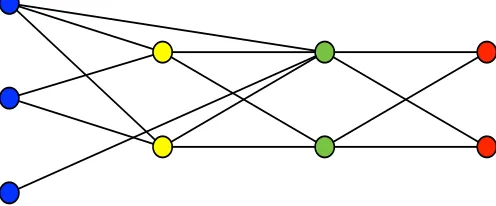
We show a example of 3-local biclique coloring in fig. 2.3.
Remark. On one side, the best approximation for vertex cover of general graph is 2 −
Θ
1
√
log|V|
[91]. More strictly, it is a randomized algorithm and the ratio is parameterized by size
of vertex set |V|. WhileAlgorithm 2 is deterministic and returns an approximation independent