Nurse manager’s recognition behavior with staff nurses in
Japan-based on semi-structured interviews
Chiharu Miyata1, Hidenori Arai1, Sawako Suga2
1
Department of Human Health Sciences, Kyoto University Graduate School of Medicine, Kyoto, Japan 2
Department of Nursing, Kansai University of Nursing and Health Sciences, Hyogo, Japan Email:[email protected]
Received 20 October 2013; revised 20 November 2013; accepted 6 December 2013
Copyright © 2014 Chiharu Miyata etal. This is an open access article distributed under the Creative Commons Attribution License, which permits unrestricted use, distribution, and reproduction in any medium, provided the original work is properly cited. In accor-dance of the Creative Commons Attribution License all Copyrights © 2014 are reserved for SCIRP and the owner of the intellectual property Chiharu Miyata etal. All Copyright © 2014 are guarded by law and by SCIRP as a guardian.
ABSTRACT
Objective: The purpose of this qualitative study was to obtain a better understanding of nurse manager’s recognition behavior. Methods: This study, consisting of semi-structured interviews, was conducted in five hospitals with 100 beds or more in the Kanto, Kansai, and Kyushu regions of Japan. Fifteen nurse manag-ers, who each had more than one year of professional work experience as a nurse manager, participated in this study. Results: We extracted four categories and fourteen subcategories as the factors related to the recognition behaviors in nurse managers. The first category is the basis of the recognition behaviors, which were divided into the following four subcatego-ries: recognition behaviors that they received, per-ception of recognition behaviors, construction of con-fidential relationships with staff nurses, and the or-ganizational climate. The second category is the issues that make recognition behaviors difficult, which were classified into the following three subcategories: mul-tiple duties, number of staff nurses, and characteris-tics of the recent staff nurses. The third category is the factors regarding the staff nurses that must be considered, which consist of the following two sub-categories: the characteristics and motivation of staff nurses and recognition behaviors that the staff nurses expect. The forth category is the methods of the rec-ognition behaviors, which consist of the following five categories: watching over and consideration of indi-viduals, evaluation of routine work, development as a professional, opinion sharing and delegating work, and promotion of work-life balance. Conclusions: The recognition behavior by nurse managers is influenced by their own experience, and nurse managers prac-tice recognition behaviors in response to the charac-
teristics of their staff nurses in a busy environment. Our results suggest that nurse managers need exper- tise in management for them to identity appropriate recognition behavior.
KEYWORDS
Recognition Behavior; Nurse Manager; Staff Nurses
1. INTRODUCTION
bility; 4) reporting evaluations from patients; and 5) re-spect of desired working hours. However, few studies have been conducted to identify the recognition behavior that is most important to nurses in Japan. Thus, we fo-cused on the recognition behavior by nurse managers.
In our previous study, we investigated how staff nurses perceived the nurse managers’ recognition behaviors and found that there was a discrepancy in the practical ap-proaches to these behaviors between the nurse manager and staff nurses. We assumed that one factor causing this discrepancy could be perception gaps between the nurse manager and staff nurses. We also found discrepancy among the recognition behavior factors. Furthermore, we would like to clarify the structure of the nurse manager’s recognition behavior. Therefore, the aim of this study was to obtain a better understanding of the manager’s recognition behavior with semi-structured interviews.
2. METHODS
2.1. Participants
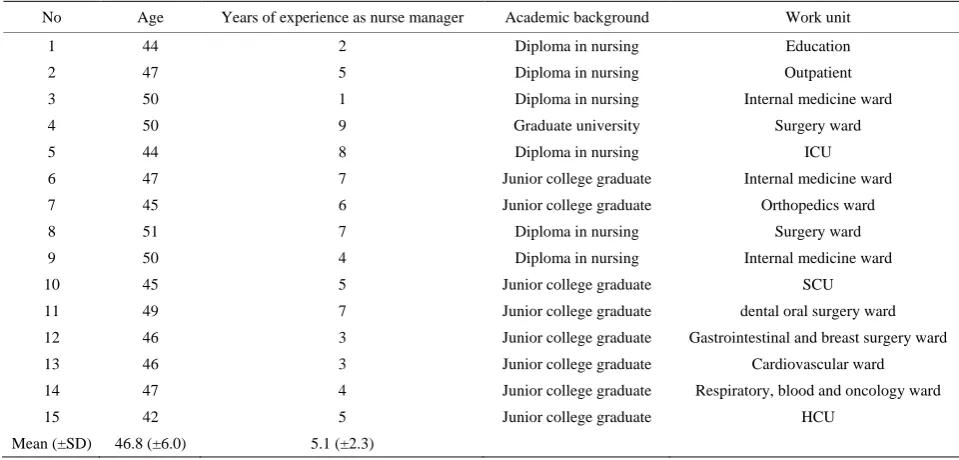
Fifteen nurse managers participated in this study. They were selected from five hospitals with 100 beds or more in the Kanto, Kansai, and Kyushu regions of Japan. Fol-lowing the agreement of the involved organizations, the researchers explained the project and procedures to the nurse managers. Criterion sampling was used as inten-tional sampling because each person had at least one year of experience as a nurse manager. All participants were women. The mean age was 46.6 years (range: 42 - 50 years). Regarding professional work experience as a nurse manager, the mean experience was 5.1 years (range: 1 - 9 years) (Table 1).
2.2. Data Collection
We conducted a qualitative study using semi-structured interviews. The interview topic guidelines were devel-oped by the investigators. The following six questions were used as an exploratory descriptive research design:
1) How do you think about recognition behavior? 2) Is there anything that has affected your perception of recognition behavior?
3) What type of recognition behavior do you think the staff nurses expect?
4) What type of recognition behavior do you usually give to the staff nurses?
5) What kind of response do you receive from the staff nurses?
6) Do you feel it is difficult to engage in recognition behavior for staff nurses?
All interviews were conducted in a private area at the nurse managers’ workplace for 0.5 to 1 h. Interviews were audio-recorded and later transcribed for the analy-sis.
2.3. Rigor
The rigor and trustworthiness of this study process and its findings were guided by Lincoln and Guba’s criteria for evaluating qualitative research [11,12]. They devel-oped the following criteria to demonstrate the trustwor-thiness of qualitative studies: credibility, transferability, dependability, and conformability.
[image:2.595.55.535.507.737.2] In our study, credibility was established in several ways. First, we used purposeful sampling, and spe-cific, criteria-based sampling for information to en-sure that participants were knowledgeable and had
Table 1. Demoraphic characteristics of the nurse managers.
No Age Years of experience as nurse manager Academic background Work unit
1 44 2 Diploma in nursing Education
2 47 5 Diploma in nursing Outpatient
3 50 1 Diploma in nursing Internal medicine ward
4 50 9 Graduate university Surgery ward
5 44 8 Diploma in nursing ICU
6 47 7 Junior college graduate Internal medicine ward
7 45 6 Junior college graduate Orthopedics ward
8 51 7 Diploma in nursing Surgery ward
9 50 4 Diploma in nursing Internal medicine ward
10 45 5 Junior college graduate SCU
11 49 7 Junior college graduate dental oral surgery ward
12 46 3 Junior college graduate Gastrointestinal and breast surgery ward
13 46 3 Junior college graduate Cardiovascular ward
14 47 4 Junior college graduate Respiratory, blood and oncology ward
15 42 5 Junior college graduate HCU
over one year of experience as a nurse manager [13]. Second, the researcher exchanged e-mails with the participants before the interview to build a strong, confidential relationship. Third, membership checks were performed [12].
Transferability: Participants in the present study were all classified in the same way (as nurse managers) and each was required to meet strict inclusion criteria. In Japan, a clear definition of nurse manager has been lacking in the literature, making it difficult to analyze and synthesize the findings from previous studies. The nurse manager definition in this study allowed us to apply the research findings with confidence.
Dependability: The author who conducted all the in-terviews received feedback on interviewing techniques from an expert senior investigator in the research team. This approach facilitated consistency of the data collection methods.
Conformability: All interviews were audio-recorded, contributing to maintaining an audit trail that could be used to trace each step of the analysis back to the original study protocol. Content analysis of the data and peer review of the steps in the analysis were achieved through an interactive feedback process with the research team.
2.4. Ethical Consideration
The study was approved by the Ethics Committee of Kyoto University Graduate School and the Faculty of Medicine. Additionally, research permission was given by the chief nursing directors of all five hospitals.
2.5. Data Analysis
The authors independently reviewed the transcriptions and constructed tables of code categories based on the actual words or phrases (meaning units). We independ-ently identified themes representing one or more code category and specific quotations representing each code category. This qualitative content analysis approach was adapted from Graneheim and Lundman [14]. We used the Nvivo 9 software program (QSR International Pyt Ltd, Concaster, Victoria, Australia) to count the meaning unit code categories. We discussed the coding theme and the major themes arising from the data to reach consen-sus.
3. RESULTS
We extracted four categories and fourteen subcategories as the significant factors of the nurse manager’s recogni-tion behavior (Table 2).
Basis of recognition behavior:
We selected four subcategories as the basis of recogni-tion behaviors, which were recognirecogni-tion behaviors that
they received, perception of the recognition behaviors, construction of a confidential relationship with staff nurses, and the organizational climate. The recognition behavior that they received included nine codes, which were “I was allowed to do anything, which was very useful”, “She listened to my story enthusiastically”, “She watched me when I was not aware”, “I received a letter of gratitude”, “I was told she was glad to be with me”, “My proposal and opinion were accepted, so I have a sense of accomplishment”, “I was praised and promoted, and I do the same for others”, “I was instructed to per-form a task but did not receive praise, so I try to praise others as much as I can”, and “Since I used to have a feeling of unfairness, I place an importance on fairness”. Fourteen participants (93%) answered that these recogni-tion behaviors that they received are the basis for their current perceptions of recognition behavior and practice. The perceptions of recognition behaviors included two codes, which were “Praise is regarded as a more impor-tant factor than before” and “Recognition behaviors are necessary in particular for young staff nurses”. Eleven participants (73%) recognized that recognition behaviors are necessary for the growth of staff nurses. The con-struction of a confidential relationship with staff nurses included three codes, which were “It is necessary to rec-ognize each other”, “It is necessary to build a confiden-tial relationship”, and “As long as the human relationship is good, the recognition behavior is not required for the communication”. They told us that the confidential rela-tionship with staff nurses is a premise for the practice of recognition behaviors. The organizational climate in-cluded four codes, which were “Caring about particularly young staff nurses by the nurse manager and all staff members”, “Bringing up staff members by the entire or-ganization”, “Ward with high motivation”, and “Recog-nition behind the scenes”. They placed importance on having a culture of personal development at the workplace wherein the nurse manager attempts to be uplifting for staff nurses in the entire ward or hospital.
Table 2. Recognition behavior: Category, Sabcategory and Code.
Category Sabcategory Code
The basis of recognition behaviors
The recognition behaviors that they received
I was allowed to do anything, which was very useful She listened to my story enthusiastically
She watched me when I was not aware I got a letter of gratitude
I was told she was glad to be with me
My proposal and opinion were accepted, so I have a sense of accomplishment I was praised and promoted, and I do the same for others
I was instructed to perform a task but did not receive praise, so I try to praise others as much as I can
Since I used to have a feeling of unfairness, I place an importance on fairness The perceptions of
recognition behaviors
Praise is regarded as a more important factor than before
Recognition behaviors are necessary in particular for young staff nurses
The construction of a confidential relationship with staff nurses
It is necessary to recognize each other
It is necessary to build up confidential relationship
As long as human relationship is good, recognition behavior is not required for communication
The organizational climate Caring about particularly young staff nurses by the nurse manager and staff nurses Bringing up staff members by the entire organization
Ward with high motivation Recognition behind the scenes
Issues that make recognition behavior difficult
Multiple duties I am too busy and my job is too demanding
I cannot afford to praise someone for performing their duties
The number of staff nurses
It is hard to find small things in daily duties It is difficult to support or follow all staff nurses It is difficult to fairly watch each staff nurse
The characteristics of recent staff nurses
They have not had an experience of failure and do not learn things It takes time for them to grow into full-fledged nurses
They can only do their own jobs
They highly evaluate themselves, although they do not work on their tasks They place an importance on their private time
Factors regarding staff nurses that must be considered
The characteristics and motivation of staff nurses
It is necessary to change a way of recognition behaviors in accordance with levels of motivation
We practice recognition and instruction by sorting the staff nurses into three categories We understand their background and character
We understand staff nurses and recognize their personalities Recognition depending on their age
Timing to speak
The recognition behaviors which the staff nurses expect
They want to be praised by patients and their family They do not expect excessive recognition
They plane an importance on detailed evaluation They am recognized by co-workers and seniors
Methods of recognition behavior
The watching over and considering individuals
We listen to staff nurses talking We offer a warm expression
We provide a feeling of security that they are watching the staff nurses We speak to the staff nurses with interest
We accept their existence We look at them doing their best
The evaluating routine work
We look at and evaluate inventive ideas of the staff nurses We share care for patients and evaluations from patients We praise the staff nurses for doing their best with concrete words We praise staff nurses particularly when they are busy
The developing as a professional
We praise the good points of the staff nurses at personal interviews, which are regularly carried out, and reinforce that they are doing a good job/recommend additional training and education to increase their motivation
We recommend the next step
We mentor the staff nurses so that they can be independent
The opinion sharing and delegating of work
We transfer authority and support them
We listen to their opinions and incorporate feedback Delegating work increases their motivation
which were “They have not had an experience of failure and do not learn things”, “It takes time for them to grow into full-fledged nurses”, “They can only do their own jobs”, “They highly evaluate themselves, although they do not work on their tasks”, and “They place an impor-tance on their private time”. The nurse managers found human resource development difficult due to the charac-teristics of young staff nurses.
Factors that must be considered regarding staff nurses: The factors that must be considered regarding staff nurses consisted of two subcategories, which were the characteristics and motivation of staff nurses and recog-nition behaviors that the staff nurses expect. The charac-teristics and motivation of staff nurses had six codes, which were “It is necessary to change the recognition behaviors according to the levels of motivation,” “We practice recognition and instruction by sorting the staff nurses into three categories,” “We understand their back-ground and character”, “We understand staff nurses and recognize their personalities”, “Recognition depends on their age”, and “Timing to speak”. Nine participants (60%) with more than five years of experience as a nurse man-ager stated that the level of recognition needs to be changed depending on the individual characteristics and the age of the staff nurses. The recognition behaviors the staff nurses expect included four codes, which are “They want to be praised by patients and their families”, “They do not expect excessive recognition”, “They place an importance on detailed evaluation”, and “They want to be recognized by co-workers and seniors”. The partici-pants judged what type of recognition behaviors the staff nurses expect based on the response or remark of the staff nurses.
Methods of recognition behavior:
The methods of recognition behaviors had five sub-categories, which were watching over and considering individuals, evaluating routine work, developing as a professional, opinion sharing and delegating work, and promoting work-life balance. The watching over and considering individuals consisted of six codes of em-pathic recognition behaviors for each staff nurse, which were “We listen to staff nurses talking”, “We offer a warm expression”, “We provide a feeling of security that they are watching the staff nurses”, “We speak to the staff nurses with interest”, “We accept their existence”, and “We look at them doing their best”. The evaluation of routine work had four codes, which were “We look at and evaluate the inventive ideas of the staff nurses”, “We share care for patients and evaluations from patients”, “We praise the staff nurses for doing their best with con-crete words”, and “We praise staff nurses particularly when they are busy”. The development in a professional job contained three codes, which were “We praise the
good points of the staff nurses at personal interviews, which are regularly carried out, and reinforce that they are doing a good job/recommend additional training and education to increase their motivation”, “We recommend the next step”, and “We mentor the staff nurses so that they can be independent”. The opinion sharing and dele- gating work included three codes, which are “We trans- fer authority and support them”, “We listen to their opi- nions and incorporate feedback”, and “Delegating work increases their motivation”. The promoting work-life bal- ance included two codes, which are “Requests are re- spected for work schedule although equality is regarded as important” and “Request for days off and privacy is respected”. Most participants reported that there is a balance between work and privacy.
4. DISCUSSION
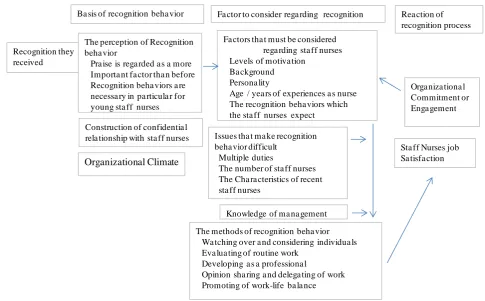
The factors that lead to the practice of recognition be-haviors were structured for how the categories are placed
(Figure 1). We should discuss the meaning of the four
categories.
4.1. Basis of Recognition Behavior
The recognition they received before they became nurs-ing managers affects how the nursnurs-ing managers behave when they take on that role. “Role model” and “Initial work experience” can promote the growth of a middle leader [15]. The nurse managers in our study learned from the nurse managers before them, and they modeled their concept of a nurse manager on their predecessors, which included recognizing the importance of recogni-tion behaviors. Furthermore, the nurse managers believed that the need to build a confidential relationship with the staff nurses and the organizational climate in which per-sons are accepted are essential for the staff nurses to fa-vorably receive recognition behaviors.
The relationship with their superiors can stress staff nurses even when the support from their superiors is relatively high, which indicates that the support from superiors has both positive and negative influences [16]. In other words, the organizational climate and construc-tion of the relaconstruc-tionship with staff members are important factors that affect the improvement of the staff members' motivation. Recognition behaviors by a nurse manager are based on the experience of the recognition that they previously received, perception of recognition behaviors, the confidential relationship with staff members, and the organizational climate in which persons are accepted and allowed to grow.
4.2. Factors to Consider Regarding Recognition
Figure 1.Construction of recognition behavior.
nurses
Nine nurse managers who have more than five years of experience as a nurse manager (60%) chose a method of recognition behavior based on the characteristics and age of the staff nurses. Nomi etal. [17] reported that the support from a superior strongly influences the empathic organizational commitment of staff nurses with over five years of experience compared to those with fewer years of experience. The participants talked about the difficulty in recognition for nurses with many years of experience, who can manage all tasks. They judge the difference in years of experience based on their experience as a nurse manager. In particular, one nurse manager who earned a master’s degree in management practiced recognition behaviors by classifying the staff nurses according to their types and referring to such evidence. Atwater etal. [18] suggested that the method of feedback needs to change in accordance with the difference in the charac-teristics and motivation of staff members. Thus, it is thought that the expert knowledge of management is an important factor influencing the practice of recognition behaviors.
As for recognition behaviors that staff nurses seem to expect, Greg [19] indicated that the relationship with patients and positive feedback from patients and their family members brings a feeling of fulfillment and joy to the nurses. A nurse can begin to offer appropriate
nurs-ing care with experience and boost self-confidence in his or her ability to practice. Staff members grasp their own growth and recognition through the existence of their co-workers and recognition of each other as individual people improves their abilities. Additionally, competing and treating each person positively will improve job sat-isfaction, and the nurses look at their co-workers as peo-ple they can cooperate with in a friendly way. Therefore, being praised and recognized by patients and their family members, co-workers and seniors, which has been re-garded as a recognition behavior expected by staff nurses, is an important recognition behavior.
The nurse managers believe their staff nurses do not expect excessive recognition. There is a culture in which individuals are not accepted positively in Japanese or-ganizations and society, and even though Japanese people strongly wish to be recognized, they are unlikely to share that wish with other people [20]. Nurse managers are aware of the cultural background of our country.
2) Issues that make the recognition behavior difficult Most of the nurse managers talked about the difficulty in having multiple duties and the number of staff nurses. Nurse managers are also stressed with some of the busi-ness aspects of medicine such as practicing high quality medical treatment while there is a shortening of hospi-talization days and medical cost reduction. Furthermore, nurses are expected to improve quality and quantity,
Recognition they received
Knowledge of ma na gement The perception of Recognition
beha vior
Pra ise is rega rded a s a more Importa nt fa ctor tha n before Recognition beha viors a re necessa ry in pa rticula r for young sta ff nurses
Construction of confidentia l rela tionship with sta ff nurses
The methods of recognition beha vior Wa tching over a nd considering individua ls Eva lua ting of routine work Developing a s a professiona l
Opinion sha ring a nd delega ting of work Promoting of work-life ba la nce
Fa ctors tha t must be considered rega rding sta ff nurses Levels of motiva tion Ba ckground Persona lity
Age / yea rs of experiences a s nurse The recognition beha viors which the sta ff nurses expect
Orga niza tiona l Commitment or Enga gement
Sta ff Nurses job Sa tisfa ction
Ba sis of recognition beha vior Rea ction of
recognition process Fa ctor to consider rega rding recognition
Organizational Climate
Issues tha t ma ke recognition beha vior difficult
Multiple duties
which are contradictory duties. Moreover, in spite of the recommendation that the number of persons one admin-istrator manages should be around fifteen (span of con-trol), the number of nurses for one ward is over twenty or thirty. In addition, younger nurses tend to lack aggres-siveness and identity, are afraid of making mistakes, wait for directions, and are passive, as indicated by the fact that they do only what they are told to do [21]. Oversee-ing younger nurses makes the recognition behavior prac-tice of the nurse manager difficult.
3) The methods of recognition behavior
In the studies by Blegen et al. [1] and Ozaki [10], evaluation of staff members by language and feedback behaviors were commonly observed in the recognition behaviors that nurse managers concretely practiced. How-ever, the results were not conveyed or presented to others as a recognition behavior.
Watching over and considering the individuals: Herzberg [22] reported that there are common points in the incidents in which staff members feel job satisfac-tion and many of them include achievement, recognisatisfac-tion, the job itself, responsibility, and promotion. Thus, rec-ognition in a workplace is one of the processes that strengthens the awareness role of staff nurses, increasing their job satisfaction as well as their commitment to the organization. The feeling of job satisfaction is important for job motivation. Job satisfaction is actually felt when the people realize their abilities and potential through the job and experience mental growth.
Evaluation of routine work and Development as a professional:
There are problems related to the labor circumstances and conditions of nurses such as heavy work burden, long working hours, and the use of paid holidays for night shifts. It is hard to expect staff nurses to love their jobs and feel joy when they are working in an environ-ment where there is insufficient time to provide adequate care. Once staff nurses feel that their hospital offers an environment that promotes ideal nursing, they have a sense of belonging to the hospital and experience higher job satisfaction. As nurse managers realize, recognition as a positive evaluation for patient care is particularly necessary when the nurses are busy.
Ota [20] categorized recognition based on the tempo-ral axes and content, instead of on subjects who are given recognition. One is everyday recognition, which relies on desire for recognition, recognizes routine and leads to the improvement of short-term motivations, and the other is recognition of career, in which a management-level em-ployee performs with a medium-and-long term viewpoint. From the viewpoint of career recognition, as years of continuous employment become long, nurses reach a transitional period such as marriage and raising children, and at the same time, the organization expands the role
for the workers. In such a period, it is necessary to estab-lish a flexible career design to meet the changes such as role assignments that satisfy individual needs and pro-vide opportunities for study.
Promotion is also included in career recognition. The recommendation for a staff nurse to aim to become a manager indicates that the staff nurse has received a positive career evaluation, which influences job satisfac-tion. However, although the number of nurses is larger than other health professionals in a hospital, few of them are promoted to the managerial class. For the nurses who do undertake a post, it is necessary to recognize their career by recommending that they join workshops that promote expertise in their specialty even if they are not going to be promoted.
Promotion of work-life balance:
Lim etal. [23] has reported that maturity as an adult leads to employment continuation. The sense of values among the people shows diversity; therefore, we expect career development in which each individual can priori-tize their work or privacy depending on their situation. Thus, the promotion of work-life balance is a challenge for nurse managers.
5. RECOMMENDATION
In this study, we aimed to reveal the factors related to recognition behaviors by nurse managers through inter-views. We found that the recognition given by a nurse manager is influenced by their own experiences, and the nurse managers conduct recognition behaviors while they consider the characteristics of their staff members in a busy environment. These results can be utilized for future nurse management and for the required practice of knowledge and recognition behaviors.
6. LIMITATIONS OF THIS STUDY
In this study, there are some limitations: first, the results present only the nurse managers’ perspective of the rec-ognition behavior and may miss the perspective of staff nurses. Second, there are many interlinking factors, such as the individual’s sense of values, regional characteris-tics, and job locations, and these have not been dis-cussed.
ACKNOWLEDGEMENTS
appre-ciated. Part of this work was supported by Grants-in-Aid for Compre-hensive Research on Aging and Health from the Ministry of Health, Labor, and Welfare of Japan (H24-Tyojyu-001).
REFERENCES
[1] Blegen, M.A. (1992) Recognizing staff nurse job perfor- mance and achievements. ResearchinNursing&Health, 15, 57-66. http://dx.doi.org/10.1002/nur.4770150109
[2] Froman, L. (2010) Positive psychology in the workplace.
Journal of Adult Development, 17, 59-69.
http://dx.doi.org/10.1007/s10804-009-9080-0
[3] Nahrgang, J.D., Morgeson, F.P. and Hofmann, D.A. (2011) Safety at work: A Meta-analytic investigation of the link between job demands, job resources, burnout, engagement and safety outcomes. Journal of Applied Psychology, 96, 71-94.
http://dx.doi.org/10.1037/a0021484
[4] Kalisch, B.J., Lee, H. and Rochman, M. (2010). Nursing staff teamwork and job satisfaction. Journal of Nursing Management, 18, 938-947.
http://dx.doi.org/10.1111/j.1365-2834.2010.01153.x
[5] O’Driscoll, M.P. and Randall, D.M. (1999) Perceived organizational support, satisfaction with rewards, and em- ployee involvement and organizational commitment. Ap- plied Psychology: An International Review, 48, 197-209.
http://dx.doi.org/10.1111/j.1464-0597.1999.tb00058.x
[6] Tourangeau, A.E., Cummings, G., Cranley, L.A., Ferron, E.M. and Harvey, S. (2010) Determinates of hospital nurse intention to remain employed: Broadening our un- derstanding. Journal of Advanced Nursing, 66, 22-32.
http://dx.doi.org/10.1111/j.1365-2648.2009.05190.x
[7] Carter, M.R. and Tourangeau, A.E. (2012) Staying in nursing: What factors determine whether nurses intend to remain employed? Journal of Advanced Nursing, 68, 1589-1600.
http://dx.doi.org/10.1111/j.1365-2648.2012.05973.x
[8] Chan, E. and Morrison, P. (2000) Factors influencing the retention and turnover intentions of registered nurses in a Singapore hospital. Nursing and Health Sciences, 2, 113- 121. http://dx.doi.org/10.1046/j.1442-2018.2000.00046.x
[9] Ulrich, B.T., Lavandero, R., Hart, K.A., Woods, D., Leggett, J., Friedman, D., D’Aurizio, P. and Edwards, S. J. (2009) Critical care nurses’ work environments 2008: A follow-up report. Critical Care Nurse, 29, 93-102.
http://dx.doi.org/10.4037/ccn2009619
[10] Ozaki, F. (2003) Influence of head nurse recognition be- havior to staff nurses’ job satisfaction. Niigata Medical Journal, 117, 155-161.
[11] Guba, E.G. (1981) Criteria for assessing the trustworthy- ness of naturalistic inquiries. Education Communication Technology Journal, 29, 75-91.
[12] Lincoln, Y.S. and Guba, E.G. (1985) Naturalistic inquiry. Sage Publications, Calif.
[13] Baxter, J. and Eyles, J. (1997) Evaluating qualitative research in social geography: Establishing “Rigor” in in- terview analysis. Transactions of the Institute of British Geographers, 22, 505-525.
http://dx.doi.org/10.1111/j.0020-2754.1997.00505.x
[14] Graneheim, U. and Lundman, B. (2004) Qualitative con- tent analysis in nursing research: concepts, procedures and measures to achieve trustworthiness. Nurse Educa- tion Today, 24, 105-112.
http://dx.doi.org/10.1016/j.nedt.2003.10.001
[15] Kanai, Y. and Furuno, Y. (2001) Quantum leap experi- ences for leadership development-developing middles managers as basis of intellectual competitiveness hi- totsubashi. Business Review, 49, 48-67.
[16] Tanaka, M. (2007) Reconsideration of contemporary nursing issues based on the theory of profession. Bulletin of the Graduate School of Yamagichi Prefecutural Uni-versity, 8, 119-128.
[17] Nohmi, K., Mizuno, M. and Ozawa, M. (2010) How fac- tors relating to affective commitment to organization vary depending on the years of nursing experience. Japan Academy of Nursing Science, 30, 51-60.
[18] Atwater, L., Brett J. and Charles, C. (2007) Multisource Feedback: Lessons learned and implications for practice.
Human Resource Management, 46, 285-307.
http://dx.doi.org/10.1002/hrm.20161
[19] Gregg, F.M. (2005) Clinical nurses’ experiences which facilitate organizational commitment. Gifu College of nursing Journal, 6, 11-18.
[20] Ohta, H. (2011) Shounin to motivation (Recognition and Motivation). Dobunkann, Tokyo.
[21] Takahashi, H., Ida, M. and Nishimatu, Y. (2011) Devel- opment of full-fledged employee scale and verification of its reliablity and validity. The Journal of Psychology Rissho University, 2, 81-96.
[22] Herzberg, F., Mausner, B. and Snyderman, B. (1959) The Motivation to Work. 2nd Edition, John Wiley & Sons Inc., New York, 20, 141-147.
[23] Lim, Y. and Yoneyama, K. (2008) Career formation in nurses and factors to effect on it. Japan Journal of Nurs- ing Science, 28, 12-20.