Munich Personal RePEc Archive
Optimal Collusion-Proof Auctions
Che, Yeon-Koo and Kim, Jinwoo
6 September 2007
Online at
https://mpra.ub.uni-muenchen.de/6098/
Optimal Collusion-Proof Auctions
Yeon-Koo Che
∗Jinwoo Kim
†September 6, 2007
Abstract: We study an optimal collusion-proof auction in an environ-ment where subsets of bidders may collude not just on their bids but also on their participation. Despite their ability to collude on partici-pation, informational asymmetry facing the potential colluders can be exploited significantly to weaken their collusive power. The second-best auction — i.e., the optimal auction in a collusion-free environment — can be made collusion-proof, if at least one bidder is not collusive, or there are multiple bidding cartels, or the second-best outcome involves a nontrivial probability of the object not being sold. In case the second-best outcome is not weak collusion-proof implementable, we characterize an optimal collusion-proof auction. This auction involves nontrivial ex-clusion of collusive bidders — i.e., the object is not sold to any collusive bidder with positive probability.
Keywords: Collusion on participation, subgroup collusion, multiple bidding cartels, an exclusion principle.
∗Columbia University, Economics Department. Email: [email protected]. †Yonsei University, School of Economics, Email: [email protected].
1
Introduction
Collusion by participants often poses a serious threat to markets and organizations. Nowhere is such a threat more intimately felt than in auctions where bidders can manipulate or simply withdraw their bids to limit competition. Not surprisingly, auctions have provided the volume and prominence to the study of collusion, with its evidence found in highway construction contracts (Porter and Zona (1993)), timber sales (Baldwin et al. (1997)), and in school milk delivery contracts (Pesendorfer (2000), and Porter and Zona (1999)).
In keeping with these evidences are the theoretical findings that “standard” auctions are vulnerable to bidder collusion, even when the cartel members face mutual asymmetric informa-tion. McAfee and McMillan (1992) demonstrate in their seminal article that asymmetrically informed cartel members can structure a knock-out auction that enables them to (re)allocate the good among themselves efficiently while limiting the seller’s revenue to at most her re-serve price. The ability by the cartel members to exchange side payments (without getting detected) is crucial for this result, but they can achieve the same effect via adjusting their bid rotation or market shares, if auctions are repeated.1
If standard auctions are vulnerable to collusion, can one find an auction rule that is not? This is the question we pursue in this paper. What makes this question nontrivial is the informational asymmetry facing potential colluders. If colluders have complete information about one another, then they can effectively act like a single agent and maximize their joint payoffs. Then, there would be little room for auction design, for an optimal scheme would simply reduce to textbook monopoly pricing. If bidders face mutual asymmetric information, however, they may not effectively coordinate their behavior, and the seller may exploit this to undermine collusion. Although standard auctions are not capable of this (as has been shown by extant literature), other auction rule may enable the seller to exploit the bidders’ mutual asymmetric information more effectively. We seek to identify such an auction rule.
In order to study an optimal response to collusion, one must understand a bidder’s incentive to participate in collusion. In particular, one must deal with the question of what happens after a bidder refuses to participate in collusion. What belief would they form about the subsequent competition and about the types of bidders they face? Can the remaining cartel members punish the defecting bidder, and if so, to what degree? How one models the (out-of-equilibrium) belief and the cartel members’ ability to punish a defector determines a bidder’s
1Graham and Marshall (1987), McAfee and McMillan (1992), Mailath and Zemsky (1991), Eso and
incentive to participate in a collusive arrangement, which in turn determines the scope and the nature of the seller’s response. In this regard, we take an eclectic approach by considering both weak and strong notions of collusion-proof auctions.
The weak notion postulates that collusion arisesonly when it benefits all types of bidders relative to a non-cooperative play without any updating of beliefs. An auction rule is said to be weak collusion-proof if it admits no such collusion. This notion is reasonable to the extent that cartel members will often find it difficult to punish a defector more severely than bidding competitively. At the same time, the weak notion restricts the bidders’ out-of-equilibrium beliefs. Hence, we also consider a “strong” notion, which imposes no restriction on the cartel members’ out-of-equilibrium beliefs or their ability to punish a defector: an auction rule is defined to be strong collusion-proof if, under that rule, the seller enjoys in every Bayesian Nash equilibrium the same expected revenue as she would absent any collusion. Further, we require the strong collusion-proof auction to be robust to the specifics of the cartel operation. While the alternative notions matter to some extent, they do not affect the main thrust of our results. We find, largely irrespective of the particular notion used, that a seller can overcome her vulnerability to collusion in a surprisingly broad range of circumstances. Specif-ically, a seller can attain the highest revenue she can without any collusion, either if a cartel is not all-inclusive or if the object is not sold to any bidder with some probability. This re-sult holds with respect to the weak notion of collusion-proofness but also with respect to the strong notion given an additional condition (which is satisfied for the case of the all-inclusive cartel). When neither condition is met, we identify an optimal collusion-proof auction in some restricted class of auctions. In the process, we establish an exclusion principle which states that an optimal collusion-proof auction involves a positive probability of not selling to any col-lusive bidder. The exclusion principle holds quite generally, regardless of the buyers’ support of valuations, thus exhibiting a qualitative departure from the collusion-free auction design.2
In sum, the present paper suggests that a seller can overcome collusion completely in many cases and do generally much better than she could if she would resort to simple monopoly pricing.
The current paper is related to several recent papers.3 First, it is related to our companion
2As is well known, the standard optimal auction allocates the good to a buyer with probability one, if there
is at least one buyer whose infimum valuation is sufficiently high. See Myerson (1981).
3Other authors have studied optimal collusion-proof mechanisms in different contexts. Quesada (2004) finds
paper, Che and Kim (2007) (henceforth, CK), as well as Laffont and Martimort (1999, 2000) (henceforth, LM), which studies a collusion-proof contract when, unlike the current setting, agents can collude only after they participate in the contract. This latter assumption may not be appropriate in many auctions where bidders are intimately familiar with their opponents even before participating. In fact, an allegedly predominant form of collusion involves bidders coordinating on their participation decisions: Colluders either refuse to participate or with-draw their bids to let a designated cartel member win without facing competition. Further, the idea of “selling the firm” to potential colluders, featured in Che and Kim (2007), relies on the agents’ inability to collude on their participation decision. The current paper relaxes the assumption by allowing the bidders to collude on their participation decision.
In this latter respect, the current paper is related to Dequiedt (2007) and Pavlov (2006), who also study collusion-proof auctions when bidders can collude on their participation. De-quiedt considers two bidders with binary types (i.e., of either low or high valuation). He shows that, if a cartel can commit to punish a defector to his reservation utility, then the seller can at most collect her reserve price when a bidder’s valuation exceeds that price. This seemingly pessimistic result, however, has more to do with the binary type of the model than say with the bidders’ ability to collude on participation or their ability to punish a defector (which in fact corresponds to the strong notion in the current paper). With binary types, exclusion of a low valuation type is equivalent to setting a reserve price equal to the high valuation type. Hence, the optimality of this latter behavior, although completely explainable by our exclusion principle, may appear to suggest that the seller can’t do any better than adopting a text-book monopoly pricing. Our paper will show that the optimal collusion-proof auction does not generally reduce to monopoly pricing, and will typically generate strictly higher revenue.
Like us, Pavlov (2006) considers a model with a continuous bidder types, and his main result parallels some of the current paper, particularly Theorem 5. There are several dif-ferences, however. His analysis concerns only the case of the all-inclusive cartel and focuses only on ex ante symmetric bidders.4 The current paper goes much beyond that environment.
First of all, we consider the general case in which subsets of bidders are collusive. In fact, the most important result concerns the case in which a proper subset of bidders is collusive — i.e., at least one bidder is noncollusive or there are multiple bidding cartels — in which case the second-best outcome is shown to be collusion-proof implementable. Second, we can
pricing context. Laffont and Martimort (1998), Celik (2004) and Faure-Grimaud et al. (2004) study the optimality of delegation in the presence of collusive agents.
4Our results for the all-inclusive cartel case are obtained independently. As will be apparent, the methods
handle the case of ex ante asymmetric bidders, at least with the all-inclusive cartel: We show that the second-best outcome is collusion-proof implementable, given a somewhat stronger condition than is needed for the symmetric bidders case. Third, our model of collusion differs from his in that we allow members of collusion to reallocate the good once it is sold to one of the members.
Above all, the ability to handle collusion by a subset(s) of bidders is practically important and useful. In many circumstances, not all bidders are in a position to collude. Government auctions used in defense procurement, mineral extraction, or spectrum licenses often have incumbents with long history of operation competing against relative new comers. Long term interaction and shared experiences among the incumbents will put them in a better position to collude than the new comers. Likewise, in auctions for construction repairs or food service procurement, competition may involve both local and non-local providers, and the former group may be able to collude more effectively, based on their regular contacts and their interaction through trade associations. The problem of only a subset of bidders being collusive introduces a new challenge, since the cartel may prey on noncollusive bidders as much as on the seller. Hence, a collusion-proof design must eliminate incentives for the cartel to engage in such behavior.
The rest of the paper is organized as follows. Section 2 introduces an auction model and describes the second-best outcome in a collusion-free environment. Section 3 introduces a model of collusion and the notion of weak collusion-proof auctions. Section 4 identifies the properties of weak collusion-proof auctions and uses them to derive a condition that is necessary and sufficient for implementing the second-best outcome in a collusion-proof fashion. In Section 5, we characterize the optimal collusion-proof auction when the second-best is not weak collusion-proof implementable. Section 6 characterizes strong collusion-proof implementation. Section 7 concludes.
2
Primitives
A risk-neutral seller has an object for sale. The seller’s valuation of the object is normalized to zero. There are n ≥ 2 risk-neutral buyers who each independently draw a value, θi, on
the object from an interval Θi := [θi, θi]⊂R+ according to distributionFi, which has strictly
positive density fi on the support. We assume that both
Ji(θi) :=θi−
1−Fi(θi)
fi(θi)
and Ki(θi) :=θi+
Fi(θi)
fi(θi)
are strictly increasing in θi for all i∈N. Throughout, we let E[·] :=
R Θ[·]d(
Q
i∈NFi(θi)). and
Eθ˜−i[·] := R
Θ−i[·]d(
Q
j6=iFj(θj)) denote expectation operators based on the prior distribution,
where Θ :=Q
i∈NΘi and Θ−i :=
Q
j6=iΘj.
For a later analysis, it is convenient to augment each bidder’s type space to include the “participation decision” as part of his possible type. Specifically, we let θ∅ denote “non-participation” or “exit” option available to each bidder with the convention thatθ∅ < θi,∀i∈
N,∀θi ∈ Θi, and define Θi := {θ∅} ∪ Θi. We then let θ := (θ1, ..., θn) ∈ Θ := Qi∈NΘi
denote a possible profile of types in these enriched type spaces. Since we shall consider randomization in cartel members’ reports over their augmented type spaces, it is convenient to consider arbitrary probability distribution,µC, over Θ
C :=Qi∈CΘi for any C ⊂N and to
use EµC[·] := R
ΘC[·]d(µ
C(θ
C)) as an expectation operator relative toµC.
We now describe arbitrary auction rules, and we do so in direct mechanisms. An auction rule, M = (q, t), consists of an allocation rule, q = (q1,· · · , qn) : Θ → Q, where Q := {x ∈
[0,1]n|P
i∈Nxi ≤ 1} and a payment rule, t = (t1, ..., tn) : Θ → Rn, such that qi(θ∅, θ−i) =
ti(θ∅, θ−i) = 0,∀i, θ−i ∈Θ−i. An auction rule determines, for each profile of bidders’ reports
in Θ, a vector of probabilities for the bidders to obtain the object and a vector of expected payments they must pay, subject to the constraint that, if a bidder does not participate, he does not receive the good and collects his reservation utility, normalized to zero. Any equilibrium arising in any auction game can be described as an auction rule in this framework, so we sometimes use an “outcome” interchangeably with an auction rule.
Fix an auction rule,M = (q, t). Buyer i’s interim payoff when his valuation isθi ∈Θi but
reports ˜θi ∈Θi is
uMi (˜θi, θi) :=θiQi(˜θi)−Ti(˜θi),
where Qi(θi) :=Eθ˜−i[qi(θ)] and Ti(θi) :=Eθ˜−i[ti(θ)]. Given hidden information and the
avail-ability of the non-participation option, an auction rule must be incentive compatible and individually rational to be consistent with equilibrium. We say an auction rule M is feasible if
UM
i (θi) :=uMi (θi, θi)≥uMi (˜θi, θi), ∀i, θi ∈Θi,θ˜i ∈Θi. (IC∗)
Note (IC∗) subsumes both incentive compatibility and individual rationality, since it requires
UiM(θi)≥uiM(θ∅, θi) = 0. (IR)
Lemma 0. If M = (q, t)∈ M, then, for each θi ∈Θi,
UiM(θi) =E
h
Ki(˜θi)qi(˜θ)1{θ˜i≤θi}+Ji(˜θi)qi(˜θ)1{θ˜i≥θi}−ti(˜θ)
i
. (1)
Before proceeding, it is useful to consider a collusion-free environment. It is by now well known that, in such an environment, an optimal auction rule, calledsecond-best ornoncollusive optimal outcome, solves
[N C] max
M∈ME
" X
i∈N
ti(θ)
#
,
and its associated outcome is characterized as follows:
Theorem 0. (Myerson) An optimal mechanism that solves [N C] involves the allocation rule given by ∀θ ∈Θ,
q∗i(θ) =
(
1 if Ji(θi)>max{0,maxk6=iJk(θk)},
0 otherwise,
and yields revenue of
V∗ :=E
" X
i∈N
Ji(θi)qi∗(θ)
#
to the seller.
We assume that E[q∗
i(θ)] < 1 for each i ∈ N, or else the optimal mechanism reduces to
bargaining with a single buyer, so there would be no problem of collusion. Letting ˆθi :=
min{θi ∈ [θi,θ¯i]|Ji(θ) ≥ 0}, the optimal mechanism allocates the good to the bidder with
the highest virtual valuation Ji(θi) as long as θi ≥ θˆi. In particular, the object is sold with
probability one if there is a bidder i such that Ji(θi)>0.
3
A Model of Collusion
encompasses a range of possibilities that include the all-inclusive cartel (i.e., C ={N}), that allows for the presence of noncollusive bidders (i.e., some elements of C may be singleton) and/or for multiple bidding cartels (i.e., C may include Cj, j = 1, ..., k with |Cj| ≥ 2).
The cartel structure C is a common knowledge for all bidders in N and for the seller. The assumption that the seller knows the cartel structure, albeit not innocuous, may not be as restrictive as it may appear. For instance, our analysis would still apply if some cartel may not collude effectively. Also, the structure of potential bidding cartels (who is likely to collude with whom) can be sometimes discerned from prior auction experiences and other industry observables. Of course, none of these issues arise if there is only one cartel, as has been assumed in all existing papers. In this sense, the current model generalizes all existing models of collusion.
The time line is similar to that of LM and CK, except for one important difference: Cartels are formed prior to the bidders’ participation into the mechanism.
Time line:
• At date 0, each bidder learns his type, θi, drawn from Θi. The realized type is private
information of the bidder, unobservable to the seller as well as to other bidders.
• At date 1, the seller proposes an auction rule M ∈ M.
• At date 2, the (uninformed) representative of each cartelC∈ C simultaneously proposes a collusive side contract (to be described in detail later). Each member of C ∈ C then accepts or rejects the contract. If all bidders ofC accept, then that cartel’s side contract is enforced; or else, the members of C play the subsequent game non-cooperatively. Neither the side contract proposed for a cartelC nor its members’ decision on accepting that contract is observed by the bidders outside C (and by the seller).
• At date 3, each bidder,i∈N, chooses ˜θi ∈Θi; i.e., he accepts or rejectsM, and reports
from Θi if he accepts. (If the side contract of a cartel was accepted, then its members
report according to the side contract.)
• At date 4, if collusion by a cartel is active, then the outcome of their side contract arises. If no collusion is active, then M results.
Collusion Technology:
and (d) side payments that the cartel members can exchange in a budget-balanced fashion. These four instruments together encompass all possible ways in which a cartel can coordinate their members’ behavior.
To formally describe possible manipulations utilizing all these instruments, fix a possible cartel C ∈ C, and an auction rule M = (q, t)∈ M the seller may propose. We then suppose that an uninformed representative of each cartel C, |C| ≥ 2 proposes a side contract to its members, given that bidders outside C behave non-collusively (or equivalently their repre-sentatives offer null contracts). The latter presumption is made since later we shall focus on how non-collusive behavior can be supported as an equilibrium, which requires a unilateral deviation by each cartel to be prevented. Instead of considering a possible side contract by each cartel, it is convenient to think of a manipulation, the outcome that will emerge when that side contract is enforced and all others, including noncollusive bidders and members of different cartels, report truthfully.
Formally, an outcome, ˜M = (˜q,˜t) is a manipulation of M by cartel C, if there exists a function, µC : Θ
C → ∆ΘC, that maps from their types in ΘC into a probability distribution
over ΘC such that,∀θ ∈Θ,
X
i∈C
˜
qi(θ) = EµC(θ C)[
X
i∈C
qi(˜θC, θN\C)], (RCCM)
˜
qi(θ) =EµC(θ
C)[qi(˜θC, θN\C)],∀i∈N\C, (RC
M N\C)
E
" X
i∈C
˜ ti(θ)
#
=E
" X
i∈C
EµC(θ
C)[ti(˜θC, θN\C)]
#
, (BBM
C )
˜
ti(θ) = EµC(θ
C)[ti(˜θC, θN\C)].∀i∈N\C. (BB
M N\C)
These conditions are explained as follows. First, condition (RCM
C ) requires the final
as-signment of the good to be “reallocationally consistent” in the sense that the good is allocated to any cartel member only if some member of that cartel obtains the good from the seller un-der some manipulation of reports/participation decision. Condition (BBM
C ) allows the cartel
members to exchange side transfers in a budget-balanced fashion. Since budget balancing is required at the ex ante level, we are allowing for the cartel to finance (from a competi-tive capital market) across different realizations of its members’ type profiles.5 Conditions
(RCM
N\C) and (BBNM\C) simply assume that bidders outside C are not colluding: there is no
reallocation and no exchange of side payments among all bidders outside C and between C
5Our results do not change, if budget balancing is required at theex post level. Clearly, our collusion-proof
and N\C. This presumption would be without any loss if N\C were all noncollusive. Even if N\C may involve some bidding cartels, the above conditions are still sufficient for there to be an equilibrium with no collusion, since they ensure that the representative of each cartel offers a null side contract when other cartels adopt null side contracts.
Incentive Feasibility of Collusion
For collusive manipulation to work, the members of the cartel must have the incentive to carry it out. We say that ˜M is feasible if it satisfies
UiM˜(θi)≥u
˜
M
i (˜θi, θi), ∀i∈C, θi ∈Θi,θ˜i ∈Θi, (ICC∗)
and
UM˜
i (θi)≥UiM(θi), ∀i∈C, θi ∈Θi. (IRMC)
These conditions are explained as follows. First of all, (IC∗
C) requires the outcome
re-sulting from collusion to be incentive compatible to all members of cartel. Since the cartel members face asymmetric information about one another, this condition must hold, regardless of the specifics of how the cartel is formed and how the members bargain over their collusive arrangement. Next, (IRM
C ) requires that each member of the cartel must do as well with the
proposed manipulation as they would by vetoing that manipulation and acting noncoopera-tively. Clearly, what each member will get in the latter event depends on the inferences made by the members of the cartel about that member. Condition (IRM
C) assumes that no new
inferences about the members’ types are made in such an event. This “passivity” of out-of-equilibrium beliefs is an important element of LM’s weak collusion-proofness notion. Although (IRM
C) assumes passive out-of-equilibrium beliefs, it in fact accommodates all non-pessimistic
beliefs for our purpose. If a collusive proposal is made unattractive to a bidder with a passive belief about what will happen when he refuses the proposal, it will be unattractive to him if his beliefs were more optimistic about that event. In this sense, the real restriction arising from (IRM
C ) is for out-of-equilibrium beliefs to be non-pessimistic. This restriction serves as
a reasonable discipline over belief formation.6
Lastly, note these conditions are imposed only for the members of the cartel, since the manipulation constitutes its deviation unobserved by outsiders of that cartel. We turn next
6In fact, it is not too difficult to constructanon-collusive equilibrium, supported by an arbitrarilyoptimistic
to the weak notion of collusion-proof auctions.
Definition WCP. An auction rule M ∈ M is weak collusion-proof (henceforth, WCP), if, for each cartel C ∈ C with |C| ≥2, any feasible manipulation of M by C makes no member of C strictly better off.
To explain this notion, suppose the seller offers an auction rule M. If M is WCP, then, for each cartel C, there exists no feasible manipulation that would make some members of C strictly better (without making the other members of C worse off), given that all other cartels are inactive. Our WCP notion is the same as the WCP of LM, except that we allow for randomization and reallocation possibilities in the collusive bidders and that we allow for proper subsets of bidders to be collusive. It is in fact a natural generalization of their notion to allow for these new features. It follows from LM that, if an auction rule is WCP, it will admit an equilibrium in which the representatives of cartels propose no collusive manipulations — or equivalently, they all propose null side contracts.7
Despite the restrictions, the WCP auctions are worth studying for several reasons. First, WCP auctions offer a reasonable protection against collusion since it is often unrealistic for cartel members to punish more severely than bidding noncooperatively. Second, the weak notion provides a conservative test of when collusion imposes a real cost to the seller: If for instance there is no WCP auction that would allow a seller to earn the second-best revenue, then one can safely conclude that collusion matters, for the seller would not fare any better if the bidders can collude more effectively. Finally, the restrictions involved in the WCP notion are not crucial for the results obtained. We will later show that under some condition, the main result can be strengthened to the strong notion of collusion-proofness.
4
WCP Implementation of the Second-Best Outcome
In this section, we characterize the properties of WCP auction rules (Lemma 1 and 2) and use these properties to obtain a necessary condition for the second-best outcome to be WCP im-plementable (Theorem 1). We then show that, for symmetric bidders, the necessary condition is also sufficient for the WCP implementability of the second-best outcome.
7Our WCP requirement is equivalent to that the auction rule be “interim incentive efficient” according
4.1
Properties of WCP Auction Rules
Fix a cartel C ∈ C, and an auction rule M = (q, t) that the seller proposes. It is useful to have a few definitions. Let qC
i (θC) := Eθ˜N\C[qi(θC,θ˜N\C)]. Let qC(θ) := Pi∈Cqi(θ) and
QC(θC) := Eθ˜N\C[qC(θC,θ˜N\C)] denote the probability that the auction rule allocates to good
to a member of the cartel given the value profile of all bidders and that of the cartel members, respectively. Let QC := [0,supθC∈ΘCQC(θC)] be the set of all probabilities with which the
cartel can secure the good to its members under M. This set contains zero since all its members can boycott the auction i.e., QC(θ∅,· · · , θ∅) = 0. This set is convex since the cartel
members can randomize between boycotting and reporting some profile θC ∈ ΘC. We then
obtain our first property of WCP auction rules.
Lemma 1. If M = (q, t) ∈ M is WCP, then for each C ∈ C there exists a convex function, r :QC →R+ with r(0) = 0, such that
Eθ˜N\C "
X
i∈C
ti(θC,θ˜N\C)
#
=r(QC(θC)),∀θC ∈ΘC.
To see how this property restricts the auction rules, suppose all bidders belong to one cartel, and suppose the seller wishes to implement a deterministic allocation (i.e., q(·) ∈ {0,1}). Lemma 1 implies that, for the auction to be weak collusion proof, it must charge a single price if and only if the good is sold. More generally, the seller cannot collect any fee from a cartel whenever its members do not obtain the good. This feature arises from the abilities of the bidders to collude on their participation decisions; were they charged positive entry fees, they could all simply refuse to participate. Similarly, the collusive bidders can never be charged different prices for the same probability of obtaining the good; or else, they could manipulate their reports (or bids) to pick the lowest price for a given probability of obtaining the good. The surplus generated from such manipulation can be shared among all cartel members via appropriate side transfers and reallocations so that (IC∗) and (IRM
C ) conditions are satisfied.
Finally, the sale price is (weakly) convex in the probability of the object being allocated to any cartel member, since the cartel members can at least randomize between non-participation and any probability of allocation attainable by some reports.
The next property is obtained for a class of allocation rules satisfyingmonotonicity: for all C ∈ C, qC(·) is nondecreasing in θC and, for allC ∈ C and for alli∈C,qi(·) is nondecreasing
in θi and nonincreasing in θ−i. Let M0 ⊂ M denote the set of auction rules satisfying this
price charged to the cartel per unit probability:
p(θC) :=
r(QC(θC))
QC(θC)
if QC(θC)>0,
0 otherwise.
Lemma 2. IfM = (q, t)∈ M0 is WCP, then∀ C ∈ C, ∀i∈C and for almost every θC ∈ΘC,
(Ki(θi)−p(θC))qiC(θC)≥ max θ′
i∈{θ∅}∪[θi,θi]
(Ki(θi)−p(θi′, θC−i))qCi (θi′, θC−i). (2)
This lemma characterizes the extent to which each cartel can “behave like a single agent.” Specifically, condition (2) resembles an incentive compatibility constraint for a “single” agent who may consume one of |C| alternative values. But this resemblance is not perfect. First, that agent realizes “pseudo” value Ki(θi) rather than true value θi. Second, the bidder’s
constraint is required only in one direction, i.e., not to under-report or withdraw from the auction. Third, the agent may not be able to shift his consumption among the alternative uses. All together, these features serve to limit the extent to which the cartel can coordinate their members’ behavior. For instance, the fact that pseudo values, rather than true values, matter means that the cartel can be forced to sustain some ex post loss. SinceKi(θi)> θi, an
average price ofp(θi)> θi need not violate the above constraint. The cartel’s limited ability to
coordinate their behavior arises from the fact that any collusive defection requires a consensus from all types of bidders. Different types of bidders may have conflicting interests, say about consumption of the good by any particular typeθi. For instance, ifθi < p(θC), then the cartel
wishes to cancel such consumption, but the highest type of bidder i would not agree as long as Ki(θi)> p(θC).
Naturally, the necessary conditions for WCP implementation (given by Lemma 1 and 2) constrain the set of circumstances in which the second-best outcome is WCP implementable. We next characterize these circumstances. To this end, fix any bidder i∈C for some C ∈ C with |C| ≥2. For each profile θN\C ∈ΘN\C, let
φi(θN\C) := inf{θi ∈Θi |Ji(θi)≥max{max
j∈N\CJj(θj),0}}
denote the lowest type of bidder i that can obtain the good with positive probability in the second-best allocation.
Condition (SB): (i) If C ={N}, then
Ki(ˆθi) E
" X
i∈N
qi∗(θ)
#!
≥E
" X
i∈N
Ji(θi)qi∗(θ)
#
(ii) If C 6={N}, then, for each C ∈ C with |C| ≥2,
E
" X
i∈C
Ki(φi(θN\C))qi∗(θ)
#
≥E
" X
i∈C
Ji(θi)qi∗(θ)
#
.
This condition is explained as follows. The RHS of the inequalities represent the amounts of surplus that should be extracted from the cartel to implement the second-best payoff for the seller. As will be proven next, the LHS of the inequalities represent the highest payments that are collusion-proof collectable from the cartel, given the second-best allocationq∗. Thus,
the inequalities are necessary for the second-best outcome to be WCP implementable.
Theorem 1. (Necessity) Condition (SB) is necessary for the second-best outcome to be WCP implementable.
This theorem immediately identifies a class of situations for which the second-best outcome is not WCP implementable.
Corollary 1. A second-best outcome is not WCP implementable if it assigns the good to members of a cartel with probability one.
Proof: Without loss C = N, or else we can simply redefine N to coincide with C. We show that Condition (SB)-(i) fails if the members ofN receives the good with probability one.
Since P
i∈Nq∗i(θ) = 1 for all θ, there must exist isuch that Jk(θi)≥0, so ˆθk =θk. Hence,
Kk(ˆθk) =θk=E[Jk(θk)]<E[
X
i∈N
Ji(θj)qi∗(θ)],
where the strict inequality follows from the assumption (made in Section 2) thatE[q∗
k(θ)]<1.
This shows that excluding some types of collusive bidders is crucial for WCP implemen-tation of the second-best outcome, a theme that will be generalized later.
4.2
WCP Implementation of the Second-Best Outcome:
Symmet-ric Bidders
will be seen to hold if either at least one bidder is noncollusive or the second-best mechanism involves a nontrivial probability of no sale.
We begin with the symmetry assumption: Fi(·) =: F(·) for all i ∈ N, for some common
cdf F(·) which has a positive density f. The associated virtual valuations J and K are defined analogously, and their monotonicity properties are maintained. Likewise, we let ˆθ:= inf{θ|J(θ) ≥ 0}. Condition (SB) is now more succinctly described in this environment. Define first θC(1) := maxi∈Cθi and θN(1)\C := max{maxi∈N\Cθi,θˆ}. (We adopt a convention
that θN(1)\C := ˆθ when C ={N}.) Then, Condition (SB) simplifies to:
Condition (SB′): For eachCwith|C| ≥2,EhK(θ(1)
N\C)|θ
(1)
C > θ
(1)
N\C
i
≥EhJ(θC(1))|θ(1)C > θ(1)N\Ci.
As pointed out earlier, this condition requires a collusive bidder’s valuation to be sufficiently high whenever the good is allocated to him. It turns out that this requirement is not very onerous to satisfy. The condition holds if at least one buyer is noncollusive or there are more than one bidding cartel, or if the cutoff threshold ˆθ is sufficiently high.
Lemma 3. Condition (SB′) holds if C 6={N}, or if C ={N} and
K(ˆθ)≥E
h
J(θ(1)N )|θN(1) >θˆi. (3)
In case of the all-inclusive cartel (i.e., C = {N}), Condition (SB′), or equivalently (3), is
not trivial. For instance, if ˆθ = θ, then K(ˆθ) = θ, so the condition fails. In other words, a non-trivial exclusion is necessary to prevent collusion. Although not obvious at first glance, a similar exclusion is used in the case C 6={N}in that the good is sold to bidders outside that cartel with positive probability.
We now construct an auction rule that WCP implements the second-best outcome when Condition (SB′) holds. Suppose that a second price auction is held with a reserve price ˆθ, and consider the associated outcome M∗ = (q∗, t∗) defined over Θ. (Recall that the outcome is well defined even when some bidders do not participate, a situation described by θ∅ being chosen by these bidders.) We then construct a new auction rule ˆM = (ˆq,ˆt) defined over Θ. The allocation rule ˆq is constructed so that ˆq(·) = q∗(·). To construct the payment rule ˆt, we first determine the sale price against each cartelC ∈ C (with |C| ≥2). LetαC ∈[0,1] satisfy
EhαCK(θ(1)N\C) + (1−αC)J(θ(1)N\C)|θC(1) > θ
(1)
N\C
i
=EhJ(θ(1)C )|θC(1) > θ(1)N\Ci. (4)
Condition (SB′) allows such an αC to be well defined. The sale price against cartel C is then
set at HC(θN(1)\C) :=αCK(θN(1)\C) + (1−αC)J(θ(1)N\C). This sale price is defined in terms of the
average from the highest valuation bidder in C. Let δC(θ) := HC(θ(1)N\C)Pi∈Cqi∗(θ) denote
the expected sale price charged against cartel C.
We now describe the payment rule ˆt. For each noncollusive bidderi (i.e., {i} ∈ C), we set ˆ
ti(θ) := t∗i(θ), ∀θ ∈Θ. For each cartel C ∈ C, let C(θC) := {i ∈ C|θi 6=θ∅} be the set of its
members who participate in the auction, given θC. For each i∈C, ifC(θC) = C, then we set
ˆ
ti(θ) :=
1
|C|δC(θ) +Eθ˜−i
t∗i(θi,θ˜−i)−
1
|C|δC(θi,θ˜−i))
− 1
|C| −1
X
k∈C\{i}
Eθ˜−k
t∗k(θk,θ˜−k)−
1
|C|δC(θk,θ˜−k)
(5)
and, if C(θC)(C, then we set
ˆ
ti(θ) :=
δC(θ) if i∈C(θC)
0 if i∈C\C(θC).
(6)
Two properties of the current construction are important. First, in case all bidders par-ticipate, (5) implies Eθ˜−i[ˆti(θi,θ˜−i)] =Eθ˜−i[ti∗(θi,θ˜−i)],∀i ∈N, ∀θi ∈ Θi,8 so that each bidder
has the same interim incentives as with M. This property means that the new auction rule ˆ
M inherits the incentive and participation properties of the original auction M∗. Hence,
ˆ
M satisfies (IC∗) and implements V∗. Second, it can be checked from (5) and (6) that
P
i∈Cˆti(θ) = δC(θ) = HC(θ(1)N\C)Pi∈Cqi∗(θ) if every member of each cartel participates (or
else, each participating cartel member pays a high “punishment price” equal to δC(θ)). That
is, upon participating, each cartel C ∈ C is charged a single sale price, H(θ(1)N\C), depend-ing only on non-cartel members’ types and payable only when the object is allocated to its member. This property satisfies Lemma 1 and also ensures that the cartel cannot manipulate the sale price charged against its members. These two properties deliver weak collusion-proof implementation of the second-best outcome:
8To see this, note first, by (5) and symmetry,
E[δC(θ)] =E
J(θC(1))1{θ(1)
C >θ
(1)
N\C}
=E
" X
i∈C
t∗i(θ)
#
=|C|E[t∗i(θ)],∀i∈C, (7)
from which it follows that
Eθ˜−i[ˆti(θi,
˜
θ−i)] =Eθ˜−i[t
∗
i(θi,θ˜−i)]− 1
|C| −1
X
k∈C\{i} Eθ˜
t∗k(˜θ)−
1 |C|δC(˜θ)
=Eθ˜−i[t
∗
i(θi,θ˜−i)],
Theorem 2. (Sufficiency) Given Condition (SB′), the auction rule Mˆ is WCP and achieves the second-best revenue.
Combining Lemma 3 with Theorem 2 produces one of the main results of this paper.
Corollary 2. The second-best outcome is WCP implementable if C 6={N}, or if C ={N} but (3) holds.
In words, the second-best outcome is weak collusion-proof implementable if a cartel is not all-inclusive, which will be the case if either there exists at least one noncollusive bidder or there are multiple bidding cartels. In these latter cases, the seller can leverage the presence of the bidders outside a cartel to extract sufficient rents from the cartel. If entire bidders form a bidding cartel, then no such leverage exists, but the seller can still use the threat of no sale to accomplish the same objective as long as that threat is sufficiently credible in the sense of (3).
The following examples illustrate two different scenarios.
Example 1. (C = {{1,2}}) Suppose there are two bidders each with valuation drawn uni-formly from [0,1]. According to Theorem 0, the second-best outcome allocates the object ef-ficiently for valuation exceeding θˆ = 1
2, and yields revenue of 5
12. This also satisfies (3),
so the second-best is WCP implementable. The WCP auction rule charges a sale price of r∗ := E[J(θ(1)
N )|θ
(1)
N > θˆ] = 5/9 to the bidders, regardless of who win and what their bids are.
Without collusion, each bidder receives the interim payoff of
UMˆ(θ) =
(
0 if θ ∈[0,12)
1 2θ2−
1
8 if θ ∈[ 1 2,1].
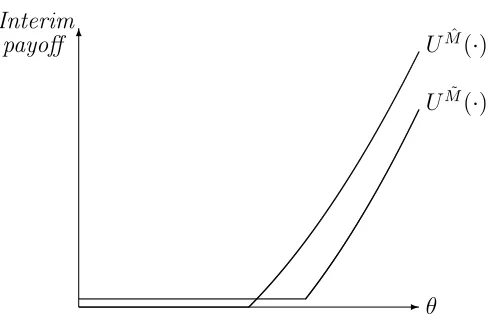
Since the cartel is charged a sale price of 5/9, it suffers an ex post loss whenever the highest valuation is in the interval [12,59]. Why can they not simply boycott the auction in this situa-tion? Indeed, their joint surplus will increase by doing so. The problem, however, is that the increased surplus cannot be allocated to benefit all types; some types will be strictly worse off and thus object to that move. To illustrate, suppose indeed that the bidders boycott auction whenever no bidder has valuation exceeding5/9, and, otherwise, the high-valuation bidder con-sumes the object. Under this collusive arrangement, labeled M, each bidder’s interim payoff˜ is9
UM˜(θ) =
( 32
2187 if θ ∈[0, 5 9) 1
2θ
2− 611
4374 if θ ∈[ 5 9,1].
9This payoff can be obtained by applying the transfer rule in (29) with n = 2, r = 5/9, ρ
i = 0, and
✻
✲
UMˆ(·)
UM˜(·)
θ Interim
[image:19.612.178.424.111.268.2]payoff
Figure 1: Comparison of interim payoffs from Mˆ and M˜
As can be seen from Figure 1, a bidder benefits from this collusion when his valuation is less than 0.528 but is strictly worse off if his valuation is higher. Hence, a collusive arrangement
˜
M is not feasible. (The same is true for any other feasible manipulations.) Even though the net expected surplus may rise with some collusive manipulation, incentive compatibility facing the collusive bidders limits the way surplus can be allocated across types to make them uniformly better off. In this sense, our WCP auction exploits the informational asymmetry facing the collusive bidders.
Example 2. (C = {{1,2},{3}}) Consider the example from Section 2, where there are two collusive bidders and a noncollusive bidder, each with valuation drawn from [1,2]. Here, the presence of a noncollusive bidder is crucial for WCP implementability of the second-best outcome. (If all three bidders belong to one grand cartel, the second-second-best is not WCP implementable, for the distribution fails (3).) Our WCP auction charges the sale price of H{1,2}(θ3) = 2θ3 − 54 to the cartel {1,2}, In fact, the non-collusive can be induced to reveal
its type as a dominant strategy. The cartel cannot manipulate the sale price, for it is tied to the non-collusive bidder’s strategy. Further, their ability to collude on participation does not help. Since the allocation is efficient, when a collusive bidder, say with valuation θ wins, the cartel ends up paying θ − 14 in expected value, which leaves the expected surplus of 14 to the cartel.10 Hence, the cartel has no incentive to boycott the auction regardless of θ. Other
10This can be seen by the fact that
E[t1(˜θ) +t2(˜θ)|θ˜3<max{θ˜1,θ˜2}=θ] =E[H{1,2}(˜θ3)|θ˜3< θ] =
Z θ
1
2˜θ3−54
θ−1
!
dθ˜3=θ−1
possible incentive for misrepresenting the cartel’s types is also thwarted by the lack of consensus in the interests among the cartel members in a way much like Example 1.
4.3
WCP Implementation of the Second-Best Outcome:
Asymmet-ric Bidders
We now turn to the case of asymmetric bidders. In this case, the optimal noncollusive auction, as characterized in Theorem 0, requires bidders to be treated differently based on their ex ante distribution of types. This presents an extra challenge for the WCP implementation since, as shown in Lemma 1, the same price is charged no matter which member of the cartel receives the good. This does not mean, however, that the collusive bidders cannot be treated differently, for different interests of the heterogeneous types can be exploited to make (IRM
N)
difficult to satisfy. Indeed, we will show that the second-best outcome is WCP implementable at least with respect to the all-inclusive cartel (i.e., C ={N}), under a condition that is not much stronger than Condition (SB).
Consider now a strict inequality version of (SB)-(i):
Condition (SB∗): K
i(ˆθi)> r∗ :=
E[P
i∈NJi(θi)qi∗(θ)]
E[P
i∈Nq∗i(θ)]
,∀i∈N.
Theorem 3. Assume C = {N} and Condition (SB∗) holds. Suppose also that (Ji(·)−
r∗)fi(·) is increasing in the interval [θi, Ji−1(r∗)] for all i ∈N. Then, there exists an auction
rule which is WCP and achieves the second-best outcome.
5
Optimal WCP Auctions
What happens if the second-best outcome is not collusion-proof implementable? What will the optimal WCP auction look like in such a case? While a complete answer to this latter question is unavailable, we provide two observations that will help answer that question. First, we show that any optimal WCP auction in a general monotonic class involves “exclusion” — a positive probability that the object is not sold to any collusive bidder. Second, we characterize the optimal WCP auction completely in the linear class for the case of symmetric bidders.
5.1
An Exclusion Principle
class. That is, we show below that the optimal auction rule in the monotonic class must entail some exclusion of collusive bidders. To gain some idea behind this result, suppose to the contrary that optimal WCP auction sells the object to some members of any given cartel C. Lemma 1 implies that the seller can only charge a sale price to collusive bidders, regardless of their types. Meanwhile, Lemma 2 says that this price cannot be too high relative to the pseudo value, Ki(θi), of the collusive bidder who consumes the good. Combined together,
these lemmas imply that the seller must either charge a low sale price, or else she should exclude types with low pseudo values from consuming the good.
Theorem 4 (Exclusion Principle). Assume that there are more than one bidder i ∈ C with θi = θ := maxj∈Cθj. Then, the optimal WCP mechanism in M0 requires that the object not
be sold to any member of C with a positive probability.
Proof: Let M = (q, t) denote the optimal WCP mechanism. Suppose to the contrary that P
i∈Cqi(θ) = 1 for all θ ∈Θ, which implies by Lemma 1 that
P
i∈Cti(θ) = r for some r.
Then, Lemma 2 requires that
r ≤max
i∈C Ki(θi) =θ.
Thus, the revenue cannot exceed θ. We now generate a contradiction by constructing a WCP mechanism which raises a higher revenue than θ: Sell the object at a fixed price ˜r, which is slightly greater than θ, if and only if at least one member of C has a value higher than ˜r. This take-it-or-leave offer is clearly WCP and generates a revenue equal to R(˜r) := ˜
r(1−Q
i∈CFi(˜r)). AndR(˜r)> R(θ) = θ for ˜r slightly above θ since
d d˜rR(˜r)
˜
r=θ = (1−
Y
i∈C
Fi(θ))−θ
X
i∈C
fi(θ)
Y
j6=i
Fj(θ) = 1>0,
where the last equality holds because for each i∈C, there exists at least one bidderj 6=ifor whom Fj(θ) = 0.
An optimal auction excludes some low valuation bidders even in the absence of collusion. Yet, exclusion never arises if there is some buyer i whose valuation is always high so that Ji(θ)≥0. Collusion tilts the tradeoff toward more exclusion, since the seller can only charge
5.2
Optimal Linear WCP Auctions for Symmetric Bidders
Here, we search for an optimal WCP auction rule when Condition (SB) fails with symmetric bidders. This condition can only fail when all bidders are collusive (recall Lemma 3 or equiv-alently Corollary 1), so we focus on that case and assume C ={N}. Further, we restrict our search to the class of linear auction rules where the aggregate payment schedule is linear in the probability of sale (to any bidder): P
i∈Nti(θ) =r·Q(θ), for some nonnegative constant
r.11
With a linear auction rule, the seller offers a uniform price against the cartel. This restric-tion appears to entail very little loss. Recall from Lemma 1 that the seller can only charge a single price against the cartel for each probability of sale, and that the sale price must be convex in the probability of sale. The linearity restriction simply eliminates the strictly convex portion of the sale price. The convex portion would matter only if the cartel is assigned the object with probability between zero and one at price discount, but this latter feature seems unlikely to be appealing to the seller (although we have not ruled out this possibility). In fact, most of the plausible auction rules allocate the object deterministically as functions of bidders’ types. Any such auction rules can be implemented by linear auction rules.12
Given the linearity restriction, the constraint in Lemma 2 implies
(K(θi)−r)qi(θ)≥0,∀i∈N,∀θ∈Θ. (8)
Consider the following revenue maximization program:
[C] max
(r,q) E "
rX
i∈N
qi(θ)
#
subject to
X
i∈N
Ui(θi) =E
" X
i∈N
(J(θi)−r)qi(θ)
#
≥0 (IC∗
1)
and
E
" X
i∈N
min{K(θi)−r,0}qi(θ)
#
≥0. (K)
The equality in (IC∗
1) follows from Lemma 0, which utilizes bidders’ incentive constraints.
Hence, (IC∗
1) follows from (IC∗), which is necessary for any feasible auction rule. In fact, 11Alternatively, we can restrict attention to auction rules that allocate the object efficiently among the
collusive bidders. The analysis based on this restriction is available from the authors.
12As will become clear from the subsequent analysis, a solution to [C] below can be obtained even with an
additional constraintPq
without (K), the above maximization problem simply yields the second-best outcome. The constraint (K) follows from the coalitional incentive constraint in (8) (which in turn follows from Lemma 2). Since the program [C] only imposes necessary conditions for weak collusion-proofness, its solution gives an upper bound for the revenue attainable by any linear WCP auction. We show next that this upper bound is attainable by a WCP auction.
Theorem 5. Assume C = {N} and bidders are symmetric. Then, there exists an optimal linear WCP auction rule, which implements the solution of [C]. If Condition (SB) fails, then the optimal linear auction rule involves a sales price, r0, that solves either
max
r∈R+
r(1−Fn(K−1(r))) (9)
or
E[J(θ(1)N )|θN(1) > K−1(r)] =r, (10)
and an allocation rule qˆ(·) that satisfies
ˆ qi(θ) =
(
1 if θi >max{maxj∈N\{i}θj,θˆ0}
0 otherwise, (11)
where θˆ0 :=K−1(r0).
The features of optimal WCP auctions are illustrated by the next example.
Example 3. Assume that there are two bidders whose types are uniformly distributed on interval [m, m+ 1]. Then, J(θ) = 2θ−(m+ 1), K(θ) = 2θ−m, and θˆ= max{m2+1, m}. The exclusion threshold is then given by
ˆ θ0 =
m+1
2 if m≤
7−√33 2
m+ √334−5 if 7−√233 < m≤m,ˆ
5m+√m2+12
6 if m >m,ˆ
for some m >ˆ 7−√233.13 Observe that the optimal WCP auction rule implements the
second-best if and only if m ≤ 7−√233. For m > 7−√233, θˆ0 >θ, so it involves more exclusion than theˆ
second-best outcome. Regardless of m, θˆ0 > m, so the optimal WCP auction always involves
exclusion. This is in sharp contrasts to the second-best outcome which does not involve any exclusion if m≥1.
13More precisely, ˆmis the level ofmsuch that (9) and (10) are satisfied simultaneously, which is given as a
root of the following equation:
Remark 1. Pavlov (2006) finds the outcome presented in Theorem 5 to be optimal in a more restricted class of WCP auction rules, namely, those that are linear and symmetric. (Recall the symmetry restriction is not invoked in the current paper.) In fact, he shows that there are asymmetric or nonlinear auction rules that are WCP and yield higher revenue than the optimal auction in the restricted class. However, such auction rules violate our Lemma 1 and thus are not WCP in our model. This difference arises from the fact that we allow for a reallocational ability by the cartel, which is not allowed in Pavlov (2006), at least for the main analysis.
6
Strong Collusion-Proof Implementation
Thus far, we have focused on weak collusion-proof implementation. Weak collusion-proof auctions protect a seller from a wide range of manipulations collusive bidders may employ. At the same time, it involves some restrictions. First, it rules out collusion supported by non-pessimistic beliefs on the part of members of a cartel about what may happen when they refuse to collude. Although such pessimistic beliefs may not be very plausible, the restriction on beliefs is nonetheless unsatisfactory. Second, the concept of weak collusion-proofness presumes that a cartel is organized by a third party who is uninformed of the members’ types. Clearly, such an assumption simplifies the modeling of the collusive behavior, but has no clear empirical justification. We show, however, that these restrictions are not crucial for the main result of the paper: Given an additional condition, the second-best outcome can be implemented in a way robust to the specific beliefs entertained off the equilibrium path and to the particular way in which a cartel is formed and its proposal is made.
To begin, we define a strong collusion-proof auction. To that end, fix any arbitrary indirect auction rule, A = (B, ξ, τ), where B = (B1, ..., Bn) is the profile of the message spaces, Bi
for bidder i, and (ξ, τ) : B → Q ×Rn is the outcome function mapping from messages to an allocation and payments. As before, we assume that Bi includes the option of
non-participation by iand the outcome function maps a null outcome for the bidder invoking that option. Next, consider an extensive form game in which, for a cartelC ∈ C, each member ofC (which may include a third party maximizing joint payoffs of C) may propose a side contract which maps from ΘC to a probability distribution over Qi∈CBi and which is reallocationally
vary depending on who refuse and who accept the contract. In other words, like Dequiedt (2007), we allow the remaining members of a cartel to commit themselves to punish a member when the latter refuses to participate in collusion. If a side contract has been proposed, the members of the cartel then simultaneously decide whether to reject all side contracts or accept one of them, and the messages in B are chosen according to the agreed-upon side contract,14
the seller determines the outcome based on the message according to the auction rule, and the good is reallocated and side transfers are exchanged according to the agreed-upon side contracts. Let EA be the set of all Bayesian Nash equilibria in undominated strategies. The
strong collusion-proof auctions are then defined as follows.
Definition SCP. Expected revenue V is strong collusion-proof (henceforth, SCP) imple-mentable if there exists an indirect auction rule, A = (B, ξ, τ), such that EA is nonempty
and that the seller receives expected revenue of V in every equilibrium of EA.
It is worth emphasizing that SCP implementation restricts neither cartel members’ out-of-equilibrium beliefs nor, as noted above, their ability to punish a defector. In fact, an SCP auction implementing V would guarantee the seller the revenue in every Bayesian Nash equilibrium, let alone every Perfect Bayesian equilibrium. More important, an SCP auction (or precisely an auction SCP implementing a target level of revenue) is robust to who proposes the collusive proposal. In these respects, the current SCP notion is stronger than any existing notions proposed by the existing authors.
Consider the case of ex ante symmetric bidders. Assume further that there exists only one cartel C ∈ C with |C| > 1. In this case, we show that the second-best revenue V∗ is SCP
implementable, given (SB′) and an additional condition. We construct the auction rule that
SCP implements the desired outcome. That auction rule, labeled A= (B, ξ, τ), builds on the WCP auction, ˆM. Recall that ˆM provides a dominant strategy incentive for each noncollusive bidder to participate and report truthfully, a feature we retain inA.
We augment the WCP auction ˆM by adding a message,rz, for each cartel member, which
is interpreted as a statement: “I reject ˆM but would like to buy the item with an eagerness of z,” where z is a positive integer of his choosing. LetBi := Θi∪ {rz, z = 1,2,· · · }if i∈C and
Bi := Θi otherwise. We then define the outcome function (ξ, τ) such that it coincides with
ˆ
M if no bidder in C announces rz, but if some bidder in C announces rz, then the outcome
function is constructed as follows. Consider the following condition:
Condition (R): For each C ∈ C, there exists some θ′ ∈[ˆθ,θ¯] satisfying
UMˆ(¯θ)≤Fn−|C|(θ′)θ¯−E
h
HC(θN(1)\C)
θ
(1)
N\C ≤θ′
i
. (12)
Given Condition (R), the outcome function (ξ, τ) of Adepends on whether (a) the inequality in (12) holds strictly for all θ′ ∈[ˆθ,θ¯] or (b) there exists some θr ∈[ˆθ,θ¯] satisfying
UMˆ(¯θ) =Fn−|C|(θr)θ¯−E
h
HC(θN(1)\C)
θ
(1)
N\C ≤θ
ri. (13)
In both cases, if there is a collusive bidder who announces rz, then we pick the bidder who
announces rz with the highest z (with a tie broken randomly among bidders with the same
z). In case (a), the bidder receives the object with probability 1 at a fixed price T∗
i (¯θ). In
case (b), the bidder receives the object at price HC(θ(1)N\C) if θN(1)\C ≤ θr, or else the bidder is
not awarded the object and he pays nothing. Last, no other bidders receive the object or pay any amount to the seller.
In words, the auction ruleAgives an option for a collusive bidder with the highest valuation to secure her non-collusive payoff by announcing rz with the highest integer z. This extra
option serves to limit the cartel’s ability to punish a defector, which in turn constrains the set of side contracts sustainable in equilibrium. At the same time, the option itself may become an instrument of collusion if it proves too profitable. Condition (R) ensures that this is not the case.
Theorem 6. Suppose that there is a single cartel C ⊂N. Then, given Conditions (SB′) and
(R), the second-best revenue V∗ is SCP implementable.
How restrictive is Condition (R)? If the cartel is all-inclusive (i.e.,C =N), then Condition (R) involves no restriction, for it is always satisfied. To see this, observe the condition in (12) with θ′ = ¯θ becomes
Ti∗(¯θ)≥HN(ˆθ).
This inequality holds since
Ti∗(¯θ)>E
T∗ i (θi)
Q∗ i(θi)
Q∗ i(θi)
E[Q∗ i(θi)]
= E[Ti∗(θi)]
E[Q∗ i(θi)]
= E[J(θi)Q∗i(θi)]
E[Q∗ i(θi)]
= E
P
i∈NJ(θi)qi∗(θ)
EPi∈Nq∗ i(θ)
=HN(ˆθ),
where the inequality holds since Ti∗(·)
Q∗
i(·) is increasing (since
T∗ i(·)
Q∗
i(·) corresponds to the equilibrium
bidding function in the symmetric first-price auction), and the last equality follows from (4). IfC6=N, then Condition (R) need not always hold. Nevertheless, the condition is satisfied for a reasonable class of distributions, including the uniform distribution.15
15For instance, in the Example 2, (12) holds since
max
θ∈[1,2]F
n−|C|(θ)θ¯−EhH
C(θ(1)N\C)
θ
(1)
N\C≤θ
i
= max
θ∈[1,2]
−θ2+13 4 θ−
9 4 = 25 64 > 1 3 =U
ˆ
Remark2. That Condition(R)is often not very restrictive suggests that the particular notion of collusion-proofness does not play a significant role. In particular, the second-best outcome is SCP implementable whenever it is WCP implementable if the cartel is all-inclusive or if an additional reasonable condition holds. This suggests that the seemingly pessimistic result of Dequiedt (2007) is not attributable to the cartel’s ability to punish a defector, but rather to the binary type structure of his model. In fact, with the binary type, our weak collusion-proof notion would have led to the same result as his. By our Exclusion Principle, a WCP auction must always exclude the low type, but this means that the seller can never do better than selling the good at the price equal to the high valuation. Theorem 6 suggests that, given non-binary types, the seller can typically do strictly better than this even when the cartel can commit to punish the defector (as has been assumed in our SCP notion).
7
Conclusion
We have studied optimal collusion-proof auctions when a group of bidders can collude not only on their messages (e.g., “bids”), but also on their participation decisions. Despite this strong collusive power, we have shown that the asymmetric information facing the collusive bidders can be exploited to significantly weaken their collusive power, by eliminating the scope of collusive arrangements that could make all collusive bidders uniformly better off regardless of their types. We show that the second-best outcome is achievable if a cartel is not all-inclusive (which will be the case either if there is a noncollusive bidder or if there are multiple bidding cartels), or if the outcome involves a nontrivial probability of the object not being allocated to any bidder. More generally, we have shown that the optimal collusion-proof auction rule involves a positive probability of the object not being allocated to a collusive bidder.
Our results have two broad implications. First, unlike the prevailing impression based on the existing literature, the presence of bidder collusion need not mean that the seller can do no better than textbook monopoly pricing. Our seller can do as well as if there is no collusion in a broad set of circumstances, and do generally much better than simple monopoly pricing. Second, an auction rule different from standard may be more desirable when bidder collusion is a serious issue. We have identified an auction with a group-based sale price as being unsusceptible to collusion.
sale price. Indeed, it is quite common for a procurer of a service or a good to negotiate with a prime contractor acting as a representative of a group of contractors. Whether such a collective negotiation approach serves as a response to possible collusion among contractors is an interesting, yet unresolved, question.
It is of course quite possible that our collusion-proof auction has no real world correspon-dence. To the extent that this is true, there may be a couple of reasons. One may be simply that collusion is not a serious enough problem in many scenarios, at least serious enough to depart from a standard auction. Alternatively, the reason may be attributable to two re-strictive features of our auction design. First, our collusion-proof auction involves Bayesian implementation, which does rely on bidders’ common knowledge of priors, i.e. the assump-tion that bidders know the distribuassump-tion of other bidders’ types, know that they know the distribution, and so on and so forth. It is unlikely for bidders to possess such a knowledge, especially when they lack the opportunity to develop such a knowledge from repeated inter-actions. Relaxing the common knowledge of priors by strengthening the solution concept, say to dominant strategies, seems to be an important next step in the research of collusion-proof auctions. The implication of such an extension is nota priori obvious, however, since it affects the contracting problem at both ends, i.e., for both the auction designer and for the colluding bidders. Collusion may indeed become easier to prevent if dominant-strategy incentives are very difficult to provide in a budget-balanced fashion among the colluders. Second, we have assumed that the seller has accurate information about the cartel structure; i.e., which bidders belong to what cartel. While this assumption is not unrealistic in many situations, it would be better if the auction design need not require specific knowledge about the cartel structure. In a sense, an important lesson from the current paper may be the highlighting of these features as further challenges to overcome in collusion-proof auction design.
Appendix: Proofs
Proof of Lemma 0. It suffices to show that (IC∗) implies the following: for all i∈N and
all ˜θi ∈Θi,
UiM(θi) = E
h
Ki(˜θi)Qi(˜θi)1{θ˜i≤θi}+Ji(˜θi)Qi(˜θi)1{θ˜i≥θi}−Ti(˜θi)
i
. (14)
Note first that a well-known necessary condition for (IC∗) is: for all i∈N and all ˜θ i, θi ∈
Θi,
UiM(θi)−UiM(˜θi) =
Z θi
˜
θi
We show that (15) implies (14). Since UM
i (˜θi) = ˜θiQi(˜θi)−Ti(˜θi), (15) becomes
UiM(θi) = ˜θiQi(˜θi)−Ti(˜θi) +
Z θi
˜
θi
Qi(a)da.
Taking expectation on both sides regarding ˜θi yields
UiM(θi) = E[˜θiQi(˜θi)−Ti(˜θi)] +
Z θi
θi
Z θi
˜
θi
Qi(a)dadFi(˜θi)
= E[˜θiQi(˜θi)−Ti(˜θi)] +
Z θi
θi
Z θi
˜
θi
Qi(a)dadFi(˜θi) +
Z θ
θi
Z θi
˜
θi
Qi(a)dadFi(˜θi)
= E[˜θiQi(˜θi)−Ti(˜θi)] +
Z θi
θi
Qi(˜θi)Fi(˜θi)dθ˜i−
Z θ
θi
Qi(˜θi)(1−Fi(˜θi))dθ˜i
= E
h
Ki(˜θi)Qi(˜θi)1{θ˜i≤θi}+Ji(˜θi)Qi(˜θi)1{θ˜i≥θi}−Ti(˜θi)
i
,
where the third equality follows from the integration by parts.
Proof of Lemma 1. To begin with, define TC(θC) := Eθ˜N\C[Pi∈Cti(θC,θ˜N\C)] and QsC :=
{Q ∈ QC|Q= QC(θC) for some θC ∈ ΘC}. Then, let us define r :QC → R+ as the greatest
convex function such that for all Q∈ Qs C,
r(Q)≤inf{TC(θC)|QC(θC) =Q}.
We show that r(QC(θC)) =TC(θC) for almost every θC. Suppose not. Then, it must be that
for some ǫ >0,
E[r(QC(θC))] +ǫ <E[TC(θC)]. (16)
Also, by the definition of r(·), it is possible to find µC : Θ
C →∆ΘC satisfying that for allθC,
EµC(θ C)
h
TC(˜θC)
i
≤r(Q(θC)) +ǫ and EµC(θ
C)[QC(˜θC)] =QC(θC). (17)
We now show that M cannot be WCP with respect to C by constructing a weakly feasible manipulation ˜M = (˜q,˜t) ofM by cartelC with which some bidder is better off than withM. Let the cartel manipulate its type reports usingµC(·), whereafter, the object is reallocated to bidder i with probability wi(θC) := q
C i(θC)
QC(θC) so that
P
i∈Cwi(θC) = 1, satisfying (RCCM).
Note that the interim allocation for each collusive bidder i∈C is preserved since
˜
qCi (θC) = ωi(θC)Eθ˜N\C h
EµC(θ
C)[qC(˜θC,θ˜N\C)]
i
= ωi(θC)EµC(θ
C)[QC(˜θC)] = ωi(θC)QC(θC) =q
C