Effects of the Novel Anti-Asthenic Drug Ladasten on
Behavior and T-Cell Subsets Alterations in a Social Defeat
Animal Model of Depression
Anna V. Tallerova*, Larisa P. Kovalenko, Iosif B. Tsorin, Andrey D. Durnev, Sergey B. Seredenin
Federal State Budgetary Institution “Research Zakusov Institute of Pharmacology” under the Russian Academy of Medical Science, Moscow, Russia.
Email:
Received September 18th, 2013; revised October 28th, 2013; accepted November 12th, 2013
Copyright © 2014 Anna V. Tallerova etal. This is an open access article distributed under the Creative Commons Attribution Li-cense, which permits unrestricted use, distribution, and reproduction in any medium, provided the original work is properly cited. In accordance of the Creative Commons Attribution License all Copyrights © 2014 are reserved for SCIRP and the owner of the intel-lectual property Anna V. Tallerova etal. All Copyright © 2014 are guarded by law and by SCIRP as a guardian.
ABSTRACT
The aim of the present study was to investigate the effects of the anti-asthenic drug ladasten on behavioral pat-terns and T-cell subsets in blood, spleen, and thymus in socially stressed male C57Bl/6 mice. Mice subjected to social defeat stress (SDS) for 25 days developed a depressive-like phenotype. The submissive SDS animals were assigned to one of two treatment groups: one group was treated with ladasten (30 mg/kg, i.p.) for up to 5 days, and the other one was administered vehicle as a control. Twenty four hours after the last injection, behavioral parameters were tested, and trunk blood and tissue samples were collected. SDS mice from the vehicle-treated group showed a subordinate and passive avoidance behavior with significantly decreased spontaneous locomotor activity (SLA) and exhibited impaired parameters in the forced swimming test (FST). Changes in behavioral status were correlated with an increase spleen weight, a decrease in thymic index and a shift in the CD4/CD8 balance toward T-cytotoxic cells. The behavior parameters were reversed in the group treated with ladasten compared to the untreated SDS group and were similar to those of unstressed mice. Treatment of socially stressed mice with ladasten normalized the amount of T-lymphocyte cells in the blood, spleen, and thymus. These findings support the notion that depression is accompanied by cell-mediated immune activation and that target-ing this pathway may be a new therapeutic approach for treatment. Furthermore, our data support further in-vestigations of ladasten as a potent anti-depressive drug which can be used alone as well as in combination with other anti-depressants.
KEYWORDS
Ladasten; Social Defeat Stress; Depression; Cytokines; T-Cells
1. Introduction
An enlarging body of evidence suggests the presence of interactions among the immune system, the central nervous system and the endocrine system, where these systems can be influenced by physiological and social factors [1]. Based on evidence, including the findings of clinical depression studies and animal models, the new “5-HT” (serotonin) hypothesis of depression, which states that the T cell-mediated immune (CMI) activation con-
tributes to depressive symptoms and neurodegenerative process, was formulated [2-4]. The long-term activation of CMI not only contributes to depressive symptoms but also is accompanied by a Th-1-like shift away from Th-2 and Th-3-like cells, leading to the development of im-mune deficiency [2,5]. Some authors consider the lack of full recovery of immune reactivity in the treatment of depression with conventional drugs to be an important predisposing factor for the recurrence of depressive epi-sodes [6,7].
On the other hand in recent decades it was postulated
that dopamine might play a role in depression and the action of antidepressants. In particular, it was postulated that depression was due to an imbalance and more spe-cifically to decrease in extracellular dopamine levels [8]. Based on this hypothesis, it has been suggested that the clinical efficacy of anti-depressants may be augmented by co-administration of immunomodulatory and dopaminer-gic agents [4,7,8]. We suggest considering the anti-asthe- nic drug ladasten as a new drug candidate. Clinical in-vestigations have confirmed that ladasten improves psy-chological parameters of attention, success of operational performance, and sensomotor capabilities [9-11]. In com- pliance with ICD-10, ladasten was found to be effective in the treatment of patients with Neurasthenia F48.0, a psychogenic disorder [12]. The drug was shown to pos-sess psychotropic, immunomodulatory, and anti-inflam- matory properties as well as anxiolytic activities [11, 13-15].
It is known that the dopaminergic and serotonergic systems play an important role in the effects of ladasten [16,17]. Ladasten leads to a rapid and long-lasting increase in tyrosine hydroxylase (TH) mRNA expression in the ventral tegmental area (VTA) and TH mRNA and protein in hypothalamus. The increase in the levels of tyrosine hydroxylase mRNA in the VTA correlates well with the ladasten-mediated increase of L-DOPA and dopamine (DA) content in the nucleus accumbens. This de novo synthesis of catecholamines is regarded as the key me-chanism of the psychotropic activity of ladasten [16,18,19]. Early studies demonstrated that ladasten exerts central dopaminomimetic effects which were related to DA re-lease from the pre-synaptic endings of free-moving rats [20,21]. In vitro experiments have shown that 50 - 500 μkM ladasten significantly decreases the uptake of sero-tonin by the isolated cerebral synaptosomes of rats and, to a lesser degree, inhibits the uptake of dopamine [22].
Thus, the investigation of the effects of ladasten in an animal depression model is a topical problem.
Social defeat is an ethologically relevant stressor that utilizes the natural establishment of social rank in male rodents [23]. The social defeat stress is a model that is often used to evaluate anti-depressant drug activity in laboratory animals [24-26]. Chronic stress is induced by social dominance of an aggressor over an intruder mouse; the intruder is the subject under study [27-29]. Among the symptoms observed in the subordinate male (intruder) are weight loss, increased heart rate, sleep disturbances, and increased body temperature as well as disturbances of the hypothalamic-pituitary-adrenal axis, including an increase in corticosterone levels and changes in immune responses [30]. The social defeat stress model has been suggested to have clinical relevance in major depressive disorders in humans. This model can be used to screen
new psychotropic drugs under simulated clinic conditions and to investigate the mechanisms underlying stress- induced immune dysfunction to provide a basis for the development of immune therapy for depression [28,30,31]. This study was undertaken to analyze the effects of ladasten in a mouse model of social defeat stress simu-lating the stage of major depression. Behavioral pattern-ing and changes in T-lymphocyte subsets (CD3+, CD4+, CD8+) were analyzed in male C57Bl/6 mice. We show here that behavioral patterns in SDS mice can be re-versed by treatment with the anti-asthenic drug ladasten and that this treatment is associated with somewhat nor-malized T-cell subsets.
2. Materials and Methods
2.1. Animals
Fifty adult male C57Bl/6 mice weighing 18 - 20 g were used in this study. The animals were obtained from Stol-bovaya, the nursery of laboratory animals of the Russian Academy of Medical Science (RAMS), and adapted for 2 weeks prior to testing in the Zakusov Institute of Phar-macology RAMS vivarium. Mice were maintained in an environmentally controlled facility with a 12 h light-dark cycle (lights on at 08:00 hours) and a temperature of 22˚C ± 2˚C. All mice were maintained on a standard diet with food and water available ad libitum. The experi-mental protocols were in compliance with the European Communities Council Directive (86/609/EEC).
2.2. Drug Treatment and Social Defeat Stress
The anti-asthenic drug ladasten (N-(2-adamantyl)-N- (para-bromophenyl)-amine) was designed and developed at the Zakusov State Institute of Pharmacology RAMS [11,13] and received from the Technological Division of the Institute of Pharmacology RAMS (Moscow).
The present study adapted the sensory contact model, which was developed by N. Kudryavtseva and colleagues and is currently widely accepted as a valid chronic social defeat paradigm [27,28].
Twenty-five days after the beginning of the SDS expe-rience, submissive mice received daily intraperitoneal (i.p.) injections of 30 mg/kg ladasten or saline for 5 days. Ten submissive animals were assigned to each treatment group. The choice of the dosage of ladasten (30 mg/kg for 5 days daily) was based on previous experimental results [11,13]. The day after the last injection, we tested the behavioral consequences of chronic defeat stress and the effect of ladasten.
2.3. Behavioral Tests
an infrared actimeter (IR, PanLab, Spain). Parameters measured in this study during the 3-min testing period were the following: locomotor (fast/slow activity) and stereotyped (fast/slow) movements; traveled distance (and %); maximum, minimum and mean speed; time (and %) spent moving fast, slow and resting; and number and mean duration of rearing.
The Forced Swimming Test (FST) with video-based analysis system (OpenScience, Moscow, Russia) was used to evaluate the depression state of the mice [32,33]. Mice were individually placed in cylinders (height = 30 cm, diameter = 13 cm) containing 10 cm water (22˚C) from which they could not escape. The mice were placed in water for 5 min, and the duration of swimming was recorded on video. Images were analyzed with “Real- time” (OpenScience, Moscow, Russia) software. The la- tency to the first period of immobility and passive beha-vior (immobility) time were recorded during the test. Depressed mice were less active (exhibited less swim-ming, climbing/struggling) and floated in the cylinders, showing behavioral despair. Parameters measured in this study were the latency to immobility and the duration of immobility (floating + freezing).
2.4. Analyses of Blood (Spleen, Thymus) T-Cells by Flow Cytometry Method
The thymus and spleen were weighed, and the results were expressed as relative tissue weight, i.e., mg tissue/ 10 g mouse weight). Cell suspensions were prepared from the spleen or thymus by pushing the tissue through a nylon mesh using the plunger of a 2-ml syringe in cold PBS containing 0.1% BSA. Whole blood or 100 μL of splenocytes (thymocytes) were stained with fluorescence- labeled monoclonal antibodies against CD3 (FITC-la- beled), CD4 (PE-labeled), or CD8 (PECy5-labeled) (eBioscience, Austria) according to the manufacturer’s instructions. After incubation for 30 min at 4˚C in the dark, the red blood cells were removed by lysis buffer.
Samples were centrifuged at 300 - 400 × g at 4˚C for 5 min, the supernatant was discarded and the pellet was washed twice with 1mL PBS containing 0.1% BSA. Re-suspended stained cells were analyzed using the EPICS XL 4 flow cytometer (Beckman Coulter, USA); 10,000 - 15,000 events were acquired; and the data were analyzed using the WinMDI 2.7 software.
2.5. Statistical Analysis
Data were analyzed using two-way ANOVA, followed by Newman-Keuls post hoc test for multiple comparisons and the results are presented as mean ± SEM. When va-riances were not equal as assessed by a Levene test, non- parametric statistics were conducted using a Kruskal- Wallis test followed by Dunn’s multiple comparison test and results are presented as median (low/upper quartile). Statistical significant was set at p < 0.05.
3. Results
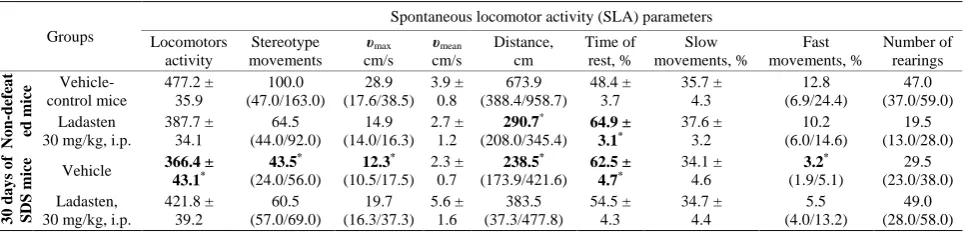
Mouse SLA was analyzed after SDS stress; the data are presented inTable 1. The results show that mice in the SDS group that received saline for 5 d showed a signifi-cant decrease in locomotor activity (by 23%), movement stereotypes (by 56%), maximum velocity (by 57%) and total traveled distance (by 65%). The number of fast movements in stressed mice diminished by 4-fold whe-reas the resting time incwhe-reased 1.3-fold.
Thus, our data demonstrate a significant decrease in the motor and exploratory activity of defeated mice as well as evidence of a behavioral deficit and development of a depressive-like phenotype, which were in line with previous findings [28,29].
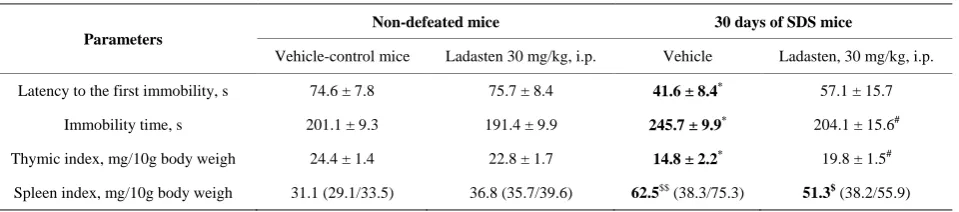
[image:3.595.57.543.592.708.2]Compared to control non-defeated mice, the mice from the FST social defeat group exhibited significantly short-er latency to the first float pshort-eriod (by 44%) and longshort-er time of immobility (by 20%). These data demonstrate that defeated mice had symptoms of depressed mood and behavioral despair (Table 2).
Table 1. Effects of ladasten on SLA parameters in SDS C57Bl/6 mice in IR actimete.
Groups
Spontaneous locomotor activity (SLA) parameters
Locomotors activity Stereotype movements υmax cm/s υmean cm/s Distance, cm Time of rest, % Slow movements, % Fast movements, % Number of rearings No n -def ea t ed m ice Vehicle- control mice 477.2 ± 35.9 100.0 (47.0/163.0) 28.9 (17.6/38.5) 3.9 ± 0.8 673.9 (388.4/958.7) 48.4 ± 3.7 35.7 ± 4.3 12.8 (6.9/24.4) 47.0 (37.0/59.0) Ladasten
30 mg/kg, i.p.
387.7 ± 34.1 64.5 (44.0/92.0) 14.9 (14.0/16.3) 2.7 ± 1.2 290.7* (208.0/345.4) 64.9 ± 3.1* 37.6 ± 3.2 10.2 (6.0/14.6) 19.5 (13.0/28.0) 30 d ays of SDS m
ice Vehicle 366.4 ±
43.1* 43.5* (24.0/56.0) 12.3* (10.5/17.5) 2.3 ± 0.7 238.5* (173.9/421.6) 62.5 ± 4.7* 34.1 ± 4.6 3.2* (1.9/5.1) 29.5 (23.0/38.0) Ladasten,
30 mg/kg, i.p.
421.8 ± 39.2 60.5 (57.0/69.0) 19.7 (16.3/37.3) 5.6 ± 1.6 383.5 (37.3/477.8) 54.5 ± 4.3 34.7 ± 4.4 5.5 (4.0/13.2) 49.0 (28.0/58.0)
Comment: υmaxи υmean—maximal and mean velocity of mice in test cm/s.Data expressed as mean ± standard error of the mean (SEM) or median (low/upper
quartile); *Significant between-group difference in parameter compared with vehicle-control group (Kruskal-Wallis test followed by Dunn’s multiple
Table 2. Effects of ladasten on the latency and immobility time in the FST and thymus and spleen weights indexes.
Parameters
Non-defeated mice 30 days of SDS mice
Vehicle-control mice Ladasten 30 mg/kg, i.p. Vehicle Ladasten, 30 mg/kg, i.p.
Latency to the first immobility, s 74.6 ± 7.8 75.7 ± 8.4 41.6 ± 8.4* 57.1 ± 15.7
Immobility time, s 201.1 ± 9.3 191.4 ± 9.9 245.7 ± 9.9* 204.1 ± 15.6#
Thymic index, mg/10g body weigh 24.4 ± 1.4 22.8 ± 1.7 14.8 ± 2.2* 19.8 ± 1.5#
Spleen index, mg/10g body weigh 31.1 (29.1/33.5) 36.8 (35.7/39.6) 62.5$$ (38.3/75.3) 51.3$(38.2/55.9)
Comment: Data expressed as mean ± standard error of the mean (SEM); *Significant between-group difference in parameter compared with vehicle-control
group; #Significant between-group difference in parameter compared with vehicle-SDS group; (two-way ANOVA, followed by Newman-Keuls post hoc test for
multiple comparisons; *p < 0.05, #p < 0.05, n = 10 per group); Data expressed as median (low/upper quartile); $Significant between-group difference in
parame-ter compared with vehicle-control group; (Kruskal-Wallis test followed by Dunn’s multiple comparison test, $p < 0.05, $$p < 0.01, n = 10 per group).
Ladasten injections alleviated SDS behavioral effects and attenuated symptoms of depression. The defeated group that received ladasten showed behavior similar to that of non-defeated control mice, which were housed and treated similarly but were not exposed to aggressors.
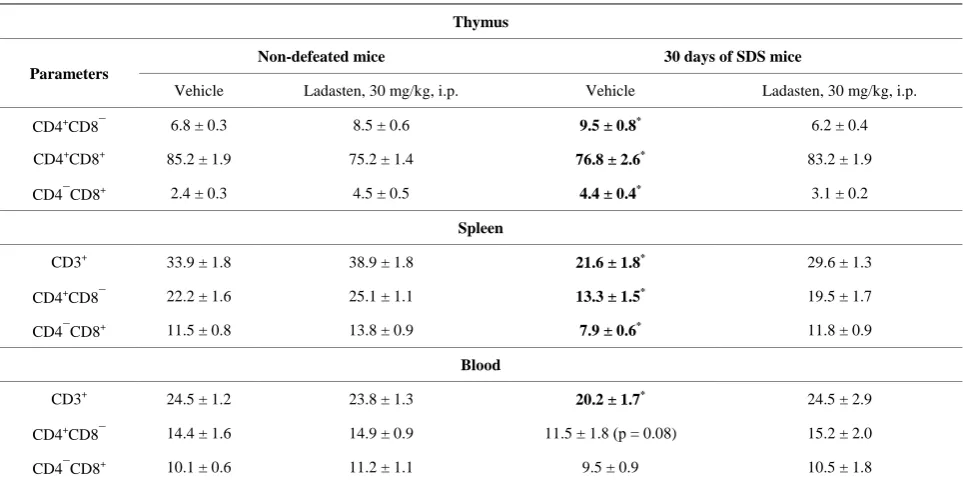
The exposure to social defeat stress for 30 days led to a 1.6-fold decrease in thymus weight whereas spleen weight increased 1.7 fold (Table 3). In comparison to control, stressed animals showed a 10 % decrease in the number of CD4+CD8+ double-stained immature thymo-cytes, whereas there were increases in subset percentages of single CD4+ (T helper cells) and single CD8+ cells (T cytotoxic cells) by 28% and 45%, respectively (Table 3). These data demonstrate marked changes in the popula-tions of T lymphocytes following social defeat stress for 30 days. These observations are in good accordance with earlier studies showing the redistribution of T-cell popu-lations in the thymus resulting in high levels of the sup-pressor/cytotoxic T-lymphocyte subset [1,4,31,34,35]. There was a 41% decrease in the number of CD3+ T lymphocytes in the spleen of stressed mice due to the decreased number of both helper and cytotoxic T cells by 40% and 31%, respectively. The total percentage of cir-culating blood CD3+ T cells diminished under stress from 24.5% in control animals to 20.2% in defeated animals (18 %, p < 0.05). However, the CD4+/CD8+ ratio was not affected by the stress.
Administration of ladasten to defeated mice prevented thymus weight loss. Although ladasten did not reverse splenomegaly, it partially restored spleen weight (by 18%). The T-lymphocyte subsets present in the blood, spleen and thymus of ladasten treated mice remained in similar proportions to those of the unstressed control animals.
4. Discussion
Our data are consistent with previous studies which have demonstrated that social defeat stress in mice after
re-peated experiences of aggression results in profound be-havioral changes reminiscent of chronic stress disorder and major depression [28-30]. Chronic social defeat stress for 30 days leads to defeat-induced social avoidance and depression in mice [23]. The administration of the an-ti-asthenic drug ladasten for 5 days prevented the expres-sion of avoidance behaviors in response to social defeat stress.
Earlier findings also completely align with our results, showing a decrease in the population of T cells in pri-mary and secondary immune organs and a stress-induced shift in the CD4+/CD8+ ratio toward T-cytotoxic subsets associated with the development of depression in mice exposed to SDS [31,35]. The degree of change in the pool of T cells in blood was not the same as that ob-served in the spleen and the thymus. The most dramatic stress-associated changes in the T-cell population were displayed in the thymus, whereas there were no signifi-cant changes in the blood. The observed extreme sensi-tivity of immature CD4+CD8+ to acute and chronic stress is a well-known phenomenon [35,36]. However, the re-sults of our experiment seem to disagree with the rere-sults of Dominguez-Gerpe, who observed the decrease of two glucocorticoid-resistant populations of CD4+ and CD8+ T cells in blood of stressed mice [35]. The observed dif-ferences in the peripheral T-cell population may depend on the duration of SDS as well as on the animal strain used. On the basis of the results seen in the present study and in a previous study, we hypothesize that the observed changes in the peripheral T-cell pool were because of the migration of naïve T-cells from the thymus for maintain-ing the blood population [30].
Thus, stress induced by social defeat is a strong mod-ulator of immune status, from the activation of CMI to immune deficiency, and abnormalities in immune func-tion are considered as the underlying mechanism of de-pression [1,4,6].
Table 3. Effects of ladasten on T-cell subsets in blood, spleen, and thymus in SDS C57Bl/6 mice.
Thymus
Parameters
Non-defeated mice 30 days of SDS mice
Vehicle Ladasten, 30 mg/kg, i.p. Vehicle Ladasten, 30 mg/kg, i.p.
CD4+CD8− 6.8 ± 0.3 8.5 ± 0.6 9.5 ± 0.8* 6.2 ± 0.4
CD4+CD8+ 85.2 ± 1.9 75.2 ± 1.4 76.8 ± 2.6* 83.2 ± 1.9
CD4−CD8+ 2.4 ± 0.3 4.5 ± 0.5 4.4 ± 0.4* 3.1 ± 0.2
Spleen
CD3+ 33.9 ± 1.8 38.9 ± 1.8 21.6 ± 1.8* 29.6 ± 1.3
CD4+CD8− 22.2 ± 1.6 25.1 ± 1.1 13.3 ± 1.5* 19.5 ± 1.7
CD4−CD8+ 11.5 ± 0.8 13.8 ± 0.9 7.9 ± 0.6* 11.8 ± 0.9
Blood
CD3+ 24.5 ± 1.2 23.8 ± 1.3 20.2 ± 1.7* 24.5 ± 2.9
CD4+CD8− 14.4 ± 1.6 14.9 ± 0.9 11.5 ± 1.8 (р = 0.08) 15.2 ± 2.0
CD4−CD8+ 10.1 ± 0.6 11.2 ± 1.1 9.5 ± 0.9 10.5 ± 1.8
*Significant between-group difference in parameter compared with vehicle-SDS group; (two-way ANOVA, followed by Newman-Keuls post hoc test for
mul-tiple comparisons; *p < 0.05, n = 10 per group).
the immune imbalance seen in defeated mice.
It is well established that dopaminomimetic drugs ex-ert stimulatory effects on the immune system, as well as antidepressant activity [8,37]. The influence of ladasten on the levels of TH mRNA and protein as well as on DA content may be linked to the regulation of neuroendo-crine function that, in turn, provides peripheral effects of the drug, such as protection from stress, metabolic status and immune modulation [16-18,21].
The affinity of ladasten to the central monoaminergic (MAergic) systems and its ability to regulate gene ex-pression in the brain were suggested to explain the effect of ladasten on behavior as well as peripheral immune- competent cells, which express neurotransmitter recep-tors. Previous studies have shown the direct effects of ladasten on the functional activity of lymphocytes, such as the stimulation of antibody production and inhibition of cytotoxic activity of T cells [16,22]. However, the exact cellular mechanism through which ladasten elicits its neuroimmunomodulation effects is unknown and re-quires further experimental and clinical study.
Thus, the results obtained in this study confirm the no-tion that depression is accompanied by disturbances in cell-mediated immune activation, including the reduction in T cells and their redistribution in immune organs. Administration of the anti-asthenic drug ladasten restores the balance of T-cell subsets in the blood, spleen and thymus and diminishes the behavioral symptoms of de-pression in stressed mice. The data reveal the
pharma-cological properties of ladasten in the SDS model of de-pression and support further investigations of ladasten as a potent anti-depressive drug that can be used alone as well as in combination with other anti-depressants.
REFERENCES
[1] R. C. Ho, L. F. Neo, A. N. Chua, A. A. Cheak and A. Mak, “Research on Psychoneuroimmunology: Does Stress Influence Immunity and Cause Coronary Artery Disease?”
Annals of the Academy of Medicine, Singapore, Vol. 39, No. 3, 2010, pp. 191-196.
[2] M. Maes, B. Leonard, A. M. Myint, M. Kubera and R. Verkerk, “The New ‘5-HT’ Hypothesis of Depression: Cell-Mediated Immune Activation Induces Indoleamine 2,3-Dioxygenase, Which Leads to Lower Plasma Tryp- tophan and an Increased Synthesis of Detrimental Tryp- tophan Catabolites (TRYCATs), Both of Which Contri- bute to the Onset of Depression,” ProgressinNeuro-Psy- chopharmacologyandBiologicalPsychiatry, Vol. 35, No. 3, 2011, pp. 702-721.
[3] M. Kubera, E. Obuchowicz, L. Goehler, J. Brzeszcz and M. Maes, “In Animal Models, Psychosocial Stress-In- duced (Neuro)Inflammation, Apoptosis and Reduced Neurogenesis Are Associated to the Onset of Depression,”
Progress inNeuro-Psychopharmacology and Biological Psychiatry, Vol. 35, No. 3, 2011, pp. 744-759.
Sequels and Concomitants Play a Role in the Pathophysi- ology of Unipolar Depression,” Neuroscience and Bio- behavioralReviews, Vol. 36, No. 2, 2012, pp. 764-785.
[5] A. M. Myint, B. E. Leonard, H. W. Steinbusch and Y. K. Kim, “Th1, Th2, and Th3 Cytokine Alterations in Major Depression,” JournalofAffectiveDisorders, Vol. 88, No. 2, 2005, pp. 167-173.
[6] B. Dean, “Understanding the Role of Inflammatory-Re- lated Pathways in the Pathophysiology and Treatment of Psychiatric Disorders Evidence from Human Peripheral Studies and CNS Studies,” InternationalJournalofNeu- ropsychopharmacology, Vol. 14, No. 7, 2011, pp. 997-
1012.
[7] M. Maes, B. Leonard, A. Fernandez, M. Kubera, G. No-wak, R. Veerhuis, A. Gardner, P. Ruckoanich, M. Geffard, C. Altamura, P. Galecki and M. Berk, “(Neuro)Inflam- mation and Neuroprogression as New Pathways and Drug Targets in Depression: From Antioxidants to Kinase In- hibitors,” Progress in Neuro-Psychopharmacology and BiologicalPsychiatry, Vol. 35, No. 3, 2011, pp. 659-663.
[8] C. Prica, M. Hascoet and M. Bourin, “Is Co-Adminis- tration of Bupropion with SSRIs and SNRIs in Forced Swimming Test in Mice, Predictive of Efficacy in Resis-tant Depression?” BehaviouralBrainResearch, Vol. 194, No. 1, 2008, pp. 92-99.
[9] N. G. Bogdan, N. V. Kolotilinskaya, B. A. Badyshtov, “Comparative Study of Ladasten and Afobazol Influence on Psychophysiological Parameters of Healthy Volun- teers,” International JournalofNeuropsychopharmacol- ogy, Vol. 85, 2012, p. 380.
[10] G. G. Neznamov, S. A. Siuniakov, E. S. Teleshova and D. V. Chumakov, “Ladasten, the New Drug with Psychos- timulant and Anxiolytic Actions in Treatment of Neuras- thenia (Results of the Comparative Clinical Study with Placebo),” Zhurnal Nevrologii i Psikhiatrii Imeni S.S. Korsakova, Vol. 109, No. 5, 2009, pp. 20-26.
[11] S. B. Seredenin, M. A. Yarkova, B. A. Badyishtov, B. M. Pyaten, N. I. Avdyunina, I. S. Morozov, T. A. Voronina and G. G. Neznamov, “Anxiolytic Drug,” Patent RF 2009, № 2376986.
[12] S. A. Siuniakov, S. A. Grishin, E. S. Teleshova, G. G. Neznamov and S. B. Seredenin, “Pilot Clinical Trial of Ladasten,” ExperimentalandClinicalPharmacology, Vol. 69, No. 4, 2006, pp. 10-15.
[13] M. A. Iarkova, M. V. Voronin and S. B. Seredenin, “Study- ing the Mechanisms of Ladasten Action,” Experimental andClinicalPharmacology, Vol. 68, No. 3, 2005, pp. 3-6.
[14] M. Kh. Salimgareeva, R. S. Yamidanov, Y. V. Vakhitova and S. B. Seredenin, “Mechanism of Action of Ladasten:
Activation of Gene Expression for Neurotrophins and Motogen-Activated Kinases,” Bulletin of Experimental Biology andMedicine, Vol. 152, No. 3, 2012, pp. 313- 317.
[15] L. P. Kovalenko, A. V. Tallerova, S. V. Alekseeva, A. D. Durnev and S. B. Seredenin, “The Main Proinflammatory Cytokines in Neuroimmune Interactions,” EuropeanNeu- ropsychopharmacology, Vol. 21, Suppl. 2, 2011, pp. S122-
S
[16] Iu. V. Vakhitova, S. V. Sadovnikov, R. S. Iamidanov and S. B. Seredenin, “Cytosine Demethylation in the Tyrosine Hydroxylase Gene Promoter in the Hypothalamus Cells of the Rat Brain under the Action of an Aminoadaman- tane Derivative Ladasten,” Genetika, Vol. 42, No. 7, 2006, pp. 968-975.
[17] A. I. Davydova, P. M. Klodt, V. S. Kudrin, E. A. Kuz-netsova and V. B. Narkevich, “Neurochemical Study of Effects of the New Anxiolitic Drugs Afobazole and La-dasten on the Synthesis and Metabolism of Monoamines and Their Metabolites in Brain Structures of Wistar Rat on the Model of Monoamine Synthesis Blockade Induced by NSD-1015—Aromatic Amino Acid Decarboxylase In- hibitory,” ExperimentalandClinicalPharmacology, Vol. 73, No. 3, 2010, pp. 2-6.
[18] M. Mikhaylova, J. V. Vakhitova, R. S. Yamidanov, M. Kh. Salimgareeva, S. B. Seredenin and T. Behnisch, “The Effects of Ladasten on Dopaminergic Neurotransmission and Hippocampal Synaptic Plasticity in Rats,” Neuro- pharmacology, Vol. 53, No. 5, 2007, pp. 601-608.
[19] R. S. Yamidanov, M. Kh. Salimgareeva, S. V. Sadovni- kov, Y. V. Vakhitova, V. M. Govorun and S. B. Serede- nin, “Proteomic Analysis and Identification of Ladasten Target Proteins in Rat Brain,” Bulletin of Experimental Biology andMedicine, Vol. 149, No. 6, 2012, pp. 775-
778.
[20] T. V. Grekhova, R. R. Gainetdinov, T. D. Sotnikova, L. M. Krasnykh, V. S. Kudrin, S. A. Sergeeva and I. S. Mo- rozov, “The Effect of Bromantane, a New Immunustimu- lant with Psychostimulating Action, on Release and Me- tabolism of Dopamine in the Dorsal Striatum of Freely Moving Rats: A Microdialysis Study,” BulletinofExpe- rimentalBiologyandMedicine, Vol. 119, No. 3, 1995, pp.
302-
[21] V. S. Kudrin, S. A. Sergeeva, L. M. Krasnykh, I. I. Mi-roshnichenko, T. V. Grekhova and R. R. Gainetdinov, “The Effects of Bromantane on Dopamine- and 5-Hydro- xytryptopanergic Systems of Rat Brain,” Experimental andKlinicalPharmacology, Vol. 58, No. 4, 1995, pp. 8-
11.
[23] H. M. Savignac, N. P. Hyland, T. G. Dinan and J. F.
Cryan, “The Effects of Repeated Social Interaction Stress on Behavioral and Physiological Parameters in a Stress- Sensitive Mouse Strain,” Behavioural Brain Research, Vol. 216, No. 2, 2011, pp. 576-584.
[24] G. Beitia, L. Garmendia, A. Azpiroz, O. Vegas, P. F. Brainb and A. Arregi, “Time-Depend Behavioral, Neuro- chemical, and Immunity Consequences of Repeated Ex- periences of Social Defeat Stress in Male Mice and the Ameliorative Affects of Fluoxetine,” BrainBehaviorand Immunity, Vol. 19, No. 6, 2005, pp. 530-539.
[25] N. M. Tsankova, W. Berton, F. Kumar, R. I. Neve and E. J. Nestler, “Sustained Hippocampal Chromatin Regula-tion in a Mouse Model of Depression and Antidepressant Action,” NatureNeuroscience, Vol. 9, 2006, pp. 519-525.
[26] M. B. Wilkinson, G. Xiao, A. Kumar, Q. LaPlant, W. Renthal, D. Sikder, T. J. Kodadek and E. J. Nestler, “Imi- pramine Treatment and Resiliency Exhibit Similar Chro- matin Regulation in the Mouse Nucleus Accumbens in Depression Models,” TheJournalofNeuroscience, Vol. 29, No. 24, 2009, pp. 7820-7832.
[27] S. A. Golden, H. E. Covington III, O. Berton and S. J. Russo, “A Standardized Protocol for Repeated Social Defeat Stress in Mice,” Nature Protocols, Vol. 6, 2011,
pp. 1183-1191.
[28] N. N. Kudryavtseva, D. F. Avgustinovich, N. P. Bondar, M. V. Tenditnik and I. L. Kovalenko, “An Experimental Approach for the Study of Psychotropic Drug Effects un- der Simulated Clinical Conditions,” CurrentDrugMeta- bolism, Vol. 9, No. 4, 2008, pp. 352-360.
[29] D. F. Avgustinovich, I. L. Kovalenko and N. N. Ku- dryavtseva, “A Model of Anxious Depression: Persis- tence of Behavioral Pathology,” NeuroscienceandBeha- vioralPhysiology, Vol. 35, No. 9, 2005, pp. 917-924.
[30] O. Vegas, E. Fano, P. F. Brain, A. Alonso and A. Azpiroz, “Social Stress, Coping Strategies and Tumor
Develop-ment in Male Mice: Behavioral, Neuroendocrine and Im- munological Implications,” Psychoneuroendocrinology, Vol. 31, No. 1, 2006, pp. 69-79.
[31] G. V. Idova, M. A. Cheido and E. N. Zhukova, “Depen- dence of Stress-Induced Alterations of Immune Response on Animal’s Behavior. The Role for Neuromediators,”
InternationalJournalofPsychophysiology, Vol. 69, No. 3, 2008, p. 146.
[32] M. P. Kaster, V. M. Gadotti, J. B. Calixto, A. R. S. Santos and A. L. S. Rodrigues, “Depressive-Like Behavior In- duced by Tumor Necrosis Factor-α in Mice,” Neuro- pharmacology, Vol. 62, No. 1, 2012, pp. 419-426.
[33] W. Marks, N. M. Fournier and L. E. Kalynchuk, “Re- peated Exposure to Corticosterone Increase Depression- Like Behavior in Two Different Versions of the Forced Swim Test without Altering Nonspecific Locomotor Ac- tivity or Muscle Strength,” PhysiologyandBehavior, Vol. 98, No. 1-2, 2009, pp. 67-72.
[34] R. Dantzer, B. Rose-Marie, N. Castanon, K. W. Kelley, J.-P. Konsman, S. Laye, J. Lestage and P. Parnet, “Cyto- kines, Sickness Behavior, and Depression,” In: R. Ader, Ed., Psychoneuroimmunology, 2007, pp. 281-318.
[35] L. Domínguez-Gerpe, “Stress-Induced Alterations in the Programmed Natural Cycles of Post-Natal Lymphoid Or- gan Development in C57BL/6 Mice: Evidence for a Reg- ulatory Feedback Relationship between Bone Marrow and Thymus,” Immunobiology, Vol. 212, No. 8, 2007, pp.
613-
[36] M. J. Billard, A. L. Gruver and G. D. Sempowski, “Acute Endotoxin-Induced Thymic Atrophy Is Characterized by Intrathymic Inflammatory and Wound Healing Res- ponses,” PLosOne, Vol. 6, 2011, Article ID: e17940.
[37] M. G. Reyes-Garsia and F. Garcia-Tamayo, “A Neuro- transmitter System That Regulates Macrophage Pro-In- flammatory Functions,” Journal of Neuroimmunology, Vol. 216, No. 1, 2009, pp. 20-30.