163
MICRO-TEACHING: A POWERFUL TOOL TO EMBEDDING THE ENGLISH
TEACHER CERTIFICATION TESTING IN THE DEVELOPMENT OF ENGLISH
TEACHING METHODOLOGIES
Wang Ping
College of Foreign Languages, Jiaxing University Jiaxing, Zhejiang, China
ABSTRACT
In this ever changing competitive global society, universities in China strive to achieve quality in
the programs, courses, qualifications and services offered to their clients. This paper debunks that
myth and argues that micro-teaching can be used as a tool to ensure quality of pre-service English
teachers. The paper reviews relevant literature to support the experiences of the author and
explores the efficacy of micro-teaching in pr-service English teacher education.
Key Words:
Micro-teaching, pre-service English teachers, teacher certification examinations, adapting.1. INTRODUCTION
A criticism often leveled against the education profession has been the too rapid induction of pre-service teachers into full-time teaching responsibilities with inadequate training and preparation in universities in China. Student teaching practice is invariably too short, poorly supervised and generally a matter of survival rather than a genuine learning situation where different techniques can be tried out, repeated, and perfected. As a result, hundreds of thousands of papers are on analyzing English teaching, yet as pre-service teachers, they still know relatively little about it even if they have had one more month of their teaching internship.
Teaching practice and apprenticeship are currently some of the terminologies widely used in normal universities in China to describe experiential component of pre-service teacher training activities. This is done to ensure that people who enter the teaching profession acquire sufficient skills to impart relevant knowledge and skills to learners. Moreover, another training technique instituted at Jiaxing University for developing specific teaching skills combined with annual teacher certification examination held by Ministry of Education in China is adopted, which is the process tasted as micro-teaching, which exposes the pre-service teachers majoring English to variables in classroom teaching while reducing the complexity of the situation. The supervisor in the university attempting to develop a new teaching skill is not confronted with preparing a English
International Journal of English Language and
Literature Studies
164 lesson plan of forty-five minutes in length, nor does he/she have to worry about the management of a group of thirty students. Teaching English to a small class, usually four students, for a short period of time, ten to twenty minutes, allows the pre-service teachers to focus their attention on mastering a specific English technique. After that the lessons taught is reviewed immediately, and the rapid development of English teaching skills is apparent. In the post stage of micro-teaching, the use of peer feedback and observation has also proved very helpful. Pre-service teachers are encouraged to observe each other, to be aware of different teaching styles and approaches. In the situation where pre-service teacher face a small group of learners for short periods of time, only minimal behavioral changes can be elicited or observed, thus depriving both the pre-service teacher and his/her supervisor of feedback concerning this vital teaching element.
Occasionally, immediately after the lesson the recording is played back to the student teacher in the presence of his tutor, who comments on the lesson and suggests remedies for any faults which have been apparent. The student teacher then returns to the classroom where he/she repeats the lesson with a new class, amending his/her presentation in the light of the tutor's advice. Tutor and student teacher then watch the playback of the repeat lesson and evaluate the effectiveness of the student teacher's remedial actions. The tutor can support his/her praise and criticism with examples from the video tape, stopping it and repeating when necessary. The student has the enormous advantage of seeing and hearing himself/herself in action. One way of using a recorded micro lesson is to show it to a class of pre-service student teachers, stopping the recording at a chosen point and so leaving the exercise “open ended”. They are then invited to work out their own procedures for completing the lesson. After the tutor has considered these, in written or oral form, the solutions may be discussed in a seminar and then compared with a complete showing of the micro lesson which has been taken as a model. The videos recorded can also be used for a second order observation in micro teaching, which takes place between tutor and student teacher as they observe the playback of the micro lesson. In its turn, this secondary observation provides valuable feedback for the tutor concerned about his/her own performance as a tutor. These recordings can also be used as a basis for discussion in staff seminars.
English Teacher Certification Testing in China is the process in which qualified teachers become licensed to teach English in a specified area (primary schools, secondary schools, or senior high schools). To become licensed, those teachers must undergo a series of coursework, exams, degrees, and other criteria, according to the Ministry of Education in China in which he/she plans to teach. To prepare for the teacher certification, potential educators need to study the criteria that are covered on the certification testing.
165
2. LITERATURE REVIEW
Micro-teaching is a teacher training technique first developed by Dwight W. Allen and his colleagues at Stanford University in 1963. Micro-teaching is a strategy that can be applied at various pre-service and in-service stages in the professional development of teacher Allen and Ryan (1969). Since its inception in the 1960s, micro-teaching has been used with success for several decades now, as a way to help teachers acquire new skills. It has become an established teacher-training procedure in many universities and school districts.
In the original process, a teacher was asked to prepare a short lesson (usually 15-20 minutes) for a small group of learners who may not have been her own students. This was videotaped, using VHS. After the lesson, the teacher, teaching colleagues, a master teacher and the students together viewed the videotape and commented on what they saw happening, referencing the teacher's learning objectives. Seeing the video and getting comments from colleagues and students provided teachers with an often intense “under the microscope” view of their teaching. They were trying to find out what had worked, which aspects had fallen short, and what needed to be done to enhance their teaching technique.
A distinctive aspect of this approach is the opportunity provided for immediate and individual feedback, often augmented by the use of video records. It helps to make a more realistic link between theory and practice, and it allows the process to be repeated to a similar group so that improvements can be discussed and worked on. The process is then repeated and expanded throughout the program, incorporating with it a small teaching unit to provide some feel for continuity. Thus, (Yule et al., 1983) comments that micro-teaching is a successful, analytical milieu because of its precision, its simplicity, its low pressures, low threats, and the fact that it encourages experimentation, can also be easily replicated and is controllable.
Micro-teaching is mainly on the practice of teaching in which a number of learners are involved. The thinking behind it is that a pre-service teacher should be guided to practice with a smaller number which may be gradually increased as his/ her competence increases. The student teacher training procedure is geared towards simplification of the complexities of the regular teaching-learning process. Class size, time, task, and content is scaled down to provide optimal training environments. The supervisor/mentor demonstrates the certain teaching skill to be practiced. This may be live demonstration, or a video presentation of the skill. Then, the group members select a topic and prepare a lesson of 10-15 minutes. The student teacher then has the opportunity to practice and evaluate his/her use of the skills. Practice takes the form of a 10-to-15-minute micro-teaching session in which 10 to 15 student teachers are involved.
166 strategies and methods have come and gone, incorporating micro-teaching experiences into
pre-service teacher education programs is still strong and alive in the 21 Century (Benton-Kupper, 2001). Bell (2007) describes micro-teaching as the common practice of having student teachers in educational method courses “teach” a lesson to their peers in order to gain experience with lesson planning and delivery. He insists that micro-teaching is a system of controlled practice that makes it possible to focus on specific teaching behaviors and practice teaching under controlled conditions.
Micro lessons are great opportunities to present sample “snapshots” of what/how you teach and to get some feedback from colleagues about how it was received. It's a chance to try teaching strategies that the teacher may not use regularly. It's a good, safe time to experiment with something new and get feedback on technique. Micro-lesson study as an aspect of micro-teaching which according to (Fernandez and T., 2006) is a cooperative learning experience which intends to challenge prospective teachers’ thinking about teaching and learning, and to encourage their connection between theory and practice.
Recent research findings (Scriven, 2009; Brookhart, 2010; Hosp, 2010; Voltz et al., 2010; Goetz, 2011; Ingersoll and Strong, 2011; Milanowski, 2011) confirms that micro-teaching is effective in helping pre-service teacher to improve in set induction, multiple frames of reference, and observation skills. In general, it has been found that there is a high correlation between micro-teaching performance and subsequent micro-teaching performance. In short, pre-service English teachers are recommended the use of the method in English teacher education because of its advantages.
MaGarvey and Swallow(1986) state that micro-teaching focuses mainly on the separateness of teaching skills than on their combination. Some may argue that the teacher works as a reflective practitioner, while micro-teaching is only a single skill, which focuses on reflecting by re-looking at his/her own classroom teaching in terms of students’ and teachers’ behaviors. Despite the criticisms expressed by some critics and practitioners, there are many other scholars who believe that there is still a role for micro-teaching to play to complement the reflective turn (Francis, 1997). It can be seen that Feedback in micro-teaching is critical for teacher-trainee improvement. It is the information that a student teacher receives concerning his attempts to imitate certain patterns of teaching. The built-in feedback mechanism in micro-teaching acquaints the trainee with the success of his performance and enables him/her to evaluate and to improve his/her teaching behavior. Electronic media gadgets that can be used to facilitate effective feedback are a vital aspect of micro-teaching.
167 integration of digital network system, which is the collection of multimedia teaching, video on demand, digital broadcast, remote monitoring and evaluation and informatization integrated management. And media micro-teaching has been put into practice in pre-service teacher training programmes. Student teachers in the classroom practice with the door closed, through the roll playing to simulation the interaction of teaching between mentors and students, drill teaching skills, and adjustment according to the instruction and instructor and other student feedback, through the continuous drill and adjustment, gradually improving teaching skills.
The digital video and storage at teaching scene, facilitates student feedback and adjustment, and also be helpful for teachers to guide and evaluate. Teaching skills trained in the micro-standard classroom can be record two files, one kind is video-audio synthetic files, and the other is teaching courseware generated by video-audio signal plus the computer VGA signals. In the whole process of micro-teaching, there are diagnostic evaluation and formative evaluation. The micro-standard teaching training platform is an open system for all the teachers and students, so vocational students can log by users system, into the center, and check the related training schedule. Teachers in the relevant training will formulate the teaching goal before class, and the goal of microteaching is mostly made by the designer according to the needs of learners, and through the network information, so you can learn in full preparation. Many participants realized that this is the prerequisite of effective teaching. Before learning to participate in the teaching goal, or clear understanding for learners is one of the effect factors to improve learning.
Under the network environment, the new characteristics of the micro-teaching developing, brings new facilities. By practicing English teacher certification examinations and reviewing coursework, pre-service student teachers can ensure a passing mark on their certification testing. To prepare for the English Teacher Certification Testing, a teaching performance test, potential university educators need to study the criteria that will be covered on the certification examinations. Throughout the preparation for the testing, he/she will learn the essential techniques of English teaching, which are practical, exploring ideas that can be immediately used in the classroom. For the pre-service student teachers the one-semester English methodological course focuses on practicing the concrete techniques provided by attending the micro-teaching.
3. METHOD
3.1. Research design
The study of the pre-test and post-test design of experimental research model has been used without the control group. The study employs the questionnaire as the research method lies in two points. The questionnaires were retrieved immediately after the respondents completed.
3.2. Participants
168
3.3. Procedures
The students attended to micro-teaching after 10 weeks theoretical lessons in the first semester of 2010-2011 academic year. After classroom discussion and group works, the activities were formed last time. The lesson plan for 15-20 minutes was prepared as being suitable for the activity theme chosen by the students. Recording of the studies by video camera, watching of the records, being evaluated by the counselor teacher and the classmates, filling the “micro-teaching evaluation form” and supplying verbal feedback by the other students and their evaluation of themselves were practiced.
3.4. Results
Luckily, 100% questionnaires were returned. The analyses were carried out by working out the proportion of each chosen option, through which respondents’ preference would be shown obviously.
Table 1. Results of pre-service teacher competency of the Paired Samples t Test of the pre-test and post-test scores
N Mean Sd Df T p N
Pre-test 76 17,36 3,38 75 4,788 .000
Post-test 76 19,16 2,78
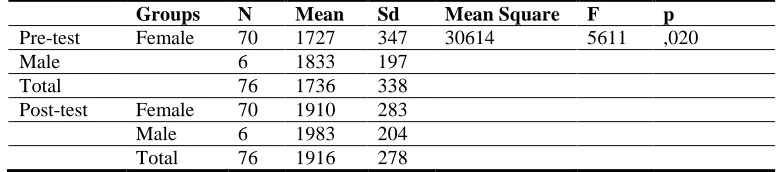
As seen Table 1, arithmetic means of pre-service teachers’ competency of pre-test was 17,36, post-test this average raised to 19,16. The study pointed out that the micro-teaching activity may affect the pre-service teacher’s competency levels positively.
Table 2. Pre-service teacher competency means of pre-test and post-test scores for gender groups.
Groups N Mean Sd Mean Square F p
Pre-test Female 70 1727 347 30614 5611 ,020
Male 6 1833 197
Total 76 1736 338
Post-test Female 70 1910 283
Male 6 1983 204
Total 76 1916 278
169
4. REFLECTION
The importance and effectiveness of reflection are widely recognized in the field of teacher education, and terminology such as reflection, reflective thinking, and reflective learning are often used in discussing the professional development of teachers (Tse, 2007). Teachers should participate consciously and creatively in their own growth and development through reflection
(Schon, 1987).
In micro teaching in Jiaxing University, a pre-service English teacher gives a short lesson to a small class under conditions which facilitate an analysis of teaching effectiveness. In most micro-teaching activities, videos are used to record the student teacher's performance as a part of micro-teaching practice. Teaching practice has always been an important part of professional training for pre-service English teachers. It often begins with the student teacher giving simulated lessons, observed by his/her tutor, and with his/her fellow students acting as a class. The student teacher will also spend some time in schools and college classrooms, observing the work of experienced teachers. At a later stage in his/her training he/she will himself/herself teach classes of kids in a internship school, or students in a college. The data in the research shows that micro-teaching in the university were used as an effective method for the pre-service English teacher education program. The concrete performance criteria and technical skills adopted in the research are listed below.
4.1. Presenting the Basic Ideas
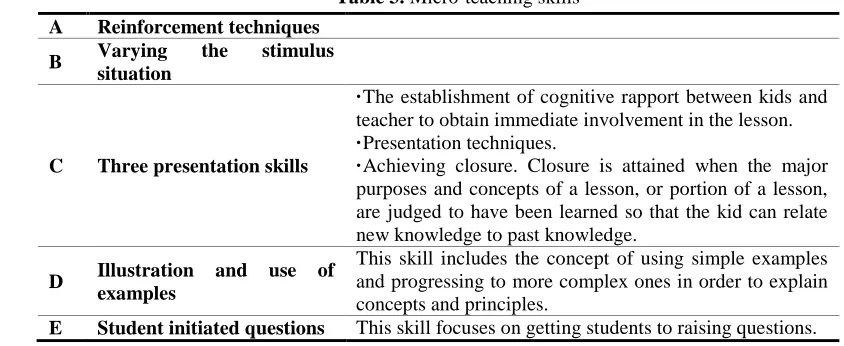
English teaching skills are defined and decisions made as to which teaching skills are the most useful for pre-service teachers to have in their repertoire. In the 2008-micro-teaching at Jiaxing University the following skills were decided upon.
Table 3. Micro-teaching skills A Reinforcement techniques
B Varying the stimulus situation
C Three presentation skills
·The establishment of cognitive rapport between kids and teacher to obtain immediate involvement in the lesson. ·Presentation techniques.
·Achieving closure. Closure is attained when the major purposes and concepts of a lesson, or portion of a lesson, are judged to have been learned so that the kid can relate new knowledge to past knowledge.
D Illustration and use of examples
This skill includes the concept of using simple examples and progressing to more complex ones in order to explain concepts and principles.
E Student initiated questions This skill focuses on getting students to raising questions.
170 skills which are common to the teachers teaching English in secondary schools or primary schools
or senior schools, it is important to realize that there are also some crucial skills unique to each area. There is no one set of technical skills which is better than another set. The selection and development of technical skills of teaching depends upon the objectives of the teacher education program base on China National English Curriculum Standard (for primary or for secondary or for senior schools). There is a great need for research in this area of selecting and defining skills in order to avoid wasting time and energy working on skills which are of little use to the teacher. In other words, what skills will produce the greatest payoff for the teacher in the classroom? Very few answers to this question are known. Research is also needed to guide the selection of the behavioral components of each skill.
There are many ways of reinforcing students for participation. Which techniques should the training emphasize? At the present time we, as teacher trainers, are operating on common sense, hunches, and intuition. This is not good enough for a long-range development of teaching skills. It is only a stop gap measure until empirical proof is gathered.
4.2. Establishing Training Protocols
The behavioral components of any English teaching skill expected of the pre-service teachers can be described to them in a lecture situation. A more powerful training procedure, in my opinion, would be to show various models demonstrating particular teaching skills. Suppose, for example, that the skill to be taught to the pre-service teachers was that of “Varying the stimulus situation.” Several ten or fifteen-minute films or video recordings could be made of experienced teachers demonstrating the skill. The pre-service teachers could then try to identify particular behaviors on the part of the model teachers which they believed demonstrated the skill of “Varying the stimulus situation.” A discussion could follow in which a list might be drawn up of the model teachers’ behaviors. The instructor could then pass out the criteria of the skill as he defined them and compare them to the list which was compiled. Another showing of the model tapes with the pre-service teachers viewing them in light of the instructor’s criteria might follow. The pre-pre-service teachers should then have the opportunity to practice the skill of “Varying the stimulus situation” soon thereafter in a micro-teaching situation.
It might be thought that student teachers would not perform naturally when surrounded by the paraphernalia of camera. It has been the author's experience they are no more distracted by the camera men’s operations of micro-teaching than by his/her presence as a supervising tutor in their own classrooms. Also, that pre-service teachers involved in micro teaching have found no difficulty in working in front of the cameras. They invariably consider that they have been helped by the feedback obtained from the recordings of their teaching performances.
4.3. Adopting the teach-reflection-re-teach model
171 a different group of students, incorporating supervisory suggestions for improvement. The basic model is one model employs cybernetic principles of immediate feedback and immediate opportunity to incorporate that feedback into the teaching act.
The teach-and-re-teach pattern seems particularly appropriate as does the use of micro-teaching as a trial framework for team presentations, as a trial instructional level, as a training ground for supervisors, and as a means of continuing supervision and evaluation of pre-service teachers.
4.4. Observing the Videos Recorded
The use of videos recorded is not an essential part of micro-teaching in current multi-media circumstances, but it is certainly a most beneficial addition. There are two major uses for the videos in developing specific teaching skills for micro-teaching. Firstly the use of videos is to show model teachers demonstrating specific skills. An experiment at Jiaxing University has demonstrated the power of the video-recordings of model teachers in obtaining desired behavior change on the part of the pre-service teachers. The video not only reflects their performance but also provides to evaluate them in classroom. This technology supports the strategy of doing, reviewing and doing again that seems effective in improving teacher performance.
Firstly, the opportunity to compare their performances with that of a model teacher enables pre-service teachers to adapt their performance to better demonstrate the specific skill. Second is the use of videos as part of the supervisory process. It is so much easier to obtain behavior change if the supervisor/mentor and the pre-service teacher agree as to what the student’s behavior was in the first place. The videos enable them to reach agreement by providing a common frame of reference in the supervisory conference. The lesson is recreated on the OHP (overhead project) or shown on the English Methodology course webpage instead of in their individual minds. As applied to pre-service English teacher training, micro-teaching has four main objectives from the study.
Table 4. The four main objectives of micro-teaching A assess the pre-service teachers’ overall teaching skills
B identify skills that require improvement C provide a system for practicing the skills D monitor the skill development process
It has also been my finding that the pre-service English teacher is less apt to take constructive criticism personally when it is directed at his/her image on the monitor rather than at his person. Use of the videos takes some of the sting out of the supervisor’s suggestions by depersonalizing the criticism and makes the pre-service English teacher less defensive. Another advantage of video-recordings is that they help the pre-service English teacher to supervise himself/herself, namely, to analyze his/her own performance in terms of its strengths and weaknesses.
172 how successful he/she thought the lesson was, using positive and negative examples. He/she should also state what changes he/she intends to make for the re-teach lesson. Following the re-teach and second critique session he/she should state how effective he/she thought the changes were. Later that day, the pre-service teacher should meet with his/her supervisor to view the lessons again and compare his/her written analysis with that of his/her supervisor. In this manner the pre-service teachers can learn to diagnose their own strengths and weaknesses. This self-analysis is important if the pre-service teacher is to continue to develop professionally after his initial training period. The use of videos permits self-analyses in a way that is impossible without this accurate recording of the lesson.
4.5. Developing and Designing the Specific Evaluative Instruments
In the first three micro-teaching rounds conducted at Jiaxing University a general teacher competence appraisal guide was used to evaluate a pre-service English teacher’s competence in specific technical skills of teaching. This instrument proved to be unsatisfactory because it was designed to measure overall teaching competency. None of the items on the appraisal guide were specifically designed for any of the technical skills that were the focus of the micro-teaching clinic. It was very difficult to tell, for instance, which items on the appraisal guide specifically measured the skill of “Reinforcement Techniques.”
Last summer I constructed evaluative instruments to measure progress in each of the technical skills that were included in the micro-teaching clinic. However, because of the pressing demands of limited time, these instruments were not validated nor were reliability established prior to their use. The development of instruments designed specifically to measure the skills which are the foci of training in micro-teaching is definitely needed in order to assess correctly the effects of training in various skills. The reliability of the instruments must also be established in order to have faith in the analysis of the data designed to measure the effects of training. Only by a systematic measurement of the skills and the training protocols can programs be properly evaluated and the micro-teaching process upgraded.
Another advantage of having evaluative instruments for specific English teaching skills is their usefulness in the critiquing sessions. Since the object of working on discrete English teaching skills is to develop competence in these skills which comprise much of the teaching act, it makes little sense to give the pre-service teachers feedback based, not upon these skills, but rather on some sort of global non-behavioral type rating. The appraisal instruments, in other words, should reflect the specific skill which the pre-service English teacher is attempting to master.
5. LIMITATION AND DISCUSSION
173 English teacher to perform in the desired way, or at least at some minimal criteria level. The main
technique of supervision in the micro-teaching process is to selectively reward or reinforce behaviors which approximate the skills I am trying to teach and to criticize those behaviors which do not lead the pre-service teacher to behave in the way I think he/she should.
In short, do we, as English educators, want to base a micro-teaching program on a psychology whose goal its chief advocate sees as the prediction and control of human behavior? As English educators are we not interested in the freedom of the human animal and not his/her control?
Another question I have about micro-teaching, as I have seen it developed so far, is the assumptions it makes about teaching and learning and about the role of the teacher in the process. Most of the skills that I have discussed, “reinforcement,” “probing,” “varying the stimulus,” presuppose the idea that the teacher’s role is to control the students and to direct the class. As those who are training English teachers assume that it is their role to control the training of the English teachers, the skills developed in micro-teaching reflect the same assumptions operating between the pre-service teacher and his future students. If we treat our pre-service English teacher mechanistically, how will they treat their students? As of yet, and I would love to stand corrected, I have seen no skills developed which assume any other role for the teacher than that of controller of the students’ behavior. Yet it seems to me that some of the most recent interesting ideas about teaching challenge that concept of the role of the teacher.
It is very difficult to see how micro-teaching can give much help with the peer-teaching development of skills that are observable only in a real English learning situation, particularly if the pre-service teachers are required to teach a ‘micro-class’ of peers, rather than real kids. This is often the case, mainly because of the logistical problems involved in using real kids. A common solution is to require peers to simulate a class of real kids. This has inherent dangers. Peers are often inconsistent in playing their roles. This is sometimes because of insufficient information and background. Sometimes it is because they cannot feel their way into their role because it is too remote from their own personalities and experience. Too often the result is a theatrical performance.
At the present context in China, most English teachers use textbooks with accompanying English teacher's guides. One of the main problems with these guides is how to translate the suggestions/instructions into action in the classroom. If two pre-service teachers are given the same textbooks and teacher's guides and are asked to teach similar kids, the results are often surprising, for there rarely seems to be any agreement in interpretation. This is sometimes because the instructions are themselves poorly framed and rarely tested by the author. Also, pre-service teachers interpret instructions according to their experiences and training. But the most frequent cause for breakdowns in classroom organization is inexperience or confused methodology.
6. CONCLUSION
174 In sum, micro-teaching provides a powerful and constructive setting for the development of such specific teaching skills, which are required in the Teacher Certification Testing. As has been emphasized in this article, there is much that we do not know about training teachers through this method, just as there is much we don’t know about training teachers in a more conventional manner. I would hope that every university that attempts the development of specific teaching skills through micro-teaching will also set up experimental controls to test hypotheses regarding the skills and the training protocols. We need more reliable knowledge about this method of training teachers, and we can only gain this knowledge if each university using this technique will add its findings to the general fund of knowledge.
There is, of course, still much that we do not know about educating pre-service English teachers through this method. Hopefully, universities using micro-teaching will also set up controls to test their hypotheses regarding the English teaching skills and the training protocols. More reliable knowledge about this method of preparation is needed and can be gained only if each university using it will add its findings to the general fund of knowledge.
BIBLIOGRAPHY
Allen, D and Ryan, K., 1969. Micro-teaching; Reading, Massachusetts: Addison: Wesley
Publishing Company.
Bell, N.D., 2007. Micro-teaching: what is going on there? Journal of Linguistics and
Education, 18, 24-40.
Benton-Kupper, J. 2001. The microteaching experience: student perspectives. Education,
121, 830-835
Brookhart, S., 2010. How to assess higher-order thinking skills in your classroom.
Alexandria, VA: Association of Supervision and Curriculum Development.
Brown, R.W., 1988. Teacher Training for Sri Lanka. Prisett. ELT Journal. 42(1). Oxford
University Press, 42(1).
Copeland, W., 2001. The Relationship Between Micro-teaching and Pre-service teacher
Classroom Performance, The Journal of Educational Research, 68, (8), 289-293.
Fernandez, M. L. 2005. Exploring “Lesson Study” in teacher preparation. In H. L. Chick,
& J. L. Vincent (Eds.). Proceedings of the 29th Conference of the International
Group for the Psychology of Mathematics Education (pp. 305-312). Melbourne:
PME.
Fernandez, M. L. & Robinson. T., 2006. Prospective teachers’ perspective on
micro-teaching.
Francis, D., 1997. Reconceptualizing micro-teaching as a critical inquiry. Asia-Pacific
Journal of Teacher Education, 25(3). 355-356.
Goetz, T., 2011. The feedback loop: how technology has turned an age-old concept into an
exciting new strategy for changing human behavior. Wired, 3(19), 126-162.
Hosp, J. L., 2010. Linking assessment and instruction: teacher preparation and
175