GE-International Journal of Engineering Research
Vol. 4, Issue 6, June 2016 IF- 4.721 ISSN: (2321-1717)
© Associated Asia Research Foundation (AARF) PublicationWebsite:
www.aarf.asia
:
[email protected] , [email protected]
EXPERMENTAL STUDY ON FERRO- GEOPOLYMER WALL PANEL
Anju Viswan1, Ashok Mathew2
1
PG Scholar, Structural Engineering, SBCE.
2
Assistant Professor, Department of Civil Engineering, SBCE
ABSTRACT
Rural development has assumed global attention especially among the developing nations. It has great significance for a country like India where majority of the population, around 65% of the people, live in rural areas and were shortage in housing stock. All these needs lead to affordable shelters with access to developed land, appropriate building material and technology. One of the environmental friendly building material technologies for cost effective housing is ferrocement wall panel. Ferrocement wall panel is used by BMTPC (Building Materials & Technology Promotion Council) to achieve a low cost building construction effectively.
Precast wall panels were casted using ferro cement and ferro-geopolymer to study its effectiveness. Skeleton steel cage and chicken mesh of are to be provided. The geopolymer mix constitutes flyash instead of cement, M-sand and an alkaline solution comprising sodium hydroxide and sodium silicate solution. Cast the specimens using the mortar and reinforcement and conduct the load deflection tests on them. Conduct a comparative study in terms of strength and cost, so as to prove that, it is a cost effective material for rural housing constructions. Hence obtain a most viable & cost effective housing component. Hope that my work can lead towards a comprehensive and integrated approach for promotion and transfer of potential and cost effective, environmental friendly technologies including locally available material for sustainable development on housing.
Key words: ferrocement, ferro geopolymer, precast wall panel, wire mesh, sustainable development
I. INTRODUCTION
Rural development has assumed global attention especially among the developing nations. It has great significance for a country like India where majority of the population, around 65% of the people, live in rural areas. The present strategy of rural development in India mainly focuses on poverty alleviation, better livelihood
opportunities, provision of basic amenities and infrastructure facilities through innovative programmes of wage and self-employment. So many scientific and technological interventions in the field of rural life have been well discussed and documented by certain research institutions and organizations. BMTPC (Building Materials & Technology Promotion Council), is one such institution under Ministry of Urban Employment & Poverty Alleviation, Government of India strives to promote innovative, cost-effective building materials and products through evaluation, validation of proven technologies, demonstration and large scale dissemination of information. Their vision is to provide solutions to all the special focus on the common man in the area of sustainable materials, appropriate construction technologies and disaster resistant construction. The IAY (Indira Awaas Yojana) is such a core program for providing free housing to families in rural areas. The massive housing concept as a part this scheme is achieved by the introduction of precast building components which were validated and approved by BMTPC. Ferrocement wall panel is one such cost effective building component which was widely and effectively used in the rural areas of Tripura.
Ferrocement is a relatively new material consisting of wire meshes and cement mortar. It consists of closely spaced wire meshes which are impregnated with rich cement mortar mix. While the mortar provides the mass, the wire mesh imparts tensile strength and ductility to the material. The ferrocement possess high resistance against cracking, high fatigue resistance, higher toughness and higher impermeability. It possess unique qualities of strength and serviceability. It can be constructed with a minimum of skilled
Studies indicate that it appears to be an excellent composite in the case of seismic resistant structures.
The main difference between ferrocement and reinforced concrete is ferrocement is a thin composite made of cement matrix reinforced with closely spaced small diameter wire meshes instead of larger diameter rods and large size aggregates. The thickness of ferrocement generally ranges from 25 - 50 mm. The latest ACI Code encourages the use of non - metallic reinforcement and fibres. The following definition was adopted by the ACI Committee: “Ferrocement is a type of thin wall reinforced concrete commonly constructed of hydraulic cement mortar reinforced with closely spaced layers of continuous and relatively small size wire mesh. The mesh may be made of metallic or other suitable materials.”
Ferrocement is an environment friendly sound technology and possesses excellent unique properties such as good tensile strength, improved toughness, water tightness, liglitness, fire resistance, resistance to cracking and cost, time and material effective construction technology. Inorder to further make the reduction in the cost of massive housing in rural areas, an alternative can be introduced in the place of cement. Thereby we can reduce the evolution of tons of carbon dioxide into atmosphere by making use of flyash. Hence on the other scenario, huge level deposition of flyash on low lying areas can be controlled to a certain extent. In this context I‟m introducing a new material ferro geopolymer cements in place of normal ferrocements.
II. LITERATURE SURVEY
[1] Mohamad Mahmood Civil Engineering department Mosul University Iraq
The paper describes the results of testing folded and flat ferrocement panels reinforced with different number of wire mesh layers. The main objective of these experimental tests is to study the effect of using different numbers of wire mesh layers on the flexural strength of folded and flat ferrocement panels and to compare the effect of varying the number of wire mesh layers on the ductility and the ultimate strength of these types of ferrocement structure. Seven ferrocement elements were constructed and tested each having (600x380mm) horizontal projection and 20mm thick, consisting of four flat panels and three folded panels. The used number of wire mesh layers is one, two and three layers. The experimental results show that flexural strength of the folded panels increased by 37% and 90% for panels having 2 and 3 wire mesh layers respectively, compared with that having single layer, while for flat panel the increase in flexural strength compared with panel of plan mortar is 4.5%, 65% and 68% for panels having 1, 2 and 3 wire mesh layers respectively. The strength capacity of the folded panels, having the particular geometry used in the present study, is in the order of 3.5 to 5 times that of the corresponding flat panels having the same number of wire mesh layers.
[2] Dr.T.S.Thandavamoorty and S.Durairaj Professor at Adhiparasakti Engineering college Melmaaruvathur A hollow cored ferrocement floor panel of size 900 mm X 600 mm was precast with cement mortar 1:2 and cured for 7 days. Then it was arranged in a loading frame and tested under gradually increasing static loading till failure. The ultimate load sustained by the panel was 85 kN. Experimental Program A welded mesh was prepared with two layers of chicken mesh. The specimen was casted with cement mortar 1:2 and reinforcement mesh as prescribed. The finished specimen was cured for 7 days. The specimen was arranged on a loading frame. Load was applied in increment and dial reading for each in increment was recorded. Load was increased till failure of the panel. Results The ultimate load observed was 85 kN. This load was distributed on the panel with the intensity of 78.7 kN/m2. As per IS 875 part 2 the live load recommended on floor is only 2 kN/m2. Going by this consideration ferrocement floor panel is suitable, realistic and feasible.
III. OBJECTIVE OF THE WORK
IV. METHODOLOGY
The methodology of the work consist of 1) Selection of a stiff mix.3) Casting panel specimens of normal ferrocement and geopolymer cement.
4) Conduct loading tests and the cost requirement studies 5) Study their effects under loading and documentation
[image:3.595.322.545.52.286.2]V. MATERIAL TEST
TABLE 1: MATERIAL TESTING RESULTS
Tests Material Equipment Used
Values Obtained
Specific Gravity
Ramco cement (OPC 43
grade)
Le Chatelier
flask 3.2
Specific Gravity
Fine
Aggregates pycnometer 2.61
Water absorption
Fine Aggregates
Vessel 1.02%
VI. EXPERIMENTAL INVESTIGATION
A. Experimental Program
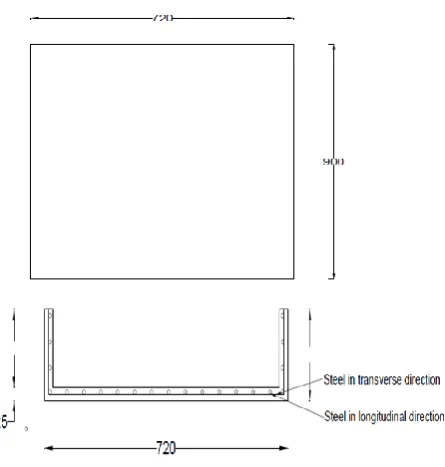
The test program consists of casting and testing the panels with normal ferrocement and with geopolymer cements. The sections that are designed and validated by BMTPC are directly followed in my work. And further details are based on the IS 456-2000 code. The panel having a standard dimension (900x720x30) was followed. Actually the panel have a „C‟ shaped cross section with a flange arising all around. This shape is adopted by them to get a high moment of inertia and inorder to place them properly and to be bolted. The minimum reinforcement was provided as per IS 456-2000. It includes GI wires straightened to form a skeleton form work along with a wire mesh. Both of them constitute the whole reinforcement cage for the panel. Spacing is also as per the specifications provided by the code. Wire mesh of hexagonal shape is used with 22 gauge and 12mm hexagonal opening. The cross section is appeared to be „C‟ shaped as shown in Figure 1.
Figure.1 Plan and cross section of the panel
[image:3.595.320.538.368.524.2]In case of ferrocement wall panel, cement is used to cast the panel along with GI wires and wire mesh as in Figure.2 below.
[image:3.595.320.544.543.695.2]But in case of ferro geopolymer wall panels cement is fully replaced with fylash and it constitute geopolymer. The medium for this geopolymer is an alkaline solution chemically combined of sodium hydroxide and sodium silicate. So the ferro-geopolymer constitute flyash, sand and alkaline solution. Sodium hydroxide is having a concentration of 16M and sodium silicate solution helps in the dissolution of ions in alkaline liquid which promote the polymerisation process. This polymerisation took place in different conditions such as in ambient condition, under oven dry condition and under the presence of steam. So curing should be under these conditions. No water curing is required for this type of mortar mixes. Normal ferro cement wall panel is casted as in the Figure.3 below and cured for 28 days and ferro-geopolymer panels for ambient curing.
Figure.3 Casting of panels
B. Test Procedure
The strength of the specimens were tested using a 100t loading frame; LVDT was used to determine the deflection at the center of the panel. The panel is loaded at it base thickness only and the flange portion is devoided from it. The strength of the panel is found by uniformly distributed loading using the jack attached to the loading frame as in Figure.4. The behaviour of panel is keenly observed from beginning to the failure. The loading was stopped when the panel was just on the verge of collapse. The crack propagation and its development and propagation are observed keenly. The values of load applied and deflection are noted directly and further the plot of load vs. deflection is performed which is taken as the output. The load in KN is applied with uniformly increasing the value of the load and the deflection under the different applied loads is noted down. The applied load increased up to the breaking point or till the failure of the material.
The behaviour of this panel is somewhat like the buckling of a slender member like column. Care should be taken whether the load is uniformly distributed to the 3cm thickness only and no load is get applied to the flange portion, as there may be a chance of bending this portion initially. Note the behaviour of panel carefully and note the load at which the panel fails finally.
Figure.4 Experimental set up of wall panel
VII. EXPERIMENTAL RESULTS AND
DISCUSSION
A. Load Carrying Capacity
Ultimate strength of panels under loading was confirmed through recording the maximum load indicated by LVDT, but the cracking load was specified with developing the first crack on the specimen. It was found that the load carrying capacity of all ferro geopolymer panels are found to be better than the normal ones.
B. Crack Pattern
At Initial stages of loading, all were un-cracked. When the applied load reached to the rupture strength, the specimens, started to crack. The failure pattern in all the tested specimens was observed as a buckling failure.
C. Load Vs. Deflection Graph
As the load increases the deflection of the panel begins. Load will be directly proportional to deflection. The load values and corresponding deflection of normal ferrocement and ferro geopolymer upto a safe load of 700kN are noted and are given in the below Figure.5 and Figure.6. As per the test result it is observed that geopolymer wall panels show less deflection than control beam at the safe load.
Figure.5 Load Vs. Deflection graph for ferrocement wall panel
D. Cement Saving and self-weight and cost reduction In ferro- geopolymer panels cement is totally replaced with flyash and it utilizes the geopolymer tehnology. So there will be a large reduction in the cost when we consider the binder part. No utilization of coarse aggregate, hence there will be much reduction in the self weight. Hence these precast members are easy to place on the site without any mechanical supports. Again coming to the manufacture part, no much skilled labours are required for the casting of panels. For ferro geopolymer panels water curing is not required. So this technique is more economic compared to the normal ferrocement panels.
VIII. CONCLUSIONS
Based on the experimental study conducted on panels the test result obtained, the following conclusions were drawn:
1. The ultimate load carrying capacity of Ferro Geopolymer panels are high.
2. Pecast construction will helps in the massive production of building units very easily.
3. Less skilled labours are enough to work on. 4. Its very easy to cast and to place in position.
5. Economy and reduction of weight in panels depends on the replacement of reinforced concrete with ferro cement
6. Expected loads can be gained in the early stages of curing for both types of specimens.
IX. SCOPE OF FUTURE STUDY
Corrosion studies, compressive strength with various types of meshes, and strength under multiaxial loading contiditions can be done. Long term durability property of Ferro Geopolymer can be studied
REFERENCES
Davidovits, J. “Properties of geopolymer cements”, Concrete International, Vol.9, pp.23-35, 1987.
Djwantoro Hardjito and Tsen, M.Z. “Strength and Thermal Stability of Fly Ash-Based Geopolymer Mortar”, The 3rd
International Conference-ACF/VCA, pp.144-150, 2008. Hardjito, D. and Rangan, B. V. “Development and properties of Low-Calcium Fly Ash-based Geopolymer Concrete”, Research Report GC 1, 2005.
Jagannathan, A. and Sundararajan, T. “Bending Response of Polymeric Mesh Reinforced Ferrocement Panels”, New Building Materials and Construction World, pp. 68-77, 2004.
Mansur, M.A. and Paramasivam, P. “Cracking Behaviour and Ultimate Strength of Ferrocernent in
Flexure”, Journal of Ferrocement, Vol. l6, No. 4, pp. 405-415, 1986.