
A Monthly Double-Blind Peer Reviewed Refereed Open Access International e-Journal - Included in the International Serial Directories.
GE-International Journal of Engineering Research
112 | P a g e
THE DESIGN OF FUZZY LOGIC CONTROLLER VIA COPYING A LINEAR CONTROLLER
Ibekwe B.E.Ph.D
Department of Electrical and Electronic Engineering Enugu State University of Science and Technology (ESUT)
Ilo Frederick U.Ph.D
Department of Electrical and Electronic Engineering Enugu State University of Science and Technology (ESUT)
Eneh Princewill Chigozie
Department of Electrical and Electronic Engineering, Enugu State University of Science and Technology, Enugu Nigeria
Abstract
The design of the fuzzy logic controller via copying a Linear Quadratic Regulator (LQR) is presented. To synthesize a fuzzy controller, we pursued the idea of making it match the LQR for small inputs since the LQR was so successful[9]. Then we still have the added tuning flexibility with the fuzzy controller to shape the control surface so that for larger inputs, it can perform differently from the LQR. The 25 “If-Then” rules determined heuristically based on the knowledge of the plant dynamics were stored in the MATLAB workspace from where they were transferred into the fuzzy controller model ready to be used for simulation in MATLAB/Simulink environment.
Keywords: Fuzzy controller, LQR, tuning flexibility, synthesized controller, If-Then rules.
1.0 INTRODUCTION
Fuzzy controller can be viewed as an artificial decision maker that operates in a closed loop
system in real time (see fig. 1.1). It gathers the plant output data y(t), compares it with the
reference input r(t) and decides on what the plant input u(t) should be to ensure the
performance objectives are met. Note that every fuzzy control system is a nonlinear system
and more so that even if the plant is linear, fuzzy and hence fuzzy control is nonlinear.
To design the fuzzy controller, the control engineer must gather enough information on how
artificial decision maker should act in a closed-loop system. Sometimes, this information
could come from a human decision maker (the machine operator), who performs the control
task, while at other times, it may come from the control engineer who comes to understand
the plant dynamics and write down a set of rules about how to control the system without
outside help[7].
GE-International Journal of Engineering Research
Vol. 4, Issue 7, July 2016 IF- 4.721 ISSN: (2321-1717)
© Associated Asia Research Foundation (AARF) PublicationA Monthly Double-Blind Peer Reviewed Refereed Open Access International e-Journal - Included in the International Serial Directories.
GE-International Journal of Engineering Research
113 | P a g e
These “rules” basically say, “If the plant output and reference input are behaving in a certain
manner then the plant input should be some value.” A whole set of such “If-Then” rules are
loaded into the rule base and inference strategy is chosen, then the system is ready to be
[image:2.595.97.507.110.237.2]tested to see if the closed-loop specifications are met.
Fig. 1:1 Fuzzy Controller Architecture[9].
1.1 Conventional/Fuzzy Control Approach to Balancing Control
There is no general systematic procedure for the design of fuzzy controllers that will
definitely produce a high performance fuzzy control system for a wide variety of application.
It is necessary to learn about fuzzy controller design via example[9]. Although, numerous
linear control design techniques have been applied to this particular system, here we consider
the performance of only the LQR. The objective is of two folds:[8]
i. To form a base line for comparison of fuzzy control design to follow.
ii. To provide a starting point for the synthesis of fuzzy controller.
A linear map such as LQR can be easily approximated by a fuzzy system (at least for small
values of inputs to the fuzzy system). For the fact that a linearized system is completely
controllable and observable, linear state-feedback strategies, such as LQR is applicable. The
performance index for the LQR is given by[5],
J = X(t)T Qx
(t)+ U(t)T Ru(t) dt ∞
o (1.1)
Where Q and R are the weighting matrices of appropriate dimension corresponding to the
state X and input U respectively. Given a fixed Q and R, the feedback gains that optimize the
function J can be uniquely determined by solving an algebraic Riccati equation in MATLAB.
In effect, the idea of using the LQR controller is analogous to the actual implementation o f
results for the case where there is no additional load or mass to the end point (i.e. nominal
case) in a pendulum. Now, when an extra weight or sloshing liquid (using a watertight bottle)
is attached to the end point of the pendulum, for instance, the performance of all the linear Inference
mechanism
Rule base efuzD
zi
fi
ca
ti
on
Fuzzi
fi
ca
ti
on
Process
A Monthly Double-Blind Peer Reviewed Refereed Open Access International e-Journal - Included in the International Serial Directories.
GE-International Journal of Engineering Research
114 | P a g e
controller degrades considerably, often resulting in unstable behaviour, and here a fuzzy
control is needed[7].
2.0 DESIGN Assumptions:
The following assumptions were made during the design[7]:
i. Assume that all the input universes of discourse have uniformly distributed triangular
membership functions (as shown in fig. 2.1) with the effective universes of discourse,
all given by (-1, +1) i.e. so that the left-most membership function and the right-most
membership function saturate at -1 and +1 respectively.
ii. Assume we label the membership functions with linguistic numeric indices that are
integers with zero at the middle.
iii. Assume an isolated power station with the following parameters (see table 2.1).
(a) (b)
[image:3.595.86.456.495.687.2]Fig. 2.1: Set of input membership functions[9].
Table 2.1: Parameters for an Isolated Power Station[5]
Gain Time Constant
Turbine KT = 1
Governor Kg = 1
Amplifier KA = 10
Exciter KE = 1
Generator KG = 0.8
Sensor KR = 1
Inertia H = 5
Regulation R = 0.05
γr = 0.5
γg = 0.2
γA = 0.1
γE = 0.4
γG = 1.4
γR = 0.05
Assume a sudden load change of PL = 0.2 (p.u). E1−3 E2−2 E1−1 1 E10 E1+1 E1+2 E1+3
-5.1 -3.4 -1.7 0 1.7 3.4 5.1 i(rad)
E2−3 E2−2 E2−1 1 E20 E2+1 E2+2 E2+3
A Monthly Double-Blind Peer Reviewed Refereed Open Access International e-Journal - Included in the International Serial Directories.
GE-International Journal of Engineering Research
115 | P a g e
2.1 METHODOLOGY
2.1.1 Summation Operation
First, the IF – THEN rules were arranged so that the output membership function centres are
equal to a scaled sum of the premise linguistic numeric indices. For a fuzzy controller in
general, the centre of the controller output is given by[9]:-
Y = j + k … + l x N−1 n2 (2.1)
Where Y is the value of the output membership function centres (j + k … + l) are sum of the
premise linguistic numeric indices
N is the number of the membership functions in each input universe of discourse.
n is the number of inputs as assumed by the designer.
If for instance,
j + k = sum of the premise linguistic numeric indices
N = 5 (as a standard)
n = 2
Substituting the above values, equation 2.1 reduces to:
Y = j + k x 5−1 22 (2.2)
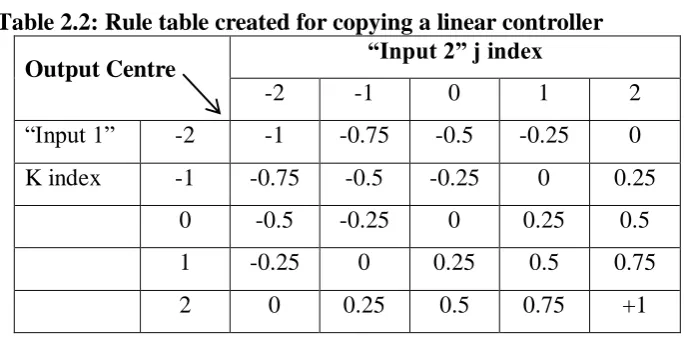
= (j + k)1 4
[image:4.595.74.417.496.668.2]Equation 2.2 was then used to generate the rule base shown in table 2.2
Table 2.2: Rule table created for copying a linear controller
Output Centre “Input 2” j index
-2 -1 0 1 2
“Input 1” -2 -1 -0.75 -0.5 -0.25 0
K index -1 -0.75 -0.5 -0.25 0 0.25
0 -0.5 -0.25 0 0.25 0.5
1 -0.25 0 0.25 0.5 0.75
2 0 0.25 0.5 0.75 +1
Observations:
From table 2.2, it can be seen that the fuzzy system is normalized i.e. the effective
A Monthly Double-Blind Peer Reviewed Refereed Open Access International e-Journal - Included in the International Serial Directories.
GE-International Journal of Engineering Research
116 | P a g e
Again, the body of the table represents the centres of nine distinct output membership
function centres.
Note the diagonal of zeros; and by viewing the body of the table as a matrix, we see
that it has a certain symmetry to it. This symmetry is not by accident but a
representation of abstract knowledge about how to control the system[7].
Table of Linguistic Variable with Rules:
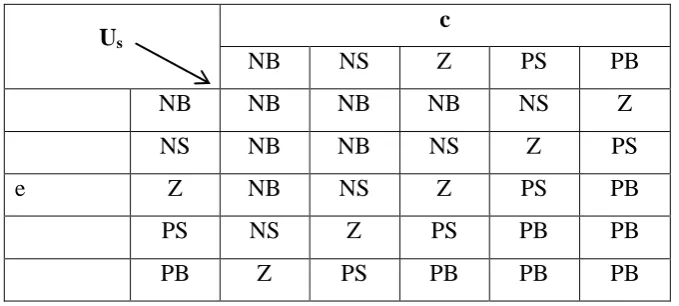
The linguistic variables were written from the output membership function centres of table
[image:5.595.79.419.284.437.2]2.2. Hence, we have table 2.3 as shown.
Table 2.3: Showing the Linguistic Variables (Us = output membership function centres;
e = error and c = change in error)
Us
c
NB NS Z PS PB
NB NB NB NB NS Z
NS NB NB NS Z PS
e Z NB NS Z PS PB
PS NS Z PS PB PB
PB Z PS PB PB PB
The output membership function centres are 25 in number, and these represent 25 IF-THEN
rules from this table. These 25 rules were clearly spelt and stated, and then stored in the
MATLAB workspace from where they were transferred into the fuzzy controller by opening
its dialog box. Here are some of the IF-THEN rules organized from the rule table:-
IF e is negative big NB and c is negative big NB, THEN Us is negative big NB. IF e is
negative small NS and c is negative big NB THEN Us is negative big NB. IF e is zero Z and c
is negative big NB THEN Us is negative big NB. IF e is positive small PS and c is negative
big NB THEN Us is negative small NS. IF e is positive big PB and c is negative big NB
A Monthly Double-Blind Peer Reviewed Refereed Open Access International e-Journal - Included in the International Serial Directories.
GE-International Journal of Engineering Research
117 | P a g e
2.1.2 The Scaling Gain
Having achieved so far in the design, next is to pick the scaling gains so that the fuzzy system
implements a weighted sum. Prior to this, the LQR was first designed by solving its algebraic
Riccati equation in MATLAB[5], thus:
Given performance index J = (o∞ X12+ 5x32+ U2) dt (2.3)
The state equation in matrix form[5] is given by
∆Pv ∆Pm
∆ω =
−1
𝛾𝑔 0 −1 Rγg 1
γT 1 γT 0
0 2H1 −D2H
∆Pv ∆Pm ∆ω + 0 0 −1 2H
∆PL+ 1 γg
0 0
∆Pref (2.4)
Substituting the parameter values of the system (see the third assumption) into the state
equation (2.4), with∆Pref = 0 we have:
x = −5 0 − 1002 − 2 0 0 0.1 − 0.08
x + 00 −0.1
U (2.5)
and the output equation y = [0 0 1] x (2.6)
where y = ∆ω and x =
∆Pv ∆Pm
∆ω
For this system we have by inspection:
A = −5 0 − 1002 − 2 0 0 0.1 − 0.08
, B = 00
−0.1
, C = 0 0 1 , Q = 1 0 00 0 0 0 0 5
and R = 1
To obtain the optimal feedback gain vector to minimize the given performance index (eqn.
2.3), we use the following, MATLAB commands[8]:-
PL = 0.2;
A = [-5 0 -100; 2 -2 0; 0 0.1 -0.08];
B = [0; 0; -0.1]; BPL = PL * B;
C = [0 0 1]; D = 0;
A Monthly Double-Blind Peer Reviewed Refereed Open Access International e-Journal - Included in the International Serial Directories.
GE-International Journal of Engineering Research
118 | P a g e
Q = [1 0 0; 0 0 0; 0 0 5];
R = 1;
[K, P] = Lqr2 (A, B, Q, R)
Af = A – B * K
t = 0 : 0.02 : 1;
[y, x] = Step (Af, BPL, C, D, 1, t);
Plot (t, y), grid, xlabel („t, sec‟), ylabel („pu‟)
The result is
K1, K2, K3 respectively
= 0.0834, -0.2875, -12.1381
P
= 0.1100 0.0267 -0.8338
0.0267 0.1231 2.8751
-0.8338 2.8751 121.3810
Af
= -5.0000 0 -100.0000
2.0000 -2.0000 0
A Monthly Double-Blind Peer Reviewed Refereed Open Access International e-Journal - Included in the International Serial Directories.
GE-International Journal of Engineering Research
119 | P a g e
Fig. 2.2: Plot of frequency deviation responses
[image:8.595.108.490.39.324.2]The simulation block diagram of the system condition is constructed as shown in fig. 2.3
Fig. 2.3: Simulation Block Diagram of the System[5].
The state-space description dialog box was opened and the values of A, B, C and D constants
were entered in the appropriate box in Matlab matrix notation. +
- x = Ay = Cx + Bu
x + Du Demux
K
PL
Step
Scope Feedback gain
using LQR design
A Monthly Double-Blind Peer Reviewed Refereed Open Access International e-Journal - Included in the International Serial Directories.
GE-International Journal of Engineering Research
120 | P a g e
2.1.3 Choice of Scaling Gains
To choose the scaling gains so that the fuzzy system implements a weighted sum, the
appropriate gain on the ith input-output pair is gigo; so to copy the ki of the state feedback
controller, we choose[9]:-
gigo = ki (2.7)
Where ki = optimal gain of LQR
gi = ith input gain
go = ith output gain
Choosing the controller input that most greatly influences the plant behaviour to be g3 = 2[9](2.8)
From the results of the optimal gains calculated, K3 = -12.14.
g3g0 = K3 from equation (2.7) and hence, 𝐾3
𝑔3 = 𝑔0
∴ 𝑔0 =
−12.1381
2 = −6.069
Now, for 𝑔0 = -6.07, the input gains are:
𝑔1 = 0.0834−6.07 = −0.01374
𝑔2= −0.2875
−6.07 = 0.04736
𝑔3= −12.138
−6.07 = 1.9996 ≅ 2
Try the scaling gains of 0.04736 or 2.
3.0 ANALYSIS RESULT
The gains of 2 were chosen so that the fuzzy system implements a weighted sum and is
inserted in any model bearing the fuzzy controller and any chosen compensator. A simulation
is done in Matlab/Simulink environment to get a result.
4.0 CONCLUSION
Fuzzy logic is dynamic because human expert has the responsibility to control the plant; and
A Monthly Double-Blind Peer Reviewed Refereed Open Access International e-Journal - Included in the International Serial Directories.
GE-International Journal of Engineering Research
121 | P a g e
model in problem solving, it is a natural language and easy to understand. Above all, it acts as
a supplementary controller to major controllers in a given system.
REFERENCES
1) Berde, M.A. (2000). Thyristor Control Engineering (Power Electronics), 9th Edition, Khama Publishers.
2) Duber, G.K. (1998). Power Semiconductor Controlled Drive, Prentice Hall Int.
3) Harish, C.R. (1999). Power Electronics, 3rd Edition, Galgotia, New Delhi.
4) Holt, J. and Schwellenberg, U. (1983). A New Fast Response Current Control Scheme for Line Controlled Converters. IEE Transaction on Industrial Appl. Vol. 1A-19, No. 4, July, pp. 127-134.
5) HadiSaadat (2004). Power System Analysis, 2nd Edition, McGraw Hill Publication.
6) Ibekwe, B.E. et al (2014). Guiding Principles in Selectinga.c to d.c Converters for Power Factor Collection in a.c Transmission System, IJERA Publications.
7) Ibekwe, B.E. (2016). Ph.D Thesis on Dynamic Compensation of Reactive Power in 330kv Transmission Line using Fuzzy Controller Static Var Compensator, ESUT Enugu (unpublished).
8) PrabhaKundur (2010). Power System Stability and Control, Tata McGraw Hill Edition.
9) Passino and Yurkovich (1998). Fuzzy Logic Control, Addison Wesley Longman Inc.
![Fig. 1:1 Fuzzy Controller Architecture[9].](https://thumb-us.123doks.com/thumbv2/123dok_us/49418.1008393/2.595.97.507.110.237/fig-fuzzy-controller-architecture.webp)
![Table 2.1: Parameters for an Isolated Power Station[5]](https://thumb-us.123doks.com/thumbv2/123dok_us/49418.1008393/3.595.86.456.495.687/table-parameters-isolated-power-station.webp)
![Fig. 2.3: Simulation Block Diagram of the System[5].](https://thumb-us.123doks.com/thumbv2/123dok_us/49418.1008393/8.595.108.490.39.324/fig-simulation-block-diagram.webp)
